Infectious Lameness in Poultry
Enterococcus cecorum and Bacterial Chondronecrosis with Osteomyelitis (BCO) in Broilers: An Emerging Poultry Health Challenge
Introduction
Modern broiler farming has achieved remarkable success in terms of fast growth and feed efficiency. A broiler chicken can now reach 2–2.5 kg in just 35–40 days — a huge leap compared to the 1960s.
But this success comes at a cost. One of the biggest challenges facing the poultry industry today is lameness in broilers, particularly caused by Bacterial Chondronecrosis with Osteomyelitis (BCO), often linked to Enterococcus cecorum infection.
This blog explores the economic impact, causes, clinical signs, pathogenesis, and prevention of this growing threat, with practical solutions for poultry producers.
Economic Losses from Lameness in Broilers
- In the United States, lameness due to BCO costs more than $100 million annually.
- In India, with an annual production of nearly 5 billion broilers, even a 1% rise in lameness could result in massive financial losses running into hundreds of crores.
- Beyond economics, broiler lameness raises serious poultry welfare concerns, affecting consumer trust and meat quality.
Enterococcus cecorum: An Emerging Poultry Pathogen
- Enterococcus cecorum is normally a commensal gut bacterium in chickens.
- Since the 2000s, certain pathogenic strains have emerged globally, causing spondylitis (kinky back), femoral head necrosis, and septicemia.
- Outbreaks have been reported in Europe, USA, Asia, and Africa.
- In India, published epidemiological data is lacking, but risk factors strongly suggest underreporting.
High Growth Rates: A Key Predisposing Factor
- Modern broilers grow 400% faster than their counterparts from the 1950s.
- Skeletal growth lags behind muscle growth, creating excessive stress on bones.
- Weight-bearing bones such as the femur, tibia, and free thoracic vertebra (FTV) are especially prone to microfractures, which bacteria exploit.
Etiology (Cause)
The main agent is Enterococcus cecorum, but other bacteria like Staphylococcus aureus, Staphylococcus agnetis, and E. coli may also be involved in BCO in poultry.
Epidemiology
- Global outbreaks since the early 2000s.
- Risk factors include:
- High stocking density.
- Hatchery contamination.
- Poor litter and ventilation management.
- Rapid growth pressure.
- India: No published large-scale studies but high production scale = high risk.
Clinical Signs of BCO in Broilers
- Reluctance to walk, sitting on hocks.
- Support on wings when moving.
- Paralysis of both legs in spondylitis (“kinky back”).
- Sudden death in severe spinal cord compression cases.
Anatomical Locations Affected
- Femoral Head – Femoral Head Necrosis (FHN).
- Tibia – Tibial Head Necrosis (THN).
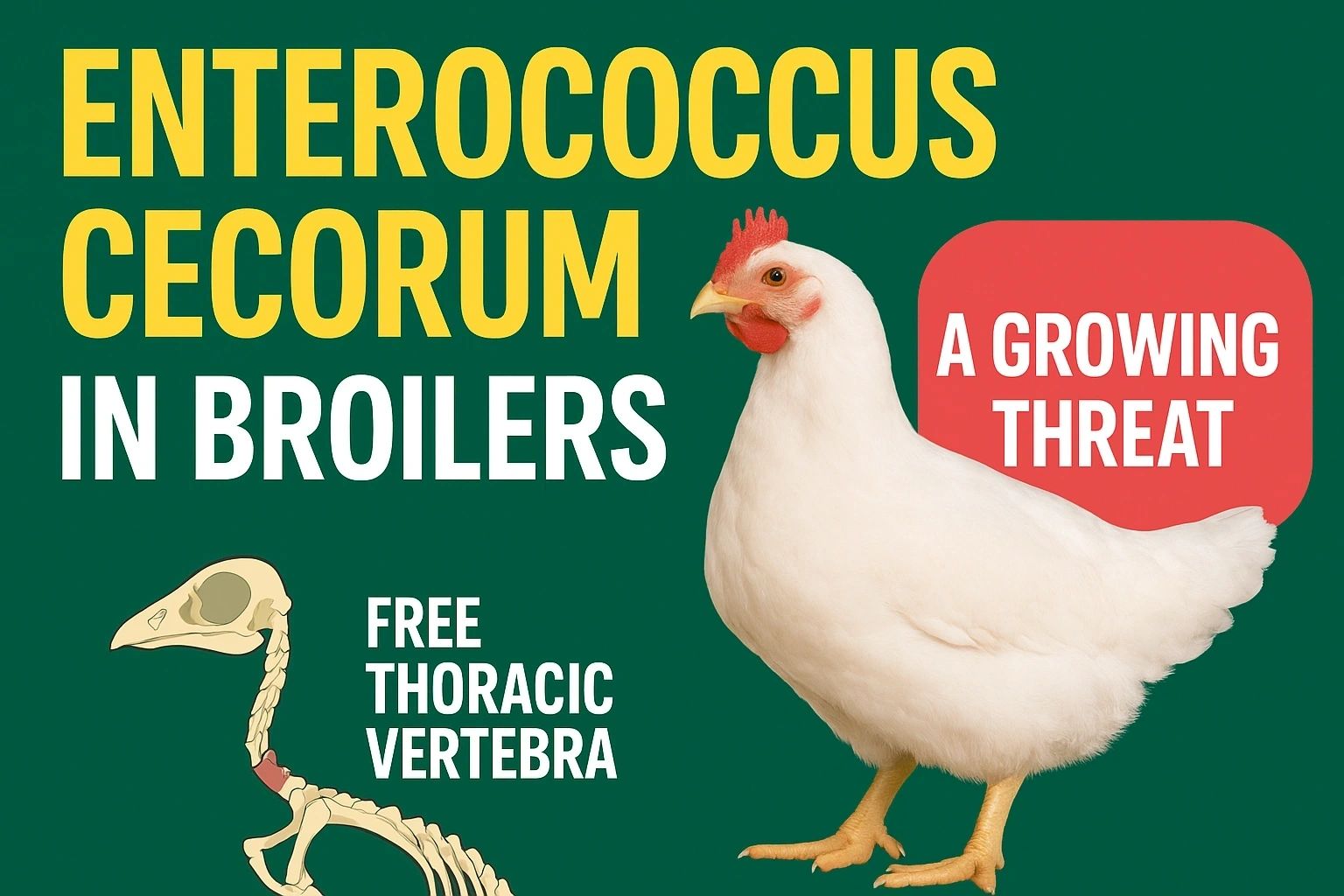
- Free Thoracic Vertebra (FTV) – A hotspot for E. cecorum infections.
Pathogenesis of Enterococcus cecorum in Poultry
- Mechanical stress → microfractures in growth plates.
- Vascular compromise → necrotic zones.
- Bacteremia → bacteria spread from gut into bloodstream.
- Colonization → necrotic cartilage becomes colonization site.
- Lesion development → necrosis, osteomyelitis, abscess.
- Clinical signs → lameness, paralysis, or mortality.
How Bacteria Travel from Gut to Bone (Stepwise)
- Colonization in the gut of young chicks (week 1).
- Gut leakage allows bacteria into circulation.
- Stress (transport, overcrowding) worsens bacteremia.
- Bacteria target growth plates and FTV.
- Colonization + necrosis = BCO lesions.
Prevention and Control Strategies
✅ General Poultry Health Practices
- Maintain biosecurity in hatcheries and farms.
- Ensure optimum litter quality & ventilation.
- Control early chick growth rates.
- Balance diet with calcium, phosphorus, zinc, copper, manganese.
- Conduct regular flock surveillance.
🧪 Supportive Solutions (Treatment of Lameness in Broilers)
- Pyrocal-B
- Multimineral + multivitamin calcium supplement.
- Provides Zn, Cu, Mn, Se, I, Ca, P, and B-complex vitamins.
- Enhances nerve health and helps in healing microfractures.
- Remipro
- Probiotic formula.
- Reduces gut leakage and prevents bacteria from entering the bloodstream.
- Easy Brood
- Electrolytes + amino acids.
- Optimizes calcium metabolism by stabilizing blood pH.
- Improves early brooding performance and skeletal development.
- Septima
- Antimicrobial supportive therapy.
- Reduces bacteremia and prevents bacterial colonization in bones.
Interesting Poultry Facts
- Broilers spend 90% of their life indoors, making biosecurity and gut health critical.
- The Free Thoracic Vertebra (FTV) is the most common site of E. cecorum infection — often referred to as the "Achilles’ heel" of broilers.
- Within just two decades, E. cecorum has shifted from a harmless commensal to a clonal, multidrug-resistant pathogen.
Conclusion
Lameness in broilers caused by Enterococcus cecorum is a serious threat to poultry health and farm profitability. The disease leads to economic losses, welfare concerns, and reduced productivity.
While antibiotic options are limited due to resistance, prevention through biosecurity, nutritional management, probiotics, and supportive products like Pyrocal-B, Remipro, Easy Brood, and Septima can significantly reduce the risk.
👉 Key Message: Proactive management and gut health optimization are the strongest defenses against BCO and lameness in poultry.
🔑 SEO Keywords Covered
- Poultry health
- Lameness in broilers
- Enterococcus cecorum
- BCO in poultry
- Femoral head necrosis
- Spondylitis in broilers
- Gut health in poultry
- Poultry supplements for bone health
Contact for consultation 9871584101
Problem in your flock? Send photos of the birds and droppings on WhatsApp for a first opinion from Dr. Ibne Ali.
WhatsApp: 98715 84101Poultry में संक्रमण से होने वाला लंगड़ापन
Broilers में Enterococcus cecorum और Bacterial Chondronecrosis with Osteomyelitis (BCO): Poultry स्वास्थ्य की एक नई उभरती चुनौती
परिचय
आज की broiler farming ने तेज़ बढ़त और feed efficiency में कमाल की सफलता पाई है। एक broiler मुर्गा अब सिर्फ 35–40 दिन में 2–2.5 kg तक पहुँच जाता है — 1960 के दशक के मुकाबले यह बहुत बड़ी छलांग है।
लेकिन इस सफलता की एक कीमत भी है। आज poultry industry के सामने सबसे बड़ी चुनौतियों में से एक है broilers में लंगड़ापन, खासकर Bacterial Chondronecrosis with Osteomyelitis (BCO) की वजह से, जो अक्सर Enterococcus cecorum infection से जुड़ा होता है।
इस blog में हम इस बढ़ते खतरे के आर्थिक असर, कारण, लक्षण, बीमारी कैसे बनती है (pathogenesis) और बचाव के बारे में बात करेंगे, साथ में poultry farmers के लिए practical उपाय भी।
Broilers में लंगड़ापन से आर्थिक नुकसान
- United States में BCO से होने वाले लंगड़ेपन का नुकसान हर साल $100 million से ज़्यादा है।
- India में हर साल लगभग 5 billion broilers का उत्पादन होता है, यहाँ लंगड़ेपन में सिर्फ 1% बढ़त भी सैकड़ों करोड़ का भारी नुकसान कर सकती है।
- पैसे के अलावा, broiler lameness से पक्षियों के welfare की गंभीर चिंता भी होती है, जिससे ग्राहक का भरोसा और meat quality दोनों पर असर पड़ता है।
Enterococcus cecorum: Poultry का एक नया उभरता रोगाणु
- Enterococcus cecorum आम तौर पर मुर्गियों की आंत में रहने वाला सामान्य (commensal) bacteria है।
- 2000 के दशक से दुनिया भर में इसके कुछ बीमारी करने वाले (pathogenic) strains सामने आए हैं, जो spondylitis (kinky back), femoral head necrosis और septicemia करते हैं।
- इसके outbreaks Europe, USA, Asia और Africa में दर्ज हुए हैं।
- India में इस पर प्रकाशित epidemiological data नहीं है, लेकिन risk factors देखकर साफ लगता है कि केस कम रिपोर्ट हो रहे हैं।
तेज़ बढ़त: एक मुख्य कारण
- आज के broilers 1950 के दशक के पक्षियों से 400% तेज़ बढ़ते हैं।
- हड्डियों की बढ़त muscle की बढ़त से पीछे रह जाती है, जिससे हड्डियों पर बहुत ज़्यादा दबाव पड़ता है।
- वज़न उठाने वाली हड्डियाँ जैसे femur, tibia और free thoracic vertebra (FTV) में खास तौर पर बारीक दरारें (microfractures) आ जाती हैं, जिनका फायदा bacteria उठाते हैं।
Etiology (कारण)
मुख्य कारण Enterococcus cecorum है, लेकिन poultry में BCO में दूसरे bacteria जैसे Staphylococcus aureus, Staphylococcus agnetis और E. coli भी शामिल हो सकते हैं।
Epidemiology (बीमारी का फैलाव)
- 2000 के दशक की शुरुआत से दुनिया भर में outbreaks।
- Risk factors में शामिल हैं:
- ज़्यादा stocking density (कम जगह में ज़्यादा पक्षी)।
- Hatchery में गंदगी/contamination।
- Litter और ventilation का खराब प्रबंधन।
- तेज़ बढ़त का दबाव।
- India: कोई बड़े पैमाने की प्रकाशित study नहीं, लेकिन उत्पादन बहुत बड़ा है = खतरा भी ज़्यादा।
Broilers में BCO के लक्षण
- चलने से कतराना, hocks (एड़ी के जोड़) पर बैठे रहना।
- चलते समय पंखों का सहारा लेना।
- Spondylitis (“kinky back”) में दोनों पैरों में लकवा।
- Spinal cord पर ज़्यादा दबाव वाले गंभीर केस में अचानक मौत।
शरीर के कौन से हिस्से प्रभावित होते हैं
- Femoral Head – Femoral Head Necrosis (FHN)।
- Tibia – Tibial Head Necrosis (THN)।
- Free Thoracic Vertebra (FTV) – E. cecorum infection की सबसे आम जगह (hotspot)।
Poultry में Enterococcus cecorum का Pathogenesis (बीमारी कैसे बनती है)
- Mechanical stress (दबाव) → growth plates में बारीक दरारें।
- खून की सप्लाई में रुकावट → मरे हुए (necrotic) हिस्से बनना।
- Bacteremia → bacteria आंत से खून में फैल जाते हैं।
- Colonization → मरा हुआ cartilage bacteria के बसने की जगह बन जाता है।
- घाव बनना → necrosis, osteomyelitis, फोड़ा (abscess)।
- लक्षण → लंगड़ापन, लकवा या मौत।
Bacteria आंत से हड्डी तक कैसे पहुँचते हैं (कदम-दर-कदम)
- छोटे चूज़ों की आंत में bacteria का बसना (पहला हफ्ता)।
- Gut leakage (आंत की कमज़ोर दीवार) से bacteria खून में चले जाते हैं।
- Stress (transport, भीड़) से bacteremia और बिगड़ता है।
- Bacteria growth plates और FTV को निशाना बनाते हैं।
- Colonization + necrosis = BCO के घाव।
बचाव और नियंत्रण के तरीके
✅ Poultry स्वास्थ्य के सामान्य नियम
- Hatchery और farm में biosecurity बनाए रखें।
- Litter की अच्छी quality और ventilation सुनिश्चित करें।
- शुरुआती दिनों में चूज़ों की बढ़त को नियंत्रित रखें।
- Diet में calcium, phosphorus, zinc, copper, manganese का संतुलन रखें।
- Flock की नियमित निगरानी करें।
🧪 सहायक उपाय (Broilers में लंगड़ेपन का इलाज)
- Pyrocal-B
- Multimineral + multivitamin calcium supplement।
- Zn, Cu, Mn, Se, I, Ca, P और B-complex vitamins देता है।
- Nerves की सेहत सुधारता है और बारीक दरारों को भरने में मदद करता है।
- Remipro
- Probiotic formula।
- Gut leakage कम करता है और bacteria को खून में जाने से रोकता है।
- Easy Brood
- Electrolytes + amino acids।
- खून का pH स्थिर रखकर calcium metabolism को बेहतर करता है।
- शुरुआती brooding performance और हड्डियों के विकास को सुधारता है।
- Septima
- Antimicrobial सहायक therapy।
- Bacteremia कम करता है और हड्डियों में bacteria को बसने से रोकता है।
Poultry से जुड़ी रोचक बातें
- Broilers अपनी 90% ज़िंदगी शेड के अंदर बिताते हैं, इसलिए biosecurity और gut health बहुत ज़रूरी हैं।
- Free Thoracic Vertebra (FTV) E. cecorum infection की सबसे आम जगह है — इसे अक्सर broilers की "Achilles’ heel" (सबसे कमज़ोर कड़ी) कहा जाता है।
- सिर्फ दो दशकों में E. cecorum एक नुकसान न करने वाले commensal से clonal, कई दवाओं से न मरने वाला (multidrug-resistant) रोगाणु बन गया है।
निष्कर्ष
Enterococcus cecorum से होने वाला broilers में लंगड़ापन poultry स्वास्थ्य और farm के मुनाफे के लिए गंभीर खतरा है। इस बीमारी से आर्थिक नुकसान, welfare की चिंता और उत्पादन में कमी होती है।
Resistance की वजह से antibiotic के विकल्प सीमित हैं, लेकिन biosecurity, सही पोषण प्रबंधन, probiotics और सहायक products जैसे Pyrocal-B, Remipro, Easy Brood और Septima से बचाव करके खतरे को काफी कम किया जा सकता है।
👉 मुख्य संदेश: पहले से सही प्रबंधन और gut health को बेहतर रखना ही BCO और poultry में लंगड़ेपन से सबसे मज़बूत बचाव है।
🔑 इस लेख में शामिल SEO Keywords
- Poultry स्वास्थ्य
- Broilers में लंगड़ापन
- Enterococcus cecorum
- Poultry में BCO
- Femoral head necrosis
- Broilers में spondylitis
- Poultry में gut health
- हड्डियों की सेहत के लिए poultry supplements
सलाह के लिए संपर्क करें 9871584101
फ़ार्म में कोई दिक्कत? पक्षियों और बीट की फ़ोटो WhatsApp पर भेजिए, डॉ. इब्ने अली से पहली राय लीजिए।
WhatsApp: 98715 84101Poultry me infection se hone wala langdapan
Broilers me Enterococcus cecorum aur Bacterial Chondronecrosis with Osteomyelitis (BCO): Poultry health ki ek nayi badhti chunauti
Parichay
Aaj ki broiler farming ne tez growth aur feed efficiency me kamaal ki safalta payi hai. Ek broiler murga ab sirf 35–40 din me 2–2.5 kg tak pahunch jata hai — 1960 ke time ke mukable ye bahut badi chhalang hai.
Lekin is safalta ki ek keemat bhi hai. Aaj poultry industry ke saamne sabse badi problems me se ek hai broilers me langdapan, khaas kar Bacterial Chondronecrosis with Osteomyelitis (BCO) ki wajah se, jo aksar Enterococcus cecorum infection se juda hota hai.
Is blog me hum is badhte khatre ke aarthik nuksaan, kaaran, lakshan, bimari kaise banti hai (pathogenesis) aur bachav ki baat karenge, saath me poultry farmers ke liye practical upay bhi.
Broilers me langdapan se aarthik nuksaan
- United States me BCO se hone wale langdapan ka nuksaan har saal $100 million se zyada hai.
- India me har saal lagbhag 5 billion broilers paida hote hain, yahan langdapan me sirf 1% badhat bhi sau-sau crore ka bhaari nuksaan kar sakti hai.
- Paise ke alawa, broiler lameness se pakshiyon ke welfare ki gambhir chinta bhi hoti hai, jisse customer ka bharosa aur meat quality dono par asar padta hai.
Enterococcus cecorum: Poultry ka ek naya ubharta rogaanu
- Enterococcus cecorum aam taur par murgiyon ki aant me rehne wala normal (commensal) bacteria hai.
- 2000 ke dashak se duniya bhar me iske kuch bimari karne wale (pathogenic) strains saamne aaye hain, jo spondylitis (kinky back), femoral head necrosis aur septicemia karte hain.
- Iske outbreaks Europe, USA, Asia aur Africa me report hue hain.
- India me is par published epidemiological data nahi hai, lekin risk factors dekh kar saaf lagta hai ki case kam report ho rahe hain.
Tez growth: ek main kaaran
- Aaj ke broilers 1950 ke time ke pakshiyon se 400% tez badhte hain.
- Haddiyon ki growth muscle ki growth se peeche reh jati hai, jisse haddiyon par bahut zyada pressure padta hai.
- Wazan uthane wali haddiyan jaise femur, tibia aur free thoracic vertebra (FTV) me khaas kar baarik daraar (microfractures) aa jati hain, jinka fayda bacteria uthate hain.
Etiology (Kaaran)
Main kaaran Enterococcus cecorum hai, lekin poultry me BCO me dusre bacteria jaise Staphylococcus aureus, Staphylococcus agnetis aur E. coli bhi shamil ho sakte hain.
Epidemiology (Bimari ka failav)
- 2000 ke dashak ki shuruat se duniya bhar me outbreaks.
- Risk factors me shamil hain:
- Zyada stocking density (kam jagah me zyada birds).
- Hatchery me gandagi/contamination.
- Litter aur ventilation ka kharab management.
- Tez growth ka pressure.
- India: koi bade level ki published study nahi, lekin production bahut bada hai = khatra bhi zyada.
Broilers me BCO ke lakshan
- Chalne se katrana, hocks (edi ke jod) par baithe rehna.
- Chalte waqt pankhon ka sahara lena.
- Spondylitis (“kinky back”) me dono pairon me lakwa.
- Spinal cord par zyada dabav wale serious case me achanak maut.
Sharir ke kaun se hisse affect hote hain
- Femoral Head – Femoral Head Necrosis (FHN).
- Tibia – Tibial Head Necrosis (THN).
- Free Thoracic Vertebra (FTV) – E. cecorum infection ki sabse common jagah (hotspot).
Poultry me Enterococcus cecorum ka Pathogenesis (bimari kaise banti hai)
- Mechanical stress (dabav) → growth plates me baarik daraar.
- Khoon ki supply me rukawat → mare hue (necrotic) hisse banna.
- Bacteremia → bacteria aant se khoon me fail jate hain.
- Colonization → mara hua cartilage bacteria ke basne ki jagah ban jata hai.
- Ghav banna → necrosis, osteomyelitis, phoda (abscess).
- Lakshan → langdapan, lakwa ya maut.
Bacteria aant se haddi tak kaise pahunchte hain (step by step)
- Chhote chuzon ki aant me bacteria ka basna (pehla hafta).
- Gut leakage (aant ki kamzor deewar) se bacteria khoon me chale jate hain.
- Stress (transport, bheed) se bacteremia aur bigadta hai.
- Bacteria growth plates aur FTV ko target karte hain.
- Colonization + necrosis = BCO ke ghav.
Bachav aur control ke tareeke
✅ Poultry health ke general niyam
- Hatchery aur farm me biosecurity banaye rakhein.
- Litter ki achhi quality aur ventilation pakka karein.
- Shuruati dino me chuzon ki growth control me rakhein.
- Diet me calcium, phosphorus, zinc, copper, manganese ka balance rakhein.
- Flock ki regular nigrani karein.
🧪 Sahayak upay (Broilers me langdapan ka ilaaj)
- Pyrocal-B
- Multimineral + multivitamin calcium supplement.
- Zn, Cu, Mn, Se, I, Ca, P aur B-complex vitamins deta hai.
- Nerves ki sehat sudharta hai aur baarik daraar bharne me madad karta hai.
- Remipro
- Probiotic formula.
- Gut leakage kam karta hai aur bacteria ko khoon me jane se rokta hai.
- Easy Brood
- Electrolytes + amino acids.
- Khoon ka pH stable rakh kar calcium metabolism ko behtar karta hai.
- Shuruati brooding performance aur haddiyon ka vikas sudharta hai.
- Septima
- Antimicrobial sahayak therapy.
- Bacteremia kam karta hai aur haddiyon me bacteria ko basne se rokta hai.
Poultry se judi interesting baatein
- Broilers apni 90% zindagi shed ke andar bitate hain, isliye biosecurity aur gut health bahut zaroori hain.
- Free Thoracic Vertebra (FTV) E. cecorum infection ki sabse common jagah hai — ise aksar broilers ki "Achilles’ heel" (sabse kamzor kadi) kaha jata hai.
- Sirf do dashakon me E. cecorum ek nuksaan na karne wale commensal se clonal, kai dawaon se na marne wala (multidrug-resistant) rogaanu ban gaya hai.
Nishkarsh
Enterococcus cecorum se hone wala broilers me langdapan poultry health aur farm ke munafe ke liye serious khatra hai. Is bimari se aarthik nuksaan, welfare ki chinta aur production me kami hoti hai.
Resistance ki wajah se antibiotic ke options kam hain, lekin biosecurity, sahi nutrition management, probiotics aur sahayak products jaise Pyrocal-B, Remipro, Easy Brood aur Septima se bachav karke khatre ko kaafi kam kiya ja sakta hai.
👉 Main message: Pehle se sahi management aur gut health ko behtar rakhna hi BCO aur poultry me langdapan se sabse mazboot bachav hai.
🔑 Is lekh me shamil SEO Keywords
- Poultry health
- Broilers me langdapan
- Enterococcus cecorum
- Poultry me BCO
- Femoral head necrosis
- Broilers me spondylitis
- Poultry me gut health
- Haddiyon ki sehat ke liye poultry supplements
Salah ke liye contact karein 9871584101
Farm me koi dikkat? Pakshiyon aur beet ki photo WhatsApp par bhejiye, Dr. Ibne Ali se pehli raay lijiye.
WhatsApp: 98715 84101