Ranikhet Disease / Newcastle Disease – ND in Poultry
Introduction: What is Ranikhet Disease?
- Ranikhet disease (RD), also known as Newcastle disease (ND) or pseudo-plague, is a sudden and severe, rapidly spreading viral disease affecting wild and domestic birds.
- It is characterized by rapid onset, respiratory symptoms, nervous manifestations, and varying mortality.
- Ranikhet disease primarily affects chickens and turkeys, but most poultry and many wild and domestic birds are susceptible.
- For nd treatment in poultry we will see in another blog
- It has a worldwide distribution.
- In India, Ranikhet is the most dreaded viral disease of poultry and is considered the number one cause of deaths every year.
- The first outbreaks were recorded in 1926 in Java, Indonesia, and Newcastle, England (hence the name 'Newcastle disease'). In India, the disease was first reported from Ranikhet, Uttaranchal, in 1927, hence the name 'Ranikhet disease'.
- The economic impact of ND is huge, including direct losses (mortality) and indirect costs like vaccination and testing in disease-free countries. In developing countries like India where eggs and poultry meat are main protein sources, endemic NDV significantly impedes poultry industry development.
- From a public health perspective, ND is considered a minor zoonosis. Transmission to humans is anecdotal and usually results in ocular infection (conjunctivitis, eyelid edema, watery eyes). Headache and fever are sometimes observed. Newcastle disease is a minor zoonosis generally resulting in conjunctivitis.
The Virus: Cause, Classification, Structure, Genetic Variation
- Ranikhet disease is caused by a group of closely related viruses that form the avian paramyxovirus type 1 serotype (APMV-1 or PMV-1).
- Newcastle disease virus (NDV) is part of the genus Avulavirus, belonging to the family Paramyxoviridae.
- These viruses are enveloped, single-stranded RNA viruses with negative polarity.
- They have a nucleocapsid with helical symmetry, surrounded by an envelope derived from the host cell membrane.
- The envelope has spicules of two glycoproteins:
- Hemagglutinin-neuraminidase (HN): responsible for virus attachment to cellular receptors.
- F glycoprotein: induces fusion of the viral envelope with the cell membrane, allowing viral RNA entry.
- All avian paramyxoviruses agglutinate red blood cells of birds.
- Nine different serotypes of avian paramyxovirus (PMV-1 to PMV-9) are distinguished using hemagglutination inhibition (HI) tests. NDV strains belong to PMV-1.
- Antigenic variations exist within the PMV-1 group, identifiable using monoclonal antibodies. Cross-reactions can occur between PMV-1 and PMV-3 viruses, particularly those isolated from turkeys and psittacines.
- Considerable genetic diversity is linked to spatio-temporal origin and host species.
- Sequencing the fusion (F) protein gene has identified at least six distinct lineages of NDV (1-6).
- Complete genome analysis shows two major divisions (Class I and II), with Class II further subdivided into eight genotypes (I-VIII).
- These genetic variations can affect antigenicity and potentially vaccination effectiveness.
How it Spreads (Epidemiology – Practical Points)
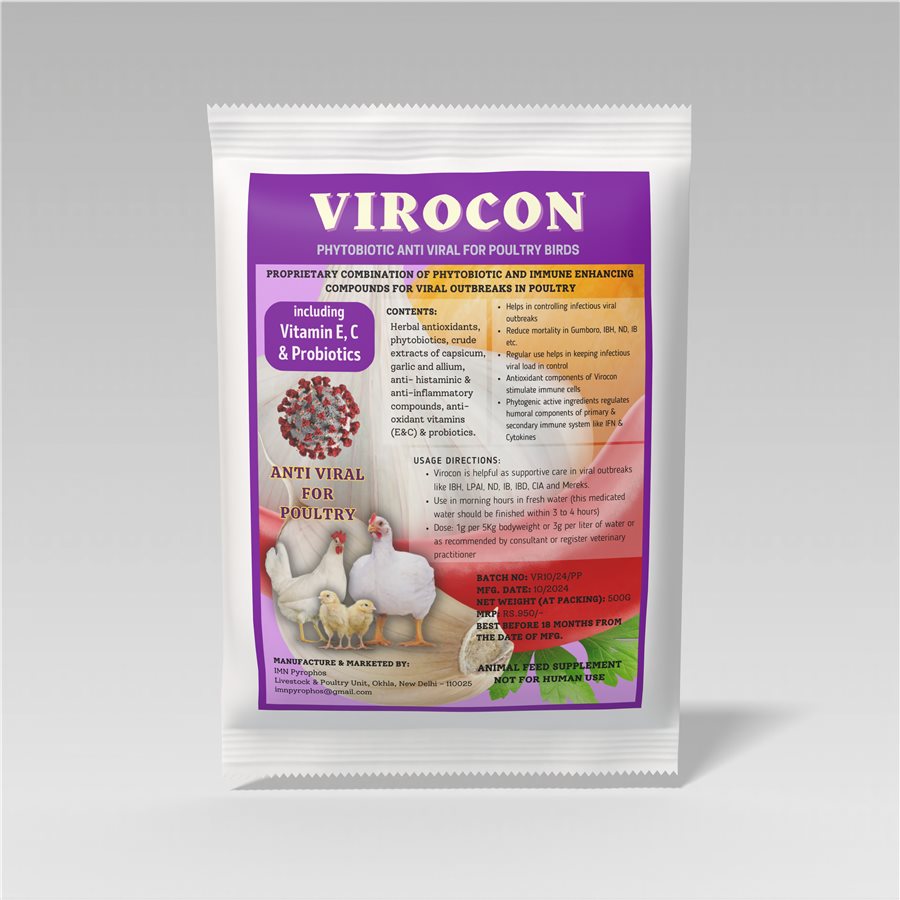
Viral outbreak support
Virocon
Phytobiotic support with herbal antioxidants, capsicum, garlic and allium extracts, vitamins E and C and probiotics. Supportive care in viral outbreaks such as ND, IB, IBD, IBH, LPAI, CIA and Marek’s; helps reduce mortality.
Dose: 1 g per 5 kg body weight or 3 g per litre. Give in the morning in fresh water and let birds finish it in 3–4 hours.
500 g ₹579MRP ₹950
- Ranikhet disease virus is highly contagious and spreads easily.
- Transmission Routes:
- Fecal-Oral Route: Through ingestion of contaminated feed and drinking water. Viruses primarily growing in the intestine are spread this way.
- Airborne Route: Through inhalation of aerosol and droplets shed from the respiratory tract. Birds with respiratory disease shed virus in mucus particles. Coughing helps make the virus airborne. The European epidemic of 1970-1972 had a very pronounced respiratory tropism and spread rapidly via airborne transmission.
- Virus Shedding: Infected birds shed the virus through aerosol and/or droppings after replicating in their respiratory and/or digestive tracts.
- Survival: Although enveloped, NDV is relatively stable outside the host. It can survive for several days or even months in the presence of organic material, depending on temperature and surrounding moisture. In infected carcasses, the virus can survive for several weeks at cool temperatures or several years if frozen. Faeces, where virus concentrations can be high, are an excellent medium for survival; they remain infective for over a month even at 37°C.
- Key Sources and Vectors (Practical Points):
- Humans and Equipment: The greatest possibility for spread is often by humans and their equipment. Spread occurs via contaminated material (fomites) like soil, litter, equipment, clothes, and shoes. Movement of people and vehicles must be limited and include disinfection and change of clothing/footwear. Vaccinators moving farm to farm have been involved in virus spread. Humans themselves can carry the virus, potentially in the conjunctival sac of the eye. Mechanical transfer of infectious material (usually faeces) is a common human-mediated spread method.
- Live Birds: Movement of live birds is a major factor. This includes commercial poultry, wild birds, pet/exotic birds (like psittacines), game birds, and racing pigeons. Exotic birds, particularly psittacines, can act as healthy carriers of PMV-1 virus and represent a significant source of contamination.
- Contaminated Feed and Water: Feed and drinking water can become contaminated by droppings. Feed can be contaminated by infected wild birds, such as pigeons.
- Poultry Products: Movement of poultry products, including dead birds and faeces (e.g., for fertilizer), can spread the virus.
- Eggs: Eggs laid by infected breeders may occasionally contain the virus, though they rarely hatch. However, if broken in the hatchery, they can contaminate hatched chicks. Virus may also penetrate the shell after laying. Cracked or broken infected eggs serve as a virus source for chicks.
- Wild Birds and Other Wildlife: Can spread the disease by infection or mechanical transfer. Preventing contact between poultry and wild birds (pigeons, waterfowl) is important for biosecurity. Ducks and geese may carry viral strains, generally nonpathogenic for chickens. Wild ducks often are the source of asymptomatic enteric lentogenic strains.
- Vaccines: Live viruses used for vaccination are a reservoir because vaccinated poultry can replicate and disseminate them. Contamination of vaccines has also occurred.
- Factors Influencing Spread:
- Crowded conditions, like intensive broiler houses, facilitate rapid airborne spread and successive batches without proper cleaning.
- If birds are not in direct contact (e.g., layers in cages), spread via faeces in feed/water may be slower.
Problem in your flock? Send photos of the birds and droppings on WhatsApp for a first opinion from Dr. Ibne Ali.
WhatsApp: 98715 84101रानीखेत रोग / Newcastle Disease – पोल्ट्री में ND
परिचय: रानीखेत रोग क्या है?
- रानीखेत रोग (RD), जिसे Newcastle disease (ND) या pseudo-plague भी कहते हैं, एक अचानक होने वाला, गंभीर और तेज़ी से फैलने वाला वायरल रोग है जो जंगली और पालतू पक्षियों को होता है।
- इसकी पहचान है अचानक शुरुआत, साँस के लक्षण, नसों (nervous) के लक्षण और अलग-अलग मृत्यु दर।
- रानीखेत रोग मुख्य रूप से मुर्गियों और टर्की को होता है, लेकिन ज़्यादातर पोल्ट्री और कई जंगली व पालतू पक्षी भी इसकी चपेट में आ सकते हैं।
- पोल्ट्री में ND के इलाज के बारे में हम दूसरे ब्लॉग में देखेंगे
- यह पूरी दुनिया में पाया जाता है।
- भारत में रानीखेत पोल्ट्री का सबसे डरावना वायरल रोग है और हर साल मौतों का नंबर एक कारण माना जाता है।
- पहले प्रकोप 1926 में जावा, इंडोनेशिया और न्यूकैसल, इंग्लैंड में दर्ज हुए (इसीलिए नाम 'Newcastle disease')। भारत में यह रोग पहली बार 1927 में रानीखेत, उत्तरांचल से रिपोर्ट हुआ, इसीलिए नाम 'रानीखेत रोग'।
- ND का आर्थिक असर बहुत बड़ा है, जिसमें सीधे नुकसान (मौतें) और अप्रत्यक्ष खर्च जैसे रोग-मुक्त देशों में vaccination और टेस्टिंग शामिल हैं। भारत जैसे विकासशील देशों में, जहाँ अंडे और चिकन मांस प्रोटीन के मुख्य स्रोत हैं, लगातार मौजूद NDV पोल्ट्री उद्योग के विकास में बड़ी रुकावट है।
- जन-स्वास्थ्य के नज़रिए से ND को एक मामूली zoonosis (जानवर से इंसान में जाने वाला रोग) माना जाता है। इंसानों में फैलने के मामले कम ही सुने गए हैं और आम तौर पर आँख का संक्रमण (conjunctivitis, पलक में सूजन, आँखों से पानी) होता है। कभी-कभी सिरदर्द और बुखार भी देखा जाता है। Newcastle disease एक मामूली zoonosis है जिससे आम तौर पर conjunctivitis होता है।
वायरस: कारण, वर्गीकरण, बनावट, जेनेटिक बदलाव
- रानीखेत रोग आपस में मिलते-जुलते वायरसों के एक समूह से होता है जो avian paramyxovirus type 1 serotype (APMV-1 या PMV-1) बनाते हैं।
- Newcastle disease virus (NDV) genus Avulavirus का हिस्सा है, जो family Paramyxoviridae में आता है।
- ये वायरस envelope वाले, single-stranded RNA वायरस हैं जिनकी polarity negative होती है।
- इनमें helical symmetry वाला nucleocapsid होता है, जो host cell की झिल्ली से बने envelope से घिरा होता है।
- Envelope पर दो glycoproteins के काँटे (spicules) होते हैं:
- Hemagglutinin-neuraminidase (HN): वायरस को कोशिका के receptors से चिपकाने का काम करता है।
- F glycoprotein: वायरस के envelope को कोशिका झिल्ली से जोड़ता (fusion) है, जिससे वायरस का RNA अंदर जा पाता है।
- सभी avian paramyxovirus पक्षियों की लाल रक्त कोशिकाओं को आपस में चिपका देते हैं (agglutinate)।
- Hemagglutination inhibition (HI) टेस्ट से avian paramyxovirus के नौ अलग serotypes (PMV-1 से PMV-9) पहचाने जाते हैं। NDV strains PMV-1 में आते हैं।
- PMV-1 समूह के अंदर antigenic बदलाव होते हैं, जिन्हें monoclonal antibodies से पहचाना जा सकता है। PMV-1 और PMV-3 वायरसों के बीच cross-reaction हो सकता है, खासकर टर्की और psittacines (तोता प्रजाति) से अलग किए गए वायरसों में।
- काफी ज़्यादा जेनेटिक विविधता जगह, समय और host प्रजाति से जुड़ी होती है।
- Fusion (F) protein gene की sequencing से NDV की कम से कम छह अलग lineages (1-6) पहचानी गई हैं।
- पूरे genome के विश्लेषण से दो बड़े भाग (Class I और II) दिखते हैं, और Class II को आगे आठ genotypes (I-VIII) में बाँटा गया है।
- ये जेनेटिक बदलाव antigenicity पर और संभवतः vaccination के असर पर प्रभाव डाल सकते हैं।
यह कैसे फैलता है (Epidemiology – व्यावहारिक बातें)
वायरल बीमारी में सहारा
Virocon
हर्बल एंटीऑक्सीडेंट, कैप्सिकम, लहसुन और एलियम एक्सट्रैक्ट, विटामिन E और C और प्रोबायोटिक वाला फाइटोबायोटिक। ND, IB, IBD, IBH, LPAI, CIA और मैरेक्स जैसी वायरल बीमारियों में सहायक इलाज; मृत्यु घटाने में मदद करता है।
मात्रा: 1 ग्राम प्रति 5 किलो वज़न या 3 ग्राम प्रति लीटर। सुबह ताज़े पानी में दें और 3–4 घंटे में खत्म होने दें।
500 g ₹579MRP ₹950
- रानीखेत रोग का वायरस बहुत ज़्यादा संक्रामक है और आसानी से फैलता है।
- फैलने के रास्ते:
- बीट-मुँह का रास्ता (Fecal-Oral Route): दूषित feed और पीने के पानी के ज़रिए। जो वायरस मुख्य रूप से आँत में बढ़ते हैं, वे इसी तरह फैलते हैं।
- हवा का रास्ता (Airborne Route): साँस की नली से निकलने वाले aerosol और बूँदों को साँस में लेने से। साँस की बीमारी वाले पक्षी बलगम के कणों में वायरस छोड़ते हैं। खाँसी से वायरस हवा में फैलता है। 1970-1972 की यूरोपीय महामारी में साँस के अंगों पर बहुत ज़्यादा असर था और यह हवा के ज़रिए तेज़ी से फैली।
- वायरस का बाहर निकलना (Shedding): संक्रमित पक्षी साँस और/या पाचन तंत्र में वायरस के बढ़ने के बाद aerosol और/या बीट के ज़रिए वायरस बाहर छोड़ते हैं।
- ज़िंदा रहना: Envelope होने के बावजूद NDV शरीर के बाहर काफी टिकाऊ है। यह तापमान और आसपास की नमी के हिसाब से जैविक पदार्थ (organic material) की मौजूदगी में कई दिनों या महीनों तक ज़िंदा रह सकता है। संक्रमित मरे पक्षियों में वायरस ठंडे तापमान पर कई हफ्तों तक या जमा देने (frozen) पर कई सालों तक ज़िंदा रह सकता है। बीट (faeces), जिसमें वायरस की मात्रा ज़्यादा हो सकती है, वायरस के ज़िंदा रहने का बहुत अच्छा माध्यम है; यह 37°C पर भी एक महीने से ज़्यादा समय तक संक्रामक रहती है।
- मुख्य स्रोत और फैलाने वाले (व्यावहारिक बातें):
- इंसान और उपकरण: फैलने की सबसे बड़ी संभावना अक्सर इंसानों और उनके उपकरणों से होती है। यह दूषित चीज़ों (fomites) जैसे मिट्टी, litter, उपकरण, कपड़े और जूतों के ज़रिए फैलता है। लोगों और गाड़ियों की आवाजाही सीमित होनी चाहिए और इसमें disinfection और कपड़े/जूते बदलना शामिल होना चाहिए। एक फार्म से दूसरे फार्म जाने वाले vaccinators वायरस फैलाने में शामिल पाए गए हैं। इंसान खुद भी वायरस ले जा सकते हैं, संभवतः आँख की conjunctival sac में। संक्रामक चीज़ (आम तौर पर बीट) को एक जगह से दूसरी जगह ले जाना इंसानों से फैलने का एक आम तरीका है।
- ज़िंदा पक्षी: ज़िंदा पक्षियों की आवाजाही एक बड़ी वजह है। इसमें व्यावसायिक पोल्ट्री, जंगली पक्षी, पालतू/विदेशी पक्षी (जैसे psittacines), शिकार वाले पक्षी और रेसिंग कबूतर शामिल हैं। विदेशी पक्षी, खासकर psittacines, PMV-1 वायरस के स्वस्थ वाहक (healthy carriers) हो सकते हैं और संक्रमण का बड़ा स्रोत होते हैं।
- दूषित feed और पानी: Feed और पीने का पानी बीट से दूषित हो सकता है। Feed संक्रमित जंगली पक्षियों, जैसे कबूतरों, से दूषित हो सकता है।
- पोल्ट्री उत्पाद: पोल्ट्री उत्पादों की आवाजाही, जिसमें मरे पक्षी और बीट (जैसे खाद के लिए) शामिल हैं, वायरस फैला सकती है।
- अंडे: संक्रमित ब्रीडर के अंडों में कभी-कभी वायरस हो सकता है, हालाँकि वे बहुत कम हैच होते हैं। लेकिन अगर ये हैचरी में टूट जाएँ, तो हैच हुए चूज़ों को संक्रमित कर सकते हैं। अंडा देने के बाद वायरस छिलके के अंदर भी घुस सकता है। दरार वाले या टूटे संक्रमित अंडे चूज़ों के लिए वायरस का स्रोत बनते हैं।
- जंगली पक्षी और दूसरे जंगली जीव: ये संक्रमण से या संक्रामक चीज़ को एक जगह से दूसरी जगह ले जाकर रोग फैला सकते हैं। Biosecurity के लिए पोल्ट्री और जंगली पक्षियों (कबूतर, जलपक्षी) के बीच संपर्क रोकना ज़रूरी है। बत्तख और हंस वायरस strains ले जा सकते हैं, जो आम तौर पर मुर्गियों के लिए रोग पैदा नहीं करते। जंगली बत्तखें अक्सर बिना लक्षण वाले आँत के lentogenic strains का स्रोत होती हैं।
- Vaccine: Vaccination में इस्तेमाल होने वाले ज़िंदा वायरस एक भंडार (reservoir) हैं, क्योंकि vaccinated पोल्ट्री इन्हें अपने अंदर बढ़ाकर फैला सकती है। Vaccine के दूषित होने के मामले भी हुए हैं।
- फैलाव पर असर डालने वाली बातें:
- भीड़-भाड़ वाली स्थिति, जैसे intensive broiler शेड, हवा से तेज़ फैलाव को आसान बनाती है, और बिना सही सफाई के लगातार बैच डालना भी।
- अगर पक्षी सीधे संपर्क में नहीं हैं (जैसे पिंजरों में layers), तो feed/पानी में बीट के ज़रिए फैलाव धीमा हो सकता है।
फ़ार्म में कोई दिक्कत? पक्षियों और बीट की फ़ोटो WhatsApp पर भेजिए, डॉ. इब्ने अली से पहली राय लीजिए।
WhatsApp: 98715 84101Ranikhet Disease / Newcastle Disease – Poultry me ND
Introduction: Ranikhet Disease kya hai?
- Ranikhet disease (RD), jise Newcastle disease (ND) ya pseudo-plague bhi kehte hain, ek achanak hone wali, serious aur tezi se phailne wali viral bimari hai jo jungli aur paltu dono tarah ke pakshiyon ko hoti hai.
- Iski pehchaan hai achanak shuruaat, saans ke lakshan, nervous lakshan aur alag-alag mortality.
- Ranikhet mainly murgiyon aur turkey ko hota hai, lekin zyadatar poultry aur kai jungli aur paltu pakshi bhi iski chapet me aa sakte hain.
- Poultry me ND ka treatment hum dusre blog me dekhenge
- Ye poori duniya me paaya jata hai.
- India me Ranikhet poultry ki sabse darawni viral bimari hai aur har saal maut ka number one kaaran maani jaati hai.
- Pehle outbreak 1926 me Java, Indonesia aur Newcastle, England me record hue (isliye naam 'Newcastle disease'). India me ye bimari pehli baar 1927 me Ranikhet, Uttaranchal se report hui, isliye naam 'Ranikhet disease'.
- ND ka economic asar bahut bada hai, jisme seedha nuksan (mortality) aur indirect kharche jaise disease-free deshon me vaccination aur testing shaamil hain. India jaise developing deshon me, jahan ande aur chicken meat protein ke main source hain, lagatar maujood NDV poultry industry ke development me badi rukawat hai.
- Public health ke hisaab se ND ek minor zoonosis (janwar se insaan me jaane wali bimari) maani jaati hai. Insaano me phailne ke case kam hi sune gaye hain aur aam taur par aankh ka infection (conjunctivitis, palak me soojan, aankh se paani) hota hai. Kabhi-kabhi sar dard aur bukhar bhi dekha jata hai. Newcastle disease ek minor zoonosis hai jisse aam taur par conjunctivitis hota hai.
Virus: Kaaran, Classification, Structure, Genetic Variation
- Ranikhet disease aapas me milte-julte viruses ke ek group se hota hai jo avian paramyxovirus type 1 serotype (APMV-1 ya PMV-1) banate hain.
- Newcastle disease virus (NDV) genus Avulavirus ka hissa hai, jo family Paramyxoviridae me aata hai.
- Ye viruses envelope wale, single-stranded RNA virus hain jinki polarity negative hoti hai.
- Inme helical symmetry wala nucleocapsid hota hai, jo host cell ki membrane se bane envelope se ghira hota hai.
- Envelope par do glycoproteins ke kaante (spicules) hote hain:
- Hemagglutinin-neuraminidase (HN): virus ko cell ke receptors se chipkane ka kaam karta hai.
- F glycoprotein: virus ke envelope ko cell membrane se jodta (fusion) hai, jisse virus ka RNA andar ja pata hai.
- Saare avian paramyxovirus pakshiyon ki red blood cells ko aapas me chipka dete hain (agglutinate).
- Hemagglutination inhibition (HI) test se avian paramyxovirus ke nau alag serotypes (PMV-1 se PMV-9) pehchane jaate hain. NDV strains PMV-1 me aate hain.
- PMV-1 group ke andar antigenic variation hote hain, jinhe monoclonal antibodies se pehchana ja sakta hai. PMV-1 aur PMV-3 viruses ke beech cross-reaction ho sakta hai, khaaskar turkey aur psittacines (tota jaati) se nikale gaye viruses me.
- Kaafi zyada genetic diversity jagah, time aur host species se judi hoti hai.
- Fusion (F) protein gene ki sequencing se NDV ki kam se kam chhe alag lineages (1-6) pehchani gayi hain.
- Poore genome ke analysis se do bade division (Class I aur II) dikhte hain, aur Class II ko aage aath genotypes (I-VIII) me baanta gaya hai.
- Ye genetic variations antigenicity par aur shayad vaccination ke asar par bhi farak daal sakte hain.
Ye Kaise Phailta hai (Epidemiology – Practical Points)
Viral bimari me sahara
Virocon
Herbal antioxidant, capsicum, lehsun aur allium extract, vitamin E aur C aur probiotic wala phytobiotic. ND, IB, IBD, IBH, LPAI, CIA aur Marek’s jaisi viral bimariyon me sahayak ilaaj; maut ghatane me madad karta hai.
Matra: 1 g prati 5 kg wazan ya 3 g prati litre. Subah taaze paani me dijiye aur 3–4 ghante me khatam hone dijiye.
500 g ₹579MRP ₹950
- Ranikhet ka virus bahut zyada contagious hai aur aasani se phailta hai.
- Phailne ke Raaste:
- Fecal-Oral Route (beet se munh tak): Contaminated feed aur peene ke paani ke through. Jo virus mainly aant me badhte hain, wo isi tarah phailte hain.
- Airborne Route (hawa se): Saans ki nali se nikalne wale aerosol aur boondon ko saans me lene se. Saans ki bimari wale pakshi balgam ke kano me virus chhodte hain. Khaansi se virus hawa me phailta hai. 1970-1972 ki European mahamari me respiratory asar bahut zyada tha aur ye hawa ke through tezi se phaili.
- Virus Shedding (virus ka bahar nikalna): Infected pakshi saans aur/ya digestive tract me virus badhne ke baad aerosol aur/ya beet ke through virus bahar chhodte hain.
- Zinda Rehna: Envelope hone ke bawajood NDV body ke bahar kaafi tikaau hai. Ye temperature aur aas-paas ki nami ke hisaab se organic material ki maujoodgi me kai din ya mahino tak zinda reh sakta hai. Infected mare pakshiyon me virus thande temperature par kai hafto tak ya frozen hone par kai saalon tak zinda reh sakta hai. Beet (faeces), jisme virus ki matra zyada ho sakti hai, virus ke zinda rehne ka bahut achha medium hai; ye 37°C par bhi ek mahine se zyada time tak infective rehti hai.
- Main Source aur Phailane wale (Practical Points):
- Insaan aur Equipment: Phailne ki sabse badi sambhavna aksar insaano aur unke equipment se hoti hai. Ye contaminated cheezon (fomites) jaise mitti, litter, equipment, kapde aur jooton ke through phailta hai. Logon aur gaadiyon ka aana-jaana limit hona chahiye aur isme disinfection aur kapde/joote badalna shaamil hona chahiye. Ek farm se dusre farm jaane wale vaccinators virus phailane me shaamil paaye gaye hain. Insaan khud bhi virus le ja sakte hain, shayad aankh ki conjunctival sac me. Infectious cheez (aam taur par beet) ko ek jagah se dusri jagah le jaana insaano se phailne ka ek common tarika hai.
- Zinda Pakshi: Zinda pakshiyon ka aana-jaana ek bada factor hai. Isme commercial poultry, jungli pakshi, paltu/exotic pakshi (jaise psittacines), game birds aur racing kabootar shaamil hain. Exotic pakshi, khaaskar psittacines, PMV-1 virus ke healthy carrier ho sakte hain aur infection ka bada source hote hain.
- Contaminated Feed aur Paani: Feed aur peene ka paani beet se contaminate ho sakta hai. Feed infected jungli pakshiyon, jaise kabootaron, se contaminate ho sakta hai.
- Poultry Products: Poultry products ka aana-jaana, jisme mare pakshi aur beet (jaise khaad ke liye) shaamil hain, virus phaila sakta hai.
- Ande: Infected breeder ke ando me kabhi-kabhi virus ho sakta hai, halanki wo bahut kam hatch hote hain. Lekin agar ye hatchery me toot jaayein, to hatch hue chicks ko infect kar sakte hain. Anda dene ke baad virus shell ke andar bhi ghus sakta hai. Daraar wale ya toote infected ande chicks ke liye virus ka source bante hain.
- Jungli Pakshi aur Dusre Jungli Jaanwar: Ye infection se ya infectious cheez ko ek jagah se dusri jagah le jaakar bimari phaila sakte hain. Biosecurity ke liye poultry aur jungli pakshiyon (kabootar, paani wale pakshi) ke beech contact rokna zaroori hai. Batakh aur hans virus strains le ja sakte hain, jo aam taur par murgiyon me bimari nahi karte. Jungli batakhein aksar bina lakshan wale aant ke lentogenic strains ka source hoti hain.
- Vaccines: Vaccination me use hone wale zinda virus ek reservoir hain, kyunki vaccinated poultry inhe apne andar badhakar phaila sakti hai. Vaccine contaminate hone ke case bhi hue hain.
- Phailaav par Asar Daalne wali Baatein:
- Bheed-bhaad wali condition, jaise intensive broiler shed, hawa se tez phailaav ko aasan banati hai, aur bina sahi safai ke lagatar batch daalna bhi.
- Agar pakshi seedhe contact me nahi hain (jaise cages me layers), to feed/paani me beet ke through phailaav slow ho sakta hai.
Farm me koi dikkat? Pakshiyon aur beet ki photo WhatsApp par bhejiye, Dr. Ibne Ali se pehli raay lijiye.
WhatsApp: 98715 84101