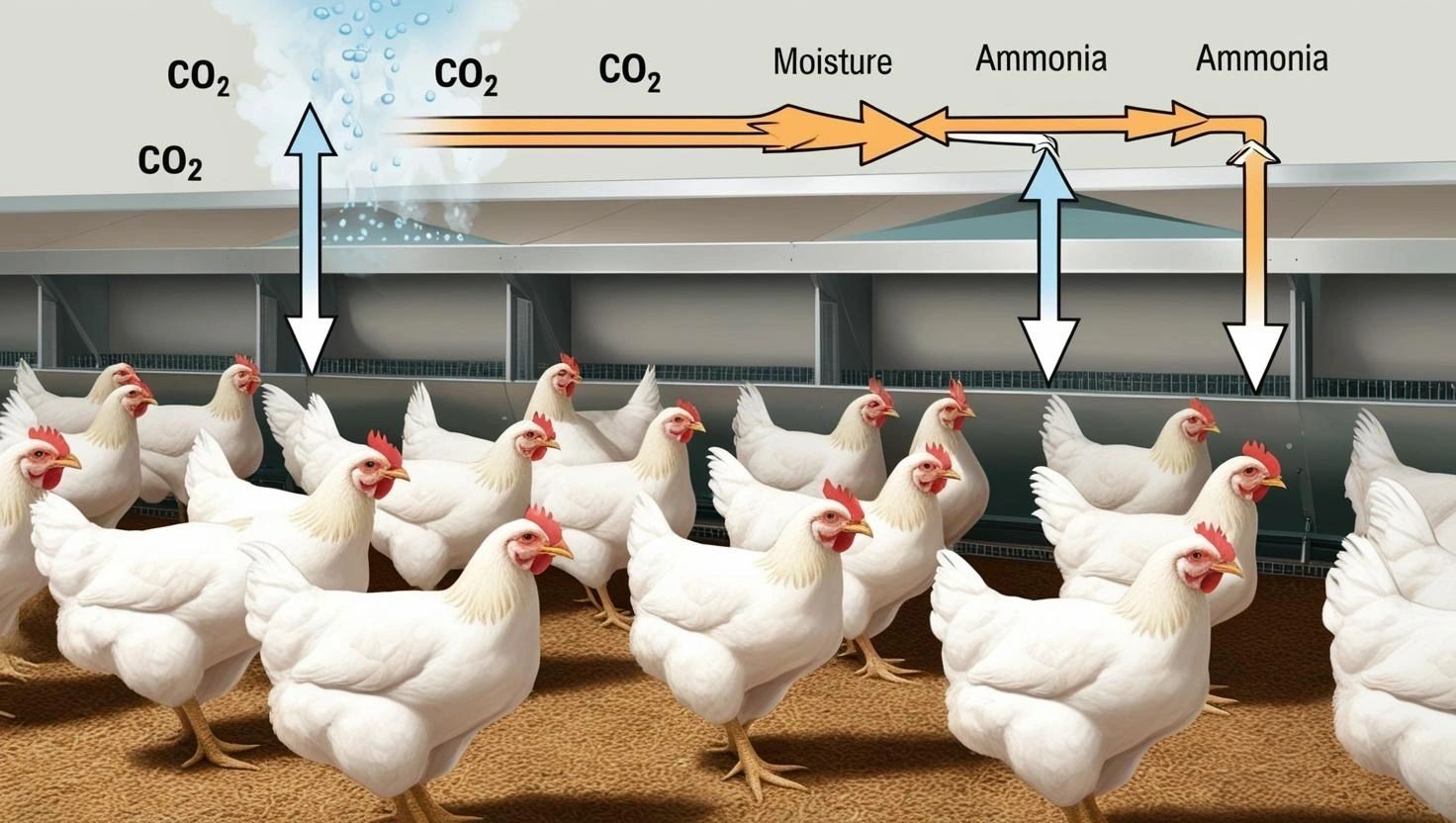
Comprehensive Guide to Poultry Ventilation Management: Optimizing Broiler House Air Quality
Poultry ventilation management in environment-controlled poultry farms is becoming crucial now a days. In this context Broiler house ventilation systems are now popular choice of new entrepreneurs. In this various systems like minimum ventilation poultry, tunnel ventilation poultry and negative pressure ventilation are common. Whole idea behind this task is to improve poultry air quality management for infectious disease control in poultry. EC poultry farms India are therefore trending and aim of writing this article is to give some important poultry farming ventilation tips.
Effective poultry ventilation management is critical for maintaining optimal air quality, ensuring bird health, and maximizing productivity in broiler farming. Proper ventilation systems regulate oxygen levels, control moisture, reduce harmful gases, and prevent infectious disease outbreaks. This guide, based on industry standards like the COBB Broiler Management Guide, provides a detailed overview of ventilation techniques, practical tips for farmers, and insights into the growing trend of environment-controlled (EC) poultry farms in India.
Why Ventilation Matters in Poultry Farming
Ventilation in poultry houses serves three primary functions:
- Oxygen Supply: Ensures birds receive adequate oxygen (>19.6%) to meet metabolic demands.
- Moisture and Humidity Control: Maintains relative humidity below 70% to prevent wet litter and respiratory issues.
- Air Quality Management: Removes harmful gases like carbon dioxide (<3,000 ppm), ammonia (<10 ppm), and carbon monoxide (<10 ppm), while keeping dust levels low (<3.4 mg/m³).
Poor ventilation can lead to:
- Reduced growth rates due to oxygen deficiency.
- Increased mortality from respiratory diseases.
- Higher feed conversion ratios (FCR) due to stress.
- Infectious disease outbreaks, particularly in densely populated EC sheds.
By implementing poultry house ventilation systems, farmers can create an environment that supports bird welfare and farm profitability.
Types of Poultry Ventilation Systems
The COBB Broiler Management Guide outlines three key ventilation stages for broiler houses: Minimum Ventilation, Transitional Ventilation, and Tunnel Ventilation. Each stage addresses specific environmental and bird needs.
1. Minimum Ventilation
Purpose: Maintain air quality during cooler weather or early flock stages without creating drafts.
- Mechanism: Uses cycle timer fans to exchange 12.5% of house volume every 8 minutes (1-2 cfm/ft² of floor area).
- Key Guidelines:
- Operates independently of temperature, activating when house temperature is at or below the set point.
- Ensures minimal air movement at chick level (<0.3 m/s) to avoid chilling.
- Maintains humidity below 60-65% and ensures oxygen levels above 19.6%.
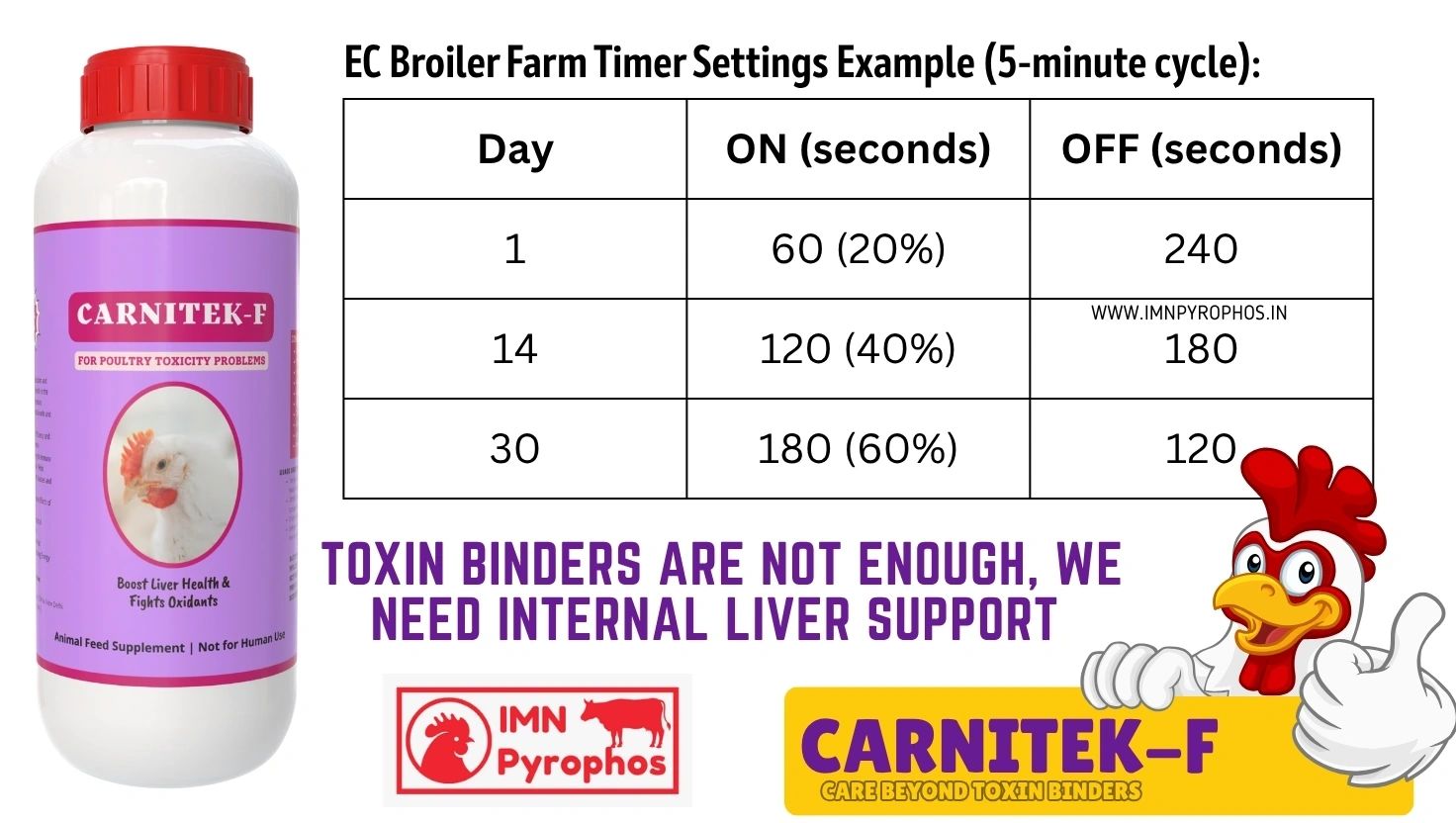
- Fans run on a 5-minute cycle, with a minimum 60-second ON time for air mixing.
- Timer Settings Example
- Fan Calculation:
- Method A: Calculate house volume (length × width × average height) and divide by desired air exchange rate (8-5 minutes). For a 150m × 15m × 2.88m house, 2-4 fans (900mm, 340 m³/min) are needed.
- Method B: Use 1-2 cfm/ft² of floor area. For a 25,000 ft² house, 2 fans (36", 12,000 cfm) suffice.
- Negative Pressure: Achieved by sealing the house and using side wall inlets to direct air to the house peak. A pressure drop of 0.01" WC per 61 cm of air travel ensures even distribution.
2. Transitional Ventilation
Purpose: Control temperature without high air speeds (poultry house fans) , ideal for young birds or hot climates.
- Mechanism: Uses 40-50% of tunnel ventilation capacity with side wall inlets, achieving air exchange every 2-3 minutes (4-5 cfm/ft²).
- Key Guidelines:
- Air speeds range from 0.5-0.8 m/s (100-150 fpm).
- Inlets are pressure-controlled to maintain constant air speed.
- For a 150m × 15m house, 3-5 fans (50", 24,000 cfm) and 112 inlets (56 per side) are needed.
3. Tunnel Ventilation
Purpose: Provide maximum cooling in hot weather by creating a wind-chill effect.
- Mechanism: High-capacity fans at one end pull air through intakes at the opposite end, achieving air exchange in <1 minute.
- Key Guidelines:
- Air speeds range from 3.0-4.0 m/s (600-800 fpm), reducing effective temperature by 1-8°C.
- For a 150m × 15m house, 12 fans (50", 24,000 cfm) achieve 3.15 m/s air speed and 48-second air exchange.
- Method B: Use 9-11 cfm/ft². For a 25,000 ft² house, 10 fans (250,000 cfm) are recommended.
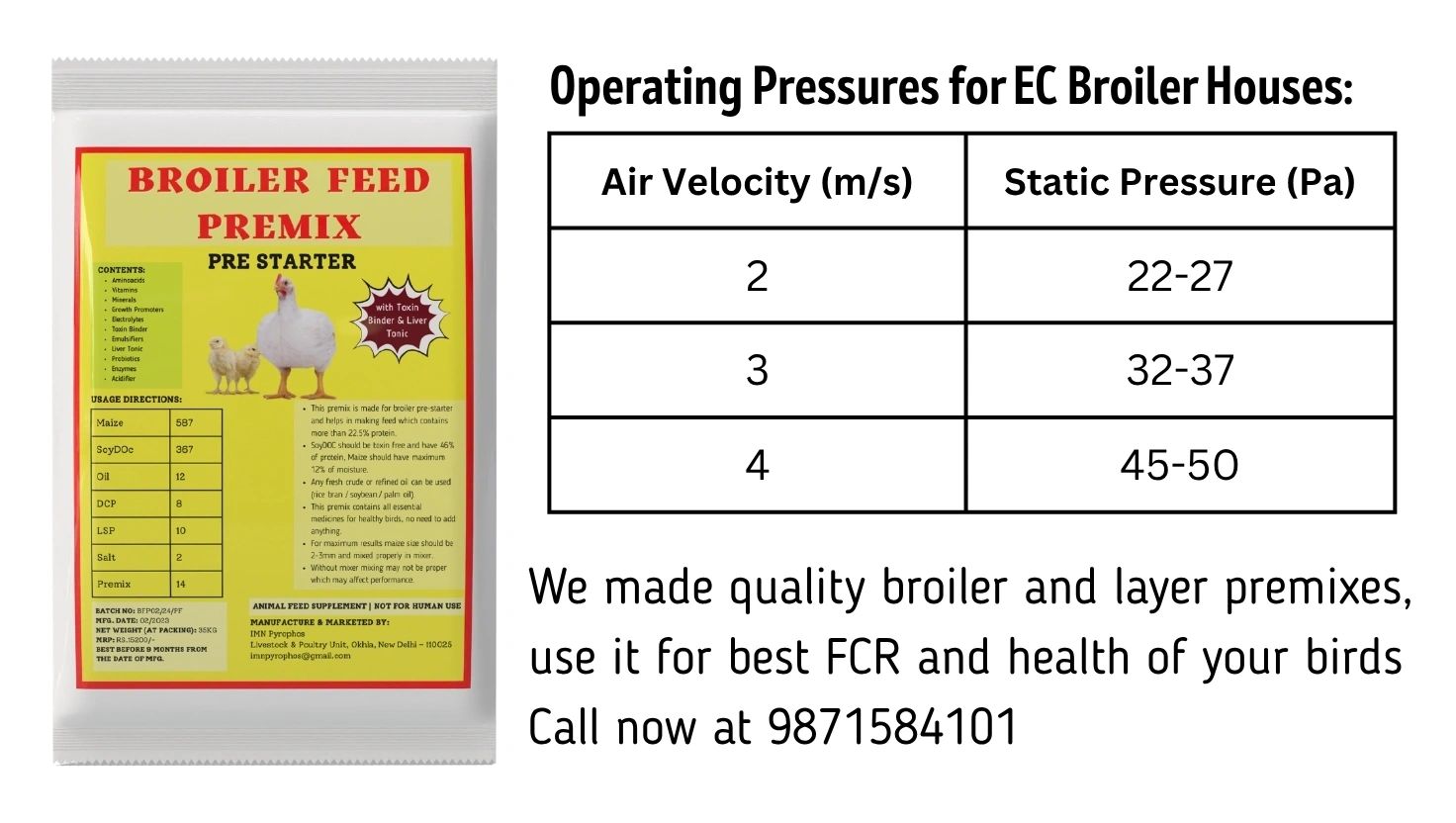
- Operating Pressures:
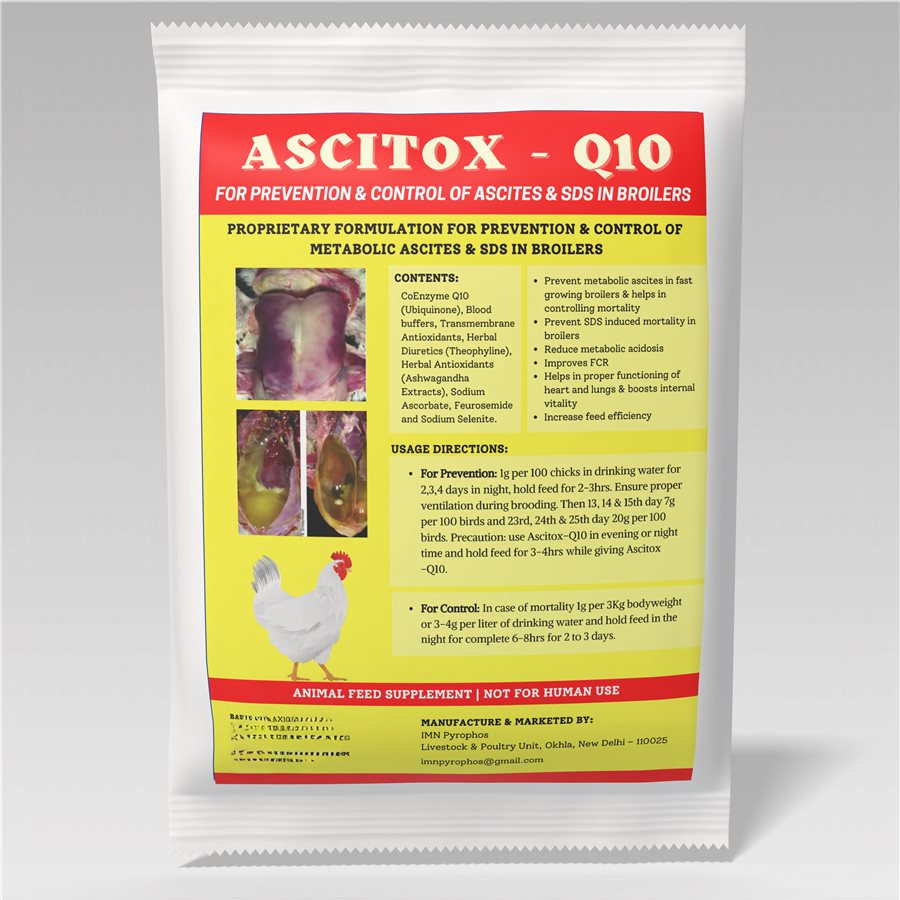
Ascites and SDS in broilers
Ascitox Q10
CoQ10 with blood buffers, antioxidants, herbal diuretics, sodium ascorbate and selenite for prevention and control of metabolic ascites and sudden death syndrome in fast-growing broilers, especially in winter.
Dose: Prevention: 1 g per 100 chicks on day 2–4 at night (hold feed 2–3 h), 7 g per 100 birds on day 13–15, 20 g per 100 birds on day 23–25, in the evening or at night. Control: 1 g per 3 kg body weight or 3–4 g per litre, holding feed 6–8 h at night for 2–3 days.
1 kg ₹698MRP ₹1,080
Ventilation and Infectious Disease Outbreaks in EC Sheds
Environment-controlled (EC) poultry sheds are designed to optimize temperature, humidity, and air quality, but their high stocking densities increase the risk of infectious disease outbreaks such as Avian Influenza, Infectious Bronchitis, and Newcastle Disease. Ventilation plays a critical role in mitigating these risks:
- Pathogen Spread: Poor ventilation leads to high ammonia and dust levels, which irritate bird respiratory systems, making them more susceptible to infections.
- Humidity Control: Excess humidity (>70%) promotes bacterial and fungal growth, increasing disease risk. Proper ventilation keeps humidity below 65%.
- Airborne Transmission: Inadequate air exchange allows pathogens to accumulate. Tunnel ventilation ensures rapid removal of contaminated air.
- Dead Spots: Low air speeds in poorly designed systems create areas of stagnant air, where pathogens thrive. Negative pressure systems ensure even air distribution.
Case Study: A 2023 study from the University of Georgia found that poultry houses with consistent negative pressure ventilation had 30% lower incidences of respiratory diseases compared to those with erratic airflow. In EC sheds, maintaining static pressures of 25-50 Pa during tunnel ventilation significantly reduced pathogen loads.
Ventilation in the Indian Context
India’s poultry industry is rapidly adopting environment-controlled poultry farms, particularly in states like Tamil Nadu, Andhra Pradesh, and Maharashtra. These modern systems are replacing traditional open-sided houses due to their ability to control climate variations, improve FCR, and increase year-round productivity. However, challenges like high setup costs, technical expertise, and power reliability persist.
Why EC Farms Are Trending in India
- Climate Variability: India’s diverse climate, with temperatures ranging from 10°C in winter to 45°C in summer, necessitates precise environmental control.
- Rising Demand: Growing demand for poultry meat (projected to reach 9 million tons by 2027, per ICAR) drives investment in efficient farming systems.
- Disease Control: EC sheds reduce exposure to external pathogens, critical in regions prone to Avian Influenza outbreaks.
- Government Support: Schemes like the National Livestock Mission offer subsidies for EC farm setup, encouraging adoption.
Challenges in India
- High Initial Costs: EC sheds require significant investment in fans, inlets, and automation systems.
- Technical Know-How: Farmers need training to manage negative pressure and tunnel ventilation systems effectively.
- Power Supply: Frequent power outages in rural areas disrupt ventilation, risking bird health. Backup generators are essential.
Practical Tips for Indian Farmers
- Start Small: Begin with a single EC shed to gain experience before scaling up.
- Local Expertise: Collaborate with poultry consultants or companies like Venky’s or Suguna Foods for technical support.
- Energy Efficiency: Invest in energy-efficient fans (23 cfm/Watt) to reduce operational costs.
- Regular Maintenance: Clean fans and inlets weekly to prevent dust buildup, which reduces efficiency and spreads pathogens.
- Monitor Air Quality: Use affordable sensors to track CO₂, ammonia, and humidity levels, ensuring compliance with COBB guidelines.
Essential and Practical Points for Poultry Farmers
To optimize poultry ventilation systems, farmers should follow these actionable steps:
- Seal the House: Test for leaks (target >37.5 Pa pressure with 1 cfm/ft² fan capacity). Seal roof ridges, doors, and stem walls to maintain negative pressure.
- Match Fan and Inlet Capacity: Ensure inlet capacity matches fan output at operating pressure (e.g., 112 inlets for 2,720 m³/min fan capacity).
- Use Negative Pressure: Adjust inlet openings (2.5-5 cm) to direct air to the house peak, preventing cold air from chilling birds.
- Monitor Air Quality Daily: Check oxygen (>19.6%), CO₂ (<3,000 ppm), and ammonia (<10 ppm) levels. Increase fan ON time if thresholds are exceeded.
- Perform Smoke Tests: Verify air reaches the house center, adjusting pressure drops based on house width (e.g., 31 Pa for 15m-wide houses).
- Adjust Ventilation by Flock Age: Increase ON time gradually (e.g., 60s on Day 1 to 180s on Day 30) to match bird growth and heat production.
- Invest in High-Efficiency Fans: Choose cone fans (1.2-1.42m diameter) with airflow ratios >0.75 for consistent performance under high static pressures.
- Train Staff: Educate workers on ventilation system operation, maintenance, and troubleshooting to prevent errors during critical periods.
Conclusion
Effective poultry ventilation management is the cornerstone of modern broiler farming, ensuring optimal bird health, growth, and farm profitability. By implementing minimum, transitional, and tunnel ventilation systems as outlined in the COBB Broiler Management Guide, farmers can maintain air quality, control humidity, and reduce the risk of infectious disease outbreaks. In India, the rise of environment-controlled poultry farms offers immense potential, provided farmers address challenges like cost, training, and power reliability. By following practical guidelines and leveraging technology, poultry farmers can create sustainable and productive operations that meet the growing demand for poultry products.
For all type of disease and nutrition related consultation you can whatsapp or call at 9871584101
Problem in your flock? Send photos of the birds and droppings on WhatsApp for a first opinion from Dr. Ibne Ali.
WhatsApp: 98715 84101पोल्ट्री वेंटिलेशन मैनेजमेंट की पूरी गाइड: ब्रॉयलर हाउस की हवा की क्वालिटी को बेहतर बनाना
आजकल environment-controlled पोल्ट्री फार्म में वेंटिलेशन मैनेजमेंट बहुत ज़रूरी होता जा रहा है। इसी वजह से नए उद्यमियों के बीच broiler house ventilation system काफ़ी पसंद किए जा रहे हैं। इनमें minimum ventilation, tunnel ventilation और negative pressure ventilation जैसे सिस्टम आम हैं। इस पूरे काम का मकसद पोल्ट्री में हवा की क्वालिटी सुधारना है, ताकि संक्रामक बीमारियों पर कंट्रोल रहे। इसलिए भारत में EC पोल्ट्री फार्म का चलन बढ़ रहा है, और इस लेख को लिखने का मकसद पोल्ट्री फार्मिंग में वेंटिलेशन के कुछ ज़रूरी टिप्स देना है।
ब्रॉयलर फार्मिंग में हवा की सही क्वालिटी बनाए रखने, पक्षियों की सेहत ठीक रखने और ज़्यादा से ज़्यादा उत्पादन पाने के लिए सही पोल्ट्री वेंटिलेशन मैनेजमेंट बहुत ज़रूरी है। सही वेंटिलेशन सिस्टम ऑक्सीजन का लेवल ठीक रखता है, नमी को कंट्रोल करता है, नुकसानदायक गैसों को कम करता है और संक्रामक बीमारियों के फैलाव को रोकता है। यह गाइड COBB Broiler Management Guide जैसे इंडस्ट्री स्टैंडर्ड पर आधारित है। इसमें वेंटिलेशन के तरीकों की पूरी जानकारी, किसानों के लिए काम के टिप्स, और भारत में environment-controlled (EC) पोल्ट्री फार्म के बढ़ते चलन के बारे में बताया गया है।
पोल्ट्री फार्मिंग में वेंटिलेशन क्यों ज़रूरी है
पोल्ट्री हाउस में वेंटिलेशन के तीन मुख्य काम हैं:
- ऑक्सीजन की सप्लाई: पक्षियों को उनके शरीर की ज़रूरत के हिसाब से पूरी ऑक्सीजन (>19.6%) मिलती रहे।
- नमी और ह्यूमिडिटी का कंट्रोल: relative humidity को 70% से नीचे रखना, ताकि litter गीला न हो और सांस की बीमारियाँ न हों।
- हवा की क्वालिटी का मैनेजमेंट: नुकसानदायक गैसें जैसे कार्बन डाइऑक्साइड (<3,000 ppm), अमोनिया (<10 ppm) और कार्बन मोनोऑक्साइड (<10 ppm) बाहर निकालना, और धूल का लेवल कम (<3.4 mg/m³) रखना।
खराब वेंटिलेशन से ये नुकसान हो सकते हैं:
- ऑक्सीजन की कमी से ग्रोथ कम होना।
- सांस की बीमारियों से मृत्यु दर (mortality) बढ़ना।
- स्ट्रेस की वजह से feed conversion ratio (FCR) बढ़ जाना।
- संक्रामक बीमारियों का फैलना, ख़ासकर ज़्यादा पक्षियों वाले EC शेड में।
पोल्ट्री हाउस वेंटिलेशन सिस्टम लगाकर किसान ऐसा माहौल बना सकते हैं जिससे पक्षियों की भलाई भी हो और फार्म का मुनाफ़ा भी बढ़े।
पोल्ट्री वेंटिलेशन सिस्टम के प्रकार
COBB Broiler Management Guide में ब्रॉयलर हाउस के लिए वेंटिलेशन के तीन मुख्य स्टेज बताए गए हैं: Minimum Ventilation, Transitional Ventilation और Tunnel Ventilation। हर स्टेज माहौल और पक्षियों की अलग-अलग ज़रूरतों को पूरा करता है।
1. Minimum Ventilation
मकसद: ठंडे मौसम में या फ्लॉक की शुरुआती उम्र में, बिना ठंडी हवा का झोंका (draft) बनाए, हवा की क्वालिटी ठीक रखना।
- कैसे काम करता है: cycle timer वाले फैन हर 8 मिनट में हाउस के वॉल्यूम का 12.5% हवा बदलते हैं (फ़र्श के एरिया का 1-2 cfm/ft²)।
- मुख्य निर्देश:
- यह तापमान से अलग चलता है, यानी जब हाउस का तापमान set point पर या उससे नीचे हो तब भी चालू रहता है।
- चूज़ों की ऊँचाई पर हवा की रफ़्तार बहुत कम (<0.3 m/s) रखी जाती है ताकि चूज़ों को ठंड न लगे।
- ह्यूमिडिटी 60-65% से नीचे रखी जाती है और ऑक्सीजन 19.6% से ऊपर।
- फैन 5 मिनट की साइकिल पर चलते हैं, जिसमें हवा मिलाने के लिए कम से कम 60 सेकंड ON टाइम होता है।
- टाइमर सेटिंग का उदाहरण
- फैन का हिसाब:
- तरीका A: हाउस का वॉल्यूम निकालें (लंबाई × चौड़ाई × औसत ऊँचाई) और उसे चाहिए गए air exchange rate (8-5 मिनट) से भाग दें। 150m × 15m × 2.88m के हाउस के लिए 2-4 फैन (900mm, 340 m³/min) चाहिए।
- तरीका B: फ़र्श के एरिया का 1-2 cfm/ft² लें। 25,000 ft² के हाउस के लिए 2 फैन (36", 12,000 cfm) काफ़ी हैं।
- Negative Pressure: हाउस को पूरी तरह सील करके और साइड वॉल के inlet से हवा को हाउस की छत के सबसे ऊँचे हिस्से (peak) की तरफ़ भेजकर बनाया जाता है। हवा के हर 61 cm सफ़र पर 0.01" WC का pressure drop होने से हवा बराबर फैलती है।
2. Transitional Ventilation
मकसद: हवा की तेज़ रफ़्तार (पोल्ट्री हाउस फैन) के बिना तापमान को कंट्रोल करना, जो छोटे पक्षियों या गर्म मौसम के लिए सही है।
- कैसे काम करता है: tunnel ventilation की क्षमता का 40-50% हिस्सा साइड वॉल inlet के साथ इस्तेमाल होता है, जिससे हर 2-3 मिनट में हवा बदलती है (4-5 cfm/ft²)।
- मुख्य निर्देश:
- हवा की रफ़्तार 0.5-0.8 m/s (100-150 fpm) रहती है।
- Inlet प्रेशर से कंट्रोल होते हैं ताकि हवा की रफ़्तार एक जैसी रहे।
- 150m × 15m के हाउस के लिए 3-5 फैन (50", 24,000 cfm) और 112 inlet (हर साइड 56) चाहिए।
3. Tunnel Ventilation
मकसद: गर्म मौसम में wind-chill effect बनाकर ज़्यादा से ज़्यादा ठंडक देना।
- कैसे काम करता है: एक तरफ़ लगे बड़ी क्षमता वाले फैन दूसरी तरफ़ के intake से हवा खींचते हैं, जिससे 1 मिनट से कम (<1 मिनट) में हवा बदल जाती है।
- मुख्य निर्देश:
- हवा की रफ़्तार 3.0-4.0 m/s (600-800 fpm) रहती है, जिससे महसूस होने वाला तापमान 1-8°C कम हो जाता है।
- 150m × 15m के हाउस के लिए 12 फैन (50", 24,000 cfm) से 3.15 m/s हवा की रफ़्तार और 48 सेकंड में air exchange मिलता है।
- तरीका B: 9-11 cfm/ft² लें। 25,000 ft² के हाउस के लिए 10 फैन (250,000 cfm) की सलाह दी जाती है।
- Operating Pressures:
ब्रॉयलर में जलोदर (ascites) और SDS
Ascitox Q10
CoQ10 के साथ ब्लड बफर, एंटीऑक्सीडेंट, हर्बल मूत्रवर्धक, सोडियम एस्कॉर्बेट और सेलेनाइट। तेज़ बढ़ने वाले ब्रॉयलर में, खासकर सर्दी में, मेटाबॉलिक ascites और अचानक मौत (SDS) से बचाव और कंट्रोल के लिए।
मात्रा: बचाव: दिन 2–4 रात में 1 ग्राम प्रति 100 चूज़े (2–3 घंटे दाना रोकें), दिन 13–15 पर 7 ग्राम प्रति 100 पक्षी, दिन 23–25 पर 20 ग्राम प्रति 100 पक्षी, शाम या रात में। कंट्रोल: 1 ग्राम प्रति 3 किलो वज़न या 3–4 ग्राम प्रति लीटर, 2–3 दिन रात में 6–8 घंटे दाना रोक कर।
1 kg ₹698MRP ₹1,080
EC शेड में वेंटिलेशन और संक्रामक बीमारियाँ
Environment-controlled (EC) पोल्ट्री शेड तापमान, ह्यूमिडिटी और हवा की क्वालिटी को सही रखने के लिए बनाए जाते हैं, लेकिन इनमें पक्षियों की संख्या (stocking density) ज़्यादा होने से Avian Influenza, Infectious Bronchitis और Newcastle Disease जैसी संक्रामक बीमारियों के फैलने का खतरा बढ़ जाता है। इन खतरों को कम करने में वेंटिलेशन की बहुत बड़ी भूमिका है:
- कीटाणुओं का फैलना: खराब वेंटिलेशन से अमोनिया और धूल बढ़ जाती है, जो पक्षियों की सांस की नली में जलन करती है और उन्हें इन्फेक्शन जल्दी पकड़ता है।
- ह्यूमिडिटी का कंट्रोल: ज़्यादा ह्यूमिडिटी (>70%) से बैक्टीरिया और फंगस बढ़ते हैं, जिससे बीमारी का खतरा बढ़ता है। सही वेंटिलेशन ह्यूमिडिटी को 65% से नीचे रखता है।
- हवा से फैलना: हवा ठीक से न बदलने पर कीटाणु जमा होते रहते हैं। Tunnel ventilation गंदी हवा को जल्दी बाहर निकाल देता है।
- Dead Spots: खराब डिज़ाइन वाले सिस्टम में हवा की रफ़्तार कम होने से कुछ जगहों पर हवा रुकी रहती है, जहाँ कीटाणु पनपते हैं। Negative pressure सिस्टम हवा को बराबर फैलाते हैं।
केस स्टडी: University of Georgia की 2023 की एक स्टडी में पाया गया कि जिन पोल्ट्री हाउस में लगातार negative pressure ventilation था, उनमें सांस की बीमारियाँ उन हाउस से 30% कम हुईं जिनमें हवा का बहाव अनियमित था। EC शेड में tunnel ventilation के दौरान 25-50 Pa का static pressure बनाए रखने से कीटाणुओं की मात्रा काफ़ी कम हुई।
भारत के हिसाब से वेंटिलेशन
भारत की पोल्ट्री इंडस्ट्री तेज़ी से environment-controlled पोल्ट्री फार्म अपना रही है, ख़ासकर तमिलनाडु, आंध्र प्रदेश और महाराष्ट्र जैसे राज्यों में। ये आधुनिक सिस्टम पुराने खुले (open-sided) हाउस की जगह ले रहे हैं, क्योंकि इनमें मौसम के बदलाव को कंट्रोल किया जा सकता है, FCR सुधरता है और पूरे साल उत्पादन बढ़ता है। लेकिन ज़्यादा लागत, तकनीकी जानकारी और बिजली की भरोसेमंद सप्लाई जैसी चुनौतियाँ अभी भी हैं।
भारत में EC फार्म का चलन क्यों बढ़ रहा है
- मौसम में बदलाव: भारत का मौसम बहुत अलग-अलग है, सर्दी में 10°C से गर्मी में 45°C तक, इसलिए माहौल पर सटीक कंट्रोल ज़रूरी है।
- बढ़ती माँग: पोल्ट्री मीट की बढ़ती माँग (ICAR के अनुसार 2027 तक 9 million टन तक पहुँचने का अनुमान) की वजह से अच्छे फार्मिंग सिस्टम में निवेश बढ़ रहा है।
- बीमारी पर कंट्रोल: EC शेड बाहर के कीटाणुओं से बचाव करते हैं, जो Avian Influenza वाले इलाकों में बहुत ज़रूरी है।
- सरकारी मदद: National Livestock Mission जैसी योजनाएँ EC फार्म लगाने पर सब्सिडी देती हैं, जिससे लोग इसे अपना रहे हैं।
भारत में चुनौतियाँ
- शुरुआती लागत ज़्यादा: EC शेड में फैन, inlet और ऑटोमेशन सिस्टम पर काफ़ी पैसा लगता है।
- तकनीकी जानकारी: negative pressure और tunnel ventilation सिस्टम को ठीक से चलाने के लिए किसानों को ट्रेनिंग चाहिए।
- बिजली की सप्लाई: गाँवों में बार-बार बिजली जाने से वेंटिलेशन रुक जाता है और पक्षियों की सेहत पर खतरा आता है। बैकअप जनरेटर ज़रूरी है।
भारतीय किसानों के लिए काम के टिप्स
- छोटे से शुरू करें: बड़ा करने से पहले एक EC शेड से शुरू करके अनुभव लें।
- लोकल एक्सपर्ट की मदद: तकनीकी मदद के लिए पोल्ट्री कंसल्टेंट या Venky’s या Suguna Foods जैसी कंपनियों के साथ जुड़ें।
- बिजली की बचत: चलाने का खर्च कम करने के लिए कम बिजली वाले फैन (23 cfm/Watt) लगाएँ।
- नियमित देखभाल: फैन और inlet हर हफ़्ते साफ़ करें ताकि धूल जमा न हो, क्योंकि धूल से फैन की क्षमता घटती है और कीटाणु फैलते हैं।
- हवा की क्वालिटी पर नज़र रखें: CO₂, अमोनिया और ह्यूमिडिटी देखने के लिए सस्ते सेंसर लगाएँ, ताकि COBB के निर्देशों का पालन हो।
पोल्ट्री किसानों के लिए ज़रूरी और काम की बातें
पोल्ट्री वेंटिलेशन सिस्टम को सबसे अच्छा चलाने के लिए किसान ये कदम उठाएँ:
- हाउस को सील करें: लीकेज की जाँच करें (1 cfm/ft² फैन क्षमता पर >37.5 Pa प्रेशर का लक्ष्य रखें)। Negative pressure बनाए रखने के लिए छत की ridge, दरवाज़े और stem wall सील करें।
- फैन और inlet की क्षमता मिलाएँ: ध्यान रखें कि operating pressure पर inlet की क्षमता फैन के आउटपुट के बराबर हो (जैसे 2,720 m³/min फैन क्षमता के लिए 112 inlet)।
- Negative Pressure का इस्तेमाल करें: inlet का खुलाव (2.5-5 cm) ऐसा रखें कि हवा हाउस के peak की तरफ़ जाए और ठंडी हवा सीधे पक्षियों पर न गिरे।
- रोज़ हवा की क्वालिटी जाँचें: ऑक्सीजन (>19.6%), CO₂ (<3,000 ppm) और अमोनिया (<10 ppm) का लेवल देखें। लिमिट पार हो तो फैन का ON टाइम बढ़ाएँ।
- Smoke Test करें: देखें कि हवा हाउस के बीच तक पहुँच रही है, और हाउस की चौड़ाई के हिसाब से pressure drop ठीक करें (जैसे 15m चौड़े हाउस के लिए 31 Pa)।
- फ्लॉक की उम्र के हिसाब से वेंटिलेशन बदलें: पक्षियों की ग्रोथ और गर्मी बढ़ने के साथ ON टाइम धीरे-धीरे बढ़ाएँ (जैसे Day 1 पर 60s से Day 30 पर 180s तक)।
- अच्छी क्षमता वाले फैन लें: ज़्यादा static pressure पर भी एक जैसा काम करने के लिए cone fan (1.2-1.42m डायमीटर) लें जिनका airflow ratio >0.75 हो।
- स्टाफ़ को ट्रेनिंग दें: मज़दूरों को वेंटिलेशन सिस्टम चलाना, उसकी देखभाल और खराबी ठीक करना सिखाएँ, ताकि ज़रूरी समय पर गलती न हो।
निष्कर्ष
सही पोल्ट्री वेंटिलेशन मैनेजमेंट आधुनिक ब्रॉयलर फार्मिंग की नींव है, जिससे पक्षियों की सेहत, ग्रोथ और फार्म का मुनाफ़ा सबसे अच्छा रहता है। COBB Broiler Management Guide में बताए गए minimum, transitional और tunnel ventilation सिस्टम अपनाकर किसान हवा की क्वालिटी ठीक रख सकते हैं, ह्यूमिडिटी कंट्रोल कर सकते हैं और संक्रामक बीमारियों के फैलने का खतरा कम कर सकते हैं। भारत में environment-controlled पोल्ट्री फार्म का बढ़ना बहुत बड़ा मौका है, बशर्ते किसान लागत, ट्रेनिंग और बिजली जैसी चुनौतियों का हल निकालें। काम के निर्देशों का पालन करके और टेक्नोलॉजी का फ़ायदा उठाकर पोल्ट्री किसान टिकाऊ और फ़ायदेमंद फार्म चला सकते हैं, जो पोल्ट्री उत्पादों की बढ़ती माँग को पूरा करें।
हर तरह की बीमारी और न्यूट्रिशन से जुड़ी सलाह के लिए आप 9871584101 पर WhatsApp या कॉल कर सकते हैं
फ़ार्म में कोई दिक्कत? पक्षियों और बीट की फ़ोटो WhatsApp पर भेजिए, डॉ. इब्ने अली से पहली राय लीजिए।
WhatsApp: 98715 84101Poultry ventilation management ki puri guide: broiler house ki hawa ki quality ko behtar banana
Aajkal environment-controlled poultry farm me ventilation management bahut zaroori hota ja raha hai. Isi wajah se naye entrepreneurs ke beech broiler house ventilation system kaafi pasand kiye ja rahe hain. Inme minimum ventilation, tunnel ventilation aur negative pressure ventilation jaise system common hain. Is pure kaam ka maksad poultry me hawa ki quality sudharna hai, taaki infectious bimariyon par control rahe. Isliye India me EC poultry farm ka trend badh raha hai, aur is article ko likhne ka maksad poultry farming me ventilation ke kuch zaroori tips dena hai.
Broiler farming me hawa ki sahi quality banaye rakhne, birds ki health theek rakhne aur zyada se zyada production lene ke liye sahi poultry ventilation management bahut zaroori hai. Sahi ventilation system oxygen level theek rakhta hai, nami ko control karta hai, nuksaan wali gases kam karta hai aur infectious bimariyon ko failne se rokta hai. Ye guide COBB Broiler Management Guide jaise industry standard par based hai. Isme ventilation ke tareekon ki puri jaankari, farmers ke liye kaam ke tips, aur India me environment-controlled (EC) poultry farm ke badhte trend ke baare me bataya gaya hai.
Poultry farming me ventilation kyun zaroori hai
Poultry house me ventilation ke teen main kaam hain:
- Oxygen ki supply: Birds ko unke body ki zaroorat ke hisaab se puri oxygen (>19.6%) milti rahe.
- Nami aur humidity ka control: Relative humidity ko 70% se neeche rakhna, taaki litter geela na ho aur saans ki bimariyan na hon.
- Hawa ki quality ka management: Nuksaan wali gases jaise carbon dioxide (<3,000 ppm), ammonia (<10 ppm) aur carbon monoxide (<10 ppm) bahar nikalna, aur dhool ka level kam (<3.4 mg/m³) rakhna.
Kharab ventilation se ye nuksaan ho sakte hain:
- Oxygen ki kami se growth kam hona.
- Saans ki bimariyon se mortality badhna.
- Stress ki wajah se feed conversion ratio (FCR) badh jana.
- Infectious bimariyon ka failna, khaas kar zyada birds wale EC shed me.
Poultry house ventilation system lagakar farmer aisa mahaul bana sakte hain jisse birds ki bhalai bhi ho aur farm ka munafa bhi badhe.
Poultry ventilation system ke types
COBB Broiler Management Guide me broiler house ke liye ventilation ke teen main stage bataye gaye hain: Minimum Ventilation, Transitional Ventilation aur Tunnel Ventilation. Har stage mahaul aur birds ki alag-alag zaroorat ko pura karta hai.
1. Minimum Ventilation
Maksad: Thande mausam me ya flock ki shuruaati umar me, bina thandi hawa ka jhonka (draft) banaye, hawa ki quality theek rakhna.
- Kaise kaam karta hai: Cycle timer wale fan har 8 minute me house ke volume ka 12.5% hawa badalte hain (floor area ka 1-2 cfm/ft²).
- Main guidelines:
- Ye temperature se alag chalta hai, yani jab house ka temperature set point par ya usse neeche ho tab bhi chalu rehta hai.
- Chicks ki height par hawa ki speed bahut kam (<0.3 m/s) rakhi jati hai taaki chicks ko thand na lage.
- Humidity 60-65% se neeche rakhi jati hai aur oxygen 19.6% se upar.
- Fan 5 minute ki cycle par chalte hain, jisme hawa milane ke liye kam se kam 60 second ON time hota hai.
- Timer setting ka example
- Fan ka hisaab:
- Method A: House ka volume nikalo (lambai × chaudai × average unchai) aur use chahiye gaye air exchange rate (8-5 minute) se divide karo. 150m × 15m × 2.88m ke house ke liye 2-4 fan (900mm, 340 m³/min) chahiye.
- Method B: Floor area ka 1-2 cfm/ft² lo. 25,000 ft² ke house ke liye 2 fan (36", 12,000 cfm) kaafi hain.
- Negative Pressure: House ko pura seal karke aur side wall ke inlet se hawa ko house ki chhat ke sabse unche hisse (peak) ki taraf bhejkar banaya jata hai. Hawa ke har 61 cm safar par 0.01" WC ka pressure drop hone se hawa barabar failti hai.
2. Transitional Ventilation
Maksad: Hawa ki tez speed (poultry house fan) ke bina temperature control karna, jo chhote birds ya garam mausam ke liye sahi hai.
- Kaise kaam karta hai: Tunnel ventilation ki capacity ka 40-50% hissa side wall inlet ke saath use hota hai, jisse har 2-3 minute me hawa badalti hai (4-5 cfm/ft²).
- Main guidelines:
- Hawa ki speed 0.5-0.8 m/s (100-150 fpm) rehti hai.
- Inlet pressure se control hote hain taaki hawa ki speed ek jaisi rahe.
- 150m × 15m ke house ke liye 3-5 fan (50", 24,000 cfm) aur 112 inlet (har side 56) chahiye.
3. Tunnel Ventilation
Maksad: Garam mausam me wind-chill effect banakar zyada se zyada thandak dena.
- Kaise kaam karta hai: Ek taraf lage badi capacity wale fan doosri taraf ke intake se hawa kheenchte hain, jisse 1 minute se kam (<1 minute) me hawa badal jati hai.
- Main guidelines:
- Hawa ki speed 3.0-4.0 m/s (600-800 fpm) rehti hai, jisse mehsoos hone wala temperature 1-8°C kam ho jata hai.
- 150m × 15m ke house ke liye 12 fan (50", 24,000 cfm) se 3.15 m/s hawa ki speed aur 48 second me air exchange milta hai.
- Method B: 9-11 cfm/ft² lo. 25,000 ft² ke house ke liye 10 fan (250,000 cfm) ki salah di jati hai.
- Operating Pressures:
Broiler me ascites (pet me paani) aur SDS
Ascitox Q10
CoQ10 ke saath blood buffer, antioxidant, herbal diuretic, sodium ascorbate aur selenite. Tez badhne wale broiler me, khaas kar sardi me, metabolic ascites aur achanak maut (SDS) se bachav aur control ke liye.
Matra: Bachav: din 2–4 raat me 1 g prati 100 chooze (2–3 ghante daana rokiye), din 13–15 par 7 g prati 100 pakshi, din 23–25 par 20 g prati 100 pakshi, shaam ya raat me. Control: 1 g prati 3 kg wazan ya 3–4 g prati litre, 2–3 din raat me 6–8 ghante daana rok kar.
1 kg ₹698MRP ₹1,080
EC shed me ventilation aur infectious bimariyan
Environment-controlled (EC) poultry shed temperature, humidity aur hawa ki quality sahi rakhne ke liye banaye jate hain, lekin inme birds ki sankhya (stocking density) zyada hone se Avian Influenza, Infectious Bronchitis aur Newcastle Disease jaisi infectious bimariyon ke failne ka khatra badh jata hai. In khatron ko kam karne me ventilation ka bahut bada role hai:
- Keetanuon ka failna: Kharab ventilation se ammonia aur dhool badh jati hai, jo birds ki saans ki nali me jalan karti hai aur unhe infection jaldi pakadta hai.
- Humidity ka control: Zyada humidity (>70%) se bacteria aur fungus badhte hain, jisse bimari ka khatra badhta hai. Sahi ventilation humidity ko 65% se neeche rakhta hai.
- Hawa se failna: Hawa theek se na badalne par keetanu jama hote rehte hain. Tunnel ventilation gandi hawa ko jaldi bahar nikal deta hai.
- Dead Spots: Kharab design wale system me hawa ki speed kam hone se kuch jagah hawa ruki rehti hai, jahan keetanu panapte hain. Negative pressure system hawa ko barabar failate hain.
Case Study: University of Georgia ki 2023 ki ek study me paya gaya ki jin poultry house me lagatar negative pressure ventilation tha, unme saans ki bimariyan un house se 30% kam huin jinme hawa ka flow irregular tha. EC shed me tunnel ventilation ke dauran 25-50 Pa ka static pressure banaye rakhne se keetanuon ki matra kaafi kam hui.
India ke hisaab se ventilation
India ki poultry industry tezi se environment-controlled poultry farm apna rahi hai, khaas kar Tamil Nadu, Andhra Pradesh aur Maharashtra jaise states me. Ye modern system purane khule (open-sided) house ki jagah le rahe hain, kyunki inme mausam ke badlav ko control kiya ja sakta hai, FCR sudharta hai aur pure saal production badhta hai. Lekin zyada lagat, technical jaankari aur bijli ki bharosemand supply jaisi challenges abhi bhi hain.
India me EC farm ka trend kyun badh raha hai
- Mausam me badlav: India ka mausam bahut alag-alag hai, sardi me 10°C se garmi me 45°C tak, isliye mahaul par sahi control zaroori hai.
- Badhti demand: Poultry meat ki badhti demand (ICAR ke hisaab se 2027 tak 9 million ton tak pahunchne ka anuman) ki wajah se achhe farming system me investment badh raha hai.
- Bimari par control: EC shed bahar ke keetanuon se bachav karte hain, jo Avian Influenza wale ilakon me bahut zaroori hai.
- Sarkari madad: National Livestock Mission jaisi schemes EC farm lagane par subsidy deti hain, jisse log ise apna rahe hain.
India me challenges
- Shuruaati lagat zyada: EC shed me fan, inlet aur automation system par kaafi paisa lagta hai.
- Technical jaankari: Negative pressure aur tunnel ventilation system ko theek se chalane ke liye farmers ko training chahiye.
- Bijli ki supply: Gaon me baar-baar light jane se ventilation ruk jata hai aur birds ki health par khatra aata hai. Backup generator zaroori hai.
Indian farmers ke liye kaam ke tips
- Chhote se shuru karo: Bada karne se pehle ek EC shed se shuru karke experience lo.
- Local expert ki madad: Technical madad ke liye poultry consultant ya Venky’s ya Suguna Foods jaisi companies ke saath judo.
- Bijli ki bachat: Chalane ka kharcha kam karne ke liye kam bijli wale fan (23 cfm/Watt) lagao.
- Regular dekhbhal: Fan aur inlet har hafte saaf karo taaki dhool jama na ho, kyunki dhool se fan ki capacity ghatti hai aur keetanu failte hain.
- Hawa ki quality par nazar rakho: CO₂, ammonia aur humidity dekhne ke liye saste sensor lagao, taaki COBB ki guidelines follow hon.
Poultry farmers ke liye zaroori aur kaam ki baatein
Poultry ventilation system ko sabse achha chalane ke liye farmer ye steps follow karein:
- House ko seal karo: Leakage check karo (1 cfm/ft² fan capacity par >37.5 Pa pressure ka target rakho). Negative pressure banaye rakhne ke liye chhat ki ridge, darwaze aur stem wall seal karo.
- Fan aur inlet ki capacity match karo: Dhyan rakho ki operating pressure par inlet ki capacity fan ke output ke barabar ho (jaise 2,720 m³/min fan capacity ke liye 112 inlet).
- Negative Pressure use karo: Inlet ka khulav (2.5-5 cm) aisa rakho ki hawa house ke peak ki taraf jaye aur thandi hawa seedhe birds par na gire.
- Roz hawa ki quality check karo: Oxygen (>19.6%), CO₂ (<3,000 ppm) aur ammonia (<10 ppm) ka level dekho. Limit paar ho to fan ka ON time badhao.
- Smoke Test karo: Dekho ki hawa house ke beech tak pahunch rahi hai, aur house ki chaudai ke hisaab se pressure drop set karo (jaise 15m chaude house ke liye 31 Pa).
- Flock ki umar ke hisaab se ventilation badlo: Birds ki growth aur garmi badhne ke saath ON time dheere-dheere badhao (jaise Day 1 par 60s se Day 30 par 180s tak).
- Achhi capacity wale fan lo: Zyada static pressure par bhi ek jaisa kaam karne ke liye cone fan (1.2-1.42m diameter) lo jinka airflow ratio >0.75 ho.
- Staff ko training do: Workers ko ventilation system chalana, uski dekhbhal aur kharabi theek karna sikhao, taaki zaroori time par galti na ho.
Nishkarsh
Sahi poultry ventilation management modern broiler farming ki neev hai, jisse birds ki health, growth aur farm ka munafa sabse achha rehta hai. COBB Broiler Management Guide me bataye gaye minimum, transitional aur tunnel ventilation system apnakar farmer hawa ki quality theek rakh sakte hain, humidity control kar sakte hain aur infectious bimariyon ke failne ka khatra kam kar sakte hain. India me environment-controlled poultry farm ka badhna bahut bada mauka hai, bas farmers lagat, training aur bijli jaisi challenges ka hal nikalein. Kaam ki guidelines follow karke aur technology ka fayda uthakar poultry farmer tikau aur fayde wale farm chala sakte hain, jo poultry products ki badhti demand ko pura karein.
Har tarah ki bimari aur nutrition se judi salah ke liye aap 9871584101 par WhatsApp ya call kar sakte hain
Farm me koi dikkat? Pakshiyon aur beet ki photo WhatsApp par bhejiye, Dr. Ibne Ali se pehli raay lijiye.
WhatsApp: 98715 84101