A complete explanation of Pullorum Disease along with its treatment
Pullorum Disease (PD) and Fowl Typhoid (FT) are septicemic bacterial diseases of chickens and turkeys. However, other birds such as quails, pheasants, ducks, peacocks and guinea fowls can also be susceptible to it. Pullorum disease has been recognised since 1899. It is a common disease in many parts of the world, where it causes heavy economic losses. However, the disease has been eliminated from commercial poultry in the United States, Canada, Australia and Western Europe.
Cause of the Disease and Epidemiology (Etiology & Epidemiology)
Pullorum disease is caused by the bacterium Salmonella Pullorum. These are placed in a single species called Salmonella enterica serovar Gallinarum-pullorum, which is highly adapted to poultry. These bacteria are Gram-negative, non-motile, slender rods and facultative anaerobic. A specific biochemical difference between S. Pullorum and S. Gallinarum is that S. Pullorum rapidly decarboxylates ornithine while S. Gallinarum does not.
Chickens are the natural host for S. Pullorum. However, outbreaks of PD have also been described in turkeys, guinea fowl, quails, pheasants, sparrows, parrots and other birds.
PD can spread in many ways, such as horizontal transmission through contaminated feed, water, droppings and other things. But egg transmission, through contamination of the ovum after ovulation, is the most important route of spread. Infected adult hens become carriers and can pass the infection to their embryos through the egg (vertically).
The disease is widely distributed around the world, but it has been eradicated from commercial poultry in many developed countries such as Western Europe, the United States, Canada, Australia and Japan. In developing countries, such as Latin America, the Middle East, the Indian subcontinent, Africa and perhaps other parts of the world, S. pullorum infections are common and pullorum disease remains one of the major threats to poultry producers.
The severity of the disease varies depending on factors such as age, stress on the bird, management, nutritional status, the route and dose of exposure, and the stress of other diseases in the flock.
Pathogenesis
The pathogenicity of Salmonella pullorum depends on its invasive ability to survive and multiply inside cells, especially inside macrophages. The bacteria are usually taken in through the mouth and first pass through the acidic environment of the proventriculus so that they can reach the small intestine. After invading through the intestinal mucosa, cecum, tonsils and the bursa of Fabricius, the organisms are taken up by macrophages and finally enter the blood, which is called bacteremia. From the blood, the bacteria spread to various organs such as the liver, lung, spleen, kidney, various parts of the hen’s reproductive tract, the testes of the male and other tissues, causing pathological lesions. It has also been confirmed that the bacteria invade the ovary and egg follicles, and this infection persists in the ovary and egg follicles and is passed into the eggs laid and then into the chicks hatched from those eggs.
Clinical Signs
Pullorum disease usually affects chicks before 2 to 3 weeks of age. Clinical signs in chicks and poults include:
- Anorexia (loss of appetite)
- Huddling together
- Droopy wings
- Dehydration
- Diarrhea
- Ruffled feathers
- Weakness
- White material caked around the vent (white-caked vents / pasting of the vent feathers)
- Difficulty in breathing (dyspnea)
- Blindness
- Swelling of the hock joints
- Excessive numbers of dead-in-shell chicks and the highest mortality after hatching
The highest mortality is usually seen in birds of 2 to 3 weeks of age, and it can reach up to 100%.
In growing and mature birds, clinical signs may not be clear in some cases. Signs that may be seen include reduced feed intake, a drooping appearance, ruffled feathers, and pale, shrunken combs. A drop in egg production, fertility and hatchability may also be seen.
Lesions
In acute cases, gross lesions may be few. In acute cases, the liver, spleen and kidneys may be seen enlarged and congested.
- The liver may have white foci of necrosis.
- The spleen may be enlarged and mottled white.
- The contents of the yolk sac may be coagulated, with fibrinous exudate on the pericardium, the capsule of the liver and the peritoneum.
- White or light yellow nodules may be present in the epicardium and myocardium. Large sterile necrotic lesions in the myocardium may be seen in chronic cases.
- Similar small nodules may also be present in the gizzard, pancreas, lung, muscle and sometimes in the wall of the cecum.
- There may be caseous cores in the lumen of the cecum.
Other lesions may include swelling of the joints with thick fluid in the synovium, and exudate in the anterior chamber of the eye.
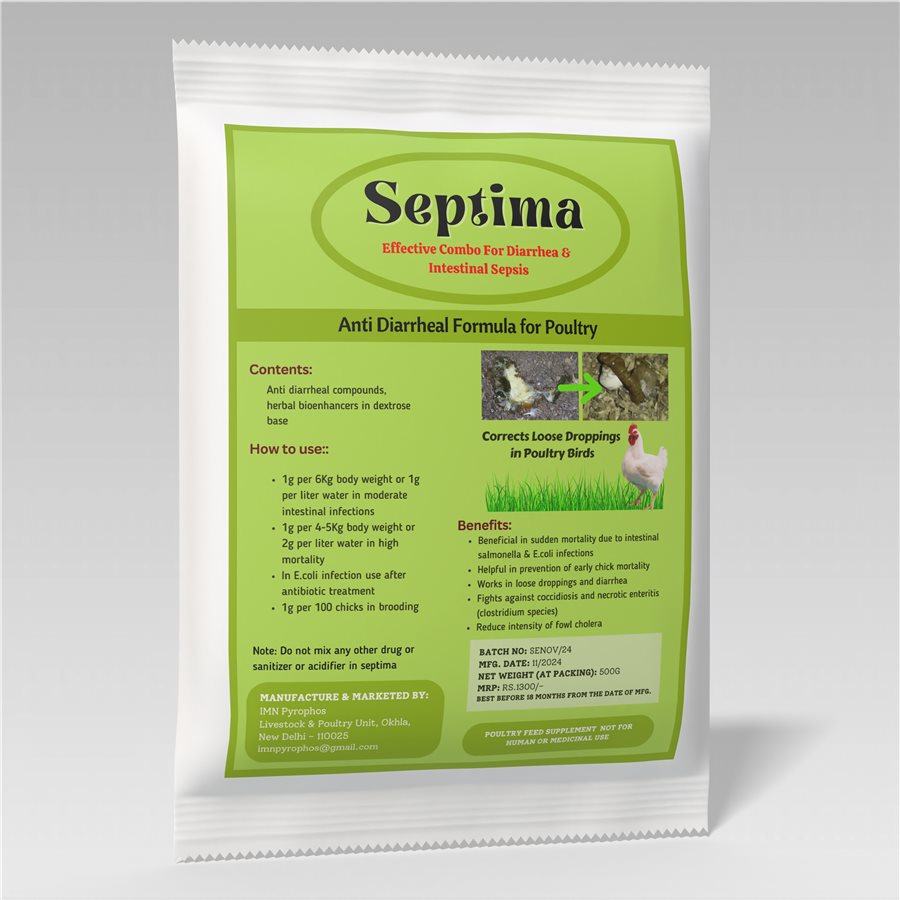
Loose droppings · bestseller
Septima
Anti-diarrhoeal combination with herbal bioenhancers in a dextrose base. Corrects loose droppings and is helpful in sudden mortality from intestinal Salmonella and E. coli, in early chick mortality, and against coccidiosis and necrotic enteritis.
Dose: 1 g per 6 kg body weight or 1 g per litre for moderate cases; 1 g per 4–5 kg body weight or 2 g per litre in high mortality. In E. coli infection, use after the antibiotic course. Do not mix with other drugs, sanitizers or acidifiers.
500 g ₹793MRP ₹1,300
In adult hens, lesions may be minimal, such as small nodular regressing ovarian follicles. But the most prominent lesions are a few to many misshapen and discoloured nodular ovarian follicles, which may be attached to the ovary by a long stalk. The oviduct often has caseous exudate in the lumen. Fibrinous exudate may also be seen on the peritoneum and the capsule of the liver. In males, the testes may have white foci or nodules.
Histologically, in acute cases in young chicks and poults, there is coagulative necrosis of hepatocytes with infiltration of heterophils, mixed with fibrin, fibrinosuppurative inflammation of the yolk sac, pericardium, peritoneum and lungs, and caseous cores in the ceca. Nodules in the ovaries of adults are usually made up of pyogranulomatous inflammation associated with many bacteria.
Diagnosis
A preliminary diagnosis of PD can be made on the basis of flock history, clinical signs, mortality and lesions.
For a confirmed diagnosis, isolation and identification of S. Pullorum is necessary. Organs such as the liver, spleen, yolk sac and ceca are the preferred organs for culture. In mature birds, lesions are present in the reproductive organs and in the oviduct, ovarian follicles and testes, and these can be cultured. These organs and other organs of chicks can be cultured directly on veal infusion and brilliant green agar plates and incubated at 37°C for 48 hours.
Various serological tests can be done, such as the microscopic tube agglutination test, the rapid serum test, the stained antigen whole blood test, and the microagglutination test using tetrazolium-stained antigen. ELISA is also available and can be used to screen large numbers of blood samples. However, the antigens used in these tests will cross-react with serum from birds infected with other Salmonella, especially Salmonella Enteritidis. Serological tests are satisfactory for establishing the presence of infection in a flock and estimating it.
Biochemical tests are used to differentiate S. Pullorum from S. Gallinarum and from other common pathogens. Salmonella Pullorum ferments glucose and mannitol with gas, while S. Gallinarum does so without gas.
Differential Diagnosis
The signs and lesions of the disease produced by Salmonella pullorum (pullorum disease) and Salmonella gallinarum (fowl typhoid) are clearly indistinguishable. These bacteria are also very similar in their antigenic and biochemical properties.
Public Health Importance
Although Salmonella typhimurium and Salmonella enteritidis are the most common agents of foodborne illness in humans, PD also has public health importance. The disease can spread through meat and eggs. Salmonella pullorum sometimes causes acute, self-limiting enteritis in people who eat heavily contaminated food.
Economic Importance
Salmonella infection is one of the most important global poultry diseases in avian species because of its heavy economic impact, worldwide distribution and the difficulty of controlling the disease. S. pullorum is a main cause of considerable economic importance in the poultry industry, especially in developing countries. The disease can not only cause high mortality rates in young chicks, which can reach 100%, but it also persists for a long time in the spleen and reproductive tract, leading to infection of the eggs or offspring. Economic losses include reduced production (eggs and chicks), condemnation of affected carcasses and the cost of medicines. Elimination of carrier parent flocks and growing birds, and their replacement with new birds, also causes significant economic loss. Exportable eggs and poultry meat must be free from Salmonella, which has a big impact on the country’s currency earnings.
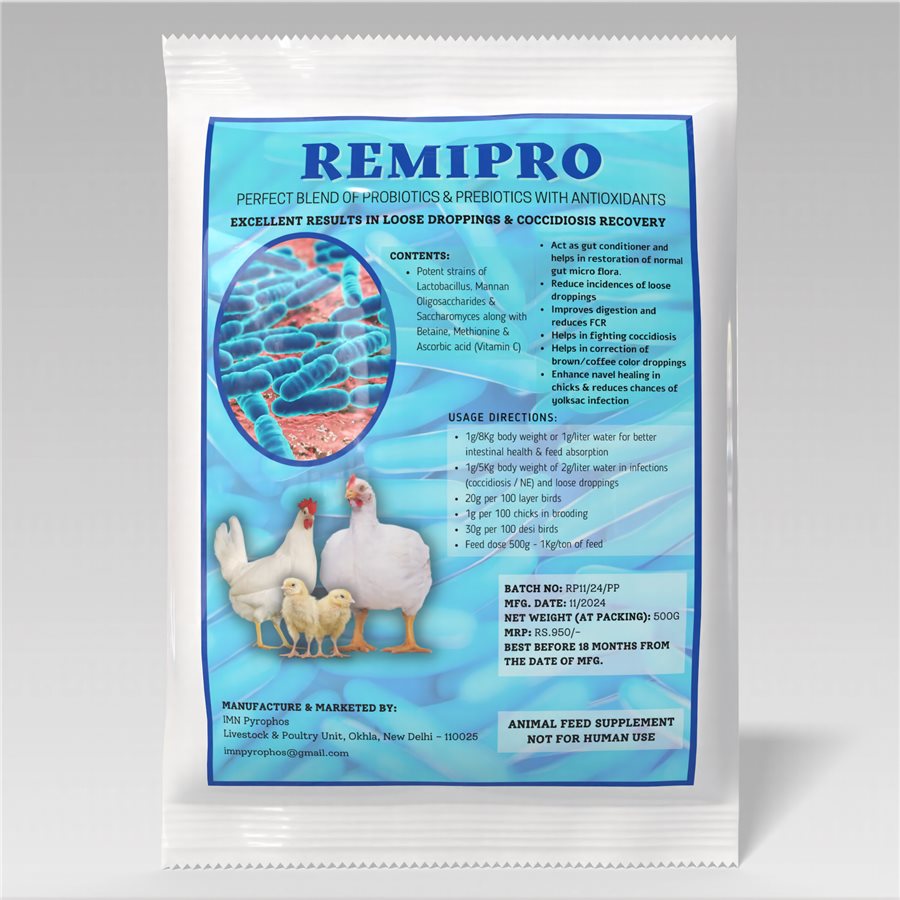
Gut health · bestseller
Remipro
Probiotics, prebiotics (MOS) and Saccharomyces with betaine, methionine and vitamin C. Restores normal gut flora, reduces loose droppings, improves digestion and FCR, helps in coccidiosis recovery and corrects brown/coffee coloured droppings.
Dose: 1 g per 8 kg body weight or 1 g per litre of water for routine gut health; 1 g per 5 kg body weight or 2 g per litre during loose droppings and infections; 1 g per 100 chicks in brooding.
500 g ₹626MRP ₹950
Treatment & Control
Every possible effort should be made to eliminate PD and FT, and treatment should be the last option. Various sulfonamides, followed by nitrofurans and other antibiotics, have been found effective in reducing mortality from PD and FT. Various other antibiotics such as furaltodone, furazolidone, chloramphenicol, biomycin, apramycin, gentamicin and chlorotetracycline have been used to control and treat PD and FT. However, the use of chloramphenicol for treating poultry is illegal in many countries. Resistance to some antibiotics has also been reported.
Although antibiotic treatment helps reduce mortality, treated chickens remain carriers. Therefore, treatment of Salmonella pullorum is neither possible nor desirable. Prevention is a better approach than treatment, because recovered birds tend to become carriers.
Successful control programmes can be achieved by developing routine serological tests and a slaughter policy, along with good hygiene and management.
The basic requirements for prevention are:
- Establishing breeding flocks free from PD and FT.
- Hatching and rearing the offspring in conditions that prevent direct or indirect contact with infected chickens or turkeys.
- Bringing in eggs only from flocks that are free from PD and FT.
- Routine serological testing and elimination of carriers.
- Keeping chicks and poults in an environment that can be cleaned and sanitised.
- Salmonella-free feed ingredients and a sound biosecurity program.
In countries where there are no eradication programmes, various vaccines have been used to protect birds against fowl typhoid, such as the 9R strain, outer membrane proteins, mutant strains of S. Gallinarum, and virulence plasmid cured derivatives of S. Gallinarum. Live, attenuated vaccines are more effective than inactivated vaccines because they stimulate both cellular and humoral immunity. The S. Gallinarum 9R vaccine gives good protection against fowl typhoid. It is also protective against the closely related S. Enteritidis.
Competitive exclusion is also a control measure. Since adult birds are much more resistant to colonization as a result of their complex, mature intestinal flora, giving newly hatched chicks commercially available cultures of adult intestinal flora within 24 hours of hatching provides a high level of protection against Salmonella colonization.
Some chicken breeds are more resistant to systemic salmonellosis. Several loci/genes contribute to genetic resistance.
Problem in your flock? Send photos of the birds and droppings on WhatsApp for a first opinion from Dr. Ibne Ali.
WhatsApp: 98715 84101पुलोरम डिजीज (Pullorum Disease) ट्रीटमेंट के साथ एक सम्पूर्ण व्याख्यान
पुलोरम डिजीज / पुलोरुम डिजीज (Pulorum Disease – PD) और फ़ाउल टाइफाइड (Fowl Typhoid – FT) मुर्गियों और टर्की पक्षियों में होने वाले सेप्टीसेमिक बैक्टीरियल रोग हैं। हालांकि, बटेर (quails), तीतर (pheasants), बत्तख (ducks), मोर (peacocks) और गिनी फाउल (guinea fowls) जैसे अन्य पक्षी भी इसके प्रति संवेदनशील हो सकते हैं। पुलोरम डिजीज को 1899 से पहचाना गया है। यह दुनिया के कई हिस्सों में एक आम बीमारी है जहाँ यह बड़े आर्थिक नुकसान का कारण बनती है। हालांकि, यह रोग संयुक्त राज्य अमेरिका, कनाडा, ऑस्ट्रेलिया और पश्चिमी यूरोप में वाणिज्यिक मुर्गी पालन से खत्म कर दिया गया है।
रोग का कारण और महामारी विज्ञान (Etiology & Epidemiology)
पुलोरम डिजीज Salmonella Pullorum नामक बैक्टीरिया के कारण होती है। यह Salmonella enterica serovar Gallinarum-pullorum नामक एक ही प्रजाति में रखे गए हैं, जो मुर्गी पालन के लिए अत्यधिक अनुकूलित हैं। ये बैक्टीरिया ग्राम-नेगेटिव (Gram-negative), गैर-गतिशील (non-motile), पतली छड़ के आकार के (slender rods) और फैकल्टेटिव एनारोबिक (facultative anaerobic) होते हैं। S. Pullorum और S. Gallinarum के बीच एक विशिष्ट जैव रासायनिक अंतर यह है कि S. Pullorum ऑर्निथिन (ornithine) का तेजी से डीकार्बोक्सिलेशन (decarboxylation) करता है जबकि S. Gallinarum नहीं करता है।
मुर्गियां S. Pullorum के लिए प्राकृतिक होस्ट हैं। हालांकि, टर्की, गिनी फाउल, बटेर, तीतर, गौरैया (sparrows), तोते (parrots), और अन्य पक्षियों में भी PD के प्रकोप का वर्णन किया गया है।
PD कई तरीकों से फैल सकता है, जैसे दूषित फ़ीड, पानी, बीट और अन्य चीजों के माध्यम से क्षैतिज संचरण (horizontal transmission)। लेकिन अंडा संचरण (egg transmission), ओव्यूलेशन के बाद ओवम के दूषित होने से, फैलने का सबसे महत्वपूर्ण तरीका है। संक्रमित वयस्क मुर्गियाँ वाहक (carriers) बन जाती हैं और अंडे के माध्यम से अपने भ्रूणों में (vertically) संक्रमण भेज सकती हैं।
यह रोग दुनिया भर में व्यापक रूप से वितरित है, लेकिन पश्चिमी यूरोप, संयुक्त राज्य अमेरिका, कनाडा, ऑस्ट्रेलिया और जापान जैसे कई विकसित देशों में वाणिज्यिक मुर्गी पालन से इसका उन्मूलन कर दिया गया है। विकासशील देशों में, जैसे लैटिन अमेरिका, मध्य पूर्व, भारतीय उपमहाद्वीप, अफ्रीका और शायद दुनिया के अन्य हिस्सों में, S. pullorum संक्रमण आम हैं और पुलोरम रोग मुर्गी पालन उत्पादकों के लिए प्रमुख खतरों में से एक बना हुआ है।
रोग की गंभीरता, उम्र, पक्षी के तनाव, प्रबंधन, पोषण की स्थिति, जोखिम का मार्ग और खुराक, और झुंड में अन्य बीमारियों के तनाव जैसे कारकों के आधार पर भिन्न होती है।
रोगजनन (Pathogenesis)
Salmonella pullorum की रोगजनकता (pathogenicity) कोशिका के अंदर जीवित रहने और गुणा करने की उनकी आक्रामक क्षमता पर निर्भर करती है, खासकर मैक्रोफेज (macrophages) के अंदर। बैक्टीरिया आमतौर पर मौखिक रूप से ग्रहण किए जाते हैं और पहले प्रोवेंट्रिकुलस (proventriculus) के अम्लीय वातावरण से गुजरते हैं ताकि वे छोटी आंत में जा सकें। आंतों की म्यूकोसा, सेकम (cecum), टॉन्सिल (tonsils) और बरसा ऑफ फैब्रिकियस (bursa of Fabricius) के माध्यम से आक्रमण करने के बाद, जीव मैक्रोफेज द्वारा ले लिए जाते हैं, और अंततः रक्त में प्रवेश करते हैं जिसे बैक्टीरिमिया कहा जाता है। रक्त से, बैक्टीरिया विभिन्न अंगों जैसे यकृत (liver), फेफड़े (lung), प्लीहा (spleen), गुर्दे (kidney), मुर्गियों के प्रजनन पथ के विभिन्न हिस्सों और नर के अंडकोष (testes) और अन्य ऊतकों में फैल जाते हैं, जिससे पैथोलॉजिकल घाव (pathological lesions) होते हैं। यह भी पुष्टि की गई है कि बैक्टीरिया अंडाशय (ovary) और अंडे के रोमों (egg follicles) पर आक्रमण करते हैं, और यह संक्रमण अंडाशय और अंडे के रोमों में बना रहता है और दिए गए अंडों में और फिर अंडों से निकले चूजों में प्रसारित होता है।
नैदानिक लक्षण (Clinical Signs)
पुलोरम रोग आमतौर पर 2 से 3 सप्ताह की उम्र के पहले के चूजों को प्रभावित करता है। चूजों और पाउल्ट्स (poults) में नैदानिक लक्षणों में शामिल हैं:
- एनोरेक्सिया (anorexia – भूख न लगना)
- एक साथ झुंड बनाना (huddling together)
- झुकते हुए पंख (droopy wings)
- निर्जलीकरण (dehydration)
- दस्त (diarrhea)
- पंखों का खुरदुरा होना (ruffled feathers)
- कमजोरी (weakness)
- वेंट के आसपास सफेद रंग का मल जमा होना (white-caked vents / pasting of the vent feathers)
- श्वसन कष्ट (dyspnea)
- अंधापन (blindness)
- हॉक जोड़ों की सूजन (swelling of the hock joints)
- मृत चूजों की अत्यधिक संख्या (excessive numbers of dead in shell chicks) और अंडे सेने के बाद सबसे ज्यादा मृत्यु दर
सबसे अधिक मृत्यु दर आमतौर पर 2 से 3 सप्ताह के पक्षियों में देखी जाती है, जो 100% तक हो सकती है।
बढ़ते और परिपक्व पक्षियों में, नैदानिक लक्षण कुछ मामलों में स्पष्ट नहीं हो सकते हैं। देखे जाने वाले लक्षणों में फ़ीड सेवन में कमी, झुकी हुई उपस्थिति, खुरदुरे पंख, पीली और सिकुड़ी हुई कंघी (combs) शामिल हो सकते हैं। अंडों के उत्पादन, उर्वरता (fertility) और अंडे सेने की क्षमता (hatchability) में कमी भी देखी जा सकती है।
घाव (Lesions)
तीव्र मामलों (acute cases) में, सकल घाव (gross lesions) कम हो सकते हैं। तीव्र मामलों में, यकृत (liver), प्लीहा (spleen) और गुर्दे (kidneys) बढ़े हुए और रक्त जमाव (congested) वाले देखे जा सकते हैं।
- यकृत में परिगलन (necrosis) के सफेद foci (फोकस/केंद्र) हो सकते हैं।
- प्लीहा बड़ी (enlarged) और सफेद धब्बेदार (mottled white) हो सकती है।
- अंडे की जर्दी थैली (yolk sac) की सामग्री जमा हुआ (coagulated) हो सकती है जिसमें पेरीकार्डियम (pericardium), यकृत के कैप्सूल (capsule of the liver) और पेरिटोनियम (peritoneum) पर फाइब्रिनस एक्सयूडेट (fibrinous exudate) हो सकता है।
- एपिकार्डियम (epicardium) और मायोकार्डियम (myocardium) में सफेद या हल्के पीले रंग के नोड्यूल (nodules) मौजूद हो सकते हैं। मायोकार्डियम में परिगलन के बड़े बाँझ घाव (sterile necrotic lesions) पुराने मामलों में देखे जा सकते हैं।
- गिजार्ड (gizzard), अग्न्याशय (pancreas), फेफड़े (lung), मांसपेशियों (muscle) और कभी-कभी सेकम की दीवार में भी इसी तरह के छोटे नोड्यूल मौजूद हो सकते हैं।
- सेकम में लुमेन (lumen) में कैसियस कोर (caseous cores) हो सकते हैं。
अन्य घावों में जोड़ों की सूजन शामिल हो सकती है जिसमें श्लेष (synovium) में गाढ़ा द्रव होता है, आंख के पूर्वकाल कक्ष (anterior chamber) में एक्सयूडेट होता है।
पतली बीट · बेस्टसेलर
Septima
डेक्सट्रोज़ बेस में हर्बल बायोएन्हांसर के साथ दस्त-रोधी कॉम्बिनेशन। पतली बीट ठीक करता है; आँत के Salmonella और E. coli से अचानक मौतों, शुरुआती चूज़ा मृत्यु, कॉक्सीडियोसिस और नेक्रोटिक एंटेराइटिस में मददगार।
मात्रा: सामान्य केस में 1 ग्राम प्रति 6 किलो वज़न या 1 ग्राम प्रति लीटर; ज़्यादा मौतों में 1 ग्राम प्रति 4–5 किलो वज़न या 2 ग्राम प्रति लीटर। E. coli में एंटीबायोटिक कोर्स के बाद दें। दूसरी दवा, सैनिटाइज़र या एसिडिफायर के साथ न मिलाएँ।
500 g ₹793MRP ₹1,300
वयस्क मुर्गियों में, घाव कम से कम हो सकते हैं, जैसे छोटे गांठदार प्रतिगामी अंडाशय के रोम (nodular regressing ovarian follicles)। लेकिन सबसे प्रमुख घाव कुछ से लेकर कई विकृत (misshapen) और रंगहीन गांठदार अंडाशय के रोम होते हैं जो एक लंबे डंठल (stalk) के साथ अंडाशय से जुड़े हो सकते हैं। अंडवाहिनी (oviduct) में अक्सर लुमेन में कैसियस एक्सयूडेट होता है। पेरिटोनियम और यकृत के कैप्सूल पर फाइब्रिनस एक्सयूडेट भी देखा जा सकता है。 नर में, अंडकोष में सफेद foci या nodules हो सकते हैं。
हिस्टोलॉजिकल रूप से (Histologically), युवा चूजों और पाउल्ट्स में तीव्र मामलों में, हेटरोफिल्स (heterophils) के घुसपैठ के साथ हेपेटोसाइट्स (hepatocytes) का कोगुलेटिव परिगलन (coagulative necrosis) होता है जो फाइब्रिन, जर्दी थैली, पेरीकार्डियम, पेरिटोनियम, फेफड़ों की फाइब्रिनोसप्पुरेटिव सूजन (fibrinosuppurative inflammation) और सेका में कैसियस कोर के साथ मिला होता है। वयस्कों के अंडाशय में नोड्यूल आमतौर पर पायोग्रैनुलोमेटस सूजन (pyogranulomatous inflammation) से बने होते हैं जो कई बैक्टीरिया से जुड़े होते हैं।
निदान (Diagnosis)
PD का प्रारंभिक निदान झुंड के इतिहास, नैदानिक लक्षणों, मृत्यु दर और घावों के आधार पर किया जा सकता है।
पुष्टि निदान के लिए S. Pullorum का आइसोलेशन (isolation) और पहचान (identification) आवश्यक है। यकृत, प्लीहा, जर्दी थैली और सेका जैसे अंग कल्चर के लिए पसंदीदा अंग हैं। परिपक्व पक्षियों में, प्रजनन अंगों और अंडवाहिनी, अंडाशय के रोमों और अंडकोष में घाव मौजूद होते हैं और उनका कल्चर किया जा सकता है。 ये अंग और चूजों के अन्य अंग सीधे वील इंफ्यूजन (veal infusion) और ब्रिलियंट ग्रीन अगर (brilliant green agar) प्लेटों पर कल्चर किए जा सकते हैं और 37°C पर 48 घंटे तक ऊष्मायन (incubated) किए जा सकते हैं।
विभिन्न सेरोलॉजिकल टेस्ट (serological tests) जैसे माइक्रोस्कोपिक ट्यूब एग्लूटिनेशन टेस्ट (microscopic tube agglutination test), रैपिड सीरम टेस्ट (rapid serum test), स्टैन्ड एंटीजन होल ब्लड टेस्ट (stained antigen whole blood test) और टेट्राजोलियम स्टैन्ड एंटीजन का उपयोग करके माइक्रोएग्लूटिनेशन टेस्ट (microagglutination test) किए जा सकते हैं। एलिसा (ELISA) भी उपलब्ध है और इसका उपयोग बड़ी संख्या में रक्त के नमूनों की स्क्रीनिंग के लिए किया जा सकता है。 हालांकि, इन परीक्षणों में उपयोग किए जाने वाले एंटीजन अन्य साल्मोनेला, विशेष रूप से Salmonella Enteritidis, से संक्रमित पक्षियों के सीरम के साथ क्रॉस-रिएक्ट करेंगे। सेरोलॉजिकल परीक्षण झुंड में संक्रमण की उपस्थिति स्थापित करने और उसका अनुमान लगाने के लिए संतोषजनक हैं।
जैव रासायनिक परीक्षण (biochemical tests) का उपयोग S. Pullorum को S. Gallinarum से और अन्य सामान्य रोगजनकों से अलग करने के लिए किया जाता है। Salmonella Pullorum ग्लूकोज और मैनिटोल को गैस के साथ किण्वित करता है, जबकि S. Gallinarum बिना गैस के करता है।
विभेदक निदान (Differential Diagnosis)
Salmonella pullorum (पुलोरम रोग) और Salmonella gallinarum (फाउल टाइफाइड) द्वारा उत्पादित रोग के लक्षण और घाव स्पष्ट रूप से अविभाज्य (indistinguishable) हैं। इन बैक्टीरिया में एंटीजेनिक और जैव रासायनिक गुणों के मामले में भी बहुत समानता है।
जन स्वास्थ्य महत्व (Public Health Importance)
यद्यपि Salmonella typhimurium और Salmonella enteritidis मनुष्यों में भोजन जनित बीमारियों के सबसे आम एजेंट हैं, PD का भी जन स्वास्थ्य महत्व है। यह रोग मांस और अंडे के माध्यम से फैल सकता है। Salmonella pullorum कभी-कभी उन लोगों में तीव्र, आत्म-सीमित आंत्रशोथ (acute, self-limiting enteritis) का कारण बनता है जो अत्यधिक दूषित भोजन खाते हैं।
आर्थिक महत्व (Economic Importance)
साल्मोनेला संक्रमण एवियन प्रजातियों में सबसे महत्वपूर्ण वैश्विक मुर्गी रोगों में से एक है क्योंकि इसका भारी आर्थिक प्रभाव, दुनिया भर में वितरण और रोग के नियंत्रण में कठिनाई होती है। S. pullorum मुर्गी उद्योग में, विशेष रूप से विकासशील देशों में, काफी आर्थिक महत्व का मुख्य कारण है। यह रोग न केवल युवा चूजों में उच्च मृत्यु दर (high mortality rates) का कारण बन सकता है, जो 100% तक पहुंच सकती है, बल्कि यह प्लीहा और प्रजनन पथ में लंबे समय तक बना रहता है, जिससे अंडे या संतान का संक्रमण होता है। आर्थिक नुकसान में उत्पादन में कमी (अंडे और चूजे), प्रभावित शवों की निंदा (condemnation of affected carcass) और दवा की लागत शामिल है। वाहक माता-पिता झुंडों और बढ़ने वाले मुर्गियों का उन्मूलन, और नए मुर्गियों द्वारा उनका प्रतिस्थापन भी महत्वपूर्ण आर्थिक नुकसान का कारण बनता है। निर्यात योग्य अंडे और मुर्गी का मांस साल्मोनेला से मुक्त होना चाहिए, जिससे देश की मुद्रा आय पर बड़ा प्रभाव पड़ता है।
आँत की सेहत · बेस्टसेलर
Remipro
प्रोबायोटिक, प्रीबायोटिक (MOS) और Saccharomyces, साथ में बीटेन, मेथियोनीन और विटामिन C। आँत के अच्छे बैक्टीरिया लौटाता है, पतली बीट घटाता है, पाचन और FCR सुधारता है, कॉक्सीडियोसिस से उबरने में मदद करता है और भूरी/कॉफी रंग की बीट ठीक करता है।
मात्रा: रोज़ की आँत सेहत के लिए 1 ग्राम प्रति 8 किलो वज़न या 1 ग्राम प्रति लीटर पानी; पतली बीट और इन्फेक्शन में 1 ग्राम प्रति 5 किलो वज़न या 2 ग्राम प्रति लीटर; ब्रूडिंग में 1 ग्राम प्रति 100 चूज़े।
500 g ₹626MRP ₹950
उपचार और नियंत्रण (Treatment & Control)
PD और FT को खत्म करने के लिए हर संभव प्रयास किया जाना चाहिए और उपचार अंतिम विकल्प होना चाहिए। विभिन्न सल्फोनामाइड्स (sulfonamides) के बाद नाइट्रोफुरान (nitrofurans) और अन्य एंटीबायोटिक्स PD और FT से मृत्यु दर को कम करने में प्रभावी पाए गए हैं। फुरल्टोडोन (furaltodone), फुराज़ोलिडोन (furazolidone), क्लोरैम्फेनिकोल (chloramphenicol), बायोमाइसिन (biomycin), एप्रामाइसिन (apramycin), जेंटामाइसिन (gentamicin) और क्लोरोटेट्रासाइक्लिन (chlorotetracycline) जैसे विभिन्न अन्य एंटीबायोटिक्स का उपयोग PD और FT को नियंत्रित करने और इलाज के लिए किया गया है। हालांकि, कई देशों में मुर्गी पालन के इलाज के लिए क्लोरैम्फेनिकोल का उपयोग अवैध है। कुछ एंटीबायोटिक दवाओं के प्रति प्रतिरोध (Resistance) भी बताया गया है।
हालांकि एंटीबायोटिक उपचार मृत्यु दर को कम करने में मदद करता है, लेकिन उपचारित मुर्गियाँ वाहक बनी रहती हैं (treated chicken remain carriers)। इसलिए, Salmonella pullorum का उपचार न तो संभव है और न ही वांछनीय है। निवारण उपचार से बेहतर तरीका है, क्योंकि ठीक हुए पक्षियों में वाहक बनने की प्रवृत्ति होती है।
सफल नियंत्रण कार्यक्रम अच्छे स्वच्छता और प्रबंधन (good hygiene and management) के साथ नियमित सेरोलॉजिकल परीक्षण (routine serological tests) और वध नीति (slaughter policy) विकसित करके प्राप्त किए जा सकते हैं।
निवारण के लिए मूलभूत आवश्यकताएं हैं:
- PD और FT से मुक्त प्रजनन झुंड स्थापित करना।
- संक्रमित मुर्गियों या टर्की के साथ प्रत्यक्ष या अप्रत्यक्ष संपर्क को रोकने वाली स्थितियों में संतानों को अंडे सेने और पालना।
- केवल उन झुंडों से अंडे लाना जो PD और FT से मुक्त हों।
- नियमित सेरोलॉजिकल परीक्षण और वाहकों का उन्मूलन।
- चूजों और पाउल्ट्स को ऐसे वातावरण में रखना जिसे साफ और सैनिटाइज किया जा सके।
- साल्मोनेला से मुक्त फ़ीड सामग्री और एक अच्छा बायोसेक्योरिटी कार्यक्रम (sound biosecurity program)।
जहां उन्मूलन कार्यक्रम नहीं हैं, उन देशों में फाउल टाइफाइड से पक्षियों की रक्षा के लिए विभिन्न टीके (vaccines) जैसे 9R स्ट्रेन (9R strain), बाहरी झिल्ली प्रोटीन (outer membrane proteins), S. Gallinarum के उत्परिवर्ती स्ट्रेन (mutant strains), और S. Gallinarum के विरुलेंस प्लास्मिड क्यूरेड डेरिवेटिव्स (virulence plasmid cured derivatives) का उपयोग किया गया है। जीवित, क्षीण टीके (Live, attenuated vaccines) निष्क्रिय टीकों (inactivated vaccines) की तुलना में अधिक प्रभावी होते हैं क्योंकि वे सेलुलर और ह्यूमरल प्रतिरक्षा दोनों को उत्तेजित करते हैं। S. Gallinarum 9R वैक्सीन फाउल टाइफाइड के खिलाफ अच्छी सुरक्षा प्रदान करती है। यह निकट संबंधी S. Enteritidis के खिलाफ भी सुरक्षात्मक है।
प्रतिस्पर्धी बहिष्करण (Competitive exclusion) भी एक नियंत्रण उपाय है। चूंकि वयस्क पक्षी अपने जटिल, परिपक्व आंतों के वनस्पतियों के परिणामस्वरूप उपनिवेशीकरण (colonization) के प्रति बहुत अधिक प्रतिरोधी होते हैं, नवजात चूजों को वयस्क आंतों के वनस्पतियों के व्यावसायिक रूप से उपलब्ध कल्चर, अंडे सेने के 24 घंटे के भीतर, साल्मोनेला उपनिवेशीकरण के खिलाफ उच्च स्तर की सुरक्षा प्रदान करते हैं।
कुछ मुर्गियों की नस्लें प्रणालीगत साल्मोनेलोसिस के प्रति अधिक प्रतिरोधी होती हैं। आनुवंशिक प्रतिरोध (Genetic resistance) में कई लोकी/जीन (loci/genes) योगदान करते हैं。
फ़ार्म में कोई दिक्कत? पक्षियों और बीट की फ़ोटो WhatsApp पर भेजिए, डॉ. इब्ने अली से पहली राय लीजिए।
WhatsApp: 98715 84101Pullorum Disease ki treatment ke saath poori jaankari
Pullorum Disease (PD) aur Fowl Typhoid (FT) murgiyon aur turkey me hone wali septicemic bacterial bimariyan hain. Lekin bater (quails), teetar (pheasants), battakh (ducks), mor (peacocks) aur guinea fowl jaise doosre pakshi bhi isse beemar ho sakte hain. Pullorum disease ko 1899 se pehchana gaya hai. Ye duniya ke kai hisson me ek aam bimari hai jahan ye bada aarthik nuksan karti hai. Lekin ye bimari United States, Canada, Australia aur Western Europe me commercial poultry se khatam kar di gayi hai.
Bimari ka Kaaran aur Phailaav (Etiology & Epidemiology)
Pullorum disease Salmonella Pullorum naam ke bacteria se hoti hai. Inhe Salmonella enterica serovar Gallinarum-pullorum naam ki ek hi species me rakha gaya hai, jo poultry ke liye bahut zyada adapted hai. Ye bacteria Gram-negative, non-motile (khud se na chalne wale), patli chhad ke shape ke (slender rods) aur facultative anaerobic hote hain. S. Pullorum aur S. Gallinarum me ek khaas biochemical fark ye hai ki S. Pullorum ornithine ka tezi se decarboxylation karta hai jabki S. Gallinarum nahi karta.
Murgiyan S. Pullorum ki natural host hain. Lekin turkey, guinea fowl, bater, teetar, gauraiya (sparrows), tote (parrots) aur doosre pakshiyon me bhi PD ke outbreak dekhe gaye hain.
PD kai tarikon se phail sakta hai, jaise contaminated feed, paani, beet aur doosri cheezon ke through horizontal transmission. Lekin egg transmission (ande ke through phailna), yaani ovulation ke baad ovum ka contaminate hona, phailne ka sabse important tarika hai. Infected badi murgiyan carrier ban jaati hain aur ande ke through apne embryo me (vertically) infection bhej sakti hain.
Ye bimari poori duniya me phaili hui hai, lekin Western Europe, United States, Canada, Australia aur Japan jaise kai developed deshon me commercial poultry se ise khatam kar diya gaya hai. Developing deshon me, jaise Latin America, Middle East, Indian subcontinent, Africa aur shayad duniya ke doosre hisson me, S. pullorum infection aam hai aur pullorum disease poultry farmers ke liye sabse bade khatron me se ek bani hui hai.
Bimari kitni gambhir hogi, ye umar, bird ke stress, management, nutrition ki halat, infection ka raasta aur dose, aur flock me doosri bimariyon ke stress jaise factors par depend karta hai.
Bimari Kaise Hoti Hai (Pathogenesis)
Salmonella pullorum ki bimari karne ki taakat (pathogenicity) cell ke andar zinda rehne aur badhne ki unki capacity par depend karti hai, khaas kar macrophages ke andar. Bacteria aam taur par muh ke raaste andar jaate hain aur pehle proventriculus ke acidic mahaul se guzarte hain taaki chhoti aant tak pahunch sakein. Aant ki mucosa, cecum, tonsils aur bursa of Fabricius ke through andar ghusne ke baad, macrophages inhe le lete hain, aur aakhir me ye khoon me pahunch jaate hain, jise bacteremia kehte hain. Khoon se bacteria alag-alag organs jaise liver, lung (phephde), spleen (tilli), kidney, murgi ke reproductive tract ke alag hisson, murge ke testes (andkosh) aur doosre tissues me phail jaate hain, jisse pathological lesions bante hain. Ye bhi confirm hua hai ki bacteria ovary aur egg follicles par attack karte hain, aur ye infection ovary aur egg follicles me bana rehta hai, aur diye gaye ando me aur phir un ando se nikle chuzon me pahunch jaata hai.
Lakshan (Clinical Signs)
Pullorum disease aam taur par 2 se 3 hafte ki umar se pehle ke chuzon ko hoti hai. Chuzon aur poults (turkey ke bachche) me ye lakshan dikhte hain:
- Anorexia (bhookh na lagna)
- Ek saath jhund banakar baithna (huddling together)
- Pankh latakna (droopy wings)
- Paani ki kami (dehydration)
- Dast (diarrhea)
- Pankh bikhre hue (ruffled feathers)
- Kamzori (weakness)
- Vent ke aas-paas safed beet chipakna (white-caked vents / pasting of the vent feathers)
- Saans lene me takleef (dyspnea)
- Andhapan (blindness)
- Hock joint me sujan (swelling of the hock joints)
- Ande ke andar mare chuzon ki bahut zyada ginti (excessive numbers of dead in shell chicks) aur hatching ke baad sabse zyada mortality
Sabse zyada mortality aam taur par 2 se 3 hafte ke birds me dikhti hai, jo 100% tak ho sakti hai.
Badhte aur bade birds me kuch cases me lakshan saaf nahi dikhte. Jo lakshan dikh sakte hain unme feed kam khana, jhuka hua dikhna, bikhre pankh, peeli aur sikudi hui kalgi (combs) shaamil hain. Ande ka production, fertility aur hatchability bhi kam ho sakti hai.
Lesions (Postmortem me Dikhne wale Badlav)
Acute cases me gross lesions kam dikh sakte hain. Acute cases me liver, spleen aur kidney bade hue aur khoon se bhare (congested) dikh sakte hain.
- Liver par necrosis ke safed foci (dhabbe) ho sakte hain.
- Spleen badi (enlarged) aur safed dhabbedaar (mottled white) ho sakti hai.
- Yolk sac ka andar ka maal jama hua (coagulated) ho sakta hai, aur pericardium, liver ke capsule aur peritoneum par fibrinous exudate ho sakta hai.
- Epicardium aur myocardium me safed ya halke peele nodules (gaanthein) ho sakte hain. Purane (chronic) cases me myocardium me necrosis ke bade sterile lesions dikh sakte hain.
- Gizzard, pancreas, lung, muscle aur kabhi-kabhi cecum ki deewar me bhi aise hi chhote nodules ho sakte hain.
- Cecum ke lumen me caseous cores (cheese jaisa jama maal) ho sakte hain.
Doosre lesions me joints ki sujan ho sakti hai jisme synovium me gaadha fluid hota hai, aur aankh ke anterior chamber me exudate hota hai.
Patli beet · bestseller
Septima
Dextrose base me herbal bioenhancer ke saath dast-rodhi combination. Patli beet theek karta hai; aant ke Salmonella aur E. coli se achanak maut, shuruaati chooza mrityu, coccidiosis aur necrotic enteritis me madadgaar.
Matra: Saamanya case me 1 g prati 6 kg wazan ya 1 g prati litre; zyada maut me 1 g prati 4–5 kg wazan ya 2 g prati litre. E. coli me antibiotic course ke baad dijiye. Doosri dawa, sanitizer ya acidifier ke saath mat milaiye.
500 g ₹793MRP ₹1,300
Badi murgiyon me lesions bahut kam ho sakte hain, jaise chhote gaanthdar sikudte ovarian follicles (nodular regressing ovarian follicles). Lekin sabse khaas lesion kuch se lekar kai bigde shape ke (misshapen) aur rang ude gaanthdar ovarian follicles hote hain, jo ek lambe danthal (stalk) se ovary se jude ho sakte hain. Oviduct ke lumen me aksar caseous exudate hota hai. Peritoneum aur liver ke capsule par fibrinous exudate bhi dikh sakta hai. Murge me testes par safed foci ya nodules ho sakte hain.
Histology me, chhote chuzon aur poults ke acute cases me hepatocytes ka coagulative necrosis hota hai, heterophils ki ghuspaith ke saath, jo fibrin, yolk sac, pericardium, peritoneum aur lungs ki fibrinosuppurative sujan aur ceca me caseous cores ke saath mila hota hai. Badi murgiyon ki ovary me nodules aam taur par pyogranulomatous sujan se bane hote hain, jisme bahut saare bacteria hote hain.
Diagnosis (Bimari ki Pehchan)
PD ka shuruaati diagnosis flock ki history, lakshan, mortality aur lesions ke base par kiya ja sakta hai.
Pakka diagnosis ke liye S. Pullorum ka isolation aur identification zaroori hai. Liver, spleen, yolk sac aur ceca jaise organs culture ke liye sabse achhe hain. Bade birds me reproductive organs aur oviduct, ovarian follicles aur testes me lesions hote hain aur unka culture kiya ja sakta hai. Ye organs aur chuzon ke doosre organs seedhe veal infusion aur brilliant green agar plates par culture karke 37°C par 48 ghante incubate kiye ja sakte hain.
Alag-alag serological tests kiye ja sakte hain, jaise microscopic tube agglutination test, rapid serum test, stained antigen whole blood test aur tetrazolium stained antigen se microagglutination test. ELISA bhi available hai aur ise bahut saare blood samples ki screening ke liye use kiya ja sakta hai. Lekin in tests me use hone wale antigen doosre Salmonella, khaas kar Salmonella Enteritidis, se infected birds ke serum ke saath cross-react karenge. Flock me infection hai ya nahi aur kitna hai, ye pata karne ke liye serological tests theek hain.
Biochemical tests se S. Pullorum ko S. Gallinarum aur doosre common pathogens se alag pehchana jaata hai. Salmonella Pullorum glucose aur mannitol ko gas ke saath ferment karta hai, jabki S. Gallinarum bina gas ke karta hai.
Differential Diagnosis (Milti-julti Bimariyon se Fark)
Salmonella pullorum (pullorum disease) aur Salmonella gallinarum (fowl typhoid) se hone wali bimari ke lakshan aur lesions saaf taur par ek jaise hote hain, inhe alag nahi pehchana ja sakta. In bacteria ke antigenic aur biochemical gun bhi kaafi milte-julte hain.
Insaano ki Sehat ke liye Mahatva (Public Health Importance)
Waise to Salmonella typhimurium aur Salmonella enteritidis insaano me khane se hone wali bimariyon ke sabse aam kaaran hain, lekin PD ka bhi public health me mahatva hai. Ye bimari meat aur ande ke through phail sakti hai. Salmonella pullorum kabhi-kabhi un logon me acute, apne aap theek hone wala enteritis (pet/aant ki sujan) kar deta hai jo bahut zyada contaminated khana khaate hain.
Aarthik Mahatva (Economic Importance)
Salmonella infection pakshiyon me duniya ki sabse important poultry bimariyon me se ek hai, kyunki iska bahut bada aarthik asar hai, ye poori duniya me phaili hai aur ise control karna mushkil hai. S. pullorum poultry industry me, khaas kar developing deshon me, bade aarthik nuksan ka main kaaran hai. Ye bimari na sirf chhote chuzon me high mortality kar sakti hai, jo 100% tak pahunch sakti hai, balki spleen aur reproductive tract me lambe time tak bani rehti hai, jisse ande ya bachchon me infection jaata hai. Aarthik nuksan me production kam hona (ande aur chuze), infected carcass ka reject hona (condemnation) aur dawai ka kharcha shaamil hai. Carrier parent flocks aur badhte birds ko hatana, aur unki jagah naye birds laana bhi bada aarthik nuksan karta hai. Export hone wale ande aur chicken meat Salmonella free hone chahiye, jiska desh ki currency kamai par bada asar padta hai.
Aant ki sehat · bestseller
Remipro
Probiotic, prebiotic (MOS) aur Saccharomyces, saath me betaine, methionine aur vitamin C. Aant ke achhe bacteria lautata hai, patli beet ghatata hai, pachan aur FCR sudharta hai, coccidiosis se ubharne me madad karta hai aur bhoori/coffee rang ki beet theek karta hai.
Matra: Roz ki aant sehat ke liye 1 g prati 8 kg wazan ya 1 g prati litre paani; patli beet aur infection me 1 g prati 5 kg wazan ya 2 g prati litre; brooding me 1 g prati 100 chooze.
500 g ₹626MRP ₹950
Treatment aur Control (Treatment & Control)
PD aur FT ko khatam karne ki har possible koshish karni chahiye aur treatment aakhri option hona chahiye. Alag-alag sulfonamides, uske baad nitrofurans aur doosre antibiotics PD aur FT se mortality kam karne me asardaar paye gaye hain. Furaltodone, furazolidone, chloramphenicol, biomycin, apramycin, gentamicin aur chlorotetracycline jaise kai doosre antibiotics PD aur FT ko control aur treat karne ke liye use kiye gaye hain. Lekin kai deshon me poultry ke treatment ke liye chloramphenicol ka use illegal hai. Kuch antibiotics ke against resistance bhi report hua hai.
Antibiotic treatment se mortality to kam hoti hai, lekin treat ki gayi murgiyan carrier bani rehti hain (treated chicken remain carriers). Isliye Salmonella pullorum ka treatment na to possible hai aur na hi sahi hai. Bachaav treatment se better tarika hai, kyunki theek hue birds carrier ban jaate hain.
Achhi safai aur management (good hygiene and management) ke saath regular serological tests (routine serological tests) aur slaughter policy banakar control program successful banaye ja sakte hain.
Bachaav ke liye basic zarooratein ye hain:
- PD aur FT se free breeding flock banana.
- Bachchon ki hatching aur paalan aisi jagah karna jahan infected murgiyon ya turkey se seedha ya ghuma-phira kar contact na ho.
- Sirf un flocks se ande laana jo PD aur FT se free hon.
- Regular serological test aur carriers ko hatana.
- Chuzon aur poults ko aisi jagah rakhna jise saaf aur sanitize kiya ja sake.
- Salmonella free feed ingredients aur ek achha biosecurity program (sound biosecurity program).
Jin deshon me eradication program nahi hain, wahan fowl typhoid se birds ko bachane ke liye alag-alag vaccines use kiye gaye hain, jaise 9R strain, outer membrane proteins, S. Gallinarum ke mutant strains, aur S. Gallinarum ke virulence plasmid cured derivatives. Live, attenuated vaccines inactivated vaccines se zyada asardaar hote hain kyunki ye cellular aur humoral dono immunity ko badhate hain. S. Gallinarum 9R vaccine fowl typhoid ke against achhi suraksha deti hai. Ye isse milte-julte S. Enteritidis ke against bhi bachaav karti hai.
Competitive exclusion bhi ek control ka tarika hai. Kyunki bade birds apni complex, mature aant ki flora ki wajah se colonization ke against bahut zyada resistant hote hain, isliye naye chuzon ko hatching ke 24 ghante ke andar badi murgiyon ki aant ki flora ka market me milne wala culture dene se Salmonella colonization ke against achhi suraksha milti hai.
Murgiyon ki kuch nasle systemic salmonellosis ke against zyada resistant hoti hain. Genetic resistance me kai loci/genes ka yogdan hota hai.
Farm me koi dikkat? Pakshiyon aur beet ki photo WhatsApp par bhejiye, Dr. Ibne Ali se pehli raay lijiye.
WhatsApp: 98715 84101