Most winter broiler batches look fine until day 15. The chicks are out of the brooder, eating well, and the farmer relaxes. Then, in the third and fourth week, the shed starts to smell, the litter near the drinkers turns into a wet cake, birds start sneezing at night, and in the last week the heaviest birds die with a swollen, watery belly. None of this is bad luck. It is what happens when a closed winter shed holds heat but not fresh air. This guide covers the second half of the batch, from day 15 to sale: how much air to give at each age, how to read ammonia with your own nose and eyes, how to work the curtains through the day, and what targets to aim for every week. For the first two weeks, read our winter broiler brooding guide first.
Why winter batches lose money after day 15
In the first two weeks, chicks are small, they breathe little and they produce little moisture. By day 21 the same flock eats several times more feed, drinks several times more water and puts out a lot of moisture through breath and droppings. If the curtains are still closed the way they were in week one, that moisture has nowhere to go. Five problems follow, and they feed each other:
| Problem | What you see | How it costs you |
|---|---|---|
| Ammonia build-up | Sharp smell, eye burning, birds with watery eyes | Damages the airways, birds eat less, opens the door to CRD and E. coli |
| Wet, caked litter | Sticky cake under drinkers, dirty feathers, breast and foot sores | More ammonia, more coccidiosis, downgraded birds at sale |
| CRD / E. coli (respiratory complex) | Rattling sound at night, sneezing, swollen face, rising deaths in week 4–5 | Poor weight, poor FCR, medicine cost, culls |
| Ascites and sudden death (SDS) | Blue comb, swollen water belly, heavy birds found dead on their back | You lose the biggest birds, right before sale |
| Low water intake | Ice-cold water in the morning, slow drinking, dry feed left in feeders | Less feed eaten, slower growth, uneven flock |
The good news: almost all of these come from the same root cause, poor air and moisture control, so one good routine fixes most of them together.
Minimum ventilation by age
Think of it this way: heat is for the bird’s body, fresh air is for its lungs. You can give both at the same time. Minimum ventilation means the smallest amount of fresh air that still removes moisture and ammonia, without chilling the birds. It is not “opening the shed”. It is a small, steady exchange of air, every hour, day and night.
Temperature and air guide, day 15 to sale
| Age (days) | Temperature at bird height | Fresh air need | What to watch |
|---|---|---|---|
| 15–21 | About 26–24 °C | Small but continuous; top curtain gap even at night | Moisture rising fast; first ammonia smell in early morning |
| 22–28 | About 24–22 °C | Clearly more than week 3; open more in the warm afternoon | Caking near drinkers, first sneezing |
| 29–35 | About 22–20 °C | High; birds now make a lot of heat themselves | Ammonia at night, ascites in fast birds |
| 36–sale | About 20–18 °C | Highest of the batch; heavy birds can overheat even in winter | Panting in the afternoon, sudden deaths, wet litter |
These are general figures. Follow your chick company’s breed chart and your vet’s advice for your shed, because shed design and local weather differ a lot. Always measure at bird height, not at your head height, and keep at least two thermometers in different parts of the shed.
Sheds with fans (EC or tunnel)
If you have exhaust fans, use a timer for minimum ventilation instead of keeping all fans off at night. A common starting point is to run one fan for a short time in every few minutes (for example, under a minute in every 5 minutes) and increase the run time as the birds grow and whenever you smell ammonia. Your air inlet must be small and high, so cold air mixes near the roof before it reaches the birds. For more detail, see poultry ventilation management.
How to judge the air without any machine
- The bend-down test: when you enter in the morning, bend down to bird height for 30 seconds. If you can clearly smell ammonia, it is already above what is comfortable for birds. Aim for no noticeable smell.
- Eye burning: if your eyes water or sting, ammonia is high and birds are already being hurt. Increase fresh air the same day.
- Water drops on the roof or curtains in the morning mean moist air is not leaving the shed.
- Bird behaviour: birds huddled in groups are cold; birds spread with open beaks and wings away from the body are hot; birds spread evenly, eating, drinking and resting, are comfortable.
- Stuffy, heavy air and headache in workers are a warning, especially where coal or wood heaters are used.
Do the check at the worst time: early morning, before you open anything. That is when ammonia is highest.
Curtain management by time of day
In open-sided sheds, curtains are your ventilation system. The golden rule: open from the top, never from the bottom. Air coming in from the bottom hits the birds directly and chills them; air from the top mixes with warm air first.
| Time | Curtain position | Why |
|---|---|---|
| Early morning (before sunrise) | Mostly closed, but a small top gap on the side away from the wind | Coldest hours; the gap still lets ammonia and moisture out |
| Mid-morning (after the sun is up) | Open the top gradually, a few inches at a time | Flush out the night’s ammonia as the outside warms up |
| Afternoon (warmest hours) | Open the most of the day; in week 5–6 open widely if birds pant | Best chance to dry the litter and change the air |
| Late afternoon (before sunset) | Start closing in steps, not all at once | Avoid a sudden temperature drop as the sun goes down |
| Night | Closed, with a small top gap on the downwind side | Never seal the shed completely, especially from week 3 onward |
- On windy or foggy days, open the side away from the wind and keep the windward side closed.
- A second inner curtain or a false ceiling of sheet or tarpaulin above the birds keeps warmth in without stopping air exchange near the roof.
- Check curtains for holes and loose edges. A draught at bird level near a torn curtain chills birds more than a planned top opening.
Heater management after brooding
After day 15, the flock starts to produce its own heat. Heaters move from “always on” to “night and cold spells only”.
- Reduce step by step. In week 3, heaters usually run mainly at night and in the early morning. By week 4 most flocks only need heat on very cold nights. Let the birds and the thermometer guide you, not the calendar alone.
- Coal stoves, wood heaters and angithis must have a working chimney or pipe that takes smoke outside. Smoke and carbon monoxide inside a closed shed harm birds and workers. Never keep an open fire in a sealed shed.
- Gas brooders also use oxygen and release moisture. More heaters means you need a little more fresh air, not less.
- Keep heaters away from curtains, litter piles and feed bags. Every winter some sheds burn down.
- Do not turn all heat off on the first warm day. Nights can drop sharply; a cold night in week 4 can trigger a respiratory problem that takes the rest of the batch to recover from.
Litter management, day 15 to sale
Litter is where most winter problems start. Dry, loose litter soaks up droppings and releases little ammonia. Wet, caked litter is a factory for ammonia, coccidia and bacteria. For a full guide to fixing it, read wet litter and loose droppings in broilers in winter.
- Squeeze test daily: take a handful of litter from three places, including near drinkers, and squeeze. Good litter falls apart when you open your hand. If it stays as a ball, it is too wet.
- Rake or turn the litter regularly, during the warmest part of the day when curtains are open, so moisture can escape. Start near drinkers and feeders, where caking is worst.
- Remove caked patches under and around drinkers, take them out of the shed, and fill the spot with fresh dry litter.
- Add a thin layer of fresh, dry litter (rice husk or wood shavings) on wet areas rather than piling a thick layer on top of wet cake. The wet layer underneath will keep giving off ammonia.
- Stop the water at the source: set drinkers at bird back height, fix leaking nipples and pipes, and do not overfill bell drinkers. Most wet litter in winter is caused by drinkers, not by disease.
- Do not spread lime heavily on wet litter while birds are in the shed. It makes dust and can raise ammonia release. Ask your vet before using any litter treatment.
Water in winter: temperature, intake and cleanliness
Water is the most ignored input in winter. A bird that drinks less eats less, and a bird that eats less does not grow.
Water temperature
Water lying in tanks and pipes overnight can be ice cold by morning, and birds drink much less of it. Take the chill off: keep tanks shaded from cold wind, insulate exposed pipes, and flush the lines in the morning so birds get fresher, less cold water. Water at roughly room temperature is fine. Do not give hot water.
How much should they drink?
A healthy broiler flock usually drinks roughly 1.7 to 2 times as much water as feed by weight. In cold weather the ratio often moves to the lower end. A rough daily guide per 1,000 birds:
| Age | Water per 1,000 birds per day (rough guide) |
|---|---|
| Week 3 (day 15–21) | About 160–200 litres |
| Week 4 (day 22–28) | About 230–280 litres |
| Week 5 (day 29–35) | About 290–340 litres |
| Week 6 (day 36–42) | About 340–400 litres |
The exact number matters less than the trend. Fit a simple water meter, or note how many times the tank is filled. A sudden drop in water use for a day is often the first sign of disease, cold stress or a blocked line, a day or two before you see sick birds.
Sanitising water
- Clean tanks and flush drinker lines between batches; biofilm in pipes grows E. coli.
- During the batch, use a water sanitiser at the dose advised by your vet.
- Stop sanitisers on vaccination days and while giving probiotics or other water products that should not be mixed, as your vet or the label says.
More on this in water quality for poultry.
Feed and energy needs in cold weather
In cold weather, birds use part of their feed just to stay warm. If the shed is too cold, feed is burnt as heat, not turned into meat, and FCR gets worse. So warmth at bird level is also a feed-saving measure.
- Never let feeders run empty at night. Hungry birds in a cold shed lose weight quickly and crowd the feeders in the morning.
- Keep feeder height at bird back level so feed is not spilled into the litter.
- Follow the starter, grower and finisher change-over days from your feed company. Do not dilute feed with grain to save money; it costs more in poor FCR.
- Check feed for moisture and mould. Damp winter weather spoils feed bags kept on the floor or against walls. Store bags on pallets, away from walls, and use them in order.
- Lighting programmes and any feed control to slow very fast growth should follow your integrator or vet. Do not invent your own programme mid-batch.
Gut health in winter: wet droppings and E. coli
Cold stress, ammonia and wet litter upset the gut. Droppings become loose and watery, the litter gets wetter, and the cycle repeats. A healthy gut flora also means better digestion and FCR in the last weeks, when birds eat the most feed.
Gut health · Bestseller
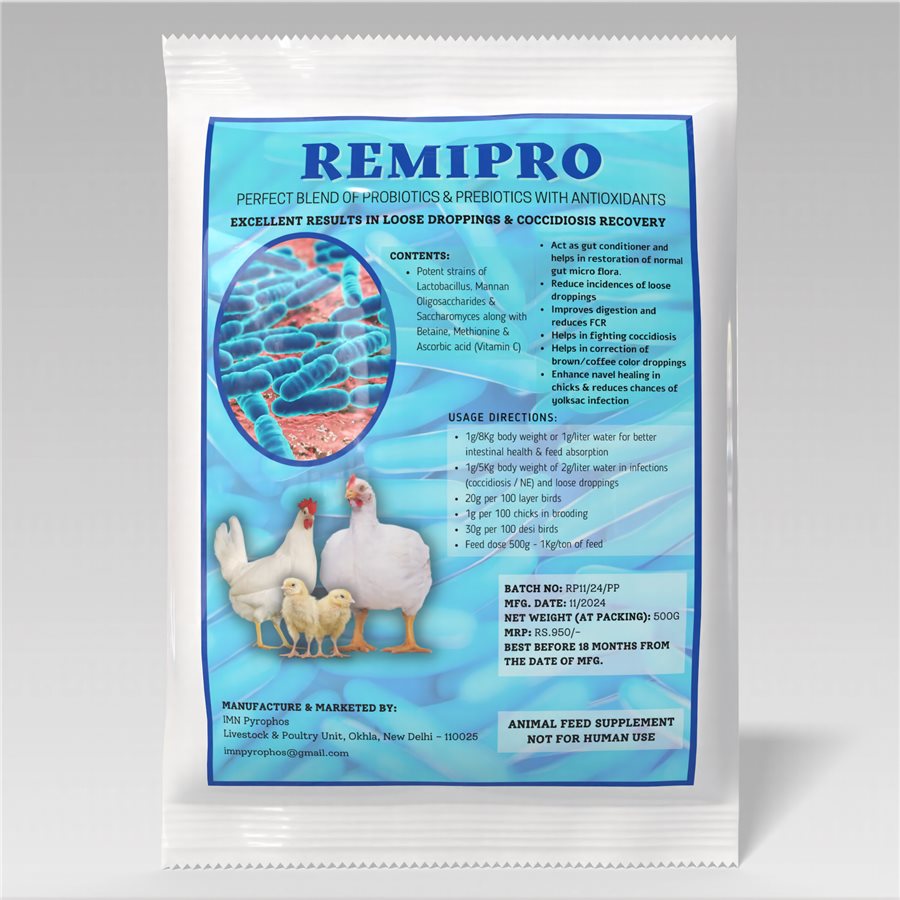
Remipro
Probiotics, prebiotics (MOS) and Saccharomyces, with betaine, methionine and vitamin C. Restores healthy gut flora, reduces loose droppings, improves digestion and FCR, helps in coccidiosis recovery and corrects brown or coffee-coloured droppings.
Dose: routine gut health 1 g per 8 kg body weight or 1 g per litre of water; in loose droppings and infections 1 g per 5 kg body weight or 2 g per litre.
500 g ₹626MRP ₹950
If loose droppings come with sudden deaths, the problem may be bacterial (E. coli or Salmonella in the gut), and you need your vet’s diagnosis. Once the cause is known and any antibiotic course is finished, an anti-diarrhoeal support helps the gut settle:
Loose droppings · Bestseller
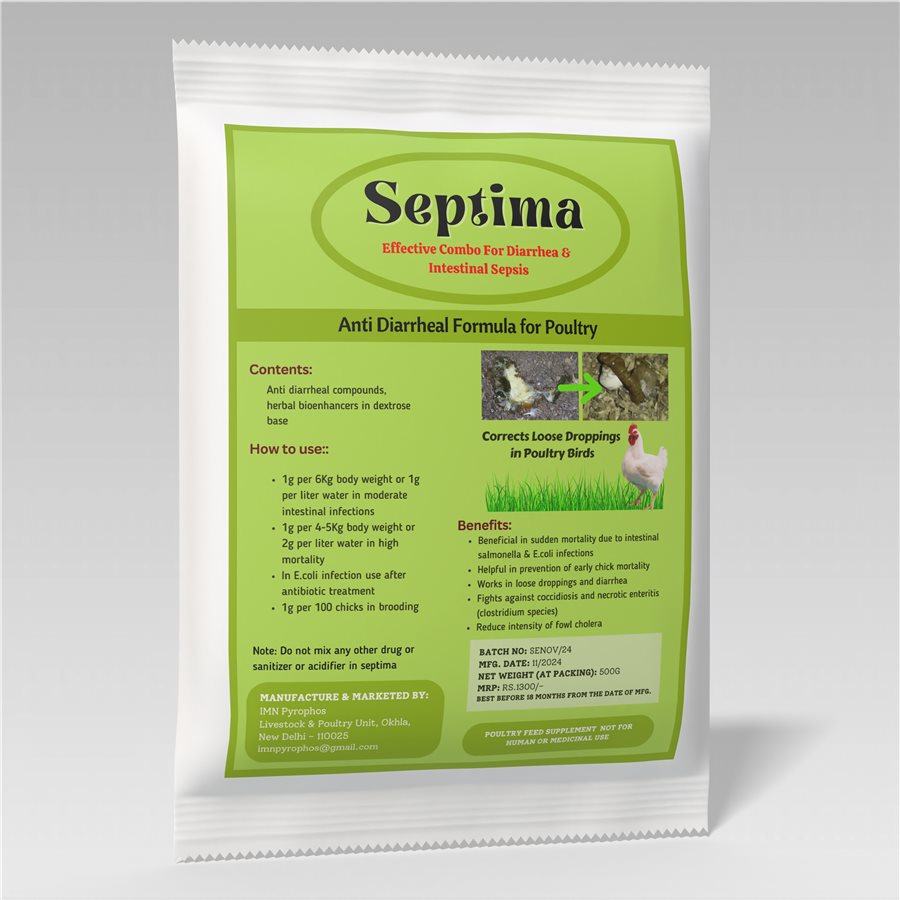
Septima
Anti-diarrhoeal combination with herbal bioenhancers on a dextrose base. Corrects loose droppings; helpful in sudden mortality from intestinal Salmonella and E. coli, early chick mortality, coccidiosis and necrotic enteritis.
Dose: moderate cases 1 g per 6 kg body weight or 1 g per litre; high mortality 1 g per 4–5 kg body weight or 2 g per litre. In E. coli, use after the antibiotic course. Do not mix with any other drug, sanitiser or acidifier.
500 g ₹793MRP ₹1,300
Ascites and sudden death (SDS) in winter
Ascites, or “water belly”, is a heart and lung problem of fast-growing broilers. A fast-growing bird needs a lot of oxygen. In winter, cold makes it burn more energy and need even more oxygen, while a closed shed with ammonia gives it less. The heart has to pump harder to push blood through the lungs, the right side of the heart gets weak and enlarged, and fluid leaks into the belly. Sudden death syndrome (SDS, “flip-over”) hits fast, healthy-looking birds that die within minutes, often found on their back.
Signs
- Bluish comb and face, breathing hard even at rest
- Swollen, soft belly full of fluid; bird stands upright like a penguin
- Deaths mostly from week 4 onward, and mostly among the heaviest, best-looking birds
- At post-mortem: yellowish fluid in the belly, enlarged heart, congested lungs
Prevention
- Minimum ventilation every hour, as above. Ammonia-damaged lungs make ascites worse.
- Avoid cold stress and night-time temperature crashes, especially in week 2–4.
- Follow your lighting programme; some dark hours slow the growth spurt and rest the heart.
- Avoid extra salt: check that water and feed are not high in sodium.
- Do not handle or chase heavy birds unnecessarily in the last two weeks.
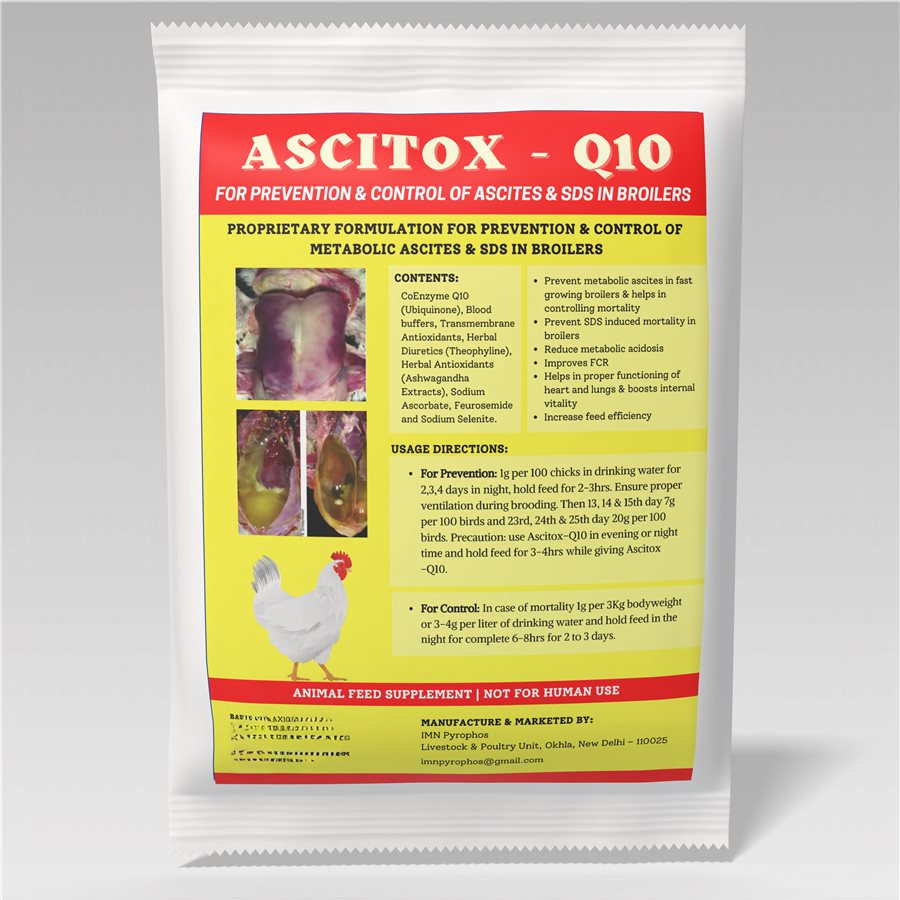
Ascites and SDS prevention
Ascitox Q10
A blend of CoQ10, blood buffers, antioxidants, herbal diuretics, sodium ascorbate and selenite. Helps in the prevention and control of metabolic ascites and SDS in broilers.
Dose: in the IMN winter 2026 schedule, per 1,000 birds: 90 g on day 12 and 13, 140 g on day 21 and 22, 180 g on day 30, 200 g on day 36 and 42. If birds start showing water belly (label control dose): 3–4 g per litre in night-time drinking water for 3–5 days, holding feed while it is given.
1 kg ₹698MRP ₹1,080
Ascitox Q10 supports prevention and control; it does not replace ventilation and temperature control. More detail in broiler ascites treatment.
Night management
In winter, most damage happens between midnight and sunrise: the coldest hours, the highest ammonia and nobody watching. One or two short night rounds pay for themselves.
- Late evening round: feeders full, water flowing, heaters working safely, curtains closed with the top gap, thermometer reading noted.
- Early morning round (before sunrise): look at how birds are lying. Huddled in corners or under heaters means too cold; panting means too hot or too stuffy.
- Listen in the quiet: rattling, gurgling or sneezing is an early sign of a respiratory problem (see infectious bronchitis).
- Check corners and the area near curtains for cold draughts and piling. Piling in cold sheds can smother birds.
- Walk slowly with a dim torch. Sudden noise or bright light makes heavy birds panic and pile.
Weekly targets: body weight, FCR and water
Weigh at least 50–100 birds from different parts of the shed every week, on the same day and time, and compare with your chick company’s chart. The table below is a rough field guide for well-managed modern broilers; your breed chart is the main reference.
| Day | Average body weight | Cumulative FCR (guide) | Feed per bird per day | Water : feed |
|---|---|---|---|---|
| 14 | About 430–500 g | About 1.05–1.20 | About 60–75 g | About 1.8–2.0 |
| 21 | About 850–950 g | About 1.25–1.35 | About 95–115 g | About 1.7–2.0 |
| 28 | About 1,400–1,550 g | About 1.40–1.50 | About 140–160 g | About 1.7–2.0 |
| 35 | About 1,950–2,150 g | About 1.50–1.62 | About 175–195 g | About 1.7–2.0 |
| 42 | About 2,450–2,700 g | About 1.65–1.78 | About 195–215 g | About 1.7–2.0 |
- If weight falls behind for two weeks in a row, check temperature at bird height, feeder and drinker space, and water intake first.
- Uneven birds (many small and many big) usually mean feeder or drinker space problems, cold corners, or disease.
- Plan your sale with the market in mind: check today’s broiler rate and work out your profit with the poultry cost and profit calculator.
Daily and weekly checklist
Every day
| Time | Check |
|---|---|
| Early morning | Bend-down ammonia test, bird spread, thermometer at bird height, count and remove dead birds |
| Morning | Flush drinker lines, note water use, fill feeders, open top curtains step by step |
| Afternoon | Rake litter, remove wet cake, squeeze test, open curtains the most, look for panting |
| Evening | Close curtains in steps, keep top gap, check heaters and chimneys, fill feeders for the night |
| Night | Short round: listen for breathing sounds, check piling, drafts, heater safety |
Every week
- Weigh 50–100 birds and compare with the breed chart
- Calculate feed used, cumulative FCR and water-to-feed ratio
- Check all nipples and drinkers for leaks; adjust drinker and feeder height to bird back level
- Check feed stock for damp or mouldy bags
- Review mortality: write down the daily count and look for a rising trend
- Check your vaccination and medicine plan with the winter broiler medicine schedule and your vet
Signs to call the vet
- Daily deaths rising for two days in a row, or clearly higher than earlier in the batch
- Rattling breathing, swollen faces or sneezing spreading through the shed
- Blood in droppings, or very watery droppings with dull, fluffed-up birds
- Several birds with swollen water bellies or blue combs
- Twisted necks, paralysis or greenish droppings (think of Ranikhet)
- Sudden heavy deaths with swollen heads or blue combs: report to the veterinary department, as it may be bird flu
- A sudden fall in feed or water intake without an obvious reason
If your vet prescribes an antibiotic, finish the course as advised and keep the withdrawal period before sale.
Common mistakes in winter broiler management
- Sealing the shed at night to “save heat”. This is the number one cause of ammonia, CRD and ascites.
- Opening curtains from the bottom, so cold air hits the birds directly.
- Using the brooding routine for the whole batch. Birds after day 15 need less heat and more air every week.
- Piling fresh litter on top of wet cake instead of removing the cake first.
- Ignoring leaking drinkers. One leaking nipple line can wet a large part of the shed in a single night.
- Not measuring water use, so the earliest warning of disease is missed.
- Coal or wood heaters without a chimney, filling the shed with smoke and gas.
- Letting feeders go empty overnight, then a rush and crowding in the morning.
- Starting antibiotics on guesswork at the first sneeze, without a diagnosis.
- Weighing a handful of birds near the door and believing the flock is on target.
Frequently asked questions
How do I know if my shed has too much ammonia?
Bend down to bird height first thing in the morning, before opening any curtain. If you can clearly smell ammonia, or your eyes sting or water, the level is too high for the birds. Increase fresh air (top curtain gap or fan timer) the same day and look for wet litter near drinkers.
Should I close all curtains on very cold nights?
No. Keep them mostly closed, but leave a small gap at the top on the side away from the wind. Give heat at bird level if needed. A fully sealed shed builds up ammonia and moisture, which does more harm than a little cool air near the roof.
Until what age do broilers need a heater in winter?
It depends on your area and shed. Many flocks need heat at night until about week 3 or 4, and after that only on very cold nights. Watch the birds: if they huddle, they need warmth; if they are spread evenly and eating, they are comfortable. Follow your vet’s advice for your region.
Why do my best, heaviest birds die suddenly in the last weeks?
This is the typical picture of ascites and sudden death syndrome. Fast growth, cold stress and poor air make the heart and lungs work too hard. Improve ventilation, avoid cold nights, follow your lighting programme and talk to your vet about prevention, such as Ascitox Q10 on fixed days.
My birds drink less in winter. Is that a problem?
Some fall is normal, but very cold water can reduce drinking a lot, and then feed intake and growth fall too. Take the chill off the water, flush lines in the morning and keep a daily record. A sudden drop from one day to the next is a warning sign.
How often should I add fresh litter?
Add fresh dry litter whenever wet patches appear, after removing the caked part. In most winter batches that means regular small top-ups near drinkers and in busy areas rather than one big addition at the end.
Can I use probiotics and water sanitiser together?
Generally no. Sanitisers can kill the good bacteria in probiotics. Give them at different times or on different days, as your vet or the product label advises. Septima’s label clearly says not to mix it with any sanitiser or acidifier.
Also read: winter management in poultry farming · wet litter in winter · infectious bronchitis · today’s broiler rate · poultry profit calculator · IMN poultry products
सर्दी में ब्रॉयलर प्रबंधन: 15वें दिन से बिक्री तक (हवा, अमोनिया, लिटर, दाना)
सर्दी के ज़्यादातर ब्रॉयलर बैच 15वें दिन तक ठीक दिखते हैं। चूज़े ब्रूडर से बाहर आ जाते हैं, अच्छा खाते हैं और किसान थोड़ा निश्चिंत हो जाता है। फिर तीसरे-चौथे हफ्ते में शेड से बदबू आने लगती है, ड्रिंकर के पास लिटर गीला होकर केक बन जाता है, रात में पक्षी छींकने लगते हैं, और आखिरी हफ्ते में सबसे भारी पक्षी पानी से फूले पेट के साथ मरने लगते हैं। यह किस्मत की बात नहीं है। यह तब होता है जब सर्दी का बंद शेड गर्मी तो रोक लेता है, पर ताज़ी हवा नहीं आने देता। यह गाइड बैच के दूसरे हिस्से के लिए है, 15वें दिन से बिक्री तक: हर उम्र में कितनी हवा दें, अपनी नाक और आँखों से अमोनिया कैसे पहचानें, दिन भर पर्दे कैसे चलाएँ, और हर हफ्ते क्या लक्ष्य रखें। पहले दो हफ्तों के लिए पहले हमारी सर्दी में ब्रॉयलर ब्रूडिंग गाइड पढ़ें।
15वें दिन के बाद सर्दी के बैच में घाटा क्यों होता है
पहले दो हफ्तों में चूज़े छोटे होते हैं, कम साँस लेते हैं और कम नमी बनाते हैं। 21वें दिन तक वही फ्लॉक कई गुना ज़्यादा दाना खाता है, कई गुना ज़्यादा पानी पीता है, और साँस व बीट से बहुत नमी छोड़ता है। अगर पर्दे अब भी पहले हफ्ते की तरह बंद हैं, तो यह नमी कहीं नहीं जाती। इससे पाँच समस्याएँ आती हैं, जो एक-दूसरे को बढ़ाती हैं:
| समस्या | क्या दिखता है | नुकसान कैसे होता है |
|---|---|---|
| अमोनिया गैस का जमना | तेज़ गंध, आँखों में जलन, पक्षियों की आँखों से पानी | साँस की नली खराब होती है, पक्षी कम खाते हैं, CRD और E. coli को रास्ता मिलता है |
| गीला, जमा हुआ लिटर | ड्रिंकर के नीचे चिपचिपा केक, गंदे पंख, छाती और पैरों में घाव | और अमोनिया, ज़्यादा कॉक्सीडियोसिस, बिक्री पर कम दाम |
| CRD / E. coli (साँस की मिली-जुली बीमारी) | रात में घर्र-घर्र, छींकें, सूजा चेहरा, चौथे-पाँचवें हफ्ते में बढ़ती मौतें | कम वज़न, खराब FCR, दवा का खर्च, छँटनी |
| एसाइटिस और अचानक मौत (SDS) | नीली कलगी, पानी से फूला पेट, भारी पक्षी पीठ के बल मरे मिलना | सबसे बड़े पक्षी बिक्री से ठीक पहले मरते हैं |
| कम पानी पीना | सुबह बर्फ जैसा ठंडा पानी, धीरे पीना, फीडर में दाना बचा रहना | कम दाना खाना, धीमी बढ़त, फ्लॉक में असमान वज़न |
अच्छी खबर यह है कि इनमें से लगभग सबकी जड़ एक ही है: हवा और नमी का खराब प्रबंधन। इसलिए एक अच्छा रोज़ का तरीका इनमें से ज़्यादातर को एक साथ ठीक कर देता है।
उम्र के हिसाब से कम से कम हवा (मिनिमम वेंटिलेशन)
ऐसे समझिए: गर्मी पक्षी के शरीर के लिए है, ताज़ी हवा उसके फेफड़ों के लिए। दोनों एक साथ दी जा सकती हैं। मिनिमम वेंटिलेशन का मतलब है उतनी कम से कम ताज़ी हवा जो नमी और अमोनिया बाहर निकाल दे, पर पक्षियों को ठंड न लगे। इसका मतलब “शेड खोल देना” नहीं है। यह हर घंटे, दिन और रात, हवा का छोटा पर लगातार बदलाव है।
15वें दिन से बिक्री तक तापमान और हवा
| उम्र (दिन) | पक्षियों की ऊँचाई पर तापमान | ताज़ी हवा की ज़रूरत | किस बात पर नज़र रखें |
|---|---|---|---|
| 15–21 | लगभग 26–24 °C | कम पर लगातार; रात में भी ऊपर से पर्दे में थोड़ी जगह | नमी तेज़ी से बढ़ती है; सुबह पहली बार अमोनिया की गंध |
| 22–28 | लगभग 24–22 °C | तीसरे हफ्ते से साफ ज़्यादा; दोपहर की गर्मी में ज़्यादा खोलें | ड्रिंकर के पास लिटर जमना, पहली छींकें |
| 29–35 | लगभग 22–20 °C | ज़्यादा; अब पक्षी खुद बहुत गर्मी बनाते हैं | रात में अमोनिया, तेज़ बढ़ने वाले पक्षियों में एसाइटिस |
| 36–बिक्री | लगभग 20–18 °C | पूरे बैच में सबसे ज़्यादा; भारी पक्षी सर्दी में भी गर्मी से परेशान हो सकते हैं | दोपहर में हाँफना, अचानक मौतें, गीला लिटर |
ये आम आँकड़े हैं। अपनी चूज़ा कंपनी का ब्रीड चार्ट और अपने डॉक्टर की सलाह मानें, क्योंकि हर शेड और इलाके का मौसम अलग होता है। तापमान हमेशा पक्षियों की ऊँचाई पर नापें, अपने सिर की ऊँचाई पर नहीं, और शेड के अलग-अलग हिस्सों में कम से कम दो थर्मामीटर रखें।
पंखे वाले शेड (EC या टनल)
अगर आपके शेड में एग्ज़ॉस्ट पंखे हैं, तो रात में सारे पंखे बंद रखने की जगह मिनिमम वेंटिलेशन के लिए टाइमर लगाएँ। शुरुआत के लिए आम तरीका है कि हर कुछ मिनट में एक पंखा थोड़ी देर चले (जैसे हर 5 मिनट में एक मिनट से कम), और पक्षी बड़े होने पर या अमोनिया की गंध आने पर चलने का समय बढ़ाएँ। हवा अंदर आने का रास्ता छोटा और ऊँचा हो, ताकि ठंडी हवा पक्षियों तक पहुँचने से पहले छत के पास गर्म हवा में मिल जाए। ज़्यादा जानकारी के लिए पोल्ट्री वेंटिलेशन मैनेजमेंट पढ़ें।
बिना मशीन के हवा कैसे परखें
- झुक कर जाँच: सुबह शेड में घुसते ही 30 सेकंड के लिए पक्षियों की ऊँचाई तक झुकें। अगर अमोनिया की गंध साफ आ रही है, तो वह पक्षियों के लिए पहले ही ज़्यादा है। लक्ष्य यह है कि कोई खास गंध न आए।
- आँखों में जलन: अगर आपकी आँखों से पानी आए या जलन हो, तो अमोनिया ज़्यादा है और पक्षियों को नुकसान हो रहा है। उसी दिन ताज़ी हवा बढ़ाएँ।
- सुबह छत या पर्दों पर पानी की बूँदें बताती हैं कि नम हवा शेड से बाहर नहीं जा रही।
- पक्षियों का व्यवहार: झुंड में सिमटे पक्षी ठंड में हैं; चोंच खोल कर और पंख फैला कर बैठे पक्षी गर्मी में हैं; पूरे शेड में बराबर फैले, खाते-पीते और आराम करते पक्षी ठीक हैं।
- भारी, घुटन वाली हवा और मज़दूरों को सिरदर्द खतरे का संकेत है, खासकर जहाँ कोयले या लकड़ी की अंगीठी जलती है।
जाँच सबसे खराब समय पर करें: सुबह, कुछ भी खोलने से पहले। उसी समय अमोनिया सबसे ज़्यादा होती है।
दिन के समय के हिसाब से पर्दों का प्रबंधन
खुले शेड में पर्दे ही आपका वेंटिलेशन सिस्टम हैं। सुनहरा नियम: पर्दे ऊपर से खोलें, नीचे से कभी नहीं। नीचे से आई हवा सीधे पक्षियों को लगती है और ठंड पहुँचाती है; ऊपर से आई हवा पहले गर्म हवा में मिल जाती है।
| समय | पर्दा कैसे रखें | क्यों |
|---|---|---|
| सुबह जल्दी (सूरज निकलने से पहले) | ज़्यादातर बंद, पर हवा से उल्टी तरफ ऊपर थोड़ी जगह | सबसे ठंडे घंटे; फिर भी उस जगह से अमोनिया और नमी निकलती रहती है |
| सुबह धूप निकलने के बाद | ऊपर से धीरे-धीरे, कुछ इंच करके खोलें | बाहर गर्म होते ही रात की अमोनिया बाहर निकालें |
| दोपहर (सबसे गर्म घंटे) | दिन में सबसे ज़्यादा खोलें; पाँचवें-छठे हफ्ते में पक्षी हाँफें तो खूब खोलें | लिटर सुखाने और हवा बदलने का सबसे अच्छा समय |
| शाम (सूरज ढलने से पहले) | धीरे-धीरे, कदम-कदम बंद करें, एक साथ नहीं | सूरज ढलते समय तापमान अचानक न गिरे |
| रात | बंद, पर हवा से उल्टी तरफ ऊपर थोड़ी जगह | तीसरे हफ्ते से शेड को कभी पूरा बंद न करें |
- तेज़ हवा या कोहरे वाले दिन, हवा से उल्टी तरफ का पर्दा खोलें और हवा वाली तरफ बंद रखें।
- पक्षियों के ऊपर अंदर एक दूसरा पर्दा या तिरपाल की नकली छत गर्मी रोकती है, और छत के पास हवा का बदलाव चलता रहता है।
- पर्दों में छेद और ढीले किनारे जाँचें। फटे पर्दे से पक्षियों की ऊँचाई पर आने वाली ठंडी हवा, ऊपर से सोच-समझ कर खोली गई जगह से ज़्यादा नुकसान करती है।
ब्रूडिंग के बाद हीटर का प्रबंधन
15वें दिन के बाद फ्लॉक खुद गर्मी बनाने लगता है। हीटर “हमेशा चालू” से “सिर्फ रात और ठंडे दिनों” पर आ जाते हैं।
- धीरे-धीरे कम करें। तीसरे हफ्ते में हीटर ज़्यादातर रात और सुबह जल्दी चलते हैं। चौथे हफ्ते तक ज़्यादातर फ्लॉक को सिर्फ बहुत ठंडी रातों में गर्मी चाहिए। सिर्फ कैलेंडर से नहीं, पक्षियों और थर्मामीटर को देख कर फैसला करें।
- कोयले की अंगीठी, लकड़ी के हीटर में चिमनी या पाइप ज़रूर हो जो धुआँ बाहर निकाले। बंद शेड में धुआँ और कार्बन मोनोऑक्साइड गैस पक्षियों और मज़दूरों दोनों को नुकसान पहुँचाती है। बंद शेड में खुली आग कभी न रखें।
- गैस ब्रूडर भी ऑक्सीजन लेते हैं और नमी छोड़ते हैं। ज़्यादा हीटर मतलब थोड़ी ज़्यादा ताज़ी हवा चाहिए, कम नहीं।
- हीटर को पर्दों, लिटर के ढेर और दाने की बोरियों से दूर रखें। हर सर्दी कुछ शेड आग में जल जाते हैं।
- पहले गर्म दिन पर सारी गर्मी बंद न करें। रात अचानक बहुत ठंडी हो सकती है; चौथे हफ्ते की एक ठंडी रात साँस की ऐसी बीमारी शुरू कर सकती है जिससे पूरा बैच उबर नहीं पाता।
15वें दिन से बिक्री तक लिटर का प्रबंधन
सर्दी की ज़्यादातर समस्याएँ लिटर से शुरू होती हैं। सूखा, भुरभुरा लिटर बीट सोख लेता है और कम अमोनिया छोड़ता है। गीला, जमा हुआ लिटर अमोनिया, कॉक्सीडिया और बैक्टीरिया का कारखाना है। पूरी जानकारी के लिए सर्दी में ब्रॉयलर का गीला लिटर और पतली बीट पढ़ें।
- रोज़ मुट्ठी जाँच: ड्रिंकर के पास समेत तीन जगह से मुट्ठी भर लिटर लें और दबाएँ। अच्छा लिटर हाथ खोलते ही बिखर जाता है। अगर गोला बना रहे, तो लिटर बहुत गीला है।
- लिटर को नियमित रूप से पलटें या रेक करें, दिन के सबसे गर्म समय जब पर्दे खुले हों, ताकि नमी निकल जाए। ड्रिंकर और फीडर के पास से शुरू करें, जहाँ सबसे ज़्यादा जमता है।
- जमे हुए टुकड़े निकालें, ड्रिंकर के नीचे और आसपास से, उन्हें शेड से बाहर ले जाएँ, और वहाँ ताज़ा सूखा लिटर भरें।
- गीली जगहों पर ताज़े, सूखे लिटर की पतली परत (धान की भूसी या लकड़ी का बुरादा) डालें। गीले केक के ऊपर मोटी परत न डालें; नीचे का गीला लिटर अमोनिया छोड़ता रहेगा।
- पानी को जड़ से रोकें: ड्रिंकर पक्षी की पीठ की ऊँचाई पर रखें, टपकते निप्पल और पाइप ठीक करें, और बेल ड्रिंकर ज़्यादा न भरें। सर्दी में ज़्यादातर गीला लिटर बीमारी से नहीं, ड्रिंकर से होता है।
- पक्षी शेड में हों तो गीले लिटर पर ज़्यादा चूना न डालें। इससे धूल उड़ती है और अमोनिया ज़्यादा निकल सकती है। कोई भी लिटर ट्रीटमेंट डालने से पहले डॉक्टर से पूछें।
सर्दी में पानी: तापमान, मात्रा और सफाई
सर्दी में पानी पर सबसे कम ध्यान दिया जाता है। जो पक्षी कम पीता है वह कम खाता है, और जो कम खाता है वह नहीं बढ़ता।
पानी का तापमान
रात भर टंकी और पाइप में रखा पानी सुबह तक बर्फ जैसा ठंडा हो सकता है, और पक्षी उसे बहुत कम पीते हैं। पानी की ठंडक कम करें: टंकी को ठंडी हवा से बचाएँ, खुले पाइपों को ढकें, और सुबह लाइनें फ्लश करें ताकि पक्षियों को ताज़ा, कम ठंडा पानी मिले। कमरे के तापमान जितना पानी ठीक है। गर्म पानी न दें।
पक्षियों को कितना पीना चाहिए?
स्वस्थ ब्रॉयलर फ्लॉक आम तौर पर वज़न में दाने से लगभग 1.7 से 2 गुना पानी पीता है। ठंड में यह अनुपात अक्सर नीचे की तरफ रहता है। 1,000 पक्षियों के लिए रोज़ का मोटा अंदाज़ा:
| उम्र | 1,000 पक्षियों का रोज़ का पानी (मोटा अंदाज़ा) |
|---|---|
| तीसरा हफ्ता (दिन 15–21) | लगभग 160–200 लीटर |
| चौथा हफ्ता (दिन 22–28) | लगभग 230–280 लीटर |
| पाँचवाँ हफ्ता (दिन 29–35) | लगभग 290–340 लीटर |
| छठा हफ्ता (दिन 36–42) | लगभग 340–400 लीटर |
सही संख्या से ज़्यादा ज़रूरी है रुझान। एक सादा पानी मीटर लगाएँ, या लिखें कि टंकी कितनी बार भरी। किसी दिन पानी की खपत अचानक गिरना अक्सर बीमारी, ठंड के तनाव या बंद लाइन का पहला संकेत होता है, बीमार पक्षी दिखने से एक-दो दिन पहले।
पानी की सफाई
- बैच के बीच टंकी साफ करें और ड्रिंकर लाइनें फ्लश करें; पाइपों में जमी परत (बायोफिल्म) में E. coli पनपता है।
- बैच के दौरान डॉक्टर की बताई मात्रा में पानी का सैनिटाइज़र इस्तेमाल करें।
- टीके वाले दिन और प्रोबायोटिक या ऐसे दूसरे पानी वाले प्रोडक्ट देते समय सैनिटाइज़र बंद रखें, जैसा डॉक्टर या लेबल कहे।
ज़्यादा जानकारी: पोल्ट्री के लिए पानी की गुणवत्ता।
ठंड में दाना और ऊर्जा की ज़रूरत
ठंड में पक्षी दाने का एक हिस्सा सिर्फ गर्म रहने में खर्च करते हैं। शेड बहुत ठंडा हो तो दाना मांस बनने की जगह गर्मी में जल जाता है और FCR खराब होता है। इसलिए पक्षियों की ऊँचाई पर गर्माहट, दाना बचाने का भी तरीका है।
- रात में फीडर कभी खाली न होने दें। ठंडे शेड में भूखे पक्षी जल्दी वज़न खोते हैं और सुबह फीडर पर भीड़ लगाते हैं।
- फीडर की ऊँचाई पक्षी की पीठ के बराबर रखें ताकि दाना लिटर में न गिरे।
- दाना कंपनी के बताए दिन पर स्टार्टर, ग्रोअर और फिनिशर बदलें। पैसे बचाने के लिए दाने में अनाज मिला कर उसे पतला न करें; खराब FCR में उससे ज़्यादा पैसा जाता है।
- दाने में नमी और फफूंद जाँचें। सर्दी के नम मौसम में ज़मीन या दीवार से लगी बोरियाँ खराब हो जाती हैं। बोरियाँ लकड़ी के पट्टों पर, दीवार से दूर रखें और पहले आई बोरी पहले इस्तेमाल करें।
- लाइट का प्रोग्राम और बहुत तेज़ बढ़त धीमी करने के लिए दाने पर कोई नियंत्रण, अपने इंटीग्रेटर या डॉक्टर के हिसाब से ही करें। बैच के बीच में अपना प्रोग्राम न बनाएँ।
सर्दी में आँत की सेहत: पतली बीट और E. coli
ठंड का तनाव, अमोनिया और गीला लिटर आँत को बिगाड़ते हैं। बीट पतली और पानी जैसी हो जाती है, लिटर और गीला होता है, और चक्र चलता रहता है। आँत के अच्छे बैक्टीरिया का मतलब आखिरी हफ्तों में बेहतर पाचन और FCR भी है, जब पक्षी सबसे ज़्यादा दाना खाते हैं।
आँत की सेहत · बेस्टसेलर
Remipro
प्रोबायोटिक, प्रीबायोटिक (MOS) और Saccharomyces, साथ में बीटेन, मेथियोनीन और विटामिन C। आँत के अच्छे बैक्टीरिया लौटाता है, पतली बीट घटाता है, पाचन और FCR सुधारता है, कॉक्सीडियोसिस से उबरने में मदद करता है और भूरी/कॉफी रंग की बीट ठीक करता है।
मात्रा: रोज़ की आँत सेहत के लिए 1 ग्राम प्रति 8 किलो वज़न या 1 ग्राम प्रति लीटर पानी; पतली बीट और इन्फेक्शन में 1 ग्राम प्रति 5 किलो वज़न या 2 ग्राम प्रति लीटर; ब्रूडिंग में 1 ग्राम प्रति 100 चूज़े।
500 g ₹626MRP ₹950
अगर पतली बीट के साथ अचानक मौतें हो रही हैं, तो समस्या बैक्टीरिया की हो सकती है (आँत में E. coli या Salmonella), और डॉक्टर की जाँच ज़रूरी है। कारण पता चलने और एंटीबायोटिक कोर्स पूरा होने के बाद, दस्त-रोधी सहारा आँत को सँभालने में मदद करता है:
पतली बीट · बेस्टसेलर
Septima
डेक्सट्रोज़ बेस में हर्बल बायोएन्हांसर के साथ दस्त-रोधी कॉम्बिनेशन। पतली बीट ठीक करता है; आँत के Salmonella और E. coli से अचानक मौतों, शुरुआती चूज़ा मृत्यु, कॉक्सीडियोसिस और नेक्रोटिक एंटेराइटिस में मददगार।
मात्रा: सामान्य केस में 1 ग्राम प्रति 6 किलो वज़न या 1 ग्राम प्रति लीटर; ज़्यादा मौतों में 1 ग्राम प्रति 4–5 किलो वज़न या 2 ग्राम प्रति लीटर। E. coli में एंटीबायोटिक कोर्स के बाद दें। दूसरी दवा, सैनिटाइज़र या एसिडिफायर के साथ न मिलाएँ।
500 g ₹793MRP ₹1,300
सर्दी में एसाइटिस और अचानक मौत (SDS)
एसाइटिस, यानी “पेट में पानी”, तेज़ बढ़ने वाले ब्रॉयलर में दिल और फेफड़ों की समस्या है। तेज़ बढ़ने वाले पक्षी को बहुत ऑक्सीजन चाहिए। सर्दी में ठंड से वह ज़्यादा ऊर्जा जलाता है और उसे और ज़्यादा ऑक्सीजन चाहिए, जबकि अमोनिया वाला बंद शेड उसे कम ऑक्सीजन देता है। दिल को फेफड़ों में खून धकेलने के लिए ज़्यादा ज़ोर लगाना पड़ता है, दिल का दायाँ हिस्सा कमज़ोर होकर बड़ा हो जाता है, और पेट में पानी भरने लगता है। अचानक मौत (SDS, “पलटी”) तेज़ बढ़ने वाले, स्वस्थ दिखने वाले पक्षियों को लगती है, जो मिनटों में मर जाते हैं और अक्सर पीठ के बल पड़े मिलते हैं।
लक्षण
- नीली कलगी और चेहरा, आराम करते हुए भी तेज़ साँस
- सूजा हुआ, नरम पेट जिसमें पानी भरा हो; पक्षी पेंगुइन की तरह सीधा खड़ा होता है
- मौतें ज़्यादातर चौथे हफ्ते से, और ज़्यादातर सबसे भारी, सबसे अच्छे दिखने वाले पक्षियों में
- पोस्टमार्टम में: पेट में पीला पानी, बड़ा दिल, खून से भरे फेफड़े
बचाव
- ऊपर बताए अनुसार हर घंटे मिनिमम वेंटिलेशन। अमोनिया से खराब फेफड़े एसाइटिस को बढ़ाते हैं।
- ठंड के तनाव और रात में तापमान के अचानक गिरने से बचें, खासकर दूसरे से चौथे हफ्ते में।
- लाइट प्रोग्राम मानें; कुछ घंटे अँधेरा बढ़त की तेज़ी कम करता है और दिल को आराम देता है।
- ज़्यादा नमक से बचें: पानी और दाने में सोडियम ज़्यादा न हो, यह जाँचें।
- आखिरी दो हफ्तों में भारी पक्षियों को बिना ज़रूरत न पकड़ें, न दौड़ाएँ।
एसाइटिस और SDS से बचाव
Ascitox Q10
तेज़ बढ़ने वाले ब्रॉयलर में, खासकर सर्दी में, एसाइटिस (पेट में पानी भरना) के प्रबंधन का फ़ॉर्मूला। मेटाबॉलिक एसाइटिस से बचाव, मौतें काबू करने, SDS (अचानक मौत) घटाने और मेटाबॉलिक एसिडोसिस कम करने में मदद करता है, और दिल व फेफड़ों के सही काम को सहारा देता है।
मात्रा: IMN सर्दी शेड्यूल में प्रति 1000 पक्षी: दिन 12 और 13 को 90 ग्राम, दिन 21 और 22 को 140 ग्राम, दिन 30 को 180 ग्राम, दिन 36 और 42 को 200 ग्राम। पेट में पानी भरने लगे तो (लेबल): रात के पीने के पानी में 3–4 ग्राम प्रति लीटर, 3 से 5 दिन, देते समय दाना रोकें।
1 kg ₹698MRP ₹1,080
Ascitox Q10 बचाव और नियंत्रण में सहायक है; यह वेंटिलेशन और तापमान के प्रबंधन की जगह नहीं लेता। ज़्यादा जानकारी: ब्रॉयलर में एसाइटिस का इलाज।
रात का प्रबंधन
सर्दी में सबसे ज़्यादा नुकसान आधी रात से सुबह तक होता है: सबसे ठंडे घंटे, सबसे ज़्यादा अमोनिया, और देखने वाला कोई नहीं। रात के एक-दो छोटे चक्कर अपनी कीमत वसूल कर देते हैं।
- देर शाम का चक्कर: फीडर भरे हों, पानी चल रहा हो, हीटर सुरक्षित चल रहे हों, पर्दे ऊपर की थोड़ी जगह के साथ बंद हों, थर्मामीटर की रीडिंग लिखी हो।
- सुबह जल्दी का चक्कर (सूरज निकलने से पहले): देखें पक्षी कैसे लेटे हैं। कोनों में या हीटर के नीचे सिमटे हों तो ठंड ज़्यादा है; हाँफ रहे हों तो गर्मी या घुटन ज़्यादा है।
- सुनें: शांत रात में घर्र-घर्र, गुड़गुड़ या छींक साँस की बीमारी का शुरुआती संकेत है (देखें इंफेक्शियस ब्रोंकाइटिस)।
- कोनों और पर्दों के पास ठंडी हवा और पक्षियों के एक-दूसरे पर चढ़ने (पाइलिंग) को देखें। ठंडे शेड में पाइलिंग से पक्षी दब कर मर सकते हैं।
- मंद टॉर्च के साथ धीरे चलें। अचानक आवाज़ या तेज़ रोशनी से भारी पक्षी घबरा कर एक-दूसरे पर चढ़ जाते हैं।
हर हफ्ते के लक्ष्य: वज़न, FCR और पानी
हर हफ्ते, एक ही दिन और समय पर, शेड के अलग-अलग हिस्सों से कम से कम 50–100 पक्षी तौलें, और अपनी चूज़ा कंपनी के चार्ट से मिलाएँ। नीचे की तालिका अच्छे प्रबंधन वाले आधुनिक ब्रॉयलर के लिए मोटा फील्ड अंदाज़ा है; असली पैमाना आपका ब्रीड चार्ट है।
| दिन | औसत वज़न | कुल FCR (अंदाज़ा) | रोज़ का दाना प्रति पक्षी | पानी : दाना |
|---|---|---|---|---|
| 14 | लगभग 430–500 ग्राम | लगभग 1.05–1.20 | लगभग 60–75 ग्राम | लगभग 1.8–2.0 |
| 21 | लगभग 850–950 ग्राम | लगभग 1.25–1.35 | लगभग 95–115 ग्राम | लगभग 1.7–2.0 |
| 28 | लगभग 1,400–1,550 ग्राम | लगभग 1.40–1.50 | लगभग 140–160 ग्राम | लगभग 1.7–2.0 |
| 35 | लगभग 1,950–2,150 ग्राम | लगभग 1.50–1.62 | लगभग 175–195 ग्राम | लगभग 1.7–2.0 |
| 42 | लगभग 2,450–2,700 ग्राम | लगभग 1.65–1.78 | लगभग 195–215 ग्राम | लगभग 1.7–2.0 |
- अगर लगातार दो हफ्ते वज़न पीछे रहे, तो सबसे पहले पक्षियों की ऊँचाई पर तापमान, फीडर और ड्रिंकर की जगह, और पानी की खपत जाँचें।
- असमान पक्षी (कई छोटे, कई बड़े) आम तौर पर फीडर-ड्रिंकर की कमी, ठंडे कोनों या बीमारी का संकेत हैं।
- बिक्री बाज़ार देख कर तय करें: आज का ब्रॉयलर रेट देखें और पोल्ट्री लागत और मुनाफा कैलकुलेटर से अपना मुनाफा निकालें।
रोज़ और हर हफ्ते की चेकलिस्ट
हर दिन
| समय | क्या जाँचें |
|---|---|
| सुबह जल्दी | झुक कर अमोनिया जाँच, पक्षियों का फैलाव, पक्षियों की ऊँचाई पर थर्मामीटर, मरे पक्षी गिनें और निकालें |
| सुबह | ड्रिंकर लाइनें फ्लश करें, पानी की खपत लिखें, फीडर भरें, ऊपर के पर्दे धीरे-धीरे खोलें |
| दोपहर | लिटर रेक करें, गीला केक निकालें, मुट्ठी जाँच, पर्दे सबसे ज़्यादा खोलें, हाँफने वाले पक्षी देखें |
| शाम | पर्दे धीरे-धीरे बंद करें, ऊपर थोड़ी जगह रखें, हीटर और चिमनी जाँचें, रात के लिए फीडर भरें |
| रात | छोटा चक्कर: साँस की आवाज़ सुनें, पाइलिंग, ठंडी हवा और हीटर की सुरक्षा देखें |
हर हफ्ते
- 50–100 पक्षी तौलें और ब्रीड चार्ट से मिलाएँ
- खाया गया दाना, कुल FCR और पानी-दाना अनुपात निकालें
- सारे निप्पल और ड्रिंकर में रिसाव जाँचें; ड्रिंकर और फीडर की ऊँचाई पक्षी की पीठ के बराबर करें
- दाने के स्टॉक में नम या फफूंद वाली बोरियाँ देखें
- मौतों का हिसाब देखें: रोज़ की गिनती लिखें और बढ़ता रुझान पहचानें
- टीके और दवा की योजना सर्दी में ब्रॉयलर दवा शेड्यूल और अपने डॉक्टर से मिलाएँ
डॉक्टर को कब बुलाएँ
- लगातार दो दिन रोज़ की मौतें बढ़ना, या बैच में पहले से साफ ज़्यादा मौतें
- घर्र-घर्र साँस, सूजे चेहरे या छींकें पूरे शेड में फैलना
- बीट में खून, या सुस्त, पंख फुलाए पक्षियों में बहुत पतली बीट
- कई पक्षियों में पानी से फूला पेट या नीली कलगी
- मुड़ी गर्दन, लकवा या हरी बीट (रानीखेत का शक)
- सूजे सिर या नीली कलगी के साथ अचानक भारी मौतें: पशुपालन विभाग को खबर करें, यह बर्ड फ्लू हो सकता है
- बिना किसी साफ कारण के दाना या पानी अचानक कम होना
अगर डॉक्टर एंटीबायोटिक लिखें, तो कोर्स बताए अनुसार पूरा करें और बिक्री से पहले विदड्रॉल समय (दवा बंद करने के बाद रुकने का समय) ज़रूर पूरा करें।
सर्दी के ब्रॉयलर प्रबंधन में आम गलतियाँ
- “गर्मी बचाने” के लिए रात में शेड पूरा बंद करना। अमोनिया, CRD और एसाइटिस का यह सबसे बड़ा कारण है।
- पर्दे नीचे से खोलना, जिससे ठंडी हवा सीधे पक्षियों को लगती है।
- पूरे बैच में ब्रूडिंग वाला तरीका चलाना। 15वें दिन के बाद पक्षियों को हर हफ्ते कम गर्मी और ज़्यादा हवा चाहिए।
- गीले केक के ऊपर ताज़ा लिटर डाल देना, केक निकाले बिना।
- टपकते ड्रिंकर को अनदेखा करना। एक टपकती निप्पल लाइन एक ही रात में शेड का बड़ा हिस्सा गीला कर सकती है।
- पानी की खपत न नापना, जिससे बीमारी का सबसे पहला संकेत छूट जाता है।
- बिना चिमनी की कोयले या लकड़ी की अंगीठी, जिससे शेड धुएँ और गैस से भर जाता है।
- रात में फीडर खाली छोड़ना, फिर सुबह भगदड़ और भीड़।
- पहली छींक पर अंदाज़े से एंटीबायोटिक शुरू करना, बिना जाँच के।
- दरवाज़े के पास से चार-पाँच पक्षी तौल कर मान लेना कि पूरा फ्लॉक लक्ष्य पर है।
अक्सर पूछे जाने वाले सवाल
कैसे पता करें कि शेड में अमोनिया ज़्यादा है?
सुबह सबसे पहले, कोई पर्दा खोलने से पहले, पक्षियों की ऊँचाई तक झुकें। अगर अमोनिया की गंध साफ आए, या आँखें जलें या पानी आए, तो स्तर पक्षियों के लिए ज़्यादा है। उसी दिन ताज़ी हवा बढ़ाएँ (ऊपर से पर्दे की जगह या पंखे का टाइमर) और ड्रिंकर के पास गीला लिटर देखें।
बहुत ठंडी रात में क्या सारे पर्दे बंद कर दें?
नहीं। ज़्यादातर बंद रखें, पर हवा से उल्टी तरफ ऊपर थोड़ी जगह छोड़ें। ज़रूरत हो तो पक्षियों की ऊँचाई पर गर्मी दें। पूरी तरह बंद शेड में अमोनिया और नमी जमती है, जो छत के पास थोड़ी ठंडी हवा से कहीं ज़्यादा नुकसान करती है।
सर्दी में ब्रॉयलर को किस उम्र तक हीटर चाहिए?
यह आपके इलाके और शेड पर निर्भर है। कई फ्लॉक को लगभग तीसरे या चौथे हफ्ते तक रात में गर्मी चाहिए, उसके बाद सिर्फ बहुत ठंडी रातों में। पक्षियों को देखें: सिमटें तो गर्मी चाहिए; बराबर फैले हों और खा रहे हों तो ठीक हैं। अपने इलाके के लिए डॉक्टर की सलाह मानें।
आखिरी हफ्तों में मेरे सबसे अच्छे, भारी पक्षी अचानक क्यों मरते हैं?
यह एसाइटिस और अचानक मौत (SDS) की आम तस्वीर है। तेज़ बढ़त, ठंड का तनाव और खराब हवा दिल और फेफड़ों पर बहुत ज़ोर डालते हैं। वेंटिलेशन सुधारें, ठंडी रातों से बचाएँ, लाइट प्रोग्राम मानें, और बचाव के बारे में डॉक्टर से बात करें, जैसे तय दिनों पर Ascitox Q10।
सर्दी में मेरे पक्षी कम पानी पीते हैं। क्या यह समस्या है?
थोड़ी कमी सामान्य है, पर बहुत ठंडा पानी पीना बहुत कम कर सकता है, और फिर दाना और बढ़त भी गिरती है। पानी की ठंडक कम करें, सुबह लाइनें फ्लश करें और रोज़ का रिकॉर्ड रखें। एक दिन से अगले दिन अचानक गिरावट खतरे का संकेत है।
ताज़ा लिटर कितनी बार डालें?
जब भी गीली जगह दिखे, जमा हिस्सा निकाल कर ताज़ा सूखा लिटर डालें। सर्दी के ज़्यादातर बैच में इसका मतलब है ड्रिंकर के पास और भीड़ वाली जगहों पर बार-बार थोड़ा-थोड़ा डालना, आखिर में एक साथ बहुत सारा नहीं।
क्या प्रोबायोटिक और पानी का सैनिटाइज़र साथ दे सकते हैं?
आम तौर पर नहीं। सैनिटाइज़र प्रोबायोटिक के अच्छे बैक्टीरिया को मार सकता है। डॉक्टर या लेबल के अनुसार इन्हें अलग समय या अलग दिन दें। Septima के लेबल पर साफ लिखा है कि इसे किसी सैनिटाइज़र या एसिडिफायर के साथ न मिलाएँ।
यह भी पढ़ें: सर्दी में पोल्ट्री फार्म का प्रबंधन · सर्दी में गीला लिटर · इंफेक्शियस ब्रोंकाइटिस · आज का ब्रॉयलर रेट · पोल्ट्री मुनाफा कैलकुलेटर · IMN पोल्ट्री प्रोडक्ट
Sardi me broiler management: 15ve din se bikri tak (hawa, ammonia, litter, daana)
Sardi ke zyadatar broiler batch 15ve din tak theek dikhte hain. Chooze brooder se bahar aa jaate hain, achha khaate hain aur kisan thoda nishchint ho jaata hai. Phir teesre-chauthe hafte me shed se badboo aane lagti hai, drinker ke paas litter geela ho kar cake ban jaata hai, raat me pakshi chheenkne lagte hain, aur aakhri hafte me sabse bhaari pakshi paani se phoole pet ke saath marne lagte hain. Ye kismat ki baat nahi hai. Ye tab hota hai jab sardi ka band shed garmi to rok leta hai, par taazi hawa nahi aane deta. Ye guide batch ke doosre hisse ke liye hai, 15ve din se bikri tak: har umar me kitni hawa dein, apni naak aur aankhon se ammonia kaise pehchanein, din bhar parde kaise chalayein, aur har hafte kya target rakhein. Pehle do hafton ke liye pehle hamari sardi me broiler brooding guide padhiye.
15ve din ke baad sardi ke batch me ghata kyon hota hai
Pehle do hafton me chooze chhote hote hain, kam saans lete hain aur kam nami banate hain. 21ve din tak wahi flock kai guna zyada daana khaata hai, kai guna zyada paani peeta hai, aur saans aur beet se bahut nami chhodta hai. Agar parde ab bhi pehle hafte ki tarah band hain, to ye nami kahin nahi jaati. Isse paanch samasyayein aati hain, jo ek-doosre ko badhati hain:
| Samasya | Kya dikhta hai | Nuksan kaise hota hai |
|---|---|---|
| Ammonia gas ka jamna | Tez gandh, aankhon me jalan, pakshiyon ki aankhon se paani | Saans ki nali kharab hoti hai, pakshi kam khaate hain, CRD aur E. coli ko raasta milta hai |
| Geela, jama hua litter | Drinker ke neeche chipchipa cake, gande pankh, chhaati aur pairon me ghaav | Aur ammonia, zyada coccidiosis, bikri par kam daam |
| CRD / E. coli (saans ki mili-juli beemari) | Raat me gharr-gharr, chheenkein, sooja chehra, chauthe-paanchve hafte me badhti maut | Kam wazan, kharab FCR, dawa ka kharcha, chhantni |
| Ascites aur achanak maut (SDS) | Neeli kalgi, paani se phoola pet, bhaari pakshi peeth ke bal mare milna | Sabse bade pakshi bikri se theek pehle marte hain |
| Kam paani peena | Subah barf jaisa thanda paani, dheere peena, feeder me daana bacha rehna | Kam daana khaana, dheemi badhat, flock me asamaan wazan |
Achhi khabar ye hai ki inme se lagbhag sabki jad ek hi hai: hawa aur nami ka kharab management. Isliye ek achha roz ka tareeka inme se zyadatar ko ek saath theek kar deta hai.
Umar ke hisaab se kam se kam hawa (minimum ventilation)
Aise samjhiye: garmi pakshi ke shareer ke liye hai, taazi hawa uske phephdon ke liye. Dono ek saath di ja sakti hain. Minimum ventilation ka matlab hai utni kam se kam taazi hawa jo nami aur ammonia bahar nikaal de, par pakshiyon ko thand na lage. Iska matlab “shed khol dena” nahi hai. Ye har ghante, din aur raat, hawa ka chhota par lagataar badlaav hai.
15ve din se bikri tak taapmaan aur hawa
| Umar (din) | Pakshiyon ki oonchai par taapmaan | Taazi hawa ki zaroorat | Kis baat par nazar rakhein |
|---|---|---|---|
| 15–21 | Lagbhag 26–24 °C | Kam par lagataar; raat me bhi oopar se parde me thodi jagah | Nami tezi se badhti hai; subah pehli baar ammonia ki gandh |
| 22–28 | Lagbhag 24–22 °C | Teesre hafte se saaf zyada; dopahar ki garmi me zyada kholiye | Drinker ke paas litter jamna, pehli chheenkein |
| 29–35 | Lagbhag 22–20 °C | Zyada; ab pakshi khud bahut garmi banate hain | Raat me ammonia, tez badhne wale pakshiyon me ascites |
| 36–bikri | Lagbhag 20–18 °C | Poore batch me sabse zyada; bhaari pakshi sardi me bhi garmi se pareshan ho sakte hain | Dopahar me haanfna, achanak maut, geela litter |
Ye aam aankde hain. Apni chooza company ka breed chart aur apne doctor ki salah maaniye, kyonki har shed aur ilaake ka mausam alag hota hai. Taapmaan hamesha pakshiyon ki oonchai par naapiye, apne sir ki oonchai par nahi, aur shed ke alag-alag hisson me kam se kam do thermometer rakhiye.
Pankhe wale shed (EC ya tunnel)
Agar aapke shed me exhaust pankhe hain, to raat me saare pankhe band rakhne ki jagah minimum ventilation ke liye timer lagaiye. Shuruaat ke liye aam tareeka hai ki har kuch minute me ek pankha thodi der chale (jaise har 5 minute me ek minute se kam), aur pakshi bade hone par ya ammonia ki gandh aane par chalne ka samay badhaiye. Hawa andar aane ka raasta chhota aur ooncha ho, taaki thandi hawa pakshiyon tak pahunchne se pehle chhat ke paas garam hawa me mil jaaye. Zyada jaankari ke liye poultry ventilation management padhiye.
Bina machine ke hawa kaise parkhein
- Jhuk kar jaanch: subah shed me ghuste hi 30 second ke liye pakshiyon ki oonchai tak jhukiye. Agar ammonia ki gandh saaf aa rahi hai, to wo pakshiyon ke liye pehle hi zyada hai. Target ye hai ki koi khaas gandh na aaye.
- Aankhon me jalan: agar aapki aankhon se paani aaye ya jalan ho, to ammonia zyada hai aur pakshiyon ko nuksan ho raha hai. Usi din taazi hawa badhaiye.
- Subah chhat ya pardon par paani ki boondein batati hain ki nam hawa shed se bahar nahi ja rahi.
- Pakshiyon ka vyavhaar: jhund me simte pakshi thand me hain; chonch khol kar aur pankh phaila kar baithe pakshi garmi me hain; poore shed me barabar phaile, khaate-peete aur aaram karte pakshi theek hain.
- Bhaari, ghutan wali hawa aur mazdooron ko sirdard khatre ka sanket hai, khaas kar jahan koyle ya lakdi ki angeethi jalti hai.
Jaanch sabse kharab samay par kariye: subah, kuch bhi kholne se pehle. Usi samay ammonia sabse zyada hoti hai.
Din ke samay ke hisaab se pardon ka management
Khule shed me parde hi aapka ventilation system hain. Sunehra niyam: parde oopar se kholiye, neeche se kabhi nahi. Neeche se aayi hawa seedhe pakshiyon ko lagti hai aur thand pahunchati hai; oopar se aayi hawa pehle garam hawa me mil jaati hai.
| Samay | Parda kaise rakhein | Kyon |
|---|---|---|
| Subah jaldi (sooraj nikalne se pehle) | Zyadatar band, par hawa se ulti taraf oopar thodi jagah | Sabse thande ghante; phir bhi us jagah se ammonia aur nami nikalti rehti hai |
| Subah dhoop nikalne ke baad | Oopar se dheere-dheere, kuch inch kar ke kholiye | Bahar garam hote hi raat ki ammonia bahar nikaliye |
| Dopahar (sabse garam ghante) | Din me sabse zyada kholiye; paanchve-chhathe hafte me pakshi haanfein to khoob kholiye | Litter sukhane aur hawa badalne ka sabse achha samay |
| Shaam (sooraj dhalne se pehle) | Dheere-dheere, kadam-kadam band kariye, ek saath nahi | Sooraj dhalte samay taapmaan achanak na gire |
| Raat | Band, par hawa se ulti taraf oopar thodi jagah | Teesre hafte se shed ko kabhi poora band mat kariye |
- Tez hawa ya kohre wale din, hawa se ulti taraf ka parda kholiye aur hawa wali taraf band rakhiye.
- Pakshiyon ke oopar andar ek doosra parda ya tirpal ki nakli chhat garmi rokti hai, aur chhat ke paas hawa ka badlaav chalta rehta hai.
- Pardon me chhed aur dheele kinaare jaanchiye. Phate parde se pakshiyon ki oonchai par aane wali thandi hawa, oopar se soch-samajh kar kholi gayi jagah se zyada nuksan karti hai.
Brooding ke baad heater ka management
15ve din ke baad flock khud garmi banane lagta hai. Heater “hamesha chalu” se “sirf raat aur thande dinon” par aa jaate hain.
- Dheere-dheere kam kariye. Teesre hafte me heater zyadatar raat aur subah jaldi chalte hain. Chauthe hafte tak zyadatar flock ko sirf bahut thandi raaton me garmi chahiye. Sirf calendar se nahi, pakshiyon aur thermometer ko dekh kar faisla kariye.
- Koyle ki angeethi, lakdi ke heater me chimney ya pipe zaroor ho jo dhuan bahar nikaale. Band shed me dhuan aur carbon monoxide gas pakshiyon aur mazdooron dono ko nuksan pahunchati hai. Band shed me khuli aag kabhi mat rakhiye.
- Gas brooder bhi oxygen lete hain aur nami chhodte hain. Zyada heater matlab thodi zyada taazi hawa chahiye, kam nahi.
- Heater ko pardon, litter ke dher aur daane ki boriyon se door rakhiye. Har sardi kuch shed aag me jal jaate hain.
- Pehle garam din par saari garmi band mat kariye. Raat achanak bahut thandi ho sakti hai; chauthe hafte ki ek thandi raat saans ki aisi beemari shuru kar sakti hai jisse poora batch ubhar nahi paata.
15ve din se bikri tak litter ka management
Sardi ki zyadatar samasyayein litter se shuru hoti hain. Sookha, bhurbhura litter beet sokh leta hai aur kam ammonia chhodta hai. Geela, jama hua litter ammonia, coccidia aur bacteria ka kaarkhana hai. Poori jaankari ke liye sardi me broiler ka geela litter aur patli beet padhiye.
- Roz mutthi jaanch: drinker ke paas samet teen jagah se mutthi bhar litter lijiye aur dabaiye. Achha litter haath kholte hi bikhar jaata hai. Agar gola bana rahe, to litter bahut geela hai.
- Litter ko niyamit roop se palatiye ya rake kariye, din ke sabse garam samay jab parde khule hon, taaki nami nikal jaaye. Drinker aur feeder ke paas se shuru kariye, jahan sabse zyada jamta hai.
- Jame hue tukde nikaaliye, drinker ke neeche aur aaspaas se, unhe shed se bahar le jaiye, aur wahan taaza sookha litter bhariye.
- Geeli jagahon par taaze, sookhe litter ki patli parat (dhaan ki bhoosi ya lakdi ka buraada) daaliye. Geele cake ke oopar moti parat mat daaliye; neeche ka geela litter ammonia chhodta rahega.
- Paani ko jad se rokiye: drinker pakshi ki peeth ki oonchai par rakhiye, tapakte nipple aur pipe theek kariye, aur bell drinker zyada mat bhariye. Sardi me zyadatar geela litter beemari se nahi, drinker se hota hai.
- Pakshi shed me hon to geele litter par zyada choona mat daaliye. Isse dhool udti hai aur ammonia zyada nikal sakti hai. Koi bhi litter treatment daalne se pehle doctor se poochhiye.
Sardi me paani: taapmaan, matra aur safai
Sardi me paani par sabse kam dhyan diya jaata hai. Jo pakshi kam peeta hai wo kam khaata hai, aur jo kam khaata hai wo nahi badhta.
Paani ka taapmaan
Raat bhar tanki aur pipe me rakha paani subah tak barf jaisa thanda ho sakta hai, aur pakshi use bahut kam peete hain. Paani ki thandak kam kariye: tanki ko thandi hawa se bachaiye, khule pipon ko dhakiye, aur subah lines flush kariye taaki pakshiyon ko taaza, kam thanda paani mile. Kamre ke taapmaan jitna paani theek hai. Garam paani mat dijiye.
Pakshiyon ko kitna peena chahiye?
Swasth broiler flock aam taur par wazan me daane se lagbhag 1.7 se 2 guna paani peeta hai. Thand me ye anupaat aksar neeche ki taraf rehta hai. 1,000 pakshiyon ke liye roz ka mota andaaza:
| Umar | 1,000 pakshiyon ka roz ka paani (mota andaaza) |
|---|---|
| Teesra hafta (din 15–21) | Lagbhag 160–200 litre |
| Chautha hafta (din 22–28) | Lagbhag 230–280 litre |
| Paanchva hafta (din 29–35) | Lagbhag 290–340 litre |
| Chhatha hafta (din 36–42) | Lagbhag 340–400 litre |
Sahi sankhya se zyada zaroori hai trend. Ek saada paani meter lagaiye, ya likhiye ki tanki kitni baar bhari. Kisi din paani ki khapat achanak girna aksar beemari, thand ke tanaav ya band line ka pehla sanket hota hai, beemar pakshi dikhne se ek-do din pehle.
Paani ki safai
- Batch ke beech tanki saaf kariye aur drinker lines flush kariye; pipon me jami parat (biofilm) me E. coli panapta hai.
- Batch ke dauraan doctor ki batayi matra me paani ka sanitizer istemaal kariye.
- Teeke wale din aur probiotic ya aise doosre paani wale product dete samay sanitizer band rakhiye, jaisa doctor ya label kahe.
Zyada jaankari: poultry ke liye paani ki quality.
Thand me daana aur urja ki zaroorat
Thand me pakshi daane ka ek hissa sirf garam rehne me kharch karte hain. Shed bahut thanda ho to daana maans banne ki jagah garmi me jal jaata hai aur FCR kharab hota hai. Isliye pakshiyon ki oonchai par garmahat, daana bachane ka bhi tareeka hai.
- Raat me feeder kabhi khaali mat hone dijiye. Thande shed me bhookhe pakshi jaldi wazan khote hain aur subah feeder par bheed lagate hain.
- Feeder ki oonchai pakshi ki peeth ke barabar rakhiye taaki daana litter me na gire.
- Daana company ke bataye din par starter, grower aur finisher badaliye. Paise bachane ke liye daane me anaaj mila kar use patla mat kariye; kharab FCR me usse zyada paisa jaata hai.
- Daane me nami aur phaphoond jaanchiye. Sardi ke nam mausam me zameen ya deewar se lagi boriyan kharab ho jaati hain. Boriyan lakdi ke patton par, deewar se door rakhiye aur pehle aayi bori pehle istemaal kariye.
- Light ka program aur bahut tez badhat dheemi karne ke liye daane par koi niyantran, apne integrator ya doctor ke hisaab se hi kariye. Batch ke beech me apna program mat banaiye.
Sardi me aant ki sehat: patli beet aur E. coli
Thand ka tanaav, ammonia aur geela litter aant ko bigaadte hain. Beet patli aur paani jaisi ho jaati hai, litter aur geela hota hai, aur chakra chalta rehta hai. Aant ke achhe bacteria ka matlab aakhri hafton me behtar pachan aur FCR bhi hai, jab pakshi sabse zyada daana khaate hain.
Aant ki sehat · bestseller
Remipro
Probiotic, prebiotic (MOS) aur Saccharomyces, saath me betaine, methionine aur vitamin C. Aant ke achhe bacteria lautata hai, patli beet ghatata hai, pachan aur FCR sudharta hai, coccidiosis se ubharne me madad karta hai aur bhoori/coffee rang ki beet theek karta hai.
Matra: Roz ki aant sehat ke liye 1 g prati 8 kg wazan ya 1 g prati litre paani; patli beet aur infection me 1 g prati 5 kg wazan ya 2 g prati litre; brooding me 1 g prati 100 chooze.
500 g ₹626MRP ₹950
Agar patli beet ke saath achanak maut ho rahi hai, to samasya bacteria ki ho sakti hai (aant me E. coli ya Salmonella), aur doctor ki jaanch zaroori hai. Kaaran pata chalne aur antibiotic course poora hone ke baad, dast-rodhi sahara aant ko sambhalne me madad karta hai:
Patli beet · bestseller
Septima
Dextrose base me herbal bioenhancer ke saath dast-rodhi combination. Patli beet theek karta hai; aant ke Salmonella aur E. coli se achanak maut, shuruaati chooza mrityu, coccidiosis aur necrotic enteritis me madadgaar.
Matra: Saamanya case me 1 g prati 6 kg wazan ya 1 g prati litre; zyada maut me 1 g prati 4–5 kg wazan ya 2 g prati litre. E. coli me antibiotic course ke baad dijiye. Doosri dawa, sanitizer ya acidifier ke saath mat milaiye.
500 g ₹793MRP ₹1,300
Sardi me ascites aur achanak maut (SDS)
Ascites, yaani “pet me paani”, tez badhne wale broiler me dil aur phephdon ki samasya hai. Tez badhne wale pakshi ko bahut oxygen chahiye. Sardi me thand se wo zyada urja jalata hai aur use aur zyada oxygen chahiye, jabki ammonia wala band shed use kam oxygen deta hai. Dil ko phephdon me khoon dhakelne ke liye zyada zor lagana padta hai, dil ka daayan hissa kamzor ho kar bada ho jaata hai, aur pet me paani bharne lagta hai. Achanak maut (SDS, “palti”) tez badhne wale, swasth dikhne wale pakshiyon ko lagti hai, jo minton me mar jaate hain aur aksar peeth ke bal pade milte hain.
Lakshan
- Neeli kalgi aur chehra, aaram karte hue bhi tez saans
- Sooja hua, naram pet jisme paani bhara ho; pakshi penguin ki tarah seedha khada hota hai
- Maut zyadatar chauthe hafte se, aur zyadatar sabse bhaari, sabse achhe dikhne wale pakshiyon me
- Postmortem me: pet me peela paani, bada dil, khoon se bhare phephde
Bachav
- Oopar bataye anusaar har ghante minimum ventilation. Ammonia se kharab phephde ascites ko badhate hain.
- Thand ke tanaav aur raat me taapmaan ke achanak girne se bachiye, khaas kar doosre se chauthe hafte me.
- Light program maaniye; kuch ghante andhera badhat ki tezi kam karta hai aur dil ko aaram deta hai.
- Zyada namak se bachiye: paani aur daane me sodium zyada na ho, ye jaanchiye.
- Aakhri do hafton me bhaari pakshiyon ko bina zaroorat na pakadiye, na daudaiye.
Ascites aur SDS se bachav
Ascitox Q10
Tez badhne wale broiler me, khaaskar sardi me, ascites (pet me paani bharna) ke prabandhan ka formula. Metabolic ascites se bachav, maut kaabu karne, SDS (achanak maut) ghatane aur metabolic acidosis kam karne me madad karta hai, aur dil va phephdon ke sahi kaam ko sahara deta hai.
Matra: IMN sardi schedule me prati 1000 pakshi: din 12 aur 13 ko 90 g, din 21 aur 22 ko 140 g, din 30 ko 180 g, din 36 aur 42 ko 200 g. Pet me paani bharne lage to (label): raat ke peene ke paani me 3–4 g prati litre, 3 se 5 din, dete samay daana rokiye.
1 kg ₹698MRP ₹1,080
Ascitox Q10 bachav aur niyantran me sahayak hai; ye ventilation aur taapmaan ke management ki jagah nahi leta. Zyada jaankari: broiler me ascites ka ilaaj.
Raat ka management
Sardi me sabse zyada nuksan aadhi raat se subah tak hota hai: sabse thande ghante, sabse zyada ammonia, aur dekhne wala koi nahi. Raat ke ek-do chhote chakkar apni keemat vasool kar dete hain.
- Der shaam ka chakkar: feeder bhare hon, paani chal raha ho, heater surakshit chal rahe hon, parde oopar ki thodi jagah ke saath band hon, thermometer ki reading likhi ho.
- Subah jaldi ka chakkar (sooraj nikalne se pehle): dekhiye pakshi kaise lete hain. Konon me ya heater ke neeche simte hon to thand zyada hai; haanf rahe hon to garmi ya ghutan zyada hai.
- Suniye: shaant raat me gharr-gharr, gudgud ya chheenk saans ki beemari ka shuruaati sanket hai (dekhiye Infectious Bronchitis).
- Konon aur pardon ke paas thandi hawa aur pakshiyon ke ek-doosre par chadhne (piling) ko dekhiye. Thande shed me piling se pakshi dab kar mar sakte hain.
- Mand torch ke saath dheere chaliye. Achanak awaaz ya tez roshni se bhaari pakshi ghabra kar ek-doosre par chadh jaate hain.
Har hafte ke target: wazan, FCR aur paani
Har hafte, ek hi din aur samay par, shed ke alag-alag hisson se kam se kam 50–100 pakshi tauliye, aur apni chooza company ke chart se milaiye. Neeche ki table achhe management wale aadhunik broiler ke liye mota field andaaza hai; asli paimana aapka breed chart hai.
| Din | Ausat wazan | Kul FCR (andaaza) | Roz ka daana prati pakshi | Paani : daana |
|---|---|---|---|---|
| 14 | Lagbhag 430–500 g | Lagbhag 1.05–1.20 | Lagbhag 60–75 g | Lagbhag 1.8–2.0 |
| 21 | Lagbhag 850–950 g | Lagbhag 1.25–1.35 | Lagbhag 95–115 g | Lagbhag 1.7–2.0 |
| 28 | Lagbhag 1,400–1,550 g | Lagbhag 1.40–1.50 | Lagbhag 140–160 g | Lagbhag 1.7–2.0 |
| 35 | Lagbhag 1,950–2,150 g | Lagbhag 1.50–1.62 | Lagbhag 175–195 g | Lagbhag 1.7–2.0 |
| 42 | Lagbhag 2,450–2,700 g | Lagbhag 1.65–1.78 | Lagbhag 195–215 g | Lagbhag 1.7–2.0 |
- Agar lagataar do hafte wazan peechhe rahe, to sabse pehle pakshiyon ki oonchai par taapmaan, feeder aur drinker ki jagah, aur paani ki khapat jaanchiye.
- Asamaan pakshi (kai chhote, kai bade) aam taur par feeder-drinker ki kami, thande konon ya beemari ka sanket hain.
- Bikri bazaar dekh kar tay kariye: aaj ka broiler rate dekhiye aur poultry laagat aur munafa calculator se apna munafa nikaaliye.
Roz aur har hafte ki checklist
Har din
| Samay | Kya jaanchein |
|---|---|
| Subah jaldi | Jhuk kar ammonia jaanch, pakshiyon ka phailaav, pakshiyon ki oonchai par thermometer, mare pakshi giniye aur nikaaliye |
| Subah | Drinker lines flush kariye, paani ki khapat likhiye, feeder bhariye, oopar ke parde dheere-dheere kholiye |
| Dopahar | Litter rake kariye, geela cake nikaaliye, mutthi jaanch, parde sabse zyada kholiye, haanfne wale pakshi dekhiye |
| Shaam | Parde dheere-dheere band kariye, oopar thodi jagah rakhiye, heater aur chimney jaanchiye, raat ke liye feeder bhariye |
| Raat | Chhota chakkar: saans ki awaaz suniye, piling, thandi hawa aur heater ki suraksha dekhiye |
Har hafte
- 50–100 pakshi tauliye aur breed chart se milaiye
- Khaaya gaya daana, kul FCR aur paani-daana anupaat nikaaliye
- Saare nipple aur drinker me risaav jaanchiye; drinker aur feeder ki oonchai pakshi ki peeth ke barabar kariye
- Daane ke stock me nam ya phaphoond wali boriyan dekhiye
- Maut ka hisaab dekhiye: roz ki ginti likhiye aur badhta trend pehchaniye
- Teeke aur dawa ki yojana sardi me broiler dawa schedule aur apne doctor se milaiye
Doctor ko kab bulayein
- Lagataar do din roz ki maut badhna, ya batch me pehle se saaf zyada maut
- Gharr-gharr saans, sooje chehre ya chheenkein poore shed me phailna
- Beet me khoon, ya sust, pankh phulaye pakshiyon me bahut patli beet
- Kai pakshiyon me paani se phoola pet ya neeli kalgi
- Mudi gardan, lakwa ya hari beet (Ranikhet ka shak)
- Sooje sir ya neeli kalgi ke saath achanak bhaari maut: pashupalan vibhag ko khabar kariye, ye bird flu ho sakta hai
- Bina kisi saaf kaaran ke daana ya paani achanak kam hona
Agar doctor antibiotic likhein, to course bataye anusaar poora kariye aur bikri se pehle withdrawal samay (dawa band karne ke baad rukne ka samay) zaroor poora kariye.
Sardi ke broiler management me aam galtiyan
- “Garmi bachane” ke liye raat me shed poora band karna. Ammonia, CRD aur ascites ka ye sabse bada kaaran hai.
- Parde neeche se kholna, jisse thandi hawa seedhe pakshiyon ko lagti hai.
- Poore batch me brooding wala tareeka chalana. 15ve din ke baad pakshiyon ko har hafte kam garmi aur zyada hawa chahiye.
- Geele cake ke oopar taaza litter daal dena, cake nikale bina.
- Tapakte drinker ko andekha karna. Ek tapakti nipple line ek hi raat me shed ka bada hissa geela kar sakti hai.
- Paani ki khapat na naapna, jisse beemari ka sabse pehla sanket chhoot jaata hai.
- Bina chimney ki koyle ya lakdi ki angeethi, jisse shed dhuen aur gas se bhar jaata hai.
- Raat me feeder khaali chhodna, phir subah bhagdad aur bheed.
- Pehli chheenk par andaaze se antibiotic shuru karna, bina jaanch ke.
- Darwaze ke paas se chaar-paanch pakshi taul kar maan lena ki poora flock target par hai.
Aksar poochhe jaane wale sawaal
Kaise pata karein ki shed me ammonia zyada hai?
Subah sabse pehle, koi parda kholne se pehle, pakshiyon ki oonchai tak jhukiye. Agar ammonia ki gandh saaf aaye, ya aankhein jalein ya paani aaye, to star pakshiyon ke liye zyada hai. Usi din taazi hawa badhaiye (oopar se parde ki jagah ya pankhe ka timer) aur drinker ke paas geela litter dekhiye.
Bahut thandi raat me kya saare parde band kar dein?
Nahi. Zyadatar band rakhiye, par hawa se ulti taraf oopar thodi jagah chhodiye. Zaroorat ho to pakshiyon ki oonchai par garmi dijiye. Poori tarah band shed me ammonia aur nami jamti hai, jo chhat ke paas thodi thandi hawa se kahin zyada nuksan karti hai.
Sardi me broiler ko kis umar tak heater chahiye?
Ye aapke ilaake aur shed par nirbhar hai. Kai flock ko lagbhag teesre ya chauthe hafte tak raat me garmi chahiye, uske baad sirf bahut thandi raaton me. Pakshiyon ko dekhiye: simtein to garmi chahiye; barabar phaile hon aur kha rahe hon to theek hain. Apne ilaake ke liye doctor ki salah maaniye.
Aakhri hafton me mere sabse achhe, bhaari pakshi achanak kyon marte hain?
Ye ascites aur achanak maut (SDS) ki aam tasveer hai. Tez badhat, thand ka tanaav aur kharab hawa dil aur phephdon par bahut zor daalte hain. Ventilation sudhariye, thandi raaton se bachaiye, light program maaniye, aur bachav ke baare me doctor se baat kariye, jaise tay dinon par Ascitox Q10.
Sardi me mere pakshi kam paani peete hain. Kya ye samasya hai?
Thodi kami saamanya hai, par bahut thanda paani peena bahut kam kar sakta hai, aur phir daana aur badhat bhi girti hai. Paani ki thandak kam kariye, subah lines flush kariye aur roz ka record rakhiye. Ek din se agle din achanak giravat khatre ka sanket hai.
Taaza litter kitni baar daalein?
Jab bhi geeli jagah dikhe, jama hissa nikaal kar taaza sookha litter daaliye. Sardi ke zyadatar batch me iska matlab hai drinker ke paas aur bheed wali jagahon par baar-baar thoda-thoda daalna, aakhir me ek saath bahut saara nahi.
Kya probiotic aur paani ka sanitizer saath de sakte hain?
Aam taur par nahi. Sanitizer probiotic ke achhe bacteria ko maar sakta hai. Doctor ya label ke anusaar inhe alag samay ya alag din dijiye. Septima ke label par saaf likha hai ki ise kisi sanitizer ya acidifier ke saath na milayein.
Ye bhi padhiye: sardi me poultry farm ka management · sardi me geela litter · Infectious Bronchitis · aaj ka broiler rate · poultry munafa calculator · IMN poultry products