More is probably known about the nutrition of poultry than any other animal. Research determining requirements for chickens has been conducted for over half a century, and numerous publications and books have been written on the topic. Furthermore, the industry has nutritional-management guidelines from genetic-breeding companies that provide important nutrient values aimed at maximizing growth performance.
These values are usually based on findings in birds reared in optimal conditions that enable them to reach their peak potential. Many nutritionists formulate diets to meet the bird’s requirements without exceeding them, particularly the protein/amino acid levels. Producers are trying to maximize profit and bird growth as well as limiting the nutrients being excreted.
What happens, however, when birds are faced with intestinal distress, such as that caused by coccidiosis — a significant parasitic intestinal attack that’s considered by many broiler veterinarians to be the No.1 disease of poultry?
The parasites responsible for coccidiosis in poultry belong to the family of the Eimeriidae, all obligate intracellular parasitic protozoa.
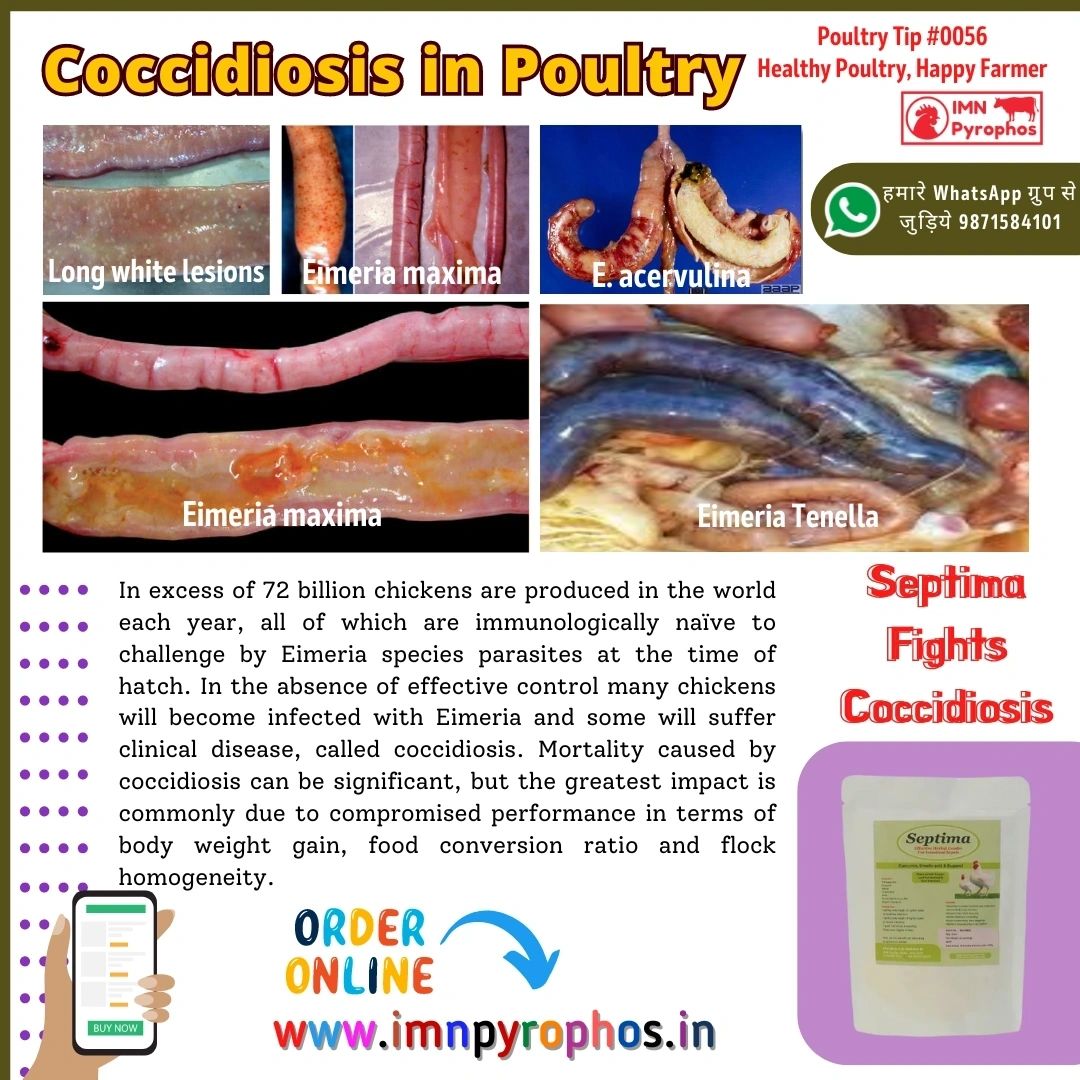
In excess of 72 billion chickens are produced in the world each year, all of which are immunologically naïve to challenge by Eimeria species parasites at the time of hatch. In the absence of effective control many chickens will become infected with Eimeria and some will suffer clinical disease, called coccidiosis.
The global cost attributed to Eimeria has been estimated to exceed $10 billion every year, including losses attributed to subclinical and clinical disease, as well as the costs of anticoccidial control. Mortality caused by coccidiosis can be significant, but the greatest impact is commonly due to compromised performance in terms of body weight gain, food conversion ratio and flock homogeneity.
Nine species of Eimeria have been described from chickens. New evidence suggests that all should be considered valid. Concurrent infection with 2 or more species of coccidia is common. Each species causes separate and distinct, recognizable diseases, independent of the other species. A number of factors, either related to the parasites or the host, will affect this life cycle. Depending on the Eimeria species, these parasites will colonize specific regions of the intestinal tract, at a depth varying with the species considered. at a depth varying with the species considered. The period between the ingestion of the sporulated oocysts and the release in the feces of the first unsporulated oocysts, also called prepatent period, is specific for each Eimeria species. Likewise, the period required for the sporulation of oocysts is also species specific. These two elements can be used as an aid to the identification of the Eimeria species involved.
Nine species of Eimeria have been described in chickens: E. acervulina, E. necatrix, E. maxima, E. brunetti, E. tenella. E. mitis,E. mivati,E. praecox and E. hagani. Clinical disease is determined by the species of the infecting coccidia.
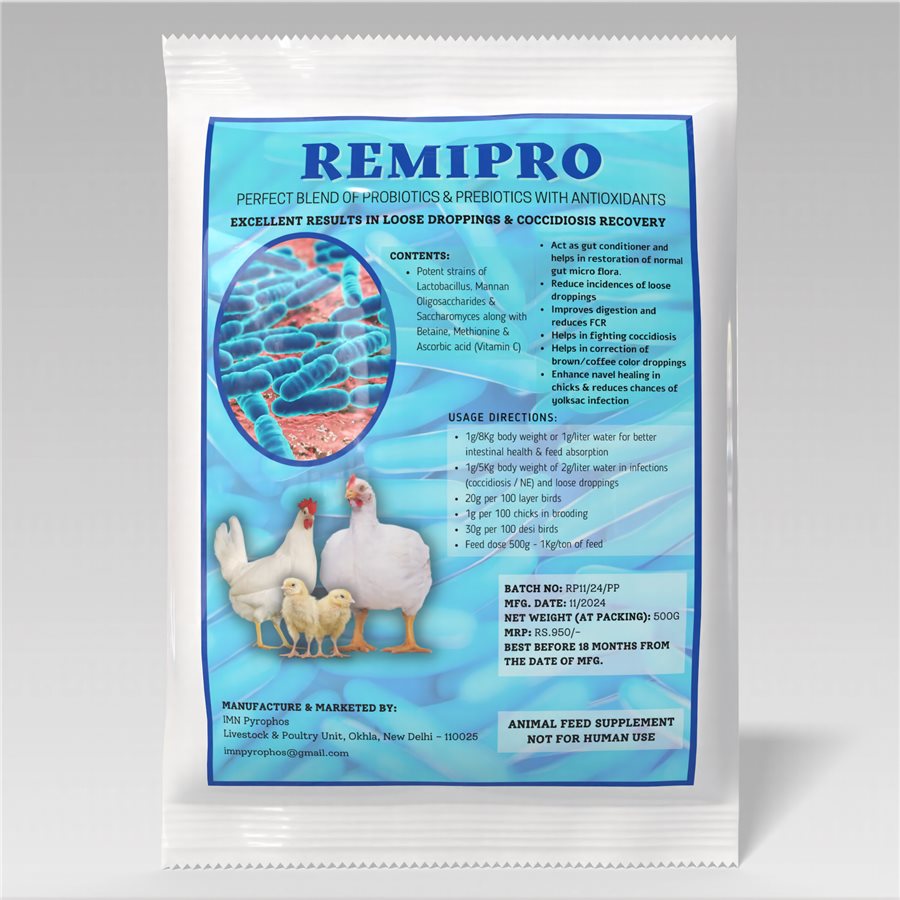
Gut health · bestseller
Remipro
Probiotics, prebiotics (MOS) and Saccharomyces with betaine, methionine and vitamin C. Restores normal gut flora, reduces loose droppings, improves digestion and FCR, helps in coccidiosis recovery and corrects brown/coffee coloured droppings.
Dose: 1 g per 8 kg body weight or 1 g per litre of water for routine gut health; 1 g per 5 kg body weight or 2 g per litre during loose droppings and infections; 1 g per 100 chicks in brooding.
500 g ₹626MRP ₹950
Moderately severe pathogen causing enteritis in the duodenum region, but when severe, the lesions will extend to the jejunum. The enteritis can be mild to severe and cause thickening of the mucosa. May affect skin pigmentation due to malabsorption of carotenoids and reduce feed conversion. Transverse white to gray striations are visible in the mucosa, these are Typical ladder-like white steaks along the duodenum. This location is also favored by other less pathogenic species i.e. frequently multiple species will be present, obscuring the diagnosis. This type of coccidiosis occurs rather frequently in older birds. This species is one of the most prevalent in commercial poultry operations. The thickening of the intestinal mucosa observed is due to the aggregation of gametocytes and oocysts. It mainly causes malabsorptive coccidiosis, rarely results in mortality unless the level of challenge is overwhelming.
Eimeria maxima is moderately pathogenic and may cause moderately high mortality. It causes mild to severe enteritis sometimes with thickening of the intestinal wall and marked dilatation of the the middle small intestine, these resemble E. necatrix, but the lesions of E. maxima are bright red (Fig. 6). Intestinal content may be bloody. Very large oocysts (30.5 x 20.7 microns), often with a golden color and large gamonts are diagnostic for this species. Subclinical infections may impede absorption and result in poor skin pigmentation. This species is very prevalent in commercial poultry operations.
Eimeria brunetti causes enteritis in the lower small intestine, rectum and proximal cecum. In severe cases, a fibrinous or fibrinonecrotic mass of debris may cover the affected mucosa or produce caseous cores in the ileum and rectum. These oocysts are fairly large, each with a polar granule. E. brunetti is a moderately severe pathogen that can produce moderate mortality, loss of weight gain, and poor feed conversion.
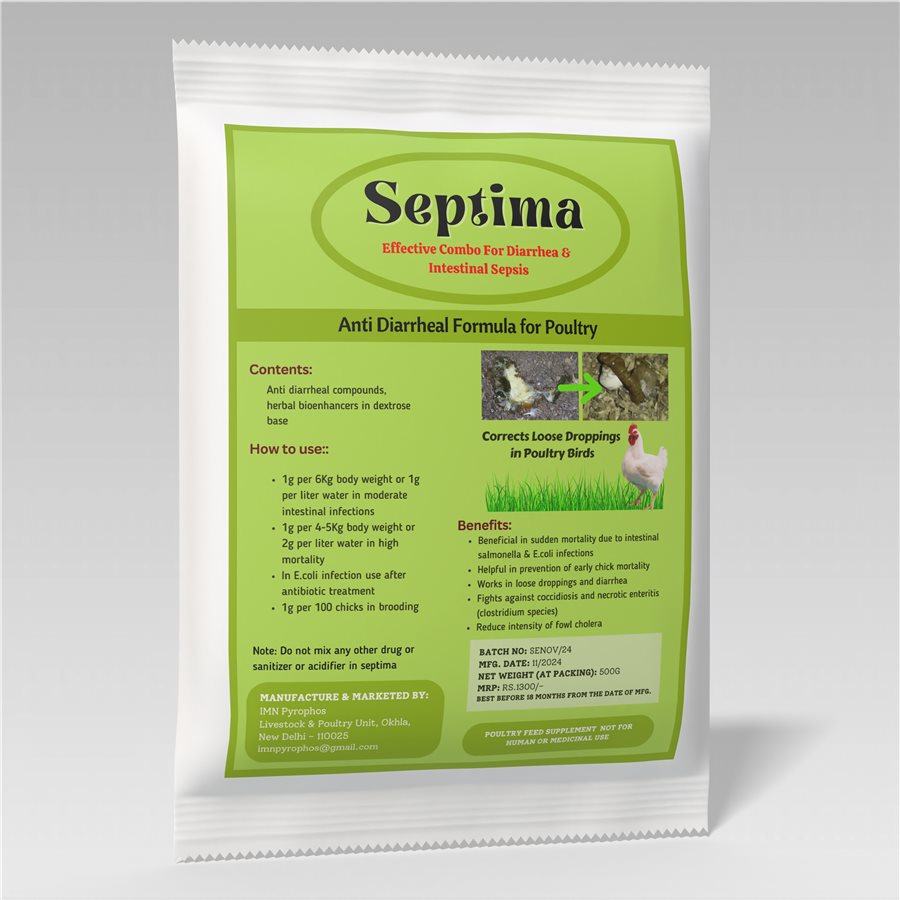
Loose droppings · bestseller
Septima
Anti-diarrhoeal combination with herbal bioenhancers in a dextrose base. Corrects loose droppings and is helpful in sudden mortality from intestinal Salmonella and E. coli, in early chick mortality, and against coccidiosis and necrotic enteritis.
Dose: 1 g per 6 kg body weight or 1 g per litre for moderate cases; 1 g per 4–5 kg body weight or 2 g per litre in high mortality. In E. coli infection, use after the antibiotic course. Do not mix with other drugs, sanitizers or acidifiers.
500 g ₹793MRP ₹1,300
Eimeria necatrix causes severe enteritis characterized by congestion, hemorrhage, necrosis and blood in the middle small intestine with bloody feces. The intestine often is markedly dilated, inflamed and thickened. White to yellow foci and petechial hemorrhages may be seen through the serosa of the unopened gut; these lesions are the development of the large schizonts predominantly in the mid small intestines. This species is often mistaken or confused with E. maxima; the lesions with E. necatrix have the appearance of salt ands pepper (dark red). Oocysts develop only in the ceca, and the oocysts may not be numerous; moreover, mortality may precede the appearance of oocysts in the feces. Often causes high mortality. Often causes disease in commercial broiler breeders or layer pullets.
Eimeria tenella is highly pathogenic, causes a marked typhlitis with occasional involvement of the adjacent areas of the intestine. Blood is often apparent in the ceca and feces in the early stages of the infections; later, cheesy cecal cores may be found. Large clusters of schizonts may be seen in microscopic scrapings of the ceca. E. tenella can cause high morbidity, mortality and reduced weight gain in commercial broilers or layer pullets. This species is commonly found in commercial poultry.
For treatment Septima and Remipro at the dose rate of 1g per 5kg body weight are given in different water which would helps in controlling coccidiosis.
Problem in your flock? Send photos of the birds and droppings on WhatsApp for a first opinion from Dr. Ibne Ali.
WhatsApp: 98715 84101शायद किसी भी दूसरे पशु से ज़्यादा जानकारी poultry के पोषण के बारे में है। मुर्गियों की ज़रूरतें तय करने पर आधी सदी से ज़्यादा समय से research हो रही है, और इस विषय पर बहुत सारी publications और किताबें लिखी गई हैं। इसके अलावा, industry के पास genetic-breeding companies की पोषण-प्रबंधन guidelines हैं जो बढ़त को ज़्यादा से ज़्यादा करने के लिए ज़रूरी पोषक तत्वों के मान बताती हैं।
ये मान आम तौर पर उन पक्षियों पर मिले नतीजों पर आधारित होते हैं जिन्हें बेहतरीन हालात में पाला गया हो ताकि वे अपनी पूरी क्षमता तक पहुँच सकें। कई nutritionists आहार ऐसा बनाते हैं कि पक्षी की ज़रूरत पूरी हो लेकिन उससे ज़्यादा न हो, खासकर protein/amino acid के स्तर। Producers मुनाफा और पक्षियों की बढ़त ज़्यादा से ज़्यादा करने के साथ-साथ बीट में निकलने वाले पोषक तत्वों को भी कम रखने की कोशिश करते हैं।
लेकिन क्या होता है जब पक्षियों की आंतों में परेशानी हो, जैसे coccidiosis से — यह आंतों पर परजीवी (parasite) का एक बड़ा हमला है जिसे कई broiler veterinarians poultry की नंबर 1 (No.1) बीमारी मानते हैं?
Poultry में coccidiosis करने वाले परजीवी Eimeriidae परिवार के हैं, जो सभी ऐसे protozoa परजीवी हैं जो सिर्फ cells के अंदर ही जी सकते हैं (obligate intracellular)।
दुनिया में हर साल 72 billion से ज़्यादा मुर्गियाँ पैदा होती हैं, और hatch के समय इन सभी में Eimeria परजीवियों के खिलाफ कोई immunity नहीं होती। असरदार नियंत्रण न हो तो कई मुर्गियाँ Eimeria से infect होंगी और कुछ में बीमारी के लक्षण दिखेंगे, जिसे coccidiosis कहते हैं।
Eimeria से दुनिया भर में होने वाला नुकसान हर साल $10 billion से ज़्यादा आंका गया है, जिसमें बिना लक्षण (subclinical) और लक्षण वाली (clinical) बीमारी के नुकसान और anticoccidial नियंत्रण का खर्च शामिल है। Coccidiosis से मृत्यु दर काफी हो सकती है, लेकिन सबसे बड़ा असर आम तौर पर performance बिगड़ने का होता है — वज़न बढ़त, feed conversion ratio और flock की एकरूपता (homogeneity) में।
मुर्गियों में Eimeria की नौ species बताई गई हैं। नए सबूत बताते हैं कि सभी को सही (valid) माना जाना चाहिए। एक साथ 2 या ज़्यादा species का infection आम है। हर species अलग और पहचानी जा सकने वाली बीमारी करती है, जो दूसरी species से स्वतंत्र होती है। परजीवी या पक्षी से जुड़े कई कारण इस जीवन चक्र पर असर डालते हैं। Eimeria की species के हिसाब से ये परजीवी आंत के खास हिस्सों में बसते हैं, और कितनी गहराई तक जाते हैं यह species पर निर्भर करता है। Sporulated oocysts खाने से लेकर बीट में पहले unsporulated oocysts निकलने तक का समय, जिसे prepatent period भी कहते हैं, हर Eimeria species के लिए अलग होता है। इसी तरह oocysts के sporulation में लगने वाला समय भी हर species का अलग होता है। इन दोनों बातों से यह पहचानने में मदद मिल सकती है कि कौन सी Eimeria species शामिल है।
मुर्गियों में Eimeria की नौ species बताई गई हैं: E. acervulina, E. necatrix, E. maxima, E. brunetti, E. tenella. E. mitis,E. mivati,E. praecox और E. hagani। बीमारी कैसी होगी यह infect करने वाली coccidia की species से तय होता है।
आँत की सेहत · बेस्टसेलर
Remipro
प्रोबायोटिक, प्रीबायोटिक (MOS) और Saccharomyces, साथ में बीटेन, मेथियोनीन और विटामिन C। आँत के अच्छे बैक्टीरिया लौटाता है, पतली बीट घटाता है, पाचन और FCR सुधारता है, कॉक्सीडियोसिस से उबरने में मदद करता है और भूरी/कॉफी रंग की बीट ठीक करता है।
मात्रा: रोज़ की आँत सेहत के लिए 1 ग्राम प्रति 8 किलो वज़न या 1 ग्राम प्रति लीटर पानी; पतली बीट और इन्फेक्शन में 1 ग्राम प्रति 5 किलो वज़न या 2 ग्राम प्रति लीटर; ब्रूडिंग में 1 ग्राम प्रति 100 चूज़े।
500 g ₹626MRP ₹950
मध्यम रूप से गंभीर रोगाणु जो duodenum वाले हिस्से में enteritis (आंतों की सूजन) करता है, लेकिन गंभीर होने पर घाव jejunum तक फैल जाते हैं। Enteritis हल्का से गंभीर हो सकता है और mucosa (आंत की अंदरूनी परत) को मोटा कर देता है। Carotenoids ठीक से न सोखे जाने की वजह से चमड़ी के रंग (skin pigmentation) पर असर पड़ सकता है और feed conversion घट सकता है। Mucosa में आड़ी सफेद से भूरी धारियाँ दिखती हैं, ये duodenum के साथ-साथ सीढ़ी जैसी खास सफेद धारियाँ होती हैं। यह जगह दूसरी कम नुकसान वाली species को भी पसंद है, यानी अक्सर कई species एक साथ मौजूद होती हैं, जिससे diagnosis मुश्किल हो जाता है। इस तरह का coccidiosis बड़े पक्षियों में काफी बार होता है। यह species commercial poultry farms में सबसे ज़्यादा पाई जाने वाली species में से एक है। आंत की mucosa का मोटा होना gametocytes और oocysts के जमा होने की वजह से होता है। यह मुख्य रूप से पोषक तत्व न सोख पाने वाला (malabsorptive) coccidiosis करता है, और जब तक challenge बहुत ज़्यादा न हो, शायद ही कभी मौत होती है।
Eimeria maxima मध्यम रूप से रोगजनक है और काफी ज़्यादा मृत्यु दर कर सकता है। यह हल्का से गंभीर enteritis करता है, कभी-कभी आंत की दीवार मोटी हो जाती है और छोटी आंत का बीच वाला हिस्सा काफी फूल जाता है, ये E. necatrix जैसे लगते हैं, लेकिन E. maxima के घाव चमकीले लाल होते हैं (Fig. 6)। आंत के अंदर का सामान खूनी हो सकता है। बहुत बड़े oocysts (30.5 x 20.7 microns), जो अक्सर सुनहरे रंग के होते हैं, और बड़े gamonts इस species की पक्की पहचान हैं। बिना लक्षण वाला infection पोषक तत्वों के सोखने में रुकावट डाल सकता है और चमड़ी का रंग खराब कर सकता है। यह species commercial poultry farms में बहुत आम है।
Eimeria brunetti छोटी आंत के निचले हिस्से, rectum और cecum के शुरुआती हिस्से में enteritis करता है। गंभीर केस में fibrinous या fibrinonecrotic कचरे की परत प्रभावित mucosa को ढक सकती है या ileum और rectum में caseous cores (पनीर जैसा पदार्थ) बना सकती है। ये oocysts काफी बड़े होते हैं, हर एक में एक polar granule होता है। E. brunetti मध्यम रूप से गंभीर रोगाणु है जो मध्यम मृत्यु दर, वज़न बढ़त में कमी और खराब feed conversion कर सकता है।
पतली बीट · बेस्टसेलर
Septima
डेक्सट्रोज़ बेस में हर्बल बायोएन्हांसर के साथ दस्त-रोधी कॉम्बिनेशन। पतली बीट ठीक करता है; आँत के Salmonella और E. coli से अचानक मौतों, शुरुआती चूज़ा मृत्यु, कॉक्सीडियोसिस और नेक्रोटिक एंटेराइटिस में मददगार।
मात्रा: सामान्य केस में 1 ग्राम प्रति 6 किलो वज़न या 1 ग्राम प्रति लीटर; ज़्यादा मौतों में 1 ग्राम प्रति 4–5 किलो वज़न या 2 ग्राम प्रति लीटर। E. coli में एंटीबायोटिक कोर्स के बाद दें। दूसरी दवा, सैनिटाइज़र या एसिडिफायर के साथ न मिलाएँ।
500 g ₹793MRP ₹1,300
Eimeria necatrix गंभीर enteritis करता है, जिसमें छोटी आंत के बीच वाले हिस्से में खून भरना (congestion), खून बहना (hemorrhage), necrosis और खून दिखता है, और बीट में खून आता है। आंत अक्सर बहुत फूली हुई, सूजी हुई और मोटी हो जाती है। बिना खोली आंत की बाहरी परत (serosa) से सफेद से पीले धब्बे और छोटे-छोटे खून के धब्बे (petechial hemorrhages) दिख सकते हैं; ये घाव मुख्य रूप से छोटी आंत के बीच वाले हिस्से में बड़े schizonts के बनने से होते हैं। इस species को अक्सर गलती से E. maxima समझ लिया जाता है; E. necatrix के घाव नमक-काली मिर्च (salt and pepper) जैसे (गहरे लाल) दिखते हैं। Oocysts सिर्फ ceca में बनते हैं, और oocysts ज़्यादा नहीं भी हो सकते; इसके अलावा बीट में oocysts दिखने से पहले ही मौतें हो सकती हैं। अक्सर ज़्यादा मृत्यु दर करता है। अक्सर commercial broiler breeders या layer pullets में बीमारी करता है।
Eimeria tenella बहुत रोगजनक है, यह ceca में तेज़ सूजन (typhlitis) करता है और कभी-कभी आंत के आस-पास के हिस्से भी शामिल होते हैं। Infection के शुरुआती दौर में ceca और बीट में अक्सर खून दिखता है; बाद में ceca में पनीर जैसे cores मिल सकते हैं। Ceca की microscopic scrapings में schizonts के बड़े गुच्छे दिख सकते हैं। E. tenella commercial broilers या layer pullets में ज़्यादा बीमारी, मृत्यु दर और कम वज़न बढ़त कर सकता है। यह species commercial poultry में आम तौर पर पाई जाती है।
इलाज के लिए Septima और Remipro 1g प्रति 5kg शरीर वज़न की dose से अलग-अलग पानी में दिए जाते हैं, जो coccidiosis को नियंत्रित करने में मदद करते हैं।
फ़ार्म में कोई दिक्कत? पक्षियों और बीट की फ़ोटो WhatsApp पर भेजिए, डॉ. इब्ने अली से पहली राय लीजिए।
WhatsApp: 98715 84101Shayad kisi bhi dusre pashu se zyada jaankari poultry ke nutrition ke baare me hai. Murgiyon ki zarooratein tay karne par aadhi sadi se zyada samay se research ho rahi hai, aur is vishay par bahut saari publications aur kitabein likhi gayi hain. Iske alawa, industry ke paas genetic-breeding companies ki nutrition-management guidelines hain jo growth ko zyada se zyada karne ke liye zaroori nutrients ke values batati hain.
Ye values aam taur par un birds par mile nateejon par based hoti hain jinhe behtareen halaat me pala gaya ho taaki wo apni poori kshamta tak pahunch sakein. Kai nutritionists diet aisi banate hain ki bird ki zaroorat poori ho lekin usse zyada na ho, khaas kar protein/amino acid ke level. Producers munafa aur birds ki growth zyada se zyada karne ke saath-saath beet me nikalne wale nutrients ko bhi kam rakhne ki koshish karte hain.
Lekin kya hota hai jab birds ki aanton me pareshani ho, jaise coccidiosis se — ye aanton par parasite ka ek bada hamla hai jise kai broiler veterinarians poultry ki number 1 (No.1) bimari maante hain?
Poultry me coccidiosis karne wale parasite Eimeriidae family ke hain, jo sabhi aise protozoa parasite hain jo sirf cells ke andar hi jee sakte hain (obligate intracellular).
Duniya me har saal 72 billion se zyada murgiyan paida hoti hain, aur hatch ke time in sabhi me Eimeria parasites ke khilaf koi immunity nahi hoti. Asardaar control na ho to kai murgiyan Eimeria se infect hongi aur kuch me bimari ke lakshan dikhenge, jise coccidiosis kehte hain.
Eimeria se duniya bhar me hone wala nuksaan har saal $10 billion se zyada aanka gaya hai, jisme bina lakshan (subclinical) aur lakshan wali (clinical) bimari ke nuksaan aur anticoccidial control ka kharcha shamil hai. Coccidiosis se mortality kaafi ho sakti hai, lekin sabse bada asar aam taur par performance bigadne ka hota hai — weight gain, feed conversion ratio aur flock ki ek-roopta (homogeneity) me.
Murgiyon me Eimeria ki nau species batayi gayi hain. Naye saboot batate hain ki sabhi ko sahi (valid) maana jana chahiye. Ek saath 2 ya zyada species ka infection aam hai. Har species alag aur pehchani ja sakne wali bimari karti hai, jo dusri species se alag hoti hai. Parasite ya bird se jude kai kaaran is life cycle par asar dalte hain. Eimeria ki species ke hisaab se ye parasite aant ke khaas hisson me baste hain, aur kitni gehrai tak jate hain ye species par depend karta hai. Sporulated oocysts khane se lekar beet me pehle unsporulated oocysts nikalne tak ka samay, jise prepatent period bhi kehte hain, har Eimeria species ke liye alag hota hai. Isi tarah oocysts ke sporulation me lagne wala samay bhi har species ka alag hota hai. In dono baaton se ye pehchanne me madad mil sakti hai ki kaun si Eimeria species shamil hai.
Murgiyon me Eimeria ki nau species batayi gayi hain: E. acervulina, E. necatrix, E. maxima, E. brunetti, E. tenella. E. mitis,E. mivati,E. praecox aur E. hagani. Bimari kaisi hogi ye infect karne wali coccidia ki species se tay hota hai.
Aant ki sehat · bestseller
Remipro
Probiotic, prebiotic (MOS) aur Saccharomyces, saath me betaine, methionine aur vitamin C. Aant ke achhe bacteria lautata hai, patli beet ghatata hai, pachan aur FCR sudharta hai, coccidiosis se ubharne me madad karta hai aur bhoori/coffee rang ki beet theek karta hai.
Matra: Roz ki aant sehat ke liye 1 g prati 8 kg wazan ya 1 g prati litre paani; patli beet aur infection me 1 g prati 5 kg wazan ya 2 g prati litre; brooding me 1 g prati 100 chooze.
500 g ₹626MRP ₹950
Madhyam roop se serious rogaanu jo duodenum wale hisse me enteritis (aanton ki sujan) karta hai, lekin serious hone par ghav jejunum tak fail jate hain. Enteritis halka se serious ho sakta hai aur mucosa (aant ki andar ki parat) ko mota kar deta hai. Carotenoids theek se na sokhe jane ki wajah se chamdi ke rang (skin pigmentation) par asar pad sakta hai aur feed conversion ghat sakta hai. Mucosa me aadi safed se bhoori dhaariyan dikhti hain, ye duodenum ke saath-saath seedhi jaisi khaas safed dhaariyan hoti hain. Ye jagah dusri kam nuksaan wali species ko bhi pasand hai, yani aksar kai species ek saath maujood hoti hain, jisse diagnosis mushkil ho jata hai. Is tarah ka coccidiosis bade birds me kaafi baar hota hai. Ye species commercial poultry farms me sabse zyada payi jane wali species me se ek hai. Aant ki mucosa ka mota hona gametocytes aur oocysts ke jama hone ki wajah se hota hai. Ye mainly nutrients na sokh pane wala (malabsorptive) coccidiosis karta hai, aur jab tak challenge bahut zyada na ho, shayad hi kabhi maut hoti hai.
Eimeria maxima madhyam roop se rogjanak hai aur kaafi zyada mortality kar sakta hai. Ye halka se serious enteritis karta hai, kabhi-kabhi aant ki deewar moti ho jati hai aur chhoti aant ka beech wala hissa kaafi phool jata hai, ye E. necatrix jaise lagte hain, lekin E. maxima ke ghav chamkeele laal hote hain (Fig. 6). Aant ke andar ka saaman khooni ho sakta hai. Bahut bade oocysts (30.5 x 20.7 microns), jo aksar sunehre rang ke hote hain, aur bade gamonts is species ki pakki pehchan hain. Bina lakshan wala infection nutrients ke sokhne me rukawat daal sakta hai aur chamdi ka rang kharab kar sakta hai. Ye species commercial poultry farms me bahut aam hai.
Eimeria brunetti chhoti aant ke nichle hisse, rectum aur cecum ke shuruati hisse me enteritis karta hai. Serious case me fibrinous ya fibrinonecrotic kachre ki parat affected mucosa ko dhak sakti hai ya ileum aur rectum me caseous cores (paneer jaisa padarth) bana sakti hai. Ye oocysts kaafi bade hote hain, har ek me ek polar granule hota hai. E. brunetti madhyam roop se serious rogaanu hai jo madhyam mortality, weight gain me kami aur kharab feed conversion kar sakta hai.
Patli beet · bestseller
Septima
Dextrose base me herbal bioenhancer ke saath dast-rodhi combination. Patli beet theek karta hai; aant ke Salmonella aur E. coli se achanak maut, shuruaati chooza mrityu, coccidiosis aur necrotic enteritis me madadgaar.
Matra: Saamanya case me 1 g prati 6 kg wazan ya 1 g prati litre; zyada maut me 1 g prati 4–5 kg wazan ya 2 g prati litre. E. coli me antibiotic course ke baad dijiye. Doosri dawa, sanitizer ya acidifier ke saath mat milaiye.
500 g ₹793MRP ₹1,300
Eimeria necatrix serious enteritis karta hai, jisme chhoti aant ke beech wale hisse me khoon bharna (congestion), khoon behna (hemorrhage), necrosis aur khoon dikhta hai, aur beet me khoon aata hai. Aant aksar bahut phooli hui, suji hui aur moti ho jati hai. Bina kholi aant ki bahari parat (serosa) se safed se peele dhabbe aur chhote-chhote khoon ke dhabbe (petechial hemorrhages) dikh sakte hain; ye ghav mainly chhoti aant ke beech wale hisse me bade schizonts banne se hote hain. Is species ko aksar galti se E. maxima samajh liya jata hai; E. necatrix ke ghav namak-kaali mirch (salt and pepper) jaise (gehre laal) dikhte hain. Oocysts sirf ceca me bante hain, aur oocysts zyada nahi bhi ho sakte; iske alawa beet me oocysts dikhne se pehle hi maut ho sakti hai. Aksar zyada mortality karta hai. Aksar commercial broiler breeders ya layer pullets me bimari karta hai.
Eimeria tenella bahut rogjanak hai, ye ceca me tez sujan (typhlitis) karta hai aur kabhi-kabhi aant ke aas-paas ke hisse bhi shamil hote hain. Infection ke shuruati daur me ceca aur beet me aksar khoon dikhta hai; baad me ceca me paneer jaise cores mil sakte hain. Ceca ki microscopic scrapings me schizonts ke bade guchhe dikh sakte hain. E. tenella commercial broilers ya layer pullets me zyada bimari, mortality aur kam weight gain kar sakta hai. Ye species commercial poultry me aam taur par payi jati hai.
Ilaaj ke liye Septima aur Remipro 1g per 5kg body weight ki dose se alag-alag paani me diye jate hain, jo coccidiosis ko control karne me madad karte hain.
Farm me koi dikkat? Pakshiyon aur beet ki photo WhatsApp par bhejiye, Dr. Ibne Ali se pehli raay lijiye.
WhatsApp: 98715 84101