- Buffalo is ruminant – in our another video we have given basic information about rumen.
- So rumen is first thing which we have to keep in mind while thinking about buffalo nutrition.
- Second thing is that buffaloes are tropical and sub tropical animals and they evolve in harsh warm humid environment which impact with the availability of feed.
- Now we have to realize that digestion of poor feed is quite better in buffaloes than cattle it means buffaloes can be rear on dry poor type of feed than cows.
- In this article we will see digestion in buffaloes, how it is different and better than cows and also see how buffaloes can rear on poor quality feed.
So here we start with rumen microbiology
- The major function of the rumen is to retain the ingested feed for as long a time as is necessary for microbial digestion.
- The digestion process in the rumen is activated largely by a variety of rumen microbes. Microbial fermentation in the reticulo-rumen is achieved mainly by anaerobic bacteria and protozoa, and to a lesser extent by certain fungi.
- Of the groups of micro-organisms present in the rumen, the most important group is the rumen bacteria (rumen flora).
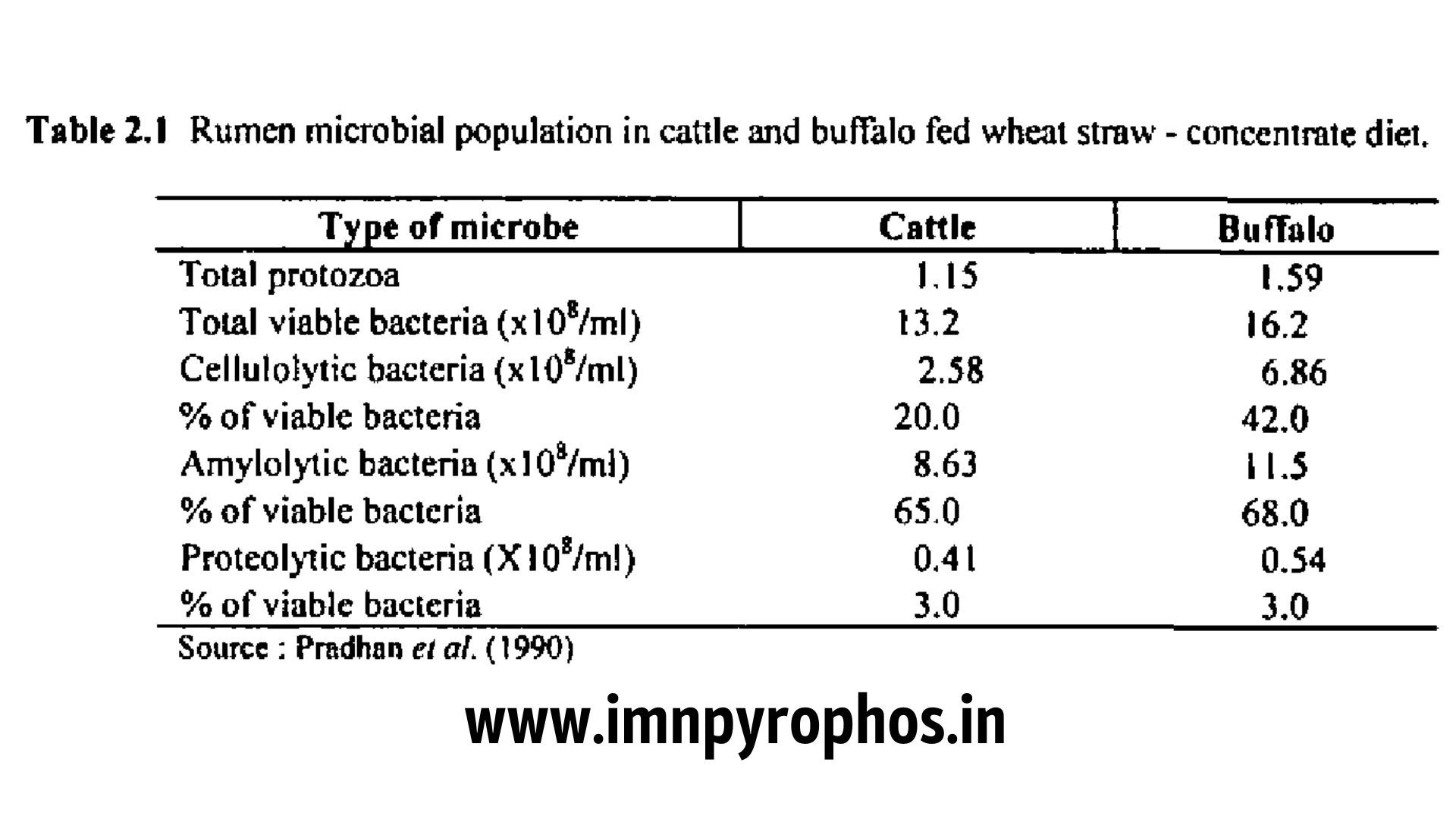
- The total rumen bacterial population in the buffalo is 16.2xl0^8/ml, while in cattle it is 13.2×10^8 /ml. The different species of rumen bacteria are grouped according to the substrates they act on. The major groups of bacteria are described below. The stabilization of this bacterial population can be successfully done by Rumenia.
- Celluloytic bacteria: This is the largest group of bacteria in the rumen and the substrate they act on is cellulose. The main species within this group are; Bacteriodes succinogen, Ruminococcus flavofaciens and Ruminococcus albus. The densities of these bacteria are estimated to be 2.6 x 10'8/ml and 6.9 x 10'8/ml in cattle and buffaloes, respectively. The viable bacterial percentages in cattle and buffaloes are 20% and 42% respectively.
- Amylolytic bacteria: The major substrate that this group acts on is starch or amylose. The main species of bacteria that use amylose are Bacteroides amylophilus and Streptococcus bovis. The total bacterial counts for each of the species, on straw based diets are 11.0 x 10'8/ml in buffalo and 8.6 x 10'8/ml in cattle, and the viability percentages are 68% and 65%, respectively. However, incorporation of soluble carbohydrates in the feed or the provision of less mature grasses, which are rich in starch and sugars can increase the bacterial population.
- Proteolytic bacteria: The common species of rumen bacteria generally do not use protein as the major energy source. However, about 30-50% of the bacteria isolated exhibited proteolytic activity towards extracellular proteins. Most species of bacteria exhibit proteolytic activity with the exception of the main cellulotytic bacteria, B. succinogen, R. flavofaciens and R. albus. Bacteroides amylophilus is one of the active proteolytic species present in the rumen. These are amlylolytic bacteria which are very important in the fermentation of starch-rich diets.
- The function of the proteolytic bacteria is the breakdown of dietary proteins into peptides and subsequently to ammonia. The total population of p’roteolytic bacteria in the buffalo is 0.54 x 10'8/ml and in cattle 0.41 x 10'8/ml on straw based diets, while the percentage viability count is 3% in both species.
- Methanogenic bacteria: This group of bacteria is important in the rumen for the removal of excess hydrogen that is produced in the rumen during carbohydrate fermentation and also to keep the rumen environment at a low hydrogen partial pressure. The most important species in this group is Methanobacterium ruminantium.
- Rumen protozoa: The population of protozoa in the rumen of cattle maintained on fibrous feeds is low (100,000/ml), but when fed on diets rich in starch or sugars, it could be as high as 4,000,000/ml in the rumen, many species of protozoa are present, but the major species are (a) Entodiniomorphids and (b) Holotrichs.
- The Entodiniomorphids which are able to take up soluble components, mainly depend on engulfment of particulate matter. They feed on bacteria, starch granules, cellulose and hemicellulose.
- The Holotrichs are a ciliated type of protozoa widely found in the reticulo-rumen. The three principal hoiotrich species in the rumen are, Isotricha intestinalis, Isotricha prostomia, Dasytricha ruminantium.
- The normal population of holotrichs is 100,000/ml, but this population increases when the diet is rich in soluble carbohydrates. The protozoa retained in the rumen are subjected to substantial lysis within the rumen. During re-mastication, bacteria and other soluble material are released from the mouth when the feed bolus is squeezed, and immediately passes into the omasum via the reticulum, while the protozoa remain in the squeezed bolus. This is due to the large size of cilia which attach them to large particles. Substantial amounts of protozoa are not only retained in rumen but also in the omasum within its more complex structure.
- Rumen fungi: Anaerobic fungi that inhabit the rumen have been isolated recently. These fungi belong to the phytomycaetes group. The vegetative stage of fungi carries sporangia developed from rhizoids (similar to the hyphae). These rhizoids grow within plant tissues. When roughage is ingested. sporangia immediately release zoospores which enter the new plant tissues through damaged parts of the plant or stomata of the leaves. Fungi are the first organisms to invade plant structural components starting from the inside. This reduces the tensile strength and facilitates the commencement of bacterial fermentation.
- Microbial interactions in the rumen: Types of microbes present in the rumen vary according to the species of livestock, feed and the time after feeding. However, the final products of fermentation are almost the same. Interaction of bacteria with bacteria in the rumen is very common. Most of the microbes in the rumen cannot survive long. They are interdependent as the end- products of one species becomes the substrate for another species. Therefore, in the absence of the first species, the survival of the latter species is uncertain. There is evidence to support the suggestion that end-products obtained from one species when present in a mixed culture is different from those from the same species in a pure culture. This indicates the inter-dependence of species for substrates that are either end-products or intemediate products. Many different species of bacteria are involved in the fermentation of cellulose to VFA. The relationship between hydrogen producing and hydrogen utilising bacteria is well recognised. These associations (syntropic associations) are mutually beneficial to the species and little can be done to alter these associations other than by inhibition of methanogenesis.
- Another common interaction in the rumen is that between bacteria and protozoa. Generally, protozoa predate on bacteria by engulfing (ensiling) them. 'This leads to low bacterial populations and as a result the colonization around structural feed particles is reduced. This will result in an increase in the retention time of feed in the rumen. Such conditions can be acute when the diet of the animal is low in soluble carbohydrates and rich in structural components. Under these circumstances, it is mandatory for protozoa to predate on bacteria for energy and nitrogen. Protozoa depend mainly on soluble starch and sugars. Once these are engulfed by the protozoa, they are stored within cells. Thus the competition between protozoa and bacteria for sugars and starch is very severe. Often when high sugar containing diets are fed, protozoa out-number the bacteria. One advantage is that in certain situations, protozoa reduce the severity of acidosis on some diets. Elimination of protozoa from the rumen (defaunation) increases the bacterial numbers in the liquid pool. The apparent dry matter digestibility is increased by 18% under defaunated conditions.
Made for buffaloes
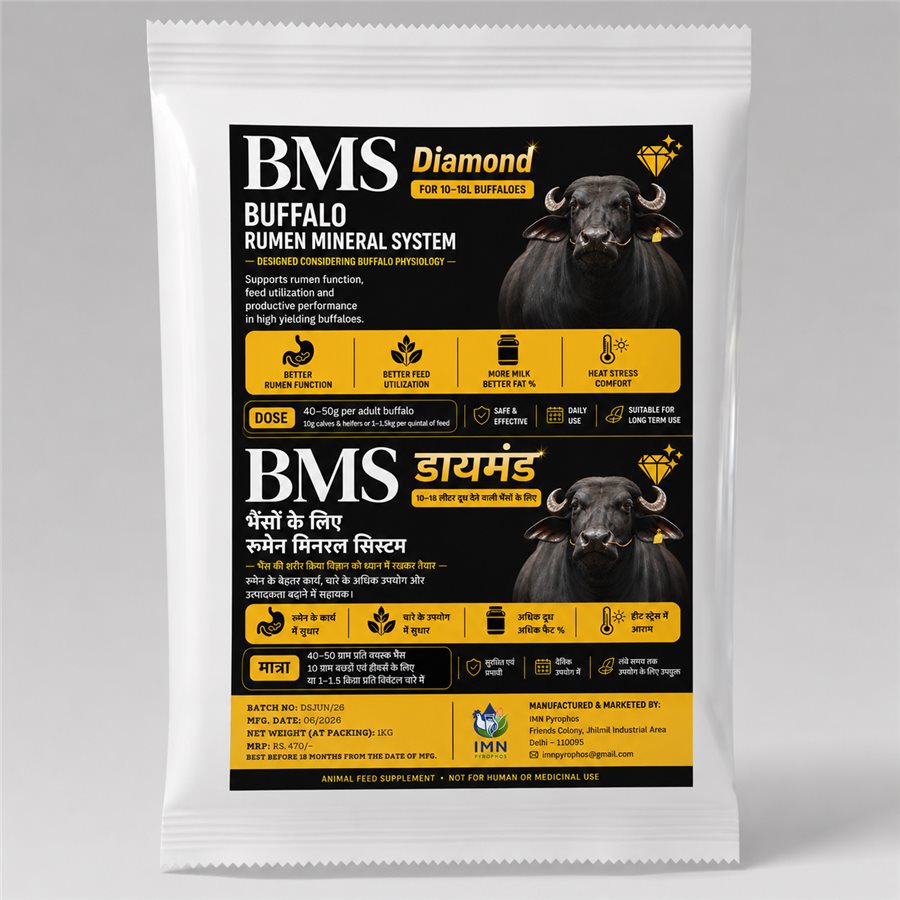
BMS Buffalo Mineral Mixture
A rumen mineral system designed for buffaloes giving 10–18 litres. Supports rumen function, feed utilization, milk and fat %, with comfort in heat stress. Safe for long-term daily use.
Dose: 40–50 g per adult buffalo per day, 10 g for calves and heifers, or 1–1.5 kg per quintal of feed.
5 kg ₹1,700MRP ₹3,150
Dairy feed premix · top seller
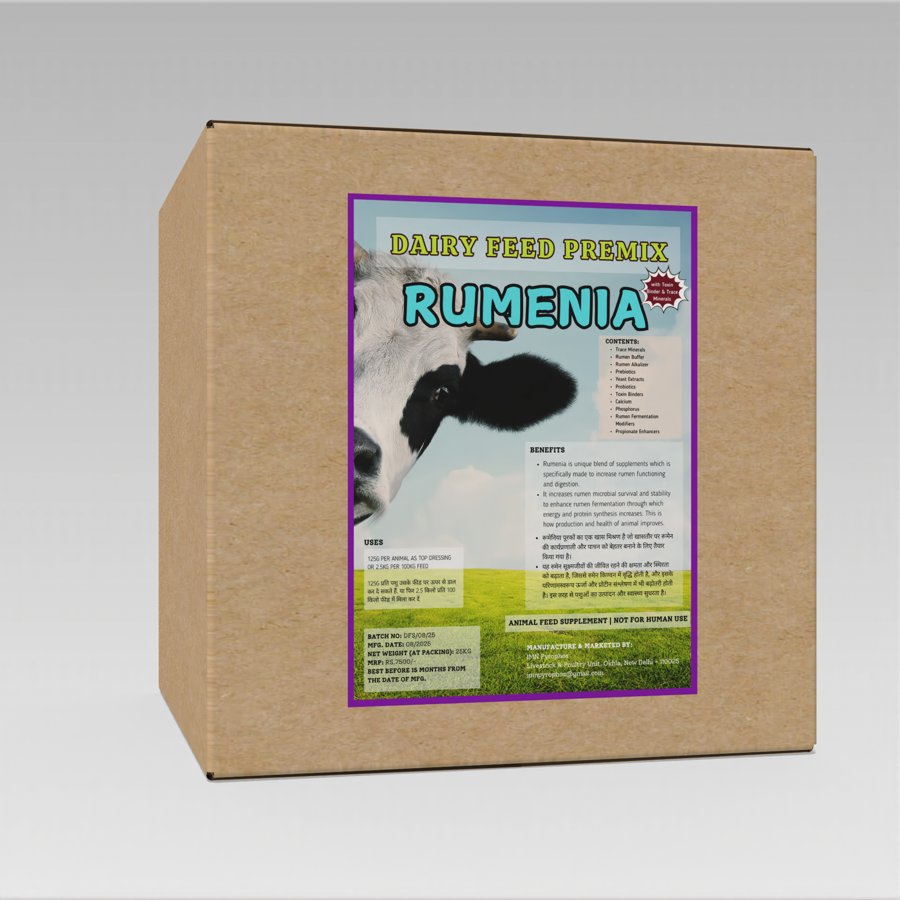
Rumenia
Trace minerals, rumen buffer, prebiotics, yeast extracts, probiotics, toxin binders, calcium, phosphorus and rumen fermentation modifiers. Improves rumen function, microbial stability, fermentation and energy and protein synthesis. 25 kg bag ₹5,625.
Dose: 2.5 kg per 100 kg feed.
5 kg ₹1,400MRP ₹1,800
Need help with feeding or a health problem in your cows or buffaloes? Message Dr. Ibne Ali on WhatsApp.
WhatsApp: 98715 84101- भैंस जुगाली करने वाला पशु (ruminant) है – हमारे एक और video में हमने rumen के बारे में बुनियादी जानकारी दी है।
- इसलिए भैंस के पोषण के बारे में सोचते समय सबसे पहले rumen को ध्यान में रखना है।
- दूसरी बात यह है कि भैंसें tropical और sub tropical (गर्म और अर्ध-गर्म इलाकों की) पशु हैं और वे कठोर, गर्म, नमी वाले वातावरण में विकसित हुई हैं, जिसका असर चारे की उपलब्धता पर पड़ता है।
- अब हमें यह समझना है कि घटिया चारे का पाचन गाय के मुकाबले भैंस में काफ़ी बेहतर होता है, यानी भैंसों को गायों के मुकाबले सूखे, घटिया तरह के चारे पर पाला जा सकता है।
- इस लेख में हम देखेंगे कि भैंसों में पाचन कैसे होता है, यह गायों से कैसे अलग और बेहतर है, और यह भी देखेंगे कि भैंसें घटिया quality के चारे पर कैसे पल सकती हैं।
तो चलिए rumen microbiology (rumen के सूक्ष्म जीवों) से शुरू करते हैं
- Rumen का मुख्य काम खाए गए चारे को उतनी देर तक रोककर रखना है जितनी देर सूक्ष्म जीवों (microbes) द्वारा पाचन के लिए ज़रूरी है।
- Rumen में पाचन की प्रक्रिया ज़्यादातर कई तरह के rumen microbes से चलती है। Reticulo-rumen में microbes द्वारा किण्वन (fermentation) मुख्य रूप से बिना हवा वाले (anaerobic) bacteria और protozoa से होता है, और कुछ हद तक कुछ fungi से।
- Rumen में मौजूद सूक्ष्म जीवों के समूहों में सबसे ज़रूरी समूह rumen bacteria (rumen flora) है।
- भैंस में rumen bacteria की कुल संख्या 16.2xl0^8/ml है, जबकि गाय में यह 13.2×10^8 /ml है। Rumen bacteria की अलग-अलग प्रजातियों को इस आधार पर समूहों में बाँटा जाता है कि वे किस चीज़ (substrate) पर काम करते हैं। Bacteria के मुख्य समूह नीचे बताए गए हैं। इस bacteria आबादी को स्थिर रखने का काम Rumenia से सफलतापूर्वक किया जा सकता है।
- Cellulolytic bacteria: यह rumen में bacteria का सबसे बड़ा समूह है और ये cellulose पर काम करते हैं। इस समूह की मुख्य प्रजातियाँ हैं; Bacteriodes succinogen, Ruminococcus flavofaciens और Ruminococcus albus। इन bacteria की संख्या गाय और भैंस में क्रमशः 2.6 x 10'8/ml और 6.9 x 10'8/ml आँकी गई है। गाय और भैंस में ज़िंदा (viable) bacteria का प्रतिशत क्रमशः 20% और 42% है।
- Amylolytic bacteria: यह समूह मुख्य रूप से starch या amylose पर काम करता है। Amylose इस्तेमाल करने वाले bacteria की मुख्य प्रजातियाँ Bacteroides amylophilus और Streptococcus bovis हैं। भूसा (straw) आधारित खुराक पर इनकी कुल bacteria गिनती भैंस में 11.0 x 10'8/ml और गाय में 8.6 x 10'8/ml है, और viability प्रतिशत क्रमशः 68% और 65% है। लेकिन चारे में घुलनशील carbohydrates मिलाने से या कम पकी (कच्ची) घास देने से, जिसमें starch और शक्कर भरपूर होती है, bacteria की संख्या बढ़ सकती है।
- Proteolytic bacteria: Rumen bacteria की आम प्रजातियाँ आम तौर पर protein को ऊर्जा के मुख्य स्रोत के रूप में इस्तेमाल नहीं करतीं। लेकिन अलग किए गए bacteria में से लगभग 30-50% ने बाहरी (extracellular) proteins पर proteolytic गतिविधि दिखाई। मुख्य cellulolytic bacteria, B. succinogen, R. flavofaciens और R. albus को छोड़कर, ज़्यादातर bacteria प्रजातियाँ proteolytic गतिविधि दिखाती हैं। Bacteroides amylophilus, rumen में मौजूद सक्रिय proteolytic प्रजातियों में से एक है। ये amylolytic bacteria हैं जो starch से भरपूर खुराक के किण्वन में बहुत ज़रूरी हैं।
- Proteolytic bacteria का काम खुराक के proteins को peptides में और फिर ammonia में तोड़ना है। भूसा आधारित खुराक पर proteolytic bacteria की कुल संख्या भैंस में 0.54 x 10'8/ml और गाय में 0.41 x 10'8/ml है, जबकि viability प्रतिशत दोनों में 3% है।
- Methanogenic bacteria: Bacteria का यह समूह rumen में carbohydrate के किण्वन के दौरान बनने वाली ज़्यादा hydrogen को हटाने के लिए, और rumen के वातावरण में hydrogen का partial pressure कम रखने के लिए ज़रूरी है। इस समूह की सबसे ज़रूरी प्रजाति Methanobacterium ruminantium है।
- Rumen protozoa: रेशेदार (fibrous) चारे पर रखी गई गायों के rumen में protozoa की संख्या कम (100,000/ml) होती है, लेकिन starch या शक्कर से भरपूर खुराक देने पर यह rumen में 4,000,000/ml तक हो सकती है; protozoa की कई प्रजातियाँ मौजूद होती हैं, लेकिन मुख्य प्रजातियाँ (a) Entodiniomorphids और (b) Holotrichs हैं।
- Entodiniomorphids घुलनशील चीज़ें ले सकते हैं, लेकिन मुख्य रूप से कणों (particulate matter) को निगलने पर निर्भर रहते हैं। ये bacteria, starch के दाने, cellulose और hemicellulose खाते हैं।
- Holotrichs रोएँदार (ciliated) तरह के protozoa हैं जो reticulo-rumen में बहुत पाए जाते हैं। Rumen में तीन मुख्य holotrich प्रजातियाँ हैं: Isotricha intestinalis, Isotricha prostomia, Dasytricha ruminantium।
- Holotrichs की सामान्य संख्या 100,000/ml है, लेकिन जब खुराक में घुलनशील carbohydrates भरपूर हों तो यह संख्या बढ़ जाती है। Rumen में रुके protozoa का rumen के अंदर ही काफ़ी विघटन (lysis) होता है। जुगाली (re-mastication) के दौरान जब चारे का गोला (bolus) दबाया जाता है, तो bacteria और दूसरी घुलनशील चीज़ें मुँह से निकलकर तुरंत reticulum के रास्ते omasum में चली जाती हैं, जबकि protozoa दबाए गए गोले में ही रह जाते हैं। ऐसा उनके बड़े cilia (रोओं) की वजह से होता है, जो उन्हें बड़े कणों से चिपकाए रखते हैं। काफ़ी मात्रा में protozoa न सिर्फ़ rumen में बल्कि omasum की ज़्यादा जटिल बनावट के अंदर भी रुके रहते हैं।
- Rumen fungi: Rumen में रहने वाली बिना हवा वाली (anaerobic) fungi को हाल ही में अलग किया गया है। ये fungi phytomycaetes समूह की हैं। Fungi की बढ़वार वाली अवस्था में rhizoids (hyphae जैसे) से बने sporangia होते हैं। ये rhizoids पौधे के tissues के अंदर बढ़ते हैं। जब मोटा चारा (roughage) खाया जाता है, तो sporangia तुरंत zoospores छोड़ते हैं, जो पौधे के टूटे हिस्सों या पत्तियों के stomata (छिद्रों) से नए पौधे के tissues में घुस जाते हैं। पौधे के बनावटी हिस्सों पर अंदर से हमला करने वाले सबसे पहले जीव fungi ही हैं। इससे चारे की मज़बूती (tensile strength) कम होती है और bacteria का किण्वन शुरू होना आसान हो जाता है।
- Rumen में microbes का आपसी तालमेल: Rumen में मौजूद microbes की किस्में पशु की प्रजाति, चारे और चारा खाने के बाद के समय के हिसाब से बदलती हैं। लेकिन किण्वन के अंतिम उत्पाद लगभग एक जैसे होते हैं। Rumen में bacteria का bacteria से तालमेल बहुत आम है। Rumen के ज़्यादातर microbes लंबे समय तक ज़िंदा नहीं रह पाते। वे एक-दूसरे पर निर्भर हैं, क्योंकि एक प्रजाति के अंतिम उत्पाद दूसरी प्रजाति का भोजन (substrate) बनते हैं। इसलिए पहली प्रजाति न हो तो दूसरी प्रजाति का बचना पक्का नहीं है। इस बात के सबूत हैं कि कोई प्रजाति मिली-जुली culture में जो अंतिम उत्पाद बनाती है, वे उसी प्रजाति की शुद्ध culture वाले उत्पादों से अलग होते हैं। इससे पता चलता है कि प्रजातियाँ उन substrates के लिए एक-दूसरे पर निर्भर हैं जो या तो अंतिम उत्पाद हैं या बीच के उत्पाद। Cellulose को VFA में बदलने के किण्वन में bacteria की कई अलग-अलग प्रजातियाँ शामिल होती हैं। Hydrogen बनाने वाले और hydrogen इस्तेमाल करने वाले bacteria का संबंध अच्छी तरह जाना-माना है। ये साझेदारियाँ (syntropic associations) प्रजातियों के लिए आपस में फ़ायदेमंद हैं और methane बनने (methanogenesis) को रोकने के अलावा इन साझेदारियों को बदलने के लिए कुछ खास नहीं किया जा सकता।
- Rumen में एक और आम तालमेल bacteria और protozoa के बीच होता है। आम तौर पर protozoa, bacteria को निगलकर (engulfing/ensiling) उनका शिकार करते हैं। इससे bacteria की संख्या कम हो जाती है और नतीजतन चारे के रेशेदार कणों के आसपास उनका जमना (colonization) घट जाता है। इससे rumen में चारे के रुकने का समय बढ़ जाता है। ऐसी स्थिति तब गंभीर हो सकती है जब पशु की खुराक में घुलनशील carbohydrates कम और रेशेदार हिस्से ज़्यादा हों। इन हालात में protozoa के लिए ऊर्जा और nitrogen के लिए bacteria का शिकार करना ज़रूरी हो जाता है। Protozoa मुख्य रूप से घुलनशील starch और शक्कर पर निर्भर रहते हैं। एक बार protozoa इन्हें निगल लें, तो ये cells के अंदर जमा हो जाते हैं। इसलिए शक्कर और starch के लिए protozoa और bacteria के बीच मुकाबला बहुत कड़ा होता है। अक्सर जब ज़्यादा शक्कर वाली खुराक दी जाती है, तो protozoa की संख्या bacteria से ज़्यादा हो जाती है। एक फ़ायदा यह है कि कुछ हालात में protozoa कुछ खुराकों पर acidosis की गंभीरता कम करते हैं। Rumen से protozoa हटाने (defaunation) पर तरल हिस्से (liquid pool) में bacteria की संख्या बढ़ जाती है। Defaunated हालात में dry matter की पाचनशीलता (digestibility) 18% बढ़ जाती है।
भैंसों के लिए बना
BMS Buffalo Mineral Mixture
10–18 लीटर दूध देने वाली भैंसों के लिए रुमेन मिनरल सिस्टम। रुमेन के काम, चारे के उपयोग, दूध और फैट % में सहायक, गर्मी के तनाव में आराम। रोज़ लंबे समय तक देने के लिए सुरक्षित।
मात्रा: 40–50 ग्राम प्रति वयस्क भैंस प्रति दिन, बछड़ों और बछियों को 10 ग्राम, या 1–1.5 किलो प्रति क्विंटल दाना।
5 kg ₹1,700MRP ₹3,150
डेयरी फीड प्रीमिक्स · टॉप सेलर
Rumenia
ट्रेस मिनरल, रुमेन बफर, प्रीबायोटिक, यीस्ट एक्सट्रैक्ट, प्रोबायोटिक, टॉक्सिन बाइंडर, कैल्शियम, फॉस्फोरस और रुमेन फर्मेंटेशन मॉडिफायर। रुमेन का काम, माइक्रोब की स्थिरता, फर्मेंटेशन और ऊर्जा व प्रोटीन बनना सुधारता है। 25 किलो बैग ₹5,625।
मात्रा: 2.5 किलो प्रति 100 किलो दाना।
5 kg ₹1,400MRP ₹1,800
गाय-भैंस के दाने या बीमारी में मदद चाहिए? डॉ. इब्ने अली को WhatsApp कीजिए।
WhatsApp: 98715 84101- Bhains jugaali karne wala pashu (ruminant) hai – hamare ek aur video me humne rumen ke baare me basic jaankari di hai.
- Isliye bhains ke nutrition ke baare me sochte samay sabse pehle rumen ko dhyan me rakhna hai.
- Doosri baat ye hai ki bhainsein tropical aur sub tropical (garam aur semi-garam ilakon ki) pashu hain aur wo sakht, garam, nami wale mahaul me viksit hui hain, jiska asar chare ki availability par padta hai.
- Ab hume ye samajhna hai ki ghatiya chare ka pachan gaay ke mukable bhains me kaafi behtar hota hai, yaani bhainson ko gaayon ke mukable sookhe, ghatiya type ke chare par paala ja sakta hai.
- Is article me hum dekhenge ki bhainson me pachan kaise hota hai, ye gaayon se kaise alag aur behtar hai, aur ye bhi dekhenge ki bhainsein ghatiya quality ke chare par kaise pal sakti hain.
To chaliye rumen microbiology (rumen ke sookshm jeevon) se shuru karte hain
- Rumen ka main kaam khaye gaye chare ko utni der tak rok kar rakhna hai jitni der microbes dwara pachan ke liye zaruri hai.
- Rumen me pachan ki process zyadatar kai tarah ke rumen microbes se chalti hai. Reticulo-rumen me microbes dwara fermentation mainly bina hawa wale (anaerobic) bacteria aur protozoa se hota hai, aur kuch had tak kuch fungi se.
- Rumen me maujood microbes ke groups me sabse zaruri group rumen bacteria (rumen flora) hai.
- Bhains me rumen bacteria ki total sankhya 16.2xl0^8/ml hai, jabki gaay me ye 13.2×10^8 /ml hai. Rumen bacteria ki alag-alag species ko is basis par groups me baanta jaata hai ki wo kis cheez (substrate) par kaam karte hain. Bacteria ke main groups neeche bataye gaye hain. Is bacteria population ko stable rakhne ka kaam Rumenia se successfully kiya ja sakta hai.
- Cellulolytic bacteria: Ye rumen me bacteria ka sabse bada group hai aur ye cellulose par kaam karte hain. Is group ki main species hain; Bacteriodes succinogen, Ruminococcus flavofaciens aur Ruminococcus albus. In bacteria ki sankhya gaay aur bhains me kram se 2.6 x 10'8/ml aur 6.9 x 10'8/ml aanki gayi hai. Gaay aur bhains me zinda (viable) bacteria ka percentage kram se 20% aur 42% hai.
- Amylolytic bacteria: Ye group mainly starch ya amylose par kaam karta hai. Amylose use karne wale bacteria ki main species Bacteroides amylophilus aur Streptococcus bovis hain. Bhoosa (straw) based khuraak par inki total bacteria ginti bhains me 11.0 x 10'8/ml aur gaay me 8.6 x 10'8/ml hai, aur viability percentage kram se 68% aur 65% hai. Lekin chare me ghulne wale carbohydrates milane se ya kam paki (kachchi) ghaas dene se, jisme starch aur shakkar bharpoor hoti hai, bacteria ki sankhya badh sakti hai.
- Proteolytic bacteria: Rumen bacteria ki aam species aam taur par protein ko energy ke main source ke roop me use nahi karti. Lekin alag kiye gaye bacteria me se lagbhag 30-50% ne bahari (extracellular) proteins par proteolytic activity dikhayi. Main cellulolytic bacteria, B. succinogen, R. flavofaciens aur R. albus ko chhod kar, zyadatar bacteria species proteolytic activity dikhati hain. Bacteroides amylophilus, rumen me maujood active proteolytic species me se ek hai. Ye amylolytic bacteria hain jo starch se bharpoor khuraak ke fermentation me bahut zaruri hain.
- Proteolytic bacteria ka kaam khuraak ke proteins ko peptides me aur phir ammonia me todna hai. Bhoosa based khuraak par proteolytic bacteria ki total sankhya bhains me 0.54 x 10'8/ml aur gaay me 0.41 x 10'8/ml hai, jabki viability percentage dono me 3% hai.
- Methanogenic bacteria: Bacteria ka ye group rumen me carbohydrate fermentation ke dauran banne wali extra hydrogen ko hatane ke liye, aur rumen ke mahaul me hydrogen ka partial pressure kam rakhne ke liye zaruri hai. Is group ki sabse zaruri species Methanobacterium ruminantium hai.
- Rumen protozoa: Reshedar (fibrous) chare par rakhi gayi gaayon ke rumen me protozoa ki sankhya kam (100,000/ml) hoti hai, lekin starch ya shakkar se bharpoor khuraak dene par ye rumen me 4,000,000/ml tak ho sakti hai; protozoa ki kai species maujood hoti hain, lekin main species (a) Entodiniomorphids aur (b) Holotrichs hain.
- Entodiniomorphids ghulne wali cheezein le sakte hain, lekin mainly kanon (particulate matter) ko nigalne par nirbhar rehte hain. Ye bacteria, starch ke daane, cellulose aur hemicellulose khaate hain.
- Holotrichs roondaar (ciliated) type ke protozoa hain jo reticulo-rumen me bahut paaye jaate hain. Rumen me teen main holotrich species hain: Isotricha intestinalis, Isotricha prostomia, Dasytricha ruminantium.
- Holotrichs ki normal sankhya 100,000/ml hai, lekin jab khuraak me ghulne wale carbohydrates bharpoor hon to ye sankhya badh jaati hai. Rumen me ruke protozoa ka rumen ke andar hi kaafi lysis (tootna) hota hai. Jugaali (re-mastication) ke dauran jab chare ka gola (bolus) dabaya jaata hai, to bacteria aur doosri ghulne wali cheezein munh se nikal kar turant reticulum ke raaste omasum me chali jaati hain, jabki protozoa dabaye gaye gole me hi reh jaate hain. Aisa unke bade cilia (roon) ki wajah se hota hai, jo unhe bade kanon se chipkaye rakhte hain. Kaafi matra me protozoa na sirf rumen me balki omasum ki zyada complex banawat ke andar bhi ruke rehte hain.
- Rumen fungi: Rumen me rehne wali bina hawa wali (anaerobic) fungi ko haal hi me alag kiya gaya hai. Ye fungi phytomycaetes group ki hain. Fungi ki growth wali stage me rhizoids (hyphae jaise) se bane sporangia hote hain. Ye rhizoids paudhe ke tissues ke andar badhte hain. Jab mota chara (roughage) khaya jaata hai, to sporangia turant zoospores chhodte hain, jo paudhe ke toote hisson ya pattiyon ke stomata (chhedon) se naye paudhe ke tissues me ghus jaate hain. Paudhe ke banawati hisson par andar se hamla karne wale sabse pehle jeev fungi hi hain. Isse chare ki mazbooti (tensile strength) kam hoti hai aur bacteria ka fermentation shuru hona aasaan ho jaata hai.
- Rumen me microbes ka aapsi taalmel: Rumen me maujood microbes ki kism pashu ki species, chare aur chara khane ke baad ke time ke hisaab se badalti hai. Lekin fermentation ke final products lagbhag ek jaise hote hain. Rumen me bacteria ka bacteria se taalmel bahut aam hai. Rumen ke zyadatar microbes lambe samay tak zinda nahi reh paate. Wo ek-doosre par nirbhar hain, kyunki ek species ke final products doosri species ka khana (substrate) bante hain. Isliye pehli species na ho to doosri species ka bachna pakka nahi hai. Is baat ke saboot hain ki koi species mix culture me jo final products banati hai, wo usi species ki pure culture wale products se alag hote hain. Isse pata chalta hai ki species un substrates ke liye ek-doosre par nirbhar hain jo ya to final products hain ya beech ke products. Cellulose ko VFA me badalne ke fermentation me bacteria ki kai alag-alag species shamil hoti hain. Hydrogen banane wale aur hydrogen use karne wale bacteria ka rishta achhi tarah jaana-maana hai. Ye partnerships (syntropic associations) species ke liye aapas me faydemand hain aur methane banne (methanogenesis) ko rokne ke alawa in partnerships ko badalne ke liye kuch khaas nahi kiya ja sakta.
- Rumen me ek aur aam taalmel bacteria aur protozoa ke beech hota hai. Aam taur par protozoa, bacteria ko nigal kar (engulfing/ensiling) unka shikaar karte hain. Isse bacteria ki sankhya kam ho jaati hai aur natije me chare ke reshedar kanon ke aas-paas unka jamna (colonization) ghat jaata hai. Isse rumen me chare ke rukne ka time badh jaata hai. Aisi situation tab serious ho sakti hai jab pashu ki khuraak me ghulne wale carbohydrates kam aur reshedar hisse zyada hon. In halaat me protozoa ke liye energy aur nitrogen ke liye bacteria ka shikaar karna zaruri ho jaata hai. Protozoa mainly ghulne wale starch aur shakkar par nirbhar rehte hain. Ek baar protozoa inhe nigal lein, to ye cells ke andar jama ho jaate hain. Isliye shakkar aur starch ke liye protozoa aur bacteria ke beech muqabla bahut kada hota hai. Aksar jab zyada shakkar wali khuraak di jaati hai, to protozoa ki sankhya bacteria se zyada ho jaati hai. Ek fayda ye hai ki kuch halaat me protozoa kuch khuraakon par acidosis ki gambhirta kam karte hain. Rumen se protozoa hatane (defaunation) par liquid pool me bacteria ki sankhya badh jaati hai. Defaunated halaat me dry matter ki digestibility (pachan) 18% badh jaati hai.
Bhainson ke liye bana
BMS Buffalo Mineral Mixture
10–18 litre doodh dene wali bhainson ke liye rumen mineral system. Rumen ke kaam, chaare ke upyog, doodh aur fat % me sahayak, garmi ke tanaav me aaram. Roz lambe samay tak dene ke liye surakshit.
Matra: 40–50 g prati vayask bhains prati din, bachhdon aur bachhiyon ko 10 g, ya 1–1.5 kg prati quintal daana.
5 kg ₹1,700MRP ₹3,150
Dairy feed premix · top seller
Rumenia
Trace mineral, rumen buffer, prebiotic, yeast extract, probiotic, toxin binder, calcium, phosphorus aur rumen fermentation modifier. Rumen ka kaam, microbes ki sthirta, fermentation aur urja va protein banna sudharta hai. 25 kg bag ₹5,625.
Matra: 2.5 kg prati 100 kg daana.
5 kg ₹1,400MRP ₹1,800
Gaay-bhains ke daane ya bimari me madad chahiye? Dr. Ibne Ali ko WhatsApp kijiye.
WhatsApp: 98715 84101