TLU calculator (पशु इकाई)
South Asia coefficients from this article: cattle 0.5, buffalo 0.5, sheep 0.1, goat 0.1, chicken 0.01.
Tropical Livestock Units (TLUs) in India: A Practical Guide for Sustainable Farming
Tropical Livestock Units (TLUs) in the Indian Context: A Detailed Analysis
Introduction to Tropical Livestock Units (TLUs) Tropical Livestock Units (TLUs) provide a standardized method to quantify and compare different livestock species and sizes in tropical regions, accounting for their metabolic needs and feed requirements. As outlined by Rout, Kumar, and Behera (2020), TLU is defined as the equivalent of one cow with a body weight of 250 kg, serving as a reference unit. This metric is particularly relevant in India, where diverse livestock systems support millions of rural livelihoods and contribute to food security.
Definition and Calculation:
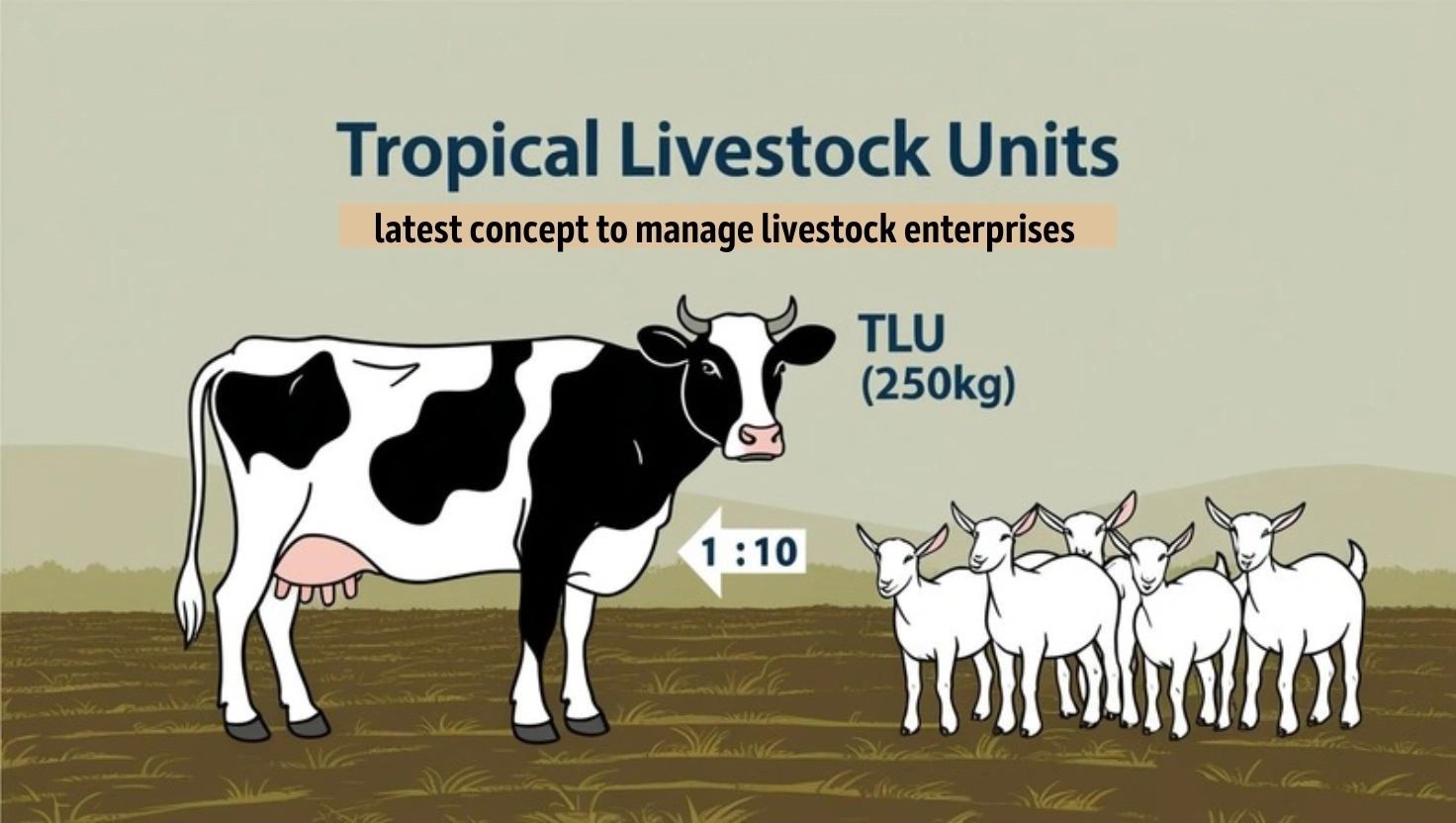
- TLU converts livestock body weight into metabolic weight (Bw^0.75) to standardize comparisons across species. It specifies TLU coefficients for various animals in tropical regions: cattle (0.7), sheep (0.1), goats (0.1), and chickens (0.01). For example, one goat is equivalent to 0.1 TLU, meaning 10 goats equal the metabolic demand of one 250 kg cow (1 TLU).
- Here we can see an example: in a farm with 3 cows (3 × 0.7 = 2.1 TLU) and 20 goats (20 × 0.1 = 2 TLU), the total TLU is 4.1. This helps farmers assess the carrying capacity of their land.
- Age and size variations are also considered. For instance, a bovine calf under 1 year has a coefficient of 0.4, while a dairy cow over 2 years is 1.0.
Regional Coefficients:
- Studies lists TLU coefficients for South Asia, where India is a major player: cattle (0.5), buffalo (0.5), sheep (0.1), goats (0.1), and chickens (0.01). These lower values reflect the smaller body sizes and feed requirements of tropical breeds compared to, say, North America (cattle = 1.0).
Stocking Density and Practical Application:
- TLU is used to calculate stocking density, defined as total livestock units divided by land area (in hectares). For example, 10 cows (7 TLU) on 5 hectares for 3 months yield an annual stocking density of 0.5 LU/ha (7 TLU ÷ 5 ha ÷ 4 quarters).
- The average animal weight method for stocking rate determination, using a conversion factor of 2.667% of body weight for daily forage needs. For a 300 kg cow, daily forage is 8.001 kg (300 × 0.02667), and monthly intake is 240.03 kg, guiding farmers on sustainable grazing.
Goat Population and TLU Contribution in India:
- India, part of South Asia, has seen significant goat population growth, contributing 12.05% to the region’s livestock population in 2014. Goats’ low TLU (0.1) makes them ideal for resource-constrained farmers, as they require less feed and land than cattle or buffalo.
- South Asia’s overall TLU growth was 6.5% from 1997–2014, driven partly by goats, which are critical in India’s arid and semi-arid regions.
Indian Context: India hosts one of the largest goat populations globally, with over 148 million goats as per the 20th Livestock Census (2019), making TLUs a vital tool for managing its diverse livestock systems. Here’s how TLUs are practically relevant in India:
1. Resource Allocation in Smallholder Systems:
- Most Indian farmers operate smallholdings with mixed livestock (goats, cattle, buffalo). TLUs help them balance feed and land resources. For instance, a farmer in Rajasthan with 2 cows (2 × 0.5 = 1 TLU), 1 buffalo (0.5 TLU), and 15 goats (15 × 0.1 = 1.5 TLU) has a total of 3 TLU. If their 2-hectare pasture supports 1.5 TLU/ha, they can sustain 3 TLU without overgrazing, ensuring sustainability.
- In Uttar Pradesh, cooperative dairy farms use TLU to allocate fodder from community lands, optimizing milk and meat production.
2. Policy and Planning:
- TLUs inform government schemes like the National Livestock Mission, which promotes sustainable livestock rearing. By estimating TLUs, policymakers can prioritize regions with high livestock density, such as Bihar (high goat populations), for feed subsidies or veterinary services.
- It suggests indicators like “livestock units per 100 people” for national planning. In India, with a rural population heavily reliant on livestock, this helps target interventions in states like Madhya Pradesh, where goats are a major income source.
3. Environmental Sustainability:
- Overgrazing is a challenge in India’s semi-arid regions, like Gujarat’s Kutch, where nomadic pastoralists rely on goats. TLUs guide stocking rates to prevent land degradation. For example, a 10-hectare rangeland supporting 5 TLU/ha can sustain 50 goats (5 TLU) or 7 cows (4.9 TLU), helping farmers avoid ecological damage.
- It also highlights integrated systems (grazing with tree cropping) in South Asia, seen in Tamil Nadu, where goats graze under coconut plantations, enhancing soil fertility via manure while maintaining low TLU pressure.
4. Herd Health and Productivity:
- This system is useful in herd health monitoring to optimize TLUs by improving animal weight and health. In India, diseases like peste des petits ruminants reduce goat productivity. TLU calculations encourage farmers to invest in vaccinations, as healthier goats contribute more effectively to the herd’s TLU value.
- For example, a Maharashtra farmer with 20 goats (2 TLU) can increase productivity by adopting FAMACHA for parasite control, potentially raising body weights and maintaining TLU efficiency with fewer animals.
Additional Insights related to TLU
- Livestock Census Data: India’s 20th Livestock Census (2019) shows goats contributing significantly to rural economies, with states like Rajasthan (20.8 million goats) and West Bengal (11.8 million) leading. TLUs help quantify their impact relative to cattle (192.5 million), guiding resource allocation (DAHD, 2019).
- FAO Guidelines: The FAO’s TLU framework, is widely used in India for livestock surveys. It aids in assessing carrying capacity in diverse agro-climatic zones, from Punjab’s fertile plains to Andhra Pradesh’s drought-prone areas (FAO, 2005).
- Research Studies: Studies like those by ICAR-Central Institute for Research on Goats (CIRG) emphasize TLUs for optimizing goat farming in India. They recommend breed-specific TLU adjustments (e.g., Black Bengal goats have lower TLU than Jamunapari due to size differences), enhancing precision in resource planning.
Practical Challenges in India
- Data Gaps: Accurate TLU calculations require reliable livestock weight and population data, often lacking in remote Indian villages. Mobile apps for livestock monitoring, as piloted in Karnataka, could bridge this gap.
- Farmer Awareness: Many smallholder farmers are unaware of TLU concepts. Extension services, like those by Krishi Vigyan Kendras, need to train farmers in TLU-based management.
- Regional Variations: TLU coefficients may vary within India due to breed diversity (e.g., Sirohi goats vs. Barbari goats). Localized studies, as suggested by CIRG, are needed for precision.
Conclusion In India, TLUs are a practical tool for managing livestock in a resource-constrained, diverse agricultural landscape. By standardizing comparisons across species, TLUs enable farmers to optimize feed, land, and health investments, as seen in examples from Rajasthan, Tamil Nadu, and Maharashtra. For policymakers, TLUs guide sustainable interventions, aligning with India’s goals of food security and rural development. Integrating TLU-based planning with modern technology and extension services can amplify its impact, making goat farming a cornerstone of India’s sustainable future.
For all type of consultation contact 9871584101
Starting or running a goat farm? Ask Dr. Ibne Ali on WhatsApp about feeding, minerals and health.
WhatsApp: 98715 84101भारत में Tropical Livestock Units (TLUs): टिकाऊ पशुपालन के लिए एक व्यावहारिक गाइड
भारतीय संदर्भ में Tropical Livestock Units (TLUs): एक विस्तृत विश्लेषण
Tropical Livestock Units (TLUs) क्या हैं Tropical Livestock Units (TLUs) गर्म (tropical) इलाकों में अलग-अलग प्रजाति और अलग-अलग आकार के पशुओं को एक ही पैमाने पर गिनने और तुलना करने का तरीका है, जिसमें उनकी metabolic ज़रूरत और चारे की ज़रूरत को ध्यान में रखा जाता है। Rout, Kumar और Behera (2020) के अनुसार, 1 TLU का मतलब है 250 kg वज़न वाली एक गाय के बराबर, यही इसकी reference unit है। भारत में यह पैमाना खास तौर पर काम का है, क्योंकि यहाँ तरह-तरह के पशुपालन सिस्टम करोड़ों ग्रामीण परिवारों की रोज़ी-रोटी चलाते हैं और खाद्य सुरक्षा में योगदान देते हैं।
परिभाषा और हिसाब:
- TLU में पशु के शरीर के वज़न को metabolic weight (Bw^0.75) में बदला जाता है, ताकि अलग-अलग प्रजातियों की तुलना एक जैसी हो सके। इसमें tropical इलाकों के पशुओं के लिए TLU coefficient तय हैं: गाय-बैल/cattle (0.7), भेड़ (0.1), बकरी (0.1), और मुर्गी (0.01)। उदाहरण के लिए, एक बकरी 0.1 TLU के बराबर है, यानी 10 बकरियों की metabolic ज़रूरत 250 kg की एक गाय (1 TLU) के बराबर है।
- एक उदाहरण देखिए: किसी फार्म पर 3 गाय (3 × 0.7 = 2.1 TLU) और 20 बकरियाँ (20 × 0.1 = 2 TLU) हैं, तो कुल TLU 4.1 है। इससे किसान समझ पाता है कि उसकी ज़मीन कितने पशु संभाल सकती है (carrying capacity)।
- उम्र और आकार का फ़र्क भी गिना जाता है। जैसे, 1 साल से छोटे बछड़े का coefficient 0.4 है, जबकि 2 साल से बड़ी दुधारू गाय का 1.0 है।
क्षेत्र के हिसाब से coefficient:
- अध्ययनों में दक्षिण एशिया के लिए TLU coefficient दिए गए हैं, जहाँ भारत एक बड़ा देश है: गाय-बैल (0.5), भैंस (0.5), भेड़ (0.1), बकरी (0.1), और मुर्गी (0.01)। ये कम मान इसलिए हैं क्योंकि tropical नस्लों का शरीर छोटा होता है और चारे की ज़रूरत कम होती है, जबकि जैसे North America में cattle = 1.0 है।
Stocking density और व्यावहारिक इस्तेमाल:
- TLU से stocking density निकाली जाती है, यानी कुल livestock units को ज़मीन के क्षेत्रफल (hectare में) से भाग देना। उदाहरण के लिए, 5 hectare पर 3 महीने के लिए 10 गाय (7 TLU) हों तो सालाना stocking density 0.5 LU/ha बनती है (7 TLU ÷ 5 ha ÷ 4 तिमाही)।
- Stocking rate निकालने का औसत पशु वज़न वाला तरीका, जिसमें रोज़ के चारे की ज़रूरत के लिए शरीर के वज़न का 2.667% conversion factor लिया जाता है। 300 kg की गाय के लिए रोज़ का चारा 8.001 kg (300 × 0.02667) है, और महीने का 240.03 kg, जिससे किसान को टिकाऊ चराई की सही दिशा मिलती है।
भारत में बकरियों की संख्या और TLU में उनका योगदान:
- दक्षिण एशिया का हिस्सा होने के नाते भारत में बकरियों की संख्या काफ़ी बढ़ी है; 2014 में क्षेत्र की कुल पशु संख्या में बकरियों का हिस्सा 12.05% था। बकरी का TLU कम (0.1) होने से यह कम साधन वाले किसानों के लिए बढ़िया है, क्योंकि इसे गाय या भैंस से कम चारा और कम ज़मीन चाहिए।
- 1997–2014 के बीच दक्षिण एशिया का कुल TLU 6.5% बढ़ा, जिसका एक कारण बकरियाँ भी हैं, जो भारत के सूखे और अर्ध-सूखे इलाकों में बहुत अहम हैं।
भारतीय संदर्भ: 20वीं पशुधन गणना (2019) के अनुसार भारत में 148 million से ज़्यादा बकरियाँ हैं, जो दुनिया की सबसे बड़ी बकरी आबादी में से एक है। इसलिए यहाँ के अलग-अलग पशुपालन सिस्टम को संभालने में TLU बहुत काम का औज़ार है। भारत में TLU का व्यावहारिक उपयोग इस तरह है:
1. छोटे किसानों के लिए साधनों का बँटवारा:
- ज़्यादातर भारतीय किसान छोटी जोत पर मिले-जुले पशु (बकरी, गाय, भैंस) रखते हैं। TLU उन्हें चारे और ज़मीन का संतुलन बनाने में मदद करता है। जैसे, राजस्थान के एक किसान के पास 2 गाय (2 × 0.5 = 1 TLU), 1 भैंस (0.5 TLU), और 15 बकरियाँ (15 × 0.1 = 1.5 TLU) हैं, तो कुल 3 TLU हुए। अगर उसका 2 hectare का चरागाह 1.5 TLU/ha संभाल सकता है, तो वह बिना ज़्यादा चराई (overgrazing) के 3 TLU रख सकता है, और खेती टिकाऊ बनी रहती है।
- उत्तर प्रदेश में सहकारी डेयरी फार्म सामुदायिक ज़मीन से चारा बाँटने के लिए TLU का इस्तेमाल करते हैं, जिससे दूध और मांस उत्पादन बेहतर होता है।
2. नीति और योजना:
- TLU से National Livestock Mission जैसी सरकारी योजनाओं को जानकारी मिलती है, जो टिकाऊ पशुपालन को बढ़ावा देती हैं। TLU का अनुमान लगाकर नीति बनाने वाले उन इलाकों को पहले चुन सकते हैं जहाँ पशु घनत्व ज़्यादा है, जैसे बिहार (जहाँ बकरियाँ बहुत हैं), ताकि वहाँ चारे पर सब्सिडी या पशु चिकित्सा सेवाएँ दी जा सकें।
- राष्ट्रीय योजना के लिए “हर 100 लोगों पर livestock units” जैसे संकेतक भी सुझाए जाते हैं। भारत में, जहाँ ग्रामीण आबादी पशुपालन पर बहुत निर्भर है, इससे मध्य प्रदेश जैसे राज्यों में मदद पहुँचाना आसान होता है, जहाँ बकरियाँ आमदनी का बड़ा ज़रिया हैं।
3. पर्यावरण की सुरक्षा:
- भारत के अर्ध-सूखे इलाकों में ज़्यादा चराई (overgrazing) एक समस्या है, जैसे गुजरात का कच्छ, जहाँ घुमंतू पशुपालक बकरियों पर निर्भर हैं। TLU से stocking rate तय होता है ताकि ज़मीन खराब न हो। उदाहरण के लिए, 5 TLU/ha संभालने वाला 10 hectare का चरागाह 50 बकरियाँ (5 TLU) या 7 गाय (4.9 TLU) रख सकता है, जिससे किसान पर्यावरण को नुकसान से बचा सकता है।
- इसमें दक्षिण एशिया के integrated सिस्टम (पेड़ों की खेती के साथ चराई) पर भी ज़ोर है, जो तमिलनाडु में दिखता है, जहाँ बकरियाँ नारियल के बागों में चरती हैं; इससे गोबर-मींगनी से मिट्टी उपजाऊ होती है और TLU का दबाव भी कम रहता है।
4. झुंड का स्वास्थ्य और उत्पादकता:
- यह सिस्टम झुंड के स्वास्थ्य की निगरानी में काम आता है, ताकि पशुओं का वज़न और सेहत सुधार कर TLU का सही उपयोग हो। भारत में peste des petits ruminants (PPR) जैसी बीमारियाँ बकरियों की उत्पादकता घटा देती हैं। TLU के हिसाब से किसान vaccination में पैसा लगाने के लिए प्रेरित होते हैं, क्योंकि स्वस्थ बकरियाँ झुंड के TLU मूल्य में बेहतर योगदान देती हैं।
- उदाहरण के लिए, महाराष्ट्र का एक किसान जिसके पास 20 बकरियाँ (2 TLU) हैं, कीड़ों (parasite) के नियंत्रण के लिए FAMACHA तरीका अपनाकर उत्पादकता बढ़ा सकता है; इससे शरीर का वज़न बढ़ सकता है और कम पशुओं में भी TLU की कुशलता बनी रहती है।
TLU से जुड़ी कुछ और बातें
- पशुधन गणना के आँकड़े: भारत की 20वीं पशुधन गणना (2019) दिखाती है कि बकरियाँ ग्रामीण अर्थव्यवस्था में बड़ा योगदान देती हैं, जिसमें राजस्थान (20.8 million बकरियाँ) और पश्चिम बंगाल (11.8 million) सबसे आगे हैं। TLU से गाय-बैल (192.5 million) की तुलना में इनका असर मापा जा सकता है, जिससे साधनों के बँटवारे में दिशा मिलती है (DAHD, 2019)।
- FAO दिशानिर्देश: FAO का TLU framework भारत में पशुधन सर्वे में बहुत इस्तेमाल होता है। इससे पंजाब के उपजाऊ मैदानों से लेकर आंध्र प्रदेश के सूखा-ग्रस्त इलाकों तक, अलग-अलग agro-climatic zones में carrying capacity आँकने में मदद मिलती है (FAO, 2005)।
- शोध अध्ययन: ICAR-Central Institute for Research on Goats (CIRG) जैसे संस्थानों के अध्ययन भारत में बकरी पालन को बेहतर बनाने के लिए TLU पर ज़ोर देते हैं। वे नस्ल के हिसाब से TLU में बदलाव की सलाह देते हैं (जैसे, आकार के फ़र्क के कारण Black Bengal बकरी का TLU Jamunapari से कम होता है), जिससे साधनों की योजना और सटीक बनती है।
भारत में व्यावहारिक चुनौतियाँ
- आँकड़ों की कमी: सही TLU हिसाब के लिए पशुओं के वज़न और संख्या के भरोसेमंद आँकड़े चाहिए, जो दूर-दराज़ के गाँवों में अक्सर नहीं मिलते। कर्नाटक में आज़माए गए पशु निगरानी वाले mobile apps इस कमी को पूरा कर सकते हैं।
- किसानों में जानकारी: बहुत से छोटे किसान TLU के बारे में नहीं जानते। Krishi Vigyan Kendra जैसी विस्तार सेवाओं को किसानों को TLU आधारित प्रबंधन की ट्रेनिंग देनी होगी।
- क्षेत्रीय फ़र्क: नस्लों की विविधता के कारण भारत के अंदर भी TLU coefficient बदल सकते हैं (जैसे, Sirohi बकरी बनाम Barbari बकरी)। CIRG के सुझाव के अनुसार, सटीकता के लिए स्थानीय अध्ययन ज़रूरी हैं।
निष्कर्ष भारत में TLU कम साधनों वाली और विविधता भरी खेती में पशु प्रबंधन का एक व्यावहारिक औज़ार है। अलग-अलग प्रजातियों को एक पैमाने पर लाकर TLU किसानों को चारा, ज़मीन और स्वास्थ्य पर खर्च को सही ढंग से लगाने में मदद करता है, जैसा राजस्थान, तमिलनाडु और महाराष्ट्र के उदाहरणों में दिखा। नीति बनाने वालों के लिए TLU टिकाऊ योजनाओं की दिशा तय करता है, जो भारत के खाद्य सुरक्षा और ग्रामीण विकास के लक्ष्यों से मेल खाती हैं। TLU आधारित योजना को आधुनिक तकनीक और विस्तार सेवाओं के साथ जोड़ने से इसका असर और बढ़ सकता है, और बकरी पालन भारत के टिकाऊ भविष्य की मज़बूत नींव बन सकता है।
हर तरह की सलाह के लिए संपर्क करें 9871584101
बकरी फ़ार्म शुरू कर रहे हैं या चला रहे हैं? दाना, मिनरल और सेहत के बारे में डॉ. इब्ने अली से WhatsApp पर पूछिए।
WhatsApp: 98715 84101India me Tropical Livestock Units (TLUs): tikau pashupalan ke liye ek practical guide
Bharat ke hisaab se Tropical Livestock Units (TLUs): ek detail analysis
Tropical Livestock Units (TLUs) kya hote hain Tropical Livestock Units (TLUs) garam (tropical) ilakon me alag-alag species aur alag size ke pashuon ko ek hi paimane par ginne aur compare karne ka tareeka hai, jisme unki metabolic zarurat aur chare ki zarurat ko dhyan me rakha jata hai. Rout, Kumar aur Behera (2020) ke hisaab se, 1 TLU matlab 250 kg wajan wali ek gaay ke barabar, yahi iski reference unit hai. India me ye paimana khas kaam ka hai, kyunki yahan tarah-tarah ke pashupalan system crore-on gaon walon ki roji-roti chalate hain aur food security me yogdan dete hain.
Definition aur hisaab:
- TLU me pashu ke body weight ko metabolic weight (Bw^0.75) me badla jata hai, taaki alag species ka comparison ek jaisa ho sake. Isme tropical ilakon ke pashuon ke TLU coefficient fix hain: cattle/gaay-bail (0.7), bhed (0.1), bakri (0.1), aur murgi (0.01). Jaise, ek bakri 0.1 TLU ke barabar hai, yaani 10 bakriyon ki metabolic zarurat 250 kg ki ek gaay (1 TLU) ke barabar hai.
- Ek example dekhiye: kisi farm par 3 gaay (3 × 0.7 = 2.1 TLU) aur 20 bakriyan (20 × 0.1 = 2 TLU) hain, to total TLU 4.1 hai. Isse kisan samajh pata hai ki uski zameen kitne pashu sambhal sakti hai (carrying capacity).
- Umar aur size ka farak bhi gina jata hai. Jaise, 1 saal se chhote bachhde ka coefficient 0.4 hai, jabki 2 saal se badi doodh wali gaay ka 1.0 hai.
Region ke hisaab se coefficient:
- Studies me South Asia ke TLU coefficient diye gaye hain, jahan India ek bada desh hai: cattle (0.5), bhains (0.5), bhed (0.1), bakri (0.1), aur murgi (0.01). Ye kam values isliye hain kyunki tropical nasl ka sharir chhota hota hai aur chara kam lagta hai, jabki jaise North America me cattle = 1.0 hai.
Stocking density aur practical use:
- TLU se stocking density nikali jati hai, yaani total livestock units ko zameen ke area (hectare me) se divide karna. Jaise, 5 hectare par 3 mahine ke liye 10 gaay (7 TLU) hon to saal ki stocking density 0.5 LU/ha banti hai (7 TLU ÷ 5 ha ÷ 4 quarter).
- Stocking rate nikalne ka average pashu weight wala tareeka, jisme roz ke chare ki zarurat ke liye body weight ka 2.667% conversion factor liya jata hai. 300 kg ki gaay ke liye roz ka chara 8.001 kg (300 × 0.02667) hai, aur mahine ka 240.03 kg, jisse kisan ko tikau charai (grazing) ki sahi direction milti hai.
India me bakriyon ki sankhya aur TLU me unka yogdan:
- South Asia ka hissa hone ke naate India me bakriyon ki sankhya kaafi badhi hai; 2014 me region ki total livestock sankhya me bakriyon ka hissa 12.05% tha. Bakri ka TLU kam (0.1) hone se ye kam saadhan wale kisano ke liye badhiya hai, kyunki ise gaay ya bhains se kam chara aur kam zameen chahiye.
- 1997–2014 ke beech South Asia ka total TLU 6.5% badha, jiska ek kaaran bakriyan bhi hain, jo India ke sookhe aur semi-arid ilakon me bahut zaruri hain.
Indian context: 20th Livestock Census (2019) ke hisaab se India me 148 million se zyada bakriyan hain, jo duniya ki sabse badi bakri population me se ek hai. Isliye yahan ke alag-alag pashupalan system ko sambhalne me TLU bahut kaam ka tool hai. India me TLU ka practical use aise hai:
1. Chhote kisano ke liye saadhan ka batwara:
- Zyadatar Indian kisan chhoti zameen par mix pashu (bakri, gaay, bhains) rakhte hain. TLU unhe chare aur zameen ka balance banane me madad karta hai. Jaise, Rajasthan ke ek kisan ke paas 2 gaay (2 × 0.5 = 1 TLU), 1 bhains (0.5 TLU), aur 15 bakriyan (15 × 0.1 = 1.5 TLU) hain, to total 3 TLU hue. Agar uska 2 hectare ka charagah 1.5 TLU/ha sambhal sakta hai, to wo bina overgrazing ke 3 TLU rakh sakta hai, aur kaam tikau bana rehta hai.
- Uttar Pradesh me cooperative dairy farm community zameen se chara baantne ke liye TLU use karte hain, jisse doodh aur meat production behtar hota hai.
2. Policy aur planning:
- TLU se National Livestock Mission jaisi sarkari schemes ko jaankari milti hai, jo tikau pashupalan ko badhawa deti hain. TLU ka andaza lagakar policy banane wale un ilakon ko pehle chun sakte hain jahan pashu zyada ghane hain, jaise Bihar (jahan bakriyan bahut hain), taaki wahan chare par subsidy ya veterinary services di ja sakein.
- National planning ke liye “har 100 logon par livestock units” jaise indicator bhi suggest kiye jaate hain. India me, jahan gaon ki aabadi pashupalan par bahut nirbhar hai, isse Madhya Pradesh jaise rajyon me madad pahunchana aasaan hota hai, jahan bakriyan kamai ka bada zariya hain.
3. Environment ki suraksha:
- India ke semi-arid ilakon me overgrazing ek problem hai, jaise Gujarat ka Kutch, jahan ghumantu pashupalak bakriyon par nirbhar hain. TLU se stocking rate tay hota hai taaki zameen kharab na ho. Jaise, 5 TLU/ha sambhalne wala 10 hectare ka charagah 50 bakriyan (5 TLU) ya 7 gaay (4.9 TLU) rakh sakta hai, jisse kisan environment ko nuksaan se bacha sakta hai.
- Isme South Asia ke integrated system (pedon ki kheti ke saath charai) par bhi zor hai, jo Tamil Nadu me dikhta hai, jahan bakriyan nariyal ke baagon me charti hain; isse gobar-meengni se mitti upjau hoti hai aur TLU ka pressure bhi kam rehta hai.
4. Jhund ki health aur productivity:
- Ye system jhund ki health monitoring me kaam aata hai, taaki pashuon ka weight aur sehat sudhar kar TLU ka sahi use ho. India me peste des petits ruminants (PPR) jaisi bimariyan bakriyon ki productivity ghata deti hain. TLU ke hisaab se kisan vaccination me paisa lagane ke liye motivate hote hain, kyunki healthy bakriyan jhund ki TLU value me behtar yogdan deti hain.
- Jaise, Maharashtra ka ek kisan jiske paas 20 bakriyan (2 TLU) hain, parasite control ke liye FAMACHA tareeka apnakar productivity badha sakta hai; isse body weight badh sakta hai aur kam pashuon me bhi TLU efficiency bani rehti hai.
TLU se judi kuch aur baatein
- Livestock Census data: India ki 20th Livestock Census (2019) dikhati hai ki bakriyan gaon ki economy me bada yogdan deti hain, jisme Rajasthan (20.8 million bakriyan) aur West Bengal (11.8 million) sabse aage hain. TLU se cattle (192.5 million) ke mukable inka asar naapa ja sakta hai, jisse saadhan ke batware me direction milti hai (DAHD, 2019).
- FAO guidelines: FAO ka TLU framework India me livestock survey me bahut use hota hai. Isse Punjab ke upjau maidano se lekar Andhra Pradesh ke sookha-grast ilakon tak, alag-alag agro-climatic zones me carrying capacity aankne me madad milti hai (FAO, 2005).
- Research studies: ICAR-Central Institute for Research on Goats (CIRG) jaise sansthanon ki studies India me bakri palan behtar karne ke liye TLU par zor deti hain. Wo nasl ke hisaab se TLU me badlav ki salah dete hain (jaise, size ke farak ki wajah se Black Bengal bakri ka TLU Jamunapari se kam hota hai), jisse saadhan ki planning aur sahi banti hai.
India me practical challenges
- Data ki kami: Sahi TLU hisaab ke liye pashuon ke weight aur sankhya ka bharosemand data chahiye, jo door-daraz ke gaon me aksar nahi milta. Karnataka me try kiye gaye livestock monitoring wale mobile apps ye kami poori kar sakte hain.
- Kisano me jaankari: Bahut se chhote kisan TLU ke baare me nahi jaante. Krishi Vigyan Kendra jaisi extension services ko kisano ko TLU based management ki training deni hogi.
- Region ka farak: Nasl ki variety ki wajah se India ke andar bhi TLU coefficient badal sakte hain (jaise, Sirohi bakri vs Barbari bakri). CIRG ke suggestion ke hisaab se, sahi hisaab ke liye local studies zaruri hain.
Conclusion India me TLU kam saadhan wali aur variety bhari kheti me pashu management ka ek practical tool hai. Alag-alag species ko ek paimane par laakar TLU kisano ko chara, zameen aur health par kharch sahi tarah lagane me madad karta hai, jaisa Rajasthan, Tamil Nadu aur Maharashtra ke examples me dikha. Policy banane walon ke liye TLU tikau yojnaon ki direction tay karta hai, jo India ke food security aur gaon ke vikas ke lakshya se mel khaati hain. TLU based planning ko modern technology aur extension services ke saath jodne se iska asar aur badh sakta hai, aur bakri palan India ke tikau bhavishya ki mazboot neev ban sakta hai.
Har tarah ki salah ke liye contact karein 9871584101
Bakri farm shuru kar rahe hain ya chala rahe hain? Daana, mineral aur sehat ke baare me Dr. Ibne Ali se WhatsApp par poochiye.
WhatsApp: 98715 84101