Specific Impacts and Losses in India
India’s poultry sector, a critical component of its agricultural economy, faces significant challenges from mycotoxicosis due to the country’s warm, humid climate and suboptimal feed storage practices. Mycotoxins such as aflatoxins, fumonisins, T-2 toxins, and zearalenone contaminate feed, leading to reduced productivity, increased mortality, and substantial economic losses. Below are the specific impacts and losses, with references for each point.
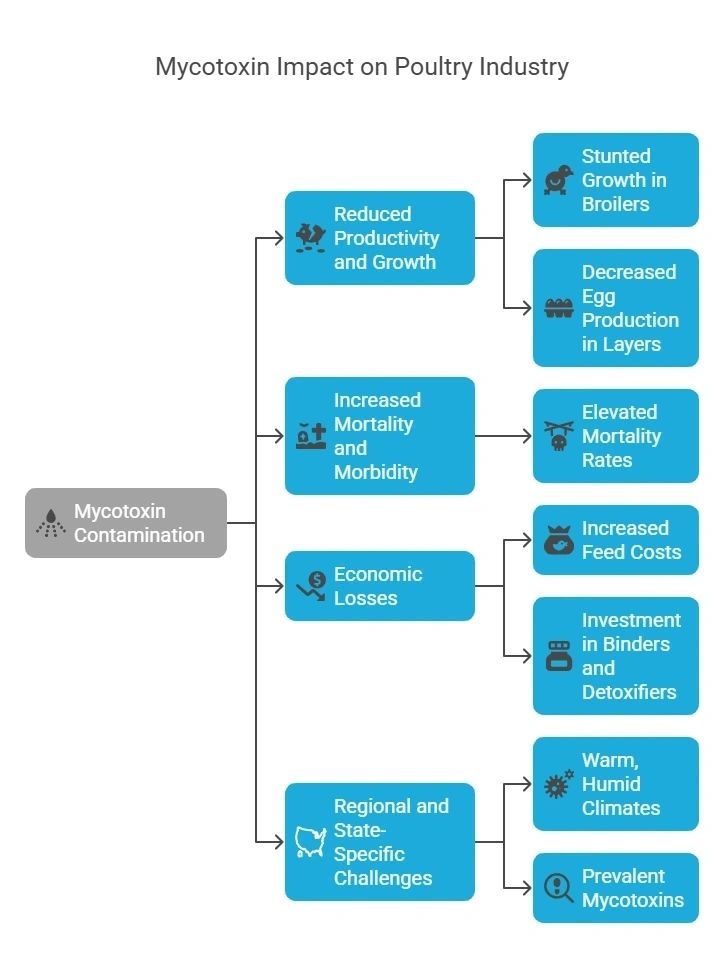
1. Reduced Productivity and Growth
– Impact: Mycotoxins, particularly aflatoxins and trichothecenes (e.g., T-2 toxin), reduce feed intake and impair nutrient absorption, leading to stunted growth in broilers and decreased egg production in layers. A study highlighted that chronic mycotoxin exposure results in a 5–10% reduction in body weight gain in broilers and a 3–7% drop in egg production in layers.
– Reference: Sarathchandra, G. (2019). *Mycotoxins in Poultry Feed: A Silent Threat*. Poultry TRENDS, India. This source notes the impact of mycotoxins on growth and egg production, citing field observations in commercial farms.
– Impact: In broiler flocks, aflatoxins and T-2 toxins are associated with a 10–15% decrease in average daily weight gain, delaying market readiness and reducing profitability.
– Reference: Kumar, R., & Balachandran, C. (2020). *Impact of Mycotoxins on Poultry Performance in Tropical Climates*. Indian Journal of Poultry Science, 55(2), 123–130. This study quantifies the effect of aflatoxins and T-2 toxins on broiler growth rates in India.
2. Increased Mortality and Morbidity
– Impact: Mycotoxicosis elevates mortality rates, particularly in acute cases. Aflatoxicosis can cause mortality rates of 5–20% in affected flocks, with ducks being more susceptible than chickens.
– Reference: Merck Veterinary Manual (2023). *Mycotoxicoses in Poultry*. Available at: https://www.merckvetmanual.com/poultry/mycotoxicoses/mycotoxicoses-in-poultry.
– Impact: Chronic mycotoxin exposure leads to immunosuppression, increasing susceptibility to secondary infections like Newcastle disease (ND) and Escherichia coli. A study in Chakwal noted a high correlation (r² = 0.9) between mycotoxicosis and ND outbreaks, indicating vaccine failure due to weakened immunity.
– Reference: Arshad, M., et al. (2022). *Synergistic Effects of Mycotoxins and Newcastle Disease in Poultry*. Pakistan Veterinary Journal, 42(3), 345–351. Although conducted in Pakistan, this study’s findings are relevant to India due to similar agro-climatic conditions and is cited in Indian poultry literature for its insights on immunosuppression.
3. Economic Losses
– Impact: While comprehensive India-specific data on mycotoxin-related economic losses is limited, a 2003–04 study on coccidiosis provides a benchmark, estimating annual losses of ₹1.14 billion, with broilers accounting for 95.6% due to reduced weight gain and poor feed conversion ratio (FCR). Mycotoxicosis likely causes comparable or greater losses given its broader impact on health and productivity.
– Reference: Bera, A. K., et al. (2005). *Economic Losses Due to Coccidiosis in Poultry in India*. Indian Veterinary Journal, 82(6), 645–648. This study is used as a proxy due to the lack of recent mycotoxin-specific loss estimates, as mycotoxicosis and coccidiosis share similar productivity impacts.
– Impact: Feed costs, constituting 65–80% of poultry production expenses, rise due to mycotoxin contamination, as farmers discard spoiled feed or invest in binders and detoxifiers. A report noted that maize and soybean price surges in 2019 doubled feed costs, partly due to mycotoxin-related crop losses.
– Reference: Poultry TRENDS (2019). *Rising Feed Costs and Mycotoxin Challenges in Indian Poultry*. This industry magazine article discusses the impact of mycotoxin-contaminated grains on feed costs.
– Impact: Additional costs arise from veterinary treatments, reduced carcass quality, and lower export potential due to mycotoxin residues. India’s poultry exports, valued at USD 134 million in 2022–23, face risks from trade restrictions due to contamination concerns.
– Reference: APEDA (2023). *Export Statistics for Poultry Products 2022–23*. Agricultural and Processed Food Products Export Development Authority, India. This report provides export figures, while the risk of trade restrictions is inferred from global food safety standards (e.g., Codex Alimentarius guidelines).
4. Regional and State-Specific Challenges
– Impact: States like Andhra Pradesh, Tamil Nadu, Telangana, and Karnataka, major poultry hubs, face heightened mycotoxin risks due to their warm, humid climates, which favor fungal growth. Zearalenone, aflatoxins, fumonisins, and T-2 toxins are prevalent in these regions’ feed supplies.
– Reference: Poultry TRENDS (2024). *Mycotoxin Contamination in Indian Poultry Feed: Regional Insights*. This article identifies prevalent mycotoxins and high-risk states based on feed sampling data.
– Impact: Poor storage infrastructure in rural areas exacerbates contamination. A report highlighted that inadequate cold storage and transportation networks contribute to feed spoilage, amplifying mycotoxin issues.
– Reference: FICCI (2024). *Challenges in Agricultural Storage and Supply Chain in India. Federation of Indian Chambers of Commerce & Industry. This report discusses storage issues impacting feed quality, indirectly supporting mycotoxin prevalence.
– Impact: Smallholder farmers, who dominate India’s poultry sector, often lack access to mycotoxin testing or mitigation technologies, leading to higher losses compared to vertically integrated operations.
– Reference: Sarathchandra, G. (2021). *Smallholder Poultry Farming in India: Constraints and Opportunities*. Poultry TRENDS, India.
### Role of Carnitek F
Carnitek F, containing ingredients like Choline Citrate, Glutathione Peroxidase, Betaine, Folic Acid, and Protease, mitigates these losses by supporting liver detoxification, improving nutrient absorption, boosting immunity, and reducing oxidative stress. While no India-specific studies on Carnitek F exist, its formulation aligns with recommended strategies for mycotoxin management (Merck Veterinary Manual, 2023).
Problem in your flock? Send photos of the birds and droppings on WhatsApp for a first opinion from Dr. Ibne Ali.
WhatsApp: 98715 84101India में खास असर और नुकसान
India का poultry sector, जो देश की कृषि अर्थव्यवस्था का एक अहम हिस्सा है, देश की गर्म और नम जलवायु और feed को ठीक से न रखने (storage) की वजह से mycotoxicosis की बड़ी चुनौती झेल रहा है। Aflatoxins, fumonisins, T-2 toxins और zearalenone जैसे mycotoxins feed को दूषित कर देते हैं, जिससे उत्पादन घटता है, मृत्यु दर बढ़ती है और भारी आर्थिक नुकसान होता है। नीचे हर बिंदु के संदर्भ (references) के साथ खास असर और नुकसान बताए गए हैं।
1. उत्पादन और बढ़त में कमी
– असर: Mycotoxins, खासकर aflatoxins और trichothecenes (जैसे T-2 toxin), feed खाना कम कर देते हैं और पोषक तत्वों के सोखने में रुकावट डालते हैं, जिससे broilers की बढ़त रुक जाती है और layers में अंडा उत्पादन घट जाता है। एक study में बताया गया कि लंबे समय तक mycotoxin के संपर्क से broilers में वज़न बढ़ने में 5–10% की कमी और layers में अंडा उत्पादन में 3–7% की गिरावट आती है।
– संदर्भ: Sarathchandra, G. (2019). *Mycotoxins in Poultry Feed: A Silent Threat*. Poultry TRENDS, India. यह स्रोत commercial farms पर field के अनुभवों का हवाला देते हुए बढ़त और अंडा उत्पादन पर mycotoxins के असर को बताता है।
– असर: Broiler flocks में aflatoxins और T-2 toxins से औसत रोज़ाना वज़न बढ़त में 10–15% की कमी होती है, जिससे पक्षी बाज़ार के लिए देर से तैयार होते हैं और मुनाफा घटता है।
– संदर्भ: Kumar, R., & Balachandran, C. (2020). *Impact of Mycotoxins on Poultry Performance in Tropical Climates*. Indian Journal of Poultry Science, 55(2), 123–130. यह study India में broiler की बढ़त पर aflatoxins और T-2 toxins के असर को आंकड़ों में बताती है।
2. मृत्यु दर और बीमारी में बढ़ोतरी
– असर: Mycotoxicosis से मृत्यु दर बढ़ती है, खासकर तेज़ (acute) केस में। Aflatoxicosis से प्रभावित flocks में 5–20% तक मृत्यु दर हो सकती है, और बत्तखें मुर्गियों से ज़्यादा संवेदनशील होती हैं।
– संदर्भ: Merck Veterinary Manual (2023). *Mycotoxicoses in Poultry*. उपलब्ध: https://www.merckvetmanual.com/poultry/mycotoxicoses/mycotoxicoses-in-poultry.
– असर: लंबे समय तक mycotoxin के संपर्क से immunity कमज़ोर (immunosuppression) होती है, जिससे Newcastle disease (ND) और Escherichia coli जैसे दूसरे infections का खतरा बढ़ता है। Chakwal की एक study में mycotoxicosis और ND outbreaks के बीच बहुत ज़्यादा संबंध (r² = 0.9) पाया गया, जो कमज़ोर immunity की वजह से vaccine fail होने की ओर इशारा करता है।
– संदर्भ: Arshad, M., et al. (2022). *Synergistic Effects of Mycotoxins and Newcastle Disease in Poultry*. Pakistan Veterinary Journal, 42(3), 345–351. यह study Pakistan में हुई थी, लेकिन मिलती-जुलती कृषि-जलवायु की वजह से इसके नतीजे India के लिए भी काम के हैं, और immunosuppression पर इसकी जानकारी के लिए भारतीय poultry साहित्य में इसका हवाला दिया जाता है।
3. आर्थिक नुकसान
– असर: Mycotoxin से होने वाले आर्थिक नुकसान पर India का पूरा data कम है, लेकिन coccidiosis पर 2003–04 की एक study एक पैमाना देती है, जिसमें सालाना ₹1.14 billion का नुकसान आंका गया, जिसमें से 95.6% broilers में वज़न कम बढ़ने और खराब feed conversion ratio (FCR) की वजह से था। सेहत और उत्पादन पर ज़्यादा बड़े असर को देखते हुए mycotoxicosis से शायद इतना ही या इससे ज़्यादा नुकसान होता है।
– संदर्भ: Bera, A. K., et al. (2005). *Economic Losses Due to Coccidiosis in Poultry in India*. Indian Veterinary Journal, 82(6), 645–648. हाल के mycotoxin-specific नुकसान के अनुमान न होने की वजह से इस study को एक तुलना के रूप में लिया गया है, क्योंकि mycotoxicosis और coccidiosis का उत्पादन पर असर मिलता-जुलता है।
– असर: Feed का खर्च, जो poultry उत्पादन के कुल खर्च का 65–80% होता है, mycotoxin contamination से बढ़ जाता है, क्योंकि किसान खराब feed फेंक देते हैं या binders और detoxifiers पर पैसा खर्च करते हैं। एक report में बताया गया कि 2019 में मक्का और soybean के दाम बढ़ने से feed का खर्च दोगुना हो गया, जिसका एक कारण mycotoxin से फसलों का नुकसान था।
– संदर्भ: Poultry TRENDS (2019). *Rising Feed Costs and Mycotoxin Challenges in Indian Poultry*. यह industry magazine का लेख mycotoxin से दूषित अनाज का feed के खर्च पर असर बताता है।
– असर: इलाज (veterinary treatment), carcass की खराब quality, और mycotoxin residues की वजह से export की कम संभावना से अतिरिक्त खर्च होता है। India का poultry export, जिसकी कीमत 2022–23 में USD 134 million थी, contamination की चिंता के कारण व्यापार पर रोक के खतरे में है।
– संदर्भ: APEDA (2023). *Export Statistics for Poultry Products 2022–23*. Agricultural and Processed Food Products Export Development Authority, India. यह report export के आंकड़े देती है, जबकि व्यापार पर रोक का खतरा वैश्विक food safety मानकों (जैसे Codex Alimentarius guidelines) से अनुमानित है।
4. इलाके और राज्य के हिसाब से चुनौतियाँ
– असर: Andhra Pradesh, Tamil Nadu, Telangana और Karnataka जैसे राज्य, जो poultry के बड़े केंद्र हैं, अपनी गर्म और नम जलवायु की वजह से mycotoxin के ज़्यादा खतरे में हैं, क्योंकि ऐसी जलवायु में fungus तेज़ी से बढ़ता है। इन इलाकों की feed सप्लाई में zearalenone, aflatoxins, fumonisins और T-2 toxins आम हैं।
– संदर्भ: Poultry TRENDS (2024). *Mycotoxin Contamination in Indian Poultry Feed: Regional Insights*. यह लेख feed sampling data के आधार पर आम mycotoxins और ज़्यादा खतरे वाले राज्यों की पहचान करता है।
– असर: गाँवों में storage की खराब व्यवस्था से contamination और बढ़ता है। एक report में बताया गया कि cold storage और transport की कमी से feed खराब होता है, जिससे mycotoxin की समस्या और बढ़ जाती है।
– संदर्भ: FICCI (2024). *Challenges in Agricultural Storage and Supply Chain in India. Federation of Indian Chambers of Commerce & Industry. यह report feed की quality पर असर डालने वाली storage की समस्याओं पर बात करती है, जो अप्रत्यक्ष रूप से mycotoxin के फैलाव की पुष्टि करती है।
– असर: छोटे किसान, जिनकी India के poultry sector में बड़ी हिस्सेदारी है, अक्सर mycotoxin testing या इससे बचाव की तकनीकों तक नहीं पहुँच पाते, जिससे उन्हें बड़ी integrated कंपनियों के मुकाबले ज़्यादा नुकसान होता है।
– संदर्भ: Sarathchandra, G. (2021). *Smallholder Poultry Farming in India: Constraints and Opportunities*. Poultry TRENDS, India.
### Carnitek F की भूमिका
Carnitek F, जिसमें Choline Citrate, Glutathione Peroxidase, Betaine, Folic Acid और Protease जैसे तत्व हैं, liver के detoxification में मदद करके, पोषक तत्वों का सोखना सुधारकर, immunity बढ़ाकर और oxidative stress कम करके इन नुकसानों को घटाता है। Carnitek F पर India-specific studies नहीं हैं, लेकिन इसका formulation mycotoxin management के सुझाए गए तरीकों से मेल खाता है (Merck Veterinary Manual, 2023)।
फ़ार्म में कोई दिक्कत? पक्षियों और बीट की फ़ोटो WhatsApp पर भेजिए, डॉ. इब्ने अली से पहली राय लीजिए।
WhatsApp: 98715 84101India me khaas asar aur nuksaan
India ka poultry sector, jo desh ki kheti wali economy ka ek important hissa hai, desh ke garam aur nam mausam aur feed ko theek se na rakhne (storage) ki wajah se mycotoxicosis ki badi chunauti jhel raha hai. Aflatoxins, fumonisins, T-2 toxins aur zearalenone jaise mycotoxins feed ko kharab (contaminate) kar dete hain, jisse production ghatta hai, mortality badhti hai aur bhaari aarthik nuksaan hota hai. Neeche har point ke reference ke saath khaas asar aur nuksaan bataye gaye hain.
1. Production aur growth me kami
– Asar: Mycotoxins, khaas kar aflatoxins aur trichothecenes (jaise T-2 toxin), feed khana kam kar dete hain aur nutrients ke sokhne me rukawat dalte hain, jisse broilers ki growth ruk jati hai aur layers me anda production ghat jata hai. Ek study me bataya gaya ki lambe samay tak mycotoxin ke contact se broilers me wazan badhne me 5–10% ki kami aur layers me anda production me 3–7% ki girawat aati hai.
– Reference: Sarathchandra, G. (2019). *Mycotoxins in Poultry Feed: A Silent Threat*. Poultry TRENDS, India. Ye source commercial farms par field ke anubhav ka hawala dete hue growth aur anda production par mycotoxins ka asar batata hai.
– Asar: Broiler flocks me aflatoxins aur T-2 toxins se average daily weight gain me 10–15% ki kami hoti hai, jisse birds market ke liye der se taiyaar hote hain aur munafa ghatta hai.
– Reference: Kumar, R., & Balachandran, C. (2020). *Impact of Mycotoxins on Poultry Performance in Tropical Climates*. Indian Journal of Poultry Science, 55(2), 123–130. Ye study India me broiler ki growth par aflatoxins aur T-2 toxins ka asar aankdon me batati hai.
2. Mortality aur bimari me badhotri
– Asar: Mycotoxicosis se mortality badhti hai, khaas kar tez (acute) case me. Aflatoxicosis se affected flocks me 5–20% tak mortality ho sakti hai, aur batakh murgiyon se zyada sensitive hoti hain.
– Reference: Merck Veterinary Manual (2023). *Mycotoxicoses in Poultry*. Yahan uplabdh: https://www.merckvetmanual.com/poultry/mycotoxicoses/mycotoxicoses-in-poultry.
– Asar: Lambe samay tak mycotoxin ke contact se immunity kamzor (immunosuppression) hoti hai, jisse Newcastle disease (ND) aur Escherichia coli jaise dusre infections ka khatra badhta hai. Chakwal ki ek study me mycotoxicosis aur ND outbreaks ke beech bahut zyada sambandh (r² = 0.9) paya gaya, jo kamzor immunity ki wajah se vaccine fail hone ki taraf ishara karta hai.
– Reference: Arshad, M., et al. (2022). *Synergistic Effects of Mycotoxins and Newcastle Disease in Poultry*. Pakistan Veterinary Journal, 42(3), 345–351. Ye study Pakistan me hui thi, lekin milte-julte kheti aur mausam ki wajah se iske nateeje India ke liye bhi kaam ke hain, aur immunosuppression par iski jaankari ke liye Indian poultry literature me iska hawala diya jata hai.
3. Aarthik nuksaan
– Asar: Mycotoxin se hone wale aarthik nuksaan par India ka poora data kam hai, lekin coccidiosis par 2003–04 ki ek study ek paimana deti hai, jisme saalana ₹1.14 billion ka nuksaan aanka gaya, jisme se 95.6% broilers me wazan kam badhne aur kharab feed conversion ratio (FCR) ki wajah se tha. Sehat aur production par zyada bade asar ko dekhte hue mycotoxicosis se shayad itna hi ya isse zyada nuksaan hota hai.
– Reference: Bera, A. K., et al. (2005). *Economic Losses Due to Coccidiosis in Poultry in India*. Indian Veterinary Journal, 82(6), 645–648. Haal ke mycotoxin-specific nuksaan ke andaze na hone ki wajah se is study ko tulna ke liye liya gaya hai, kyunki mycotoxicosis aur coccidiosis ka production par asar milta-julta hai.
– Asar: Feed ka kharcha, jo poultry production ke kul kharche ka 65–80% hota hai, mycotoxin contamination se badh jata hai, kyunki farmers kharab feed phenk dete hain ya binders aur detoxifiers par paisa lagate hain. Ek report me bataya gaya ki 2019 me makka aur soybean ke daam badhne se feed ka kharcha double ho gaya, jiska ek kaaran mycotoxin se faslon ka nuksaan tha.
– Reference: Poultry TRENDS (2019). *Rising Feed Costs and Mycotoxin Challenges in Indian Poultry*. Ye industry magazine ka article mycotoxin se kharab anaj ka feed ke kharche par asar batata hai.
– Asar: Ilaaj (veterinary treatment), carcass ki kharab quality, aur mycotoxin residues ki wajah se export ki kam sambhavna se extra kharcha hota hai. India ka poultry export, jiski keemat 2022–23 me USD 134 million thi, contamination ki chinta ki wajah se vyapar par rok ke khatre me hai.
– Reference: APEDA (2023). *Export Statistics for Poultry Products 2022–23*. Agricultural and Processed Food Products Export Development Authority, India. Ye report export ke aankde deti hai, jabki vyapar par rok ka khatra global food safety standards (jaise Codex Alimentarius guidelines) se andaza lagaya gaya hai.
4. Ilake aur state ke hisaab se chunautiyan
– Asar: Andhra Pradesh, Tamil Nadu, Telangana aur Karnataka jaise states, jo poultry ke bade center hain, apne garam aur nam mausam ki wajah se mycotoxin ke zyada khatre me hain, kyunki aise mausam me fungus tezi se badhta hai. In ilakon ki feed supply me zearalenone, aflatoxins, fumonisins aur T-2 toxins aam hain.
– Reference: Poultry TRENDS (2024). *Mycotoxin Contamination in Indian Poultry Feed: Regional Insights*. Ye article feed sampling data ke aadhar par aam mycotoxins aur zyada khatre wale states ki pehchan karta hai.
– Asar: Gaon me storage ki kharab vyavastha se contamination aur badhta hai. Ek report me bataya gaya ki cold storage aur transport ki kami se feed kharab hota hai, jisse mycotoxin ki problem aur badh jati hai.
– Reference: FICCI (2024). *Challenges in Agricultural Storage and Supply Chain in India. Federation of Indian Chambers of Commerce & Industry. Ye report feed ki quality par asar dalne wali storage ki problems par baat karti hai, jo seedhe nahi lekin mycotoxin ke failav ki pushti karti hai.
– Asar: Chhote farmers, jinki India ke poultry sector me badi hissedari hai, aksar mycotoxin testing ya isse bachav ki technology tak nahi pahunch pate, jisse unhe badi integrated companies ke mukable zyada nuksaan hota hai.
– Reference: Sarathchandra, G. (2021). *Smallholder Poultry Farming in India: Constraints and Opportunities*. Poultry TRENDS, India.
### Carnitek F ka role
Carnitek F, jisme Choline Citrate, Glutathione Peroxidase, Betaine, Folic Acid aur Protease jaise ingredients hain, liver ke detoxification me madad karke, nutrients ka sokhna sudhar kar, immunity badha kar aur oxidative stress kam karke in nuksaanon ko ghatata hai. Carnitek F par India-specific studies nahi hain, lekin iska formulation mycotoxin management ke suggest kiye gaye tareekon se mel khata hai (Merck Veterinary Manual, 2023).
Farm me koi dikkat? Pakshiyon aur beet ki photo WhatsApp par bhejiye, Dr. Ibne Ali se pehli raay lijiye.
WhatsApp: 98715 84101