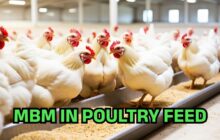
Use of MBM (Meat cum Bone Meal) in poultry, i.e. layer and broiler, feed
Meat cum Bone Meal (MBM): Exploring its importance in poultry nutrition and the practical constraints
Poultry meat is an important part of overall meat production and consumption, contributing 51.14%. With the growing global population, demand for poultry meat is expected to rise in proportion. The poultry sector is seeing a Compound Annual Growth Rate (CAGR) of 8%. However, a notable point is that about 80% of the cost of production is spent on feed, and two primary ingredients, maize and soybean meal (SBM), together make up about 90% of the feed composition.
The meat industry is under significant scrutiny, especially for the conversion of thousands of hectares of forest every year into soybean cultivation to meet the rising demand of the animal feed industry. This over-dependence on a single ingredient not only reduces forest reserves but also disturbs the whole ecosystem. For economic, environmental and sustainability reasons, addressing this dependence becomes essential. This can be achieved through two strategies: finding alternative ingredients and increasing the efficiency of existing options. One such promising ingredient is Meat cum Bone Meal (MBM). MBM has the potential to improve production, reduce feed cost and contribute to a circular economy by using by-products of the meat industry.
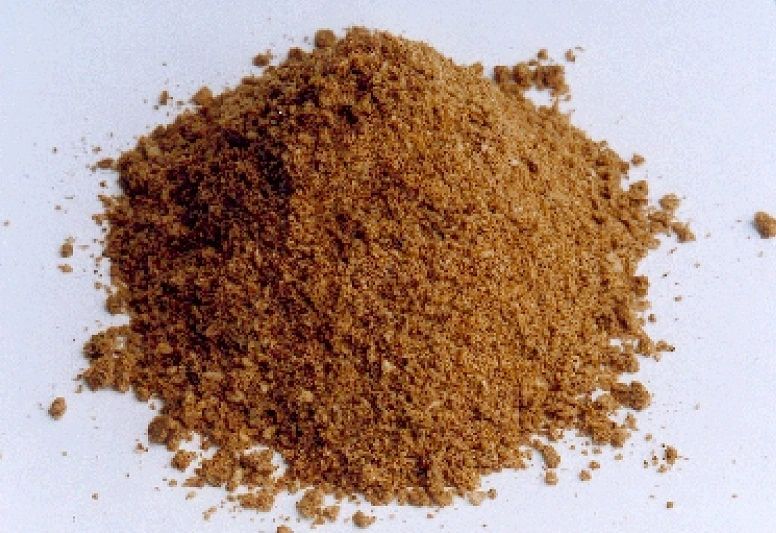
MBM is prepared from slaughterhouse waste and dead animals. It includes parts of animals that are not fit for human consumption, such as carcass trimmings, rejected carcasses, rejected livers, inedible waste and bones. Hair, hooves and blood are normally not included. MBM can also be made by processing the carcasses of animals after they die. The material used to prepare MBM can show wide variation between different plants and batches. The ash content indicates how much bone it contains; higher ash means more bone.
Nutritional benefits of MBM in poultry feed
MBM offers several nutritional benefits in poultry feed:
- A powerful source of protein: MBM is a powerful source of protein, with crude protein (CP) content usually 42-45%, and in some sources it can be as high as 55%. It has been described as an excellent source of supplementary protein with a balanced amino acid profile. Its amino acid composition is very close to the ideal amino acid profile. Digestibility of the protein fraction is usually 81 to 87%.
- Source of macro minerals (calcium and phosphorus): MBM is rich in calcium (Ca) and phosphorus (P). Calcium content is usually 7 to 10% with a minimum of 10%, and phosphorus 4.5 to 6% with a minimum of 5%. In MBM with bones, the calcium to phosphorus ratio should be about 2:1. By including 3% MBM, the need for inorganic phosphorus sources like dicalcium phosphate (DCP) and monocalcium phosphate (MCP) can be reduced considerably, possibly replacing 50% or more.
- Metabolizable energy: MBM has a significant metabolizable energy (ME) value, usually 2200-2400 Kcal/kg. Recent evidence suggests that the ME content of meat meal may be higher than earlier estimates, especially at low inclusion levels (5-10%).
- Least cost formulation: Including MBM can bring a notable reduction in production cost. According to one article, MBM can save about INR 0.35 per kilogram of feed.
- Environmental benefit and circular economy: Using meat industry by-products like MBM aligns with the principles of a circular economy, reduces waste and maximizes resource efficiency.
Practical constraints in using MBM
Despite its benefits, the use of MBM is limited due to several practical constraints:
- Inconsistent quality: The nutritional quality of MBM can show significant variation, mainly because of inconsistency in the composition of the waste used and in the conditions of the preparation process. Variation in calcium and phosphorus content is still a problem.
- Microbial contamination: MBM is susceptible to microbial contamination, which poses a significant risk to both poultry and human health. Salmonella, E. coli and Clostridium are the bacteria of special concern. Conventional rendering reduces Salmonella and E. coli, but Clostridium is more resilient. The presence of these bacteria is a major limiting factor for increasing the MBM inclusion level. Recontamination after leaving the cooking chambers is a common problem. The acceptable total bacterial count should be less than 10*10³ CFU per gram.
- Limited shelf life: The rich fat content of MBM makes it susceptible to oxidative damage, which is a serious threat to its shelf life. High nutrient content and a favourable environment encourage rapid bacterial growth, which increases the risk of spoilage over time.
- Demand and supply: Compared to SBM, the availability of MBM is relatively low. As demand rises with greater use of MBM, the price may also go up.
- Variation in nutrient availability: Conventionally processed MBM shows variation in nutrient availability. For example, lysine digestibility can vary from 70% to 88%. Excessive heat during processing can reduce protein digestibility, especially lysine availability. Methionine and cysteine can be limiting amino acids for poultry when MBM is combined with grains.
- Regulatory restrictions: MBM was identified as a vector of Bovine Spongiform Encephalopathy (BSE). For this reason, many countries have restricted or banned feeding MBM to livestock. For example, in the European Union the use of MBM in livestock feed was banned in 2002. Where it is authorised, proper heat treatment is required to control pathogens like BSE and Salmonella.
Precautions for farmers when using feed containing MBM
Farmers should take some precautions when using MBM:
- Source MBM from reliable suppliers: Because of variation in quality and the potential for contamination, it is important to get MBM from suppliers who have quality control procedures.
- Check quality and consistency: Apply quality control checks on the MBM batches received, especially for nutrient composition (protein, ash, calcium, phosphorus) and microbial load. Make sure the calcium to phosphorus ratio is about 2:1. Ash content can indicate the amount of bone present.
- Be aware of contamination risks: Processing aims to reduce the bacterial load, but recontamination is possible. Store MBM properly to reduce further microbial growth and oxidative damage.
- Follow inclusion levels: Be careful about the recommended maximum inclusion levels in feed formulation, especially with respect to calcium and phosphorus content and possible variation in nutrient availability. Typical formulation constraints suggest maximum inclusion levels of 6% for birds of 0-4 weeks and 8% for birds of >4 weeks.
- Consider additives: Sources mention that exploring additives like organic acids and enzymes may help increase the use of MBM by inhibiting bacterial growth and improving digestibility.
- Check local regulations: Potential users are strongly advised to check their country’s regulations on the use of meat and bone meal in livestock feed.
MBM has the potential to improve production efficiency, reduce feed cost and contribute to a circular economy. However, optimising its use requires addressing its current limitations through continuous, strategic processes. Using MBM efficiently is seen not just as an option but as an imperative to address the rising SBM demand, reduce dependence on limited natural resources and facilitate a circular economy.
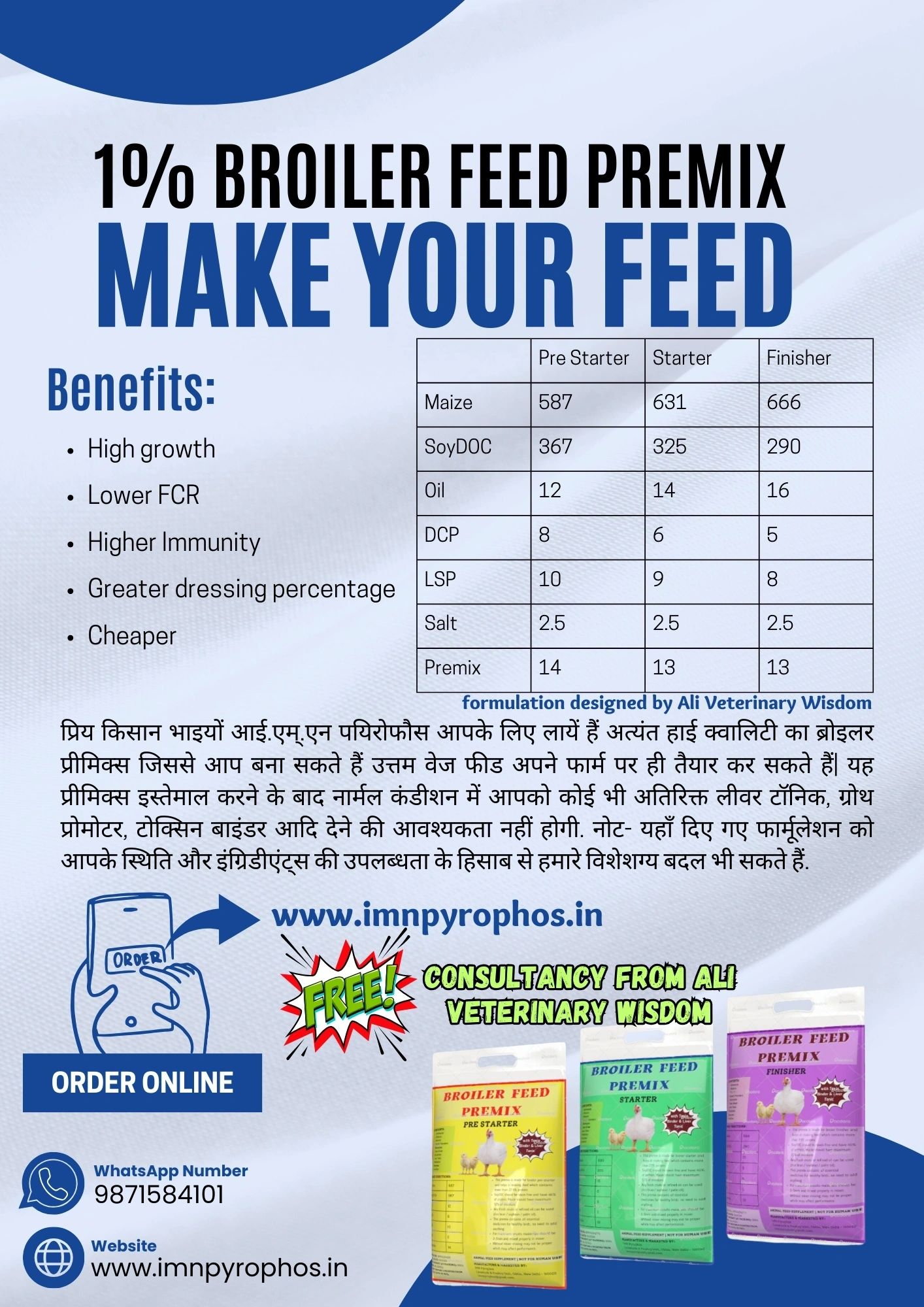
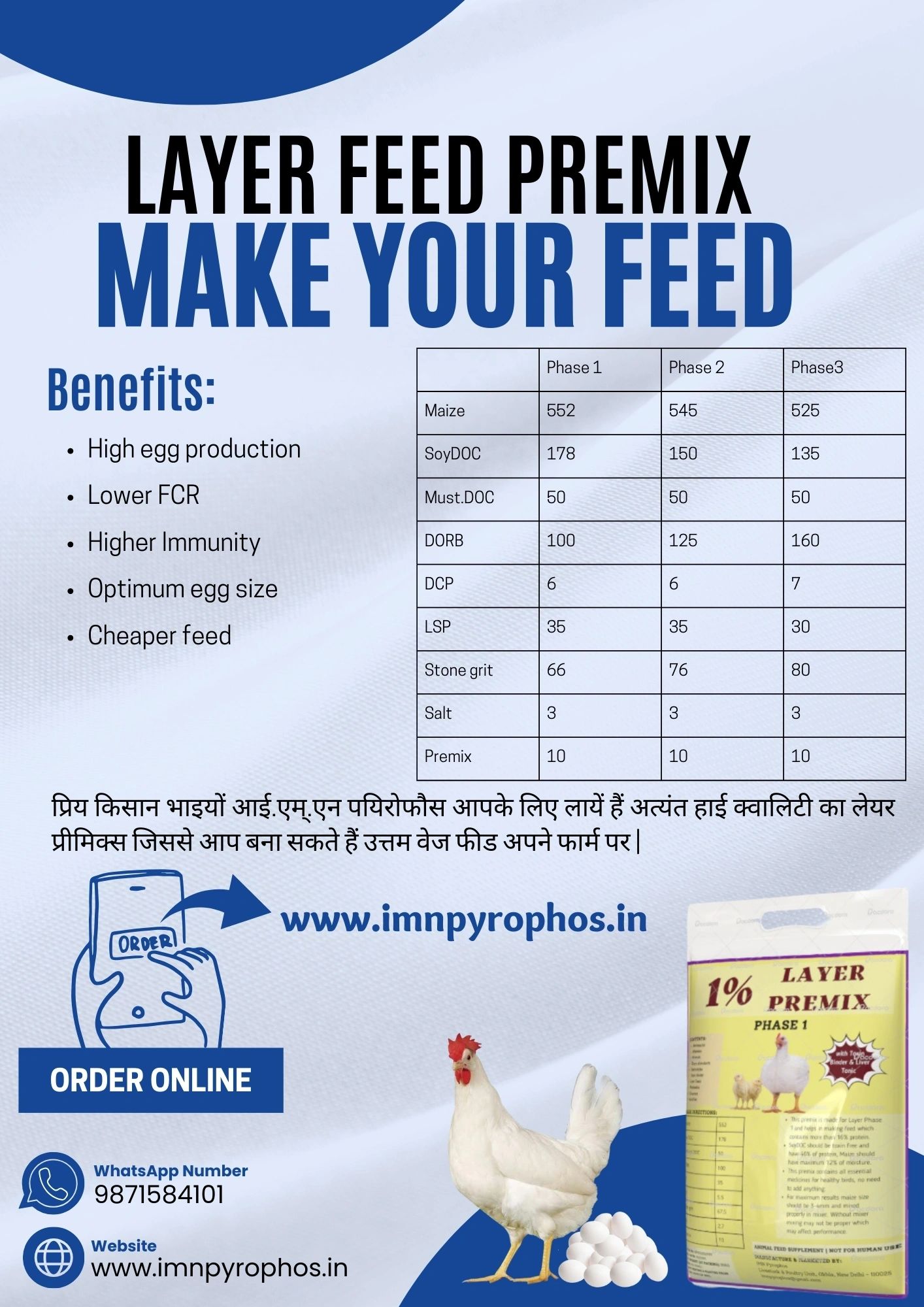
Make your poultry feed with our high quality premix, keep your birds healthy and get better FCR – call now 9871584101
Problem in your flock? Send photos of the birds and droppings on WhatsApp for a first opinion from Dr. Ibne Ali.
WhatsApp: 98715 84101पोल्ट्री अर्थात लेयर और ब्रायलर फीड में MBM का उपयोग मीट कम बोन मील
मीट कम बोन मील (MBM): पोल्ट्री पोषण में इसके महत्व और व्यावहारिक बाधाओं का अन्वेषण
पोल्ट्री मांस समग्र मांस उत्पादन और खपत का एक महत्वपूर्ण हिस्सा है, जिसका योगदान 51.14% है। बढ़ती वैश्विक आबादी के साथ, पोल्ट्री मांस की मांग में आनुपातिक वृद्धि होने की उम्मीद है। पोल्ट्री क्षेत्र 8% की चक्रवृद्धि वार्षिक वृद्धि दर (CAGR) का अनुभव कर रहा है। हालाँकि, एक उल्लेखनीय पहलू यह है कि उत्पादन लागत का लगभग 80% फ़ीड पर खर्च होता है, जिसमें दो प्राथमिक सामग्री, मक्का और सोयाबीन मील (SBM), मिलकर लगभग 90% फ़ीड संरचना का गठन करते हैं।
मांस उद्योग पर महत्वपूर्ण निगरानी है, विशेष रूप से पशु फ़ीड उद्योग में बढ़ती मांग को पूरा करने के लिए सोयाबीन की खेती के लिए सालाना हजारों हेक्टेयर जंगलों के रूपांतरण के लिए। किसी एक सामग्री पर यह अति-निर्भरता न केवल वन भंडार को कम करती है, बल्कि पूरे पारिस्थितिक तंत्र को भी बाधित करती है। आर्थिक, पर्यावरणीय और स्थिरता कारणों से इस निर्भरता को संबोधित करना अनिवार्य हो जाता है। यह दो रणनीतियों के माध्यम से प्राप्त किया जा सकता है: वैकल्पिक सामग्री की खोज करना और मौजूदा विकल्पों की दक्षता बढ़ाना। ऐसी ही एक आशाजनक सामग्री मीट कम बोन मील (MBM) है। MBM में उत्पादन में सुधार करने, फ़ीड लागत को कम करने और मांस उद्योग के उप-उत्पादों का उपयोग करके एक चक्रीय अर्थव्यवस्था में योगदान करने की क्षमता है।
MBM बूचड़खाने के अपशिष्टों और मृत जानवरों से तैयार किया जाता है। इसमें जानवरों के वे हिस्से शामिल होते हैं जो मानव उपभोग के लिए उपयुक्त नहीं होते हैं, जैसे कि शव की छंटनी, अस्वीकृत शव, अस्वीकृत जिगर, अखाद्य अपशिष्ट और हड्डियां। सामान्यतः बाल, खुर और रक्त इसमें शामिल नहीं होते हैं। जानवरों के मरने के बाद उनके शवों को संसाधित करके भी MBM बनाया जा सकता है। MBM तैयार करने में उपयोग की जाने वाली सामग्री में विभिन्न संयंत्रों और बैचों के बीच व्यापक भिन्नता हो सकती है। राख की मात्रा इंगित करती है कि इसमें हड्डियों की मात्रा कितनी है; उच्च राख का मतलब अधिक हड्डी है।
पोल्ट्री फीड में MBM के पोषण संबंधी लाभ
MBM पोल्ट्री फ़ीड में कई पोषण संबंधी लाभ प्रदान करता है:
- प्रोटीन का शक्तिशाली स्रोत: MBM प्रोटीन का एक शक्तिशाली स्रोत है, जिसमें क्रूड प्रोटीन (CP) की मात्रा सामान्यतः 42-45% तक होती है, और कुछ स्रोतों में 55% तक भी हो सकती है। इसे पूरक प्रोटीन का एक उत्कृष्ट स्रोत बताया गया है जिसमें एक संतुलित अमीनो एसिड प्रोफाइल है। इसकी अमीनो एसिड संरचना आदर्श अमीनो एसिड प्रोफाइल के बहुत करीब है। प्रोटीन अंश की पाचनशक्ति सामान्यतः 81 से 87% तक होती है।
- मैक्रो मिनरल्स (कैल्शियम और फास्फोरस) का स्रोत: MBM कैल्शियम (Ca) और फास्फोरस (P) से भरपूर है। कैल्शियम की मात्रा सामान्यतः 7 से 10% और न्यूनतम 10% तक होती है, और फास्फोरस 4.5 से 6% और न्यूनतम 5% तक होता है। हड्डियों के साथ MBM में कैल्शियम से फास्फोरस का अनुपात लगभग 2:1 होना चाहिए। 3% MBM शामिल करने से, डाइकैल्शियम फॉस्फेट (DCP) और मोनोकैल्शियम फॉस्फेट (MCP) जैसे अकार्बनिक फास्फोरस स्रोतों की आवश्यकता को काफी कम किया जा सकता है, संभावित रूप से 50% और उससे अधिक की जगह ले सकता है।
- मेटाबोलाइजेबल एनर्जी: MBM का एक महत्वपूर्ण मेटाबोलाइजेबल एनर्जी (ME) मान है, जो सामान्यतः 2200-2400 Kcal/kg तक होता है। हाल के साक्ष्य बताते हैं कि मीट मील की ME सामग्री पिछले अनुमानों से अधिक हो सकती है, खासकर कम समावेशन स्तरों (5-10%) पर।
- न्यूनतम लागत फ़ार्मूलेशन: MBM को शामिल करने से उत्पादन लागत में उल्लेखनीय कमी आ सकती है। एक लेख के अनुसार MBM प्रति किलोग्राम फ़ीड पर लगभग INR 0.35 बचा सकता है।
- पर्यावरणीय लाभ और चक्रीय अर्थव्यवस्था: MBM जैसे मांस उद्योग के उप-उत्पादों का उपयोग करना एक चक्रीय अर्थव्यवस्था के सिद्धांतों के साथ संरेखित होता है, अपशिष्ट को कम करता है और संसाधन दक्षता को अधिकतम करता है।
MBM के उपयोग की व्यावहारिक बाधाएं
इसके लाभों के बावजूद, MBM का उपयोग कई व्यावहारिक बाधाओं के कारण सीमित है:
- असंगत गुणवत्ता: MBM की पोषण गुणवत्ता में महत्वपूर्ण भिन्नता हो सकती है, मुख्य रूप से उपयोग किए गए अपशिष्टों की संरचना और तैयारी प्रक्रिया की स्थितियों में असंगतता के कारण। कैल्शियम और फास्फोरस सामग्री में भिन्नता अभी भी समस्याग्रस्त है।
- सूक्ष्मजीवों का संदूषण: MBM सूक्ष्मजीवों के संदूषण के प्रति संवेदनशील है, जो पोल्ट्री और मानव स्वास्थ्य दोनों के लिए महत्वपूर्ण जोखिम पैदा करता है। साल्मोनेला (Salmonella), ई. कोलाई (E. coli), और क्लोस्ट्रीडियम (Clostridium) विशेष चिंता के बैक्टीरिया हैं। पारंपरिक रेंडरिंग साल्मोनेला और ई. कोलाई को कम करती है, लेकिन क्लोस्ट्रीडियम अधिक लचीला होता है। इन बैक्टीरिया की उपस्थिति MBM समावेशन स्तर को बढ़ाने के लिए एक प्रमुख सीमित कारक है। खाना पकाने के कक्षों से निकलने के बाद पुन: संदूषण (recontamination) एक आम समस्या है। स्वीकार्य कुल जीवाणु संख्या प्रति ग्राम 10*10³ CFU से कम होनी चाहिए।
- सीमित शेल्फ लाइफ: MBM की समृद्ध वसा सामग्री इसे ऑक्सीडेटिव क्षति के प्रति संवेदनशील बनाती है, जो इसकी शेल्फ लाइफ के लिए एक गंभीर खतरा है। उच्च पोषक तत्व सामग्री और अनुकूल वातावरण तेजी से जीवाणु प्रसार को प्रोत्साहित करता है, जो समय के साथ खराब होने के जोखिम को बढ़ाता है।
- मांग और आपूर्ति: SBM की तुलना में, MBM की उपलब्धता तुलनात्मक रूप से कम है। जैसे-जैसे MBM के अधिक उपयोग के साथ इसकी मांग बढ़ती है, कीमत भी बढ़ सकती है।
- पोषक तत्व उपलब्धता में भिन्नता: पारंपरिक रूप से संसाधित MBM में पोषक तत्व उपलब्धता में भिन्नता है। उदाहरण के लिए, लाइसिन पाचनशक्ति 70% से 88% तक भिन्न हो सकती है। प्रसंस्करण के दौरान अत्यधिक गर्मी प्रोटीन पाचनशक्ति को कम कर सकती है, विशेष रूप से लाइसिन उपलब्धता को। पोल्ट्री के लिए मेथिओनिन और सिस्टीन सीमित अमीनो एसिड हो सकते हैं जब MBM को अनाज के साथ संयोजित किया जाता है।
- नियामक प्रतिबंध: MBM को बोवाइन स्पॉन्जिफॉर्म एन्सेफैलोपैथी (BSE) के वेक्टर के रूप में पहचाना गया। इस कारण से, कई देशों ने MBM को पशुधन को खिलाने पर प्रतिबंध या रोक लगा दी है। उदाहरण के लिए, यूरोपीय संघ में 2002 में पशुधन फ़ीड के लिए MBM के उपयोग पर प्रतिबंध लगा दिया गया था। जहाँ अधिकृत है, BSE और साल्मोनेला जैसे रोगजनकों को नियंत्रित करने के लिए उचित गर्मी उपचार की आवश्यकता होती है।
किसानों के लिए MBM युक्त फ़ीड का उपयोग करते समय सावधानियां
MBM का उपयोग करते समय किसानों को कुछ सावधानियां बरतनी चाहिए:
- विश्वसनीय आपूर्तिकर्ताओं से MBM स्रोत करें: गुणवत्ता में भिन्नता और संदूषण की क्षमता के कारण, गुणवत्ता नियंत्रण प्रक्रियाओं वाले आपूर्तिकर्ताओं से MBM प्राप्त करना महत्वपूर्ण है।
- गुणवत्ता और स्थिरता की जांच करें: प्राप्त MBM बैचों पर गुणवत्ता नियंत्रण जांच लागू करें, विशेष रूप से पोषक तत्व संरचना (प्रोटीन, राख, कैल्शियम, फास्फोरस) और सूक्ष्मजीवों की मात्रा के संबंध में। सुनिश्चित करें कि कैल्शियम से फास्फोरस का अनुपात लगभग 2:1 हो। राख की मात्रा मौजूद हड्डियों की मात्रा का संकेत दे सकती है।
- संदूषण जोखिमों से अवगत रहें: प्रसंस्करण का उद्देश्य जीवाणु भार को कम करना है, लेकिन पुन: संदूषण संभव है। आगे के सूक्ष्मजीवों के विकास और ऑक्सीडेटिव क्षति को कम करने के लिए MBM को ठीक से स्टोर करें।
- समावेशन स्तरों का पालन करें: फ़ीड फ़ार्मूलेशन में अनुशंसित अधिकतम समावेशन स्तरों से सावधान रहें, विशेष रूप से कैल्शियम और फास्फोरस सामग्री और संभावित पोषक तत्व उपलब्धता भिन्नता के संबंध में। विशिष्ट फ़ार्मूलेशन बाधाएं 0-4 सप्ताह के पक्षियों के लिए 6% और >4 सप्ताह के पक्षियों के लिए 8% की अधिकतम समावेशन स्तरों का सुझाव देती हैं।
- योजकों पर विचार करें: स्रोत उल्लेख करते हैं कि कार्बनिक एसिड (organic acids) और एंजाइम (enzymes) जैसे योजकों की खोज संभावित रूप से जीवाणु वृद्धि को रोककर और पाचनशक्ति में सुधार करके MBM के उपयोग को बढ़ाने में मदद कर सकती है।
- स्थानीय नियमों की जांच करें: संभावित उपयोगकर्ताओं को पशुधन फ़ीड में मीट और बोन मील के उपयोग के संबंध में अपने देश के नियमों की जांच करने की पुरजोर सलाह दी जाती है।
MBM में उत्पादन दक्षता में सुधार करने, फ़ीड लागत को कम करने और एक चक्रीय अर्थव्यवस्था में योगदान करने की क्षमता है। हालांकि, इसके उपयोग को अनुकूलित करने के लिए निरंतर, रणनीतिक प्रक्रियाओं के माध्यम से इसकी वर्तमान सीमाओं को संबोधित करने की आवश्यकता है। MBM का कुशलतापूर्वक उपयोग करना न केवल एक विकल्प के रूप में देखा जाता है, बल्कि बढ़ती SBM मांग को संबोधित करने, सीमित प्राकृतिक संसाधनों पर निर्भरता को कम करने, और एक चक्रीय अर्थव्यवस्था को सुविधाजनक बनाने के लिए एक अनिवार्य है।
अपने पोल्ट्री फीड को हमारे उच्च क्वालिटी के प्रीमिक्स से बनाये, अपनी बर्ड्स को स्वस्थ बनाएं और बेहतर FCR पाएं – अभी कॉल करें 9871584101
फ़ार्म में कोई दिक्कत? पक्षियों और बीट की फ़ोटो WhatsApp पर भेजिए, डॉ. इब्ने अली से पहली राय लीजिए।
WhatsApp: 98715 84101Poultry yani layer aur broiler feed me MBM (Meat cum Bone Meal) ka upyog
Meat cum Bone Meal (MBM): Poultry nutrition me iski importance aur practical dikkatein
Poultry meat kul meat production aur khapat ka ek bada hissa hai, iska yogdan 51.14% hai. Duniya ki badhti aabadi ke saath poultry meat ki demand bhi usi hisaab se badhne ki ummeed hai. Poultry sector 8% ki CAGR (Compound Annual Growth Rate) se badh raha hai. Lekin ek dhyan dene wali baat ye hai ki production cost ka lagbhag 80% feed par kharch hota hai, aur do main ingredients, makka (maize) aur soybean meal (SBM), milkar feed ka lagbhag 90% hissa banate hain.
Meat industry par kaafi nazar rakhi ja rahi hai, khaas kar is baat ke liye ki animal feed industry ki badhti demand poori karne ke liye har saal hazaron hectare jungle ko soybean ki kheti me badla ja raha hai. Ek hi ingredient par itni zyada dependence na sirf jungle kam karti hai, balki poore ecosystem ko bhi bigadti hai. Aarthik, environment aur sustainability ki wajah se is dependence ko kam karna zaroori ho jata hai. Ye do tareeke se ho sakta hai: dusre (alternative) ingredients dhundhna aur maujooda options ki efficiency badhana. Aisa hi ek achha option hai Meat cum Bone Meal (MBM). MBM me production sudharne, feed cost kam karne aur meat industry ke by-products use karke circular economy me yogdan dene ki kshamta hai.
MBM boochadkhane (slaughterhouse) ke waste aur mare hue janwaron se banaya jata hai. Isme janwaron ke wo hisse hote hain jo insaan ke khane layak nahi hote, jaise carcass ki chhatai (trimmings), reject kiye gaye carcass, reject kiya gaya liver, na khane layak waste aur haddiyan. Aam taur par baal, khur aur khoon isme shamil nahi hote. Janwaron ke marne ke baad unke carcass ko process karke bhi MBM banaya ja sakta hai. MBM banane me use hone wale maal me alag-alag plants aur batches ke beech kaafi fark ho sakta hai. Ash (raakh) ki matra batati hai ki isme kitni haddi hai; zyada ash matlab zyada haddi.
Poultry feed me MBM ke nutrition wale fayde
MBM poultry feed me kai nutrition wale fayde deta hai:
- Protein ka mazboot source: MBM protein ka ek mazboot source hai, isme crude protein (CP) aam taur par 42-45% tak hota hai, aur kuch sources me 55% tak bhi ho sakta hai. Ise supplementary protein ka ek behtareen source bataya gaya hai jisme balanced amino acid profile hai. Iska amino acid composition ideal amino acid profile ke bahut kareeb hai. Protein hisse ki digestibility aam taur par 81 se 87% tak hoti hai.
- Macro minerals (calcium aur phosphorus) ka source: MBM calcium (Ca) aur phosphorus (P) se bharpoor hai. Calcium aam taur par 7 se 10% aur kam se kam 10% tak hota hai, aur phosphorus 4.5 se 6% aur kam se kam 5% tak hota hai. Haddi wale MBM me calcium aur phosphorus ka ratio lagbhag 2:1 hona chahiye. 3% MBM daalne se DCP (dicalcium phosphate) aur MCP (monocalcium phosphate) jaise inorganic phosphorus sources ki zaroorat kaafi kam ho sakti hai, shayad 50% ya usse zyada ki jagah le sakta hai.
- Metabolizable energy: MBM ki metabolizable energy (ME) kaafi achhi hoti hai, aam taur par 2200-2400 Kcal/kg. Haal ke saboot batate hain ki meat meal ki ME pehle ke andaze se zyada ho sakti hai, khaas kar kam inclusion level (5-10%) par.
- Least cost formulation: MBM daalne se production cost me achhi kami aa sakti hai. Ek article ke hisaab se MBM har kilo feed par lagbhag INR 0.35 bacha sakta hai.
- Environment ka fayda aur circular economy: MBM jaise meat industry ke by-products use karna circular economy ke siddhanton ke hisaab se hai, waste kam karta hai aur resources ka poora fayda uthata hai.
MBM use karne me practical dikkatein
In faydon ke bawajood, kai practical dikkaton ki wajah se MBM ka use seemit hai:
- Quality ek jaisi nahi: MBM ki nutrition quality me kaafi fark ho sakta hai, mainly use hone wale waste ke composition aur banane ke process ki conditions ek jaisi na hone ki wajah se. Calcium aur phosphorus ki matra me fark abhi bhi problem hai.
- Microbes ka contamination: MBM me microbes ka contamination jaldi hota hai, jo poultry aur insaan dono ki sehat ke liye bada khatra hai. Salmonella, E. coli aur Clostridium khaas chinta wale bacteria hain. Normal rendering Salmonella aur E. coli ko kam kar deti hai, lekin Clostridium zyada mazboot hota hai. In bacteria ka hona MBM ka inclusion level badhane me sabse badi rukawat hai. Cooking chambers se nikalne ke baad dobara contamination (recontamination) ek aam problem hai. Total bacteria count 10*10³ CFU per gram se kam hona chahiye.
- Kam shelf life: MBM me fat zyada hone se ye oxidative damage (oxidation se kharab hona) jaldi pakadta hai, jo iski shelf life ke liye bada khatra hai. Zyada nutrients aur anukool mahaul bacteria ko tezi se badhne deta hai, jisse samay ke saath kharab hone ka risk badhta hai.
- Demand aur supply: SBM ke mukable MBM kam milta hai. Jaise-jaise MBM ka use badhega aur demand badhegi, iska rate bhi badh sakta hai.
- Nutrients milne me fark: Normal tareeke se process kiye gaye MBM me nutrients ki availability me fark hota hai. Jaise, lysine ki digestibility 70% se 88% tak badal sakti hai. Processing ke time zyada garmi se protein digestibility kam ho sakti hai, khaas kar lysine ki availability. Jab MBM ko anaj ke saath milaya jata hai to poultry ke liye methionine aur cysteine limiting amino acids ho sakte hain.
- Sarkari niyam aur rok: MBM ko Bovine Spongiform Encephalopathy (BSE) failane wala maana gaya. Isi wajah se kai deshon ne pashuon ko MBM khilane par rok ya pabandi laga di hai. Jaise, European Union me 2002 me pashu feed me MBM ke use par rok laga di gayi thi. Jahan ijazat hai, wahan BSE aur Salmonella jaise rogaanuon ko control karne ke liye sahi heat treatment zaroori hai.
Farmers ke liye MBM wala feed use karte waqt savdhaniyan
MBM use karte waqt farmers ko kuch savdhaniyan rakhni chahiye:
- Bharosemand suppliers se MBM lein: Quality me fark aur contamination ke khatre ki wajah se, aise suppliers se MBM lena zaroori hai jinke paas quality control process ho.
- Quality aur consistency check karein: Aane wale MBM batches ki quality check karein, khaas kar nutrients (protein, ash, calcium, phosphorus) aur microbes ki matra. Pakka karein ki calcium aur phosphorus ka ratio lagbhag 2:1 ho. Ash ki matra se pata chal sakta hai ki kitni haddi hai.
- Contamination ke khatre ka dhyan rakhein: Processing ka maksad bacteria kam karna hai, lekin dobara contamination ho sakta hai. Aage microbes badhne aur oxidative damage kam karne ke liye MBM ko sahi tareeke se store karein.
- Inclusion level follow karein: Feed formulation me recommended maximum inclusion level ka dhyan rakhein, khaas kar calcium aur phosphorus ki matra aur nutrients ki availability me fark ko dekhte hue. Aam formulation limits 0-4 hafte ke birds ke liye 6% aur >4 hafte ke birds ke liye 8% maximum inclusion level batati hain.
- Additives ke baare me sochein: Sources batate hain ki organic acids aur enzymes jaise additives bacteria ki growth rok kar aur digestibility sudhar kar MBM ka use badhane me madad kar sakte hain.
- Local niyam check karein: Jo log use karna chahte hain unhe pashu feed me meat aur bone meal ke use ke baare me apne desh ke niyam zaroor check karne chahiye.
MBM me production efficiency sudharne, feed cost kam karne aur circular economy me yogdan dene ki kshamta hai. Lekin iska use behtar karne ke liye lagatar, sahi planning ke saath iski abhi ki kamiyon ko door karna hoga. MBM ka sahi use sirf ek option nahi balki badhti SBM demand ko sambhalne, seemit natural resources par dependence kam karne aur circular economy ko aage badhane ke liye zaroori maana jata hai.
Apna poultry feed hamare high quality premix se banaiye, apne birds ko healthy rakhiye aur behtar FCR paiye – abhi call karein 9871584101
Farm me koi dikkat? Pakshiyon aur beet ki photo WhatsApp par bhejiye, Dr. Ibne Ali se pehli raay lijiye.
WhatsApp: 98715 84101