

A cow or buffalo does not make milk straight from the feed bag. She makes milk from what the rumen microbes build out of that feed. When the rumen is stable, more energy and protein reach the udder. When it is upset by heavy grain, heat, damp feed or a sudden ration change, the same feed gives less milk, thinner fat and loose dung. A dairy feed premix is a small-dose powder, added to the concentrate or the TMR, that gives the rumen and the body what the ration alone often does not: trace minerals, vitamins, a buffer, yeast and a toxin binder. This guide is for dairy farmers, TMR feeders and feed-mill owners who want to understand what a premix is, what to look for on the label, how to dose and mix it, and how to judge it fairly on your own farm. It is written by Dr. Ibne Ali’s team and uses Rumenia from IMN Pyrophos as the worked example.
What is a dairy feed premix? Premix vs mineral mixture vs cattle feed
A dairy feed premix is a concentrated blend of micro-ingredients that is mixed into the feed at a low rate, usually a few kilograms per ton. It is built to be spread evenly through a large batch of feed. It is not a feed on its own, and it is not a medicine. People also search for it as a cattle feed premix, a mineral premix for dairy cows and buffaloes, or a TMR premix. They all mean the same family of products, but they are not the same as a plain mineral mixture or a bag of cattle feed.
| Product | What it is | Typical use | What it does not do |
|---|---|---|---|
| Plain mineral mixture | Calcium, phosphorus and some trace minerals, mostly for the daily mineral need | Given daily per animal, or mixed in the concentrate | Usually no rumen buffer, yeast or toxin binder |
| Dairy feed premix | Trace minerals plus rumen-support ingredients (buffer, yeast, probiotics, toxin binder, fermentation modifiers) | Low rate in the concentrate or TMR, per ton of feed | Does not replace fodder, water or a mineral mixture where the ration needs one |
| Concentrate or cattle feed | Energy and protein: grains, cakes, bran, by-products | Fed by quantity, in kilograms per animal | Does not stabilize the rumen on its own |
| Bypass fat or a single additive | One ingredient for one job, such as extra energy or one function | Added to a ration that is already balanced | Does not cover trace minerals, buffer and toxin risk together |
Think of it like this: the concentrate is the fuel, the fodder is the fibre, the mineral mixture is the daily mineral base, and the premix is the tuning for the rumen. If you are choosing a daily mineral, read our guide to the best mineral mixture for cow and buffalo first, then come back to the premix.
Why dairy animals need a premix
Today’s cows and buffaloes give far more milk than animals did a generation ago, but the rumen has not changed. That gap is where a premix earns its place.
- Higher yield, higher demand. A high-yielding animal needs more energy, protein and minerals than fodder alone can give, so the ration becomes grain-heavy.
- Grain-heavy rations drop rumen pH. Starch ferments fast and makes acid. If the animal does not chew enough cud to produce saliva, the rumen turns acidic and the microbes that digest fibre suffer. This shows up as loose dung, undigested grain in dung, falling fat percentage and off-feed days.
- Heat stress. In summer the animal eats less, pants, and loses saliva buffer, so the rumen becomes unstable exactly when milk is most at risk.
- Mycotoxins. Damp maize, cakes and stored feed can carry moulds. Even low levels can reduce intake and milk and leave animals dull. A toxin binder in the premix is a safety layer, not a licence to feed bad feed.
- Soil and fodder gaps. Many soils and fodders are short in trace minerals such as zinc, copper, cobalt, iodine and selenium. Green fodder looks good but may not fill these gaps.
- Buffaloes often have short or silent heat, strong seasonal swings and a heavy dependence on rumen fibre digestion, so a stable rumen matters for them as much as for cows.
For the fat side of this story, see how to increase milk fat percentage in cow and buffalo.
What a good dairy feed premix contains
Labels differ, but a complete dairy feed premix usually works across the groups below. Use this table to read any label, from any company.
| Group | Examples | What it does |
|---|---|---|
| Macro minerals | Calcium, phosphorus, magnesium | Bone, milk synthesis, nerve and muscle function, appetite |
| Trace minerals | Zinc, copper, manganese, cobalt, iodine, selenium | Enzymes, immunity, hoof and skin, fertility, rumen microbes (cobalt feeds vitamin B12 production) |
| Organic vs inorganic trace minerals | Chelated or organic forms vs oxide and sulphate forms | Organic forms are generally better absorbed and less reactive in the rumen, inorganic forms cost less. A label should say which is used. |
| Vitamins | A, D3, E | Vision and epithelium, calcium use, antioxidant protection and immunity |
| Rumen buffer and alkalizer | Buffering salts | Helps hold rumen pH steady on grain-heavy feed |
| Yeast, prebiotics, probiotics | Yeast extracts, live yeast, beneficial bacteria, prebiotic sugars | Supports microbe survival, fibre digestion and fermentation stability |
| Toxin binder | Clay-based or similar binders | Binds part of the mycotoxin load in feed so less reaches the animal |
| Fermentation modifiers and propionate enhancers | Ingredients that steer rumen fermentation | Supports propionate, the main glucose precursor, which helps energy balance |
Do not judge a premix by the length of its ingredient list alone. What matters is that the ingredients are listed, the rate of use is clear, and the product fits the gaps in your own ration.
How to choose a dairy feed premix: 8-point checklist
- Clear inclusion rate. The pack should say how many kilograms go in a ton of feed, or how many grams per animal. If you cannot find the dose, do not buy.
- Contents listed on the label. You should be able to read the groups in the table above. A label that only says “mineral and vitamin mix” tells you little.
- Rumen buffer and yeast. For grain-fed dairy animals, these are what separate a rumen premix from a basic mineral mix.
- Toxin binder. Useful in the rainy season and in any herd that feeds stored maize or cakes.
- Batch number and manufacturing date. Check both on the pack, and ask for the same on the next order.
- Cost per animal per day, not per kg. A cheap kilogram at a high dose can cost more than an expensive kilogram at a low dose. Work it out (see the cost section below).
- Vet and company support. Someone should be able to answer questions about your ration and your results.
- Trial before bulk. Run it on a group for 30 days, keep records, then scale. Never switch the whole herd on day one.
Rumenia: IMN Pyrophos dairy feed premix
Rumenia is sold by IMN Pyrophos as a dairy feed premix with toxin binder and trace minerals. Here is exactly what is on the label and the product page.
Label contents: trace minerals, rumen buffer, rumen alkalizer, prebiotics, yeast extracts, probiotics, toxin binders, calcium, phosphorus, rumen fermentation modifiers and propionate enhancers.
Label benefits:
- A unique blend made to increase rumen functioning and digestion.
- Supports the survival and stability of rumen microbes.
- Supports rumen fermentation, energy and protein synthesis.
- That is how production and health of the animal improve.
Product-page claims: it is a 2.5 percent premix; it gives about 200 g of extra metabolizable protein, which supports milk fat and SNF; it keeps rumen pH stable on high-energy feed; it reduces energy and methane loss; it supports a positive energy balance (body condition and fertility); it binds mycotoxins; it reduces ups and downs in milk; and it helps in summer and when green fodder is short.
These are the company’s claims and the label wording. Results on your farm depend on your ration, fodder, water and management, which is why the 30-day trial below matters.
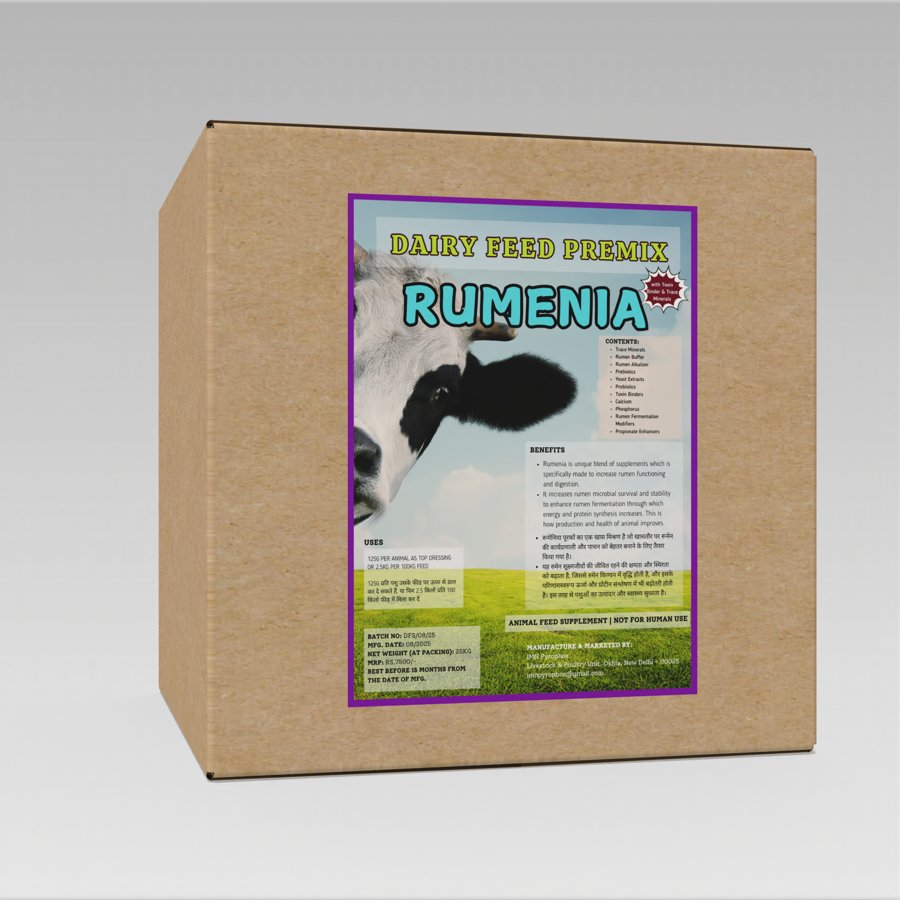
Dairy feed premix
Rumenia
Dairy feed premix with trace minerals, rumen buffer, prebiotics, yeast extracts, probiotics, toxin binders, calcium and phosphorus. Supports rumen function, microbe stability and fermentation, so energy and protein synthesis increase.
Dose: 2.5-3 kg per ton of feed (2.5-3 g per kg feed).
5 kg ₹1,400MRP ₹1,800 25 kg ₹5,625MRP ₹7,500
Rumenia dose and cost per animal per day
The dose is 2.5-3 kg of Rumenia per ton of feed, which is the same as 2.5-3 g per kg of feed. It goes in the concentrate or TMR. It is not dosed per animal on its own, so the amount each cow gets depends on how much feed she eats.
| Feed quantity | Rumenia amount (2.5-3 g per kg feed) |
|---|---|
| 1 ton of feed | 2.5-3 kg |
| 100 kg of concentrate | 250-300 g |
| 5 kg feed per animal per day | 12.5-15 g |
| 8 kg feed per animal per day | 20-24 g |
| 10 kg feed per animal per day | 25-30 g |
Pack prices: 25 kg pack Rs 5,625 (MRP Rs 7,500), which is Rs 225 per kg. 5 kg pack Rs 1,400 (MRP Rs 1,800), which is Rs 280 per kg. The 25 kg pack is the better value for a regular feeder.
Working for cost per animal per day (25 kg pack, 5 kg concentrate per day):
- Dose: 5 kg x 2.5 g = 12.5 g, and 5 kg x 3 g = 15 g per animal per day.
- Price per gram: Rs 225 per kg = Rs 0.225 per g.
- Cost: 12.5 g x 0.225 = about Rs 2.8, and 15 g x 0.225 = about Rs 3.4.
- So Rumenia costs about Rs 2.8 to Rs 3.4 per animal per day at 5 kg of feed.
At 8 kg feed per day the same method gives about Rs 4.5 to Rs 5.4, and at 10 kg about Rs 5.6 to Rs 6.8. On the 5 kg pack (Rs 0.28 per g), 5 kg of feed costs about Rs 3.5 to Rs 4.2 per animal per day. Prices can change, so confirm on WhatsApp before a bulk order. Compare this small daily cost with your milk and fat records during the trial, not with a single day’s yield.
How to mix a dairy feed premix right
A small dose only works if every animal gets her share. Poor mixing is the most common reason a good premix looks like it did nothing.
- Weigh the batch and the premix. Use a scale. For one ton of feed at 2.5-3 kg, weigh the powder; do not pour by eye.
- Make a premix of the premix. Mix the weighed Rumenia first with a small portion of ground grain, for example 10 to 20 kg, until it is uniform. This pre-dilution spreads the powder far better than dropping it straight on a large heap.
- Add it to the main mixer. In a TMR wagon or feed mixer, add the pre-dilution early, then run the mixer for the full mixing time of your machine so it spreads through the whole batch.
- On-farm hand mixing. If you mix on the floor, spread the concentrate in a layer, sprinkle the pre-dilution over it, and turn it from the edges at least several times with a shovel until the colour is even.
- Do not add it to water. Rumenia is a dry feed premix. Keep fresh water separate and always available.
- Do not mix with wet feed far ahead. Mix with dry feed, and with wet or fermented feed only at feeding time, so moisture does not spoil the batch.
- Store it right. Keep the pack dry, cool and tightly closed, off the floor, away from sunlight and from rodents.
- Keep records. Note the date, batch number, feed quantity, premix quantity and which animals ate it.
Feeding a dairy feed premix by stage
The premix goes in the concentrate or TMR of milking and, where your ration allows, other groups. The table shows how the ration focus changes, and which companion product fits each stage.
| Stage | Focus | Premix and related support |
|---|---|---|
| Calf and heifer | Rumen development, growth, gut health | Ask about heifer ration on WhatsApp; for calves see Probium Probiotek |
| Dry cow | Body condition, minerals, low energy density | Keep the ration balanced; use the premix only if the dry ration is concentrate-based and ask for guidance |
| Close-up (last 3 weeks) | Preparing for calving, calcium handling | Negative DCAD feeding with Chloromate; see negative DCAD premix guide |
| Early lactation | Appetite, negative energy balance, recovery | Rumenia in the ration, Calcigain at calving, Bionice in the first weeks |
| Peak lactation | Maximum intake, rumen stability on high grain | Core stage for Rumenia: buffer, yeast and toxin binder do the most work here |
| Late lactation | Cost control, body condition recovery | Continue at the same per-ton rate on a lower feed quantity; review the cost |
Buffalo-specific notes
Buffaloes digest fibre well and often eat less concentrate than high-yield cows, so their premix quantity per animal is smaller at the same per-ton rate. Watch dung and cud chewing, keep wallowing or shower facilities in summer, and track fat percentage along with litres. For winter, see how to increase buffalo milk in winter.
Summer and heat stress
In hot weather intake falls and the rumen is less stable. Feed in the cool hours, keep water cool and plentiful, and keep the ration dense but not starchy. For off-feed animals and electrolyte support, PotMax Heat Buster is a separate product you can discuss with our team.
Signs your rumen needs help, and what a premix cannot fix
These signs suggest the rumen is not coping. Check them in the pen before you buy anything.
- Dung score. Very loose, watery or bubbly dung, or dung that looks the same every day with no form, points to an unstable rumen.
- Undigested grain visible in dung.
- Loose dung after a feed change or after a big concentrate meal.
- Drop in fat percentage without a drop in litres.
- Off-feed days, slow eating, or leaving the concentrate.
- Poor cud chewing. A healthy cow chews cud for several hours a day. If fewer than about half the resting cows are chewing at any time, look at fibre and rumen health.
A premix has limits. It cannot fix poor or short fodder, dirty or hot water, an uncomfortable shed, bad genetics or disease. If an animal is sick, call your vet first. For mastitis and immunity, see our mastitis and immune booster guide, and for fat problems see Acetomax for milk fat.
30-day trial plan for a dairy feed premix
Step 0: baseline. For 7 days before you start, record daily milk per animal or per group, fat percentage and SNF, a dung score for several animals, cud chewing (count how many resting cows are chewing), and feed intake. Do not change the ration, fodder or milking routine during the trial.
| Week | What to do | What to record |
|---|---|---|
| Week 1 | Start Rumenia at 2.5-3 g per kg feed in the trial group’s concentrate or TMR. Keep a control group on the old feed if you can. | Daily milk, feed leftover, dung score, any change in appetite |
| Week 2 | Same dose, same ration. Do not adjust anything else. | Daily milk, cud chewing count, dung form |
| Week 3 | Keep going. Rumen changes often need two to three weeks to show. | Weekly average milk, fat and SNF test |
| Week 4 | Compare with the baseline and with the control group. | Weekly averages, fat and SNF, dung, cost per animal per day |
How to judge. Compare weekly averages, not single days. Look at steadier milk, better dung form, more cud chewing, healthier fat and SNF and fewer off-feed days, and set them against the cost per animal per day you worked out above. We do not promise a fixed number of litres: a premix supports the rumen, and the result depends on your ration and management.
When to scale herd-wide. If the trial group shows clear gains in two or more signs and the cost is acceptable, extend the premix to the whole milking herd and keep recording monthly. If there is no change, check mixing, fibre, water and shed before you decide the product is the problem, and ask us on WhatsApp.
Rumenia and related IMN products map
Each product has one role. Pick by problem and stage, and do not stack products without advice.
| Product | Role in one line |
|---|---|
| Rumenia | Everyday dairy feed premix for rumen stability, trace minerals and toxin binding |
| Pyrosach | Rumen-adapted yeast for rumen health, fibre digestion, milk, fat and SNF |
| Acetomax | Milk fat improver that supplies acetate, the building block of milk fat |
| Chloromate | Negative DCAD premix for the close-up period, fed only in feed |
| Calcigain | Calving support: appetite, electrolytes and organic calcium at calving |
| Bionice | Early lactation energy and metabolic support (biotin, niacin, chelated zinc, chromium) |
| Sel E Boost (Dairy) | Vitamin E and selenium immune support for dairy animals |
| Probium Probiotek | Probiotic for rumen development and diarrhoea control in calves |
| Toxtrap | Feed toxin binder to lower the mycotoxin load in feed |
Related reading: milk fat booster Acetomax for cow and buffalo, negative DCAD premix: Chloromate, Calcigain and Bionice, calf diarrhoea and Probium Probiotek, mastitis and immune booster, increasing milk fat percentage and increasing buffalo milk in winter. The full list is in the IMN product guide.
Myths and facts about dairy feed premix
- Myth: a premix makes milk by itself. Fact: it supports the rumen and the body. Milk still comes from feed, fodder, water and the animal.
- Myth: more premix means more milk. Fact: use the stated rate. Extra only raises cost and does not make the rumen better.
- Myth: a premix replaces the mineral mixture. Fact: check what your ration still lacks. A premix works alongside a sound mineral plan, not as a shortcut.
- Myth: a toxin binder makes mouldy feed safe. Fact: it helps with a low load. Throw out visibly mouldy feed.
- Myth: premix is only for high-yield cows. Fact: it helps most in grain-heavy rations, but buffaloes and moderate yielders on concentrate also benefit from rumen stability.
- Myth: you will see results in two days. Fact: rumen changes take days to weeks. Judge by the weekly average.
- Myth: the cheapest kilogram is the cheapest premix. Fact: compare the cost per animal per day.
Frequently asked questions
What is a dairy feed premix?
It is a low-dose powder of trace minerals, vitamins and rumen-support ingredients that is mixed into the concentrate or TMR. It supports the rumen and the whole ration. It is not a feed or a medicine.
What is the difference between a dairy feed premix and a mineral mixture?
A mineral mixture mainly gives calcium, phosphorus and trace minerals. A dairy feed premix adds rumen buffer, yeast, probiotics, toxin binder and fermentation modifiers, and is dosed per ton of feed.
What is the Rumenia dose per cow?
The dose is 2.5-3 kg per ton of feed, which is 2.5-3 g per kg. On 5 kg of concentrate a day, that is 12.5-15 g per cow per day. Weigh it, do not guess.
Can buffaloes take dairy feed premix?
Yes. Buffaloes get the same per-ton rate in their concentrate, so their daily amount follows how much feed they eat. Share the buffalo’s yield and ration on WhatsApp for advice.
Can I mix the premix in water?
No. Mix Rumenia into dry concentrate or TMR. Give water separately and keep it clean and fresh.
How long should I give a dairy feed premix?
Run a 30-day trial first. If the records look good, many farms keep it in the milking ration as a regular part of the feed. Ask on WhatsApp how long to run it for your herd.
What is the price of Rumenia?
The 25 kg pack is Rs 5,625 (MRP Rs 7,500), about Rs 225 per kg, and the 5 kg pack is Rs 1,400 (MRP Rs 1,800), about Rs 280 per kg. At 5 kg of feed a day it costs about Rs 2.8 to Rs 3.4 per animal per day on the 25 kg pack.
Are there side effects, such as acidosis?
Used at the stated rate it is a feed ingredient and is not expected to cause problems. A premix does not remove the risk of acidosis from overfeeding grain or too little fibre, so keep fibre and feeding routine right.
Can pregnant and dry cows get it?
Dry and pregnant animals have different needs, especially in the last three weeks before calving. Ask on WhatsApp for the right plan, and see our close-up guidance above.
Where can I buy Rumenia?
You can order it on the Rumenia product page or on WhatsApp at +91 98715 84101.
Conclusion: use a dairy feed premix with records
A good dairy feed premix is about a steady rumen: the right minerals, a buffer, yeast and a toxin binder at a low dose that you can measure, mix and price per animal per day. Start with a clean baseline, run a 30-day trial, and scale only if your own records support it. Rumenia at 2.5-3 kg per ton of feed (2.5-3 g per kg) costs about Rs 2.8 to Rs 3.4 per cow per day on a 5 kg concentrate and the 25 kg pack, which is easy to test fairly. You can order from the Rumenia page or ask for help with your ration first.
Also read: Rumenia · Increase milk fat percentage · Best mineral mixture for cow and buffalo · Dairy feeding and nutrition · IMN product guide
दाने की बोरी महँगी होती जा रही है, पर दूध उतना नहीं बढ़ता। गाय का गोबर कभी पतला, कभी दाने वाला, और फैट बार-बार ऊपर-नीचे। ज़्यादातर मामलों में गड़बड़ी बोरी में नहीं, rumen में होती है। यही वह जगह है जहाँ डेयरी फीड प्रीमिक्स काम आता है। यह गाइड डॉ. इब्ने अली की टीम के अनुभव के आधार पर गाय और भैंस पालने वाले किसानों, डेयरी फार्म मैनेजर्स और TMR चलाने वालों के लिए है। इसमें हम सरल भाषा में समझाएँगे कि डेयरी फीड प्रीमिक्स (cattle feed premix, mineral premix, TMR premix) क्या है, उसमें क्या होना चाहिए, कैसे चुनें, कितनी मात्रा दें, खर्च प्रति पशु प्रति दिन कितना आता है, कैसे मिलाएँ, और 30 दिन का ट्रायल कैसे करें। उदाहरण के लिए हम IMN Pyrophos के Rumenia का इस्तेमाल करेंगे, क्योंकि उसके label की जानकारी हमारे पास पक्की है।
डेयरी फीड प्रीमिक्स क्या है? (मिनरल मिक्सचर और cattle feed से फ़र्क)
डेयरी फीड प्रीमिक्स बारीक पाउडर का वह मिश्रण है जो थोड़ी मात्रा में दाने या TMR में मिलाया जाता है और rumen को स्थिर रखने वाली कई चीज़ें एक साथ देता है। इसमें trace minerals, कैल्शियम और फॉस्फोरस जैसे मिनरल के साथ rumen buffer, yeast, prebiotics, probiotics और toxin binder जैसे फ़ीड एडिटिव भी हो सकते हैं। यानी यह सिर्फ़ मिनरल नहीं, पूरा rumen सपोर्ट पैकेज है।
किसान अक्सर इन चार चीज़ों को आपस में मिला देते हैं, इसलिए फ़र्क साफ़ समझ लें:
| चीज़ | क्या है | मुख्य काम | कितना देते हैं |
|---|---|---|---|
| साधारण मिनरल मिक्सचर | मिनरल और विटामिन का पाउडर | शरीर की मिनरल ज़रूरत, प्रजनन, हड्डी, इम्युनिटी | रोज़ कुछ दर्जन ग्राम प्रति पशु |
| डेयरी फीड प्रीमिक्स | मिनरल के साथ buffer, yeast, probiotics, toxin binder आदि | rumen की स्थिरता, पाचन, दूध और फैट में सहारा | फ़ीड के हिसाब से, अक्सर प्रति टन किलो में |
| कंसन्ट्रेट / cattle feed (दाना) | अनाज, खली, चोकर से बना मुख्य राशन | ऊर्जा और प्रोटीन की मुख्य सप्लाई | रोज़ कई किलो |
| बाईपास फैट और अलग एडिटिव | एक खास काम का अलग प्रोडक्ट | सिर्फ़ ऊर्जा घनत्व या सिर्फ़ एक ज़रूरत | प्रोडक्ट के हिसाब से |
सीधी बात: दाना पेट भरता है, मिनरल मिक्सचर कमी पूरी करता है, और प्रीमिक्स यह ध्यान रखता है कि ज़्यादा दाने के बावजूद rumen का माहौल न बिगड़े। इसीलिए अच्छे फार्म में प्रीमिक्स मिनरल मिक्सचर की जगह नहीं लेता, उसके साथ चलता है। मिनरल मिक्सचर कैसे चुनें, यह हमारी गाय-भैंस के लिए सबसे अच्छा मिनरल मिक्सचर गाइड में पढ़ें, और मिनरल के फ़ायदे यहाँ देखें।
डेयरी पशुओं को प्रीमिक्स की ज़रूरत क्यों पड़ती है
पहले की देसी गाय कम दूध देती थी और ज़्यादातर चारे पर चलती थी। आज की संकर गाय और अच्छी मुर्रा भैंस रोज़ 20, 30 या उससे भी ज़्यादा लीटर दूध देने वाली मशीन बन चुकी हैं। इतना दूध बनाने के लिए जितनी ऊर्जा और प्रोटीन चाहिए, वह सिर्फ़ चारे से नहीं आती, इसलिए दाना बढ़ाना पड़ता है। यहीं से दिक्कत शुरू होती है:
- ज़्यादा अनाज, कम रेशा: स्टार्च तेज़ी से पचता है, rumen में एसिड बढ़ता है और pH गिरता है। इससे acidosis जैसी स्थिति बनती है, गोबर पतला होता है और दूध का फैट गिरता है।
- चारे और मिट्टी में मिनरल की कमी: कई इलाकों की मिट्टी में ज़िंक, कॉपर, सेलेनियम जैसे ट्रेस मिनरल कम होते हैं, तो चारे में भी कम आते हैं। सिर्फ़ खुला नमक या सस्ता मिक्सचर काफ़ी नहीं पड़ता।
- गर्मी और heat stress: गर्मी में पशु कम खाता है, हाँफता है, लार कम बनती है और rumen का buffer घट जाता है।
- mycotoxin: बरसात और उमस में मक्का, खली और दाने में फफूंदी लगती है। इसके toxin पशु का खाना, पाचन और इम्युनिटी बिगाड़ते हैं, और किसान को पता भी नहीं चलता।
- अचानक फ़ीड बदलना: नया दाना, नई खली या चारा बदलते ही rumen के microbes को संभलने का समय नहीं मिलता।
इन सबका नतीजा एक ही है: दाना खाया जा रहा है, पर उसका पूरा फ़ायदा दूध में नहीं पहुँच रहा। इस नुकसान को कम करने का सबसे सीधा तरीका rumen को स्थिर रखना है, और प्रीमिक्स का असली काम यही है। फैट गिरने की समस्या पर अलग से गाय-भैंस के दूध में फैट कैसे बढ़ाएँ पढ़ें।
अच्छे डेयरी फीड प्रीमिक्स में क्या-क्या होना चाहिए
बाज़ार में सैकड़ों प्रीमिक्स हैं। नीचे की तालिका एक आम समझ देती है कि कौन-सी चीज़ क्यों ज़रूरी है। यह सामान्य जानकारी है, किसी एक ब्रांड का फ़ार्मूला नहीं।
| घटक | यह क्या करता है |
|---|---|
| मैक्रो मिनरल: कैल्शियम (Ca), फॉस्फोरस (P), मैग्नीशियम (Mg) | हड्डी, दूध बनाने, मांसपेशी और पाचन के लिए बुनियादी मिनरल। Ca और P का अनुपात संतुलित होना चाहिए। |
| ट्रेस मिनरल: ज़िंक (Zn), कॉपर (Cu), मैंगनीज़ (Mn), कोबाल्ट (Co), आयोडीन (I), सेलेनियम (Se) | खुर, चमड़ी, थन की सेहत, प्रजनन, इम्युनिटी और rumen microbes के काम में मदद। Co rumen में विटामिन B12 बनाने में लगता है। |
| ऑर्गेनिक बनाम इनऑर्गेनिक रूप | ऑर्गेनिक (chelated) रूप आम तौर पर शरीर में बेहतर अवशोषित माना जाता है, इनऑर्गेनिक सस्ता होता है। label पर रूप ज़रूर देखें। |
| विटामिन A, D3, E | A आँख, चमड़ी और प्रजनन के लिए, D3 कैल्शियम के उपयोग के लिए, E इम्युनिटी और तनाव में सहारे के लिए। |
| rumen buffer / alkalizer | ज़्यादा दाने पर rumen का pH गिरने से बचाने में मदद। |
| yeast, prebiotics, probiotics | rumen microbes को स्थिर रखना, रेशे का पाचन और फ़ीड का उपयोग बेहतर करने में सहारा। |
| toxin binder | फ़ीड में मौजूद mycotoxin को बाँधने में मदद। यह खराब फ़ीड को सही नहीं बनाता। |
| propionate enhancers / rumen fermentation modifiers | fermentation को ऊर्जा देने वाली दिशा में रखना, जिससे ऊर्जा संतुलन बेहतर रहे। |
जिस प्रीमिक्स में सिर्फ़ मिनरल हों और buffer, yeast या toxin binder बिल्कुल न हों, वह असल में मिनरल मिक्सचर ही है, भले ही नाम प्रीमिक्स हो।
डेयरी फीड प्रीमिक्स कैसे चुनें: 8 बातों की जाँच सूची
- इस्तेमाल की मात्रा (inclusion rate) साफ़ लिखी हो। प्रति टन फ़ीड कितना और प्रति पशु कितना, दोनों पता होना चाहिए। “थोड़ा डालो” वाला प्रोडक्ट न लें।
- label पर सारे contents लिखे हों। जो ब्रांड अपनी सामग्री छिपाता है, उसकी तुलना नहीं हो सकती।
- buffer और yeast दोनों हों। ज़्यादा दाने वाले राशन में इनके बिना rumen का सहारा अधूरा रहता है।
- toxin binder शामिल हो। खासकर बरसात, उमस और मक्का-खली वाले राशन में।
- बैच नंबर और MFG तारीख छपी हो। ताज़ा बैच लें और पैकिंग देखकर लें।
- खर्च प्रति पशु प्रति दिन देखें, प्रति किलो नहीं। सस्ता दिखने वाला प्रोडक्ट अगर कई गुना ज़्यादा डालना पड़े तो महँगा पड़ता है। इसकी गणना नीचे हम करके दिखाएँगे।
- कंपनी या डॉक्टर का सपोर्ट मिले। राशन के हिसाब से मात्रा तय करने में कोई जवाबदेह इंसान हो।
- पहले ट्रायल, फिर बड़ी खरीद। एक छोटे ग्रुप पर 30 दिन देखें, फिर पूरे झुंड के लिए बोरियाँ मँगाएँ।
Rumenia: IMN Pyrophos का डेयरी फीड प्रीमिक्स
Rumenia के label पर पहली लाइन है “Dairy Feed Premix, with Toxin Binder & Trace Minerals”। यह पाउडर rumen को सहारा देने के लिए बना है और गाय-भैंस के राशन में इस्तेमाल होता है।
Label पर लिखी सामग्री: trace minerals, rumen buffer, rumen alkalizer, prebiotics, yeast extracts, probiotics, toxin binders, कैल्शियम, फॉस्फोरस, rumen fermentation modifiers और propionate enhancers।
Label पर लिखे फ़ायदे:
- rumen के काम और पाचन को बेहतर करने के लिए बना खास मिश्रण।
- rumen microbes की जीवित रहने की क्षमता और स्थिरता।
- rumen fermentation, ऊर्जा और प्रोटीन के संश्लेषण में सहारा।
- उत्पादन और स्वास्थ्य में सुधार।
प्रोडक्ट पेज पर लिखी बातें: यह 2.5 प्रतिशत premix के रूप में चलता है, लगभग 200 ग्राम अतिरिक्त metabolizable protein बनाने में मदद करता है (जो दूध के फैट और SNF के काम आता है), ज़्यादा ऊर्जा वाले दाने पर rumen pH स्थिर रखता है, मीथेन के रूप में ऊर्जा का नुकसान घटाता है, positive energy balance (body score और फर्टिलिटी के लिए) में मदद करता है, mycotoxins को बाँधता है, दूध की ऊँच-नीच कम करता है और गर्मी या हरे चारे की कमी के समय दूध बनाए रखने में सहायक है। ये प्रोडक्ट के दावे हैं, नतीजा आपके राशन, चारे और प्रबंधन पर निर्भर करता है।
डेयरी फीड प्रीमिक्स · बेस्टसेलर
Rumenia
Trace minerals, rumen buffer, prebiotics, yeast extracts, probiotics, toxin binders, कैल्शियम और फॉस्फोरस वाला डेयरी फीड प्रीमिक्स। rumen का काम, microbes की स्थिरता और fermentation बढ़ाता है, जिससे ऊर्जा और प्रोटीन का संश्लेषण बढ़ता है।
मात्रा: 2.5-3 किलो प्रति टन फ़ीड (2.5-3 ग्राम प्रति किलो फ़ीड)।
5 kg ₹1,400 · 25 kg ₹5,625MRP ₹1,800 / ₹7,500
Rumenia की मात्रा और खर्च का पूरा हिसाब
मात्रा: 2.5 से 3 किलो Rumenia प्रति टन फ़ीड (यानी 2.5 से 3 ग्राम प्रति किलो फ़ीड)। पशु के हिसाब से देखें तो अगर गाय रोज़ 5 किलो दाना खाती है, तो उसे 12.5 से 15 ग्राम Rumenia प्रति दिन मिलेगा। अपने फ़ीड की मात्रा से सीधे गणना कर लें:
| फ़ीड की मात्रा | Rumenia की मात्रा |
|---|---|
| 1 टन (1000 किलो) फ़ीड | 2.5 से 3 किलो |
| 100 किलो फ़ीड | 250 से 300 ग्राम |
| 5 किलो फ़ीड प्रति दिन (प्रति पशु) | 12.5 से 15 ग्राम |
| 8 किलो फ़ीड प्रति दिन (प्रति पशु) | 20 से 24 ग्राम |
| 10 किलो फ़ीड प्रति दिन (प्रति पशु) | 25 से 30 ग्राम |
कीमत: 25 किलो पैक ₹5,625 का है (MRP ₹7,500), यानी ₹225 प्रति किलो। 5 किलो पैक ₹1,400 का है (MRP ₹1,800), यानी ₹280 प्रति किलो। कीमत बदल सकती है, ऑर्डर से पहले पक्की कर लें।
प्रति पशु प्रति दिन खर्च, हिसाब के साथ (25 किलो पैक, 5 किलो फ़ीड प्रति दिन):
- ₹225 प्रति किलो का मतलब है ₹0.225 प्रति ग्राम।
- 12.5 ग्राम × ₹0.225 = लगभग ₹2.8 प्रति दिन।
- 15 ग्राम × ₹0.225 = लगभग ₹3.4 प्रति दिन।
- यानी लगभग ₹2.8 से ₹3.4 प्रति गाय प्रति दिन, और एक महीने में लगभग ₹84 से ₹101 प्रति गाय।
5 किलो पैक पर वही हिसाब: ₹0.28 प्रति ग्राम, तो 12.5 से 15 ग्राम का खर्च लगभग ₹3.5 से ₹4.2 प्रति दिन पड़ता है। बड़े झुंड के लिए 25 किलो पैक सस्ता पड़ता है। टन के हिसाब से देखें तो 1 टन फ़ीड में 2.5 से 3 किलो Rumenia लगता है, जो 25 किलो पैक पर लगभग ₹563 से ₹675 है। 10 किलो फ़ीड खाने वाली गाय पर खर्च लगभग ₹5.6 से ₹6.8 प्रति दिन होगा। इसे 30 दिन के ट्रायल में दूध, फैट और गोबर पर दिखे असर से तौलकर देखें।
प्रीमिक्स सही तरीके से कैसे मिलाएँ
अच्छा प्रीमिक्स भी गलत तरीके से मिलाने पर बेकार हो जाता है, क्योंकि मात्रा थोड़ी होती है और बराबर बँटना ज़रूरी है।
- पहले मात्रा तय करें। जितना फ़ीड एक बार में बनाना है उसे तोलें और ऊपर की तालिका से Rumenia की मात्रा निकालें।
- प्रीमिक्स का प्रीमिक्स बनाएँ। पूरी मात्रा सीधे मिक्सर में डालने के बजाय पहले प्रीमिक्स को थोड़े से पिसे हुए अनाज या दाने (जैसे 10 से 20 किलो) में हाथ से या छोटे मिक्सर में अच्छी तरह मिलाएँ। इससे पाउडर गुच्छे में नहीं रहता।
- TMR वैगन या मिक्सर में: पहले सूखा दाना और खली डालें, फिर यह तैयार प्रीमिक्स, और आख़िर में चारा। मिक्सर को पूरे समय चलाकर रखें, ताकि हर पशु को बराबर मात्रा पहुँचे।
- हाथ से मिलाने वाले छोटे किसान: दाने को साफ़ फ़र्श या तिरपाल पर फैलाएँ, प्रीमिक्स ऊपर से छिड़कें और फावड़े से कम से कम 5 बार पलटें। या हर पशु के हिस्से का Rumenia तोलकर नाँद में दाने के ऊपर डालें और हाथ से मिला दें।
- पानी में न घोलें। प्रीमिक्स का काम दाने के साथ मिलकर जाने का है, पानी में घोलने से पाउडर नीचे बैठता है और मात्रा बराबर नहीं जाती।
- गीले फ़ीड में बहुत पहले न मिलाएँ। जो फ़ीड गीला है और कई घंटे पड़ा रहेगा, उसमें प्रीमिक्स खिलाने से बस थोड़ी देर पहले मिलाएँ। नमी और गर्मी में फ़ीड सड़ता है और खराब फ़ीड खिलाना ही नहीं है।
- भंडारण: पैक सूखी, ठंडी और बंद जगह पर रखें, धूप और नमी से दूर। खोलने के बाद मुँह कसकर बाँधें। पैक सीधे ज़मीन पर नहीं, पट्टे या पैलेट पर रखें।
- रिकॉर्ड रखें। किस तारीख को कितना फ़ीड बना, कितना प्रीमिक्स डाला, किस बैच का था, और उसी हफ़्ते दूध और गोबर कैसा रहा, यह कॉपी में लिखें। ट्रायल में यही आपका सबूत होगा।
अलग-अलग अवस्था में प्रीमिक्स कैसे दें
एक ही ढंग हर अवस्था में सही नहीं बैठता। नीचे की तालिका सामान्य दिशा देती है। असली मात्रा हर पशु के राशन और डॉक्टर की सलाह पर तय होती है।
| अवस्था | प्रीमिक्स की भूमिका | ध्यान रखें |
|---|---|---|
| बछड़ी / heifer | फ़ीड में 2.5 से 3 ग्राम प्रति किलो के हिसाब से, जितना दाना खाएँ उसी अनुपात में | मात्रा बहुत छोटी रहेगी। बछड़ों के पेट के लिए अलग सहारा यहाँ पढ़ें। |
| सूखी अवस्था (dry) | मिनरल और rumen की स्थिरता बनाए रखना | दाना कम रखें, चारा अच्छा रखें। मोटापा न बढ़ने दें। |
| close-up (ब्याने से लगभग 3 हफ़्ते पहले) | negative DCAD राशन अलग से रखा जाता है | इसके लिए Chloromate और negative DCAD गाइड देखें। राशन में बदलाव पर डॉक्टर से बात करें। |
| ब्याने के बाद शुरुआती दूध (early lactation) | ऊर्जा और rumen को संभालना, दाना धीरे-धीरे बढ़ाना | ब्याने के समय Calcigain और उसके बाद Bionice का अलग रोल है, पूरी जानकारी इस गाइड में है। |
| पीक दूध (peak) | सबसे ज़्यादा दाना, इसलिए rumen buffer और yeast का सहारा सबसे ज़्यादा काम का | गोबर और cud chewing रोज़ देखें। |
| late lactation | दूध घटने के साथ दाना घटाएँ और प्रीमिक्स भी उसी अनुपात में | पशु को मोटा न होने दें, अगली ब्यांत की तैयारी करें। |
भैंस के लिए खास बातें: भैंस गर्मी बर्दाश्त नहीं कर पाती और रेशे वाले चारे पर ज़्यादा निर्भर रहती है, इसलिए दाना बढ़ाने में और भी सावधानी चाहिए। भैंस के दूध में फैट ज़्यादा होता है, तो rumen की स्थिरता और भी अहम है। सर्दियों में भैंस का दूध घटने की समस्या पर हमारी गाइड सर्दी में भैंस का दूध कैसे बढ़ाएँ पढ़ें। फैट के लिए अलग से Acetomax गाइड भी है।
गर्मी और heat stress: गर्मी में पशु दाना कम खाता है और लार कम बनती है, इसलिए rumen का pH गिरने का खतरा बढ़ता है। ऐसे में प्रीमिक्स के साथ छाया, पंखे, साफ़ पानी और दाना सुबह-शाम की ठंडी घड़ियों में देना सबसे ज़रूरी है। कम खाने वाले पशुओं के लिए अलग से PotMax भी है, इसके बारे में WhatsApp पर पूछें।
कैसे पहचानें कि rumen को मदद चाहिए (और प्रीमिक्स क्या नहीं सुधार सकता)
झुंड के रोज़ के संकेत देखिए। ये बातें बताती हैं कि rumen का माहौल गड़बड़ा रहा है:
- गोबर पतला या बुलबुले वाला (dung score गिरता हुआ): हद से ज़्यादा पतला या हद से ज़्यादा सख़्त, दोनों ठीक नहीं।
- गोबर में बिना पचा दाना या रेशे के टुकड़े: मतलब दाना पूरा पचे बिना निकल रहा है।
- दूध का फैट अचानक गिरना: खासकर जब दाना बढ़ाया हो।
- पशु का खाने से मुँह मोड़ना (off feed) या कभी खाना, कभी छोड़ना।
- जुगाली (cud chewing) कम होना: स्वस्थ पशु लेटकर लगातार जुगाली करता है। झुंड में बहुत कम पशु जुगाली करते दिखें तो rumen को मदद चाहिए।
- दूध का एक दिन ऊपर, एक दिन नीचे जाना।
पर प्रीमिक्स हर समस्या का हल नहीं है। ये चीज़ें प्रीमिक्स से नहीं सुधरतीं:
- खराब, सड़ा या फफूंदी वाला चारा और दाना। इन्हें हटाना ही पड़ेगा।
- गंदा या कम पानी। गाय को साफ़ और भरपूर पानी चाहिए।
- गर्मी, गंदी या कम जगह वाली नाँद और असुविधाजनक शेड।
- खराब नस्ल या आनुवंशिकी की सीमा।
- बीमारी। बीमार पशु को डॉक्टर देखेगा, प्रीमिक्स इलाज नहीं है।
30 दिन का ट्रायल प्लान
किसी भी नई चीज़ को सीधे पूरे झुंड पर लगाने के बजाय एक छोटे समूह पर पहले परखें। हम कोई तय लीटर का वादा नहीं करते, क्योंकि नतीजा आपके राशन और झुंड पर निर्भर करता है। ट्रायल यह बताता है कि आपके यहाँ क्या हुआ।
शुरुआत से पहले (baseline) 5 से 7 दिन लिखें: रोज़ का दूध (सुबह, शाम), फैट और SNF (कम से कम हफ़्ते में एक बार), गोबर की हालत (dung score), cud chewing करते पशुओं की गिनती, और दाने की खपत।
| हफ़्ता | क्या करें | क्या देखें |
|---|---|---|
| हफ़्ता 1 | 10 से 20 पशुओं का एक समूह चुनें, वही राशन रखें और Rumenia सही मात्रा में मिलाना शुरू करें | दाने की खपत, गोबर में शुरुआती बदलाव, कोई पशु off feed तो नहीं |
| हफ़्ता 2 | कुछ और न बदलें, सिर्फ़ रिकॉर्ड लें | गोबर का स्कोर, जुगाली करने वाले पशुओं की गिनती |
| हफ़्ता 3 | फैट और SNF की जाँच कराएँ | दूध में स्थिरता, ऊपर-नीचे कम हुआ या नहीं |
| हफ़्ता 4 | सारे आँकड़े baseline से मिलाएँ | दूध, फैट, SNF, गोबर, पशु की सेहत, और खर्च बनाम फ़ायदा |
नतीजा कैसे परखें: केवल दो दिन का दूध न देखें, हफ़्ते का औसत लें। अगर उसी दौरान चारा, दाना, मौसम या ग्रुप बदला है तो तुलना ठीक नहीं रहेगी। बराबर के दूसरे समूह को बिना प्रीमिक्स के रखकर तुलना करें तो सबसे साफ़ तस्वीर मिलती है। देखें कि दूध, फैट/SNF, गोबर और जुगाली में सुधार दिखा या नहीं, और खर्च (प्रति पशु प्रति दिन) उस फ़ायदे से कम रहा या नहीं।
पूरे झुंड में कब लगाएँ: जब 30 दिन के रिकॉर्ड में कुछ साफ़ सुधार दिखे और खर्च ठीक बैठे। तब धीरे-धीरे बाकी पशुओं में बढ़ाएँ।
Rumenia और IMN के बाकी संबंधित प्रोडक्ट
एक अकेला प्रोडक्ट हर काम नहीं करता। नीचे की तालिका में हर प्रोडक्ट का सिर्फ़ एक लाइन का रोल है। मात्रा और भाव के लिए प्रोडक्ट पेज या WhatsApp देखें।
| प्रोडक्ट | एक लाइन में रोल |
|---|---|
| Rumenia | रोज़ के राशन में rumen और मिनरल सपोर्ट वाला डेयरी फीड प्रीमिक्स |
| Pyrosach | yeast, rumen health और रेशे के पाचन के लिए |
| Acetomax | दूध के फैट के लिए acetate सपोर्ट |
| Chloromate | close-up के दौरान negative DCAD के लिए |
| Calcigain | ब्याने के समय का सपोर्ट |
| Bionice | ब्याने के बाद शुरुआती दूध के दौर का सहारा |
| Sel E Boost (Dairy) | विटामिन E और सेलेनियम से इम्युनिटी का सहारा |
| Probium Probiotek | बछड़ों में rumen विकास और पेट का सहारा |
| Toxtrap | फ़ीड में toxin binder |
संबंधित गाइड: दूध का फैट बढ़ाने वाला Acetomax, negative DCAD, Chloromate, Calcigain और Bionice, बछड़ों के दस्त में probiotic, थनैला और इम्युनिटी, दूध में फैट प्रतिशत बढ़ाना और सर्दी में भैंस का दूध।
डेयरी फीड प्रीमिक्स के बारे में मिथक और सच्चाई
- मिथक: प्रीमिक्स डालने से दूध अपने आप बढ़ जाता है। सच्चाई: प्रीमिक्स rumen और पोषण को सहारा देता है। दूध तब बढ़ता है जब बाकी राशन, पानी और शेड भी ठीक हों।
- मिथक: जितना ज़्यादा डालो उतना अच्छा। सच्चाई: मात्रा तय है। ज़्यादा डालने से खर्च बढ़ता है, फ़ायदा नहीं।
- मिथक: प्रीमिक्स मिनरल मिक्सचर की जगह ले लेता है। सच्चाई: दोनों के काम अलग हैं, और आम तौर पर दोनों साथ चलते हैं।
- मिथक: सिर्फ़ ज़्यादा दूध वाली गाय को चाहिए। सच्चाई: जहाँ भी दाना और दबाव है, वहाँ rumen को सहारा चाहिए। भैंस को भी।
- मिथक: toxin binder है तो फफूंदी वाला दाना भी चलेगा। सच्चाई: बिल्कुल नहीं। खराब फ़ीड फेंकिए।
- मिथक: असर दो दिन में दिख जाएगा। सच्चाई: rumen को संभलने में समय लगता है। हफ़्ते का औसत और पूरे 30 दिन देखें।
- मिथक: महँगा प्रोडक्ट हमेशा बेहतर। सच्चाई: प्रति पशु प्रति दिन खर्च और ट्रायल का नतीजा देखें, किलो का भाव नहीं।
अक्सर पूछे जाने वाले सवाल (FAQ)
डेयरी फीड प्रीमिक्स क्या होता है?
यह मिनरल, विटामिन, rumen buffer, yeast, probiotics और toxin binder जैसी चीज़ों का पाउडर मिश्रण है जो थोड़ी मात्रा में दाने या TMR में मिलाया जाता है। इसका काम rumen को स्थिर रखना और राशन का पूरा उपयोग करवाने में मदद करना है।
यह मिनरल मिक्सचर से कैसे अलग है?
मिनरल मिक्सचर मुख्य रूप से मिनरल और विटामिन की कमी पूरी करता है। प्रीमिक्स में मिनरल के साथ buffer, yeast, probiotics और toxin binder जैसे rumen सपोर्ट वाले घटक भी होते हैं। दोनों अलग काम करते हैं और साथ में चल सकते हैं।
Rumenia की मात्रा प्रति गाय कितनी है?
फ़ीड में 2.5 से 3 किलो प्रति टन (2.5 से 3 ग्राम प्रति किलो फ़ीड)। 5 किलो दाना खाने वाली गाय को लगभग 12.5 से 15 ग्राम रोज़, 8 किलो पर 20 से 24 ग्राम और 10 किलो पर 25 से 30 ग्राम।
क्या भैंस को भी दे सकते हैं?
हाँ, गाय और भैंस दोनों के राशन में इसका इस्तेमाल होता है। भैंस के लिए भी वही फ़ीड-आधारित मात्रा लगती है। भैंस में गर्मी और दाना बढ़ाने पर ज़्यादा ध्यान रखें।
क्या इसे पानी में घोलकर दे सकते हैं?
नहीं। इसे दाने या TMR में मिलाकर देना है। पानी में घोलने पर पाउडर नीचे बैठ जाता है और मात्रा बराबर नहीं पहुँचती।
कितने दिन तक देना चाहिए?
पहले 30 दिन का ट्रायल करें। अगर फ़ायदा दिखे तो इसे राशन का स्थायी हिस्सा बनाया जा सकता है, क्योंकि जब तक ज़्यादा दाना और दबाव है, rumen को सहारा चाहिए। अपने झुंड के हिसाब से अवधि WhatsApp पर पूछें।
Rumenia की कीमत क्या है?
25 किलो पैक ₹5,625 (MRP ₹7,500), यानी ₹225 प्रति किलो। 5 किलो पैक ₹1,400 (MRP ₹1,800), यानी ₹280 प्रति किलो। 5 किलो दाना पर प्रति गाय खर्च 25 किलो पैक में लगभग ₹2.8 से ₹3.4 प्रति दिन है। कीमत बदल सकती है।
क्या इसका कोई साइड इफ़ेक्ट या acidosis का खतरा है?
प्रीमिक्स का काम rumen के pH को स्थिर रखने में मदद करना है, पर यह दाने को गलत ढंग से बढ़ाने की भरपाई नहीं कर सकता। मात्रा के भीतर रहें, दाना धीरे-धीरे बढ़ाएँ और रेशा पर्याप्त रखें। कोई असामान्य लक्षण दिखे तो डॉक्टर को बताएँ।
क्या गाभिन या सूखी गाय को दे सकते हैं?
हाँ, राशन का हिस्सा होने के नाते वह भी इसे ले सकती है, पर सूखी अवस्था में दाना कम रहता है, इसलिए मात्रा भी उसी अनुपात में बहुत कम रहेगी। close-up के लिए अलग negative DCAD राशन होता है, उसके लिए डॉक्टर और इस गाइड की सलाह लें।
Rumenia कहाँ से ख़रीदें?
सीधे Rumenia प्रोडक्ट पेज से ऑर्डर करें या WhatsApp +91 98715 84101 पर संपर्क करें।
निष्कर्ष: पहले ट्रायल, फिर पूरा झुंड
डेयरी फीड प्रीमिक्स का मकसद जादू नहीं, बल्कि rumen को स्थिर रखकर आपके दाने का पूरा फ़ायदा दूध तक पहुँचाने में मदद करना है। अच्छे प्रीमिक्स में मिनरल के साथ buffer, yeast और toxin binder हों, मात्रा साफ़ हो, और खर्च प्रति पशु प्रति दिन में तौला जाए। Rumenia की मात्रा 2.5 से 3 किलो प्रति टन फ़ीड है, यानी 5 किलो दाने पर लगभग 12.5 से 15 ग्राम और लगभग ₹2.8 से ₹3.4 प्रति दिन (25 किलो पैक पर)। 30 दिन छोटे समूह पर रिकॉर्ड के साथ परखें, फिर पूरे झुंड में बढ़ाएँ। डॉ. इब्ने अली की टीम की यही सलाह है कि बिना रिकॉर्ड के कोई भी बदलाव न करें।
यह भी पढ़ें: Pyromin · सबसे अच्छा मिनरल मिक्सचर · IMN प्रोडक्ट गाइड
Gaay ya bhains daane ki bori se seedha doodh nahi banati. Doodh wo cheez banati hai jo rumen ke microbes us feed se taiyaar karte hain. Isliye jab farm par daana wahi rehta hai par doodh upar-neeche hota hai, fat% gir jaata hai ya dung patla ho jaata hai, to samasya aksar bori me nahi, rumen me hoti hai. Yahin dairy feed premix kaam aata hai. Ye guide un dairy farmers ke liye hai jo cow aur buffalo ko TMR ya concentrate khilate hain aur jaanna chahte hain ki dairy feed premix kya hai, usme kya hona chahiye, kaise chunein, kitna dein, kitna kharch aayega aur 30 din me kaise parakhein. Dr. Ibne Ali ki team ke saath farm par jo seekha, wahi saaf bhasha me yahan likha hai, aur IMN Pyrophos ka Rumenia dairy feed premix ek udaharan ke roop me poori matra aur ganana ke saath diya hai.
Dairy feed premix kya hota hai? Mineral mixture aur cattle feed se kya fark hai
Dairy feed premix ek concentrated powder hai jo roz ke daane ya TMR me bahut kam matra me milaya jaata hai (aksar prati ton feed kuch kilo). Isme sirf mineral nahi hote. Achha dairy feed premix mineral aur vitamin ke saath rumen ko sambhalne wale tatva, jaise buffer, yeast, probiotics, toxin binder aur fermentation support, ek hi packet me rakhta hai. Ye dawa nahi hai, ye feed ka hissa hai. Kai kisan ise cattle feed premix, mineral premix for dairy cow buffalo ya TMR premix bhi kehte hain. Naam alag hain, par kaam wahi hai: ration ko rumen ke liye surakshit aur poora banana.
Aksar kisan in teen cheezon me ulajh jaate hain: mineral mixture, cattle feed (concentrate) aur premix. Neeche ka table fark saaf karta hai.
| Cheez | Kya hai | Kitna diya jaata hai | Kaam |
|---|---|---|---|
| Plain mineral mixture | Macro aur trace minerals, kabhi-kabhi vitamins | Pashu ko roz kuch dozen gram | Mineral ki kami poori karna |
| Cattle feed / concentrate | Anaaj, khal, chokar jaise raw material se bana daana | Roz kilo me | Urja aur protein dena |
| Dairy feed premix | Mineral, vitamin ke saath buffer, yeast, probiotics, toxin binder, fermentation support | Prati ton feed kuch kilo, ya top dressing | Rumen sthir rakhna aur feed ka poora faayda dilana |
| Bypass fat aur alag additives | Energy ya ek khaas kaam ke liye alag product | Product ke hisaab se | Ek hi kaam: urja ya fat% jaise |
Yaani premix, mineral mixture ki jagah nahi leta aur achhe cattle feed ki jagah bhi nahi leta. Ye dono ke upar ek suraksha parat jaisa hai. Mineral mixture kitna zaroori hai, ye hamare mineral mixture ke fayde aur gaay-bhains ke liye sabse achha mineral mixture guide me hai. Premix ka kaam unse aage ka hai.
Dairy animals ko premix ki zaroorat kyon padti hai
Pehle ki desi gaay kam doodh deti thi aur chaare par chal jaati thi. Aaj ki cross-bred cow aur high-yield buffalo ka sharir ek tarah ki factory hai jo roz bahut urja aur protein jalaati hai. Isse kuch khaas dikkatein aati hain.
- Zyada doodh, zyada daana, rumen par dabaav. Jitna anaaj zyada, utna rumen me acid banne ka khatra, jise acidosis kehte hain. Jab rumen pH gir jaata hai to cud chabana kam ho jaata hai, dung patla aur bubble wala ho jaata hai aur fat% girta hai.
- Rumen microbes ko sthirta chahiye. Rumen ke microbes feed badalne, garmi aur gande paani se asani se bigad jaate hain. Buffer, yeast aur probiotics unhe sahara dete hain.
- Mitti aur chaare me mineral ki kami. Zameen aur chaare me zinc, copper, selenium, cobalt jaise trace minerals aksar kam hote hain, aur sirf chaare se zaroorat poori nahi hoti.
- Garmi ka tanav. Garmi me pashu kam khaata hai, haanfta hai aur rumen ka buffering badal jaata hai. Premix feed ki kami ko kuch had tak sambhalne me madad karta hai.
- Mycotoxin. Barsaat aur seelan me makka, khal aur chokar me fafoondi ke toxin aa jaate hain jo feed intake, doodh aur fertility ko bigaad sakte hain. Toxin binder iska ek hissa sambhalta hai.
- Byaane ke baad urja ki kami. Byaane ke baad doodh tez chadhta hai par daana utni tezi se nahi badhta. Rumen jitna sthir, utni asani se feed pachta hai.
Jo kisan fat% girne ya doodh ke upar-neeche hone se pareshan hain, unke liye ye hamara gaay-bhains me milk fat percentage badhane ka guide bhi kaam aayega.
Achhe dairy feed premix me kya hona chahiye
Neeche ka table batata hai ki ek poore dairy feed premix me kaun se ghatak hone chahiye aur wo kya kaam karte hain. Ye aam jaankari hai. Kisi ek brand me sab hona zaroori nahi, par label par saaf likha hona chahiye ki kya kya hai.
| Ghatak | Kya kaam karta hai |
|---|---|
| Macro minerals (calcium, phosphorus, magnesium) | Haddi, doodh banne aur muscle ke liye. Calcium aur phosphorus ka santulan zaroori hai, sirf ek badhane se kaam nahi chalta. |
| Trace minerals (zinc, copper, manganese, cobalt, iodine, selenium) | Immunity, thane ki sehat, khur, prajanan, rumen microbes (cobalt) aur thyroid. Inki kami ka asar dheere dikhta hai. |
| Organic aur inorganic form | Organic (chelated) form aksar achhe se absorb hota hai, par mehnga hota hai. Inorganic sasta hai. Label par form likha hona chahiye. |
| Vitamins A, D3, E | Vitamin A aankh aur prajanan, D3 calcium ke upyog, E immunity aur thane ki sehat me madad karta hai. |
| Rumen buffer / alkalizer | Zyada daane me rumen ka pH girne se bachane me madad karta hai. |
| Yeast aur prebiotics | Fiber ka pachan aur rumen microbes ki sthirta me madad karte hain. |
| Probiotics | Faydemand microbes badhane me madad, feed badalne aur tanav ke samay sthirta. |
| Toxin binder | Feed ke mycotoxin ko baandhne me madad karta hai. Ye kharab feed ko theek nahi karta. |
| Fermentation modifier aur propionate enhancer | Rumen me urja banne ke raste ko sahi rakhna, taaki feed se zyada urja doodh ke liye mile. |
Dhyaan rahe: premix me kaun sa ghatak kitni matra me hai, ye har brand ka label alag batata hai. Koi bhi premix kharidne se pehle label zaroor padhein, kyunki wahin pata chalta hai ki sirf mineral hai ya poora rumen support hai.
Dairy feed premix kaise chunein: 8 baaton ki checklist
- Inclusion rate dekhein. Premix kitna dalna hai: prati ton feed kuch kilo ya prati pashu kuch gram. Jo premix bahut zyada matra maangta hai, wo kai baar sasta dikhta hai par mehnga padta hai.
- Label par ghatak saaf likhe hon. “Special blend” jaisa gol-matol likha ho aur ghatak na ho to saavdhan rahein.
- Buffer aur yeast dono dekhein. Zyada anaaj khilane wale farm me rumen buffer aur yeast ya probiotics sabse zyada kaam aate hain.
- Toxin binder hai ya nahi. Barsaat aur seelan wale mausam me ye zaroori hai.
- Batch number aur manufacturing date. Packet par batch, MFG aur best before saaf hona chahiye. Bina batch wala maal na lein.
- Kharch prati pashu prati din me jodein, prati kg me nahi. Ek premix kam rate prati kg ka ho par bahut zyada daalna pade, to doosra zyada rate hone par bhi sasta pad sakta hai. Neeche iska hisaab diya hai.
- Doctor aur company ka support. Matra tay karne, ration dekhne aur dikkat aane par koi bataane wala ho.
- Pehle trial, phir bulk. Pehle chhota pack ya ek group par 30 din chalayein, record rakhein, phir poore jhund me jaayein.
Rumenia: IMN Pyrophos ka dairy feed premix
Rumenia ek dairy feed premix hai jo IMN Pyrophos banata hai. Label par likha hai: “Dairy Feed Premix, with Toxin Binder and Trace Minerals”. Ye dudharu pashuon, cow aur buffalo, ke liye hai.
Label par likhe ghatak: trace minerals, rumen buffer, rumen alkalizer, prebiotics, yeast extracts, probiotics, toxin binders, calcium, phosphorus, rumen fermentation modifiers aur propionate enhancers.
Label par likhe fayde:
- Rumen ke kaam aur pachan ko behtar banane ke liye khaas mishran.
- Rumen microbes ki jeevit rehne ki kshamta aur sthirta.
- Rumen fermentation, urja aur protein ke sanshleshan me madad.
- Pashu ka utpadan aur swasthya behtar hona.
Product page par aur kya likha hai: ye 2.5 percent premix ke roop me diya jaata hai; lagbhag 200 g atirikt metabolizable protein banne me madad milti hai (fat aur SNF ke liye); zyada urja wale daane par rumen pH sthir rakhta hai; urja aur methane ka nuksaan kam karta hai; positive energy balance (body score aur fertility) me madad; mycotoxin ko baandhta hai; doodh ki unch-neech kam karta hai; garmi aur hare chaare ki kami me madad karta hai. Ye sab sahayak (supports) wali baatein hain, pakke nateeje ka vaada nahi, kyunki farm ka asar chaare, paani, shed aur pashu par bhi nirbhar karta hai.
Dairy feed premix · bestseller
Rumenia
Trace minerals, rumen buffer, prebiotics, yeast extracts, probiotics, toxin binders, calcium aur phosphorus wala dairy feed premix. Rumen ka kaam, microbes ki sthirta aur fermentation badhata hai, jisse urja aur protein ka sanshleshan badhta hai.
Matra: 2.5-3 kg prati ton feed (2.5-3 g prati kg feed).
5 kg ₹1,400 · 25 kg ₹5,625MRP ₹1,800 / ₹7,500
Rumenia ki matra aur kharch: poora hisaab
Matra: 2.5 se 3 kg prati ton feed (yaani 2.5 se 3 g prati kg feed). Agar pashu roz lagbhag 5 kg concentrate khata hai to ye 12.5 se 15 g prati gaay prati din baithta hai. Neeche ka table alag-alag feed ki matra par Rumenia ki zaroorat dikhata hai.
| Feed (daane) ki matra | Rumenia ki matra |
|---|---|
| 1 ton | 2.5 se 3 kg |
| 100 kg daana | 250 se 300 g |
| 5 kg daana prati pashu prati din | 12.5 se 15 g |
| 8 kg daana prati pashu prati din | 20 se 24 g |
| 10 kg daana prati pashu prati din | 25 se 30 g |
Pack aur keemat: 25 kg pack Rs 5,625 (MRP Rs 7,500), yaani Rs 225 prati kg. 5 kg pack Rs 1,400 (MRP Rs 1,800), yaani Rs 280 prati kg. Bade farm ke liye 25 kg pack sasta padta hai, chhote parikshan ke liye 5 kg pack theek hai.
Prati pashu prati din kharch (5 kg daane par, 25 kg pack ke hisaab se):
- 12.5 g = 0.0125 kg. Rs 225 x 0.0125 = lagbhag Rs 2.8
- 15 g = 0.015 kg. Rs 225 x 0.015 = lagbhag Rs 3.4
Yaani lagbhag Rs 2.8 se 3.4 prati gaay prati din. Agar 5 kg pack se chalayein to Rs 280 x 0.0125 = Rs 3.5 aur Rs 280 x 0.015 = Rs 4.2, yaani lagbhag Rs 3.5 se 4.2 prati din.
| Daana prati din | Rumenia prati din | Kharch prati din (25 kg pack) |
|---|---|---|
| 5 kg | 12.5 se 15 g | lagbhag Rs 2.8 se 3.4 |
| 8 kg | 20 se 24 g | lagbhag Rs 4.5 se 5.4 |
| 10 kg | 25 se 30 g | lagbhag Rs 5.6 se 6.8 |
Poore jhund ka hisaab bhi seedha hai. Ek ton feed par 2.5 se 3 kg Rumenia lagta hai, jo 25 kg pack par lagbhag Rs 563 se Rs 675 aata hai. Ek gaay par 30 din me (5 kg daana) lagbhag Rs 84 se Rs 101 ka kharch hota hai. Isko aise tolein: ye kharch aapke doodh ke bhav ke saamne kitna chhota ya bada hai, aur 30 din ke record me fat%, SNF aur dung me kuch sudhar dikha ya nahi. Matra aur bhav badal sakte hain, WhatsApp par pakka kar lein.
Premix ko sahi tareeke se kaise milayein
Premix ki matra bahut kam hoti hai, isliye usko poore daane me barabar milana sabse zaroori hai. Ek hi pashu ko zyada aur doosre ko kam mile to na faayda dikhega aur na kharch ka hisaab theek baithega.
- Matra tolein. Kitna daana banana hai, usse hisaab laga lein. Premix ko rasoi ke taraazu ya nishan lage scoop se tolein, andaze se nahi.
- Premix ka premix banayein. Poori matra seedhe bade mixer me na daalein. Pehle premix ko thode se pise hue anaaj ya chokar (kuch kilo) me achhe se milayein, phir ye mishran baaki daane me daalein. Isse chhoti matra bhi barabar bant jaati hai.
- TMR wagon ya mixer me: pehle sookha daana aur premix ka pehla mishran daalein, phir chaara, aur mixer ko theek samay tak chalne dein. Zyada na ghumayein ki chaara kut jaye, aur kam bhi nahi ki premix gaanth bana rahe.
- Haath se mixing me: saaf tirpal ya pakki zameen par daane ko failayein, premix upar se chhidkein, phir belche ya haath se kai baar palatein, kam se kam 4 se 5 baar.
- Paani me na milayein. Dairy feed premix feed ke saath diya jaata hai, paani me ghol kar nahi. Saaf paani pashu ko hamesha alag se milna chahiye.
- Geele feed me bahut pehle na milayein. Geele ya TMR me milakar der tak rakhne par garmi me fermentation ya seelan ho sakta hai. Jitna khilana ho, utna hi milayein.
- Bhandaran: sookhi, thandi jagah, band packet. Khule packet me nami aur chuhe ka khatra rehta hai. Khulne ke baad jaldi istemaal karein.
- Record rakhein: kis din kitna daana bana, kitna premix daala, kis group ko diya. Ye 30 din ke parikshan me kaam aata hai.
Pashu ki avastha ke hisaab se premix aur ration
Har avastha me pashu ki zaroorat badalti hai. Neeche ka table sirf dishanirdesh hai, aapke jhund ke liye ration ke hisaab se doctor se salah lein.
| Avastha | Kya dhyaan rakhein | Premix aur support |
|---|---|---|
| Calf aur heifer | Rumen ka vikas, starter aur achha chaara | Probiotics aur achha mineral. Calf ke liye Probium Probiotek, dast ki dikkat me calf diarrhoea guide |
| Dry period | Body condition 3 se 3.5 rakhna, ration me zyada daana na dena | Mineral aur vitamin ka santulan. Dry cow par matra ke liye WhatsApp par poochhein |
| Close-up (byaane se pehle ke 3 hafte) | Milk fever se bachav ke liye negative DCAD ration | Chloromate. Poori jaankari negative DCAD premix guide me |
| Early lactation (byaane ke baad 0 se 60 din) | Urja ki kami (negative energy balance), kam khaana | Calcigain byaane ke samay, Bionice shuruaati doodh me, aur Rumenia rumen ke liye |
| Peak lactation | Sabse zyada doodh, sabse zyada daana, acidosis ka khatra | Rumenia ka buffer aur yeast, fat% par nazar |
| Late lactation | Doodh girta hai, gaabhin avastha, body condition wapas banana | Daana ghatayein aur premix ki matra ration ke hisaab se rakhein |
Bhains ke liye khaas baatein: bhains garmi se zyada pareshan hoti hai, isliye paani me nahlana, chhaanv aur thanda samay (subah-shaam) me daana zaroori hai. Bhains me heat shant hoti hai, isliye record rakhna aur prajanan ke liye mineral ka santulan aur bhi zaroori hai. Sardi me bhains ka doodh girta hai, uske liye hamara sardi me bhains ka doodh badhane ka guide dekhein.
Garmi aur heat stress: garmi me pashu kam khaata hai aur electrolyte (potassium) ka santulan bigadta hai. Aise me PotMax Heat Buster ek sahayak product ke roop me dekha ja sakta hai. Premix ke saath iski matra aur samay doctor se tay karein.
Kaise pata chalega ki rumen ko madad chahiye
Farm par aap khud kuch aasan sanket dekh sakte hain.
- Dung score: dung na bahut patla ho, na bahut sakht. Bahut patla, bubble wala ya chamak wala dung rumen ki dikkat ka sanket ho sakta hai.
- Dung me bina pache daane: dung me poore daane dikhein to anaaj theek se nahi pach raha.
- Fat% me achanak gira: jab daana zyada aur resha kam hota hai to fat% girta hai.
- Off-feed: pashu ek din bahut khaye, doosre din chhod de.
- Cud chabana (rumination): aaram karte pashu me aadhe se zyada cud chabana chahiye. Kam ho to rumen par dabaav hai.
- Doodh me unch-neech: bina wajah doodh roz badhta-ghatta hai.
Premix kya theek nahi kar sakta:
- Kharab, sookha ya seela chaara.
- Gande ya kam paani ki samasya.
- Bhid-bhad wala, garam ya geela shed, aaram ki kami.
- Pashu ki nasl ya genetic seema.
- Beemari: thanela, bachhedani ka infection, langdaapan. Ye sab doctor ke ilaaj se theek hote hain. Thane ki samasya ke liye mastitis guide dekhein.
30 din ka trial plan
Premix ka asar maapne ka sabse imaandar tareeka hai 30 din ka parikshan. Isme ek hi group par premix dein aur baaki ration wahi rakhein, taaki fark saaf dikhe. Koi fixed litre badhne ka vaada na karein, jo nateeja aaye wo apne record se dekhein.
Shuru karne se pehle (baseline) likhein: roz ka doodh (subah aur shaam), fat%, SNF, dung score, cud chabana (kitne pashu aaram me cud chaba rahe hain) aur daane ki matra.
| Hafta | Kya karein | Kya dekhein |
|---|---|---|
| Hafta 1 | Premix shuru karein, matra tay karke barabar mix karein. Baaki ration na badlein. | Daana khane ki dar, dung, cud chabana. Pehle hi hafte me bade nateeje ki ummeed na rakhein. |
| Hafta 2 | Wahi matra jaari rakhein. Mixing ki barabari dobara jaanchein. | Dung score me sudhar, fat% aur SNF ka pehla record. |
| Hafta 3 | Wahi ration aur matra. | Doodh me unch-neech kam hui ya nahi, cud chabana, daane ka bina pacha hissa. |
| Hafta 4 | Chauthe hafte ke ausat ko baseline se milayein. | Doodh, fat%, SNF, dung, kharch prati pashu prati din. |
Kaise tay karein ki kaam kiya: hafte ka ausat dekhein, ek din ka nahi. Agar doodh, fat% ya SNF me sudhar dikhe, dung aur cud chabana behtar ho aur doodh ka bhav kharch se upar baithe, to premix kaam ka hai. Agar kuch na badle, to pehle chaara, paani, shed aur mixing jaanchein, aur WhatsApp par ration bhej kar salah lein.
Poore jhund me kab jaayein: jab ek group me 30 din ka record achha dikhe aur matra tay ho jaye, tab dheere-dheere baaki group me badhayein, ek ek group karke.
Rumenia aur IMN ke baaki related products ka naksha
Rumenia rumen ko sambhalta hai. Doosre kaam ke liye IMN ke alag products hain. Har ek ka sirf chhota role neeche diya hai. Matra aur keemat ke liye product page dekhein ya WhatsApp par poochhein.
| Product | Ek line me role |
|---|---|
| Rumenia | Poora dairy feed premix: trace minerals, buffer, yeast, toxin binder |
| Pyrosach | Rumen ke liye alag yeast support |
| Acetomax | Milk fat% ke liye acetate ka source |
| Chloromate | Close-up me negative DCAD premix |
| Calcigain | Byaane ke samay madad |
| Bionice | Early lactation me urja ki kami me madad |
| Sel E Boost (Dairy) | Vitamin E aur selenium ka immunity support |
| Probium Probiotek | Calf ke rumen aur gut ke liye probiotic |
| Toxtrap | Feed toxin binder |
Aur padhne ke liye: milk fat booster Acetomax, negative DCAD premix, calf diarrhoea probiotic, mastitis immune booster, milk fat percentage badhana aur sardi me bhains ka doodh.
Dairy feed premix ke myths aur facts
- Myth: premix daalne se doodh pakka badhta hai. Fact: premix rumen aur feed ke upyog me madad karta hai. Nateeja chaare, paani, shed aur pashu par nirbhar hai, isliye trial se dekhein.
- Myth: mineral mixture aur premix ek hi cheez hain. Fact: mineral mixture sirf mineral deta hai. Dairy feed premix me rumen support (buffer, yeast, probiotics, toxin binder) bhi hota hai.
- Myth: zyada matra daalne se zyada faayda. Fact: label ki matra rakhein. Zyada daalne se kharch badhta hai, faayda nahi.
- Myth: premix kharab feed ko theek kar dega. Fact: toxin binder kuch toxin baandhta hai, par fafoondi wala ya sada feed phenk dena chahiye.
- Myth: sasta premix hi sahi hai. Fact: kharch prati pashu prati din dekhein, prati kg nahi, aur ghatak aur batch label par check karein.
- Myth: premix sirf bade farm ke liye hai. Fact: chhote farm me bhi top dressing ke roop me diya ja sakta hai, jab pashu daana khata ho.
- Myth: premix se achhe chaare ki zaroorat nahi. Fact: achha hara aur sookha chaara rumen ki neev hai. Premix usme madad karta hai, uski jagah nahi leta.
Dairy feed premix ke aam sawaal (FAQ)
Dairy feed premix kya hota hai?
Ye ek powder hai jo daane ya TMR me kam matra me milaya jaata hai. Isme mineral, vitamin ke saath rumen buffer, yeast, probiotics aur toxin binder jaise ghatak ho sakte hain. Ye dawa nahi, feed ka hissa hai.
Mineral mixture aur dairy feed premix me kya fark hai?
Mineral mixture mukhya roop se mineral (aur kabhi vitamin) deta hai. Dairy feed premix me mineral ke alawa rumen ko sambhalne wale ghatak bhi hote hain. Dono ek doosre ki jagah nahi lete, achhe farm par saath chalte hain.
Rumenia ki matra prati gaay kitni hai?
Matra 2.5 se 3 kg prati ton feed hai, yaani 2.5 se 3 g prati kg feed. 5 kg daane par ye 12.5 se 15 g prati gaay prati din baithta hai. Bade daane par matra usi hisaab se badhti hai.
Kya bhains ko dairy feed premix de sakte hain?
Haan, Rumenia cow aur buffalo dono ke dudharu pashuon ke liye hai. Matra daane ki matra ke hisaab se tay hoti hai. Bhains ka ration bhej kar WhatsApp par salah le sakte hain.
Kya premix ko paani me milakar de sakte hain?
Nahi. Premix ko daane ya TMR me achhe se milayein ya top dressing ke roop me dein. Paani alag se saaf aur hamesha uplabdh rakhein.
Premix kitne din dein?
Ise roz ke ration ka hissa banayein. Parikshan ke liye 30 din rakhein aur record dekhein. Faayda dikhe to dudharu pashuon ke ration me jaari rakhein.
Rumenia ka bhav kya hai?
25 kg pack Rs 5,625 (MRP Rs 7,500), yaani Rs 225 prati kg, aur 5 kg pack Rs 1,400 (MRP Rs 1,800), yaani Rs 280 prati kg. 5 kg daane par kharch lagbhag Rs 2.8 se 3.4 prati gaay prati din (25 kg pack). Bhav badal sakta hai, WhatsApp par pakka kar lein.
Kya premix se acidosis ya koi side effect ho sakta hai?
Premix me rumen buffer hota hai, jo rumen pH sthir rakhne me madad karta hai. Phir bhi matra label ke hisaab se hi rakhein, mixing barabar rakhein aur ration achanak na badlein. Dikkat dikhe to matra na badhayein, doctor se milein.
Kya gaabhin ya dry cow ko premix de sakte hain?
Dry cow ko mineral aur vitamin ka santulan chahiye hota hai, par close-up me negative DCAD ration alag se tay hota hai. Gaabhin aur dry cow ke liye matra WhatsApp par apna ration bhej kar poochhein.
Rumenia kahan se khareedein?
Aap seedha Rumenia product page se order kar sakte hain ya WhatsApp par +91 98715 84101 par likh sakte hain. Pehle 5 kg pack se trial bhi kar sakte hain.
Nishkarsh aur order kaise karein
Dairy feed premix kisi bhi dairy farm me rumen ko sthir rakhne ki ek surakshit parat hai, jab ration me anaaj zyada ho, garmi ho, feed badalti ho ya toxin ka khatra ho. Par ye tabhi kaam karta hai jab chaara, paani, shed aur mixing theek ho. Isliye matra label ke hisaab se rakhein (Rumenia me 2.5 se 3 kg prati ton feed), kharch prati pashu prati din dekhein, aur 30 din ka record rakh kar faisla karein. Dr. Ibne Ali ki team yahi salah deti hai: pehle ek group par chalayein, phir poore jhund me badhayein.
Rumenia ka order Rumenia product page se karein, ya apne jhund ka ration WhatsApp par bhejein aur dairy feed premix ki matra tay karwayein.
Ye bhi padhein: Rumenia · Gaay-bhains ke liye sabse achha mineral mixture · IMN product guide