

The most useful silage test costs nothing: open the pit, take a handful from inside the face and use your nose, eyes and hand. A proper silage quality check starts there, and a lab report only confirms what the handful already told you. Good silage smells mildly sour, looks green to olive-yellow, feels firm and cool, and falls apart cleanly. Bad silage smells of rancid butter, vinegar that burns the nose, mould or ammonia, feels hot or slimy, and has white or green patches. If you are searching for silage kharab hone ke sign or “good silage smell”, this guide explains every sign, what causes it, what the lab numbers (pH, lactic, acetic and butyric acid, ammonia-N) mean, and when to throw silage away. It is written for dairy farmers feeding corn or green-fodder silage to cows and buffaloes. It draws mainly on review papers by Kung et al. (2018), Kung and Shaver (2001) and Borreani et al. (2018).
Silage quality check: what good silage looks, smells and feels like
Silage is preserved by acid. Bacteria turn the sugars of the chopped crop into lactic acid in a sealed, air-free pit, the pH falls, and the crop is “locked”. Kung et al. (2018) explain that lactic acid is the main acid in good silage and is nearly odourless, so well-fermented silage should not have a strong, particular smell. Most good silage has only a mild vinegar note, because acetic acid is the second acid and it is very volatile.
| Check | Good silage | Warning sign |
|---|---|---|
| Smell | Mild sour, slightly vinegary, pleasant. Not strong. | Rancid butter, fishy or ammonia, burning vinegar, mouldy or earthy, burnt |
| Colour | Green to olive-yellow, close to the colour of the crop | Dark brown or black, olive-green and slimy, white or blue-green mould patches |
| Texture | Firm, moist, pieces keep their shape and fall apart cleanly | Slimy, sticky, mushy, or dry and crumbly with a dusty surface |
| Temperature | Cool or slightly warm inside the face | Hot to the hand, or heating again within hours of being taken out |
| Mould | None on the face, only a thin spoiled crust on the very top at most | Visible mould inside the pit, not only on the edge |
This is a farm-level guide. A nose cannot measure everything, and Kung et al. (2018) note that a complete laboratory analysis is expensive, so the appearance and smell of silage give the first clues about what happened during fermentation. We explain the lab side further down.
The 5-minute farm test: an organoleptic score you can use
“Organoleptic” simply means judged with the senses. The scorecard below is our own practical tool, not a research-validated score. It turns the signs from the research into a quick number, so that two people on the same farm give the same answer. Take the sample 20-30 cm inside the face, not from the loose surface, and do the test in the same way each time.
| Sense | 2 points | 1 point | 0 points |
|---|---|---|---|
| Smell | Mild sour, fresh | Sharp vinegar, sweet fruity, or tobacco-like | Butter, rot, ammonia, mould, earth, burnt |
| Colour | Green to olive-yellow | Brownish or yellow, dry | Black, slimy olive-green, mould patches |
| Texture | Firm, clean, moist | Dry or slightly loose | Slimy, mushy, caked |
| Temperature | Cool or slightly warm | Warm all through | Hot, or steam with a bad smell |
| Mould | None | Small spots on the edge only | Any inside the face |
How to read it: 9-10 points means feed normally. 6-8 points means feed with care, feed it fast and keep checking. 3-5 points means limit, dilute or remove the bad portions. 0-2 points, or a zero for mould or butter smell, means do not feed that part. A single zero on mould or butter smell overrides a good total, because that is the sign that matters.
Silage smell guide: what each smell means
Smell is the fastest guide and the one farmers trust most. Kung et al. (2018) describe the main smells and their causes. Use the table below the same way every time.
| Smell | What it usually means | Action |
|---|---|---|
| Mild sour, slightly vinegary | Normal lactic and acetic acid fermentation | Feed normally |
| Very sharp vinegar that stings eyes and nose | Very high acetic acid, often from very wet silage or slow fermentation. Silage may look yellow, especially at the bottom of the pit. | Feed less, mix well, watch intake |
| Sweet, fruity or like nail polish | Often alcohol (ethanol) from yeast activity, and esters. Many people wrongly take this as a sign of good silage. Some stable silages smell this way with no mould, so check temperature and keeping quality too. | Check temperature, feed it fast, do not assume it is perfect |
| Rancid butter, foul | Butyric acid from clostridia, one of the poorest fermentations | Do not feed, or dilute heavily and only after a lab check |
| Fishy, putrid, ammonia | Excess protein breakdown, also clostridial | Do not feed |
| Musty, mouldy | Aerobic spoilage, mould growth | Discard the mouldy part |
| Earthy | Growth of bacilli, high pH, heating | Discard, check for heat |
| Sweet tobacco or burnt | Heat damage of protein. Sweet tobacco is an early stage, burnt and black is severe. | Burnt or black: discard |
Do not push your face into the pit. Moulds and spores can sit in dust. Take a handful, hold it a little away, and breathe gently across it. Wear a mask for dusty or mouldy samples.
Colour and texture: what the eyes and hands tell you
Colour changes are slower to read, but they are very informative. Here are the patterns that research describes and that farmers commonly see in the pit.
- Green to olive-yellow, firm. This is a normal fermentation. A pale yellow colour at the bottom of the pit with a strong vinegar smell points to very wet silage with too much acetic acid (Kung et al., 2018).
- Slimy, olive-green. Clostridial silage often looks slimy and olive-green, with a butter or putrid smell. It is low in energy and high in soluble protein, and animals eat it poorly.
- Dry, brownish, tobacco smell. This is typical of heat damage in very dry forage with trapped air.
- Black. Extremely heat-damaged silage can smell burnt and look black.
- White, grey or blue-green patches. These are moulds. They usually start at the top layer, at the walls and where air entered.
Silage pH and dry matter: how they are linked
pH measures acidity. Fresh whole-plant corn has a pH of about 5.5-6 straight after chopping. During ensiling, lactic acid brings it down. Kung et al. (2018) give the usual final pH of corn silage as about 3.7-4.0, and of legume silage as 4.3-5.0, because corn has a lower buffering capacity (it resists a change in pH less).
Dry matter (DM) is the part of the silage that is not water. Both too wet and too dry crops cause trouble:
- Lowest pH is reached at about 30-35% DM in corn and legume silage (Kung et al., 2018).
- Above about 40-45% DM the pH rises, because water for the lactic acid bacteria becomes limited. A pH above 4.2 in corn silage is rare and can point to extremely dry (more than 42% DM), over-mature or drought-hit crop (Kung and Shaver, 2001).
- Below 30-35% DM, legumes and grasses are at higher risk of clostridial (butyric) fermentation. Kung et al. (2018) note that clostridia dislike both high osmotic pressure and low pH, so ensiling above 30-35% DM and getting lactic acid started fast reduces that risk.
- Dry silage can spoil fast after opening. Drier silage is more porous and has fewer antifungal acids such as acetic acid, so yeasts that start aerobic spoilage grow quickly once air enters.
A high pH is also a warning on its own. Common causes (Kung and Shaver, 2001) are dry silage, silage not fully fermented because of early sampling or cold weather or slow and poor packing, clostridial silage, spoiled or mouldy silage, and silage containing manure. After opening, pH can climb again as spoilage takes hold: Kung et al. (2018) quote a corn silage rising from pH 3.8 to about 5 after 3 days in air.
If you want to know how to hit the right DM and pack well from the start, read our guide on how to make corn silage: harvest stage, chopping and packing.
Lactic, acetic, propionic and butyric acid: what each one tells you
These four acids are the heart of a fermentation report. Here is what each one means, in the order the research lists them.
| Acid | What it is | Good sign | Warning sign |
|---|---|---|---|
| Lactic acid | The strongest acid, made by lactic acid bacteria. It does most of the pH drop and gives the lowest DM and energy loss. | Highest acid. Should be at least 65-70% of total acids (Kung and Shaver, 2001). | Low lactic acid with high pH: restricted or clostridial fermentation, cold weather, very dry crop, or sample taken after air exposure |
| Acetic acid | Second acid, volatile, strongly antifungal | About 1-3% of DM in corn silage. Moderate levels help silage stay stable after opening. | Above about 3-4% of DM suggests a wet crop, loose packing, slow filling or a prolonged fermentation. Above 5-6% of DM, reduce the amount fed. |
| Propionic acid | Usually small. Antifungal. | Below about 0.1% in corn silage, often undetectable | Higher only in very wet silage, or if a propionic-acid product was added |
| Butyric acid | Made by clostridia | Not detectable in well-fermented silage | Above 0.5% of DM means clostridial fermentation: low energy, high DM loss |
Lactic to acetic ratio. Kung et al. (2018) say a good fermentation usually has a lactic to acetic ratio of about 2.5-3.0. A ratio below 1 usually means an abnormal fermentation. A very high ratio can also be a mild concern: with very little acetic acid, the silage may be less stable after opening.
Butyric acid and the cow. Clostridial silage has high fibre, low digestible energy and high soluble protein, and may contain amines that affect animal performance. Intake of more than 50-100 g per day of butyric acid can induce ketosis in lactating cows (Kung et al., 2018). If you see a butter smell and a cow going off feed, take it seriously, and see our guide on transition cow and ketosis support for the animal side.
Ammonia-N, ethanol, yeasts and moulds
Ammonia-N shows how much protein broke down in the pit. A normal figure in corn silage is about 5-7% of total N, while legume and grass silages are higher. Values above about 12-15% of crude protein, in the older report, mean excessive protein breakdown from a slow pH drop or clostridia. Wetter silages have more ammonia, and silage packed loosely or filled slowly also tends to have it. By itself, ammonia is not harmful if total dietary nitrogen is balanced, but silage that is high in ammonia and in butyric acid often carries other bad products, such as amines (Kung and Shaver, 2001). Blood or milk urea can show if protein is oversupplied.
Ethanol reflects yeast activity. Usual levels are low (below 1-2% of DM), and extremely high levels (above 3-4% of DM) may cause off-flavours in milk and often go with silage that spoils quickly after opening.
Yeasts and moulds decide how long silage stays fresh after you open it. Kung et al. (2018) report that, in corn silage, aerobic stability drops as yeast count rises, and was predicted to be zero at 6 log10 cfu of yeasts per gram of wet corn silage or more. High mould counts (above 6 log10 cfu per gram) are usually seen in silage that has spoiled in air. A mould count is not a test for mycotoxins. Counts can also rise while a sample travels to the lab in warm weather, so interpret them with care.
Reading a lab fermentation report: typical ranges
A fermentation report usually lists pH, lactic, acetic, propionic and butyric acids, ammonia and ethanol. Kung and Shaver explain that it can tell you whether the fermentation was excellent, average or poor, and which type of microbe controlled it. It cannot be used to balance the ration, so always read it together with the usual analysis (NDF, protein, energy). The table below is from Kung et al. (2018), where the values are “typical suggested concentrations” from US silages, so take them as a guide, not as a pass-or-fail rule. Acids are in % of DM, ammonia in % of total N.
| Item | Corn silage (30-40% DM) | Grass silage (25-35% DM) | Legume silage (30-35% DM) |
|---|---|---|---|
| pH | 3.7-4.0 | 4.3-4.7 | 4.3-4.5 |
| Lactic acid | 3-6 | 6-10 | 6-8 |
| Acetic acid | 1-3 | 1-3 | 2-3 |
| Propionic acid | <0.1 | <0.1 | <0.5 |
| Butyric acid | 0 | <0.5-1.0 | <0.5 |
| Ethanol | 1-3 | 0.5-1.0 | 0.5-1.0 |
| Ammonia-N (% of total N) | 5-7 | 8-12 | 10-15 |
The older Kung and Shaver report gives slightly wider corn-silage values (pH 3.7-4.2, lactic acid 4-7%), which is a reminder that these are ranges, not fixed lines. Kung et al. (2018) also warn that many silages sent to labs are “problem samples”, and that samples can change on the way, so a lab result is a clue, not a verdict.
How to take a sample. To see how the silage fermented, take a fresh sample that has not touched air, at least 8-10 inches (about 20-25 cm) deep inside the face. To see what the animals are actually eating, sample at feeding. Freeze the sample at once and send it chilled, early in the week so it is not held up over the weekend (Kung and Shaver). In India, ask the lab for fermentation analysis specifically, because routine proximate analysis does not include the acids.
| Report finding | Likely meaning | What to do |
|---|---|---|
| pH higher than expected, lactic acid low | Restricted or clostridial fermentation, dry crop, or air-damaged sample | Check DM, smell, butyric acid, heat |
| Butyric acid above 0.5% | Clostridial fermentation | Limit or discard; low energy, ketosis risk |
| Ammonia-N high, with butyric acid | Wet crop, slow pH drop, protein breakdown | Reduce share in ration; check urea or MUN |
| Ethanol high, smell sweet or fruity | Yeast activity | Expect fast heating after opening; feed fast |
| Acetic acid very high | Wet crop or slow fermentation | Reduce silage in TMR, watch intake |
| Lactic to acetic ratio below 1 | Abnormal fermentation | Investigate the whole process |
Heating and aerobic spoilage after opening the pit
Many farmers do everything right in the pit and still lose silage at the face. Borreani et al. (2018) explain that once the silo is opened, oxygen entry is unavoidable, and air can go several metres into the face, especially at the edges where silage is more porous. The sequence is clear: yeasts start it by eating sugars and acids, which raises temperature and pH. Bacilli and other aerobic bacteria then grow and heat it further, and moulds finish the job. The research shows that this process affects up to 20% of stored DM on farms, and can reach 70% in the edges and near the walls of bunkers.
Temperature is the early warning. From Kung et al. (2018):
- Well-packed, quickly sealed silage should not rise more than about 5-8 degrees C above the temperature at filling.
- After the active phase, the core slowly cools to about 25-30 degrees C and retained heat seldom goes above 35 degrees C.
- Signs of aerobic spoilage at feed-out include temperature above 40 degrees C, 10-20 cm behind the face, reheating in the manger, visible mould, loss of the sharp or sweet smell, or a flat, musty smell.
- Steam from the face in cold weather does not always mean spoilage. The difference between retained heat and the outside air makes steam.
Mould shows late. Borreani et al. (2018) summarise that when the mould count passes about 5 log10 cfu per gram, which is the point where mould becomes visible, DM losses go above 20%, and above 6 log10 they can exceed 40% of the original ensiled DM. Starch also starts to fall. In other words, by the time you can see mould, a large part of the feed value is gone.
Practical guidance for Indian farms (not from the papers): in the hot months, a pit that is opened and then fed slowly will heat quickly. Cut a clean, flat face each day, keep a small face, take only what you need for 1-2 days, and recover the sheet tightly. Our guides on silage losses and how to cut dry matter loss and on silage feeding management show how to size the face to the herd. Borreani et al. found that removal rate matters: in northern Italy, over winter a feed-out rate above about 1.10 m of face per week kept the moulded surface below 2%, while over summer the suggested rate was above 1.75 m per week. Hot Indian summers need a fast feed-out as well.
Mycotoxins and listeria: the hidden risk
Visible mould is a hygiene alarm. Kung et al. (2018) say clearly that moulded silage should be discarded, because it could be contaminated with mycotoxins, which can cause serious production, health and fertility problems. The same review warns that a mould count does not tell you the mycotoxin level, so “no visible mould” does not prove “no toxin” and “some mould” does not tell you how much toxin. Borreani et al. (2018) add that deteriorated silage from top layers, if mixed into the ration, can bring mould, spores and mycotoxins into the whole TMR and may reduce intake and performance.
Listeria is another bacterium that can grow in poor silage, especially where air enters. Muck et al. (2018) note that research has looked at Listeria in silage, which is one reason the hygienic quality of silage matters for both animals and people. We are not giving numbers here because the papers do not give farm thresholds. The practical message is simple: keep air out, discard spoiled and mouldy layers, never feed the top crust, and do not let the spoiled material mix into good feed. If animals show unusual signs such as head tilt, circling, repeated abortions or sudden milk loss, call a veterinarian rather than guessing.
When to discard, limit or dilute silage
Use this as a decision guide. When in doubt, take the safer choice. The cost of a lost cart of silage is much smaller than the cost of sick cows or lost milk.
| What you find | Decision |
|---|---|
| Mild sour smell, firm, cool, green | Feed normally |
| Strong vinegar smell, very wet, yellow at the bottom | Feed less in the ration, mix well, watch intake |
| Sweet, fruity or alcohol smell, face warms fast | Feed quickly, shrink the face, check temperature daily |
| Warm face, early heating, no mould yet | Remove the warm layer, feed the rest at once, tighten the cover |
| Rancid butter, putrid, fishy or ammonia smell, slimy | Do not feed, or dilute and feed only after advice |
| Visible mould inside the face, musty smell | Discard the mouldy part and a good margin around it |
| Black, burnt smell, very hot | Discard |
| Animals refuse it, drop in intake, loose dung, off-feed | Stop and check the silage and the ration. See a vet if it continues. |
Do not “mask” bad silage with molasses, flavours or heavy concentrate to force intake. Kung et al. (2018) warn that forcing higher intake of clostridial silage with flavour or aroma-masking agents can increase production, health and fertility problems. Do not feed spoiled silage to dry cows, pregnant animals, calves or heifers either, because they are the most sensitive.
The research gives some options for silage with very high acetic acid: reduce its share in the TMR, air it for a day, or bring it back slowly into the ration over 2-3 weeks (Kung and Shaver). For butyric acid or mould, total removal or dilution is advised, not “fixing”.
Safety at the silo face
- Gas. Fresh silage in the first days can release harmful gases (nitrogen oxides). Keep children and animals away, never stand inside a closed pit or a just-opened pit, and open and ventilate it. This is practical guidance rather than something from our main papers.
- Collapse. Do not stand under a tall, overhanging face or dig under it. Cut from the top down.
- Dust and moulds. Wear a mask when you handle mouldy or dusty silage. Do not breathe the dust.
- Thermometer. Kung et al. (2018) note that inexpensive probes can monitor temperature in pits and bunkers, but extreme care should be taken not to endanger yourself when you take the measurement.
- Disposal. Keep spoiled silage away from animals, ponds and the feeding area. Do not leave it where cattle, goats or dogs can eat it.
Supportive nutrition when you feed silage (these do not treat or fix silage)
Let us be clear. Pyrosach and Sel E Boost are not silage additives or inoculants, and they do not improve or repair spoiled silage. They are fed to the animal, not added to the pit. Good silage quality comes from good harvest, packing, sealing and feed-out. The products below are only for supporting the cow in a ration that contains a lot of silage.
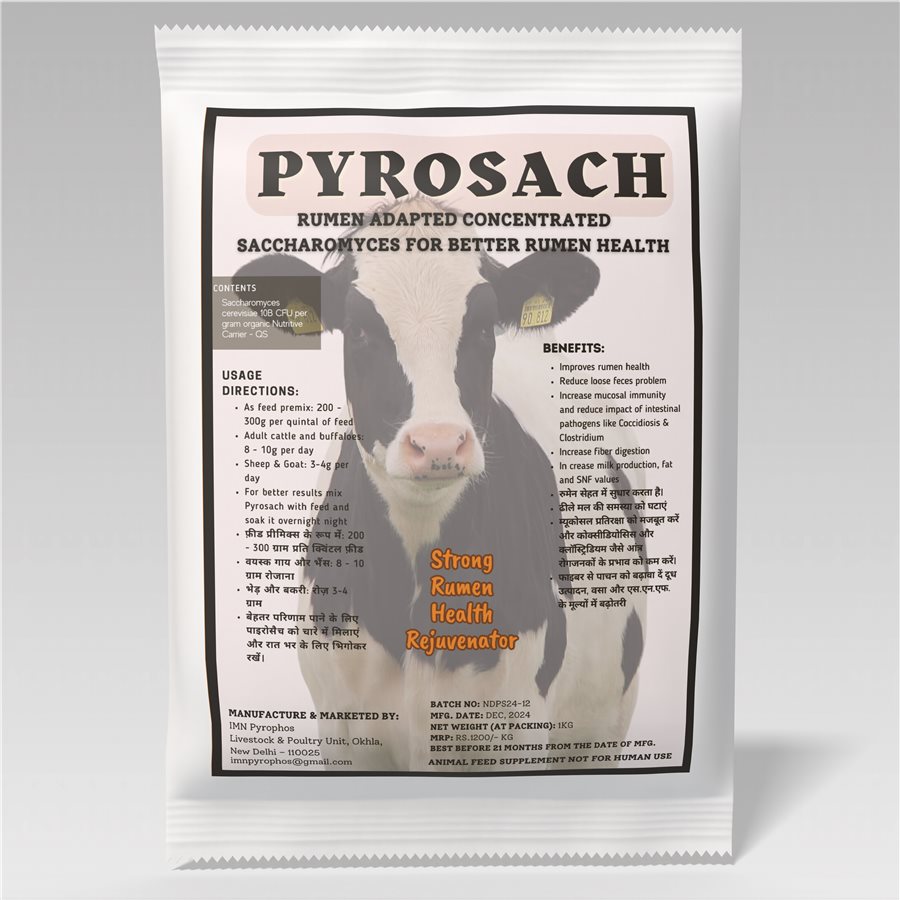
Silage-based rations are rich in acid and fermentable starch. Cows eating a lot of corn silage often have a rumen that is working hard, and yeast is one supportive tool. Pyrosach is a rumen-adapted Saccharomyces cerevisiae yeast. It supports rumen health, fibre digestion and a stable rumen, and may help reduce loose dung. It sits alongside a balanced ration: see our pillar on a complete dairy feed premix for how a premix fits in.
Rumen health
Pyrosach
Rumen-adapted Saccharomyces cerevisiae (10 billion CFU per g). Supports fibre digestion and rumen health, helps reduce loose dung and supports milk, fat and SNF.
Dose: 8-10 g per adult cow or buffalo per day, or 200-300 g per quintal of feed. For best results, mix in feed and soak overnight.
1 kg ₹700MRP ₹1,200
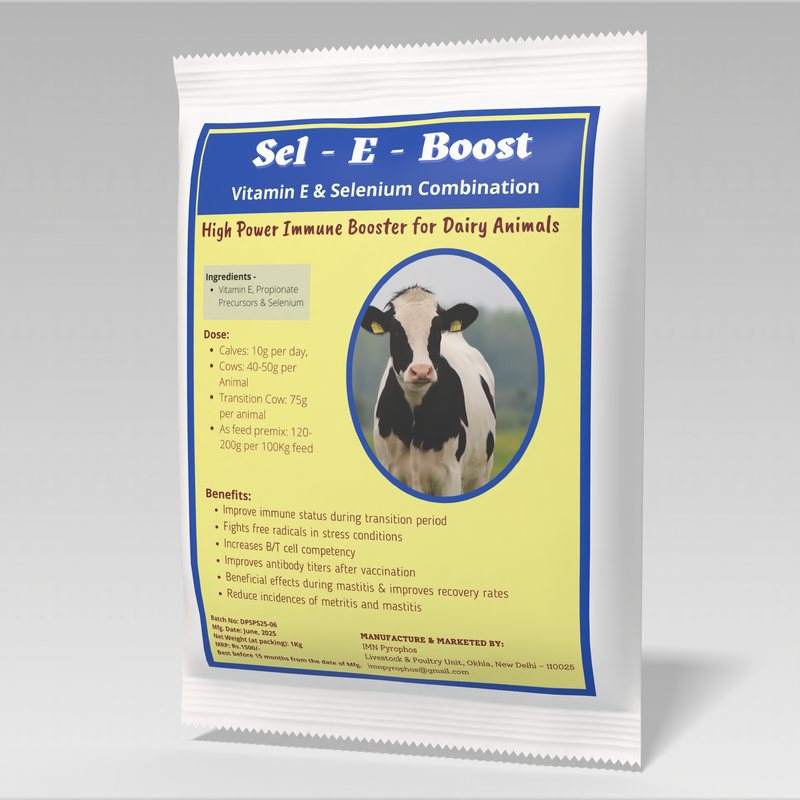
Cows under stress, such as heat, a transition period or a change in feed, need antioxidant support as well. Sel E Boost Dairy is a vitamin E and selenium combination for dairy animals. Its label says it supports immune status in the transition period and helps in stress conditions. It is a supportive feed supplement, not a treatment for a bad silage problem, and it does not remove the need to discard moulded feed.

Dairy · vitamin E + selenium
Sel E Boost (Dairy)
Vitamin E and selenium combination with propionate precursors, for dairy animals. Supports immune status in the transition period, helps against free radicals in stress and supports recovery in mastitis.
Dose (label): calves 10 g per day; cows 40-50 g per animal; transition cows 75 g per animal; as feed premix 120-200 g per 100 kg of feed.
1 kg ₹920MRP ₹1,500
If you want to see how silage, buffer and minerals fit together in one ration, read balancing a ration with corn silage. For high-fat milk with silage rations, see milk fat booster for cow and buffalo and how to increase milk fat percentage. Buffalo farmers in the cold season can read how to increase buffalo milk in winter.
Farm checklist: daily, weekly and at opening
| When | What to check |
|---|---|
| Before opening | Cover and sheet intact, no holes or water pools, silage has had enough time to ferment. See when to open silage. |
| On opening day | Smell, colour and texture 20-30 cm inside the face. Note the score. Throw away the spoiled crust. |
| Every day | Clean flat face, take only 1-2 days of feed, re-cover tightly, smell the face and the manger, feel for heat. |
| Every week | Probe or hand-check temperature 10-20 cm behind the face, look for mould at edges and corners, note intake and milk. |
| Every few months or when a problem shows | Send a sample for a fermentation report. Take it from inside the face, freeze at once. |
| If the cows change | If intake, milk, fat or dung changes suddenly, check the silage first, then the ration. |
Common mistakes in judging silage
- Trusting only appearance and ignoring smell and heat.
- Taking the sample from the loose surface instead of deep inside the face.
- Believing a sweet fruity smell means the best silage.
- Feeding the top crust “to save money”.
- Opening a big pit in the hot season and feeding it slowly.
- Relying on one lab number (such as pH) without the smell and the other acids.
- Mixing spoiled silage into the TMR to “dilute” it without a clear plan.
- Using a mould count as a mycotoxin test.
Silage quality: myths and facts
| Myth | Fact |
|---|---|
| “Sweet, fruity smell means good silage.” | It is often ethanol from yeasts. Check temperature and keeping quality (Kung et al., 2018). |
| “If I do not see mould, it is safe.” | Most deterioration is invisible at first (Borreani et al., 2018). Smell and heat come earlier. |
| “Low pH always means good silage.” | pH also depends on DM and the crop. Look at lactic acid, butyric acid and smell as well. |
| “A mould count tells me the mycotoxin level.” | It does not (Kung et al., 2018). |
| “Vinegar smell means spoiled silage.” | A mild vinegar note is normal, and moderate acetic acid helps stability. Only a very sharp, stinging smell is a concern. |
| “Steam from the face means it is rotting.” | Not always, especially in cold weather (Kung et al., 2018). |
| “A lab report can balance my ration.” | A fermentation report cannot be used to balance diets (Kung and Shaver). |
| “A supplement can fix bad silage.” | No. Only discarding, diluting or better silage management does that. Supplements support the animal only. |
Frequently asked questions
How do I know if silage is good?
Good silage smells mildly sour, looks green to olive-yellow, feels firm and cool, and has no mould inside the face. A lab report with a corn silage pH of about 3.7-4.0, no butyric acid and a lactic to acetic acid ratio near 2.5-3.0 supports that judgement.
What is the correct smell of good silage?
A mild sour, slightly vinegary and pleasant smell. Lactic acid is almost odourless, so good silage should not have a strong smell. Rancid butter, ammonia, rotten or mouldy smell is a bad sign.
What are the silage kharab hone ke sign?
Rancid butter or putrid smell, slimy and olive-green look, black or burnt colour, white or green mould, a hot face or reheating in the manger, and animals leaving the feed. Mould inside the face and a butter smell are the most serious.
What should the pH of silage be?
For corn silage the usual final pH is about 3.7-4.0, and for legume silage about 4.3-5.0 (Kung et al., 2018). Drier crops, cold weather, slow packing, clostridia or spoilage give a higher pH.
Is a pH meter or a lab report necessary?
No. Smell, colour, texture and temperature are enough for daily decisions. A lab fermentation report is useful when you have a problem, buy silage in bulk, or want to learn why a pit went wrong.
Why is my silage hot when I open it?
Air has entered. Yeasts start spoilage, then bacteria and moulds follow. Temperatures above 40 degrees C 10-20 cm behind the face, or reheating in the manger, are signs of aerobic spoilage (Kung et al., 2018). Feed faster, cut a clean face and cover it tightly.
Can I feed silage with a little mould?
Remove all visible mould and a margin around it, and do not feed the rest if mould is inside the face. Kung et al. (2018) advise discarding moulded silage, because mycotoxins may be present and mould counts do not measure them.
Is silage with a sweet, fruity smell good?
Not necessarily. It is often alcohol from yeasts, and silage with many yeasts is usually less stable in air. Check temperature, feed it quickly and watch how it behaves in the manger.
Can Pyrosach or Sel E Boost Dairy fix bad silage?
No. They are supportive feed supplements for the animal, not silage additives. Bad silage has to be discarded or diluted. Ask on WhatsApp at +91 98715 84101 how they fit into your ration.
Which silage can I feed to pregnant or fresh cows?
Only the best, with a clean smell and no mould. Fresh and transition cows are the most sensitive, and poor silage, especially with butyric acid, can add to ketosis risk (Kung et al., 2018). Share your ration on WhatsApp for advice.
Conclusion: smell, check, record, and discard when in doubt
A reliable silage quality check needs no equipment: smell, colour, texture and temperature, taken inside the face and scored the same way each time. Add a lab fermentation report when something is wrong. Know the red flags: butyric or putrid smell, mould inside the face, heating at the face and a pH that is higher than expected. Take those seriously, discard the bad portion and do not feed spoiled silage to the most sensitive animals. Support the cow with a balanced ration, and use yeast and vitamin E with selenium as supportive tools, not as a repair. For help with your own ration, send the silage type, the smell and the milk record to our team.
Also read: How to make corn silage · Silage losses · Silage additives and inoculants · Dairy feed premix · IMN product guide
Sources (research referred to above):
Kung L. Jr., Shaver R. D., Grant R. J., Schmidt R. J. (2018). Silage review: Interpretation of chemical, microbial, and organoleptic components of silages. Journal of Dairy Science 101(5).
Kung L. Jr., Shaver R. (2001). Interpretation and use of silage fermentation analysis reports. Focus on Forage 3(13), University of Wisconsin.
Borreani G., Tabacco E., Schmidt R. J., Holmes B. J., Muck R. E. (2018). Silage review: Factors affecting dry matter and quality losses in silages. Journal of Dairy Science 101(5).
Muck R. E., Nadeau E. M. G., McAllister T. A., Contreras-Govea F. E., Santos M. C., Kung L. Jr. (2018). Silage review: Recent advances and future uses of silage additives. Journal of Dairy Science 101(5).
India-specific advice (pit or bag, summer, face size, safety) is practical guidance from our team, not a research result.
साइलेज की सबसे काम की जाँच मुफ़्त है: पिट खोलिए, face के अंदर से एक मुट्ठी साइलेज निकालिए और नाक, आँख और हाथ से परखिए। सही silage quality check यहीं से शुरू होता है, और लैब रिपोर्ट वही पक्का करती है जो यह मुट्ठी पहले बता देती है। अच्छी साइलेज की smell हल्की खट्टी होती है, रंग हरा से olive-पीला, छूने पर ठंडी और ठोस, और टूटकर साफ़ बिखरती है। खराब साइलेज में rancid मक्खन, आँख-नाक चुभाने वाला सिरका, फफूँद (mould) या अमोनिया की smell होती है, वह गर्म या चिपचिपी होती है और सफ़ेद या हरे धब्बे दिखते हैं। अगर आप “साइलेज खराब होने के संकेत” या “good silage smell” खोज रहे हैं, तो यह गाइड हर संकेत, उसकी वजह, लैब के नंबर (pH, lactic, acetic, butyric acid, ammonia-N) का मतलब और साइलेज कब फेंकनी है, सब बताती है। यह उन डेयरी किसानों के लिए है जो गाय-भैंस को मक्के या हरे चारे की साइलेज खिलाते हैं। इसमें मुख्य रूप से Kung et al. (2018), Kung और Shaver (2001) और Borreani et al. (2018) के review papers का सहारा लिया गया है।
Silage quality check: अच्छी साइलेज कैसी दिखती, महकती और महसूस होती है
साइलेज acid से सुरक्षित होती है। बंद और हवा-रहित पिट में bacteria कटे चारे की चीनी को lactic acid में बदलते हैं, pH गिर जाता है और चारा “lock” हो जाता है। Kung et al. (2018) के अनुसार lactic acid अच्छी साइलेज का मुख्य acid है और लगभग गंध-रहित होता है, इसलिए अच्छी साइलेज में तेज़ या खास smell नहीं होनी चाहिए। ज़्यादातर अच्छी साइलेज में बस हल्की सिरके जैसी smell होती है, क्योंकि acetic acid दूसरा acid है और बहुत उड़ने वाला (volatile) है।
| जाँच | अच्छी साइलेज | चेतावनी का संकेत |
|---|---|---|
| Smell | हल्की खट्टी, थोड़ी सिरके जैसी, अच्छी लगने वाली। तेज़ नहीं। | rancid मक्खन, मछली या अमोनिया, चुभता सिरका, फफूँद या मिट्टी जैसी, जली हुई |
| रंग | हरा से olive-पीला, चारे के रंग के करीब | गहरा भूरा या काला, चिपचिपा olive-हरा, सफ़ेद या नीले-हरे mould के धब्बे |
| Texture | ठोस, नमी वाली, टुकड़े अपनी शक्ल रखते हैं और साफ़ बिखरते हैं | चिपचिपी, लिजलिजी, गीली-कीचड़ जैसी, या सूखी, भुरभुरी और धूल वाली |
| Temperature | face के अंदर ठंडी या हल्की गर्म | हाथ को गर्म लगे, या निकालने के कुछ घंटों में दोबारा गर्म हो जाए |
| Mould | face पर नहीं, ज़्यादा से ज़्यादा सबसे ऊपर पतली खराब परत | पिट के अंदर दिखता mould, सिर्फ़ किनारे पर नहीं |
यह farm-level गाइड है। नाक सब कुछ नहीं नाप सकती, और Kung et al. (2018) के अनुसार पूरी लैब analysis महँगी होती है, इसलिए साइलेज की शक्ल और smell से ही पता चलता है कि fermentation में क्या हुआ। लैब वाली बात आगे समझाई गई है।
5 मिनट का farm test: organoleptic score जो आप खुद लगा सकते हैं
“Organoleptic” का मतलब है इंद्रियों से परखना। नीचे का scorecard हमारा अपना practical tool है, research से validate किया हुआ score नहीं। इससे research के संकेत एक जल्दी वाले नंबर में बदल जाते हैं, ताकि एक ही फ़ार्म पर दो लोग एक जैसा जवाब दें। Sample face के अंदर 20-30 cm से लें, ऊपर की ढीली परत से नहीं, और हर बार एक ही तरीके से करें।
| इंद्रिय | 2 नंबर | 1 नंबर | 0 नंबर |
|---|---|---|---|
| Smell | हल्की खट्टी, ताज़ी | तेज़ सिरका, मीठी fruity, या तंबाकू जैसी | मक्खन, सड़न, अमोनिया, mould, मिट्टी, जली हुई |
| रंग | हरा से olive-पीला | भूरा या पीला, सूखा | काला, चिपचिपा olive-हरा, mould के धब्बे |
| Texture | ठोस, साफ़, नमी वाली | सूखी या थोड़ी ढीली | चिपचिपी, लिजलिजी, जमी हुई |
| Temperature | ठंडी या हल्की गर्म | पूरी गर्म | बहुत गर्म, या बदबू के साथ भाप |
| Mould | कोई नहीं | सिर्फ़ किनारे पर छोटे धब्बे | face के अंदर कहीं भी |
कैसे पढ़ें: 9-10 नंबर यानी सामान्य खिलाएँ। 6-8 नंबर यानी ध्यान से खिलाएँ, जल्दी खत्म करें और जाँच जारी रखें। 3-5 नंबर यानी मात्रा कम करें, मिलाकर dilute करें या खराब हिस्सा हटा दें। 0-2 नंबर, या mould या मक्खन की smell पर ज़ीरो हो, तो वह हिस्सा न खिलाएँ। Mould या मक्खन की smell पर एक ज़ीरो पूरे अच्छे टोटल को भी रोक देगा, क्योंकि वही संकेत सबसे ज़रूरी है।
साइलेज की smell की गाइड: हर smell का मतलब
Smell सबसे तेज़ गाइड है और किसान इसी पर सबसे ज़्यादा भरोसा करते हैं। Kung et al. (2018) मुख्य smell और उनके कारण बताते हैं। नीचे का table हर बार एक ही तरह से इस्तेमाल करें।
| Smell | आम तौर पर मतलब | क्या करें |
|---|---|---|
| हल्की खट्टी, थोड़ी सिरके जैसी | सामान्य lactic और acetic acid fermentation | सामान्य खिलाएँ |
| बहुत तेज़ सिरका, आँख और नाक में चुभे | बहुत ज़्यादा acetic acid, अक्सर बहुत गीली साइलेज या धीमी fermentation से। पिट के नीचे साइलेज पीली भी दिख सकती है। | मात्रा कम करें, अच्छे से mix करें, intake देखें |
| मीठी, fruity या nail polish जैसी | अक्सर yeast से बना alcohol (ethanol) और esters। बहुत लोग इसे गलती से अच्छी साइलेज का संकेत मान लेते हैं। कुछ stable साइलेज बिना mould के भी ऐसी smell देती हैं, इसलिए temperature और keeping quality भी देखें। | Temperature देखें, जल्दी खिलाएँ, यह न मानें कि सब ठीक है |
| rancid मक्खन, बदबू | Clostridia से butyric acid, सबसे खराब fermentation में से एक | न खिलाएँ, या लैब जाँच के बाद ही बहुत dilute करके |
| मछली जैसी, सड़ी, अमोनिया | प्रोटीन का ज़्यादा टूटना, यह भी clostridial | न खिलाएँ |
| सीलन, फफूँद वाली | हवा लगने से खराबी, mould | mould वाला हिस्सा फेंक दें |
| मिट्टी जैसी (earthy) | Bacilli की growth, high pH, गर्मी | फेंक दें, गर्मी जाँचें |
| मीठी तंबाकू या जली हुई | प्रोटीन का heat damage। मीठी तंबाकू शुरुआती stage है, जली और काली साइलेज severe है। | जली या काली: फेंक दें |
चेहरा पिट में घुसाकर मत सूँघें। Mould के spores धूल में हो सकते हैं। मुट्ठी हाथ में लें, थोड़ी दूर रखें और हल्की साँस से smell लें। धूल वाली या mouldy साइलेज संभालते समय mask पहनें।
रंग और texture: आँख और हाथ क्या बताते हैं
रंग का बदलाव धीरे समझ आता है, पर बहुत कुछ बताता है। नीचे वे patterns हैं जो research में और फ़ार्म पर आम हैं।
- हरा से olive-पीला, ठोस। सामान्य fermentation का संकेत। पिट के नीचे पीला रंग और तेज़ सिरके की smell बहुत गीली साइलेज में ज़्यादा acetic acid दिखाती है (Kung et al., 2018)।
- चिपचिपी, olive-हरी। Clostridial साइलेज अक्सर चिपचिपी और olive-हरी होती है, मक्खन या सड़ी smell के साथ। इसमें energy कम और soluble protein ज़्यादा होता है, पशु इसे कम खाते हैं।
- सूखी, भूरी, तंबाकू smell। बहुत सूखे चारे में फँसी हवा से heat damage का संकेत।
- काली। बहुत ज़्यादा heat damage वाली साइलेज जली हुई smell देती है और काली दिखती है।
- सफ़ेद, grey या नीले-हरे धब्बे। यह mould है। अक्सर सबसे ऊपर, दीवार के पास और जहाँ हवा घुसी वहाँ से शुरू होता है।
Silage pH और dry matter: दोनों का रिश्ता
pH acidity नापता है। ताज़ा whole-plant मक्के का pH कटाई के तुरंत बाद लगभग 5.5-6 होता है। Ensiling में lactic acid इसे नीचे लाता है। Kung et al. (2018) के अनुसार मक्के की साइलेज का final pH आम तौर पर 3.7-4.0 और legume साइलेज का 4.3-5.0 होता है, क्योंकि मक्के की buffering capacity कम होती है (pH बदलने से कम रोकता है)।
Dry matter (DM) साइलेज का वह हिस्सा है जो पानी नहीं है। बहुत गीला और बहुत सूखा, दोनों तरह का चारा दिक्कत देता है:
- सबसे कम pH लगभग 30-35% DM पर मिलता है, मक्का और legume साइलेज में (Kung et al., 2018)।
- लगभग 40-45% DM के ऊपर pH बढ़ने लगता है, क्योंकि lactic acid bacteria को पानी कम पड़ने लगता है। मक्के की साइलेज में pH 4.2 से ऊपर कम ही होता है और बहुत सूखे (42% DM से ज़्यादा), ज़्यादा पके या सूखे से मारे चारे की तरफ़ इशारा कर सकता है (Kung और Shaver, 2001)।
- 30-35% DM से नीचे legume और grass में clostridial (butyric) fermentation का खतरा बढ़ता है। Kung et al. (2018) के अनुसार clostridia को ज़्यादा osmotic pressure और कम pH दोनों पसंद नहीं, इसलिए 30-35% DM से ऊपर ensiling और जल्दी lactic acid बनवाना खतरा कम करता है।
- सूखी साइलेज खोलने के बाद जल्दी खराब हो सकती है। सूखी साइलेज ज़्यादा porous होती है और उसमें acetic acid जैसे antifungal acid कम होते हैं, इसलिए हवा लगते ही aerobic spoilage शुरू करने वाले yeast तेज़ी से बढ़ते हैं।
ज़्यादा pH अपने आप में भी चेतावनी है। आम कारण (Kung और Shaver, 2001): सूखी साइलेज, जल्दी sample लेना या ठंडा और धीमी, खराब packing की वजह से पूरी न पकी साइलेज, clostridial साइलेज, खराब या mouldy साइलेज, और गोबर मिली साइलेज। खोलने के बाद भी pH वापस चढ़ सकता है: Kung et al. (2018) एक मक्का साइलेज का ज़िक्र करते हैं जिसका pH हवा में 3 दिन में 3.8 से लगभग 5 हो गया।
शुरू से सही DM और packing के लिए हमारी गाइड पढ़ें: मक्के की साइलेज कैसे बनाएँ: harvest stage, chopping और packing।
Lactic, acetic, propionic और butyric acid: हर एक क्या बताता है
ये चार acid fermentation रिपोर्ट का दिल हैं। Research के क्रम में हर एक का मतलब नीचे है।
| Acid | यह क्या है | अच्छा संकेत | चेतावनी का संकेत |
|---|---|---|---|
| Lactic acid | सबसे strong acid, lactic acid bacteria बनाते हैं। यह pH का ज़्यादातर गिरना संभालता है और DM व energy loss सबसे कम करता है। | सबसे ज़्यादा acid। कुल acid का कम से कम 65-70% होना चाहिए (Kung और Shaver, 2001)। | कम lactic acid और high pH: restricted या clostridial fermentation, ठंड, बहुत सूखा चारा, या हवा लगने के बाद लिया sample |
| Acetic acid | दूसरा acid, उड़ने वाला, मज़बूत antifungal | मक्के की साइलेज में DM का लगभग 1-3%। मध्यम मात्रा खोलने के बाद साइलेज को stable रखती है। | DM के 3-4% से ऊपर: गीला चारा, ढीली packing, धीमी filling या लंबी fermentation। DM के 5-6% से ऊपर साइलेज की मात्रा कम करें। |
| Propionic acid | आम तौर पर थोड़ा। Antifungal। | मक्के की साइलेज में लगभग 0.1% से कम, अक्सर detect नहीं होता | ज़्यादा सिर्फ़ बहुत गीली साइलेज में, या जब propionic-acid product डाला गया हो |
| Butyric acid | Clostridia बनाते हैं | अच्छी fermented साइलेज में detect नहीं होना चाहिए | DM के 0.5% से ऊपर यानी clostridial fermentation: कम energy, ज़्यादा DM loss |
Lactic और acetic का ratio। Kung et al. (2018) के अनुसार अच्छी fermentation में lactic:acetic ratio आम तौर पर 2.5-3.0 होता है। Ratio 1 से नीचे होने का मतलब आम तौर पर abnormal fermentation है। बहुत high ratio भी हल्की चिंता है: बहुत कम acetic acid हो तो साइलेज खोलने के बाद कम stable हो सकती है।
Butyric acid और गाय। Clostridial साइलेज में fibre ज़्यादा, digestible energy कम और soluble protein ज़्यादा होता है, और इसमें amines हो सकते हैं जो पशु की performance पर असर डालते हैं। Butyric acid का 50-100 g प्रति दिन से ज़्यादा intake lactating गाय में ketosis ला सकता है (Kung et al., 2018)। अगर मक्खन की smell के साथ गाय खाना छोड़ रही है तो इसे गंभीरता से लें, और पशु की तरफ़ के लिए हमारी गाइड transition cow और ketosis support पढ़ें।
Ammonia-N, ethanol, yeast और mould
Ammonia-N बताता है कि पिट में कितना प्रोटीन टूटा। मक्के की साइलेज में आम value कुल N का लगभग 5-7% होती है, legume और grass साइलेज में ज़्यादा। पुरानी रिपोर्ट के अनुसार crude protein के 12-15% से ऊपर की value का मतलब है धीमी pH गिरावट या clostridia से ज़्यादा protein breakdown। गीली साइलेज में ammonia ज़्यादा होता है, और ढीली packing या धीमी filling में भी। अकेले ammonia से नुकसान नहीं होता अगर पूरे ration का nitrogen balanced हो, पर जिस साइलेज में ammonia और butyric acid दोनों ज़्यादा हों उसमें अक्सर amines जैसे दूसरे खराब products भी होते हैं (Kung और Shaver, 2001)। Blood या milk urea से पता चल सकता है कि प्रोटीन ज़्यादा पड़ रहा है या नहीं।
Ethanol yeast की activity दिखाता है। आम level कम होता है (DM का 1-2% से नीचे), और बहुत ज़्यादा level (DM का 3-4% से ऊपर) दूध में off-flavour ला सकता है और अक्सर खोलने के बाद जल्दी खराब होने वाली साइलेज में मिलता है।
Yeast और mould तय करते हैं कि साइलेज खोलने के बाद कितनी देर ताज़ा रहेगी। Kung et al. (2018) के अनुसार मक्के की साइलेज में yeast की गिनती बढ़ने पर aerobic stability गिरती है, और एक study में 6 log10 cfu प्रति ग्राम wet मक्का साइलेज या उससे ज़्यादा yeast पर stability शून्य predict हुई। Mould की high गिनती (6 log10 cfu प्रति ग्राम से ऊपर) आम तौर पर हवा में खराब हुई साइलेज में मिलती है। Mould count mycotoxin का test नहीं है। गर्म मौसम में sample लैब जाते समय भी count बढ़ सकता है, इसलिए ध्यान से पढ़ें।
Lab fermentation रिपोर्ट कैसे पढ़ें: typical ranges
Fermentation रिपोर्ट में आम तौर पर pH, lactic, acetic, propionic, butyric acid, ammonia और ethanol होते हैं। Kung और Shaver के अनुसार यह बता सकती है कि fermentation excellent, average या poor थी और किस microbe का control था। यह ration balance करने में इस्तेमाल नहीं हो सकती, इसलिए हमेशा NDF, protein, energy जैसी आम analysis के साथ पढ़ें। नीचे का table Kung et al. (2018) से है, जिसमें US की साइलेज के “typical suggested concentrations” हैं, इसलिए इसे गाइड मानें, pass-fail नियम नहीं। Acid DM के % में, ammonia कुल N के % में।
| Item | Corn silage (30-40% DM) | Grass silage (25-35% DM) | Legume silage (30-35% DM) |
|---|---|---|---|
| pH | 3.7-4.0 | 4.3-4.7 | 4.3-4.5 |
| Lactic acid | 3-6 | 6-10 | 6-8 |
| Acetic acid | 1-3 | 1-3 | 2-3 |
| Propionic acid | <0.1 | <0.1 | <0.5 |
| Butyric acid | 0 | <0.5-1.0 | <0.5 |
| Ethanol | 1-3 | 0.5-1.0 | 0.5-1.0 |
| Ammonia-N (कुल N का %) | 5-7 | 8-12 | 10-15 |
पुरानी Kung और Shaver रिपोर्ट में मक्के की साइलेज के लिए थोड़ी चौड़ी values हैं (pH 3.7-4.2, lactic acid 4-7%), यानी ये ranges हैं, fixed लाइनें नहीं। Kung et al. (2018) यह भी चेताते हैं कि लैब को भेजी जाने वाली बहुत-सी साइलेज “problem samples” होती हैं और sample रास्ते में बदल भी सकता है, इसलिए लैब result एक clue है, फ़ैसला नहीं।
Sample कैसे लें। यह देखना हो कि साइलेज कैसे ferment हुई, तो ताज़ा sample लें जो हवा से न लगा हो, face के अंदर कम से कम 8-10 इंच (लगभग 20-25 cm)। यह देखना हो कि पशु असल में क्या खा रहे हैं, तो खिलाते समय sample लें। Sample तुरंत freeze करें और ठंडा करके भेजें, हफ़्ते की शुरुआत में, ताकि weekend में अटके नहीं (Kung और Shaver)। भारत में लैब से खास तौर पर fermentation analysis माँगें, क्योंकि routine proximate analysis में acid नहीं होते।
| रिपोर्ट में क्या दिखा | संभावित मतलब | क्या करें |
|---|---|---|
| pH expected से ज़्यादा, lactic acid कम | Restricted या clostridial fermentation, सूखा चारा, या हवा से खराब sample | DM, smell, butyric acid, गर्मी जाँचें |
| Butyric acid 0.5% से ऊपर | Clostridial fermentation | मात्रा कम या फेंक दें; कम energy, ketosis का खतरा |
| Ammonia-N ज़्यादा, butyric के साथ | गीला चारा, धीमी pH गिरावट, protein breakdown | ration में हिस्सा कम करें; urea या MUN देखें |
| Ethanol ज़्यादा, smell मीठी या fruity | Yeast activity | खोलने के बाद जल्दी गर्म होगी; जल्दी खिलाएँ |
| Acetic acid बहुत ज़्यादा | गीला चारा या धीमी fermentation | TMR में साइलेज कम करें, intake देखें |
| Lactic:acetic ratio 1 से नीचे | Abnormal fermentation | पूरी process की जाँच करें |
Heating और aerobic spoilage: पिट खोलने के बाद
बहुत किसान पिट में सब सही करते हैं फिर भी face पर साइलेज का नुकसान होता है। Borreani et al. (2018) समझाते हैं कि silo खुलते ही oxygen का घुसना तय है, और हवा face में कई मीटर तक जा सकती है, खासकर किनारों पर जहाँ साइलेज ज़्यादा porous होती है। क्रम साफ़ है: पहले yeast चीनी और acid खाते हैं, जिससे temperature और pH बढ़ता है। फिर bacilli और दूसरे aerobic bacteria बढ़ते हैं और गर्मी और बढ़ती है, और आख़िर में mould काम खत्म करता है। Research के अनुसार फ़ार्म पर यह process कुल stored DM के 20% तक को छूती है, और bunker के किनारों और दीवार के पास 70% तक पहुँच सकती है।
Temperature पहली चेतावनी है। Kung et al. (2018) के अनुसार:
- अच्छे से pack और तुरंत seal की गई साइलेज filling के temperature से लगभग 5-8 degree C से ज़्यादा नहीं बढ़नी चाहिए।
- Active phase के बाद core धीरे-धीरे लगभग 25-30 degree C पर आता है और बची हुई गर्मी शायद ही 35 degree C से ऊपर जाती है।
- Aerobic spoilage के संकेत: face के 10-20 cm पीछे 40 degree C से ज़्यादा temperature, manger में दोबारा गर्म होना, दिखता mould, तेज़ या मीठी smell का चले जाना, या सपाट, सीलन वाली smell।
- ठंड में face से भाप निकलना हमेशा खराबी नहीं होता। बची हुई गर्मी और बाहर की हवा के अंतर से भाप बनती है।
Mould देर से दिखता है। Borreani et al. (2018) के अनुसार जब mould count लगभग 5 log10 cfu प्रति ग्राम से ऊपर जाता है, यानी mould दिखने लगता है, तो DM loss 20% से ऊपर जाता है, और 6 log10 से ऊपर ensiled DM के 40% से ज़्यादा हो सकता है। Starch भी गिरने लगता है। यानी जब तक mould दिखे, feed value का बड़ा हिस्सा जा चुका होता है।
भारत के फ़ार्म के लिए practical सलाह (papers से नहीं): गर्मी में जो पिट खोला जाए और धीरे खिलाया जाए वह जल्दी गर्म होगा। रोज़ साफ़, सपाट face काटें, face छोटा रखें, 1-2 दिन का ही चारा निकालें और sheet कसकर वापस डालें। Face का size जानवरों के हिसाब से तय करने के लिए हमारी गाइड silage losses और dry matter loss कैसे कम करें और silage feeding management पढ़ें। Borreani et al. ने पाया कि removal rate मायने रखता है: northern Italy में सर्दी में face का feed-out rate लगभग 1.10 m प्रति हफ़्ता से ऊपर रखने पर mould वाली सतह 2% से कम रही, जबकि गर्मी में suggested rate 1.75 m प्रति हफ़्ता से ऊपर था। भारत की गर्मी में भी तेज़ feed-out चाहिए।
Mycotoxin और listeria: छिपा हुआ खतरा
दिखता mould hygiene का alarm है। Kung et al. (2018) साफ़ कहते हैं कि mouldy साइलेज फेंक देनी चाहिए, क्योंकि उसमें mycotoxin हो सकते हैं जो production, health और fertility में गंभीर दिक्कत दे सकते हैं। वही review चेताता है कि mould count से mycotoxin का level नहीं पता चलता, यानी “mould नहीं दिखा” का मतलब “toxin नहीं” नहीं है, और “थोड़ा mould” से यह नहीं पता कि कितना toxin है। Borreani et al. (2018) जोड़ते हैं कि ऊपर की परतों की खराब साइलेज अगर ration में मिल जाए तो पूरे TMR में mould, spores और mycotoxin पहुँच सकते हैं और intake व performance घट सकती है।
Listeria एक और bacteria है जो खराब साइलेज में, खासकर जहाँ हवा घुसती है, बढ़ सकता है। Muck et al. (2018) बताते हैं कि साइलेज में Listeria पर research हुई है, और यह एक कारण है कि साइलेज की hygienic quality पशु और इंसान दोनों के लिए मायने रखती है। यहाँ हम कोई नंबर नहीं दे रहे क्योंकि papers फ़ार्म thresholds नहीं देते। Practical बात सीधी है: हवा बाहर रखें, खराब और mouldy परत फेंकें, ऊपर की परत कभी न खिलाएँ, और खराब साइलेज को अच्छी feed में मिक्स न होने दें। अगर पशु में अजीब संकेत दिखें जैसे गर्दन टेढ़ी, चक्कर काटना, बार-बार abortion या अचानक दूध गिरना, तो अंदाज़ा लगाने के बजाय veterinarian को बुलाएँ।
साइलेज कब फेंकें, कब limit या dilute करें
इसे decision गाइड की तरह इस्तेमाल करें। शक हो तो सुरक्षित रास्ता चुनें। एक गाड़ी साइलेज का नुकसान बीमार गायों या दूध के नुकसान से बहुत छोटा है।
| क्या मिला | फ़ैसला |
|---|---|
| हल्की खट्टी smell, ठोस, ठंडी, हरी | सामान्य खिलाएँ |
| तेज़ सिरका smell, बहुत गीली, नीचे पीली | ration में कम खिलाएँ, अच्छे से mix करें, intake देखें |
| मीठी, fruity या alcohol smell, face जल्दी गर्म होता है | जल्दी खिलाएँ, face छोटा करें, रोज़ temperature देखें |
| गर्म face, शुरुआती heating, अभी mould नहीं | गर्म परत हटा दें, बाकी तुरंत खिलाएँ, cover कसें |
| rancid मक्खन, सड़ी, मछली या अमोनिया smell, चिपचिपी | न खिलाएँ, या सलाह के बाद ही dilute करके |
| face के अंदर दिखता mould, सीलन की smell | mouldy हिस्सा और उसके आस-पास का अच्छा margin फेंक दें |
| काली, जली smell, बहुत गर्म | फेंक दें |
| पशु मना करें, intake घटे, पतला गोबर, off-feed | रुक जाएँ और साइलेज व ration जाँचें। जारी रहे तो vet से मिलें। |
खराब साइलेज को शीरे, flavour या ज़्यादा concentrate से “छुपाकर” खिलाने की कोशिश न करें। Kung et al. (2018) चेताते हैं कि clostridial साइलेज का intake flavour या aroma-masking agent से ज़बरदस्ती बढ़ाने से production, health और fertility की दिक्कतें बढ़ सकती हैं। Dry cow, गर्भवती पशु, बछड़े और heifers को भी खराब साइलेज न दें, क्योंकि ये सबसे sensitive होते हैं।
बहुत ज़्यादा acetic acid वाली साइलेज के लिए research के options: TMR में हिस्सा कम करें, एक दिन हवा में फैलाएँ, या 2-3 हफ़्तों में धीरे-धीरे ration में वापस लाएँ (Kung और Shaver)। Butyric acid या mould के लिए पूरी तरह हटाना या dilute करना सलाह है, “ठीक करना” नहीं।
Silo face पर सुरक्षा
- गैस। शुरू के दिनों में ताज़ी साइलेज नुकसानदेह गैस (nitrogen oxides) छोड़ सकती है। बच्चों और पशुओं को दूर रखें, बंद या अभी खुले पिट के अंदर कभी खड़े न हों, खोलकर हवा आने दें। यह practical सलाह है, हमारे मुख्य papers का निष्कर्ष नहीं।
- ढहना। ऊँचे, लटके हुए face के नीचे मत खड़े हों और नीचे से मत खोदें। ऊपर से नीचे काटें।
- धूल और mould। mouldy या धूल वाली साइलेज संभालते समय mask पहनें। धूल को साँस में न लें।
- Thermometer। Kung et al. (2018) के अनुसार सस्ती probes पिट और bunker में temperature नापने के काम आती हैं, पर नापते समय खुद को खतरे में डालने से बचें।
- निपटान। खराब साइलेज को पशुओं, तालाब और feeding area से दूर रखें। ऐसी जगह न छोड़ें जहाँ गाय, बकरी या कुत्ते खा लें।
साइलेज खिलाते समय supportive nutrition (ये साइलेज को ठीक नहीं करते)
साफ़ कर दें: Pyrosach और Sel E Boost साइलेज additive या inoculant नहीं हैं, और खराब साइलेज को सुधारते या ठीक नहीं करते। ये पशु को खिलाए जाते हैं, पिट में नहीं डाले जाते। अच्छी साइलेज quality अच्छी कटाई, packing, sealing और feed-out से आती है। नीचे के products सिर्फ़ उस गाय को सहारा देने के लिए हैं जिसके ration में साइलेज ज़्यादा है।
साइलेज वाले ration में acid और fermentable starch ज़्यादा होते हैं। जो गायें बहुत मक्का साइलेज खाती हैं उनका rumen अक्सर ज़्यादा मेहनत करता है, और yeast एक supportive tool है। Pyrosach rumen के अनुकूल Saccharomyces cerevisiae yeast है। यह rumen की सेहत, रेशे के पाचन और rumen को stable रखने में सहारा देता है, और पतला गोबर कम करने में मदद कर सकता है। यह balanced ration के साथ चलता है: premix ration में कैसे बैठता है, यह देखने के लिए हमारा pillar complete dairy feed premix पढ़ें।
रुमेन की सेहत
Pyrosach
रुमेन के अनुकूल Saccharomyces cerevisiae (1000 करोड़ CFU प्रति ग्राम)। रेशे का पाचन और रुमेन की सेहत सुधारता है, पतला गोबर घटाता है, दूध, फैट और SNF में सहायक।
मात्रा: 8–10 ग्राम प्रति वयस्क गाय या भैंस प्रति दिन, या 200–300 ग्राम प्रति क्विंटल दाना। अच्छे नतीजे के लिए दाने में मिलाकर रात भर भिगोएँ।
1 kg ₹700MRP ₹1,200
गर्मी, transition period या feed बदलाव जैसे stress में गायों को antioxidant support की भी ज़रूरत होती है। Sel E Boost Dairy डेयरी पशुओं के लिए विटामिन E और सेलेनियम का combination है। Label के अनुसार यह transition period में immune status और stress conditions में सहारा देता है। यह supportive feed supplement है, खराब साइलेज की समस्या का इलाज नहीं, और यह mouldy feed फेंकने की ज़रूरत खत्म नहीं करता।
डेयरी · विटामिन E + सेलेनियम
Sel-E-Boost (dairy)
डेयरी पशुओं के लिए विटामिन E और सेलेनियम combination, high power immune booster (label: विटामिन E, propionate precursors और सेलेनियम)। Transition period में immune status सुधारता है, तनाव में free radicals से लड़ता है, mastitis में recovery बेहतर करता है और metritis व mastitis के मामले घटाता है।
मात्रा: बछड़े 10 g प्रति दिन; गाय 40 से 50 g प्रति पशु; transition cow 75 g प्रति पशु; feed premix के रूप में 120 से 200 g प्रति 100 kg दाना।
1 kg ₹920MRP ₹1,500
साइलेज, buffer और मिनरल एक ration में कैसे जुड़ते हैं, यह देखने के लिए मक्के की साइलेज के साथ ration balance करना पढ़ें। साइलेज ration में दूध के फैट के लिए गाय-भैंस के लिए milk fat booster और milk fat percentage कैसे बढ़ाएँ देखें। सर्दी में भैंस के दूध के लिए सर्दी में भैंस का दूध कैसे बढ़ाएँ पढ़ें।
Farm checklist: रोज़, हर हफ़्ते और पिट खोलते समय
| कब | क्या जाँचें |
|---|---|
| खोलने से पहले | Cover और sheet सही, कोई छेद या पानी का जमाव नहीं, साइलेज को ferment होने का पूरा समय मिला। देखें साइलेज कब खोलें। |
| खोलने के दिन | Face के अंदर 20-30 cm पर smell, रंग और texture। Score लिखें। ऊपर की खराब परत फेंक दें। |
| रोज़ | साफ़ सपाट face, सिर्फ़ 1-2 दिन का चारा निकालें, कसकर दोबारा ढकें, face और manger की smell लें, गर्मी महसूस करें। |
| हर हफ़्ते | Face के 10-20 cm पीछे probe या हाथ से temperature देखें, किनारों और कोनों में mould देखें, intake और दूध लिखें। |
| कुछ महीने में या समस्या दिखने पर | Fermentation रिपोर्ट के लिए sample भेजें। Face के अंदर से लें, तुरंत freeze करें। |
| गायों में बदलाव दिखे तो | Intake, दूध, फैट या गोबर अचानक बदले तो पहले साइलेज देखें, फिर ration। |
साइलेज परखने की आम गलतियाँ
- सिर्फ़ शक्ल पर भरोसा करना, smell और गर्मी को ignore करना।
- Sample face के अंदर से नहीं, ऊपर की ढीली परत से लेना।
- मीठी fruity smell को सबसे अच्छी साइलेज मान लेना।
- पैसे बचाने के लिए ऊपर की परत खिला देना।
- गर्मी में बड़ा पिट खोलना और उसे धीरे खिलाना।
- Smell और बाकी acid देखे बिना एक ही लैब नंबर (जैसे pH) पर भरोसा।
- बिना plan के खराब साइलेज को TMR में “dilute” करने के लिए मिला देना।
- Mould count को mycotoxin test समझना।
Silage quality के myths और facts
| Myth | Fact |
|---|---|
| “मीठी, fruity smell मतलब अच्छी साइलेज।” | यह अक्सर yeast से बना ethanol होता है। Temperature और keeping quality देखें (Kung et al., 2018)। |
| “Mould नहीं दिखा तो सुरक्षित है।” | ज़्यादातर खराबी शुरू में दिखती नहीं (Borreani et al., 2018)। Smell और गर्मी पहले आते हैं। |
| “कम pH मतलब हमेशा अच्छी साइलेज।” | pH DM और crop पर भी निर्भर है। Lactic acid, butyric acid और smell भी देखें। |
| “Mould count से mycotoxin का level पता चलता है।” | नहीं चलता (Kung et al., 2018)। |
| “सिरके की smell मतलब साइलेज खराब।” | हल्की सिरके की smell सामान्य है, और मध्यम acetic acid stability में मदद करता है। सिर्फ़ बहुत तेज़, चुभने वाली smell चिंता की बात है। |
| “Face से भाप निकले तो साइलेज सड़ रही है।” | हमेशा नहीं, खासकर ठंड में (Kung et al., 2018)। |
| “लैब रिपोर्ट से ration balance हो जाता है।” | Fermentation रिपोर्ट से ration balance नहीं होता (Kung और Shaver)। |
| “कोई supplement खराब साइलेज ठीक कर देगा।” | नहीं। यह सिर्फ़ फेंकने, dilute करने या बेहतर silage management से होता है। Supplement सिर्फ़ पशु को सहारा देते हैं। |
आम सवाल (FAQ)
साइलेज अच्छी है या नहीं, कैसे पता करें?
अच्छी साइलेज की smell हल्की खट्टी, रंग हरा से olive-पीला, ठोस और ठंडी होती है और face के अंदर mould नहीं होता। लैब रिपोर्ट में मक्के की साइलेज का pH लगभग 3.7-4.0, butyric acid नहीं और lactic:acetic ratio 2.5-3.0 के आस-पास हो तो यह फ़ैसला पक्का होता है।
अच्छी साइलेज की सही smell कैसी होती है?
हल्की खट्टी, थोड़ी सिरके जैसी और अच्छी लगने वाली। Lactic acid लगभग गंध-रहित है, इसलिए अच्छी साइलेज में तेज़ smell नहीं होनी चाहिए। rancid मक्खन, अमोनिया, सड़ी या फफूँद वाली smell खराब संकेत है।
साइलेज खराब होने के संकेत क्या हैं?
rancid मक्खन या सड़ी smell, चिपचिपी और olive-हरी शक्ल, काला या जला रंग, सफ़ेद या हरा mould, गर्म face या manger में दोबारा गर्म होना, और पशुओं का feed छोड़ना। Face के अंदर mould और मक्खन की smell सबसे गंभीर हैं।
साइलेज का pH कितना होना चाहिए?
मक्के की साइलेज का आम final pH लगभग 3.7-4.0 और legume साइलेज का लगभग 4.3-5.0 होता है (Kung et al., 2018)। सूखा चारा, ठंड, धीमी packing, clostridia या खराबी से pH ज़्यादा होता है।
क्या pH meter या लैब रिपोर्ट ज़रूरी है?
नहीं। रोज़ के फ़ैसले के लिए smell, रंग, texture और temperature काफ़ी हैं। लैब fermentation रिपोर्ट तब काम आती है जब समस्या हो, bulk में साइलेज खरीदनी हो, या जानना हो कि पिट में क्या गलत हुआ।
खोलते ही साइलेज गर्म क्यों है?
हवा घुस गई है। पहले yeast खराबी शुरू करते हैं, फिर bacteria और mould आते हैं। Face के 10-20 cm पीछे 40 degree C से ऊपर temperature या manger में दोबारा गर्म होना aerobic spoilage का संकेत है (Kung et al., 2018)। जल्दी खिलाएँ, साफ़ face काटें और कसकर ढकें।
क्या थोड़े mould वाली साइलेज खिला सकते हैं?
दिखने वाला सारा mould और उसके आस-पास का margin हटा दें, और अगर face के अंदर mould हो तो बाकी भी न खिलाएँ। Kung et al. (2018) mouldy साइलेज फेंकने की सलाह देते हैं, क्योंकि mycotoxin हो सकते हैं और mould count उन्हें नहीं नापता।
मीठी, fruity smell वाली साइलेज अच्छी है?
ज़रूरी नहीं। यह अक्सर yeast से बना alcohol होता है, और ज़्यादा yeast वाली साइलेज हवा में कम stable होती है। Temperature देखें, जल्दी खिलाएँ और manger में उसका behaviour देखें।
क्या Pyrosach या Sel E Boost Dairy खराब साइलेज ठीक कर सकते हैं?
नहीं। ये पशु के लिए supportive feed supplements हैं, silage additive नहीं। खराब साइलेज को फेंकना या dilute करना पड़ता है। अपने ration में ये कैसे बैठते हैं, WhatsApp पर +91 98715 84101 पर पूछें।
गर्भवती या ताज़ा ब्याही गाय को कौन-सी साइलेज दे सकते हैं?
सिर्फ़ सबसे अच्छी, साफ़ smell और बिना mould वाली। ताज़ा ब्याही और transition गायें सबसे sensitive होती हैं, और खराब साइलेज, खासकर butyric acid वाली, ketosis का खतरा बढ़ा सकती है (Kung et al., 2018)। अपना ration WhatsApp पर भेजें, सलाह मिलेगी।
निष्कर्ष: smell लें, जाँचें, लिखें, शक हो तो फेंक दें
भरोसेमंद silage quality check के लिए कोई उपकरण नहीं चाहिए: smell, रंग, texture और temperature, face के अंदर से, हर बार एक जैसे score के साथ। कुछ गलत लगे तो लैब fermentation रिपोर्ट जोड़ें। Red flags जानें: butyric या सड़ी smell, face के अंदर mould, face पर गर्मी और expected से ज़्यादा pH। इन्हें गंभीरता से लें, खराब हिस्सा फेंक दें और सबसे sensitive पशुओं को खराब साइलेज कभी न दें। Balanced ration से गाय को सहारा दें, और yeast व विटामिन E-सेलेनियम को supportive tool की तरह इस्तेमाल करें, मरम्मत की तरह नहीं। अपने ration के लिए साइलेज का type, smell और दूध का record हमारी टीम को भेजें।
यह भी पढ़ें: मक्के की साइलेज कैसे बनाएँ · Silage losses · Silage additives और inoculants · Dairy feed premix · IMN product guide
Sources (जिन research का ज़िक्र ऊपर है):
Kung L. Jr., Shaver R. D., Grant R. J., Schmidt R. J. (2018). Silage review: Interpretation of chemical, microbial, and organoleptic components of silages. Journal of Dairy Science 101(5).
Kung L. Jr., Shaver R. (2001). Interpretation and use of silage fermentation analysis reports. Focus on Forage 3(13), University of Wisconsin.
Borreani G., Tabacco E., Schmidt R. J., Holmes B. J., Muck R. E. (2018). Silage review: Factors affecting dry matter and quality losses in silages. Journal of Dairy Science 101(5).
Muck R. E., Nadeau E. M. G., McAllister T. A., Contreras-Govea F. E., Santos M. C., Kung L. Jr. (2018). Silage review: Recent advances and future uses of silage additives. Journal of Dairy Science 101(5).
भारत से जुड़े सुझाव (पिट या bag, गर्मी, face का size, सुरक्षा) हमारी टीम की practical सलाह हैं, research का नतीजा नहीं।
Silage ki sabse kaam ki jaanch muft hai: pit kholiye, face ke andar se ek mutthi silage nikaliye aur naak, aankh aur haath se dekhiye. Sahi silage quality check yahin se shuru hota hai, aur lab report sirf wahi confirm karti hai jo ye mutthi pehle bata deti hai. Achhi silage ki smell halki khatti hoti hai, rang hara se olive-peela, chhune par thandi aur thos, aur toot kar saaf bikharti hai. Kharab silage me rancid makkhan, nak jalane wala sirka, fafund (mould) ya ammonia ki smell hoti hai, wo garm ya chipchipi hoti hai aur safed ya hari parat dikhti hai. Agar aap “silage kharab hone ke sign” ya “good silage smell” dhoondh rahe hain, to ye guide har sign, uska kaaran, lab ke numbers (pH, lactic, acetic, butyric acid, ammonia-N) ka matlab aur silage kab pheikni hai, ye sab batati hai. Ye un dairy kisanon ke liye hai jo gaay-bhains ko corn ya hare chaare ki silage khilate hain. Isme mukhya taur par Kung et al. (2018), Kung aur Shaver (2001) aur Borreani et al. (2018) ke review papers ka sahara liya gaya hai.
Silage quality check: achhi silage kaisi dikhti, mehekti aur mehsoos hoti hai
Silage acid se surakshit hoti hai. Band aur hawa-rahit pit me bacteria kate hue chaare ki cheeni ko lactic acid me badalte hain, pH gir jaata hai aur chaara “lock” ho jaata hai. Kung et al. (2018) ke anusaar lactic acid achhi silage ka mukhya acid hai aur lagbhag gandh-rahit hota hai, isliye achhi silage me tez ya khaas smell nahi honi chahiye. Zyadatar achhi silage me bas halki sirke jaisi smell hoti hai, kyunki acetic acid doosra acid hai aur bahut udne wala (volatile) hota hai.
| Jaanch | Achhi silage | Chetavni ka sign |
|---|---|---|
| Smell | Halki khatti, thodi sirke jaisi, achhi lagne wali. Tez nahi. | Rancid makkhan, machhli ya ammonia, nak jalane wala sirka, fafund ya mitti jaisi, jali hui |
| Rang | Hara se olive-peela, chaare ke rang ke kareeb | Dark brown ya kala, chipchipa olive-hara, safed ya neela-hara mould ke dhabbe |
| Texture | Thos, nami wali, tukde apni shakal rakhte hain aur saaf bikharte hain | Chipchipi, lijlijee, gili-kichad jaisi, ya sookhi, bhurbhuri aur dhool wali |
| Temperature | Face ke andar thandi ya halki garm | Haath ko garm lage, ya nikaalne ke kuch ghanton me dobara garm ho jaye |
| Mould | Face par nahi, zyada se zyada sabse upar patli kharab parat | Pit ke andar dikhne wala mould, sirf kinare par nahi |
Ye farm-level guide hai. Naak sab kuch nahi naap sakti, aur Kung et al. (2018) ke anusaar poori lab analysis mehngi hoti hai, isliye silage ki shakal aur smell se hi pata chalta hai ki fermentation me kya hua. Lab wali baat neeche samjhayi gayi hai.
5 minute ka farm test: organoleptic score jo aap khud laga sakte hain
“Organoleptic” ka matlab hai indriyon se parakhna. Neeche ka scorecard hamara apna practical tool hai, research se validate kiya hua score nahi. Isse research ke signs ek jaldi wale number me badal jaate hain, taaki ek hi farm par do log ek jaisa jawab dein. Sample face ke andar 20-30 cm se lein, upar ki dheeli parat se nahi, aur har baar ek hi tareeke se karein.
| Indriya | 2 number | 1 number | 0 number |
|---|---|---|---|
| Smell | Halki khatti, taazi | Tez sirka, meethi fruity, ya tambaku jaisi | Makkhan, sadan, ammonia, mould, mitti, jali hui |
| Rang | Hara se olive-peela | Bhoora ya peela, sookha | Kala, chipchipa olive-hara, mould ke dhabbe |
| Texture | Thos, saaf, nami wali | Sookhi ya thodi dheeli | Chipchipi, lijlijee, jami hui |
| Temperature | Thandi ya halki garm | Poori garm | Bahut garm, ya bad smell ke saath bhaap |
| Mould | Koi nahi | Sirf kinare par chhote dhabbe | Face ke andar kahin bhi |
Kaise padhein: 9-10 number matlab normal khilayein. 6-8 number matlab dhyan se khilayein, jaldi khatam karein aur jaanch jaari rakhein. 3-5 number matlab matra kam karein, milakar dilute karein ya kharab hissa hata dein. 0-2 number, ya mould ya makkhan smell par zero ho, to wo hissa mat khilayein. Mould ya makkhan smell par ek zero poore achhe total ko bhi ruk dega, kyunki wahi sign sabse zaroori hai.
Silage ki smell ki guide: har smell ka matlab
Smell sabse tez guide hai aur kisan isi par sabse zyada bharosa karte hain. Kung et al. (2018) mukhya smell aur unke kaaran batate hain. Neeche ka table har baar ek hi tareeke se use karein.
| Smell | Aam taur par matlab | Kya karein |
|---|---|---|
| Halki khatti, thodi sirke jaisi | Normal lactic aur acetic acid fermentation | Normal khilayein |
| Bahut tez sirka, aankh aur naak me chubhe | Bahut zyada acetic acid, aksar bahut geeli silage ya dheemi fermentation se. Pit ke neeche silage peeli bhi dikh sakti hai. | Matra kam karein, achhe se mix karein, intake dekhein |
| Meethi, fruity ya nail polish jaisi | Aksar yeast se bana alcohol (ethanol) aur esters. Bahut log ise galti se achhi silage ka sign maan lete hain. Kuch stable silage bina mould ke bhi aisi smell deti hain, isliye temperature aur keeping quality bhi dekhein. | Temperature dekhein, jaldi khilayein, ye na maanein ki sab theek hai |
| Rancid makkhan, badboo | Clostridia se butyric acid, sabse kharab fermentation me se ek | Mat khilayein, ya lab check ke baad hi bahut dilute karke |
| Machhli jaisi, sadi, ammonia | Protein ka zyada toot jaana, ye bhi clostridial | Mat khilayein |
| Seeli, fafund wali | Hawa lagne se kharabi, mould | Mould wala hissa pheink dein |
| Mitti jaisi (earthy) | Bacilli ki growth, high pH, garmi | Pheink dein, garmi check karein |
| Meethi tambaku ya jali hui | Protein ka heat damage. Meethi tambaku shuruati stage hai, jali aur kali silage severe hai. | Jali ya kali: pheink dein |
Chehra pit me ghusa kar mat sunghein. Mould ke spores dhool me ho sakte hain. Mutthi haath me lein, thodi door rakhein aur halki saans se smell lein. Dhool wali ya mould wali silage sambhalte waqt mask pehnein.
Rang aur texture: aankh aur haath kya batate hain
Rang ka badlaav dheere samajh aata hai, par bahut kuch batata hai. Neeche wo patterns hain jo research me aur farm par aam hain.
- Hara se olive-peela, thos. Normal fermentation ka sign. Pit ke neeche peela rang aur tez sirka smell bahut geeli silage me zyada acetic acid dikhata hai (Kung et al., 2018).
- Chipchipi, olive-hari. Clostridial silage aksar chipchipi aur olive-hari hoti hai, makkhan ya sadi smell ke saath. Isme energy kam aur soluble protein zyada hota hai, pashu ise kam khate hain.
- Sookhi, bhoori, tambaku smell. Bahut sookhe chaare me phanse hue hawa se heat damage ka sign.
- Kali. Bahut zyada heat damage wali silage jali hui smell deti hai aur kali dikhti hai.
- Safed, grey ya neela-hara dhabbe. Ye mould hai. Aksar sabse upar, deewar ke paas aur jahan hawa ghusi wahan se shuru hota hai.
Silage pH aur dry matter: dono ka rishta
pH acidity naapta hai. Taaza whole-plant corn ka pH katai ke turant baad lagbhag 5.5-6 hota hai. Ensiling me lactic acid ise neeche laata hai. Kung et al. (2018) ke anusaar corn silage ka final pH aam taur par 3.7-4.0 aur legume silage ka 4.3-5.0 hota hai, kyunki corn ki buffering capacity kam hoti hai (pH badalne se kam rokta hai).
Dry matter (DM) silage ka wo hissa hai jo paani nahi hai. Bahut geela aur bahut sookha, dono chaara dikkat dete hain:
- Sabse kam pH lagbhag 30-35% DM par milta hai, corn aur legume silage me (Kung et al., 2018).
- Lagbhag 40-45% DM ke upar pH badhne lagta hai, kyunki lactic acid bacteria ko paani kam padne lagta hai. Corn silage me pH 4.2 se upar kam hi hota hai aur bahut sookhe (42% DM se zyada), zyada pake ya sookhe se maare chaare ki taraf ishara kar sakta hai (Kung aur Shaver, 2001).
- 30-35% DM se neeche legume aur grass me clostridial (butyric) fermentation ka khatra badhta hai. Kung et al. (2018) ke anusaar clostridia ko zyada osmotic pressure aur kam pH dono pasand nahi, isliye 30-35% DM se upar ensiling aur jaldi lactic acid banwana khatra kam karta hai.
- Sookhi silage kholne ke baad jaldi kharab ho sakti hai. Sookhi silage zyada porous hoti hai aur usme acetic acid jaise antifungal acid kam hote hain, isliye hawa lagte hi aerobic spoilage shuru karne wale yeast tezi se badhte hain.
Zyada pH apne aap me bhi chetavni hai. Aam kaaran (Kung aur Shaver, 2001): sookhi silage, jaldi sample lena ya thandi aur dheemi, kharab packing ki wajah se poori na pakki silage, clostridial silage, kharab ya mouldy silage, aur gobar mili silage. Kholne ke baad bhi pH wapas chadh sakta hai: Kung et al. (2018) ek corn silage ka zikr karte hain jiska pH hawa me 3 din me 3.8 se lagbhag 5 ho gaya.
Shuru se sahi DM aur packing ke liye hamari guide padhein: corn silage kaise banayein: harvest stage, chopping aur packing.
Lactic, acetic, propionic aur butyric acid: har ek kya batata hai
Ye chaar acid fermentation report ka dil hain. Research ke kram me har ek ka matlab neeche hai.
| Acid | Ye kya hai | Achha sign | Chetavni ka sign |
|---|---|---|---|
| Lactic acid | Sabse strong acid, lactic acid bacteria banate hain. Ye pH ka zyadatar girna sambhalta hai aur DM va energy loss sabse kam karta hai. | Sabse zyada acid. Kul acid ka kam se kam 65-70% hona chahiye (Kung aur Shaver, 2001). | Kam lactic acid aur high pH: restricted ya clostridial fermentation, thandi, bahut sookha chaara, ya hawa lagne ke baad liya gaya sample |
| Acetic acid | Doosra acid, udne wala, mazboot antifungal | Corn silage me DM ka lagbhag 1-3%. Madhyam matra khulne ke baad silage ko stable rakhti hai. | DM ke 3-4% se upar: geela chaara, dheeli packing, dheemi filling ya lambi fermentation. DM ke 5-6% se upar silage ki matra kam karein. |
| Propionic acid | Aam taur par thoda. Antifungal. | Corn silage me lagbhag 0.1% se kam, aksar detect nahi hota | Zyada sirf bahut geeli silage me, ya jab propionic-acid product daala gaya ho |
| Butyric acid | Clostridia banate hain | Achhi fermented silage me detect nahi hona chahiye | DM ke 0.5% se upar matlab clostridial fermentation: kam energy, zyada DM loss |
Lactic aur acetic ka ratio. Kung et al. (2018) ke anusaar achhi fermentation me lactic:acetic ratio aam taur par 2.5-3.0 hota hai. Ratio 1 se neeche hone ka matlab aam taur par abnormal fermentation hai. Bahut high ratio bhi halki chinta hai: bahut kam acetic acid ho to silage kholne ke baad kam stable ho sakti hai.
Butyric acid aur gaay. Clostridial silage me fibre zyada, digestible energy kam aur soluble protein zyada hota hai, aur isme amines ho sakte hain jo pashu ki performance par asar daalte hain. Butyric acid ka 50-100 g prati din se zyada intake lactating gaay me ketosis laa sakta hai (Kung et al., 2018). Agar makkhan smell ke saath gaay khana chhod rahi hai to ise gambhirta se lein, aur pashu ki taraf ke liye hamari guide transition cow aur ketosis support padhein.
Ammonia-N, ethanol, yeast aur mould
Ammonia-N batata hai ki pit me kitna protein toota. Corn silage me aam value kul N ka lagbhag 5-7% hoti hai, legume aur grass silage me zyada. Purani report ke anusaar crude protein ke 12-15% se upar ki value ka matlab hai dheemi pH girawat ya clostridia se zyada protein breakdown. Geeli silage me ammonia zyada hota hai, aur dheeli packing ya dheemi filling me bhi. Akele ammonia se nuksan nahi hota agar poore ration ka nitrogen balanced ho, par jis silage me ammonia aur butyric acid dono zyada hon usme aksar amines jaise doosre kharab products bhi hote hain (Kung aur Shaver, 2001). Blood ya milk urea se pata chal sakta hai ki protein zyada pad raha hai ya nahi.
Ethanol yeast ki activity dikhata hai. Aam level kam hota hai (DM ka 1-2% se neeche), aur bahut zyada level (DM ka 3-4% se upar) doodh me off-flavour la sakta hai aur aksar kholne ke baad jaldi kharab hone wali silage me milta hai.
Yeast aur mould tay karte hain ki silage kholne ke baad kitni der taaza rahegi. Kung et al. (2018) ke anusaar corn silage me yeast ki ginti badhne par aerobic stability girti hai, aur ek study me 6 log10 cfu prati gram wet corn silage ya usse zyada yeast par stability zero predict hui. Mould ki high ginti (6 log10 cfu prati gram se upar) aam taur par hawa me kharab hui silage me milti hai. Mould count mycotoxin ka test nahi hai. Warm mausam me sample lab jaate samay bhi count badh sakta hai, isliye dhyan se padhein.
Lab fermentation report kaise padhein: typical ranges
Fermentation report me aam taur par pH, lactic, acetic, propionic, butyric acid, ammonia aur ethanol hote hain. Kung aur Shaver ke anusaar ye bata sakti hai ki fermentation excellent, average ya poor thi aur kis microbe ka control tha. Ye ration balance karne me use nahi ho sakti, isliye hamesha NDF, protein, energy jaisi aam analysis ke saath padhein. Neeche ka table Kung et al. (2018) se hai, jisme US ki silages ke “typical suggested concentrations” hain, isliye ise guide maanein, pass-fail rule nahi. Acid DM ke % me, ammonia kul N ke % me.
| Item | Corn silage (30-40% DM) | Grass silage (25-35% DM) | Legume silage (30-35% DM) |
|---|---|---|---|
| pH | 3.7-4.0 | 4.3-4.7 | 4.3-4.5 |
| Lactic acid | 3-6 | 6-10 | 6-8 |
| Acetic acid | 1-3 | 1-3 | 2-3 |
| Propionic acid | <0.1 | <0.1 | <0.5 |
| Butyric acid | 0 | <0.5-1.0 | <0.5 |
| Ethanol | 1-3 | 0.5-1.0 | 0.5-1.0 |
| Ammonia-N (kul N ka %) | 5-7 | 8-12 | 10-15 |
Purani Kung aur Shaver report me corn silage ke liye thodi chaudi values hain (pH 3.7-4.2, lactic acid 4-7%), yaani ye ranges hain, fixed lines nahi. Kung et al. (2018) ye bhi chetaate hain ki lab ko bheji jaane wali bahut si silages “problem samples” hoti hain aur sample raste me badal bhi sakta hai, isliye lab result ek clue hai, faisla nahi.
Sample kaise lein. Ye dekhna ho ki silage kaise ferment hui, to taaza sample lein jo hawa se na lagi ho, face ke andar kam se kam 8-10 inch (lagbhag 20-25 cm). Ye dekhna ho ki pashu asal me kya kha rahe hain, to khilate waqt sample lein. Sample turant freeze karein aur thanda karke bhejein, hafte ki shuruaat me, taaki weekend me atke nahi (Kung aur Shaver). India me lab se khaas taur par fermentation analysis maangein, kyunki routine proximate analysis me acid nahi hote.
| Report me kya dikha | Sambhavit matlab | Kya karein |
|---|---|---|
| pH expected se zyada, lactic acid kam | Restricted ya clostridial fermentation, sookha chaara, ya hawa se kharab sample | DM, smell, butyric acid, garmi check karein |
| Butyric acid 0.5% se upar | Clostridial fermentation | Matra kam ya pheink dein; kam energy, ketosis ka khatra |
| Ammonia-N zyada, butyric ke saath | Geela chaara, dheemi pH girawat, protein breakdown | Ration me hissa kam karein; urea ya MUN dekhein |
| Ethanol zyada, smell meethi ya fruity | Yeast activity | Kholne ke baad jaldi garm hogi; jaldi khilayein |
| Acetic acid bahut zyada | Geela chaara ya dheemi fermentation | TMR me silage kam karein, intake dekhein |
| Lactic:acetic ratio 1 se neeche | Abnormal fermentation | Poori process ki jaanch karein |
Heating aur aerobic spoilage: pit kholne ke baad
Bahut kisan pit me sab sahi karte hain phir bhi face par silage ka nuksan hota hai. Borreani et al. (2018) samjhate hain ki silo khulte hi oxygen ka ghusna tay hai, aur hawa face me kai meter tak ja sakti hai, khaaskar kinaron par jahan silage zyada porous hoti hai. Kram saaf hai: pehle yeast sugar aur acid khate hain, jisse temperature aur pH badhta hai. Phir bacilli aur doosre aerobic bacteria badhte hain aur garmi aur badhti hai, aur aakhir me mould kaam khatam karta hai. Research ke anusaar farm par ye process kul stored DM ke 20% tak ko chhooti hai, aur bunker ke kinaron aur deewar ke paas 70% tak pahunch sakti hai.
Temperature pehli chetavni hai. Kung et al. (2018) ke anusaar:
- Achhe se pack aur turant seal ki gayi silage filling ke temperature se lagbhag 5-8 degree C se zyada nahi badhni chahiye.
- Active phase ke baad core dheere dheere lagbhag 25-30 degree C par aata hai aur bacha hua heat shayad hi 35 degree C se upar jaata hai.
- Aerobic spoilage ke sign: face ke 10-20 cm peeche 40 degree C se zyada temperature, manger me dobara garm hona, dikhta mould, tez ya meethi smell ka chale jaana, ya sapaat, seeli smell.
- Thandi me face se bhaap nikalna hamesha kharabi nahi hota. Bacha hua heat aur bahar ki hawa ke antar se bhaap banti hai.
Mould der se dikhta hai. Borreani et al. (2018) ke anusaar jab mould count lagbhag 5 log10 cfu prati gram se upar jaata hai, yaani mould dikhne lagta hai, to DM loss 20% se upar jaata hai, aur 6 log10 se upar ensiled DM ke 40% se zyada ho sakta hai. Starch bhi girne lagta hai. Yaani jab tak mould dikhe, feed value ka bada hissa ja chuka hota hai.
India ke farms ke liye practical salah (papers se nahi): garmi me jo pit khola jaye aur dheere khilaya jaye wo jaldi garm hoga. Roz saaf, sapaat face kaatein, face chhota rakhein, 1-2 din ka hi chaara nikaalein aur sheet kas kar wapas daalein. Face ka size jaanwaron ke hisaab se tay karne ke liye hamari guide silage losses aur dry matter loss kaise kam karein aur silage feeding management padhein. Borreani et al. ne paya ki removal rate maayne rakhta hai: northern Italy me sardi me face ka feed-out rate lagbhag 1.10 m prati hafta se upar rakhne par mould wali sataha 2% se kam rahi, jabki garmi me suggested rate 1.75 m prati hafta se upar tha. Bharat ki garmi me bhi tez feed-out chahiye.
Mycotoxin aur listeria: chhipa hua khatra
Dikhta mould hygiene ka alarm hai. Kung et al. (2018) saaf kehte hain ki mouldy silage pheink deni chahiye, kyunki usme mycotoxin ho sakte hain jo production, health aur fertility me gambhir dikkat de sakte hain. Wahi review chetaata hai ki mould count se mycotoxin ka level nahi pata chalta, yaani “mould nahi dikha” ka matlab “toxin nahi” nahi hai, aur “thoda mould” se ye nahi pata ki kitna toxin hai. Borreani et al. (2018) jodte hain ki upar ki parton ki kharab silage agar ration me mil jaye to poore TMR me mould, spores aur mycotoxin pahunch sakte hain aur intake va performance ghat sakti hai.
Listeria ek aur bacteria hai jo kharab silage me, khaaskar jahan hawa ghusti hai, badh sakta hai. Muck et al. (2018) batate hain ki silage me Listeria par research hui hai, aur ye ek kaaran hai ki silage ki hygienic quality pashu aur insaan dono ke liye maayne rakhti hai. Yahan hum koi number nahi de rahe kyunki papers farm thresholds nahi dete. Practical baat seedhi hai: hawa bahar rakhein, kharab aur mouldy parat pheinkein, upar ki parat kabhi na khilayein, aur kharab silage ko achhi feed me mix na hone dein. Agar pashu me ajeeb signs dikhein jaise gardan tedhi, chakkar kaatna, baar baar abortion ya achanak doodh girna, to andaza lagane ke bajay veterinarian ko bulayein.
Silage kab pheinkein, kab limit ya dilute karein
Ise decision guide ki tarah use karein. Shak ho to surakshit raasta chunein. Ek gaadi silage ka nuksan beemar gaayon ya doodh ke nuksan se bahut chhota hai.
| Kya mila | Faisla |
|---|---|
| Halki khatti smell, thos, thandi, hari | Normal khilayein |
| Tez sirka smell, bahut geeli, neeche peeli | Ration me kam khilayein, achhe se mix karein, intake dekhein |
| Meethi, fruity ya alcohol smell, face jaldi garm hota hai | Jaldi khilayein, face chhota karein, roz temperature dekhein |
| Garm face, shuruati heating, abhi mould nahi | Garm parat hata dein, baaki turant khilayein, cover kasein |
| Rancid makkhan, sadi, machhli ya ammonia smell, chipchipi | Mat khilayein, ya salah ke baad hi dilute karke |
| Face ke andar dikhta mould, seeli smell | Mouldy hissa aur uske aas-paas ka achha margin pheink dein |
| Kali, jali smell, bahut garm | Pheink dein |
| Pashu mana karein, intake ghate, patla gobar, off-feed | Ruk jaayein aur silage va ration check karein. Jaari rahe to vet se milein. |
Kharab silage ko sheera, flavour ya zyada concentrate se “chhupa kar” khilane ki koshish na karein. Kung et al. (2018) chetaate hain ki clostridial silage ka intake flavour ya aroma-masking agent se zabardasti badhane se production, health aur fertility ki dikkatein badh sakti hain. Dry cow, garbhvati pashu, bachhde aur heifers ko bhi kharab silage na dein, kyunki ye sabse sensitive hote hain.
Bahut zyada acetic acid wali silage ke liye research ke options: TMR me hissa kam karein, ek din hawa me failayein, ya 2-3 hafton me dheere dheere ration me wapas laayein (Kung aur Shaver). Butyric acid ya mould ke liye poori tarah hatana ya dilute karna salah hai, “theek karna” nahi.
Silo face par suraksha
- Gas. Shuru ke dinon me taazi silage nuksandeh gas (nitrogen oxides) chhod sakti hai. Bachhon aur pashuon ko door rakhein, band ya abhi khule pit ke andar kabhi na khade hon, khol kar hawa aane dein. Ye practical salah hai, hamare mukhya papers ka nishkarsh nahi.
- Dhahna. Oonche, latke hue face ke neeche mat khade hon aur neeche se mat khodein. Upar se neeche kaatein.
- Dhool aur mould. Mouldy ya dhool wali silage sambhalte waqt mask pehnein. Dhool ko saans me na lein.
- Thermometer. Kung et al. (2018) ke anusaar sasti probes pit aur bunker me temperature naapne me kaam aati hain, par naapte waqt khud ko khatre me daalne se bachein.
- Nistaran. Kharab silage ko pashuon, talaab aur feeding area se door rakhein. Aisi jagah na chhodein jahan gaay, bakri ya kutte kha lein.
Silage khilate waqt supportive nutrition (ye silage ko theek nahi karte)
Saaf kar dein: Pyrosach aur Sel E Boost silage additive ya inoculant nahi hain, aur kharab silage ko sudharte ya theek nahi karte. Ye pashu ko khilaye jaate hain, pit me nahi daale jaate. Achhi silage quality achhi harvest, packing, sealing aur feed-out se aati hai. Neeche ke products sirf us gaay ko sahara dene ke liye hain jiske ration me silage zyada hai.
Silage wale ration me acid aur fermentable starch zyada hote hain. Jo gaayen bahut corn silage khati hain unka rumen aksar zyada mehnat karta hai, aur yeast ek supportive tool hai. Pyrosach rumen ke anukool Saccharomyces cerevisiae yeast hai. Ye rumen ki sehat, reshe ke pachan aur rumen ko stable rakhne me sahara deta hai, aur patla gobar kam karne me madad kar sakta hai. Ye balanced ration ke saath chalta hai: premix ration me kaise baithta hai, ye dekhne ke liye hamara pillar complete dairy feed premix padhein.
Rumen ki sehat
Pyrosach
Rumen ke anukool Saccharomyces cerevisiae (1000 crore CFU prati gram). Reshe ka pachan aur rumen ki sehat sudharta hai, patla gobar ghatata hai, doodh, fat aur SNF me sahayak.
Matra: 8–10 g prati vayask gaay ya bhains prati din, ya 200–300 g prati quintal daana. Achhe natije ke liye daane me mila kar raat bhar bhigoiye.
1 kg ₹700MRP ₹1,200
Garmi, transition period ya feed badlaav jaise stress me gaayon ko antioxidant support ki bhi zaroorat hoti hai. Sel E Boost Dairy dairy pashuon ke liye vitamin E aur selenium ka combination hai. Label ke anusaar ye transition period me immune status aur stress conditions me sahara deta hai. Ye supportive feed supplement hai, kharab silage ki samasya ka ilaaj nahi, aur ye mouldy feed pheinkne ki zaroorat khatam nahi karta.
Dairy · vitamin E + selenium
Sel-E-Boost (dairy)
Dairy pashuon ke liye vitamin E aur selenium combination, high power immune booster (label: vitamin E, propionate precursors aur selenium). Transition period me immune status sudharta hai, tanav me free radicals se ladta hai, mastitis me recovery behtar karta hai aur metritis va mastitis ke maamle ghatata hai.
Matra: Bachhde 10 g prati din; gaay 40 se 50 g prati pashu; transition cow 75 g prati pashu; feed premix ke roop me 120 se 200 g prati 100 kg daana.
1 kg ₹920MRP ₹1,500
Silage, buffer aur mineral ek ration me kaise judte hain, ye dekhne ke liye corn silage ke saath ration balance karna padhein. Silage ration me doodh ke fat ke liye gaay-bhains ke liye milk fat booster aur milk fat percentage kaise badhayein dekhein. Sardi me bhains ke doodh ke liye sardi me bhains ka doodh kaise badhayein padhein.
Farm checklist: roz, har hafte aur pit kholte waqt
| Kab | Kya check karein |
|---|---|
| Kholne se pehle | Cover aur sheet saabit, koi chhed ya paani ka jama hona nahi, silage ko ferment hone ka poora waqt mila. Dekhein silage kab kholein. |
| Kholne ke din | Face ke andar 20-30 cm par smell, rang aur texture. Score likhein. Upar ki kharab parat pheink dein. |
| Roz | Saaf sapaat face, sirf 1-2 din ka chaara nikaalein, kas kar dobara dhakein, face aur manger ki smell lein, garmi mehsoos karein. |
| Har hafte | Face ke 10-20 cm peeche probe ya haath se temperature dekhein, kinaron aur kono me mould dekhein, intake aur doodh likhein. |
| Kuch mahine me ya samasya dikhne par | Fermentation report ke liye sample bhejein. Face ke andar se lein, turant freeze karein. |
| Gaayon me badlaav dikhe to | Intake, doodh, fat ya gobar achanak badle to pehle silage dekhein, phir ration. |
Silage parakhne ki aam galtiyan
- Sirf shakal par bharosa karna, smell aur garmi ko ignore karna.
- Sample face ke andar se nahi, upar ki dheeli parat se lena.
- Meethi fruity smell ko sabse achhi silage maan lena.
- Paise bachane ke liye upar ki parat khila dena.
- Garmi me bada pit kholna aur use dheere khilana.
- Smell aur baaki acid dekhe bina ek hi lab number (jaise pH) par bharosa.
- Bina plan ke kharab silage ko TMR me “dilute” karne ke liye mila dena.
- Mould count ko mycotoxin test samajhna.
Silage quality ke myths aur facts
| Myth | Fact |
|---|---|
| “Meethi, fruity smell matlab achhi silage.” | Ye aksar yeast se bana ethanol hota hai. Temperature aur keeping quality dekhein (Kung et al., 2018). |
| “Mould nahi dikha to surakshit hai.” | Zyadatar kharabi shuru me dikhti nahi (Borreani et al., 2018). Smell aur garmi pehle aate hain. |
| “Kam pH matlab hamesha achhi silage.” | pH DM aur crop par bhi nirbhar hai. Lactic acid, butyric acid aur smell bhi dekhein. |
| “Mould count se mycotoxin ka level pata chalta hai.” | Nahi chalta (Kung et al., 2018). |
| “Sirke ki smell matlab silage kharab.” | Halki sirke ki smell normal hai, aur madhyam acetic acid stability me madad karta hai. Sirf bahut tez, chubhne wali smell chinta ki baat hai. |
| “Face se bhaap nikle to silage sad rahi hai.” | Hamesha nahi, khaaskar thandi me (Kung et al., 2018). |
| “Lab report se ration balance ho jaata hai.” | Fermentation report se ration balance nahi hota (Kung aur Shaver). |
| “Koi supplement kharab silage theek kar dega.” | Nahi. Ye sirf pheinkne, dilute karne ya behtar silage management se hota hai. Supplement sirf pashu ko sahara dete hain. |
Aam sawaal (FAQ)
Silage achhi hai ya nahi, kaise pata karein?
Achhi silage ki smell halki khatti, rang hara se olive-peela, thos aur thandi hoti hai aur face ke andar mould nahi hota. Lab report me corn silage ka pH lagbhag 3.7-4.0, butyric acid nahi aur lactic:acetic ratio 2.5-3.0 ke aas-paas ho to ye faisla pakka hota hai.
Achhi silage ki sahi smell kaisi hoti hai?
Halki khatti, thodi sirke jaisi aur achhi lagne wali. Lactic acid lagbhag gandh-rahit hai, isliye achhi silage me tez smell nahi honi chahiye. Rancid makkhan, ammonia, sadi ya fafund wali smell kharab sign hai.
Silage kharab hone ke sign kya hain?
Rancid makkhan ya sadi smell, chipchipi aur olive-hari shakal, kala ya jala rang, safed ya hara mould, garm face ya manger me dobara garm hona, aur pashuon ka feed chhodna. Face ke andar mould aur makkhan smell sabse gambhir hain.
Silage ka pH kitna hona chahiye?
Corn silage ka aam final pH lagbhag 3.7-4.0 aur legume silage ka lagbhag 4.3-5.0 hota hai (Kung et al., 2018). Sookha chaara, thandi, dheemi packing, clostridia ya kharabi se pH zyada hota hai.
Kya pH meter ya lab report zaroori hai?
Nahi. Roz ke faisle ke liye smell, rang, texture aur temperature kaafi hain. Lab fermentation report tab kaam aati hai jab samasya ho, bulk me silage kharidni ho, ya jaanna ho ki pit me kya galat hua.
Kholte hi silage garm kyon hai?
Hawa ghus gayi hai. Pehle yeast kharabi shuru karte hain, phir bacteria aur mould aate hain. Face ke 10-20 cm peeche 40 degree C se upar temperature ya manger me dobara garm hona aerobic spoilage ka sign hai (Kung et al., 2018). Jaldi khilayein, saaf face kaatein aur kas kar dhakein.
Kya thode mould wali silage khila sakte hain?
Dikhne wala saara mould aur uske aas-paas ka margin hata dein, aur agar face ke andar mould ho to baaki bhi na khilayein. Kung et al. (2018) mouldy silage pheinkne ki salah dete hain, kyunki mycotoxin ho sakte hain aur mould count unhe naapta nahi.
Meethi, fruity smell wali silage achhi hai?
Zaroori nahi. Ye aksar yeast se bana alcohol hota hai, aur zyada yeast wali silage hawa me kam stable hoti hai. Temperature dekhein, jaldi khilayein aur manger me uska behaviour dekhein.
Kya Pyrosach ya Sel E Boost Dairy kharab silage theek kar sakte hain?
Nahi. Ye pashu ke liye supportive feed supplements hain, silage additive nahi. Kharab silage ko pheinkna ya dilute karna padta hai. Apne ration me ye kaise baithte hain, WhatsApp par +91 98715 84101 par poochhein.
Garbhvati ya taaza byayi gaay ko kaun si silage de sakte hain?
Sirf sabse achhi, saaf smell aur bina mould wali. Taaza byayi aur transition gaayen sabse sensitive hoti hain, aur kharab silage, khaaskar butyric acid wali, ketosis ka khatra badha sakti hai (Kung et al., 2018). Apna ration WhatsApp par bhejein, salah milegi.
Nishkarsh: smell lein, check karein, likhein, shak ho to pheink dein
Bharosemand silage quality check ke liye koi upkaran nahi chahiye: smell, rang, texture aur temperature, face ke andar se, har baar ek jaise score ke saath. Kuch galat lage to lab fermentation report jodein. Red flags jaanein: butyric ya sadi smell, face ke andar mould, face par garmi aur expected se zyada pH. Inhe gambhirta se lein, kharab hissa pheink dein aur sabse sensitive pashuon ko kharab silage kabhi na dein. Balanced ration se gaay ko sahara dein, aur yeast va vitamin E-selenium ko supportive tool ki tarah use karein, marammat ki tarah nahi. Apne ration ke liye silage ka type, smell aur doodh ka record hamari team ko bhejein.
Ye bhi padhein: Corn silage kaise banayein · Silage losses · Silage additives aur inoculants · Dairy feed premix · IMN product guide
Sources (jin research ka zikr upar hai):
Kung L. Jr., Shaver R. D., Grant R. J., Schmidt R. J. (2018). Silage review: Interpretation of chemical, microbial, and organoleptic components of silages. Journal of Dairy Science 101(5).
Kung L. Jr., Shaver R. (2001). Interpretation and use of silage fermentation analysis reports. Focus on Forage 3(13), University of Wisconsin.
Borreani G., Tabacco E., Schmidt R. J., Holmes B. J., Muck R. E. (2018). Silage review: Factors affecting dry matter and quality losses in silages. Journal of Dairy Science 101(5).
Muck R. E., Nadeau E. M. G., McAllister T. A., Contreras-Govea F. E., Santos M. C., Kung L. Jr. (2018). Silage review: Recent advances and future uses of silage additives. Journal of Dairy Science 101(5).
India se jude sujhaav (pit ya bag, garmi, face ka size, suraksha) hamari team ki practical salah hain, research ka nateeja nahi.