

Many farmers say the same thing: “after calving, the cow gets mastitis.” It is not bad luck. In the weeks around calving three things go wrong together: the cow’s defences drop, the udder is under pressure, and the body is short of calcium and energy. This guide explains, step by step, how to manage feeding in the transition period, what to do on calving day and how to run the first three weeks after calving, using Chloromate, Rumenia, Pyrosach, Pyromin, Sel-E-Boost (dairy), Ketofend, Calcigain, Metacure and Bionice. If you are searching for mastitis after calving in cows or transition cow feeding, the timeline table in section 3 is the quick answer.
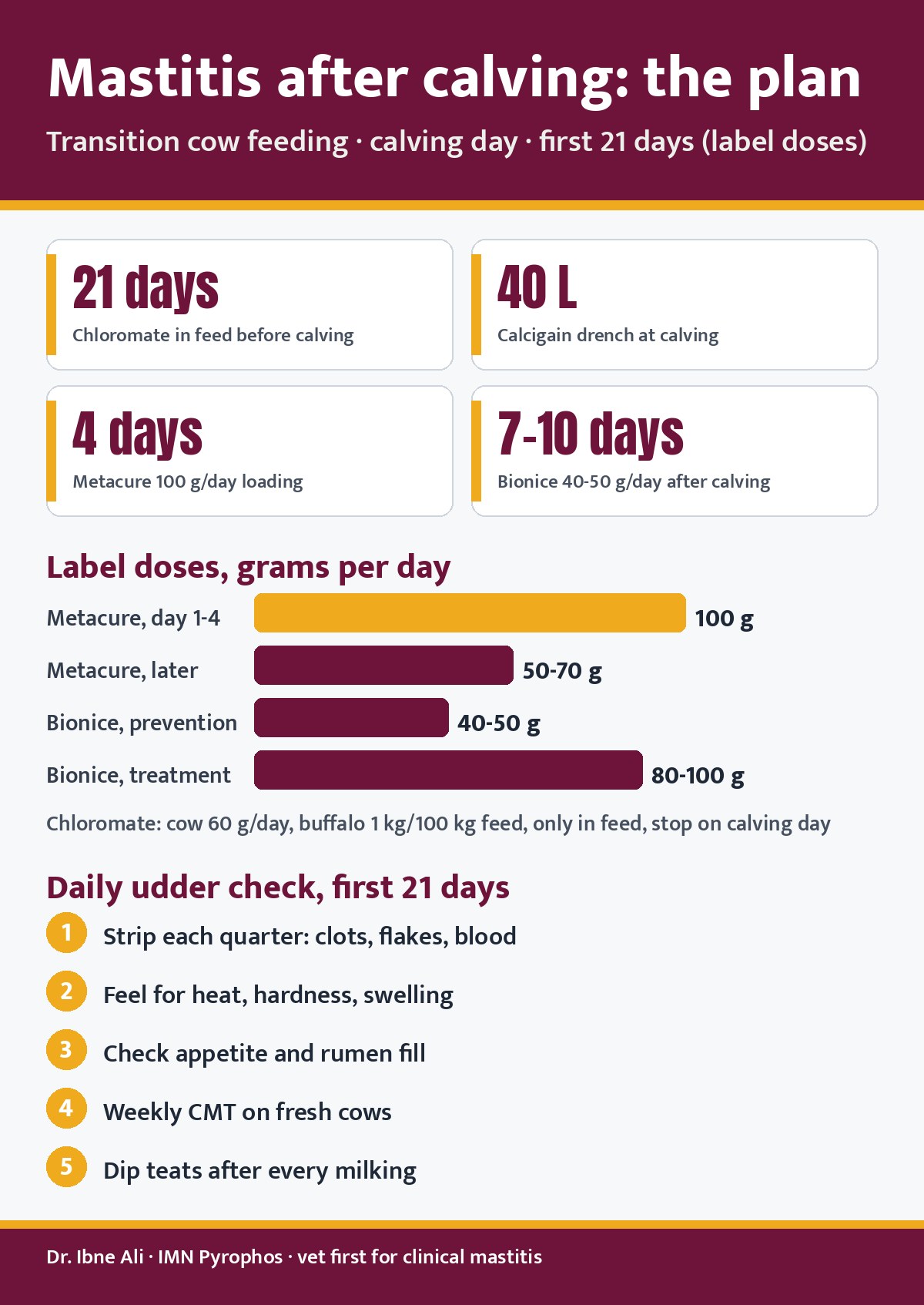
The short answer
Mastitis after calving is mostly a transition-period problem, not only an udder problem. Hygiene and the vet’s treatment come first. Feeding comes second but decides how strong the cow is when the germs arrive. A cow that calves with normal calcium, keeps eating and does not burn too much body fat has stronger udder defences than one that does not.
- Before calving (last 21 days): Chloromate in feed to prepare the calcium system, with minerals, vitamin E and selenium for defences.
- Calving day: clean calving place, Calcigain drench, early colostrum, teat care.
- After calving (first 21 days): Metacure for calcium, Ketofend and Bionice for energy and liver, Pyrosach and Rumenia to keep the rumen and appetite going, and a daily udder check.
Level 1: Why does mastitis come after calving? (the basics)
Think of the udder as a house with a door. In a healthy cow the door (the teat canal) is shut tight by a muscle and a plug of keratin, and guards (white blood cells, mainly neutrophils) stand ready inside. Around calving every part of this system weakens at once. These are well-known textbook points [general knowledge, standard dairy science].
| What goes wrong | What it means for the udder |
|---|---|
| Immune dip around calving | Hormone changes and the stress of calving make white blood cells slower at finding and killing germs. |
| Low blood calcium (even without a down cow) | Calcium is needed for muscle tone. The teat muscle closes less tightly, so germs enter more easily. White cells also work less well. A cow with subclinical low calcium is more likely to have other problems after calving. |
| Negative energy balance | Milk starts faster than appetite grows. The cow burns body fat; fat by-products (NEFA, ketones) slow the white cells and the liver. |
| Low vitamin E, selenium, zinc, copper | These minerals and vitamins help white cells kill germs. Low levels mean weaker defences. |
| Udder swelling, dirty surroundings, wet bedding | More germs at the teat end exactly when the door is weakest. |
The key idea: these problems feed each other. Low calcium lowers appetite, low appetite deepens the energy gap, the energy gap lowers immunity, low immunity lets mastitis in. Break the chain at several points, and the whole risk falls.
Level 2: The transition timeline, one table
| Phase | Goal | IMN products and label doses |
|---|---|---|
| Far-off dry (about 60 to 22 days before calving) | Keep the cow at the right body condition, do not over-feed. Keep minerals steady. | Rumenia in feed (3 kg per quintal (100 kg) of feed). Pyromin 10 g per day (adult). Pyrosach 8 to 10 g per day. |
| Close-up (last 21 days) | Prepare the calcium system and the immune system. | Chloromate in feed: cow 60 g per day or 1.2 kg per 100 kg feed, buffalo 1 kg per 100 kg feed; stop on calving day. Sel-E-Boost dairy 75 g per transition cow (label). Pyrosach and Pyromin continue. |
| Calving day | Quick, clean calving; restore calcium, energy, rumen. | Calcigain: 1 kg in 20 L warm plus 20 L normal water (40 L). Start Metacure after calving. Early colostrum. |
| Fresh cow (first 21 days) | Calcium steady, appetite up, no ketosis, daily udder check. | Metacure 100 g per day for 4 days, then 50 to 70 g per day (or alternate days) for 1 month. Bionice 40 to 50 g per day for 7 to 10 days. Ketofend 200 g on calving day with Calcigain, then 50 to 100 g per day for 7 days or as needed. Pyrosach, Rumenia, Sel-E-Boost and Pyromin continue. |
Doses mixed in feed, per quintal (100 kg) of feed (the formula we use on farm; the per-animal label doses are given with each product below):
| Product | Per quintal of feed |
|---|---|
| Rumenia | 3 kg |
| Sel-E-Boost (dairy) | 150 to 200 g |
| Pyromin | 100 to 200 g |
| Pyrosach | 200 to 250 g |
| Bionice | 100 to 150 g |
| Metacure | 100 g |
| Chloromate | 1.2 kg (cow); buffalo 1 kg |
Calcigain and Ketofend stay as described below. Everything else goes into the feed, mixed evenly (TMR is best). The calculator at the end of this article uses these per-quintal doses.
Mark the expected calving date, then count back. Every product above has its own page; see the product guide by problem. For the milk fever angle, read our milk fever prevention guide, and for the product-by-product calving plan our Chloromate, Calcigain, Bionice plan.
Level 3: Far-off dry period, build the base
This is where the quiet work is done. The aim is a cow that enters close-up at the right body condition and with steady mineral intake. Over-fat dry cows lose more appetite after calving and burn more body fat, which makes the energy and liver problem worse [general knowledge].
- Do not over-feed grain. Feed good forage and a balanced ration, and keep the dry cow from getting fat.
- Rumenia is a dairy premix (trace minerals, rumen buffer, prebiotic, yeast extract, probiotic, toxin binder, calcium and phosphorus). Label use: 3 kg per quintal (100 kg) of feed. That works out to about 150 g per cow per day if she eats 5 kg of concentrate.
- Pyromin gives chelated minerals (zinc, copper, selenium, iodine, cobalt and more) and vitamins: 10 g per adult animal per day.
- Pyrosach is a rumen-adapted yeast (Saccharomyces cerevisiae, 10 billion CFU per gram): 8 to 10 g per adult per day. It supports fibre digestion and a steady rumen, which helps appetite later.
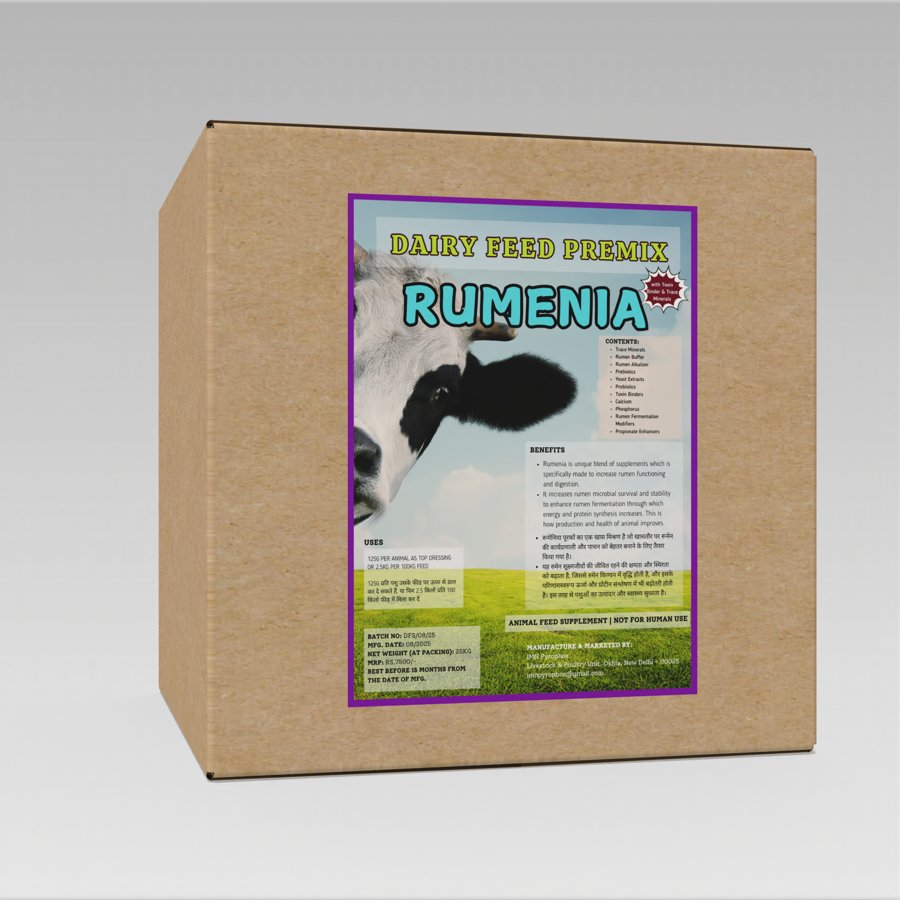
Rumen premix
Rumenia
Feed premix (trace minerals, rumen buffer, prebiotic, yeast extract, probiotic, toxin binder, calcium, phosphorus). Improves rumen function, digestion, energy and protein synthesis.
Dose: 3 kg per quintal (100 kg) of feed.
5 kg ₹1,400 · 25 kg ₹5,625MRP ₹1,800 / ₹7,500
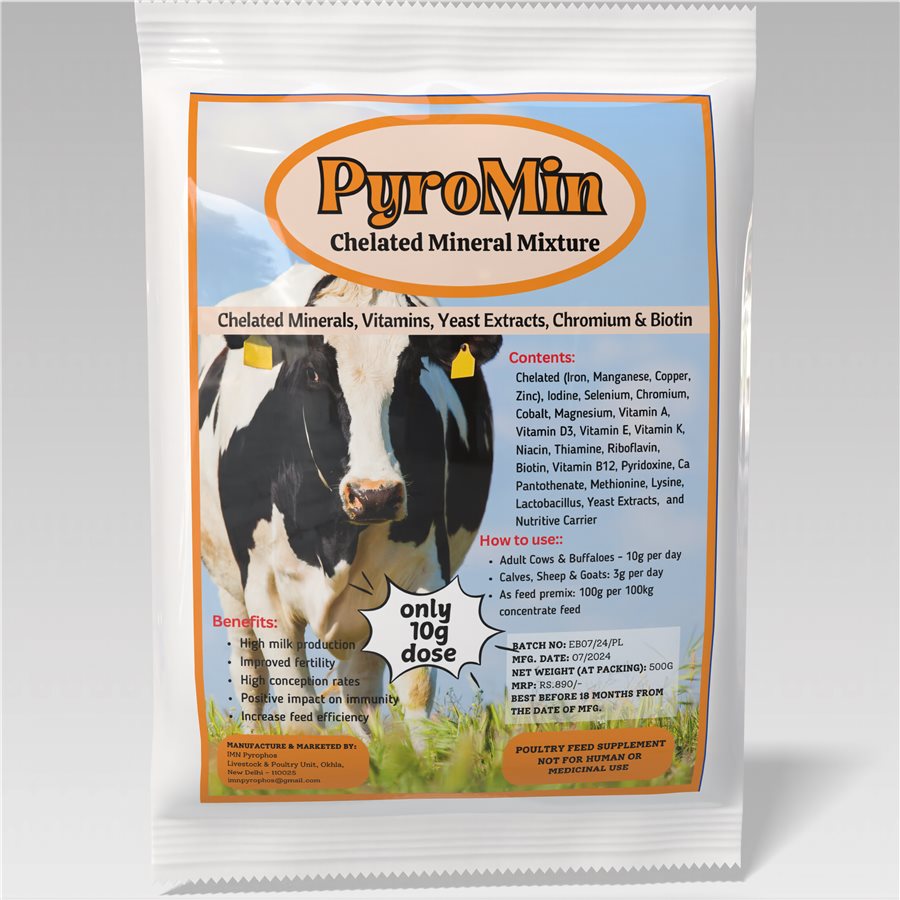
Chelated minerals · fertility
Pyromin
Chelated iron, manganese, copper, zinc, iodine, selenium, chromium, cobalt, magnesium, vitamins A, D3, E, K, B vitamins, biotin, methionine, lysine, lactobacillus and yeast extract. Supports milk production, fertility, conception and immunity.
Dose: Adult animal 10 g per day.
1 kg ₹655MRP ₹1,190
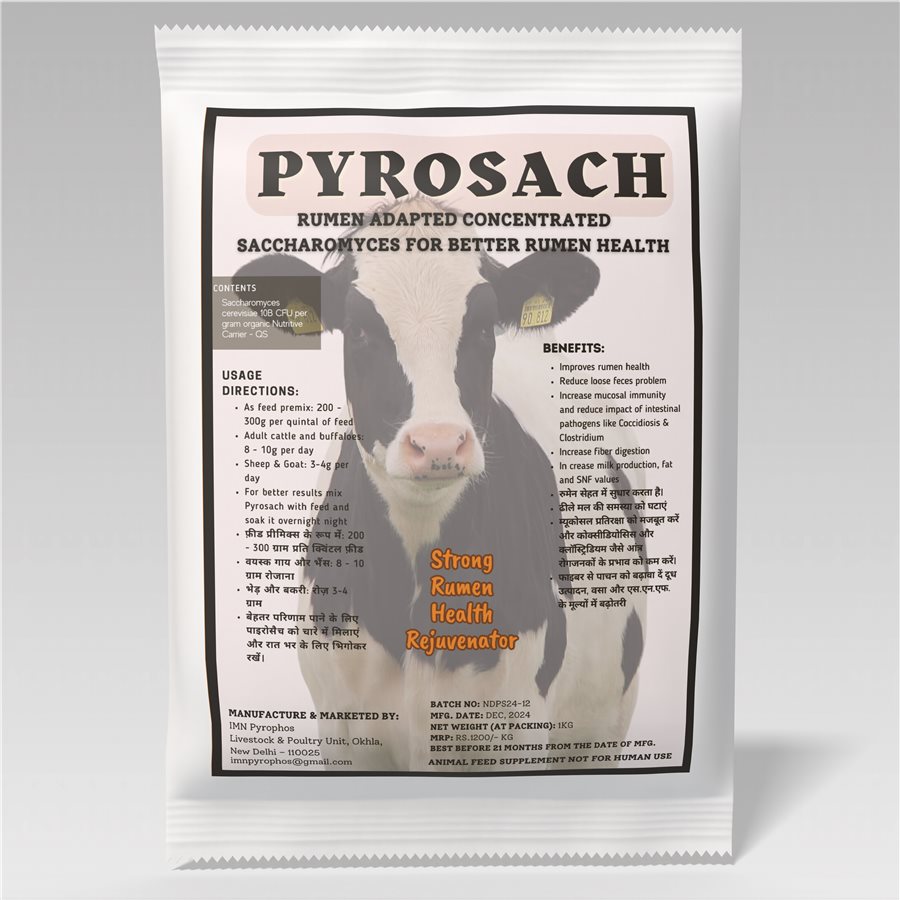
Rumen health
Pyrosach
Rumen-adapted Saccharomyces cerevisiae (10 billion CFU per gram). Improves fibre digestion and rumen health, reduces loose dung, and supports milk, fat and SNF.
Dose: 8 to 10 g per adult cow or buffalo per day, or 200 to 300 g per quintal of feed. For the best result mix into feed and soak overnight.
1 kg ₹700MRP ₹1,200
Level 4: Close-up, the last 21 days
Two things matter now: preparing calcium and preparing the immune system.
Calcium. Before calving the cow takes calcium easily from the feed and does not need to mobilise it from bone. After calving the demand explodes (colostrum and milk), and a cow whose calcium system is asleep falls behind for days. A negative DCAD diet (more chloride and sulphur, less potassium and sodium) tilts the blood slightly towards acidic and wakes the calcium system up [Goff and others, standard dairy nutrition]. Chloromate is our negative DCAD premix.
- Cow: 60 g per animal per day or 1.2 kg per 100 kg feed, for the last 21 days. Buffalo: 1 kg per 100 kg feed.
- Only in feed. Never in water, never by mouth. It does not go into pellets. Mix into chokar (bran), maize or chura. TMR is best.
- Stop on calving day.
- Do not add extra lime or calcium to the dry-period ration instead of Chloromate.
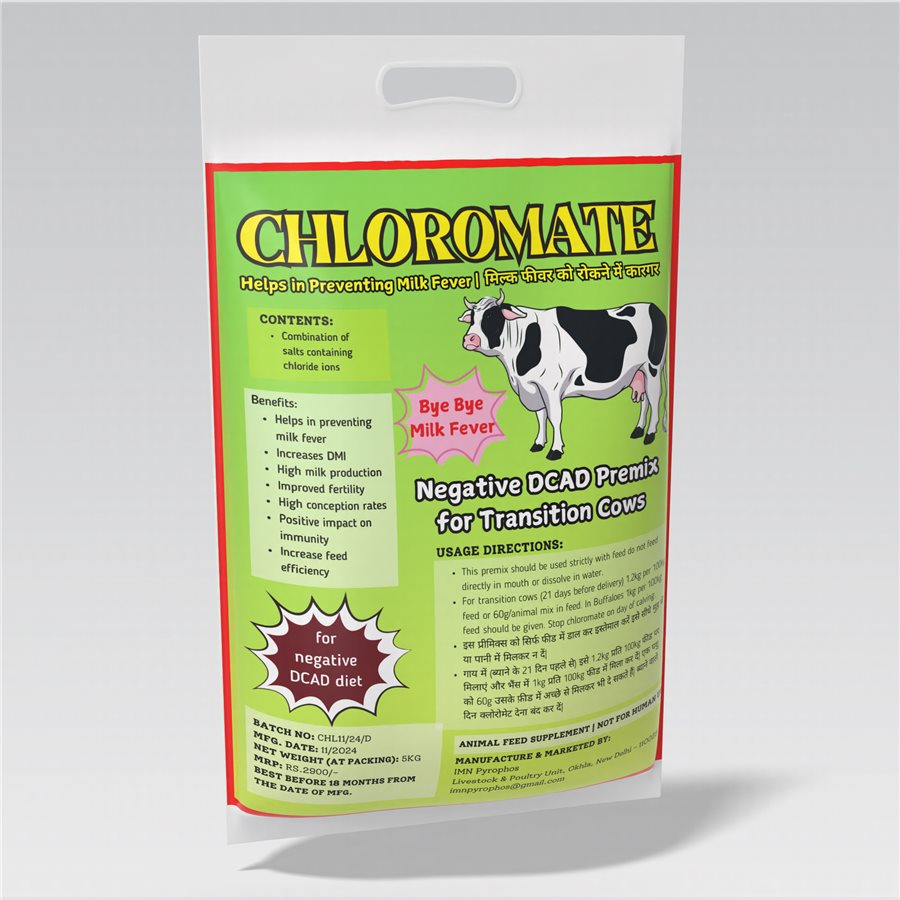
Last 21 days before calving
Chloromate
Negative DCAD premix that helps prevent milk fever when fed in the last 21 days before calving.
Dose: Cow: 60 g per animal per day, or 1.2 kg per 100 kg feed; buffalo: 1 kg per 100 kg feed. Mix only in feed, never in water or by mouth. Stop on calving day. Not for pellet feed: use chokar (bran), maize or chura. TMR is best.
1 kg ₹600 · 5 kg ₹2,900MRP ₹800 / ₹3,900
Immune system. Sel-E-Boost (dairy) combines vitamin E, selenium and propionate precursors. Label dose for a transition cow is 75 g per animal. Vitamin E and selenium are the best-known nutrients for white-cell function in the udder. Keep Pyromin and Pyrosach going. Do not mix up the dairy and poultry Sel-E-Boost: they are different products.
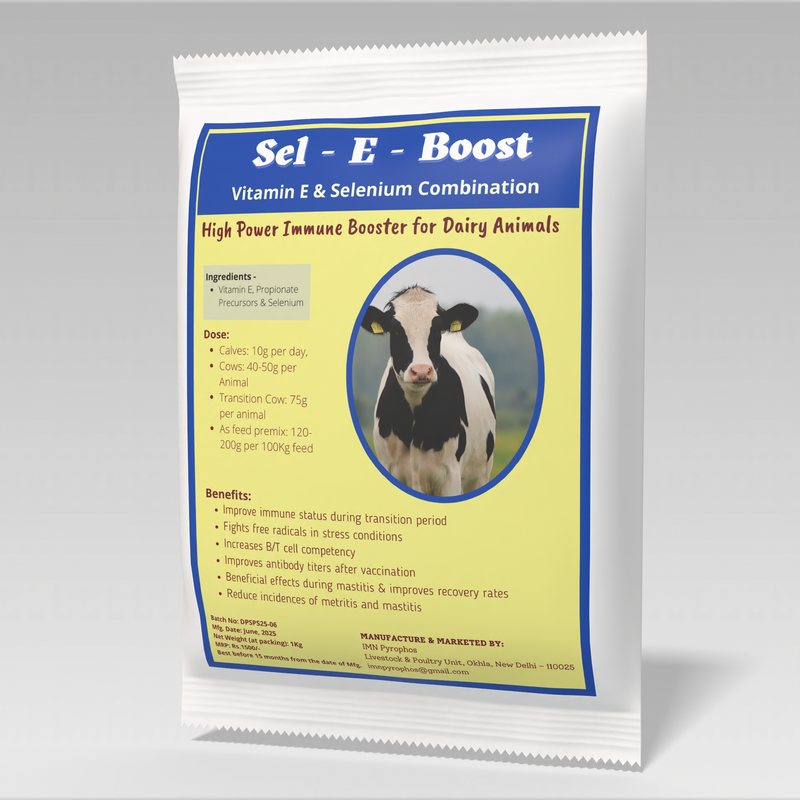
Dairy · vitamin E + selenium
Sel-E-Boost (dairy)
Vitamin E and selenium combination for dairy animals, a high power immune booster (label: vitamin E, propionate precursors and selenium). Improves immune status in the transition period, fights free radicals in stress, helps recovery in mastitis and lowers cases of metritis and mastitis.
Dose: Calves 10 g per day; cows 40 to 50 g per animal; transition cow 75 g per animal; as a feed premix 120 to 200 g per 100 kg feed.
1 kg ₹920MRP ₹1,500
Level 5: Calving day, the first 24 hours
Calving day sets the tone for the first weeks. The checklist below is plain good practice [general dairy practice]:
- Clean, dry, separate calving pen with fresh bedding. A dirty pen is the biggest source of udder germs.
- Wash and dry the udder and teats before the calf suckles or the first milking. Hands must be clean.
- Colostrum early, from a clean udder, for the calf. Do not strip the udder of all milk in the first day: milking fully can pull more calcium out of the cow.
- Dip teats after every milking for the first weeks; keep the cow standing for a while so the teat canal can close.
- Watch the placenta. Retained placenta means a sick cow and a weak udder. Call the vet.
Calcigain is a calving support with glucogenic precursors, vitamin B12, organic calcium, electrolytes, osmolytes, probiotics, trace minerals and vitamins. It restores appetite and rumen function and helps prevent abomasal displacement. Dose: 1 kg in 20 L warm water plus 20 L normal water, giving 40 L at or just after calving.
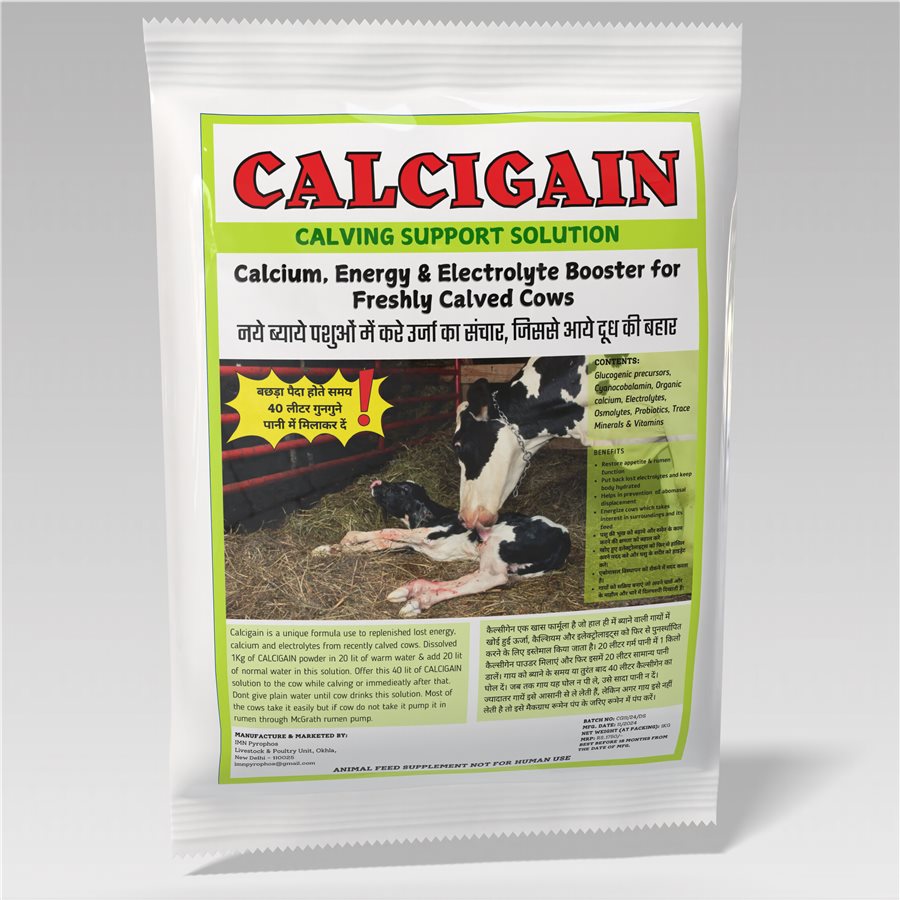
Support at calving
Calcigain
Energy, organic calcium and electrolyte drench for fresh cows and buffaloes. Restores appetite and rumen function and helps prevent abomasal displacement.
Dose: Dissolve 1 kg in 20 L warm water, add 20 L normal water, and give the 40 L at calving or just after.
1 kg ₹850MRP ₹1,750
If the cow is down, cold or unconscious, this is milk fever or another emergency: call the vet at once, do not wait for supplements.
Level 6: The first 21 days after calving
This is the period when most farmers see mastitis. The cow is at peak risk for low calcium, ketosis and infection, and each of them raises the others.
Calcium: Metacure is an ionic calcium supplement (organic calcium salts in a dextrose base) that dissolves quickly in the rumen. Label: it helps keep blood ionic calcium, lowers the chance of low calcium coming back, supports muscle strength and rumen contraction, helps uterine cleaning after calving. Dose: 100 g per day for 4 days after calving (loading), then 50 to 70 g per day or on alternate days for 1 month, or as the vet advises. In feed: 200 to 250 g per quintal.
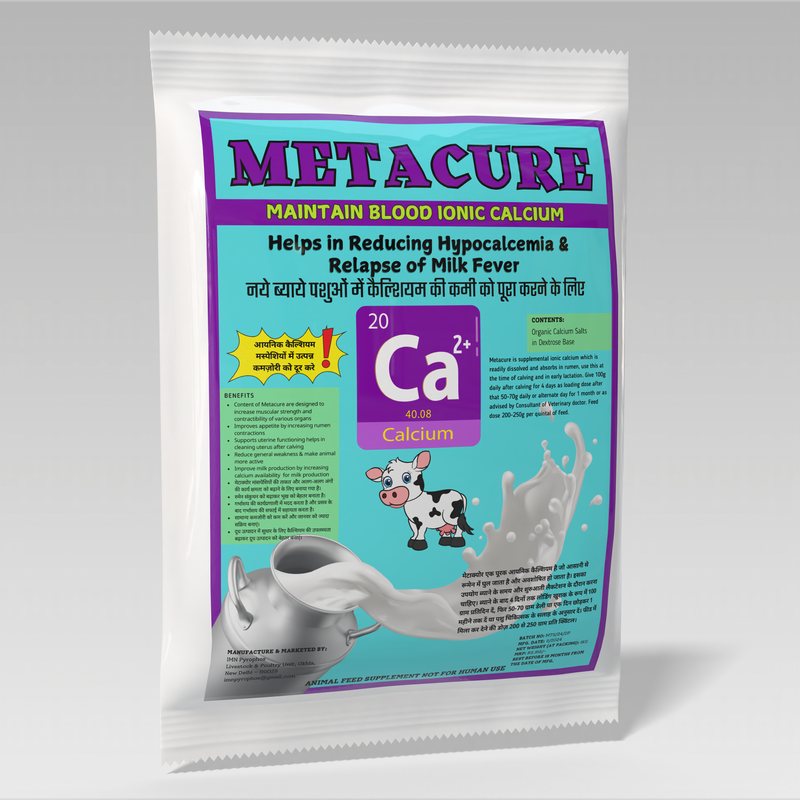
Ionic calcium
Metacure
Ionic calcium supplement (organic calcium salts in a dextrose base) that dissolves quickly in the rumen. For calving time and early lactation. A feed supplement, not a medicine.
Dose: 100 g per day for 4 days after calving (loading), then 50 to 70 g per day or on alternate days for 1 month, or as the vet advises. In feed: 200 to 250 g per quintal.
1 kg ₹460 · 5 kg ₹2,275MRP ₹815 / ₹4,000
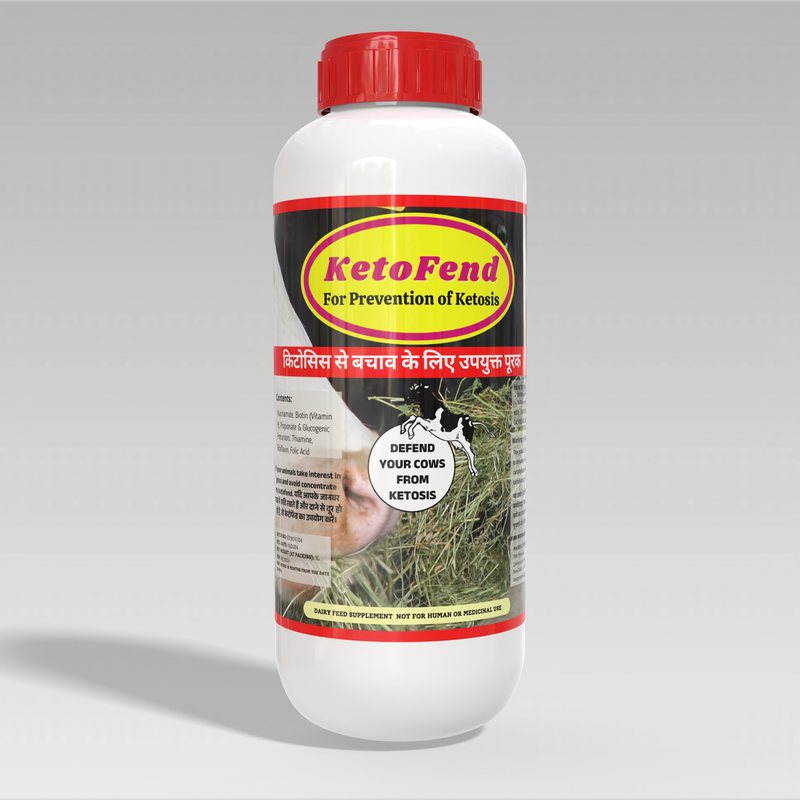
Energy and liver: Ketofend and Bionice. Ketofend is a dairy supplement for ketosis prevention: niacinamide, biotin, propionate and glucogenic precursors, thiamine, riboflavin and folic acid. The label says to use it when the animal still eats roughage but is off its grain. Dose (Doc, farm practice): 200 g on calving day together with Calcigain, then 50 to 100 g per day for 7 days, or as needed. Bionice has biotin, niacin, chelated zinc, chromium and glucose precursors, and is used for ketosis and negative energy balance, fatty liver in early lactation and mastitis recovery: 40 to 50 g per day for 7 to 10 days after calving as prevention.
Ketosis prevention
Ketofend
Dairy feed supplement for ketosis prevention: niacinamide, biotin, propionate and glucogenic precursors, thiamine, riboflavin and folic acid. Used around calving (transition).
Dose: 200 g on calving day together with Calcigain, then 50 to 100 g per day for 7 days, or as needed. Label advice: use it when the animal still eats roughage but stays away from grain.
1 kg ₹650MRP ₹1,110

After calving · early lactation
Bionice
Biotin, niacin, chelated zinc and chromium with glucose precursors. Helps with ketosis (energy shortage) and fatty liver in early lactation, and helps recovery from mastitis.
Dose: Prevention: 40 to 50 g per day for 7 to 10 days after calving; treatment: 80 to 100 g per day for 5 to 7 days; in feed 250 to 500 g per 100 kg feed.
1 kg ₹768MRP ₹1,100
Rumen and appetite: Pyrosach and Rumenia continue at the same doses. A cow that eats her ration fully has a better chance at everything else. Keep Pyromin and Sel-E-Boost in the ration as well.
Daily udder routine for the first 21 days [general dairy practice]:
- Look at the first strips of milk from every quarter in a strip cup or on a dark surface: clots, flakes, water-thin or blood-stained milk is a warning.
- Feel the udder: heat, hardness, pain or swelling of one quarter, or a cow that kicks when touched.
- Check appetite and rumen fill: a cow that stops eating needs attention the same day, whatever the udder looks like.
- Use a California Mastitis Test (CMT) once a week on fresh cows if you can: it catches hidden (subclinical) mastitis before the milk looks abnormal.
- Milk fresh and sick cows last; wash and dry the teats; dip after milking.
If mastitis is already there: what to do
- Call the vet the same day. Treatment, antibiotic choice and milk withdrawal period are the vet’s decision.
- Milk out the infected quarter often as advised, discard the milk safely and never feed it to calves.
- Keep the supportive plan running. Bionice at the treatment dose (80 to 100 g per day for 5 to 7 days) helps energy and recovery. Sel-E-Boost and Pyromin keep vitamin E, selenium and minerals steady.
- Immune support. For Nexamune L and Livolact, see our mastitis immune booster guide.
- Fix the cause. Find where the germs come from: bedding, milking hands, milking machine, teat dip, flies. Treating one cow while the cause stays only brings the next case.
The cost in one example
Selling prices for a cow, 1 kg pack rates. The close-up and after-calving core products:
| Item | Amount for one cow | Approx cost |
|---|---|---|
| Chloromate | 21 days x 60 g = 1.26 kg | about Rs 756 |
| Calcigain | 1 kg at calving | Rs 850 |
| Metacure, loading dose | 4 days x 100 g = 0.4 kg | about Rs 184 |
| Bionice (prevention) | 7 to 10 days x 40 to 50 g = 0.28 to 0.5 kg | about Rs 215 to 384 |
| Total (core four) | about Rs 2,000 to 2,200 |
Compare it with one case of milk fever, a quarter lost to mastitis or a month of lost milk. The cost of Rumenia, Pyromin, Pyrosach, Sel-E-Boost and Ketofend depends on the days you feed and the ration, so ask on WhatsApp for your farm.
Common mistakes
- Chloromate in water or in pellet feed, or continued after calving.
- Extra calcium or lime in the dry period.
- Skipping the udder check in the first 2 weeks because “the milk looks fine”.
- Starting supplements only after the cow is already sick.
- Over-conditioned dry cows.
- Using Sel-E-Boost poultry for cattle, or the other way around.
What we know and what we do not
- Known (general dairy science): calving is the highest-risk window for new udder infections; low calcium, negative energy balance and low vitamin E and selenium weaken defences; negative DCAD prevents low calcium; hygiene and early detection cut mastitis.
- Product claims on this page follow the labels and product pages of IMN Pyrophos. We do not claim a percentage drop in mastitis from any one product.
- Not fixed here: how to place Rumenia in a negative-DCAD close-up ration. We would rather say “ask” than guess a number.
Frequently asked questions
Why does mastitis often start right after calving?
Defences are at their lowest, calcium and energy are short and the teat canal is less tight. All of these come together in the first weeks.
Can Chloromate prevent mastitis?
Chloromate is for the calcium system (milk fever prevention). By lowering the chance of low calcium it supports muscle and immune function, but it is not a mastitis medicine.
Which products are used before calving, which after?
Before: Chloromate, Rumenia, Pyromin, Pyrosach, Sel-E-Boost. At calving: Calcigain. After: Metacure, Bionice, Ketofend, with Rumenia, Pyrosach, Pyromin and Sel-E-Boost continuing.
Do I give all nine products to every cow?
No. The core is Chloromate, Calcigain, Metacure and Bionice. The others depend on the ration and the herd; ask us for a plan for your farm.
When must I call the vet?
Hot, hard or swollen quarter, clots or blood in milk, fever, a cow that stops eating, a cow that cannot stand, a retained placenta.
Monthly product calculator (tentative)
Enter the number of animals and the stage. You get the quantity needed for that stage (30 days, close-up 21 days), the pack combination and an approximate cost at selling rates. Doses are per quintal (100 kg) of feed, as used in our farm formulas.
बहुत से किसान एक ही बात कहते हैं: “ब्याने के बाद गाय को मैस्टाइटिस हो जाता है।” यह बदकिस्मती नहीं है। ब्याने के आसपास के हफ़्तों में तीन चीज़ें एक साथ बिगड़ती हैं: गाय की रोग-प्रतिरोधक क्षमता गिरती है, थन पर दबाव रहता है और शरीर में कैल्शियम और ऊर्जा की कमी होती है। इस गाइड में क्रम से बताया है कि ट्रांज़िशन पीरियड में फ़ीडिंग कैसे करें, ब्याने के दिन क्या करें और ब्याने के बाद के पहले तीन हफ़्ते कैसे संभालें, Chloromate, Rumenia, Pyrosach, Pyromin, Sel-E-Boost (डेयरी), Ketofend, Calcigain, Metacure और Bionice के साथ। अगर आप ब्याने के बाद मैस्टाइटिस या ट्रांज़िशन काउ फ़ीडिंग खोज रहे हैं तो भाग 2 की टाइमलाइन तालिका सबसे तेज़ जवाब है।
छोटा जवाब
ब्याने के बाद का मैस्टाइटिस ज़्यादातर ट्रांज़िशन-पीरियड की समस्या है, सिर्फ़ थन की नहीं। सफ़ाई और पशु चिकित्सक का इलाज पहले आते हैं। फ़ीडिंग दूसरे नंबर पर है, पर यही तय करती है कि कीटाणु आने पर गाय कितनी मज़बूत है। जो गाय सामान्य कैल्शियम के साथ ब्याती है, खाना खाती रहती है और शरीर की चर्बी ज़्यादा नहीं गलाती, उसके थन की सुरक्षा ज़्यादा मज़बूत होती है।
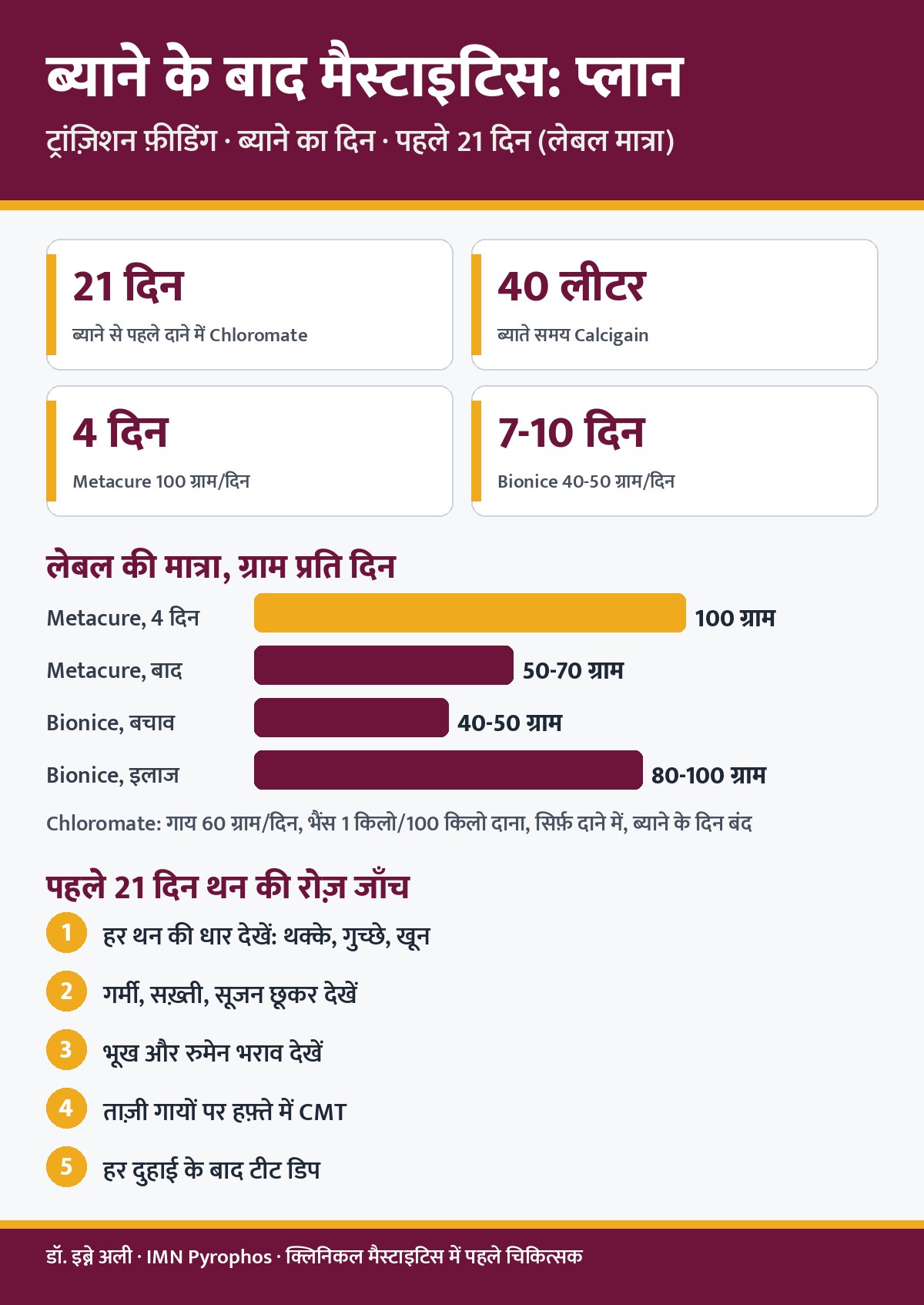
- ब्याने से पहले (आख़िरी 21 दिन): कैल्शियम तंत्र तैयार करने के लिए Chloromate दाने में, और सुरक्षा के लिए खनिज, विटामिन E और सेलेनियम।
- ब्याने का दिन: साफ़ ब्याने की जगह, Calcigain, जल्दी खीस, थन की देखभाल।
- ब्याने के बाद (पहले 21 दिन): कैल्शियम के लिए Metacure, ऊर्जा और लिवर के लिए Ketofend और Bionice, रुमेन और भूख के लिए Pyrosach और Rumenia, और रोज़ थन की जाँच।
स्तर 1: ब्याने के बाद मैस्टाइटिस क्यों? (बुनियादी बातें)
थन को एक दरवाज़े वाला घर समझिए। स्वस्थ गाय में दरवाज़ा (टीट कैनाल) एक मांसपेशी और केराटिन की डाट से कसकर बंद रहता है, और अंदर पहरेदार (श्वेत रक्त कोशिकाएँ, मुख्यतः न्यूट्रोफ़िल) तैयार रहते हैं। ब्याने के आसपास यह पूरा तंत्र एक साथ कमज़ोर पड़ता है। ये आम पाठ्यपुस्तक की बातें हैं [सामान्य जानकारी, डेयरी विज्ञान]।
| क्या बिगड़ता है | थन पर असर |
|---|---|
| ब्याने के आसपास प्रतिरोधक क्षमता में गिरावट | हार्मोन बदलाव और ब्याने के तनाव से श्वेत कोशिकाएँ कीटाणु ढूँढने और मारने में धीमी पड़ती हैं। |
| खून में कैल्शियम कम (गाय गिरी न हो तब भी) | मांसपेशी के लिए कैल्शियम चाहिए। टीट की मांसपेशी कम कसकर बंद होती है, कीटाणु आसानी से घुसते हैं। श्वेत कोशिकाएँ भी कम काम करती हैं। |
| नेगेटिव एनर्जी बैलेंस | दूध भूख से तेज़ शुरू होता है। गाय शरीर की चर्बी गलाती है; चर्बी के उप-उत्पाद (NEFA, कीटोन) श्वेत कोशिकाओं और लिवर को धीमा करते हैं। |
| विटामिन E, सेलेनियम, ज़िंक, कॉपर कम | ये खनिज और विटामिन श्वेत कोशिकाओं को कीटाणु मारने में मदद करते हैं। कमी यानी कमज़ोर सुरक्षा। |
| थन की सूजन, गंदा माहौल, गीला बिछावन | दरवाज़ा सबसे कमज़ोर हो, उसी समय टीट के सिरे पर ज़्यादा कीटाणु। |
मुख्य बात: ये समस्याएँ एक-दूसरे को बढ़ाती हैं। कैल्शियम कम तो भूख कम, भूख कम तो ऊर्जा की कमी गहरी, ऊर्जा की कमी से प्रतिरोधक क्षमता कम, और तब मैस्टाइटिस अंदर आता है। कई जगह कड़ी तोड़िए तो पूरा ख़तरा घटता है।
स्तर 2: ट्रांज़िशन की टाइमलाइन, एक तालिका में
| चरण | लक्ष्य | IMN प्रोडक्ट और लेबल की मात्रा |
|---|---|---|
| फ़ार-ऑफ़ ड्राई (ब्याने से लगभग 60 से 22 दिन पहले) | सही बॉडी कंडीशन, ज़्यादा दाना न दें, खनिज स्थिर रखें। | Rumenia दाने में (3 किलो प्रति क्विंटल (100 किलो) दाना)। Pyromin 10 ग्राम रोज़ (वयस्क)। Pyrosach 8 से 10 ग्राम रोज़। |
| क्लोज़-अप (आख़िरी 21 दिन) | कैल्शियम तंत्र और प्रतिरोधक तंत्र की तैयारी। | Chloromate दाने में: गाय 60 ग्राम रोज़ या 1.2 किलो प्रति 100 किलो दाना, भैंस 1 किलो प्रति 100 किलो दाना; ब्याने के दिन बंद। Sel-E-Boost डेयरी 75 ग्राम प्रति ट्रांज़िशन गाय (लेबल)। Pyrosach और Pyromin जारी। |
| ब्याने का दिन | साफ़ और जल्दी ब्याना; कैल्शियम, ऊर्जा, रुमेन लौटाना। | Calcigain: 1 किलो को 20 लीटर गर्म और 20 लीटर सादे पानी में (40 लीटर)। ब्याने के बाद Metacure शुरू। जल्दी खीस। |
| ताज़ी ब्याई गाय (पहले 21 दिन) | कैल्शियम स्थिर, भूख ठीक, कीटोसिस नहीं, रोज़ थन की जाँच। | Metacure 4 दिन रोज़ 100 ग्राम, फिर 1 महीने तक रोज़ 50 से 70 ग्राम (या एक दिन छोड़कर)। Bionice 7 से 10 दिन रोज़ 40 से 50 ग्राम। Ketofend ब्याने के दिन Calcigain के साथ 200 ग्राम, फिर 7 दिन रोज़ 50 से 100 ग्राम या ज़रूरत अनुसार। Pyrosach, Rumenia, Sel-E-Boost और Pyromin जारी। |
दाने में मिलाई जाने वाली मात्रा, प्रति क्विंटल (100 किलो) दाना (हमारे फ़ार्म का फ़ॉर्मूला; प्रति पशु लेबल की मात्रा नीचे हर प्रोडक्ट के साथ है):
| प्रोडक्ट | प्रति क्विंटल दाना |
|---|---|
| Rumenia | 3 किलो |
| Sel-E-Boost (डेयरी) | 150 से 200 ग्राम |
| Pyromin | 100 से 200 ग्राम |
| Pyrosach | 200 से 250 ग्राम |
| Bionice | 100 से 150 ग्राम |
| Metacure | 100 ग्राम |
| Chloromate | 1.2 किलो (गाय); भैंस 1 किलो |
Calcigain और Ketofend नीचे बताए अनुसार ही रहेंगे। बाकी सब दाने में बराबर मिलाएँ (TMR सबसे अच्छा)। लेख के अंत का कैलकुलेटर इन्हीं प्रति क्विंटल मात्राओं से हिसाब लगाता है।
ब्याने की संभावित तारीख़ लिख लीजिए और उसी से उल्टी गिनती कीजिए। हर प्रोडक्ट का अपना पेज है; समस्या के हिसाब से प्रोडक्ट गाइड देखिए। मिल्क फ़ीवर के लिए हमारी मिल्क फ़ीवर से बचाव गाइड और प्रोडक्ट-दर-प्रोडक्ट ब्याने के प्लान के लिए Chloromate, Calcigain, Bionice प्लान पढ़िए।
स्तर 3: फ़ार-ऑफ़ ड्राई पीरियड, नींव बनाइए
यहाँ चुपचाप का काम होता है। लक्ष्य है कि गाय सही बॉडी कंडीशन और स्थिर खनिज सेवन के साथ क्लोज़-अप में पहुँचे। बहुत मोटी ड्राई गाय ब्याने के बाद ज़्यादा भूख खोती है और ज़्यादा चर्बी गलाती है, जिससे ऊर्जा और लिवर की समस्या बढ़ती है [सामान्य जानकारी]।
- दाना ज़्यादा न दें। अच्छा चारा और संतुलित राशन दें, ड्राई गाय को मोटा न होने दें।
- Rumenia डेयरी प्रीमिक्स है (ट्रेस मिनरल, रुमेन बफ़र, प्रीबायोटिक, यीस्ट एक्सट्रैक्ट, प्रोबायोटिक, टॉक्सिन बाइंडर, कैल्शियम, फ़ॉस्फ़ोरस)। लेबल के हिसाब से 3 किलो प्रति क्विंटल (100 किलो) दाना। यानी अगर गाय 5 किलो दाना खाती है तो लगभग 150 ग्राम प्रति गाय प्रति दिन।
- Pyromin चिलेटेड खनिज (ज़िंक, कॉपर, सेलेनियम, आयोडीन, कोबाल्ट आदि) और विटामिन देता है: वयस्क पशु को 10 ग्राम रोज़।
- Pyrosach रुमेन के अनुकूल यीस्ट है (Saccharomyces cerevisiae, 1000 करोड़ CFU प्रति ग्राम): वयस्क को 8 से 10 ग्राम रोज़। यह रेशे के पाचन और रुमेन को स्थिर रखता है, जिससे बाद में भूख सुधरती है।
रुमेन प्रीमिक्स
Rumenia
फ़ीड प्रीमिक्स (ट्रेस मिनरल, रुमेन बफ़र, प्रीबायोटिक, यीस्ट एक्सट्रैक्ट, प्रोबायोटिक, टॉक्सिन बाइंडर, कैल्शियम, फॉस्फोरस)। रुमेन का काम, पाचन, ऊर्जा और प्रोटीन संश्लेषण बेहतर करता है।
मात्रा: दाने में 3 किलो प्रति क्विंटल (100 किलो) दाना।
5 kg ₹1,400 · 25 kg ₹5,625MRP ₹1,800 / ₹7,500
चिलेटेड मिनरल · प्रजनन
Pyromin
चिलेटेड आयरन, मैंगनीज़, कॉपर, ज़िंक, आयोडीन, सेलेनियम, क्रोमियम, कोबाल्ट, मैग्नीशियम, विटामिन A, D3, E, K, B विटामिन, बायोटिन, मेथियोनीन, लाइसीन, लैक्टोबैसिलस और यीस्ट एक्सट्रैक्ट। दूध उत्पादन, प्रजनन, गाभिन ठहरने और इम्युनिटी में सहायक।
मात्रा: रिपीट ब्रीडिंग में: 10 दिन तक 15–20 ग्राम प्रति पशु प्रति दिन (लोडिंग डोज़), फिर रोज़ 10 ग्राम।
1 kg ₹655MRP ₹1,190
रुमेन की सेहत
Pyrosach
रुमेन के अनुकूल Saccharomyces cerevisiae (1000 करोड़ CFU प्रति ग्राम)। रेशे का पाचन और रुमेन की सेहत सुधारता है, पतला गोबर घटाता है, दूध, फैट और SNF में सहायक।
मात्रा: 8–10 ग्राम प्रति वयस्क गाय या भैंस प्रति दिन, या 200–300 ग्राम प्रति क्विंटल दाना। अच्छे नतीजे के लिए दाने में मिलाकर रात भर भिगोएँ।
1 kg ₹700MRP ₹1,200
स्तर 4: क्लोज़-अप, आख़िरी 21 दिन
अब दो बातें मायने रखती हैं: कैल्शियम की तैयारी और प्रतिरोधक तंत्र की तैयारी।
कैल्शियम। ब्याने से पहले गाय दाने-चारे से आसानी से कैल्शियम ले लेती है और हड्डी से निकालने की ज़रूरत नहीं पड़ती। ब्याने के बाद माँग अचानक बहुत बढ़ जाती है (खीस और दूध), और जिस गाय का कैल्शियम तंत्र सोया हुआ है वह कई दिन पीछे रहती है। नेगेटिव DCAD राशन (क्लोराइड और सल्फ़र ज़्यादा, पोटैशियम और सोडियम कम) खून को हल्का अम्लीय करके कैल्शियम तंत्र को जगाता है [Goff व अन्य, मानक डेयरी पोषण]। Chloromate हमारा नेगेटिव DCAD प्रीमिक्स है।
- गाय: आख़िरी 21 दिन रोज़ 60 ग्राम प्रति पशु या 1.2 किलो प्रति 100 किलो दाना। भैंस: 1 किलो प्रति 100 किलो दाना।
- सिर्फ़ दाने में। पानी में नहीं, मुँह से नहीं। पेलेट फ़ीड में नहीं जाता। चोकर, मक्का या चूरी में मिलाएँ। TMR सबसे अच्छा।
- ब्याने के दिन बंद करें।
- Chloromate की जगह ड्राई पीरियड में अलग से चूना या कैल्शियम न बढ़ाएँ।
ब्याने से पहले · आखिरी 21 दिन
Chloromate
नेगेटिव DCAD प्रीमिक्स, जो ब्याने से पहले आखिरी 21 दिन दाने में देने पर मिल्क फीवर से बचाव में मदद करता है। 5 किलो पैक ₹2,900।
मात्रा: गाय: क्लोज़-अप समय (ब्याने से पहले आखिरी 21 दिन) में रोज़ 60 ग्राम प्रति पशु, या 1.2 किलो प्रति 100 किलो दाना; भैंस: 1 किलो प्रति 100 किलो दाना। सिर्फ दाने में अच्छी तरह मिला कर खिलाएँ, पानी में या मुँह से कभी नहीं। ब्याने के दिन बंद कर दें। पैलेट फ़ीड में Chloromate नहीं मिलता, इसलिए चोकर, मक्का या चूरा किए हुए पैलेट में मिला कर दें। सबसे अच्छा तरीका TMR में देना है।
1 kg ₹600MRP ₹800
प्रतिरोधक तंत्र। Sel-E-Boost (डेयरी) में विटामिन E, सेलेनियम और प्रोपियोनेट प्रिकर्सर हैं। ट्रांज़िशन गाय के लिए लेबल की मात्रा 75 ग्राम प्रति पशु है। थन में श्वेत कोशिकाओं के काम के लिए विटामिन E और सेलेनियम सबसे जाने-माने पोषक तत्व हैं। Pyromin और Pyrosach जारी रखें। डेयरी और पोल्ट्री Sel-E-Boost को आपस में न मिलाएँ, ये अलग प्रोडक्ट हैं।
डेयरी · विटामिन E + सेलेनियम
Sel-E-Boost (dairy)
डेयरी पशुओं के लिए विटामिन E और सेलेनियम combination, high power immune booster (label: विटामिन E, propionate precursors और सेलेनियम)। Transition period में immune status सुधारता है, तनाव में free radicals से लड़ता है, mastitis में recovery बेहतर करता है और metritis व mastitis के मामले घटाता है।
मात्रा: बछड़े 10 g प्रति दिन; गाय 40 से 50 g प्रति पशु; transition cow 75 g प्रति पशु; feed premix के रूप में 120 से 200 g प्रति 100 kg दाना।
1 kg ₹920MRP ₹1,500
स्तर 5: ब्याने का दिन, पहले 24 घंटे
ब्याने का दिन पहले हफ़्तों का रंग तय करता है। नीचे की सूची सामान्य अच्छा अभ्यास है [सामान्य डेयरी अभ्यास]:
- साफ़, सूखा, अलग ब्याने का बाड़ा और ताज़ा बिछावन। गंदा बाड़ा थन के कीटाणुओं का सबसे बड़ा स्रोत है।
- बछड़े के दूध पीने या पहली दुहाई से पहले थन और टीट धोकर सुखाएँ। हाथ साफ़ हों।
- खीस जल्दी, साफ़ थन से, बछड़े को। पहले दिन थन पूरा खाली न करें: पूरा दुहने से गाय से और कैल्शियम निकल सकता है।
- शुरुआती हफ़्तों में हर दुहाई के बाद टीट डिप करें; गाय को कुछ देर खड़ा रखें ताकि टीट कैनाल बंद हो जाए।
- जेर पर नज़र रखें। जेर न गिरना यानी बीमार गाय और कमज़ोर थन। पशु चिकित्सक बुलाएँ।
Calcigain ब्याने का सहारा है: ग्लूकोजेनिक प्रिकर्सर, विटामिन B12, ऑर्गेनिक कैल्शियम, इलेक्ट्रोलाइट, ऑस्मोलाइट, प्रोबायोटिक, ट्रेस मिनरल और विटामिन। यह भूख और रुमेन का काम लौटाता है और एबोमेज़ल डिसप्लेसमेंट रोकने में मदद करता है। मात्रा: 1 किलो को 20 लीटर गर्म और 20 लीटर सादे पानी में मिलाकर, ब्याते समय या तुरंत बाद 40 लीटर पिलाएँ।
ब्याने के समय सहारा
Calcigain
ताज़ा ब्याई गाय-भैंस के लिए ऊर्जा, ऑर्गेनिक कैल्शियम और इलेक्ट्रोलाइट का घोल। भूख और रुमेन का काम लौटाता है और जामा खिसकने (abomasal displacement) से बचाव में मदद करता है।
मात्रा: 1 किलो को 20 लीटर गर्म पानी में घोलें, 20 लीटर सादा पानी मिलाएँ, और 40 लीटर घोल ब्याते समय या तुरंत बाद दें।
1 kg ₹850MRP ₹1,750
अगर गाय गिरी हुई, ठंडी या बेहोश है तो यह मिल्क फ़ीवर या दूसरी आपात स्थिति है: तुरंत पशु चिकित्सक बुलाएँ, सप्लीमेंट का इंतज़ार न करें।
स्तर 6: ब्याने के बाद के पहले 21 दिन
यही वह समय है जब ज़्यादातर किसान मैस्टाइटिस देखते हैं। गाय पर कैल्शियम की कमी, कीटोसिस और संक्रमण, तीनों का ख़तरा सबसे ज़्यादा होता है, और हर एक बाकी को बढ़ाता है।
कैल्शियम: Metacure आयनिक कैल्शियम सप्लीमेंट है (डेक्सट्रोज़ बेस में ऑर्गेनिक कैल्शियम साल्ट) जो रुमेन में जल्दी घुलता है। लेबल के अनुसार यह खून में आयनिक कैल्शियम बनाए रखने में मदद करता है, कैल्शियम की कमी दोबारा होने का ख़तरा घटाता है, मांसपेशी की ताक़त और रुमेन की गति सुधारता है और ब्याने के बाद बच्चेदानी की सफ़ाई में मदद करता है। मात्रा: ब्याने के बाद 4 दिन रोज़ 100 ग्राम (लोडिंग), फिर 1 महीने तक रोज़ 50 से 70 ग्राम या एक दिन छोड़कर, या पशु चिकित्सक की सलाह से। दाने में: 200 से 250 ग्राम प्रति क्विंटल।
आयनिक कैल्शियम
Metacure
आयनिक कैल्शियम सप्लीमेंट (डेक्सट्रोज़ बेस में ऑर्गेनिक कैल्शियम साल्ट), रुमेन में जल्दी घुलकर सोखा जाता है। ब्याने के समय और शुरुआती दुग्धकाल में काम आता है। यह दवा नहीं, फ़ीड सप्लीमेंट है।
मात्रा: ब्याने के बाद 4 दिन रोज़ 100 ग्राम (लोडिंग), फिर 1 महीने तक रोज़ 50 से 70 ग्राम या एक दिन छोड़कर, या पशु चिकित्सक की सलाह से। दाने में: 200 से 250 ग्राम प्रति क्विंटल।
1 kg ₹460 · 5 kg ₹2,275MRP ₹815 / ₹4,000
ऊर्जा और लिवर: Ketofend और Bionice। Ketofend कीटोसिस से बचाव का डेयरी सप्लीमेंट है: नियासिनामाइड, बायोटिन, प्रोपियोनेट और ग्लूकोजेनिक प्रिकर्सर, थायमिन, राइबोफ़्लेविन और फ़ोलिक एसिड। लेबल की सलाह: जब पशु चारा खा रहा हो पर दाने से दूर हो तब इस्तेमाल करें। मात्रा (फ़ार्म अभ्यास): ब्याने के दिन Calcigain के साथ 200 ग्राम, फिर 7 दिन रोज़ 50 से 100 ग्राम, या ज़रूरत अनुसार। Bionice में बायोटिन, नियासिन, चिलेटेड ज़िंक, क्रोमियम और ग्लूकोज़ प्रिकर्सर हैं और यह कीटोसिस व नेगेटिव एनर्जी बैलेंस, शुरुआती दुग्धकाल के फैटी लिवर और मैस्टाइटिस से रिकवरी में काम आता है: बचाव के लिए ब्याने के बाद 7 से 10 दिन रोज़ 40 से 50 ग्राम।
कीटोसिस से बचाव
Ketofend
कीटोसिस से बचाव का डेयरी फ़ीड सप्लीमेंट: नियासिनामाइड, बायोटिन, प्रोपियोनेट और ग्लूकोजेनिक प्रिकर्सर, थायमिन, राइबोफ़्लेविन और फ़ोलिक एसिड। ब्याने के आसपास (ट्रांज़िशन) काम आता है।
मात्रा: ब्याने के दिन Calcigain के साथ 200 ग्राम, फिर 7 दिन रोज़ 50 से 100 ग्राम, या ज़रूरत अनुसार। लेबल की सलाह: जब पशु चारा खा रहा हो पर दाने से दूर हो तब इस्तेमाल करें।
1 kg ₹650MRP ₹1,110
ब्याने के बाद · शुरुआती दूध
Bionice
बायोटिन, नियासिन, चिलेटेड ज़िंक और क्रोमियम, साथ में ग्लूकोज़ बनाने वाले तत्व। शुरुआती दूध के समय कीटोसिस (ऊर्जा की कमी) और फैटी लिवर में सहायक, और थनैला से उबरने में मदद करता है।
मात्रा: बचाव के लिए ब्याने के बाद 7–10 दिन तक 40–50 ग्राम प्रति दिन; इलाज में 80–100 ग्राम प्रति दिन 5–7 दिन; दाने में 250–500 ग्राम प्रति 100 किलो दाना।
1 kg ₹768MRP ₹1,100
रुमेन और भूख: Pyrosach और Rumenia उसी मात्रा में जारी रखें। जो गाय अपना राशन पूरा खाती है, उसके बाकी सब कुछ में बेहतर मौक़े होते हैं। राशन में Pyromin और Sel-E-Boost भी जारी रखें।
पहले 21 दिन थन की रोज़ की दिनचर्या [सामान्य डेयरी अभ्यास]:
- हर थन की पहली धार स्ट्रिप कप या काली सतह पर देखें: थक्के, गुच्छे, पानी जैसा या खून मिला दूध चेतावनी है।
- थन को छूकर देखें: एक थन में गर्मी, सख़्ती, दर्द या सूजन, या छूने पर लात मारती गाय।
- भूख और रुमेन भराव देखें: जो गाय खाना छोड़ दे उसे थन कैसा भी दिखे, उसी दिन ध्यान चाहिए।
- हो सके तो ताज़ी ब्याई गायों पर हफ़्ते में एक बार कैलिफ़ोर्निया मैस्टाइटिस टेस्ट (CMT) करें: यह दूध असामान्य दिखने से पहले छिपा (सबक्लिनिकल) मैस्टाइटिस पकड़ता है।
- ताज़ी और बीमार गायों को आख़िर में दुहें; टीट धोकर सुखाएँ; दुहाई के बाद डिप करें।
अगर मैस्टाइटिस हो चुका है: क्या करें
- उसी दिन पशु चिकित्सक को दिखाएँ। इलाज, एंटीबायोटिक का चुनाव और दूध रोकने की अवधि चिकित्सक तय करते हैं।
- संक्रमित थन को सलाह के अनुसार बार-बार खाली करें, दूध सुरक्षित तरीके से फेंकें और बछड़ों को कभी न पिलाएँ।
- सहारे की योजना चलने दें। Bionice इलाज की मात्रा में (5 से 7 दिन रोज़ 80 से 100 ग्राम) ऊर्जा और रिकवरी में मदद करता है। Sel-E-Boost और Pyromin विटामिन E, सेलेनियम और खनिज स्थिर रखते हैं।
- इम्यून सपोर्ट। Nexamune L और Livolact के लिए हमारी मैस्टाइटिस इम्यून बूस्टर गाइड देखें।
- कारण ठीक करें। कीटाणु कहाँ से आ रहे हैं: बिछावन, दुहने वाले के हाथ, मिल्किंग मशीन, टीट डिप, मक्खियाँ। कारण वही रहे तो एक गाय का इलाज अगला केस ही लाता है।
एक उदाहरण में ख़र्च
एक गाय के लिए, 1 किलो पैक के सेलिंग रेट से। क्लोज़-अप और ब्याने के बाद के मुख्य प्रोडक्ट:
| प्रोडक्ट | एक गाय की मात्रा | लगभग ख़र्च |
|---|---|---|
| Chloromate | 21 दिन x 60 ग्राम = 1.26 किलो | लगभग Rs 756 |
| Calcigain | ब्याते समय 1 किलो | Rs 850 |
| Metacure, लोडिंग डोज़ | 4 दिन x 100 ग्राम = 0.4 किलो | लगभग Rs 184 |
| Bionice (बचाव) | 7 से 10 दिन x 40 से 50 ग्राम = 0.28 से 0.5 किलो | लगभग Rs 215 से 384 |
| कुल (मुख्य चार) | लगभग Rs 2,000 से 2,200 |
इसकी तुलना एक मिल्क फ़ीवर केस, मैस्टाइटिस से ख़राब हुए एक थन या एक महीने के घटे दूध से कीजिए। Rumenia, Pyromin, Pyrosach, Sel-E-Boost और Ketofend का ख़र्च आपके खिलाने के दिनों और राशन पर निर्भर है, अपने फ़ार्म के लिए WhatsApp पर पूछें।
आम ग़लतियाँ
- Chloromate पानी में या पेलेट फ़ीड में देना, या ब्याने के बाद भी जारी रखना।
- Chloromate की जगह ड्राई पीरियड में ज़्यादा चूना या कैल्शियम।
- पहले 2 हफ़्ते थन की जाँच छोड़ देना क्योंकि “दूध ठीक दिखता है”।
- गाय के बीमार होने के बाद ही सप्लीमेंट शुरू करना।
- ड्राई पीरियड में गाय का ज़्यादा मोटा होना।
- पशुओं को पोल्ट्री Sel-E-Boost देना, या उल्टा।
हम क्या जानते हैं और क्या नहीं
- ज्ञात (सामान्य डेयरी विज्ञान): ब्याना थन के नए संक्रमण का सबसे ख़तरनाक समय है; कैल्शियम की कमी, नेगेटिव एनर्जी बैलेंस और कम विटामिन E व सेलेनियम सुरक्षा कमज़ोर करते हैं; नेगेटिव DCAD कैल्शियम की कमी रोकता है; सफ़ाई और जल्दी पहचान मैस्टाइटिस घटाते हैं।
- प्रोडक्ट के दावे IMN Pyrophos के लेबल और प्रोडक्ट पेज के अनुसार हैं। हम किसी एक प्रोडक्ट से मैस्टाइटिस में कितने प्रतिशत गिरावट का दावा नहीं करते।
- यहाँ तय नहीं: नेगेटिव DCAD क्लोज़-अप राशन में Rumenia कैसे रखें। हम अंदाज़े से संख्या लिखने के बजाय “पूछिए” कहना बेहतर मानते हैं।
अक्सर पूछे जाने वाले सवाल
ब्याने के ठीक बाद मैस्टाइटिस क्यों शुरू होता है?
सुरक्षा सबसे कम होती है, कैल्शियम और ऊर्जा की कमी होती है और टीट कैनाल कम कसा होता है। ये सब पहले हफ़्तों में एक साथ आते हैं।
क्या Chloromate मैस्टाइटिस रोक सकता है?
Chloromate कैल्शियम तंत्र के लिए है (मिल्क फ़ीवर से बचाव)। कैल्शियम की कमी का ख़तरा घटाकर यह मांसपेशी और प्रतिरोधक काम को सहारा देता है, पर यह मैस्टाइटिस की दवा नहीं है।
कौन से प्रोडक्ट ब्याने से पहले, कौन से बाद में?
पहले: Chloromate, Rumenia, Pyromin, Pyrosach, Sel-E-Boost। ब्याते समय: Calcigain। बाद में: Metacure, Bionice, Ketofend, और साथ में Rumenia, Pyrosach, Pyromin व Sel-E-Boost जारी।
क्या हर गाय को नौ के नौ प्रोडक्ट देने हैं?
नहीं। मुख्य हैं Chloromate, Calcigain, Metacure और Bionice। बाकी राशन और झुंड पर निर्भर हैं; अपने फ़ार्म का प्लान हमसे पूछिए।
पशु चिकित्सक को कब बुलाएँ?
गर्म, सख़्त या सूजा थन, दूध में थक्के या खून, बुखार, गाय का खाना छोड़ना, गाय का खड़ा न हो पाना, जेर न गिरना।
महीने के प्रोडक्ट का कैलकुलेटर (अनुमानित)
पशुओं की संख्या और स्टेज चुनिए। उस स्टेज के लिए (30 दिन, क्लोज़-अप में 21 दिन) कितना प्रोडक्ट लगेगा, पैक का मेल और सेलिंग रेट से लगभग ख़र्च मिल जाएगा। मात्रा प्रति क्विंटल (100 किलो) दाने के हिसाब से है, जैसी हमारे फ़ार्म फ़ॉर्मूले में है।
Bahut se kisan ek hi baat kehte hain: “byaane ke baad gaay ko mastitis ho jata hai.” Ye badkismati nahi hai. Byaane ke aaspaas ke hafton me teen cheezein ek saath bigadti hain: gaay ki rog-pratirodhak kshamta girti hai, than par dabav rehta hai aur sharir me calcium aur urja ki kami hoti hai. Is guide me kram se bataya hai ki transition period me feeding kaise karein, byaane ke din kya karein aur byaane ke baad ke pehle teen hafte kaise sambhalein, Chloromate, Rumenia, Pyrosach, Pyromin, Sel-E-Boost (dairy), Ketofend, Calcigain, Metacure aur Bionice ke saath. Agar aap byaane ke baad mastitis ya transition cow feeding dhoondh rahe hain to bhaag 2 ki timeline talika sabse tez jawab hai.
Chhota jawab
Byaane ke baad ka mastitis zyadatar transition-period ki samasya hai, sirf than ki nahi. Safai aur pashu chikitsak ka ilaaj pehle aate hain. Feeding doosre number par hai, par wahi tay karti hai ki kitanu aane par gaay kitni majboot hai. Jo gaay normal calcium ke saath byaati hai, khana khaati rehti hai aur sharir ki charbi zyada nahi galati, uske than ki suraksha zyada majboot hoti hai.
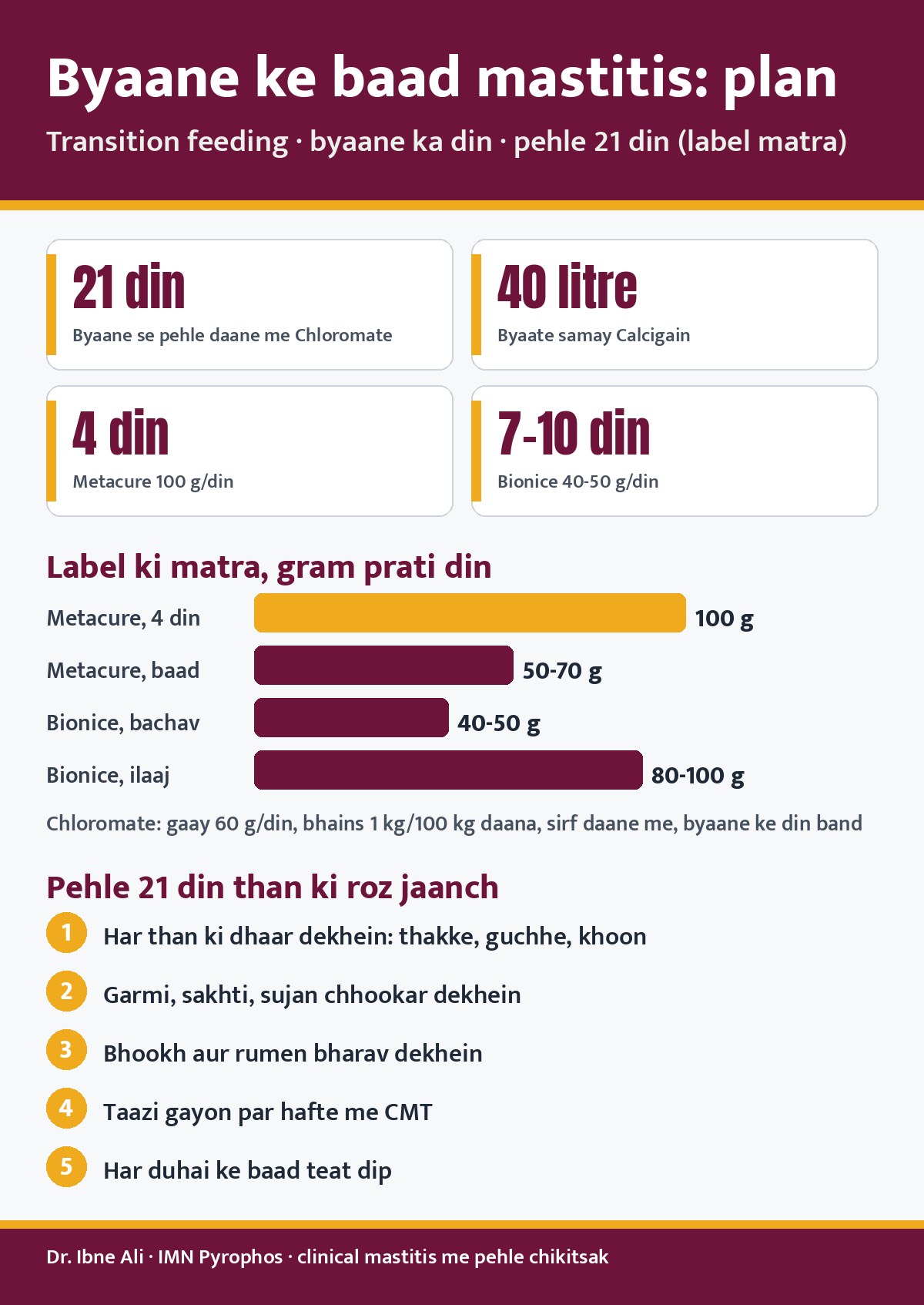
- Byaane se pehle (aakhri 21 din): calcium tantra taiyar karne ke liye Chloromate daane me, aur suraksha ke liye khanij, vitamin E aur selenium.
- Byaane ka din: saaf byaane ki jagah, Calcigain, jaldi kheece, than ki dekhbhal.
- Byaane ke baad (pehle 21 din): calcium ke liye Metacure, urja aur liver ke liye Ketofend aur Bionice, rumen aur bhookh ke liye Pyrosach aur Rumenia, aur roz than ki jaanch.
Level 1: Byaane ke baad mastitis kyun? (buniyadi baatein)
Than ko ek darwaze wale ghar ki tarah samajhiye. Swasth gaay me darwaza (teat canal) ek mansapeshi aur keratin ki daat se kasakar band rehta hai, aur andar paharedaar (shwet rakt koshikayein, mukhya roop se neutrophil) taiyar rehte hain. Byaane ke aaspaas ye poora tantra ek saath kamzor padta hai. Ye aam pathyapustak ki baatein hain [aam jaankari, dairy vigyan].
| Kya bigadta hai | Than par asar |
|---|---|
| Byaane ke aaspaas pratirodhak kshamta me girawat | Hormone badlav aur byaane ke tanaav se shwet koshikayein keetanu dhoondhne aur maarne me dheemi padti hain. |
| Khoon me calcium kam (gaay giri na ho tab bhi) | Mansapeshi ke liye calcium chahiye. Teat ki mansapeshi kam kasakar band hoti hai, keetanu aasani se ghuste hain. Shwet koshikayein bhi kam kaam karti hain. |
| Negative energy balance | Doodh bhookh se tez shuru hota hai. Gaay sharir ki charbi galati hai; charbi ke up-utpaad (NEFA, ketone) shwet koshikaon aur liver ko dheema karte hain. |
| Vitamin E, selenium, zinc, copper kam | Ye khanij aur vitamin shwet koshikaon ko keetanu maarne me madad karte hain. Kami yaani kamzor suraksha. |
| Than ki sujan, ganda mahaul, geela bichhawan | Darwaza sabse kamzor ho, usi samay teat ke sire par zyada keetanu. |
Mukhya baat: ye samasyayein ek-doosre ko badhati hain. Calcium kam to bhookh kam, bhookh kam to urja ki kami gehri, urja ki kami se pratirodhak kshamta kam, aur tab mastitis andar aata hai. Kai jagah kadi todiye to poora khatra ghatta hai.
Level 2: Transition ki timeline, ek talika me
| Charan | Lakshya | IMN products aur label ki matra |
|---|---|---|
| Far-off dry (byaane se lagbhag 60 se 22 din pehle) | Sahi body condition, zyada daana na dein, khanij sthir rakhein. | Rumenia daane me (3 kg prati quintal (100 kg) daana). Pyromin 10 g roz (vayask). Pyrosach 8 se 10 g roz. |
| Close-up (aakhri 21 din) | Calcium tantra aur pratirodhak tantra ki taiyari. | Chloromate daane me: gaay 60 g roz ya 1.2 kg prati 100 kg daana, bhains 1 kg prati 100 kg daana; byaane ke din band. Sel-E-Boost dairy 75 g prati transition gaay (label). Pyrosach aur Pyromin jaari. |
| Byaane ka din | Saaf aur jaldi byaana; calcium, urja, rumen lautana. | Calcigain: 1 kg ko 20 litre garam aur 20 litre saade paani me (40 litre). Byaane ke baad Metacure shuru. Jaldi kheece. |
| Taazi byaai gaay (pehle 21 din) | Calcium sthir, bhookh theek, ketosis nahi, roz than ki jaanch. | Metacure 4 din roz 100 g, phir 1 mahine tak roz 50 se 70 g (ya ek din chhodkar). Bionice 7 se 10 din roz 40 se 50 g. Ketofend byaane ke din Calcigain ke saath 200 g, phir 7 din roz 50 se 100 g ya zaroorat anusaar. Pyrosach, Rumenia, Sel-E-Boost aur Pyromin jaari. |
Daane me milaayi jaane wali matra, prati quintal (100 kg) daana (hamare farm ka formula; prati pashu label ki matra neeche har product ke saath hai):
| Product | Prati quintal daana |
|---|---|
| Rumenia | 3 kg |
| Sel-E-Boost (dairy) | 150 se 200 g |
| Pyromin | 100 se 200 g |
| Pyrosach | 200 se 250 g |
| Bionice | 100 se 150 g |
| Metacure | 100 g |
| Chloromate | 1.2 kg (gaay); bhains 1 kg |
Calcigain aur Ketofend neeche bataye anusaar hi rahenge. Baaki sab daane me barabar milayein (TMR sabse achha). Lekh ke ant ka calculator inhi prati quintal matraon se hisaab lagata hai.
Byaane ki sambhavit tareekh likh lijiye aur usi se ulti ginti kijiye. Har product ka apna page hai; samasya ke hisaab se product guide dekhiye. Milk fever ke liye hamari milk fever se bachav guide aur product-dar-product byaane ke plan ke liye Chloromate, Calcigain, Bionice plan padhiye.
Level 3: Far-off dry period, neev banayein
Yahan chupchaap ka kaam hota hai. Lakshya hai ki gaay sahi body condition aur sthir khanij sevan ke saath close-up me pahunche. Bahut moti dry gaay byaane ke baad zyada bhookh khoti hai aur zyada charbi galati hai, jisse urja aur liver ki samasya badhti hai [aam jaankari].
- Daana zyada na dein. Achha chaara aur santulit ration dein, dry gaay ko moti na hone dein.
- Rumenia dairy premix hai (trace mineral, rumen buffer, prebiotic, yeast extract, probiotic, toxin binder, calcium, phosphorus). Label ke hisaab se 3 kg prati quintal (100 kg) daana. Yaani agar gaay 5 kg daana khaati hai to lagbhag 150 g prati gaay prati din.
- Pyromin chelated khanij (zinc, copper, selenium, iodine, cobalt aadi) aur vitamin deta hai: vayask pashu ko 10 g roz.
- Pyrosach rumen ke anukool yeast hai (Saccharomyces cerevisiae, 1000 crore CFU prati gram): vayask ko 8 se 10 g roz. Ye reshe ke pachan aur rumen ko sthir rakhta hai, jisse baad me bhookh sudharti hai.
Rumen premix
Rumenia
Feed premix (trace mineral, rumen buffer, prebiotic, yeast extract, probiotic, toxin binder, calcium, phosphorus). Rumen ka kaam, pachan, urja aur protein sanshleshan behtar karta hai.
Matra: Daane me 3 kg prati quintal (100 kg) daana.
5 kg ₹1,400 · 25 kg ₹5,625MRP ₹1,800 / ₹7,500
Chelated mineral · prajanan
Pyromin
Chelated iron, manganese, copper, zinc, iodine, selenium, chromium, cobalt, magnesium, vitamin A, D3, E, K, B vitamin, biotin, methionine, lysine, lactobacillus aur yeast extract. Doodh utpadan, prajanan, garbh thaharne aur immunity me sahayak.
Matra: Repeat breeding me: 10 din tak 15–20 g prati pashu prati din (loading dose), phir roz 10 g.
1 kg ₹655MRP ₹1,190
Rumen ki sehat
Pyrosach
Rumen ke anukool Saccharomyces cerevisiae (1000 crore CFU prati gram). Reshe ka pachan aur rumen ki sehat sudharta hai, patla gobar ghatata hai, doodh, fat aur SNF me sahayak.
Matra: 8–10 g prati vayask gaay ya bhains prati din, ya 200–300 g prati quintal daana. Achhe natije ke liye daane me mila kar raat bhar bhigoiye.
1 kg ₹700MRP ₹1,200
Level 4: Close-up, aakhri 21 din
Ab do baatein maayne rakhti hain: calcium ki taiyari aur pratirodhak tantra ki taiyari.
Calcium. Byaane se pehle gaay daane-chaare se aasani se calcium le leti hai aur haddi se nikalne ki zaroorat nahi padti. Byaane ke baad maang achanak bahut badh jaati hai (kheece aur doodh), aur jis gaay ka calcium tantra soya hua hai wo kai din peeche rehti hai. Negative DCAD ration (chloride aur sulphur zyada, potassium aur sodium kam) khoon ko halka amliya karke calcium tantra ko jagata hai [Goff va anya, mankit dairy poshan]. Chloromate hamara negative DCAD premix hai.
- Gaay: aakhri 21 din roz 60 g prati pashu ya 1.2 kg prati 100 kg daana. Bhains: 1 kg prati 100 kg daana.
- Sirf daane me. Paani me nahi, munh se nahi. Pellet feed me nahi jaata. Chokar, makka ya chura me milayein. TMR sabse achha.
- Byaane ke din band karein.
- Chloromate ki jagah dry period me alag se chuna ya calcium na badhayein.
Byaane se pehle · aakhri 21 din
Chloromate
Negative DCAD premix, jo byaane se pehle aakhri 21 din daane me dene par milk fever se bachav me madad karta hai. 5 kg pack ₹2,900.
Matra: Gaay: close-up period (byaane se pehle aakhri 21 din) me roz 60 g prati pashu, ya 1.2 kg prati 100 kg daana; bhains: 1 kg prati 100 kg daana. Sirf daane me achhe se mila kar khilaiye, paani me ya munh se kabhi nahi. Byaane ke din band kar dijiye. Pellet feed me Chloromate mix nahi hota, isliye chokar, makka ya chura kiye hue pellet me mila kar dijiye. Sabse achha tareeka TMR me dena hai.
1 kg ₹600MRP ₹800
Pratirodhak tantra. Sel-E-Boost (dairy) me vitamin E, selenium aur propionate precursor hain. Transition gaay ke liye label ki matra 75 g prati pashu hai. Than me shwet koshikaon ke kaam ke liye vitamin E aur selenium sabse jaane-pehchane poshak tattva hain. Pyromin aur Pyrosach jaari rakhein. Dairy aur poultry Sel-E-Boost ko aapas me na milayein, ye alag products hain.
Dairy · vitamin E + selenium
Sel-E-Boost (dairy)
Dairy pashuon ke liye vitamin E aur selenium combination, high power immune booster (label: vitamin E, propionate precursors aur selenium). Transition period me immune status sudharta hai, tanav me free radicals se ladta hai, mastitis me recovery behtar karta hai aur metritis va mastitis ke maamle ghatata hai.
Matra: Bachhde 10 g prati din; gaay 40 se 50 g prati pashu; transition cow 75 g prati pashu; feed premix ke roop me 120 se 200 g prati 100 kg daana.
1 kg ₹920MRP ₹1,500
Level 5: Byaane ka din, pehle 24 ghante
Byaane ka din pehle hafton ka rang tay karta hai. Neeche ki soochi aam achha abhyas hai [aam dairy abhyas]:
- Saaf, sookha, alag byaane ka bada aur taaza bichhawan. Ganda bada than ke keetanuon ka sabse bada srot hai.
- Bachhde ke doodh peene ya pehli duhai se pehle than aur teat dhokar sukhayein. Haath saaf hon.
- Kheece jaldi, saaf than se, bachhde ko. Pehle din than poora khaali na karein: poora duhne se gaay se aur calcium nikal sakta hai.
- Shuruaati hafton me har duhai ke baad teat dip karein; gaay ko kuch der khada rakhein taaki teat canal band ho jaye.
- Jer par nazar rakhein. Jer na girna yaani beemar gaay aur kamzor than. Pashu chikitsak bulayein.
Calcigain byaane ka sahara hai: glucogenic precursor, vitamin B12, organic calcium, electrolyte, osmolyte, probiotic, trace mineral aur vitamin. Ye bhookh aur rumen ka kaam lautata hai aur abomasal displacement rokne me madad karta hai. Matra: 1 kg ko 20 litre garam aur 20 litre saade paani me milakar, byaate samay ya turant baad 40 litre pilayein.
Byane ke samay sahara
Calcigain
Taaza byaai gaay-bhains ke liye urja, organic calcium aur electrolyte ka ghol. Bhookh aur rumen ka kaam lautata hai aur abomasal displacement se bachav me madad karta hai.
Matra: 1 kg ko 20 litre garam paani me gholiye, 20 litre saada paani milaiye, aur 40 litre ghol byaate samay ya turant baad dijiye.
1 kg ₹850MRP ₹1,750
Agar gaay giri hui, thandi ya behosh hai to ye milk fever ya doosri aapat sthiti hai: turant pashu chikitsak bulayein, supplement ka intezaar na karein.
Level 6: Byaane ke baad ke pehle 21 din
Yahi wo samay hai jab zyadatar kisan mastitis dekhte hain. Gaay par calcium ki kami, ketosis aur sankraman, teeno ka khatra sabse zyada hota hai, aur har ek baaki ko badhata hai.
Calcium: Metacure ionic calcium supplement hai (dextrose base me organic calcium salt) jo rumen me jaldi ghulta hai. Label ke anusaar ye khoon me ionic calcium banaye rakhne me madad karta hai, calcium ki kami dobara hone ka khatra ghatata hai, mansapeshi ki taqat aur rumen ki gati sudharta hai aur byaane ke baad bachhedani ki safai me madad karta hai. Matra: byaane ke baad 4 din roz 100 g (loading), phir 1 mahine tak roz 50 se 70 g ya ek din chhodkar, ya pashu chikitsak ki salah se. Daane me: 200 se 250 g prati quintal.
Ionic calcium
Metacure
Ionic calcium supplement (dextrose base me organic calcium salt), rumen me jaldi ghulkar absorb hota hai. Byaane ke samay aur shuruaati dugdhkaal me kaam aata hai. Ye dawa nahi, feed supplement hai.
Matra: Byaane ke baad 4 din roz 100 g (loading), phir 1 mahine tak roz 50 se 70 g ya ek din chhodkar, ya pashu chikitsak ki salah se. Daane me: 200 se 250 g prati quintal.
1 kg ₹460 · 5 kg ₹2,275MRP ₹815 / ₹4,000
Urja aur liver: Ketofend aur Bionice. Ketofend ketosis se bachav ka dairy supplement hai: niacinamide, biotin, propionate aur glucogenic precursor, thiamine, riboflavin aur folic acid. Label ki salah: jab pashu chaara kha raha ho par daane se door ho tab istemal karein. Matra (farm abhyas): byaane ke din Calcigain ke saath 200 g, phir 7 din roz 50 se 100 g, ya zaroorat anusaar. Bionice me biotin, niacin, chelated zinc, chromium aur glucose precursor hain aur ye ketosis va negative energy balance, shuruaati dugdhkaal ke fatty liver aur mastitis se recovery me kaam aata hai: bachav ke liye byaane ke baad 7 se 10 din roz 40 se 50 g.
Ketosis se bachav
Ketofend
Ketosis se bachav ka dairy feed supplement: niacinamide, biotin, propionate aur glucogenic precursor, thiamine, riboflavin aur folic acid. Byaane ke aaspaas (transition) kaam aata hai.
Matra: Byaane ke din Calcigain ke saath 200 g, phir 7 din roz 50 se 100 g, ya zaroorat anusaar. Label ki salah: jab pashu chaara kha raha ho par daane se door ho tab istemal karein.
1 kg ₹650MRP ₹1,110
Byaane ke baad · shuruaati doodh
Bionice
Biotin, niacin, chelated zinc aur chromium, saath me glucose banane wale tatva. Shuruaati doodh ke samay ketosis (urja ki kami) aur fatty liver me sahayak, aur thanaila se ubharne me madad karta hai.
Matra: Bachav ke liye byaane ke baad 7–10 din tak 40–50 g prati din; ilaaj me 80–100 g prati din 5–7 din; daane me 250–500 g prati 100 kg daana.
1 kg ₹768MRP ₹1,100
Rumen aur bhookh: Pyrosach aur Rumenia usi matra me jaari rakhein. Jo gaay apna ration poora khaati hai, uske baaki sab kuch me behtar mauke hote hain. Ration me Pyromin aur Sel-E-Boost bhi jaari rakhein.
Pehle 21 din than ki roz ki dincharya [aam dairy abhyas]:
- Har than ki pehli dhaar strip cup ya kaali satah par dekhein: thakke, guchhe, paani jaisa ya khoon mila doodh chetavani hai.
- Than ko chhookar dekhein: ek than me garmi, sakhti, dard ya sujan, ya chhoone par laat marti gaay.
- Bhookh aur rumen bharav dekhein: jo gaay khana chhod de use than kaisa bhi dikhe, usi din dhyan chahiye.
- Ho sake to taazi byaai gayon par hafte me ek baar California Mastitis Test (CMT) karein: ye doodh asaamanya dikhne se pehle chhipa (subclinical) mastitis pakadta hai.
- Taazi aur beemar gayon ko aakhir me duhein; teat dhokar sukhayein; duhai ke baad dip karein.
Agar mastitis ho chuka hai: kya karein
- Usi din pashu chikitsak ko dikhayein. Ilaaj, antibiotic ka chunav aur doodh rokne ki avadhi chikitsak tay karte hain.
- Sankramit than ko salah ke anusaar baar-baar khaali karein, doodh surakshit tareeke se phenkein aur bachhdon ko kabhi na pilayein.
- Sahare ki yojana chalne dein. Bionice ilaaj ki matra me (5 se 7 din roz 80 se 100 g) urja aur recovery me madad karta hai. Sel-E-Boost aur Pyromin vitamin E, selenium aur khanij sthir rakhte hain.
- Immune support. Nexamune L aur Livolact ke liye hamari mastitis immune booster guide dekhein.
- Kaaran theek karein. Keetanu kahan se aa rahe hain: bichhawan, duhne wale ke haath, milking machine, teat dip, makkhiyan. Kaaran wahi rahe to ek gaay ka ilaaj agla case hi laata hai.
Ek udaharan me kharch
Ek gaay ke liye, 1 kg pack ke selling rate se. Close-up aur byaane ke baad ke mukhya products:
| Product | Ek gaay ki matra | Lagbhag kharch |
|---|---|---|
| Chloromate | 21 din x 60 g = 1.26 kg | lagbhag Rs 756 |
| Calcigain | Byaate samay 1 kg | Rs 850 |
| Metacure, loading dose | 4 din x 100 g = 0.4 kg | lagbhag Rs 184 |
| Bionice (bachav) | 7 se 10 din x 40 se 50 g = 0.28 se 0.5 kg | lagbhag Rs 215 se 384 |
| Kul (mukhya chaar) | lagbhag Rs 2,000 se 2,200 |
Iski tulna ek milk fever case, mastitis se kharab hue ek than ya ek mahine ke ghate doodh se kijiye. Rumenia, Pyromin, Pyrosach, Sel-E-Boost aur Ketofend ka kharch aapke khilane ke dinon aur ration par nirbhar hai, apne farm ke liye WhatsApp par poochhein.
Aam galtiyan
- Chloromate paani me ya pellet feed me dena, ya byaane ke baad bhi jaari rakhna.
- Chloromate ki jagah dry period me zyada chuna ya calcium.
- Pehle 2 hafte than ki jaanch chhod dena kyunki “doodh theek dikhta hai”.
- Gaay ke beemar hone ke baad hi supplement shuru karna.
- Dry period me gaay ka zyada moti hona.
- Pashuon ko poultry Sel-E-Boost dena, ya ulta.
Hum kya jaante hain aur kya nahi
- Gyaat (aam dairy vigyan): byaana than ke naye sankraman ka sabse khatarnak samay hai; calcium ki kami, negative energy balance aur kam vitamin E va selenium suraksha kamzor karte hain; negative DCAD calcium ki kami rokta hai; safai aur jaldi pehchaan mastitis ghatate hain.
- Product ke daawe IMN Pyrophos ke label aur product page ke anusaar hain. Hum kisi ek product se mastitis me kitne pratishat girawat ka daawa nahi karte.
- Yahan tay nahi: negative DCAD close-up ration me Rumenia kaise rakhein. Hum andaze se sankhya likhne ke bajay “poochhiye” kehna behtar maante hain.
Aksar pooche jaane wale sawal
Byaane ke theek baad mastitis kyun shuru hota hai?
Suraksha sabse kam hoti hai, calcium aur urja ki kami hoti hai aur teat canal kam kasa hota hai. Ye sab pehle hafton me ek saath aate hain.
Kya Chloromate mastitis rok sakta hai?
Chloromate calcium tantra ke liye hai (milk fever se bachav). Calcium ki kami ka khatra ghatakar ye mansapeshi aur pratirodhak kaam ko sahara deta hai, par ye mastitis ki dawa nahi hai.
Kaun se products byaane se pehle, kaun se baad me?
Pehle: Chloromate, Rumenia, Pyromin, Pyrosach, Sel-E-Boost. Byaate samay: Calcigain. Baad me: Metacure, Bionice, Ketofend, aur saath me Rumenia, Pyrosach, Pyromin va Sel-E-Boost jaari.
Kya har gaay ko nau ke nau products dene hain?
Nahi. Mukhya hain Chloromate, Calcigain, Metacure aur Bionice. Baaki ration aur jhund par nirbhar hain; apne farm ka plan humse poochhiye.
Pashu chikitsak ko kab bulayein?
Garam, sakht ya soojha than, doodh me thakke ya khoon, bukhar, gaay ka khana chhodna, gaay ka khada na ho paana, jer na girna.
Mahine ke product ka calculator (anumanit)
Pashuon ki sankhya aur stage chuniye. Us stage ke liye (30 din, close-up me 21 din) kitna product lagega, pack ka mel aur selling rate se lagbhag kharch mil jayega. Matra prati quintal (100 kg) daane ke hisaab se hai, jaisi hamare farm formule me hai.