
India is about to get its first indigenous H5N1 vaccine for chickens. The Ministry of Agriculture and Farmers Welfare has announced that Union Minister Shri Shivraj Singh Chouhan will dedicate the “Inactivated H5N1 (Clade 2.3.2.1a) Highly Pathogenic Avian Influenza Vaccine for Chickens”, developed by ICAR-NIHSAD, Bhopal, to the nation on 20 November 2026. For farmers, hatcheries and vets, this could be the biggest change in how bird flu is handled since the first outbreak in 2006. This article covers the losses India has faced, the virus itself, how it spreads, why earlier approaches fell short, and what the new vaccine can and cannot be expected to do.
What has been announced (and what has not)
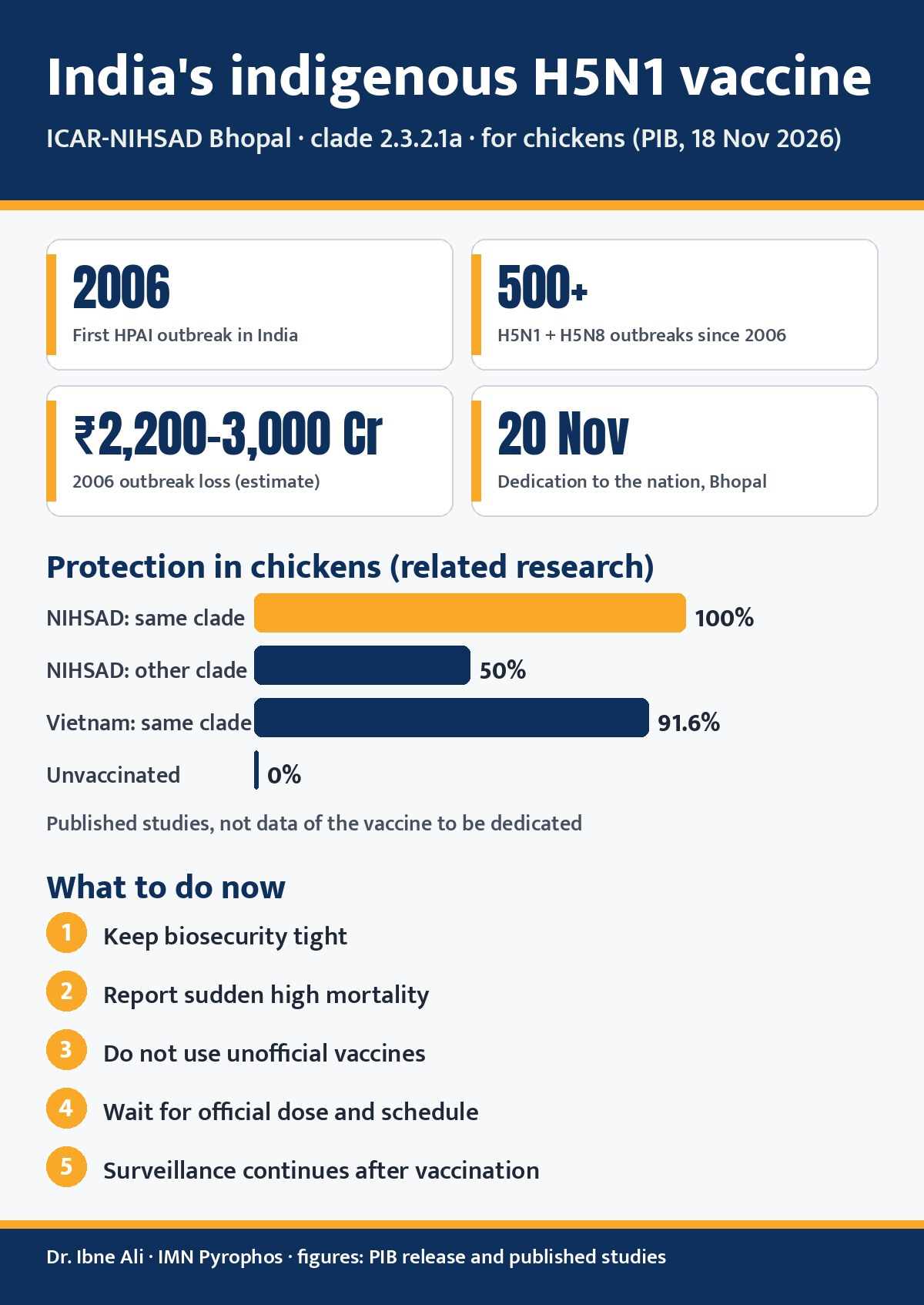
According to the Press Information Bureau release of 18 November 2026, ICAR-NIHSAD (National Institute of High Security Animal Diseases), Bhopal has developed an inactivated H5N1 vaccine against clade 2.3.2.1a for chickens. The release calls it the first of its kind in India against this clade, and states that no specific commercial vaccine is currently available for clade 2.3.2.1a. The vaccine is intended to protect against the 2.3.2.1a strains circulating in India.
Why this matters: the financial cost of bird flu in India
Highly pathogenic avian influenza (HPAI) can kill close to 100% of infected birds in a flock. Numbers from the PIB release give the scale:
- India first detected HPAI in 2006. Since then more than 500 combined H5N1 and H5N8 outbreaks have been reported.
- The 2006 outbreak caused estimated direct and indirect losses of Rs 2,200-3,000 crore.
- An outbreak in Manipur caused losses equal to about 0.5% of that state’s GDP.
- A major uncontrolled outbreak could cut India’s GDP growth by up to 1.5%, and more than 20% of the poultry population could be at risk.
Those are national numbers. On a farm, the damage is more direct: when HPAI is confirmed, birds in the affected zone are culled, movement and sales stop, and egg and chicken prices fall because of panic, even where birds are healthy. The chicks, feed, medicines and months of labour already invested are lost, and compensation does not cover all of it. For comparison, a Vietnamese study reports that bird flu there destroyed about 50 million poultry in more than 3,000 outbreaks between 2003 and 2019, costing 0.5-1.8% of GDP each year.
The disease: etiology
HPAI is caused by influenza A virus of the family Orthomyxoviridae. Its genome is made of eight segments of RNA, which allows two viruses in the same bird to swap segments (reassortment). Viruses are named by two surface proteins: H (hemagglutinin, which attaches to the host cell and is the main target of protective antibodies) and N (neuraminidase). HPAI viruses are mostly H5 and H7 types, and are notifiable to WOAH.
What makes a virus “highly pathogenic” is largely a feature of the HA protein: a multi-basic cleavage site lets the virus be activated by enzymes found in many organs, so it spreads through the whole body, not just the airways. This is also why vaccine developers often remove that site from the vaccine seed virus (the Vietnamese team did exactly that to make its seed safe).
H5N1 has been spreading in poultry since 1997 (Hong Kong). H5 viruses have evolved into many clades (0 to 9). Clade 2 dominates South Asia. Clade 2.2 was dominant until about 2010 and was replaced by 2.3.2.1, which split into 2.3.2.1a, 2.3.2.1b and 2.3.2.1c. In India, 2.3.2.1a has been the predominant H5N1 clade in poultry since about 2011, which is why the new vaccine targets it.
Epidemiology and disease pattern in India
- Hosts: chickens are highly susceptible. Ducks and other waterfowl can carry the virus with little or no sign of illness, so infection can go unnoticed (the Bhutan study points to the large duck population and possible under-reporting). The PIB release says clade 2.3.2.1a infections have also been found in other animals including mammals, and in three human cases.
- How it moves: wild and migratory birds, live-bird markets, illegal or unregulated movement of poultry, and contaminated equipment, vehicles and people. In neighbouring Bhutan, illegal movement of poultry was the main reason outbreaks happened in 2012.
- Season: most reports in India come in the cooler months, when migratory birds arrive and the virus survives longer in the environment. This is the general pattern reported in India; check your state animal husbandry department for current alerts.
- Clinical picture in chickens: sudden high mortality, depression, drop in feed and water intake, swollen head and face, bluish comb and wattles, haemorrhages on shanks, respiratory signs, and a steep fall in egg production in layers. In the ICAR-NIHSAD challenge study, unvaccinated chickens infected with the 2.3.2.1a virus died within 60 hours.
States affected over the years. India’s first outbreak was in 2006 (Maharashtra and Gujarat). Later outbreaks have been reported in West Bengal and the north-eastern states (Assam, Tripura, Manipur and others), and in recent years in several states across the country, including Andhra Pradesh, Maharashtra, Kerala, Jharkhand and Haryana, with human cases reported in Haryana (2021) and Andhra Pradesh (2025). Please check the latest state-wise list from the Department of Animal Husbandry and Dairying before quoting it.
A reassortant clade worth knowing about. A study from Bhutan (Emerging Infectious Diseases, 2016) found that the 2012 outbreaks there were caused by a 2.3.2.1a virus carrying an H9-like PB1 gene. This genotype has been reported in Bangladesh, India and Nepal. In the lab it replicated faster and spread to contact chickens more efficiently than its parent genotype, and in ferrets it infected the nose and, in one animal, caused mild brain inflammation, though it did not spread to contact ferrets. This is why genomic surveillance matters.
What the virology problem has been until now
- The virus keeps changing. Clades replace each other (2.2 to 2.3.2.1 and its subclades). A vaccine made from the wrong clade protects poorly. Vietnam learned this when imported vaccines made for clades 0 and 2.3.4 failed against local 2.3.2.1 viruses.
- Small differences matter. Between clades 2.3.2.1a and 2.3.2.1c, only 8 amino acids differ in the HA1 region, yet in ICAR-NIHSAD’s own research a recombinant vaccine matched to 2.3.2.1a protected 100% of chickens against 2.3.2.1a but only 50% against 2.3.2.1c.
- No matched vaccine for 2.3.2.1a. As the PIB release states, there is no specific commercial vaccine for this clade. With no vaccine, the only tool has been stamping out: culling, disposal, disinfection and movement control. It works only if it is fast and complete, and its cost falls on farmers.
- Dependence on imported seed strains. Many countries rely on imported candidate viruses. A local, quickly updatable platform is the long-term fix (Vietnam showed a reverse-genetics seed can be made in 10-12 weeks).
- Silent spread. Ducks and partly protected birds can carry and shed virus without looking sick, so surveillance has to continue even with a vaccine.
Technical details: what we know about the vaccine, step by step
- Type: inactivated (killed) H5N1 vaccine. Inactivated vaccines cannot cause the disease and are given by injection, usually with an oil adjuvant to boost the response.
- Target: clade 2.3.2.1a H5N1 HPAI, the clade circulating in Indian poultry. Species: chickens.
- Developer: ICAR-NIHSAD, Bhopal, the national high-biosecurity animal disease institute.
- How these vaccines work: they train the bird to make antibodies against HA. Protection is measured by the hemagglutination-inhibition (HI) antibody titre, a titre of 4 log2 or more is generally counted as positive, and by actual protection against a live-virus challenge. Both matter, because high antibodies against a different clade may not stop shedding.
Not yet disclosed: the exact production platform, seed strain, dose, schedule (number of doses, age at vaccination), duration of immunity, whether infected and vaccinated birds can be told apart (DIVA), price and when it will be available to farms.
What can we reasonably expect? Evidence from related research
| Study | Vaccine type | Result in chickens |
|---|---|---|
| ICAR-NIHSAD / IVRI (preprint, SSRN) | Recombinant H5HA1 protein of clade 2.3.2.1a made in E. coli, with oil adjuvant, two boosters | 100% survival against clade 2.3.2.1a, 50% against clade 2.3.2.1c. HI titre of 4 log2 or more kept for 154 days after the second booster. Safe at 4 times the dose. All unvaccinated controls died within 60 hours. |
| Vietnam (Hoang et al., Vaccines 2020) | Inactivated reverse-genetics vaccine, HA and NA of a clade 2.3.2.1c strain, single dose | 91.6% protection against the same clade; 83.3% against a clade 1.1 strain; all unvaccinated chickens died. |
What it tells us: (1) matching the vaccine to the circulating clade is the key to high protection; (2) a good vaccine reduces deaths and virus shedding, but does not always stop shedding completely, especially against a different clade; (3) protection after vaccination needs good dose, boosters and timing, so schedule details matter.
For farmers and vets, the sensible reading is: a clade-matched inactivated vaccine is a strong new tool for reducing losses, but it supports biosecurity and surveillance, it does not replace them.
What should farmers and vets do now
- Do not relax biosecurity. Keep visitors, vehicles and used crates out, keep wild birds and ducks away from sheds and feed, clean and disinfect between batches.
- Report sudden high mortality to the local veterinary officer. Early reporting is what limits the loss.
- Do not buy or use unofficial “bird flu vaccines”. Wait for the official notification on who may use it, which flocks, at what dose and schedule.
- Plan, but do not panic-buy. Poultry vaccination policy in India has so far been based on culling. How the new vaccine will be used on farms will be decided by the authorities.
- Watch for official announcements from ICAR-NIHSAD and the Department of Animal Husbandry and Dairying.
Our view
This section is our opinion, not a reported fact. We at IMN have long argued for a home-grown vaccine, because a country with this much poultry cannot depend only on culling. Our hope is that the vaccine is made widely available, that its field data are published openly, that vaccinated flocks stay under surveillance, and that the platform can be updated quickly when the virus changes. Backyard and duck flocks, breeders and layers should be part of the plan from the start.
Frequently asked questions
Is there a bird flu vaccine for chickens in India?
As of the PIB release of 18 November 2026, a vaccine for clade 2.3.2.1a, developed by ICAR-NIHSAD, is to be dedicated to the nation on 20 November 2026. The release says no specific commercial vaccine for this clade existed before.
Which strain does it protect against?
H5N1 clade 2.3.2.1a, the clade that has mostly been found in Indian poultry since about 2011.
Is it a live or killed vaccine?
Inactivated (killed), according to the PIB release.
What is the price and dose?
Not announced yet. We will update this page when official details are available.
Can eating chicken or eggs spread bird flu?
Cooked chicken and eggs are not considered a route when properly cooked. Human cases have mostly followed close contact with sick birds, and a recent Indian case was linked to raw chicken. Always cook poultry and eggs thoroughly.
Sources
- Press Information Bureau, Ministry of Agriculture and Farmers Welfare, release of 18 November 2026 (PRID 2337716).
- Boruah JLH et al., Immunogenicity and cross-protective efficacy of recombinant H5HA1 protein of clade 2.3.2.1a H5N1 virus expressed in E. coli (ICAR-NIHSAD / ICAR-IVRI), SSRN preprint 4049573.
- Marinova-Petkova A et al., Highly pathogenic reassortant avian influenza A(H5N1) virus clade 2.3.2.1a in poultry, Bhutan. Emerging Infectious Diseases 2016;22(12).
- Hoang HTT et al., Immunization with the H5N1 recombinant vaccine candidate induces high protection in chickens against Vietnamese HPAI virus strains. Vaccines 2020;8:159.
By Dr. Ibne Ali, IMN Pyrophos. Information here is for awareness and is not a substitute for advice from your veterinarian or the state animal husbandry department.
भारत को मुर्गियों के लिए अपनी पहली स्वदेशी H5N1 वैक्सीन मिलने जा रही है। कृषि एवं किसान कल्याण मंत्रालय ने बताया है कि केंद्रीय मंत्री श्री शिवराज सिंह चौहान ICAR-NIHSAD, भोपाल द्वारा विकसित “मुर्गियों के लिए इनएक्टिवेटेड H5N1 (क्लेड 2.3.2.1a) हाइली पैथोजेनिक एवियन इन्फ्लुएंज़ा वैक्सीन” को 20 नवंबर 2026 को राष्ट्र को समर्पित करेंगे। किसानों, हैचरी और वेट्स के लिए यह 2006 के पहले आउटब्रेक के बाद बर्ड फ्लू से निपटने का सबसे बड़ा बदलाव हो सकता है। इस लेख में हम देखेंगे कि भारत को कितना नुकसान हुआ, वायरस क्या है, कैसे फैलता है, पहले के तरीके क्यों कम पड़े, और नई वैक्सीन से क्या उम्मीद रखी जा सकती है और क्या नहीं।
क्या घोषणा हुई है (और क्या नहीं)
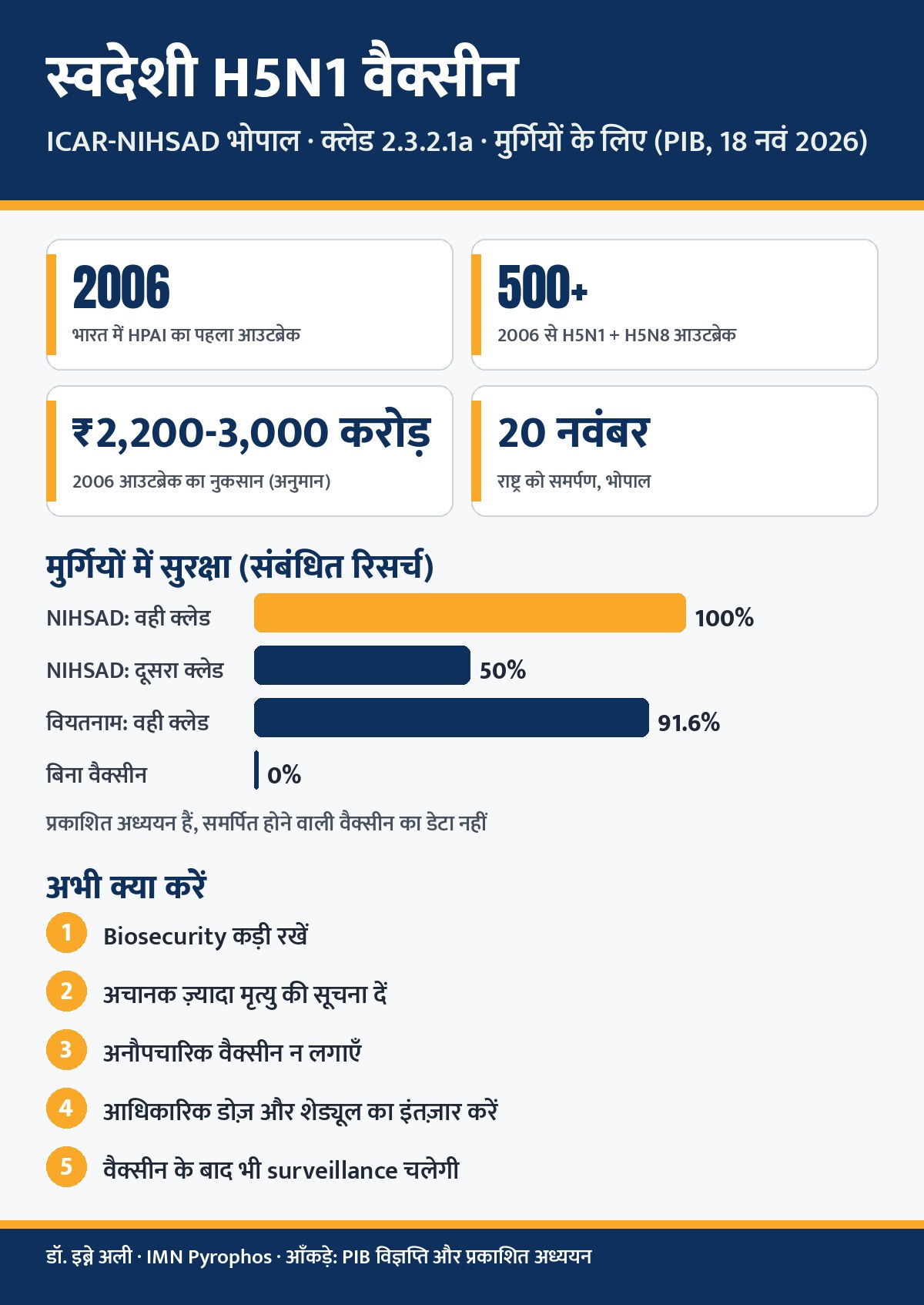
18 नवंबर 2026 की PIB (प्रेस इन्फॉर्मेशन ब्यूरो) विज्ञप्ति के अनुसार ICAR-NIHSAD (नेशनल इंस्टीट्यूट ऑफ़ हाई सिक्योरिटी एनिमल डिज़ीज़ेज़), भोपाल ने मुर्गियों के लिए क्लेड 2.3.2.1a के विरुद्ध इनएक्टिवेटेड H5N1 वैक्सीन विकसित की है। विज्ञप्ति इसे इस क्लेड के विरुद्ध भारत में अपनी तरह की पहली वैक्सीन बताती है और कहती है कि क्लेड 2.3.2.1a के लिए फ़िलहाल कोई विशिष्ट कमर्शियल वैक्सीन उपलब्ध नहीं है। यह वैक्सीन भारत में घूम रहे 2.3.2.1a स्ट्रेन से सुरक्षा के लिए बनाई गई है।
यह क्यों मायने रखता है: भारत में बर्ड फ्लू की आर्थिक कीमत
हाईली पैथोजेनिक एवियन इन्फ्लुएंज़ा (HPAI) फ़्लॉक के लगभग 100% संक्रमित पक्षियों की जान ले सकता है। PIB विज्ञप्ति के आँकड़े पैमाना बताते हैं:
- भारत में HPAI पहली बार 2006 में मिला। तब से H5N1 और H5N8 के कुल 500 से ज़्यादा आउटब्रेक दर्ज हो चुके हैं।
- 2006 के आउटब्रेक से प्रत्यक्ष और अप्रत्यक्ष नुकसान का अनुमान ₹2,200-3,000 करोड़ रहा।
- मणिपुर के एक आउटब्रेक से उस राज्य के GDP का लगभग 0.5% नुकसान हुआ।
- बड़ा बेकाबू आउटब्रेक भारत की GDP वृद्धि को 1.5% तक घटा सकता है, और 20% से ज़्यादा पोल्ट्री आबादी जोखिम में आ सकती है।
ये राष्ट्रीय आँकड़े हैं। फ़ार्म पर नुकसान सीधा है: HPAI की पुष्टि होते ही प्रभावित ज़ोन के पक्षी culling में जाते हैं, आवाजाही और बिक्री रुक जाती है, और स्वस्थ पक्षी होने पर भी घबराहट से अंडे और चिकन के भाव गिर जाते हैं। लगाए गए चूज़े, दाना, दवाइयाँ और महीनों की मेहनत डूबती है, और मुआवज़े से सब पूरा नहीं होता। तुलना के लिए, वियतनाम के एक अध्ययन के अनुसार वहाँ 2003 से 2019 के बीच 3,000 से ज़्यादा आउटब्रेक में लगभग 5 करोड़ पोल्ट्री नष्ट हुई, और हर साल GDP का 0.5-1.8% नुकसान हुआ।
बीमारी: etiology
HPAI का कारण Orthomyxoviridae परिवार का इन्फ्लुएंज़ा A वायरस है। इसका जीनोम RNA के आठ सेगमेंट का है, इसलिए एक ही पक्षी में दो वायरस आपस में सेगमेंट बदल सकते हैं (reassortment)। वायरस का नाम दो सतही प्रोटीन से तय होता है: H (हीमाग्लूटिनिन, जो होस्ट सेल से चिपकता है और सुरक्षात्मक एंटीबॉडी का मुख्य निशाना है) और N (न्यूरामिनिडेज़)। HPAI वायरस ज़्यादातर H5 और H7 टाइप के होते हैं और WOAH को notifiable हैं।
वायरस को “हाईली पैथोजेनिक” बनाने वाली चीज़ मुख्य रूप से HA प्रोटीन में है: multi-basic cleavage site, जिससे वायरस कई अंगों में मिलने वाले एंज़ाइम से एक्टिव हो जाता है और पूरे शरीर में फैलता है, सिर्फ़ श्वसन तंत्र में नहीं। इसीलिए वैक्सीन बनाने वाले अक्सर seed virus से यह साइट हटा देते हैं (वियतनामी टीम ने यही किया)।
H5N1 1997 (हांगकांग) से पोल्ट्री में फैल रहा है। H5 वायरस कई क्लेड (0 से 9) में बँट चुके हैं। दक्षिण एशिया में क्लेड 2 हावी है। क्लेड 2.2 लगभग 2010 तक हावी था, फिर 2.3.2.1 ने उसकी जगह ली, जो आगे 2.3.2.1a, 2.3.2.1b और 2.3.2.1c में बँटा। भारत में लगभग 2011 से पोल्ट्री में 2.3.2.1a ही प्रमुख H5N1 क्लेड रहा है, इसीलिए नई वैक्सीन इसी को निशाना बनाती है।
भारत में epidemiology और बीमारी का पैटर्न
- Host: मुर्गियाँ बहुत संवेदनशील हैं। बत्तख और दूसरे जलपक्षी बिना या बहुत कम लक्षण के वायरस ढो सकते हैं, इसलिए संक्रमण अनदेखा रह सकता है (भूटान का अध्ययन बड़ी बत्तख आबादी और संभावित कम रिपोर्टिंग की ओर इशारा करता है)। PIB विज्ञप्ति के अनुसार क्लेड 2.3.2.1a संक्रमण स्तनधारियों समेत दूसरे जानवरों में और तीन मानव मामलों में भी मिला है।
- फैलाव: जंगली और प्रवासी पक्षी, लाइव-बर्ड मार्केट, पोल्ट्री की अवैध या अनियंत्रित आवाजाही, और दूषित उपकरण, गाड़ियाँ और लोग। पड़ोसी भूटान में 2012 के आउटब्रेक का मुख्य कारण पोल्ट्री की अवैध आवाजाही थी।
- मौसम: भारत में ज़्यादातर रिपोर्ट ठंड के महीनों में आती हैं, जब प्रवासी पक्षी आते हैं और वायरस वातावरण में ज़्यादा समय टिकता है। यह भारत में रिपोर्ट हुआ सामान्य पैटर्न है; मौजूदा अलर्ट के लिए अपने राज्य के पशुपालन विभाग से जाँचें।
- मुर्गियों में लक्षण: अचानक ज़्यादा मृत्यु, सुस्ती, दाना-पानी कम होना, सिर और चेहरे पर सूजन, कलगी और गलकंबल नीले पड़ना, पैरों पर रक्तस्राव, श्वसन लक्षण, और लेयर में अंडा उत्पादन में तेज़ गिरावट। ICAR-NIHSAD के चैलेंज अध्ययन में बिना वैक्सीन वाली मुर्गियाँ 2.3.2.1a वायरस से 60 घंटे के भीतर मर गईं।
वर्षों में प्रभावित राज्य। भारत का पहला आउटब्रेक 2006 में (महाराष्ट्र और गुजरात) हुआ। बाद में पश्चिम बंगाल और पूर्वोत्तर राज्यों (असम, त्रिपुरा, मणिपुर आदि) में, और हाल के वर्षों में आंध्र प्रदेश, महाराष्ट्र, केरल, झारखंड और हरियाणा समेत कई राज्यों में आउटब्रेक रिपोर्ट हुए, और मानव मामले हरियाणा (2021) और आंध्र प्रदेश (2025) में रिपोर्ट हुए। इसे आगे इस्तेमाल करने से पहले पशुपालन एवं डेयरी विभाग की ताज़ा राज्यवार सूची देख लें।
जानने लायक एक reassortant जीनोटाइप। भूटान के एक अध्ययन (Emerging Infectious Diseases, 2016) में पाया गया कि वहाँ 2012 के आउटब्रेक H9-जैसे PB1 जीन वाले 2.3.2.1a वायरस से हुए थे। यह जीनोटाइप बांग्लादेश, भारत और नेपाल में भी रिपोर्ट हुआ है। लैब में यह अपने parent जीनोटाइप से तेज़ बढ़ा और संपर्क वाली मुर्गियों में ज़्यादा कुशलता से फैला; फ़ेरेट में इसने नाक में संक्रमण किया और एक जानवर में हल्की ब्रेन सूजन की, पर संपर्क वाले फ़ेरेट में नहीं फैला। इसीलिए genomic surveillance ज़रूरी है।
अब तक virology की समस्या क्या रही
- वायरस बदलता रहता है। क्लेड एक-दूसरे की जगह लेते हैं (2.2 से 2.3.2.1 और उसके सबक्लेड)। गलत क्लेड से बनी वैक्सीन कम सुरक्षा देती है। वियतनाम को यह तब समझ आया जब क्लेड 0 और 2.3.4 के लिए बनी आयातित वैक्सीन स्थानीय 2.3.2.1 वायरस पर नाकाम रहीं।
- छोटे फ़र्क़ भी मायने रखते हैं। क्लेड 2.3.2.1a और 2.3.2.1c के HA1 क्षेत्र में सिर्फ़ 8 amino acid का फ़र्क़ है, फिर भी ICAR-NIHSAD की अपनी रिसर्च में 2.3.2.1a से मैच की गई recombinant वैक्सीन ने 2.3.2.1a के विरुद्ध 100% मुर्गियों को बचाया, पर 2.3.2.1c के विरुद्ध सिर्फ़ 50%।
- 2.3.2.1a के लिए मैच वाली वैक्सीन नहीं थी। PIB विज्ञप्ति के अनुसार इस क्लेड के लिए कोई विशिष्ट कमर्शियल वैक्सीन नहीं है। वैक्सीन न होने पर एकमात्र औज़ार stamping out रहा: culling, निपटान, कीटाणुशोधन और आवाजाही पर रोक। यह तभी काम करता है जब तेज़ और पूरा हो, और इसकी कीमत किसान चुकाते हैं।
- आयातित seed strain पर निर्भरता। कई देश आयातित candidate वायरस पर निर्भर रहते हैं। देश में बना और जल्दी अपडेट होने वाला प्लेटफ़ॉर्म ही लंबा हल है (वियतनाम ने दिखाया कि reverse genetics से seed 10-12 हफ़्ते में बन सकता है)।
- चुपचाप फैलाव। बत्तख और आंशिक रूप से सुरक्षित पक्षी बीमार दिखे बिना वायरस ढो और बहा सकते हैं, इसलिए वैक्सीन के साथ भी surveillance चलती रहनी चाहिए।
तकनीकी जानकारी: वैक्सीन के बारे में अब तक क्या पता है, क्रम से
- टाइप: इनएक्टिवेटेड (मारा हुआ) H5N1 वैक्सीन। इनएक्टिवेटेड वैक्सीन बीमारी नहीं कर सकती और इंजेक्शन से दी जाती है, आमतौर पर ऑयल एडजुवेंट के साथ ताकि असर बढ़े।
- निशाना: क्लेड 2.3.2.1a H5N1 HPAI, जो भारतीय पोल्ट्री में घूम रहा क्लेड है। प्रजाति: मुर्गियाँ।
- डेवलपर: ICAR-NIHSAD, भोपाल, देश का हाई-बायोसिक्योरिटी पशु रोग संस्थान।
- ऐसी वैक्सीन कैसे काम करती हैं: ये पक्षी को HA के विरुद्ध एंटीबॉडी बनाना सिखाती हैं। सुरक्षा को hemagglutination-inhibition (HI) एंटीबॉडी टाइटर से नापा जाता है (4 log2 या ज़्यादा आमतौर पर पॉज़िटिव माना जाता है) और live-virus challenge में असली सुरक्षा से। दोनों ज़रूरी हैं, क्योंकि दूसरे क्लेड के विरुद्ध ऊँचे एंटीबॉडी भी shedding नहीं रोक पाते।
अभी बताया नहीं गया: सटीक उत्पादन प्लेटफ़ॉर्म, seed strain, डोज़, शेड्यूल (कितनी डोज़, किस उम्र में), इम्युनिटी कितने समय चलेगी, संक्रमित और वैक्सीनेटेड पक्षी अलग पहचाने जा सकेंगे या नहीं (DIVA), कीमत और फ़ार्म तक कब मिलेगी।
हम क्या उम्मीद रख सकते हैं? संबंधित रिसर्च से सबूत
| अध्ययन | वैक्सीन का प्रकार | मुर्गियों में नतीजा |
|---|---|---|
| ICAR-NIHSAD / IVRI (प्रीप्रिंट, SSRN) | क्लेड 2.3.2.1a का recombinant H5HA1 प्रोटीन (E. coli में बना), ऑयल एडजुवेंट, दो बूस्टर | क्लेड 2.3.2.1a पर 100% survival, क्लेड 2.3.2.1c पर 50%। दूसरे बूस्टर के बाद 154 दिन तक HI टाइटर 4 log2 या ज़्यादा रहा। 4 गुना डोज़ पर भी सुरक्षित। बिना वैक्सीन वाली सभी कंट्रोल मुर्गियाँ 60 घंटे में मर गईं। |
| वियतनाम (Hoang et al., Vaccines 2020) | इनएक्टिवेटेड reverse-genetics वैक्सीन, क्लेड 2.3.2.1c स्ट्रेन के HA और NA, एक डोज़ | उसी क्लेड पर 91.6% सुरक्षा; क्लेड 1.1 स्ट्रेन पर 83.3%; बिना वैक्सीन वाली सभी मुर्गियाँ मर गईं। |
इससे क्या समझ आता है: (1) वैक्सीन को घूम रहे क्लेड से मैच करना ऊँची सुरक्षा की कुंजी है; (2) अच्छी वैक्सीन मौतें और वायरस shedding घटाती है, पर हमेशा shedding पूरी तरह नहीं रोकती, ख़ासकर दूसरे क्लेड पर; (3) वैक्सीनेशन के बाद की सुरक्षा के लिए सही डोज़, बूस्टर और टाइमिंग चाहिए, इसलिए शेड्यूल की जानकारी मायने रखती है।
किसानों और वेट्स के लिए समझदारी भरी बात: क्लेड-मैच्ड इनएक्टिवेटेड वैक्सीन नुकसान घटाने का मज़बूत नया औज़ार है, पर यह biosecurity और surveillance की मदद करती है, उनकी जगह नहीं लेती।
किसान और वेट्स अभी क्या करें
- Biosecurity ढीली न करें। विज़िटर, गाड़ियाँ और इस्तेमाल हुए क्रेट शेड से दूर रखें, जंगली पक्षी और बत्तख शेड और दाने से दूर रखें, बैच के बीच सफ़ाई और कीटाणुशोधन करें।
- अचानक ज़्यादा मृत्यु की सूचना स्थानीय पशु चिकित्सा अधिकारी को दें। जल्दी रिपोर्ट करने से ही नुकसान सीमित होता है।
- अनौपचारिक “बर्ड फ्लू वैक्सीन” न खरीदें, न लगाएँ। आधिकारिक अधिसूचना का इंतज़ार करें कि कौन, किन फ़्लॉक में, किस डोज़ और शेड्यूल से इस्तेमाल करेगा।
- योजना बनाएँ, पर घबराहट में खरीदारी न करें। भारत में पोल्ट्री का अब तक का तरीक़ा culling पर टिका रहा है। नई वैक्सीन फ़ार्म पर कैसे इस्तेमाल होगी, यह अधिकारी तय करेंगे।
- ICAR-NIHSAD और पशुपालन एवं डेयरी विभाग की आधिकारिक घोषणाओं पर नज़र रखें।
हमारी राय
यह हिस्सा हमारी राय है, रिपोर्ट किया गया तथ्य नहीं। हम IMN में लंबे समय से देश में बनी वैक्सीन की बात करते रहे हैं, क्योंकि इतनी बड़ी पोल्ट्री वाला देश सिर्फ़ culling पर निर्भर नहीं रह सकता। हमारी उम्मीद है कि वैक्सीन व्यापक रूप से उपलब्ध हो, उसका फ़ील्ड डेटा खुले तौर पर प्रकाशित हो, वैक्सीनेटेड फ़्लॉक की surveillance जारी रहे, और वायरस बदलने पर प्लेटफ़ॉर्म जल्दी अपडेट हो सके। बैकयार्ड और बत्तख फ़्लॉक, ब्रीडर और लेयर शुरू से योजना में शामिल हों।
अक्सर पूछे जाने वाले सवाल
क्या भारत में मुर्गियों के लिए बर्ड फ्लू की वैक्सीन है?
18 नवंबर 2026 की PIB विज्ञप्ति के अनुसार ICAR-NIHSAD द्वारा विकसित क्लेड 2.3.2.1a की वैक्सीन 20 नवंबर 2026 को राष्ट्र को समर्पित की जानी है। विज्ञप्ति कहती है कि इस क्लेड के लिए पहले कोई विशिष्ट कमर्शियल वैक्सीन नहीं थी।
यह किस स्ट्रेन से बचाती है?
H5N1 क्लेड 2.3.2.1a, जो लगभग 2011 से भारतीय पोल्ट्री में ज़्यादातर मिला है।
यह लाइव है या मारी हुई वैक्सीन?
PIB विज्ञप्ति के अनुसार इनएक्टिवेटेड (मारी हुई)।
कीमत और डोज़ क्या है?
अभी घोषित नहीं हुई। आधिकारिक जानकारी आते ही हम यह पेज अपडेट करेंगे।
क्या चिकन या अंडे खाने से बर्ड फ्लू फैल सकता है?
ठीक से पका हुआ चिकन और अंडा रास्ता नहीं माना जाता। मानव मामले ज़्यादातर बीमार पक्षियों के नज़दीकी संपर्क के बाद हुए हैं, और हाल का एक भारतीय मामला कच्चे चिकन से जुड़ा बताया गया। चिकन और अंडे हमेशा अच्छी तरह पकाकर खाएँ।
स्रोत
- प्रेस इन्फॉर्मेशन ब्यूरो, कृषि एवं किसान कल्याण मंत्रालय, 18 नवंबर 2026 की विज्ञप्ति (PRID 2337716)।
- Boruah JLH et al., Immunogenicity and cross-protective efficacy of recombinant H5HA1 protein of clade 2.3.2.1a H5N1 virus expressed in E. coli (ICAR-NIHSAD / ICAR-IVRI), SSRN preprint 4049573।
- Marinova-Petkova A et al., Highly pathogenic reassortant avian influenza A(H5N1) virus clade 2.3.2.1a in poultry, Bhutan. Emerging Infectious Diseases 2016;22(12)।
- Hoang HTT et al., Immunization with the H5N1 recombinant vaccine candidate induces high protection in chickens against Vietnamese HPAI virus strains. Vaccines 2020;8:159।
डॉ. इब्ने अली, IMN Pyrophos द्वारा। यह जानकारी जागरूकता के लिए है और आपके पशु चिकित्सक या राज्य के पशुपालन विभाग की सलाह का विकल्प नहीं है।
India ko murgiyon ke liye apni pehli swadeshi H5N1 vaccine milne ja rahi hai. Krishi evam Kisan Kalyan Mantralaya ne bataya hai ki Kendriya Mantri Shri Shivraj Singh Chouhan ICAR-NIHSAD, Bhopal dwara viksit “Inactivated H5N1 (Clade 2.3.2.1a) Highly Pathogenic Avian Influenza Vaccine for Chickens” ko 20 November 2026 ko rashtra ko samarpit karenge. Kisan, hatchery aur vets ke liye ye 2006 ke pehle outbreak ke baad bird flu se nipatne ka sabse bada badlaav ho sakta hai. Is lekh me hum dekhenge ki India ko kitna nuksan hua, virus kya hai, kaise failta hai, pehle ke tareeke kyon kam pade, aur nayi vaccine se kya umeed rakhi ja sakti hai aur kya nahi.
Kya ghoshna hui hai (aur kya nahi)
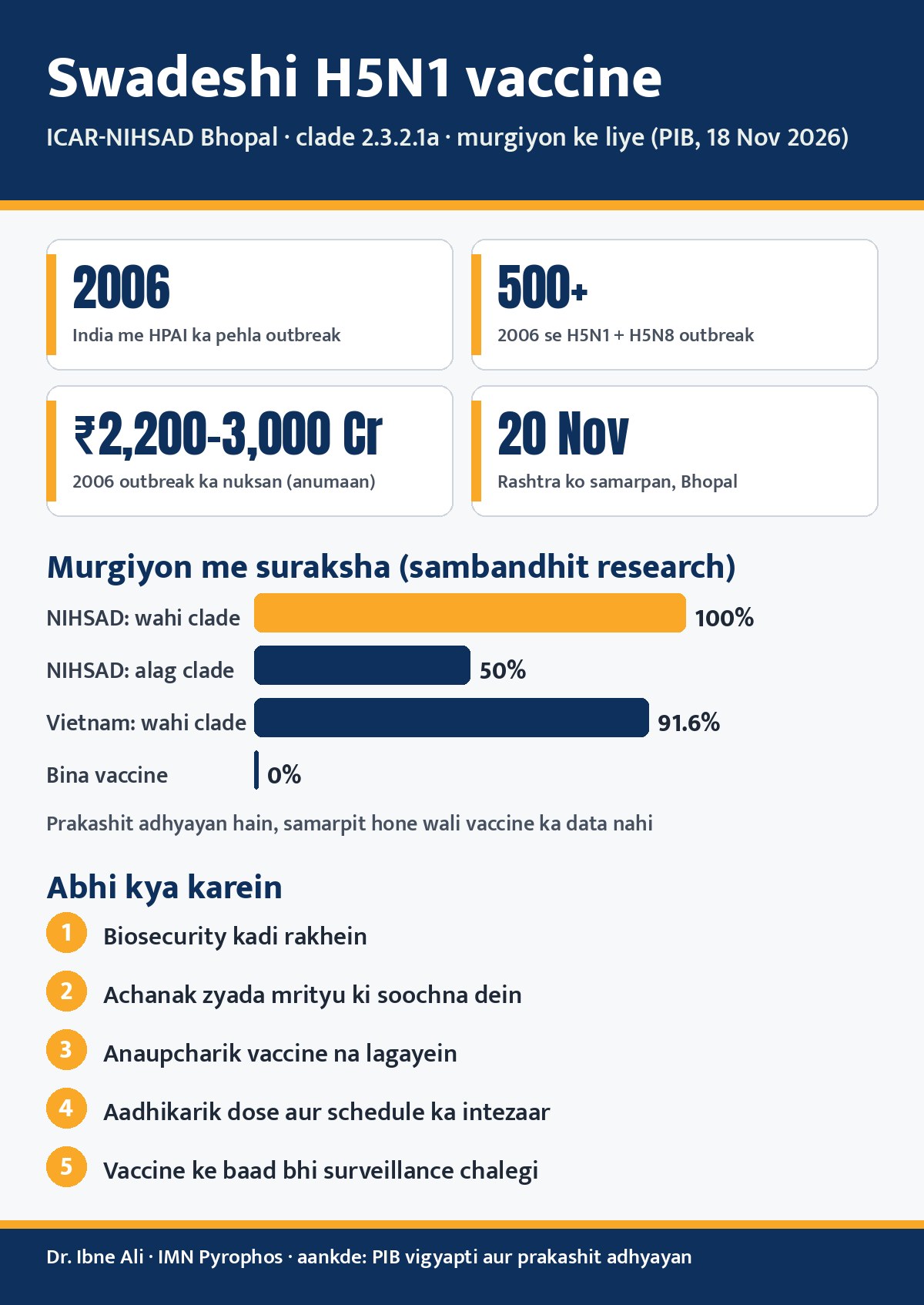
18 November 2026 ki PIB (Press Information Bureau) vigyapti ke anusaar ICAR-NIHSAD (National Institute of High Security Animal Diseases), Bhopal ne murgiyon ke liye clade 2.3.2.1a ke viruddh inactivated H5N1 vaccine viksit ki hai. Vigyapti ise is clade ke viruddh India me apni tarah ki pehli vaccine batati hai aur kehti hai ki clade 2.3.2.1a ke liye filhaal koi vishisht commercial vaccine uplabdh nahi hai. Ye vaccine India me ghoom rahe 2.3.2.1a strain se suraksha ke liye banayi gayi hai.
Ye kyon mayne rakhta hai: India me bird flu ki aarthik keemat
Highly pathogenic avian influenza (HPAI) flock ke lagbhag 100% sankramit pakshiyon ki jaan le sakta hai. PIB vigyapti ke aankde paimana batate hain:
- India me HPAI pehli baar 2006 me mila. Tab se H5N1 aur H5N8 ke kul 500 se zyada outbreak darj ho chuke hain.
- 2006 ke outbreak se pratyaksh aur apratyaksh nuksan ka anumaan ₹2,200-3,000 crore raha.
- Manipur ke ek outbreak se us rajya ki GDP ka lagbhag 0.5% nuksan hua.
- Bada bekaaboo outbreak India ki GDP vriddhi ko 1.5% tak ghata sakta hai, aur 20% se zyada poultry aabadi jokhim me aa sakti hai.
Ye rashtriya aankde hain. Farm par nuksan seedha hai: HPAI ki pushti hote hi prabhavit zone ke pakshi culling me jaate hain, aawajahi aur bikri ruk jaati hai, aur swasth pakshi hone par bhi ghabrahat se ande aur chicken ke bhaav gir jaate hain. Lagaye gaye chooze, daana, dawaiyan aur mahino ki mehnat doobti hai, aur muavze se sab poora nahi hota. Tulna ke liye, Vietnam ke ek adhyayan ke anusaar wahan 2003 se 2019 ke beech 3,000 se zyada outbreak me lagbhag 5 crore poultry nasht hui, aur har saal GDP ka 0.5-1.8% nuksan hua.
Bimari: etiology
HPAI ka karan Orthomyxoviridae parivar ka influenza A virus hai. Iska genome RNA ke aath segment ka hai, isliye ek hi pakshi me do virus aapas me segment badal sakte hain (reassortment). Virus ka naam do satahi protein se tay hota hai: H (hemagglutinin, jo host cell se chipakta hai aur suraksha dene wali antibody ka mukhya nishana hai) aur N (neuraminidase). HPAI virus zyadatar H5 aur H7 type ke hote hain aur WOAH ko notifiable hain.
Virus ko “highly pathogenic” banane wali cheez mukhya roop se HA protein me hai: multi-basic cleavage site, jisse virus kai angon me milne wale enzyme se active ho jaata hai aur poore sharir me failta hai, sirf shwasan tantra me nahi. Isiliye vaccine banane wale aksar seed virus se ye site hata dete hain (Vietnami team ne yahi kiya).
H5N1 1997 (Hong Kong) se poultry me fail raha hai. H5 virus kai clade (0 se 9) me bant chuke hain. Dakshin Asia me clade 2 haavi hai. Clade 2.2 lagbhag 2010 tak haavi tha, phir 2.3.2.1 ne uski jagah li, jo aage 2.3.2.1a, 2.3.2.1b aur 2.3.2.1c me banta. India me lagbhag 2011 se poultry me 2.3.2.1a hi pramukh H5N1 clade raha hai, isiliye nayi vaccine isi ko nishana banati hai.
India me epidemiology aur bimari ka pattern
- Host: murgiyan bahut samvedansheel hain. Batakh aur doosre jalpakshi bina ya bahut kam lakshan ke virus dho sakte hain, isliye sankraman andekha reh sakta hai (Bhutan ka adhyayan badi batakh aabadi aur sambhavit kam reporting ki taraf ishara karta hai). PIB vigyapti ke anusaar clade 2.3.2.1a sankraman stanadhariyon samet doosre janwaron me aur teen manav maamlon me bhi mila hai.
- Phailav: jangli aur pravasi pakshi, live-bird market, poultry ki avaidh ya aniyantrit aawajahi, aur doosit upkaran, gaadiyan aur log. Padosi Bhutan me 2012 ke outbreak ka mukhya karan poultry ki avaidh aawajahi thi.
- Mausam: India me zyadatar report thande mahino me aati hain, jab pravasi pakshi aate hain aur virus vatavaran me zyada der tikta hai. Ye India me report hua saamanya pattern hai; maujooda alert ke liye apne rajya ke pashupalan vibhag se jaanchein.
- Murgiyon me lakshan: achanak zyada mrityu, susti, daana-paani kam hona, sir aur chehre par sujan, kalgi aur galkambal neele padna, pairon par raktasrav, shwasan lakshan, aur layer me anda utpadan me tez giravat. ICAR-NIHSAD ke challenge adhyayan me bina vaccine wali murgiyan 2.3.2.1a virus se 60 ghante ke bheetar mar gayin.
Varshon me prabhavit rajya. India ka pehla outbreak 2006 me (Maharashtra aur Gujarat) hua. Baad me West Bengal aur purvottar rajyon (Assam, Tripura, Manipur aadi) me, aur haal ke varshon me Andhra Pradesh, Maharashtra, Kerala, Jharkhand aur Haryana samet kai rajyon me outbreak report hue, aur manav maamle Haryana (2021) aur Andhra Pradesh (2025) me report hue. Ise aage istemal karne se pehle Pashupalan evam Dairy Vibhag ki taaza rajyawar soochi dekh lein.
Jaanne layak ek reassortant genotype. Bhutan ke ek adhyayan (Emerging Infectious Diseases, 2016) me paya gaya ki wahan 2012 ke outbreak H9-jaise PB1 gene wale 2.3.2.1a virus se hue the. Ye genotype Bangladesh, India aur Nepal me bhi report hua hai. Lab me ye apne parent genotype se tez badha aur sampark wali murgiyon me zyada kushalta se faila; ferret me isne naak me sankraman kiya aur ek janwar me halki brain sujan ki, par sampark wale ferret me nahi faila. Isiliye genomic surveillance zaroori hai.
Ab tak virology ki samasya kya rahi
- Virus badalta rehta hai. Clade ek-doosre ki jagah lete hain (2.2 se 2.3.2.1 aur uske subclade). Galat clade se bani vaccine kam suraksha deti hai. Vietnam ko ye tab samajh aaya jab clade 0 aur 2.3.4 ke liye bani aayatit vaccine sthaniya 2.3.2.1 virus par nakaam raheen.
- Chhote farq bhi mayne rakhte hain. Clade 2.3.2.1a aur 2.3.2.1c ke HA1 kshetra me sirf 8 amino acid ka farq hai, phir bhi ICAR-NIHSAD ki apni research me 2.3.2.1a se match ki gayi recombinant vaccine ne 2.3.2.1a ke viruddh 100% murgiyon ko bachaya, par 2.3.2.1c ke viruddh sirf 50%.
- 2.3.2.1a ke liye match wali vaccine nahi thi. PIB vigyapti ke anusaar is clade ke liye koi vishisht commercial vaccine nahi hai. Vaccine na hone par ekmatra aujaar stamping out raha: culling, niptaan, keetanushodhan aur aawajahi par rok. Ye tabhi kaam karta hai jab tez aur poora ho, aur iski keemat kisan chukate hain.
- Aayatit seed strain par nirbharta. Kai desh aayatit candidate virus par nirbhar rehte hain. Desh me bana aur jaldi update hone wala platform hi lamba hal hai (Vietnam ne dikhaya ki reverse genetics se seed 10-12 hafte me ban sakta hai).
- Chupchaap phailav. Batakh aur aanshik roop se surakshit pakshi bimar dikhe bina virus dho aur baha sakte hain, isliye vaccine ke saath bhi surveillance chalti rehni chahiye.
Technical jaankari: vaccine ke baare me ab tak kya pata hai, kram se
- Type: inactivated (maara hua) H5N1 vaccine. Inactivated vaccine bimari nahi kar sakti aur injection se di jaati hai, aam taur par oil adjuvant ke saath taaki asar badhe.
- Nishana: clade 2.3.2.1a H5N1 HPAI, jo Bharatiya poultry me ghoom raha clade hai. Prajati: murgiyan.
- Developer: ICAR-NIHSAD, Bhopal, desh ka high-biosecurity pashu rog sansthan.
- Aisi vaccine kaise kaam karti hain: ye pakshi ko HA ke viruddh antibody banana sikhati hain. Suraksha ko hemagglutination-inhibition (HI) antibody titre se naapa jaata hai (4 log2 ya zyada aam taur par positive maana jaata hai) aur live-virus challenge me asli suraksha se. Dono zaroori hain, kyonki doosre clade ke viruddh oonche antibody bhi shedding nahi rok paate.
Abhi bataya nahi gaya: sateek utpadan platform, seed strain, dose, schedule (kitni dose, kis umra me), immunity kitne samay chalegi, sankramit aur vaccinated pakshi alag pehchane ja sakenge ya nahi (DIVA), keemat aur farm tak kab milegi.
Hum kya umeed rakh sakte hain? Sambandhit research se saboot
| Adhyayan | Vaccine ka prakaar | Murgiyon me nateeja |
|---|---|---|
| ICAR-NIHSAD / IVRI (preprint, SSRN) | Clade 2.3.2.1a ka recombinant H5HA1 protein (E. coli me bana), oil adjuvant, do booster | Clade 2.3.2.1a par 100% survival, clade 2.3.2.1c par 50%. Doosre booster ke baad 154 din tak HI titre 4 log2 ya zyada raha. 4 guna dose par bhi surakshit. Bina vaccine wali sabhi control murgiyan 60 ghante me mar gayin. |
| Vietnam (Hoang et al., Vaccines 2020) | Inactivated reverse-genetics vaccine, clade 2.3.2.1c strain ke HA aur NA, ek dose | Usi clade par 91.6% suraksha; clade 1.1 strain par 83.3%; bina vaccine wali sabhi murgiyan mar gayin. |
Isse kya samajh aata hai: (1) vaccine ko ghoom rahe clade se match karna oonchi suraksha ki kunji hai; (2) achhi vaccine mautein aur virus shedding ghatati hai, par hamesha shedding poori tarah nahi rokti, khaaskar doosre clade par; (3) vaccination ke baad ki suraksha ke liye sahi dose, booster aur timing chahiye, isliye schedule ki jaankari mayne rakhti hai.
Kisan aur vets ke liye samajhdari bhari baat: clade-matched inactivated vaccine nuksan ghatane ka mazboot naya aujaar hai, par ye biosecurity aur surveillance ki madad karti hai, unki jagah nahi leti.
Kisan aur vets abhi kya karein
- Biosecurity dheeli na karein. Visitor, gaadiyan aur istemal hue crate shed se door rakhein, jangli pakshi aur batakh shed aur daane se door rakhein, batch ke beech safai aur keetanushodhan karein.
- Achanak zyada mrityu ki soochna sthaniya pashu chikitsa adhikari ko dein. Jaldi report karne se hi nuksan seemit hota hai.
- Anaupcharik “bird flu vaccine” na khareedein, na lagayein. Aadhikarik adhisoochna ka intezaar karein ki kaun, kin flock me, kis dose aur schedule se istemal karega.
- Yojana banayein, par ghabrahat me khareedari na karein. India me poultry ka ab tak ka tareeka culling par tika raha hai. Nayi vaccine farm par kaise istemal hogi, ye adhikari tay karenge.
- ICAR-NIHSAD aur Pashupalan evam Dairy Vibhag ki aadhikarik ghoshnaon par nazar rakhein.
Hamari raay
Ye hissa hamari raay hai, report kiya gaya tathya nahi. Hum IMN me lambe samay se desh me bani vaccine ki baat karte rahe hain, kyonki itni badi poultry wala desh sirf culling par nirbhar nahi reh sakta. Hamari umeed hai ki vaccine vyapak roop se uplabdh ho, uska field data khule taur par prakashit ho, vaccinated flock ki surveillance jaari rahe, aur virus badalne par platform jaldi update ho sake. Backyard aur batakh flock, breeder aur layer shuru se yojana me shamil hon.
Aksar poochhe jaane wale sawaal
Kya India me murgiyon ke liye bird flu ki vaccine hai?
18 November 2026 ki PIB vigyapti ke anusaar ICAR-NIHSAD dwara viksit clade 2.3.2.1a ki vaccine 20 November 2026 ko rashtra ko samarpit ki jaani hai. Vigyapti kehti hai ki is clade ke liye pehle koi vishisht commercial vaccine nahi thi.
Ye kis strain se bachati hai?
H5N1 clade 2.3.2.1a, jo lagbhag 2011 se Bharatiya poultry me zyadatar mila hai.
Ye live hai ya maari hui vaccine?
PIB vigyapti ke anusaar inactivated (maari hui).
Keemat aur dose kya hai?
Abhi ghoshit nahi hui. Aadhikarik jaankari aate hi hum ye page update karenge.
Kya chicken ya ande khane se bird flu fail sakta hai?
Theek se paka hua chicken aur anda raasta nahi maana jaata. Manav maamle zyadatar bimar pakshiyon ke nazdeeki sampark ke baad hue hain, aur haal ka ek Bharatiya maamla kachche chicken se juda bataya gaya. Chicken aur ande hamesha achhi tarah pakakar khayein.
Srot
- Press Information Bureau, Krishi evam Kisan Kalyan Mantralaya, 18 November 2026 ki vigyapti (PRID 2337716).
- Boruah JLH et al., Immunogenicity and cross-protective efficacy of recombinant H5HA1 protein of clade 2.3.2.1a H5N1 virus expressed in E. coli (ICAR-NIHSAD / ICAR-IVRI), SSRN preprint 4049573.
- Marinova-Petkova A et al., Highly pathogenic reassortant avian influenza A(H5N1) virus clade 2.3.2.1a in poultry, Bhutan. Emerging Infectious Diseases 2016;22(12).
- Hoang HTT et al., Immunization with the H5N1 recombinant vaccine candidate induces high protection in chickens against Vietnamese HPAI virus strains. Vaccines 2020;8:159.
Dr. Ibne Ali, IMN Pyrophos dwara. Ye jaankari jaagrukta ke liye hai aur aapke pashu chikitsak ya rajya ke pashupalan vibhag ki salaah ka vikalp nahi hai.