
A rattling, gurgling or “sound” in the flock at night is one of the most common winter complaints on poultry farms. In India it is usually called CRD (chronic respiratory disease), and it rarely has one cause. Cold air, closed sheds, wet litter, dust and ammonia irritate the airway first, and germs such as Mycoplasma and E. coli then take over. This guide explains why winter brings it on, what to fix in the shed, and where Respoze, a herbal respiratory tonic from IMN Pyrophos, fits in as a CRD solution for poultry. If you are searching for a CRD solution for poultry, read the section on what the shed must do before any tonic.
What is CRD and why does it rise in winter?
CRD is a long-running respiratory problem in chickens. Birds show rales (a wet, rattling breath), sneezing, nasal discharge, watery eyes, a swollen face or a gaping beak, and they eat less. The germs most often involved are Mycoplasma and E. coli, and viruses such as IB and ND can start the trouble. Our guide on infectious bronchitis in poultry explains the viral side.
Winter pushes farmers to close curtains to keep chicks warm. Inside a sealed shed, three things build up:
- Ammonia from wet, caked litter burns the lining of the windpipe and lungs.
- Humidity and dust from litter, feed and feathers stay in the air.
- Stale air with too little exchange, so irritants stay at bird height.
The IMN label says respiratory sound in poultry is caused by dust, humidity, ammonia, endotoxins and germs in the air, which make the airway produce thick mucus that narrows the passage. That is why the shed, not the bottle, is the first thing to correct.
What the shed must do first
- Keep litter dry. Turn and replace wet patches near drinkers. Our guide on wet litter in broilers in winter shows how.
- Control ammonia. If you can smell ammonia when you walk in, the birds are already suffering. Ammobond is a litter treatment that binds ammonia. It is for litter only, never for feeding, and the full method is in our ammonia binder guide.
- Give minimum ventilation. Keep some fresh air moving even on the coldest night, without a direct draught on the chicks. The winter broiler management guide covers this.
- Cut dust. Avoid very fine feed powder and dusty litter.
- Keep vaccination on time for IB and ND, and keep biosecurity tight.
What is Respoze?
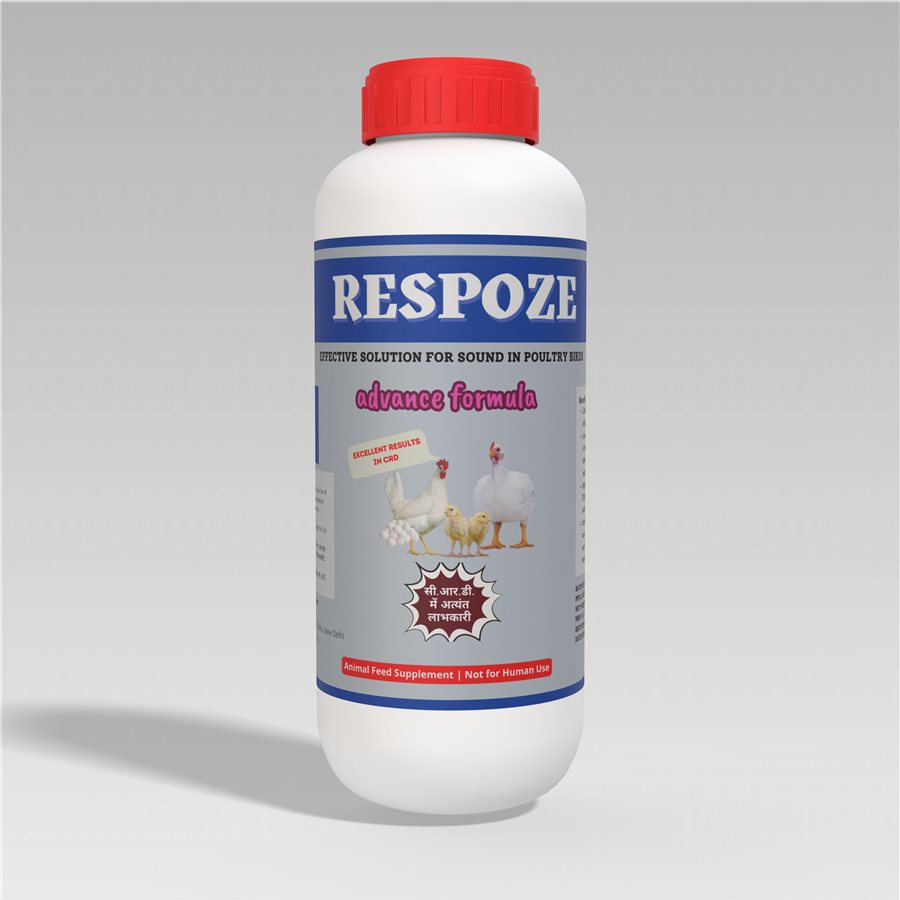
Respoze is a herbal respiratory tonic for poultry. The pack calls it a “herbal sounds tonic”, an effective solution for sound in poultry birds, with excellent results in CRD. According to our product listing it contains ginger, tulsi, thyme and garlic extracts and camphor. It is a supplement, not an antibiotic and not a vaccine.
How Respoze helps in CRD (listing claims)
| What the product listing says | What it means in the shed |
|---|---|
| Reduces respiratory sound problem in birds | Less rattling and gurgling at night |
| Widens the respiratory passage (bronchodilation) | Easier breathing, less gasping |
| Thins phlegm | Thick mucus moves out of the airway more easily |
| Helps antibiotics reach respiratory germs better | Your vet’s antibiotic has a better chance to work |
| Helps expel irritants and germs trapped in mucus | Clears what dust and ammonia leave behind |
Respoze supports the airway while the real causes are corrected. It does not replace a post-mortem, a vet’s treatment or good ventilation.
Respoze dose
The pack photo we have does not print a dose, so we are not going to guess one here. The dose depends on the age, body weight, the water used and how severe the sound is. Send the age, number of birds, average weight and how many days the sound has been present on WhatsApp +91 98715 84101, and Dr. Ibne Ali’s team will tell you the dose for your flock.
Herbal respiratory tonic
Respoze
Herbal sounds tonic for poultry with ginger, tulsi, thyme and garlic extracts and camphor. Helps reduce respiratory sound, widens the respiratory passage and thins phlegm, so that antibiotics reach respiratory germs better. Pack label: excellent results in CRD.
Dose: ask on WhatsApp with your flock’s age, number and weight.
500 ml ₹610MRP ₹820 1 L ₹920MRP ₹1,760
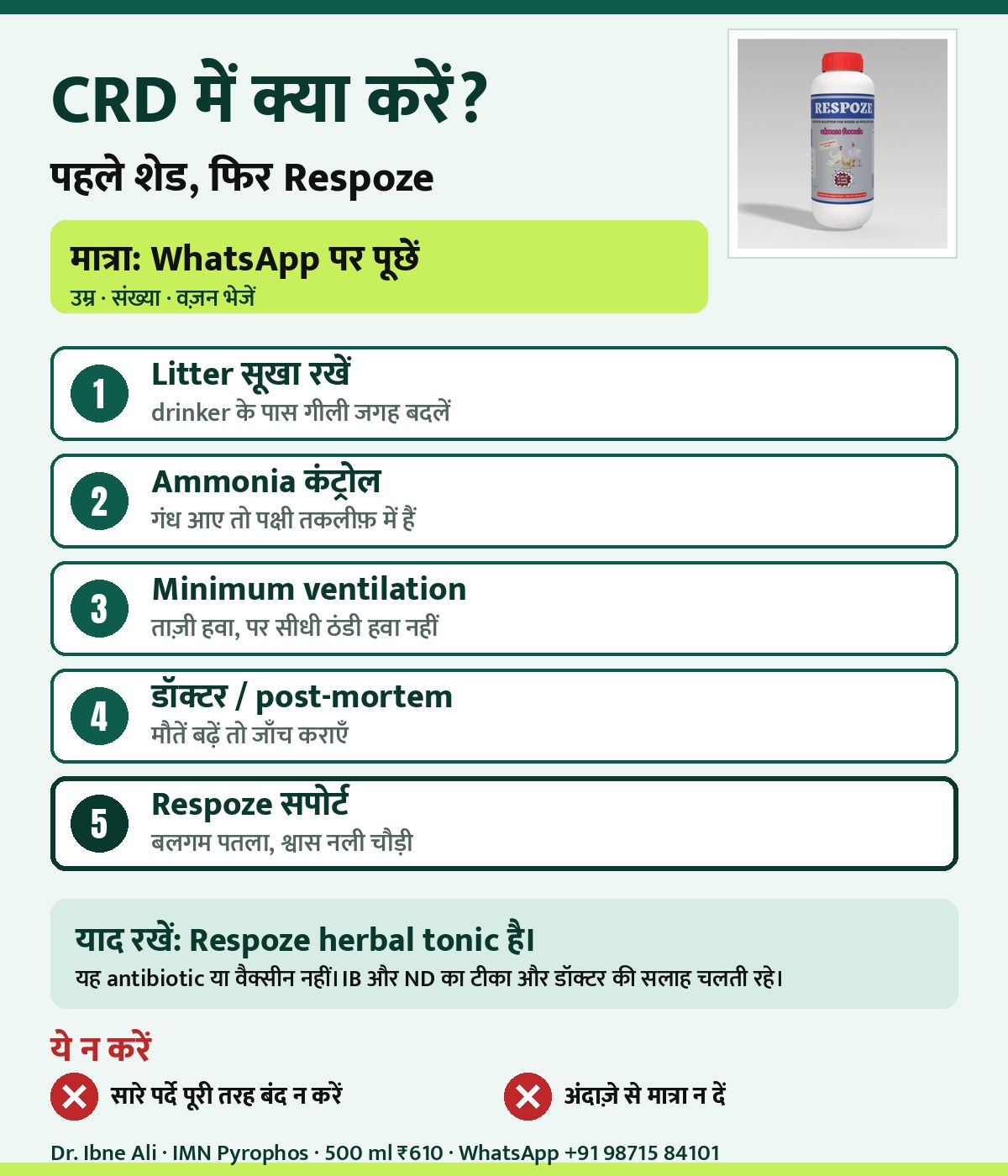
A simple CRD plan for a winter flock
- Walk the shed at night. Stand quietly for two minutes and listen. Rattling, sneezing or gurgling means the airway is irritated.
- Check the litter and the smell. Fix wet spots and treat ammonia first.
- Open minimum ventilation and remove draughts at chick height.
- Get a post-mortem if deaths are rising. Look for air-sac and pericardial lesions. Your vet decides whether an antibiotic is needed and the withdrawal period.
- Start respiratory support with Respoze in drinking water at the dose given by our team or your vet.
- Support immunity with Nexamune, whose label says it reduces the severity of CRD and other respiratory diseases and helps in vaccinations.
- Record daily sound level, feed intake and deaths, so you can see whether it is improving.
What not to do
- Do not treat CRD with a tonic alone while the shed still smells of ammonia.
- Do not close every curtain completely at night.
- Do not use an antibiotic without your vet’s advice, and respect the withdrawal period.
- Do not guess a dose. Ask for the dose that fits your flock.
- Do not skip IB and ND vaccination because you have a respiratory tonic.
Common mistakes
- Blaming only the germ. Most winter CRD begins with ammonia, damp litter and poor air.
- Waiting for deaths. By the time birds are gasping, treatment is harder. Act when the first sound appears.
- Mixing everything in one drinker. Plan products with your vet so that they do not clash. Our winter broiler medicine schedule shows how a plan is spaced.
- No records. Without a daily note it is hard to judge if the flock is improving.
Frequently asked questions
What is the best CRD solution for poultry? There is no single bottle. The best solution is a dry, low-ammonia, well-ventilated shed, on-time vaccination, a vet’s treatment when germs are involved, and a respiratory supportive like Respoze.
What is Respoze used for? It is a herbal respiratory tonic used when birds show respiratory sound, as in CRD. It helps thin phlegm and widen the respiratory passage.
What does Respoze contain? Ginger, tulsi, thyme and garlic extracts and camphor.
What is the Respoze dose? The dose is not printed on the pack photo we have. Send the age, number and weight of birds on WhatsApp and our team will give you the dose.
What is the price of Respoze? 500 ml is ₹610 (MRP ₹820) and 1 L is ₹920 (MRP ₹1,760). Prices may change, so confirm on WhatsApp.
Is Respoze an antibiotic? No. It is a herbal supplement. If bacteria are involved, your vet decides about antibiotics.
Why does CRD come back every winter? Because the same causes return: cold, closed sheds, damp litter and ammonia. Correct these and the flock stays quieter.
Where can I see all IMN products? The IMN product guide lists each product by problem and stage.
Also read: Respoze · Infectious bronchitis in poultry · Winter broiler brooding guide · Poultry viral diseases support · IMN product guide
पोल्ट्री में CRD का समाधान: सर्दी में खर्र-खर्र की आवाज़ और Respoze
रात में फ़्लॉक से खर्र-खर्र, गुड़गुड़ या “आवाज़” आना सर्दी में पोल्ट्री फ़ार्म की सबसे आम शिकायतों में से एक है। भारत में इसे आमतौर पर CRD (chronic respiratory disease) कहते हैं और इसका कारण शायद ही कभी एक होता है। ठंडी हवा, बंद शेड, गीला litter, धूल और ammonia पहले श्वास नली को परेशान करते हैं और फिर Mycoplasma और E. coli जैसे germs हावी हो जाते हैं। इस गाइड में बताया है कि सर्दी में यह क्यों बढ़ता है, शेड में पहले क्या ठीक करें और IMN Pyrophos का herbal respiratory tonic Respoze पोल्ट्री के CRD solution के तौर पर कहाँ फ़िट बैठता है। अगर आप CRD solution for poultry खोज रहे हैं तो टॉनिक से पहले “शेड को पहले क्या करना है” वाला हिस्सा पढ़ें।
CRD क्या है और सर्दी में क्यों बढ़ता है?
CRD मुर्गियों में लंबे समय तक चलने वाली साँस की बीमारी है। पक्षियों में rales (गीली, खड़खड़ाती साँस), छींक, नाक से पानी, आँखों से पानी, चेहरे की सूजन या चोंच खोलकर साँस लेना दिखता है, और वे दाना कम खाते हैं। इसमें अक्सर Mycoplasma और E. coli शामिल होते हैं, और IB व ND जैसे वायरस शुरुआत करा सकते हैं। वायरल पक्ष के लिए हमारी गाइड पोल्ट्री में infectious bronchitis पढ़ें।
सर्दी में चूज़ों को गर्म रखने के लिए पर्दे बंद कर दिए जाते हैं। बंद शेड के अंदर तीन चीज़ें जमा होती हैं:
- Ammonia: गीले, जमे litter से बनकर श्वास नली और फेफड़ों की परत को जलाती है।
- नमी और धूल: litter, दाने और पंखों से हवा में रहती है।
- बासी हवा: हवा का आदान-प्रदान कम होने से irritants पक्षियों की ऊँचाई पर टिके रहते हैं।
IMN के label के अनुसार पोल्ट्री में साँस की आवाज़ हवा की धूल, नमी, ammonia, endotoxins और germs से होती है, जिनसे श्वास नली में गाढ़ा बलगम बनता है और रास्ता तंग हो जाता है। इसीलिए सबसे पहले बोतल नहीं, शेड ठीक करें।
शेड को पहले क्या करना है
- Litter सूखा रखें। drinker के पास गीली जगह पलटें या बदलें। तरीका हमारी गाइड सर्दी में broiler का गीला litter में है।
- Ammonia कंट्रोल करें। अंदर जाते ही ammonia की गंध आए तो पक्षी पहले से तकलीफ में हैं। Ammobond litter का ट्रीटमेंट है जो ammonia को बाँधता है। यह सिर्फ़ litter के लिए है, खिलाने के लिए नहीं, पूरा तरीका हमारी ammonia binder गाइड में है।
- Minimum ventilation दें। सबसे ठंडी रात में भी थोड़ी ताज़ी हवा चलने दें, पर चूज़ों पर सीधी हवा न लगे। सर्दी में broiler management गाइड में यह है।
- धूल घटाएँ। बहुत बारीक दाना पाउडर और धूल भरा litter न रखें।
- IB और ND का टीका समय पर लगवाएँ और biosecurity सख़्त रखें।
Respoze क्या है?
Respoze पोल्ट्री के लिए herbal respiratory tonic है। पैक पर इसे “herbal sounds tonic”, पोल्ट्री पक्षियों में आवाज़ का असरदार समाधान और CRD में बेहतरीन नतीजे देने वाला बताया गया है। हमारी प्रोडक्ट लिस्टिंग के अनुसार इसमें अदरक, तुलसी, thyme और लहसुन के extracts और कपूर हैं। यह supplement है, antibiotic या वैक्सीन नहीं।
CRD में Respoze कैसे मदद करता है (लिस्टिंग के दावे)
| प्रोडक्ट लिस्टिंग क्या कहती है | शेड में इसका मतलब |
|---|---|
| पक्षियों में साँस की आवाज़ की समस्या घटाता है | रात में खर्र-खर्र और गुड़गुड़ कम |
| श्वास नली चौड़ी करता है (bronchodilation) | साँस आसान, हाँफना कम |
| बलगम पतला करता है | गाढ़ा mucus आसानी से बाहर निकलता है |
| antibiotic को साँस के germs तक बेहतर पहुँचने में मदद | डॉक्टर की antibiotic को असर करने का बेहतर मौका |
| mucus में फँसे irritants और germs निकालने में मदद | धूल और ammonia का पीछे छोड़ा हुआ साफ़ होता है |
Respoze असली कारण ठीक होने तक श्वास नली को सहारा देता है। यह post-mortem, डॉक्टर के इलाज और अच्छी ventilation की जगह नहीं लेता।
Respoze की मात्रा (dose)
हमारे पास जो पैक फ़ोटो है उस पर dose छपा नहीं है, इसलिए यहाँ अंदाज़े से कोई मात्रा नहीं लिख रहे। मात्रा उम्र, वज़न, इस्तेमाल हुए पानी और आवाज़ कितनी गंभीर है, इस पर निर्भर करती है। उम्र, पक्षियों की संख्या, औसत वज़न और आवाज़ कितने दिन से है, यह WhatsApp +91 98715 84101 पर भेजें, डॉ. इब्ने अली की टीम आपके फ़्लॉक की मात्रा बताएगी।
हर्बल respiratory टॉनिक · CRD
Respoze
अदरक, तुलसी, thyme और लहसुन के extracts और कपूर वाला हर्बल साउंड टॉनिक। साँस की आवाज़ की समस्या घटाता है, श्वास नली चौड़ी करता है और बलगम पतला करता है, ताकि antibiotic साँस के germs तक बेहतर पहुँचे। पैक पर: CRD में बेहतरीन नतीजे।
मात्रा: मात्रा पैक फ़ोटो पर नहीं छपी है। उम्र, पक्षियों की संख्या और वज़न WhatsApp पर भेजें, हमारी टीम बताएगी।
500 ml ₹610 · 1 L ₹920MRP ₹820 / ₹1,760
सर्दी के फ़्लॉक के लिए आसान CRD प्लान
- रात में शेड में चक्कर लगाएँ। दो मिनट चुपचाप खड़े होकर सुनें। खर्र-खर्र, छींक या गुड़गुड़ का मतलब है श्वास नली परेशान है।
- Litter और गंध देखें। गीली जगहें ठीक करें और पहले ammonia का इलाज करें।
- Minimum ventilation खोलें और चूज़ों की ऊँचाई पर आती सीधी हवा रोकें।
- मौतें बढ़ें तो post-mortem कराएँ। air-sac और pericardium के घाव देखें। antibiotic की ज़रूरत और withdrawal period डॉक्टर तय करें।
- Respiratory सपोर्ट शुरू करें: हमारी टीम या डॉक्टर की बताई मात्रा में पीने के पानी में Respoze दें।
- Immunity को सहारा दें: Nexamune, जिसके label में लिखा है कि यह CRD और साँस की दूसरी बीमारियों की गंभीरता घटाता है और टीकों में मदद करता है।
- रिकॉर्ड रखें: रोज़ की आवाज़, दाने की खपत और मौतें लिखें, ताकि पता चले सुधार हो रहा है या नहीं।
क्या न करें
- शेड में ammonia की गंध रहते सिर्फ़ टॉनिक से CRD का इलाज न करें।
- रात में सारे पर्दे पूरी तरह बंद न करें।
- डॉक्टर की सलाह के बिना antibiotic न दें और withdrawal period मानें।
- अंदाज़े से मात्रा न दें। अपने फ़्लॉक के हिसाब की मात्रा पूछें।
- साँस का टॉनिक है, इसलिए IB और ND का टीका न छोड़ें।
आम गलतियाँ
- सिर्फ़ germ को दोष देना। सर्दी का ज़्यादातर CRD ammonia, गीले litter और खराब हवा से शुरू होता है।
- मौतों का इंतज़ार। जब पक्षी हाँफने लगें तब इलाज मुश्किल होता है। पहली आवाज़ आते ही कदम उठाएँ।
- एक ही drinker में सब कुछ मिलाना। डॉक्टर के साथ प्रोडक्ट प्लान करें ताकि आपस में न टकराएँ। हमारा सर्दी का broiler medicine schedule दिखाता है कि प्लान कैसे बाँटा जाता है।
- रिकॉर्ड नहीं रखना। रोज़ के नोट के बिना सुधार का अंदाज़ा लगाना मुश्किल है।
अक्सर पूछे जाने वाले सवाल
पोल्ट्री में CRD का सबसे अच्छा समाधान क्या है? कोई एक बोतल नहीं है। सबसे अच्छा समाधान है सूखा, कम ammonia वाला, हवादार शेड, समय पर टीका, germs होने पर डॉक्टर का इलाज और Respoze जैसा respiratory सपोर्ट।
Respoze किसलिए इस्तेमाल होता है? यह herbal respiratory tonic है जो पक्षियों में साँस की आवाज़ (जैसे CRD में) होने पर दिया जाता है। यह बलगम पतला करने और श्वास नली चौड़ी करने में मदद करता है।
Respoze में क्या है? अदरक, तुलसी, thyme और लहसुन के extracts और कपूर।
Respoze की मात्रा क्या है? हमारे पास की पैक फ़ोटो पर मात्रा नहीं छपी है। उम्र, संख्या और वज़न WhatsApp पर भेजें, हमारी टीम मात्रा बताएगी।
Respoze की कीमत क्या है? 500 ml ₹610 (MRP ₹820) और 1 L ₹920 (MRP ₹1,760)। कीमत बदल सकती है, WhatsApp पर पक्का करें।
क्या Respoze antibiotic है? नहीं, यह herbal supplement है। अगर bacteria शामिल हों तो antibiotic का फ़ैसला डॉक्टर करते हैं।
CRD हर सर्दी में लौट क्यों आता है? क्योंकि वही कारण लौटते हैं: ठंड, बंद शेड, गीला litter और ammonia। इन्हें ठीक करें तो फ़्लॉक शांत रहता है।
सारे IMN प्रोडक्ट कहाँ देखें? IMN प्रोडक्ट गाइड में हर प्रोडक्ट समस्या और स्टेज के हिसाब से है।
यह भी पढ़ें: Respoze · पोल्ट्री में infectious bronchitis · सर्दी में broiler brooding गाइड · पोल्ट्री वायरल बीमारी में सपोर्ट · IMN प्रोडक्ट गाइड
Poultry me CRD ka solution: sardi me khar-khar ki awaaz aur Respoze
Raat me flock se khar-khar, gudgud ya “awaaz” aana sardi me poultry farm ki sabse aam shikayaton me se ek hai. Bharat me ise aam taur par CRD (chronic respiratory disease) kehte hain aur iska karan shayad hi kabhi ek hota hai. Thandi hawa, band shed, geela litter, dhool aur ammonia pehle saans ki nali ko pareshan karte hain aur phir Mycoplasma aur E. coli jaise germs haavi ho jaate hain. Is guide me bataya hai ki sardi me ye kyon badhta hai, shed me pehle kya theek karein aur IMN Pyrophos ka herbal respiratory tonic Respoze poultry ke CRD solution ke taur par kahan fit baithta hai. Agar aap CRD solution for poultry dhoondh rahe hain to tonic se pehle “shed ko pehle kya karna hai” wala hissa padhein.
CRD kya hai aur sardi me kyon badhta hai?
CRD murgiyon me lambe samay tak chalne wali saans ki beemari hai. Pakshiyon me rales (geeli, khadkhadati saans), chheenk, naak se paani, aankhon se paani, chehre ki soojan ya chonch kholkar saans lena dikhta hai, aur wo daana kam khate hain. Isme aksar Mycoplasma aur E. coli shamil hote hain, aur IB va ND jaise virus shuruaat kara sakte hain. Viral pehlu ke liye hamari guide poultry me infectious bronchitis padhein.
Sardi me choozon ko garam rakhne ke liye parde band kar diye jaate hain. Band shed ke andar teen cheezein jama hoti hain:
- Ammonia: geele, jame litter se banke saans ki nali aur phephdon ki parat ko jalati hai.
- Nami aur dhool: litter, daane aur paron se hawa me rehti hai.
- Baasi hawa: hawa ka aadan-pradan kam hone se irritants pakshiyon ki unchai par tike rehte hain.
IMN ke label ke anusaar poultry me saans ki awaaz hawa ki dhool, nami, ammonia, endotoxins aur germs se hoti hai, jinse saans ki nali me gaadha balgam banta hai aur raasta tang ho jaata hai. Isiliye sabse pehle bottle nahi, shed theek karein.
Shed ko pehle kya karna hai
- Litter sookha rakhein. Drinker ke paas geeli jagah palten ya badlein. Tareeka hamari guide sardi me broiler ka geela litter me hai.
- Ammonia control karein. Andar jaate hi ammonia ki gandh aaye to pakshi pehle se takleef me hain. Ammobond litter ka treatment hai jo ammonia ko baandhta hai. Ye sirf litter ke liye hai, khilane ke liye nahi, poora tareeka hamari ammonia binder guide me hai.
- Minimum ventilation dein. Sabse thandi raat me bhi thodi taazi hawa chalne dein, par choozon par seedhi hawa na lage. Sardi me broiler management guide me ye hai.
- Dhool ghatayein. Bahut baareek daana powder aur dhool bhara litter na rakhein.
- IB aur ND ka teeka samay par lagwayein aur biosecurity sakht rakhein.
Respoze kya hai?
Respoze poultry ke liye herbal respiratory tonic hai. Pack par ise “herbal sounds tonic”, poultry pakshiyon me awaaz ka asardaar samadhan aur CRD me behtareen nateeje dene wala bataya gaya hai. Hamari product listing ke anusaar isme adrak, tulsi, thyme aur lehsun ke extract aur kapoor hain. Ye supplement hai, antibiotic ya vaccine nahi.
CRD me Respoze kaise madad karta hai (listing ke daave)
| Product listing kya kehti hai | Shed me iska matlab |
|---|---|
| Pakshiyon me saans ki awaaz ki samasya ghatata hai | Raat me khar-khar aur gudgud kam |
| Saans ki nali chaudi karta hai (bronchodilation) | Saans aasan, hanfna kam |
| Balgam patla karta hai | Gaadha mucus aasani se bahar nikalta hai |
| Antibiotic ko saans ke germs tak behtar pahunchne me madad | Doctor ki antibiotic ko asar karne ka behtar mauka |
| Mucus me phanse irritants aur germs nikalne me madad | Dhool aur ammonia ka peeche chhoda hua saaf hota hai |
Respoze asli karan theek hone tak saans ki nali ko sahara deta hai. Ye post-mortem, doctor ke ilaaj aur achhi ventilation ki jagah nahi leta.
Respoze ki matra (dose)
Hamare paas jo pack photo hai us par dose chhapa nahi hai, isliye yahan andaze se koi matra nahi likh rahe. Matra umr, wazan, istemaal hue paani aur awaaz kitni gambhir hai, is par nirbhar karti hai. Umr, pakshiyon ki sankhya, ausat wazan aur awaaz kitne din se hai, ye WhatsApp +91 98715 84101 par bhejein, Dr. Ibne Ali ki team aapke flock ki matra batayegi.
Herbal respiratory tonic · CRD
Respoze
Adrak, tulsi, thyme aur lehsun ke extract aur kapoor wala herbal sound tonic. Saans ki awaaz ki samasya ghatata hai, saans ki nali chaudi karta hai aur balgam patla karta hai, taaki antibiotic saans ke germs tak behtar pahunche. Pack par: CRD me behtareen nateeje.
Matra: Matra pack photo par chhapi nahi hai. Umr, pakshiyon ki sankhya aur wazan WhatsApp par bhejein, hamari team batayegi.
500 ml ₹610 · 1 L ₹920MRP ₹820 / ₹1,760
Sardi ke flock ke liye aasaan CRD plan
- Raat me shed me chakkar lagayein. Do minute chupchaap khade hokar sunein. Khar-khar, chheenk ya gudgud ka matlab hai saans ki nali pareshan hai.
- Litter aur gandh dekhein. Geeli jagahein theek karein aur pehle ammonia ka ilaaj karein.
- Minimum ventilation kholein aur choozon ki unchai par aati seedhi hawa rokein.
- Maut badhein to post-mortem karayein. Air-sac aur pericardium ke ghaav dekhein. Antibiotic ki zaroorat aur withdrawal period doctor tay karein.
- Respiratory support shuru karein: Hamari team ya doctor ki batayi matra me peene ke paani me Respoze dein.
- Immunity ko sahara dein: Nexamune, jiske label me likha hai ki ye CRD aur saans ki doosri beemariyon ki gambhirta ghatata hai aur teekon me madad karta hai.
- Record rakhein: Roz ki awaaz, daane ki khapat aur maut likhein, taaki pata chale sudhaar ho raha hai ya nahi.
Kya na karein
- Shed me ammonia ki gandh rehte sirf tonic se CRD ka ilaaj na karein.
- Raat me saare parde poori tarah band na karein.
- Doctor ki salah ke bina antibiotic na dein aur withdrawal period maanein.
- Andaze se matra na dein. Apne flock ke hisaab ki matra poochhein.
- Saans ka tonic hai, isliye IB aur ND ka teeka na chhodein.
Aam galtiyan
- Sirf germ ko dosh dena. Sardi ka zyadatar CRD ammonia, geele litter aur kharab hawa se shuru hota hai.
- Maut ka intezaar. Jab pakshi hanfne lagein tab ilaaj mushkil hota hai. Pehli awaaz aate hi kadam uthayein.
- Ek hi drinker me sab kuch milana. Doctor ke saath product plan karein taaki aapas me na takrayein. Hamara sardi ka broiler medicine schedule dikhata hai ki plan kaise baanta jaata hai.
- Record na rakhna. Roz ke note ke bina sudhaar ka andaza lagana mushkil hai.
Aksar poochhe jaane wale sawal
Poultry me CRD ka sabse achha solution kya hai? Koi ek bottle nahi hai. Sabse achha solution hai sookha, kam ammonia wala, hawadaar shed, samay par teeka, germs hone par doctor ka ilaaj aur Respoze jaisa respiratory support.
Respoze kisliye istemaal hota hai? Ye herbal respiratory tonic hai jo pakshiyon me saans ki awaaz (jaise CRD me) hone par diya jaata hai. Ye balgam patla karne aur saans ki nali chaudi karne me madad karta hai.
Respoze me kya hai? Adrak, tulsi, thyme aur lehsun ke extract aur kapoor.
Respoze ki matra kya hai? Hamare paas ki pack photo par matra nahi chhapi hai. Umr, sankhya aur wazan WhatsApp par bhejein, hamari team matra batayegi.
Respoze ki keemat kya hai? 500 ml ₹610 (MRP ₹820) aur 1 L ₹920 (MRP ₹1,760). Keemat badal sakti hai, WhatsApp par pakka karein.
Kya Respoze antibiotic hai? Nahi, ye herbal supplement hai. Agar bacteria shamil hon to antibiotic ka faisla doctor karte hain.
CRD har sardi me laut kyon aata hai? Kyonki wahi karan lautte hain: thand, band shed, geela litter aur ammonia. Inhe theek karein to flock shant rehta hai.
Saare IMN product kahan dekhein? IMN product guide me har product samasya aur stage ke hisaab se hai.
Ye bhi padhein: Respoze · Poultry me infectious bronchitis · Sardi me broiler brooding guide · Poultry viral beemari me support · IMN product guide