A farmer opens the shed in the morning and sees wet, watery or brown droppings stuck to the vent feathers. The birds are eating, but the weight is not coming and the FCR is slipping. In most such batches the problem starts in the gut. Here is how to recognise a gut problem, what a probiotic for poultry actually does, how much to use at each stage, and what to fix before you spend on any product.
Signs that the gut is not working well
- Loose or watery droppings, often with undigested feed in them. The litter turns wet quickly (see wet litter and loose droppings in winter).
- Brown or coffee-coloured droppings. The droppings colour guide explains what each colour points to.
- Poor FCR and uneven weight: the same feed gives less weight because the gut is not absorbing it well.
- Weak chicks in the first week: poor navel healing and early losses.
When the balance of gut bacteria is upset (dysbiosis), harmful bacteria such as E. coli get the upper hand. The gut wall is damaged and feed passes through half digested. For the background, read poultry gut health and dysbiosis.
Fix these first, then add a probiotic
A probiotic supports the gut. It does not replace good management. Before anything else, check:
- Litter and drinkers: leaking nipples and caked litter keep the gut and the shed wet.
- Water quality and cleaning: dirty lines carry bacteria straight into the gut.
- Sudden feed changes: change the feed slowly, not overnight.
- Blood in droppings, high mortality or a sudden fall in feed intake: this needs a veterinarian and a proper diagnosis, not just a supplement.
What does a probiotic do?
A probiotic gives live, useful bacteria such as Lactobacillus and Bifidobacterium. A prebiotic (for example MOS, FOS or beta glucan) is food for those bacteria. A product that has both is called a synbiotic. Together they help the good bacteria settle in the gut, and this leaves less room for the harmful ones.
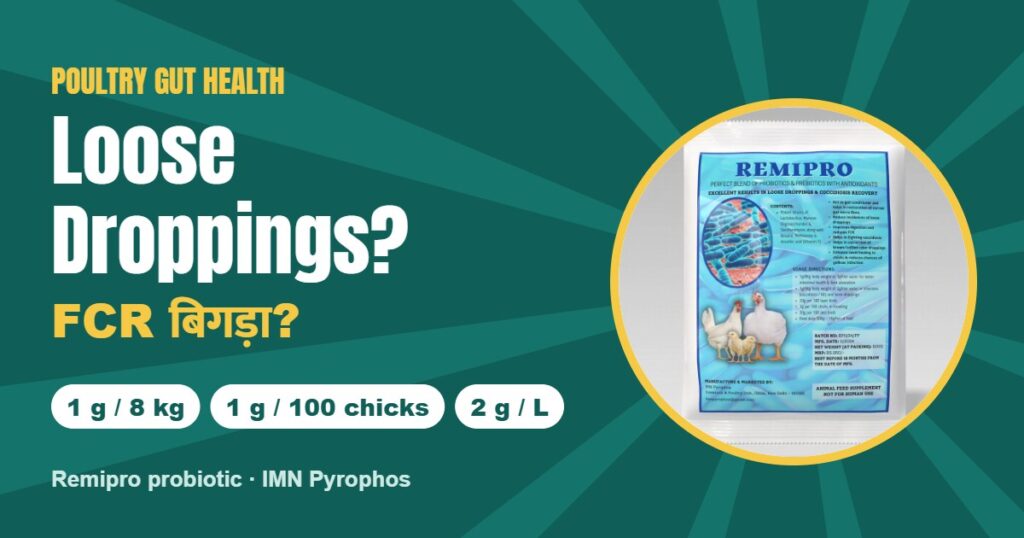
According to its label, Remipro contains Lactobacillus, Bifidobacterium and Saccharomyces, with prebiotics (beta glucan, MOS, FOS), ascorbic acid (vitamin C), osmolytes and dextrose. The label lists these benefits:
- Acts as a gut conditioner and helps restore normal gut flora.
- Reduces loose droppings.
- Improves digestion and reduces FCR.
- Helps in fighting coccidiosis and necrotic enteritis, and in recovery.
- Helps correct brown or coffee coloured droppings.
- Helps navel healing in chicks and lowers the chance of yolk sac infection.
- Helpful in prolapse cases.
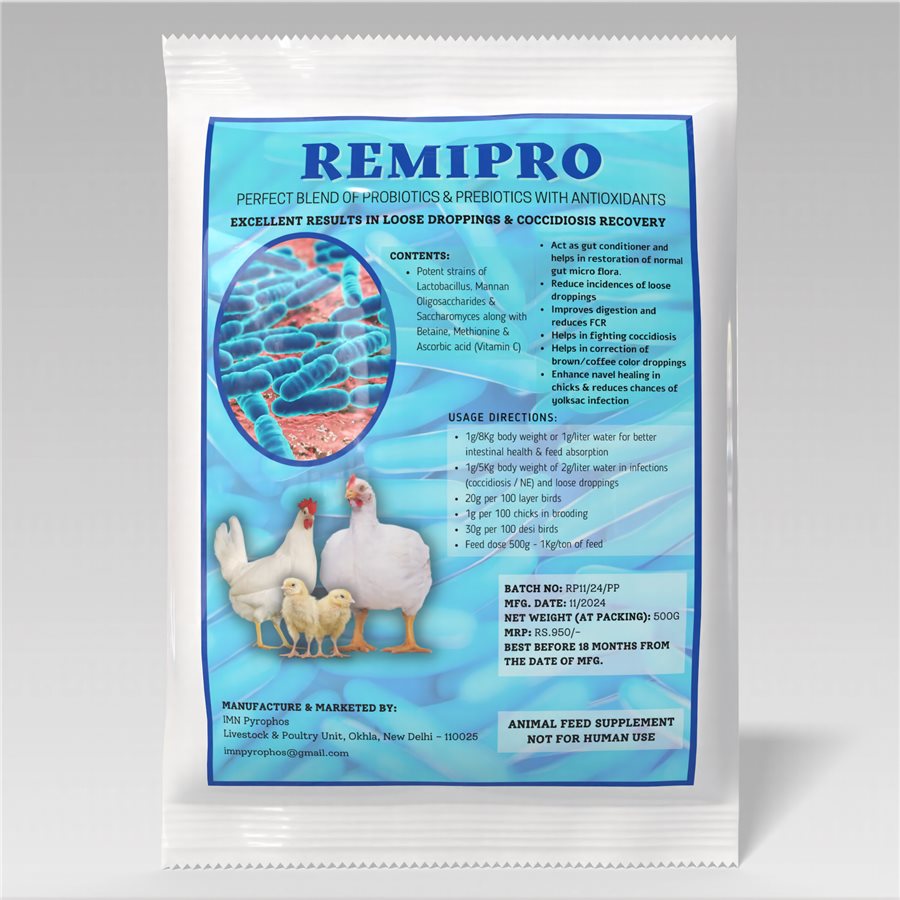
Gut health · bestseller
Remipro
Probiotics, prebiotics (MOS) and Saccharomyces, with betaine, methionine and vitamin C. Restores normal gut flora, reduces loose droppings, improves digestion and FCR, helps in coccidiosis recovery and corrects brown/coffee coloured droppings.
Dose: 1 g per 8 kg body weight or 1 g per litre water for routine gut health. 1 g per 5 kg body weight or 2 g per litre water in infections and loose droppings. 1 g per 100 chicks in brooding.
500 g ₹626MRP ₹950
Remipro dose: how much, and when
| Situation | Dose (per label) |
|---|---|
| Routine, for better gut health and feed absorption | 1 g per 8 kg body weight, or 1 g per litre of water |
| Infections (coccidiosis, NE) and loose droppings | 1 g per 5 kg body weight, or 2 g per litre of water |
| Brooding | 1 g per 100 chicks |
| Layers | 20 g per 100 birds |
| Desi birds | 30 g per 100 birds |
| In feed | 500 g to 1 kg per ton of feed |
For brooding, one 500 g pack at ₹626 works out to about ₹12.5 per 1000 chicks at 1 g per 100 chicks (prices may change; confirm on WhatsApp). For the full chick start-up plan, read the winter brooding guide.
A simple plan for the batch
| Stage | What to do |
|---|---|
| Day 1 to first week | Give Remipro at the brooding dose, with good water and a dry, warm brooder. |
| Through the batch | Use the routine dose when feed or water changes, after stress, or when droppings look softer than normal. |
| Loose droppings or brown droppings | Fix litter and water, find the cause, and use the higher dose. See a vet if there is blood or deaths. |
| Layers and desi birds | Use the layer or desi dose from the table above. |
Common mistakes
- Using a probiotic to cover a wet shed. Dry the litter first.
- Guessing the dose. Weigh the powder and measure the water for the batch.
- Treating blood in the droppings at home. Call your veterinarian.
- Changing feed suddenly and then blaming the product.
Frequently asked questions
Which is the best probiotic for poultry? Remipro by IMN Pyrophos is a probiotic and prebiotic blend with antioxidants for poultry gut health. It is a gut conditioner that restores normal gut flora and reduces loose droppings.
How much Remipro should I give? 1 g per 8 kg body weight or 1 g per litre of water for routine use. 1 g per 5 kg body weight or 2 g per litre of water in infections and loose droppings. 1 g per 100 chicks in brooding.
Can Remipro be used for layers and desi birds? Yes. The label gives 20 g per 100 layer birds and 30 g per 100 desi birds.
Does Remipro help with loose droppings? Yes, the label says it reduces loose droppings and helps correct brown or coffee coloured droppings. Fix the litter, water and feed too.
Is it useful for coccidiosis? The label says Remipro helps in fighting coccidiosis and in recovery. It does not replace a proper coccidiosis programme or treatment advised by your veterinarian.
What is the price of Remipro? The 500 g pack is ₹626 (MRP ₹950). Prices may change, so confirm on WhatsApp.
How can I see the full range? The IMN product guide lists each product by problem and by stage.
Also read: wet litter in winter · winter brooding guide · winter medicine schedule · droppings colour guide · Remipro probiotic · IMN poultry products
पोल्ट्री के लिए प्रोबायोटिक: आँत की सेहत, loose droppings और FCR
सुबह शेड खोलते ही दिखता है कि पक्षियों की वेंट के पास गीली, पानी जैसी या भूरी बीट चिपकी है। दाना खा रहे हैं, पर वज़न नहीं बन रहा और FCR बिगड़ रहा है। ऐसे ज़्यादातर बैच में गड़बड़ी आँत से शुरू होती है। यहाँ पढ़िए कि आँत की दिक्कत कैसे पहचानें, पोल्ट्री के लिए प्रोबायोटिक असल में क्या करता है, किस अवस्था में कितना देना है, और कोई प्रोडक्ट लेने से पहले क्या ठीक करें।
आँत ठीक न होने के संकेत
- Loose droppings या पानी जैसी बीट, अक्सर बिना पचा दाना दिखता है। लिटर जल्दी गीला हो जाता है (देखिए सर्दी में गीला लिटर और loose droppings)।
- भूरी या कॉफ़ी रंग की बीट। किस रंग का क्या मतलब है, ये बीट के रंग की गाइड में है।
- खराब FCR और असमान वज़न: उतना ही दाना पर कम वज़न, क्योंकि आँत दाना ठीक से सोख नहीं रही।
- पहले हफ़्ते में कमज़ोर चूज़े: नाभि ठीक से नहीं भरती और शुरुआती नुकसान होता है।
जब आँत के बैक्टीरिया का संतुलन बिगड़ता है (डिस्बायोसिस), तो E. coli जैसे हानिकारक बैक्टीरिया हावी हो जाते हैं। आँत की दीवार को नुकसान होता है और दाना अधपचा निकल जाता है। पृष्ठभूमि के लिए पढ़िए पोल्ट्री गट हेल्थ और डिस्बायोसिस।
पहले ये ठीक करें, फिर प्रोबायोटिक दें
प्रोबायोटिक आँत को सहारा देता है, अच्छे मैनेजमेंट की जगह नहीं लेता। सबसे पहले जाँचिए:
- लिटर और ड्रिंकर: टपकते निप्पल और जमा हुआ लिटर आँत और शेड दोनों को गीला रखते हैं।
- पानी की गुणवत्ता और सफ़ाई: गंदी पाइपलाइन बैक्टीरिया को सीधे आँत तक पहुँचाती है।
- अचानक फ़ीड बदलना: फ़ीड धीरे-धीरे बदलिए, एक रात में नहीं।
- बीट में खून, ज़्यादा मौत या अचानक दाना कम होना: इसमें डॉक्टर और सही जाँच चाहिए, सिर्फ़ सप्लीमेंट नहीं।
प्रोबायोटिक क्या करता है?
प्रोबायोटिक जीवित, लाभदायक बैक्टीरिया देता है, जैसे Lactobacillus और Bifidobacterium। प्रीबायोटिक (जैसे MOS, FOS या बीटा ग्लूकन) इन बैक्टीरिया का भोजन है। दोनों वाले प्रोडक्ट को सिनबायोटिक कहते हैं। साथ मिलकर ये अच्छे बैक्टीरिया को आँत में बसने में मदद करते हैं, जिससे हानिकारक बैक्टीरिया के लिए जगह कम बचती है।
लेबल के अनुसार Remipro में Lactobacillus, Bifidobacterium और Saccharomyces, प्रीबायोटिक (बीटा ग्लूकन, MOS, FOS), एस्कॉर्बिक एसिड (विटामिन C), ऑस्मोलाइट और डेक्सट्रोज़ हैं। लेबल पर ये फ़ायदे लिखे हैं:
- गट कंडीशनर की तरह काम करता है और आँत के सामान्य बैक्टीरिया लौटाने में मदद करता है।
- loose droppings घटाता है।
- पाचन सुधारता है और FCR घटाता है।
- कोक्सिडियोसिस और नेक्रोटिक एंटेराइटिस से लड़ने और ठीक होने में मदद करता है।
- भूरी या कॉफ़ी रंग की बीट ठीक करने में मदद करता है।
- चूज़ों की नाभि भरने में मदद करता है और योक सैक संक्रमण का ख़तरा घटाता है।
- प्रोलैप्स के मामलों में उपयोगी।
आँत की सेहत · बेस्टसेलर
Remipro
प्रोबायोटिक, प्रीबायोटिक (MOS) और Saccharomyces, साथ में बीटेन, मेथियोनीन और विटामिन C। आँत के अच्छे बैक्टीरिया लौटाता है, loose droppings घटाता है, पाचन और FCR सुधारता है, कॉक्सीडियोसिस से उबरने में मदद करता है और भूरी/कॉफी रंग की बीट ठीक करता है।
मात्रा: रोज़ की आँत सेहत के लिए 1 ग्राम प्रति 8 किलो वज़न या 1 ग्राम प्रति लीटर पानी; loose droppings और इन्फेक्शन में 1 ग्राम प्रति 5 किलो वज़न या 2 ग्राम प्रति लीटर; ब्रूडिंग में 1 ग्राम प्रति 100 चूज़े।
500 g ₹626MRP ₹950
Remipro की मात्रा: कितना और कब
| स्थिति | मात्रा (लेबल के अनुसार) |
|---|---|
| रोज़ के लिए, आँत की सेहत और दाने के सोखने के लिए | 1 ग्राम प्रति 8 किलो वज़न, या 1 ग्राम प्रति लीटर पानी |
| संक्रमण (कोक्सिडियोसिस, NE) और loose droppings | 1 ग्राम प्रति 5 किलो वज़न, या 2 ग्राम प्रति लीटर पानी |
| ब्रूडिंग | 1 ग्राम प्रति 100 चूज़े |
| लेयर | 20 ग्राम प्रति 100 पक्षी |
| देसी पक्षी | 30 ग्राम प्रति 100 पक्षी |
| फ़ीड में | 500 ग्राम से 1 किलो प्रति टन फ़ीड |
ब्रूडिंग में 1 ग्राम प्रति 100 चूज़े पर 500 ग्राम का पैक (₹626) लगभग ₹12.5 प्रति 1000 चूज़े पड़ता है (दाम बदल सकते हैं; WhatsApp पर पक्का कर लें)। चूज़ों की पूरी शुरुआती योजना के लिए पढ़िए सर्दी की ब्रूडिंग गाइड।
बैच के लिए आसान योजना
| अवस्था | क्या करें |
|---|---|
| पहला दिन से पहला हफ़्ता | ब्रूडिंग की मात्रा में Remipro दें, साथ में अच्छा पानी और सूखा, गर्म ब्रूडर। |
| पूरे बैच में | फ़ीड या पानी बदलने पर, तनाव के बाद, या बीट सामान्य से नरम दिखे तब रोज़ की मात्रा दें। |
| loose या भूरी बीट | लिटर और पानी ठीक करें, कारण ढूँढें और ऊँची मात्रा दें। खून या मौत दिखे तो डॉक्टर को दिखाएँ। |
| लेयर और देसी पक्षी | ऊपर की तालिका से लेयर या देसी की मात्रा लें। |
आम गलतियाँ
- गीले शेड को ढकने के लिए प्रोबायोटिक देना। पहले लिटर सुखाइए।
- मात्रा अंदाज़े से देना। बैच के हिसाब से पाउडर तोलिए और पानी नापिए।
- बीट में खून का घर पर इलाज। डॉक्टर को बुलाइए।
- अचानक फ़ीड बदलना और फिर प्रोडक्ट को दोष देना।
अक्सर पूछे जाने वाले सवाल
पोल्ट्री के लिए सबसे अच्छा प्रोबायोटिक कौन सा है? IMN Pyrophos का Remipro प्रोबायोटिक और प्रीबायोटिक का मिश्रण है, साथ में एंटीऑक्सीडेंट। ये गट कंडीशनर है जो आँत के सामान्य बैक्टीरिया लौटाता है और loose droppings घटाता है।
Remipro कितना देना है? रोज़ के लिए 1 ग्राम प्रति 8 किलो वज़न या 1 ग्राम प्रति लीटर पानी। संक्रमण और loose droppings में 1 ग्राम प्रति 5 किलो वज़न या 2 ग्राम प्रति लीटर पानी। ब्रूडिंग में 1 ग्राम प्रति 100 चूज़े।
क्या Remipro लेयर और देसी पक्षियों में दे सकते हैं? हाँ। लेबल पर लेयर के लिए 20 ग्राम प्रति 100 पक्षी और देसी के लिए 30 ग्राम प्रति 100 पक्षी लिखा है।
क्या Remipro loose droppings में मदद करता है? हाँ, लेबल के अनुसार ये loose droppings घटाता है और भूरी या कॉफ़ी रंग की बीट ठीक करने में मदद करता है। साथ में लिटर, पानी और फ़ीड भी ठीक कीजिए।
क्या कोक्सिडियोसिस में उपयोगी है? लेबल के अनुसार Remipro कोक्सिडियोसिस से लड़ने और ठीक होने में मदद करता है। ये डॉक्टर की बताई कोक्सिडियोसिस की योजना या इलाज की जगह नहीं लेता।
Remipro का दाम क्या है? 500 ग्राम का पैक ₹626 (MRP ₹950) है। दाम बदल सकते हैं, WhatsApp पर पक्का कर लें।
पूरी रेंज कहाँ देखें? IMN प्रोडक्ट गाइड में हर प्रोडक्ट समस्या और अवस्था के हिसाब से है।
ये भी पढ़िए: सर्दी में गीला लिटर · सर्दी की ब्रूडिंग गाइड · सर्दी की दवा तालिका · बीट के रंग की गाइड · Remipro प्रोबायोटिक · IMN पोल्ट्री प्रोडक्ट
Poultry ke liye probiotic: aant ki sehat, loose droppings aur FCR
Subah shed kholte hi dikhta hai ki pakshiyon ki vent ke paas geeli, paani jaisi ya bhoori beet chipki hai. Daana kha rahe hain, par wazan nahi ban raha aur FCR bigad raha hai. Aise zyadatar batch me gadbad aant se shuru hoti hai. Yahan padhiye ki aant ki dikkat kaise pehchanein, poultry ke liye probiotic asal me kya karta hai, kis avastha me kitna dena hai, aur koi product lene se pehle kya theek karein.
Aant theek na hone ke sanket
- Loose droppings ya paani jaisi beet, aksar bina pacha daana dikhta hai. Litter jaldi geela ho jata hai (dekhiye sardi me geela litter aur loose droppings).
- Bhoori ya coffee rang ki beet. Kis rang ka kya matlab hai, ye beet ke rang ki guide me hai.
- Kharab FCR aur asamaan wazan: utna hi daana par kam wazan, kyunki aant daana theek se sokh nahi rahi.
- Pehle hafte me kamzor chooze: nabhi theek se nahi bharti aur shuruaati nuksaan hota hai.
Jab aant ke bacteria ka santulan bigadta hai (dysbiosis), to E. coli jaise haanikarak bacteria haavi ho jate hain. Aant ki deewar ko nuksaan hota hai aur daana adhpacha nikal jata hai. Prishthbhoomi ke liye padhiye poultry gut health aur dysbiosis.
Pehle ye theek karein, phir probiotic dein
Probiotic aant ko sahara deta hai, achhe management ki jagah nahi leta. Sabse pehle jaanchiye:
- Litter aur drinker: tapakte nipple aur jama hua litter aant aur shed dono ko geela rakhte hain.
- Paani ki gunvatta aur safai: gandi pipeline bacteria ko seedha aant tak pahunchati hai.
- Achanak feed badalna: feed dheere-dheere badaliye, ek raat me nahi.
- Beet me khoon, zyada maut ya achanak daana kam hona: isme doctor aur sahi jaanch chahiye, sirf supplement nahi.
Probiotic kya karta hai?
Probiotic jeevit, laabhdayak bacteria deta hai, jaise Lactobacillus aur Bifidobacterium. Prebiotic (jaise MOS, FOS ya beta glucan) in bacteria ka bhojan hai. Dono wale product ko synbiotic kehte hain. Saath milkar ye achhe bacteria ko aant me basne me madad karte hain, jisse haanikarak bacteria ke liye jagah kam bachti hai.
Label ke anusaar Remipro me Lactobacillus, Bifidobacterium aur Saccharomyces, prebiotic (beta glucan, MOS, FOS), ascorbic acid (vitamin C), osmolyte aur dextrose hain. Label par ye fayde likhe hain:
- Gut conditioner ki tarah kaam karta hai aur aant ke saamanya bacteria lautane me madad karta hai.
- Loose droppings ghatata hai.
- Pachan sudharta hai aur FCR ghatata hai.
- Coccidiosis aur necrotic enteritis se ladne aur theek hone me madad karta hai.
- Bhoori ya coffee rang ki beet theek karne me madad karta hai.
- Choozon ki nabhi bharne me madad karta hai aur yolk sac infection ka khatra ghatata hai.
- Prolapse ke maamlon me upyogi.
Aant ki sehat · bestseller
Remipro
Probiotic, prebiotic (MOS) aur Saccharomyces, saath me betaine, methionine aur vitamin C. Aant ke achhe bacteria lautata hai, loose droppings ghatata hai, pachan aur FCR sudharta hai, coccidiosis se ubharne me madad karta hai aur bhoori/coffee rang ki beet theek karta hai.
Matra: Roz ki aant sehat ke liye 1 g prati 8 kg wazan ya 1 g prati litre paani; loose droppings aur infection me 1 g prati 5 kg wazan ya 2 g prati litre; brooding me 1 g prati 100 chooze.
500 g ₹626MRP ₹950
Remipro ki matra: kitna aur kab
| Sthiti | Matra (label ke anusaar) |
|---|---|
| Roz ke liye, aant ki sehat aur daana sokhne ke liye | 1 g prati 8 kg wazan, ya 1 g prati litre paani |
| Infection (coccidiosis, NE) aur loose droppings | 1 g prati 5 kg wazan, ya 2 g prati litre paani |
| Brooding | 1 g prati 100 chooze |
| Layer | 20 g prati 100 pakshi |
| Desi pakshi | 30 g prati 100 pakshi |
| Feed me | 500 g se 1 kg prati ton feed |
Brooding me 1 g prati 100 chooze par 500 g ka pack (₹626) lagbhag ₹12.5 prati 1000 chooze padta hai (daam badal sakte hain; WhatsApp par pakka kar lein). Choozon ki poori shuruaati yojana ke liye padhiye sardi ki brooding guide.
Batch ke liye aasaan yojana
| Avastha | Kya karein |
|---|---|
| Pehla din se pehla hafta | Brooding ki matra me Remipro dein, saath me achha paani aur sookha, garm brooder. |
| Poore batch me | Feed ya paani badalne par, tanaav ke baad, ya beet saamanya se naram dikhe tab roz ki matra dein. |
| Loose ya bhoori beet | Litter aur paani theek karein, karan dhundhein aur oonchi matra dein. Khoon ya maut dikhe to doctor ko dikhayein. |
| Layer aur desi pakshi | Upar ki taalika se layer ya desi ki matra lein. |
Aam galtiyan
- Geele shed ko dhakne ke liye probiotic dena. Pehle litter sukhaiye.
- Matra andaze se dena. Batch ke hisaab se powder toliye aur paani naapiye.
- Beet me khoon ka ghar par ilaaj. Doctor ko bulaiye.
- Achanak feed badalna aur phir product ko dosh dena.
Aksar puchhe jaane wale sawaal
Poultry ke liye sabse achha probiotic kaun sa hai? IMN Pyrophos ka Remipro probiotic aur prebiotic ka mishran hai, saath me antioxidant. Ye gut conditioner hai jo aant ke saamanya bacteria lautata hai aur loose droppings ghatata hai.
Remipro kitna dena hai? Roz ke liye 1 g prati 8 kg wazan ya 1 g prati litre paani. Infection aur loose droppings me 1 g prati 5 kg wazan ya 2 g prati litre paani. Brooding me 1 g prati 100 chooze.
Kya Remipro layer aur desi pakshiyon me de sakte hain? Haan. Label par layer ke liye 20 g prati 100 pakshi aur desi ke liye 30 g prati 100 pakshi likha hai.
Kya Remipro loose droppings me madad karta hai? Haan, label ke anusaar ye loose droppings ghatata hai aur bhoori ya coffee rang ki beet theek karne me madad karta hai. Saath me litter, paani aur feed bhi theek karein.
Kya coccidiosis me upyogi hai? Label ke anusaar Remipro coccidiosis se ladne aur theek hone me madad karta hai. Ye doctor ki batayi coccidiosis yojana ya ilaaj ki jagah nahi leta.
Remipro ka daam kya hai? 500 g ka pack ₹626 (MRP ₹950) hai. Daam badal sakte hain, WhatsApp par pakka kar lein.
Poori range kahan dekhein? IMN product guide me har product samasya aur avastha ke hisaab se hai.
Ye bhi padhiye: sardi me geela litter · sardi ki brooding guide · sardi ki dawa taalika · beet ke rang ki guide · Remipro probiotic · IMN poultry products