
हिंदी में सार: गम्बोरो (IBD) के लाइव टीके पक्षी को बीमारी से बचाते हैं, लेकिन ज़्यादा तेज़ (hot) स्ट्रेन बर्सा को नुकसान पहुँचाकर बर्सल एट्रोफी कर सकते हैं, यानी वही टीका प्रतिरक्षा को कमज़ोर भी कर सकता है। दुविधा यह है: जल्दी टीका लगाएँ तो माँ से मिली एंटीबॉडी (MDA) टीके को बेअसर कर देती है या तेज़ टीका चुनना पड़ता है; देर करें तो फील्ड वायरस के लिए असुरक्षित अवधि (window of susceptibility) बन जाती है। संतुलित रास्ता: दिन-1 के MDA टाइटर से टीके का दिन तय करें, सबसे हल्का स्ट्रेन चुनें जो असर करे, बर्सा-वज़न अनुपात, हिस्टोपैथोलॉजी और ELISA CV% से निगरानी करें, और बायोसिक्योरिटी व टॉक्सिन नियंत्रण पर काम करें। वेक्टर (HVT-IBD) टीके उम्मीद हैं क्योंकि ये MDA से कम प्रभावित होते हैं और बर्सा को नुकसान नहीं पहुँचाते, पर इनकी सीमाएँ भी हैं। एक SPF अध्ययन में इम्यून-कॉम्प्लेक्स टीके से सबसे ज़्यादा बर्सल एट्रोफी देखी गई, इसलिए उसे अपने-आप हल्का न मानें।
Every field vet who uses live IBD vaccines knows the trade-off: the vaccine that finally protects a flock against very virulent IBD virus is often the same one that leaves a smaller bursa at 28 days. Bursal atrophy from a vaccine is usually mild and transient with a good-quality intermediate strain, but a hot strain given at the wrong time, repeated doses, or a vaccine on top of field virus, CIA virus or mycotoxins can leave lasting B-cell damage. This article sets out the dilemma, a practical way to balance it, and where vector vaccines fit.
- Live IBD vaccines work by replicating in the bursa. The stronger the strain, the better it breaks through maternal antibody, and the more bursal damage it can cause.
- Vaccinate too early and maternal antibody (MDA) neutralises the vaccine; too late and there is a window of susceptibility to field virus.
- The aim is the mildest strain that reliably takes, given at the age set by day-old MDA titres, with bursal monitoring.
- HVT-vector (VP2) vaccines are the main hope: in a controlled SPF study they protected against a very virulent challenge and left the bursa intact. Immune complex vaccines are not automatically gentle: in the same study they caused the most bursal atrophy.
- No vaccine replaces biosecurity, downtime and control of the other immunosuppressors (CIA, mycotoxins, stress).
Why live vaccines can cause bursal atrophy
Live IBD vaccines are attenuated strains that replicate in bursal B lymphocytes. That replication is what induces immunity, but it also destroys some of the cells. Vaccine strains are usually grouped by how hot they are:
| Type | Breaks through MDA | Bursal effect | Typical use |
|---|---|---|---|
| Mild | Only when MDA is low | Little to mild, usually recovers | Low-risk areas, or low-MDA flocks |
| Intermediate | Moderate MDA levels | Mild to moderate, mostly transient | Most commercial broiler programmes |
| Intermediate plus (“hot”) | Higher MDA levels | Moderate to severe lesions possible | High field challenge with very virulent IBDV |
Bursal damage from a vaccine is not only a histology finding. A flock with a small bursa at 21–28 days can respond poorly to ND and IB vaccines, and is more exposed to colibacillosis and other secondary disease, the same picture described in our article on immunosuppression in broilers.
The dilemma
- Vaccinate early with a strong strain: good protection against field IBDV, but more bursal lesions.
- Vaccinate with a mild strain: less damage, but MDA can block it, so the flock may be unprotected when MDA falls below protective level.
- Wait for MDA to fall: the bursa is spared, but field virus gets a window of susceptibility, and in India very virulent strains challenge flocks early.
- Repeat boosters of hot vaccine: add protection in theory, but stack bursal damage and are hard to justify without a clear challenge.
There is no single right answer for every farm. The balance depends on the maternal antibody level, the field challenge and the other stresses on the flock.
A balanced approach in practice
- Measure MDA. Run IBD ELISA on about 18–20 day-old chicks per batch from each breeder flock. Use the Deventer formula (maternal antibody half-life of roughly 3–5 days in broilers, check the figure for your kit and breed) to estimate when MDA will fall below the vaccine’s breakthrough titre.
- Choose the mildest strain that will take at that age, rather than defaulting to a hot strain for every farm. Reserve intermediate plus strains for confirmed high-challenge areas.
- Avoid unnecessary repeats. One well-timed vaccination is better than several poorly timed ones.
- Monitor the bursa. At 14, 21 and 28 days, weigh the bursa against body weight (bursa:body weight ratio) in a sample of birds, and send bursae for histopathology scoring from time to time. Compare with your own healthy-flock reference at the same age.
- Check the response, not only the vaccine. Look at ND/IB ELISA mean and CV% after vaccination. High CV% suggests an uneven response.
- Cut the other hits on the bursa. CIA virus, aflatoxin, T-2 and ochratoxin, ammonia and heat or cold stress all add to bursal atrophy, so a small bursa is not always the vaccine’s fault.
- Do not skip the basics. IBD virus survives in sheds for months, so cleaning, disinfection and downtime reduce the challenge the vaccine has to meet.
What a controlled study showed
Camilotti et al. (2016) compared three IBD vaccines in 220 one-day-old SPF White Leghorn chicks: an HVT-vector recombinant vaccine (VP2), an immune complex vaccine (Winterfield 2512) and an intermediate vaccine (Lukert). A negative control group was kept, and all groups were challenged at 25 days with a very virulent IBDV strain.

- Bursa: the immune complex group (G3) showed marked bursal atrophy at 25 days, with moderate to intense cell infiltration, interfollicular fibroplasia and epithelial folding on histology. The recombinant group (G2) was unchanged, and the intermediate vaccine group (G4) showed only mild histological changes and no gross lesions.
- Antibody response: all three vaccines induced a humoral response of similar intensity.
- Protection: unvaccinated controls had clinical signs in all birds and 62% mortality after challenge, while all vaccinated birds stayed clinically normal.
- Cell-mediated response: in the PHA skin test at 23 days the recombinant and immune complex groups responded more weakly than the controls. The authors did not link this to a loss of resistance to challenge and recommended further methods to assess cell-mediated immunity.
The authors concluded that the immune complex vaccine was the most pathogenic and that the recombinant vaccine best preserved bursal tissue, while all three protected SPF chicks. This was an SPF trial, so field flocks with maternal antibody, other immunosuppressors and field virus may behave differently, but the picture supports the central point of this article: protection and bursal damage have to be judged separately.
Where vector vaccines fit
HVT-vector IBD vaccines (herpesvirus of turkeys carrying the IBDV VP2 gene) are given at the hatchery, in ovo or subcutaneously at day-old. They are the main hope for several reasons:
- They are not neutralised by maternal antibody, so the age problem largely disappears.
- They do not replicate in the bursa and so do not cause vaccine-induced bursal atrophy.
- One hatchery dose gives long-lasting HVT-based immunity, and many products also protect against Marek’s disease, or ND when the vector carries an ND gene as well.
- Protection against very virulent IBDV is reported in trials, with onset at about 2–3 weeks of age.
Immune complex (ICX) vaccines combine a live IBD vaccine with specific antibody at the hatchery. The antibody holds the virus until MDA falls, so the vaccine is released at the right time, which is why they are often assumed to be gentle. The study above shows that this cannot be taken for granted.
Limits to keep in mind:
- Protection starts later than with a live vaccine in birds that already face early challenge, so heavily challenged areas may still need a live vaccine plan alongside.
- Vector vaccines are VP2-based, so protection against antigenically distant variant strains must be checked locally.
- Cost per bird and hatchery-only administration, and possible interference between HVT-based vaccines given together.
- Availability and approval for use in India should be confirmed with the hatchery and supplier.
The realistic goal is not to abandon live vaccines but to use vector vaccines where they fit and live vaccines more carefully where they do not.
A short checklist for the next batch
- Get day-old MDA ELISA data from the hatchery, and ask for the breeder IBD programme.
- Discuss with the hatchery whether an HVT-IBD vector vaccine is available for your batches, and ask for bursal data if an immune complex vaccine is offered.
- Decide strain and age from MDA data, not habit.
- Weigh the bursa at 21 and 28 days and record the ratio.
- Test maize and feed for aflatoxin, T-2 and ochratoxin, and keep ammonia low.
Immunity support
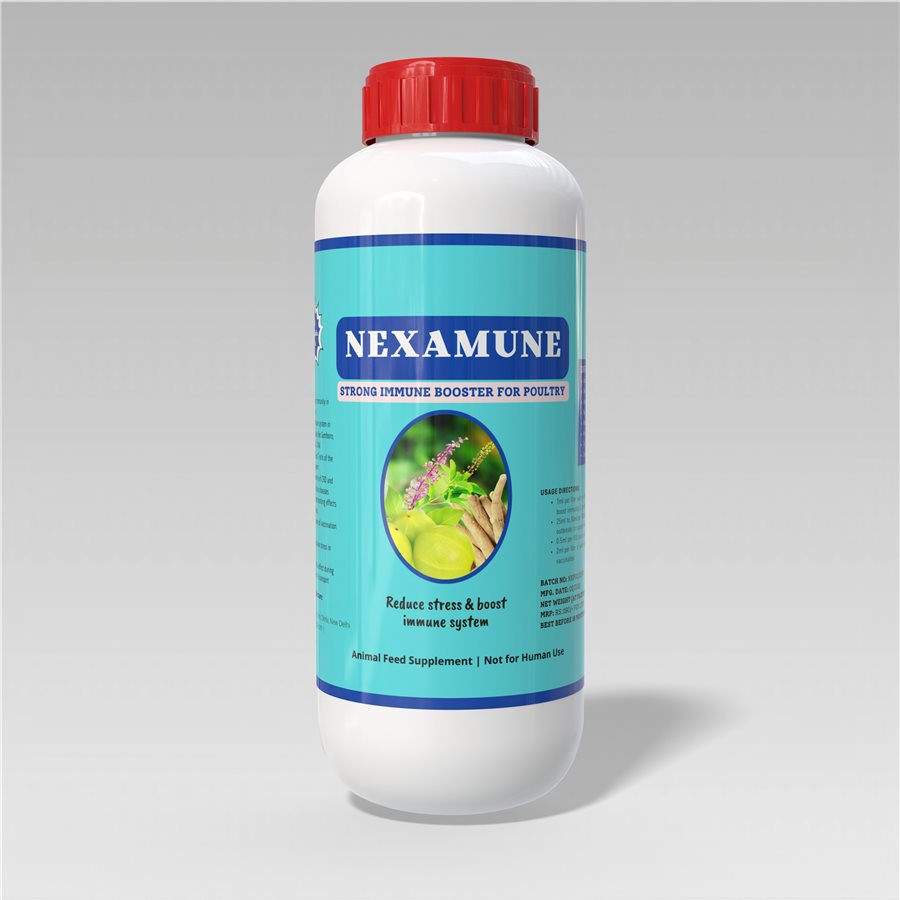
Nexamune
Vitamin E, selenium, amla, tulsi and ashwagandha extracts, vitamin C, vitamin D and niacin: an antioxidant immunity support. Supports the immune system during IB, ND, Gumboro, IBH and LPAI challenges, reduces the severity of CRD and other respiratory problems, and helps reduce the chance of vaccination failure.
Dose: 1 ml per litre of water or 15 ml per 100 birds for immunity and stress; 25–30 ml per 100 birds in viral outbreaks; 2 ml per litre before and after vaccination.
1 L ₹644MRP ₹1,190
Further reading: Swayne DE (ed.), Diseases of Poultry, 14th ed., chapter on infectious bursal disease; Camilotti E, Moraes LB, Furian TQ, Borges KA, Moraes HLS, Salle CTP. Infectious bursal disease: pathogenicity and immunogenicity of vaccines. Rev Bras Cienc Avic 2016;18(2):303-308. doi:10.1590/1806-9061-2015-0148; Müller H, Mundt E, Eterradossi N, Islam MR. Current status of vaccines against infectious bursal disease. Avian Pathology 2012;41(2):133-139.
More from the corner: Vets Technical Corner home · Immunosuppression in broilers · winter broiler medicine schedule