
हिंदी में सार: चूज़े को अंडे से माँ की एंटीबॉडी (MDA) मिलती है। यही एंटीबॉडी शुरू के दिनों में बीमारी से बचाती है, लेकिन यही लाइव टीके (IBD/गम्बोरो, रानीखेत) के वायरस को भी बेअसर कर देती है। टीका बहुत जल्दी लगे तो असर नहीं करता, बहुत देर से लगे तो बीच में पक्षी असुरक्षित रह जाता है। सही उम्र तय करने के लिए पहले दिन के चूज़ों के ELISA टाइटर (और ND के लिए HI टाइटर) देखें, एक ही लैब और किट रखें, और फ़्लॉक की एकरूपता (CV%) भी देखें। टीकाकरण की उम्र आदत से नहीं, हैचरी और लैब के आँकड़ों से तय करें। यह लेख पशु-चिकित्सकों के लिए सामान्य तकनीकी जानकारी है, किसी खास फ़्लॉक का टीकाकरण कार्यक्रम नहीं।
A live vaccine can only take when the chick has less maternal antibody than the vaccine can break through. Maternal antibody (MDA) is what protects a day-old chick, and it is also what neutralises a live IBD or ND vaccine given too early. Most “vaccine failure” calls in broilers end up being a timing problem: the vaccine was given into a bird that still had enough MDA to block it, or after MDA had gone and the flock had already met field virus.
- MDA passes from the hen to the chick through the egg yolk. It falls steadily after hatch, with a half-life of only a few days for IBD.
- Live vaccine virus is neutralised while MDA is above the level the vaccine strain can break through. Hotter strains break through higher MDA than mild ones.
- Day-old titres vary with breeder age, breeder vaccination programme and between flocks, so one fixed vaccination age cannot suit every batch.
- A flock average hides the problem: when titres are uneven (high CV%), some chicks are still blocked while others are already unprotected.
- Use the same laboratory and ELISA kit each time, and take break-through values and formula inputs from the vaccine supplier and the kit manufacturer.
What maternal antibody does and why timing matters
Breeder hens are vaccinated with live and inactivated vaccines. Their antibody goes into the yolk and the chick absorbs it in the first days after hatch. For IBD, this antibody protects the bursa during the first weeks, but it also binds live vaccine virus before the virus can replicate and induce immunity.
This produces two risks for the commercial broiler flock:
- Vaccinating too early: the vaccine is neutralised, the bird makes little or no active response, and it becomes susceptible as MDA keeps falling.
- Vaccinating too late: MDA has already dropped below the protective level, and early field virus finds an unprotected bird. This gap is often called the window of susceptibility.
The practical aim is to vaccinate as soon as MDA has fallen to the level the chosen vaccine can break through, and not before.
Reading the titres
The usual field approach is to bleed a sample of day-old chicks (many laboratories ask for about 20 to 30, from different boxes or breeder flocks) and run an IBD ELISA. Ask for the geometric mean titre (GMT) and the CV%, not just the average.
| What you see | What it usually means | What to do |
|---|---|---|
| High GMT, low CV% | Flock is evenly protected and MDA will last longer | Vaccination is later; a mild strain would be blocked, so strain and age are chosen together |
| Low GMT, low CV% | MDA will fall early | Vaccinate earlier or use a milder strain, and protect the early window with biosecurity |
| Wide spread (high CV%) | Some chicks are blocked while others are unprotected | One vaccination date will not fit all birds; discuss the hatchery programme and a second dose with your veterinarian |
| Mixed breeder ages in one batch | Titres differ between source flocks | Ask for the source flock of each batch and test them separately |
The Deventer approach
The Deventer formula is a widely used method to estimate the vaccination age for IBD. It needs three inputs: the day-old MDA titre of the flock, the rate at which MDA falls (the half-life, which depends on the antibody and chick type), and the titre at which the chosen vaccine breaks through. The calculation gives the age at which MDA is expected to fall to that level.
It is an estimate and not a schedule. It assumes a typical decline and a representative sample, and the results depend on the ELISA kit. Use the vaccine supplier’s break-through value for the product you are using, and confirm the formula inputs for your kit with the manufacturer or laboratory. Where flocks are uneven, or where field challenge starts early, the formula can be a starting point for discussion with the hatchery and not the final answer.
Newcastle disease vaccines and MDA
Maternal ND antibody can also reduce the take of live ND vaccines, especially when they are given in the first days of life. Day-old and early programmes therefore often depend on HI titres of the source flock and on the type of vaccine used. Hatchery programmes that combine live and killed vaccines differ in design, so ask the hatchery for its programme and the day-old HI results, and check HI titres again (for example around the first live booster) where the schedule is being decided.
A practical sequence for the field vet
- Ask the hatchery for the breeder flock details: age, IBD and ND vaccine programme, and whether the batch is from one flock or several.
- Bleed day-old chicks at placement (or use the hatchery’s day-old results) and request GMT and CV% for IBD, and HI for ND.
- Pick the vaccine strain with the supplier, then calculate or confirm the age from the titres.
- If the CV% is high, or batches are mixed, plan with the hatchery for an earlier protective step or a second dose.
- Re-bleed a few birds in the second or third week if you want to confirm that the vaccine took and MDA has gone.
- Record titres and results per batch. Over a few cycles you learn how each breeder source behaves.
- One fixed age (for example “day 14”) used for every batch.
- Different laboratories or kits compared as if their numbers were equal.
- Vaccine given through drinking water that is not fully consumed or uses chlorinated water, which reduces the dose reaching the birds.
- Stress, mycotoxins or other immunosuppression at vaccination age, which weakens the response even when the timing is right.
A short checklist for the next batch
- Get day-old ELISA results (GMT and CV%) and breeder source details from the hatchery.
- Choose strain and age together, using the supplier’s break-through value.
- Check ND HI titres for the source flocks as well.
- Keep one laboratory and one kit, and record results per batch.
- Check water quality and vaccination method on the farm.
Immunity support
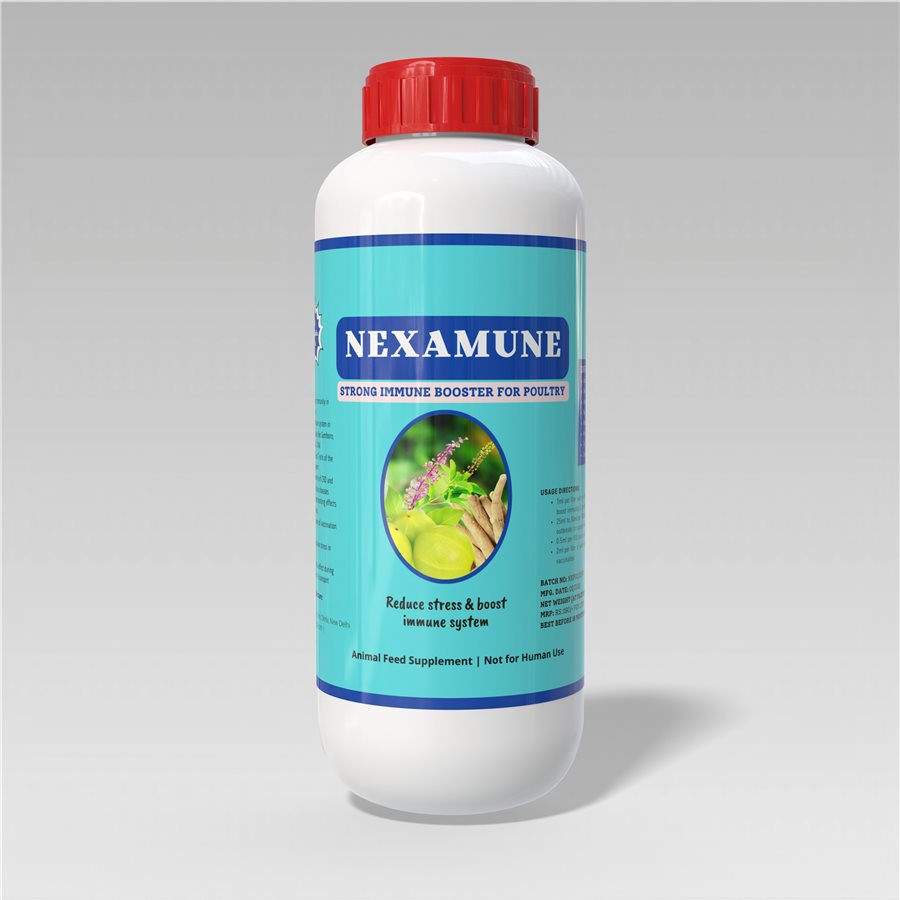
Nexamune
Vitamin E, selenium, amla, tulsi and ashwagandha extracts, vitamin C, vitamin D and niacin: an antioxidant immunity support. Supports the immune system during IB, ND, Gumboro, IBH and LPAI challenges, reduces the severity of CRD and other respiratory problems, and helps reduce the chance of vaccination failure.
Dose: 1 ml per litre of water or 15 ml per 100 birds for immunity and stress; 25–30 ml per 100 birds in viral outbreaks; 2 ml per litre before and after vaccination.
1 L ₹644MRP ₹1,190
Further reading: Swayne DE (ed.), Diseases of Poultry, 14th ed., chapters on infectious bursal disease and Newcastle disease; published work by de Wit JJ and colleagues on the Deventer formula for timing IBD vaccination; the ELISA kit manufacturer’s guidance and the vaccine supplier’s data sheet for break-through values.
More from the corner: Vets Technical Corner home · Immunosuppression in broilers · Bursal atrophy and live IBD vaccines