
Good silage can be wasted at the manger. The same silage gives a steady cow in one shed and a cow that picks, leaves and drops milk in the next. Most farmers ask only one question: “how many kg of silage per cow per day?” The honest answer is that the amount depends on the silage dry matter, the cow’s size and milk, and the rest of the ration, and how you feed it matters almost as much as how much. This guide to silage feeding for dairy cows and buffaloes explains how to work out the daily quantity from dry matter, how silage changes intake and chewing, how to stop sorting, how fast to cut the silage face, when to feed it, and what to give calves, heifers and dry cows. It uses published research, mainly Grant and Ferraretto (2018), Borreani et al. (2018), Gregorini et al. (2010) and Coppock (1969), and marks clearly where advice is our practical guidance and not research.
Silage feeding for dairy cows: why feed silage and what it can and cannot do
Silage stays popular on dairy farms because it keeps nutrients from harvest through storage, makes feeding easier, and allows timely feed mixing and handling compared with dry forages (Grant and Ferraretto, 2018). Coppock (1969) added that where corn grows well, whole-plant corn silage gives an energy yield “unsurpassed by any other crop”, the digestibility of the corn plant changes little over a wide range of maturity, and corn needs less water than several other forages (about 372 kg of water per kg of dry matter against 858 for alfalfa and 635 for oats in the data he quotes).
For a farmer with green maize or jowar and a long dry season or summer fodder gap, that means one thing: silage turns a short harvest window into months of steady feed. But silage is not magic feed.
- It is a forage, not a complete ration. It gives fibre and energy, and it is low in several minerals. Coppock’s data show corn silage with 0.33 percent calcium against 1.64 percent in alfalfa hay, and much less sodium and sulphur (dry matter basis).
- Quality at feeding is not the same as quality at harvest. Fermentation products, air damage at the face and heat in the manger all change what the cow actually eats.
- It needs routine. Bach et al. (2008), cited by Grant and Ferraretto, found that routine feed push-up and feeding for a small refusal each day were linked with 1.6 to 3.9 kg more milk per cow per day among farms feeding the same TMR.
If you are still making your silage, read how to make corn silage: harvest stage, chopping and packing, and how to check silage quality by smell, pH and spoilage signs before you open the pit.
How much silage per cow per day: calculate from dry matter, do not guess
None of the papers we used gives one fixed number of kg of silage for every cow, and a fixed number would be wrong. Silage is mostly water (Coppock quotes 25 to 35 percent dry matter, DM, for corn silage), so 30 kg of watery silage and 30 kg of drier silage are very different feeds. The right method is to decide how many kg of dry matter the silage should supply, then convert that to kg as fed (what you actually weigh).
Illustrative worked example (not a recommendation)
Say your nutritionist or ration plan decides that silage should supply 8 kg of dry matter to one cow. The weight you must put in the manger changes with the silage DM:
| Silage DM | Calculation | kg as fed for 8 kg DM |
|---|---|---|
| 25 percent (wet) | 8 ÷ 0.25 | 32 kg |
| 30 percent | 8 ÷ 0.30 | about 26.7 kg |
| 35 percent (drier) | 8 ÷ 0.35 | about 22.9 kg |
The same 8 kg of DM needs about 9 kg more silage if the silage is wet than if it is dry. A farmer who feeds “a fixed tokri” every day without knowing the DM can silently change the ration by a third. Get the DM checked (a simple drying test at home or a lab test) every time you open a new pit or bag. This is practical guidance.
What the papers do give us
- Coppock (1969, Cornell): corn silage eaten at 2.25 kg DM per 100 kg body weight, with 68 percent TDN, supplies the maintenance energy of a 600 kg cow plus enough for about 16 kg of 4 percent milk (using the National Research Council values of that time). For a 600 kg cow that is about 13.5 kg DM, which at 30 percent DM is about 45 kg as fed. This is an old figure for an ad libitum corn-silage forage diet in large Holsteins, so use it only to see the scale. It also warns that energy-rich silage fed free choice makes low yielders and dry cows over-eat.
- Beltsville study cited by Coppock: cows fed corn silage as the only forage with grain ate 7.7 to 16.4 kg of silage per day on a wet (as-fed) basis, per lactation average. That was an uncontrolled study, but it shows that real intakes vary widely between cows.
- Waugh et al., cited by Coppock: maximum dry matter intake occurred when hay was eaten at about 0.79 kg per 100 kg body weight alongside corn silage fed ad libitum, yet milk (fat-corrected) did not differ between groups. Silage and dry fodder can substitute for each other.
So the practical method is: (1) fix the DM you want from silage in your ration, (2) convert with the formula, (3) weigh the daily quantity, (4) adjust by leftovers and milk, and (5) ask for help on balancing the rest of the ration. See balancing a ration with corn silage: minerals, buffer and vitamins.
Silage by animal type: what to do for each group
The research does not give kg figures for each group, so the table below gives the method and the cautions the papers support. Do not copy a kg number from a neighbour’s shed.
| Animal | How to set the silage amount | Cautions (source) |
|---|---|---|
| Fresh and high-yielding cows | Silage is one part of forage. Set it from DM, then raise slowly and watch leftovers, dung and milk. | Higher-NDF-digestibility corn silage hybrids gave about 0.9 kg more DMI and 1.2 kg more milk per day in the review of Ferraretto and Shaver (2015), quoted by Grant and Ferraretto (2018). Silage quality matters most here. |
| Mid and late lactation, low yielders | Give enough for the milk, not free choice. | Coppock: over-consumption of energy in mid to late lactation may divert energy to body fat. Highly fermentable diets often reduce DMI in mid to late lactation (Grant and Ferraretto). |
| Dry cows | Limit silage to the dry cow’s need, with minerals balanced. | Coppock: free-choice corn silage leads to over-consumption in dry cows. House dry cows apart from the milking herd where possible. |
| Growing heifers | Control the daily gain, do not let them eat silage free choice. | Coppock: Holstein heifers gained 0.8 to 0.9 kg per day on corn silage alone, above the suggested schedules (Swanson: Holstein 0.54 to 0.86 kg per day, Jersey 0.39 to 0.63, by stage). Heifers under 300 kg held to 0.6 kg gain per day came short of digestible protein. |
| Calves | None of the papers covers calves. Practical guidance: keep calves on milk, calf starter and clean fodder first, add silage only later, in small amounts, and only fresh, well-fermented silage. | Spoiled silage lowers intake in heifers (Windle and Kung, quoted by Borreani et al., 2018). |
| Buffaloes | Same method: DM, convert, weigh. See the buffalo section below. | No paper reviewed here studied buffaloes. This is practical guidance. |
How silage affects dry matter intake: fibre, particle size, fermentation and starch
Grant and Ferraretto (2018) review how silage changes what a cow can eat, not only what the silage contains. Four silage features matter.
1. Fibre content and digestibility
Cows with high-forage diets spend longer eating. In one study, raising forage from 40 to 70 percent of the diet added 1.8 hours per day of eating time, but rumination rose only 35 minutes, and resting fell by 2.3 hours per day (Jiang et al., 2017). Cows need a fixed amount of rest, so extra eating time is taken from lying time. In another study, conventional versus brown midrib corn silage changed eating time by about 30 minutes per day (Cotanch et al., 2012). Silage with more digestible fibre is linked with meal patterns that raise intake.
2. Particle size (chop length)
Coarse silage takes longer to chew. In one alfalfa silage study, going from 4.1 to 6.8 mm mean particle length added 36 minutes of eating time per day while intake fell by 3.3 kg per day. In a corn silage study, chopping at 4.2 mm instead of 12 mm cut eating time by 43 minutes per day with similar intake. Cows chew feed to about 10 to 11 mm before swallowing, whatever the starting length (Schadt et al., 2012), so very long particles mostly add chewing time. Particles on the top (19 mm) sieve of the Penn State Particle Separator are the ones most likely to be sorted.
3. Fermentation end products
Butyric acid in silage is a typical sign of poor fermentation. Butyrate, ammonia-N and amines are often related to lower intake (Huhtanen et al., 2002; Krizsan and Randby, 2007), and both studies found no relationship between silage pH and intake, so the end products matter more than pH alone. Any limitation in the feeding environment will make the response to poor silage worse (Grant and Ferraretto). Kung and Shaver advise that if silage has very high acetic acid (above 5 to 6 percent of DM), the amount of that silage in the TMR should be reduced.
4. Starch content and digestibility
Starch digestion makes propionate, and propionate reaching the liver sends a satiety signal. This can reduce intake in mid and late lactation cows more than in fresh cows, and cows with different milk yield respond differently to the same silage, so grouping by yield helps. Starch digestibility rises as silage ferments longer, which is why the age of the silage matters (see when to open silage: ensiling time and starch digestibility).
Feeding behaviour, sorting and bunk management
A cow that sorts eats the sweet fine part and leaves the coarse fibre. Over the day her rumen gets a different diet from the one you mixed.
| Finding | Source |
|---|---|
| Under competitive feeding, every 2 percentage-unit rise in refusal was linked with 1.3 percent more sorting; milk per kg DMI fell about 3 percent for each 1 percent rise in sorting | Sova et al., 2013 |
| Finer silage (mean particle size 7.4 to 8.8 mm) raised DMI linearly and the highest sorting was in the 8.8 mm TMR; the 19 mm sieve fraction was sorted most | Kononoff et al., 2003 |
| Cows need 3 to 5 hours per day to eat in good conditions; 58 percent of US freestall farms gave less than the recommended 60 cm of bunk space per cow | Gomez and Cook, 2010; USDA, 2010 |
| Routine feed push-up and feeding for refusal were linked with 1.6 to 3.9 kg more milk per cow per day | Bach et al., 2008 |
| A tie-stall cow sorts through the day but by 24 hours eats close to what was offered; a competitive shed makes sorting more harmful | Maulfair and Heinrichs, 2013; Albright and Arave, 1997 |
What this means in an Indian shed (practical guidance)
- Give every cow bunk or manger space. A crowded manger lets dominant cows eat first and push others to sort or skip.
- Feed fresh silage in two or three smaller portions in hot weather. The papers show that silage heats and spoils in air. Windle and Kung found heifers fed a TMR left in air ate less than heifers fed fresh TMR.
- Remove leftovers every day. Do not top up old feed. Warm, sour or mouldy leftovers lower the next meal.
- Push feed back toward the cow several times a day. Cows eat what they can reach.
- Weigh a small refusal. Aim for a little leftover, not an empty manger, so every cow can eat freely. Check the refusal for sorting: is it mostly stalk and long pieces?
- Do not chop too long. The research shows long pieces raise eating time and sorting and add little in the rumen. See our chopping and packing guide.
TMR or separate feeding of silage, fodder and concentrate
A total mixed ration (TMR) mixes silage, dry fodder, concentrate and supplements, so every mouthful has the same balance. Separate feeding gives silage in one place, concentrate in the parlour or at the manger. Both work if managed well. Here is how they compare.
| Point | TMR | Separate feeding |
|---|---|---|
| Rumen supply | More uniform nutrient supply through the day, less slug feeding | Depends on how concentrate is split. Heavy grain in one meal raises acid risk |
| Sorting | Possible if the mix is long or dry. Competition makes it worse | Cows cannot sort silage from concentrate, but they eat silage by choice |
| Spoiled silage risk | One spoiled load spoils the whole mix, and a TMR can reheat in the bunk | You can see and pick out bad silage before feeding |
| Individual control | Hard for one cow in a mixed group | Easy to give each cow her own concentrate |
| Labour and machines | Needs a mixer | Works with a chaff cutter and baskets |
Grant and Ferraretto note that when the rumen gets a steady supply of nutrients, the rumen environment is more uniform, while fast eating or selective feeding makes acid production swing and leads to subacute acidosis (SARA) and related problems. For a small farm without a mixer, separate feeding is fine: weigh silage, split the concentrate into at least two meals, and give some forage first. Kung et al. (2018) also say a silage that makes the TMR heat quickly in the bunk is likely carrying a lot of yeast. For a loose-dung problem on silage rations, see our dairy feed premix guide.
Feed-out rate and face management: the biggest lever after quality
Once you open a pit, air enters the face and the silage starts to heat. Borreani et al. (2018) call the removal rate from the face “one of the most important factors to prevent aerobic spoilage”: the greater the unloading rate, the lower the losses. Air can go as far as 4 m into the silage from the face, especially at the edges.
Minimum face removal rates from the papers
| Setting | Minimum removal from the bunker face | Source |
|---|---|---|
| Wisconsin | never below 0.7 m per week in summer and 0.5 m per week in winter | Clark et al., 2008 |
| Northern Italy | above 1.10 m per week in winter, above 1.75 m per week in summer to keep a moldy surface under 2 percent | Borreani and Tabacco, 2012 |
| Severe spoilage seen | when removal was below 0.5 m per week in winter and 0.8 m per week in summer | Borreani and Tabacco, 2012 |
| Israel (31 degrees N, summer mean 23.7 °C) | suggested 1.40 m per week in winter and 2.10 m per week in summer | Table 6 in Borreani et al., 2018 |
The review found a strong relationship between the season’s mean temperature and the minimum feed-out rate: hotter means faster. Indian summers are warmer than most of these sites, so treat the Israel figure of 2.10 m per week (about 30 cm per day) as the closest guide. That is practical interpretation, not a number for India.
What spoiling silage costs
- In one trial, cows fed a TMR with aerobically unstable high-moisture corn gave about 3.2 kg less milk per day than cows fed stable corn, even though intake did not change (Hoffman and Ocker, 1997).
- Goats offered corn silage exposed to air for 8 days ate on average 53 percent less (Gerlach et al., 2013).
- Each 8.3 °C rise in 1 tonne of 30 percent DM silage uses over 26 MJ of energy, costing about 4 kg of milk per tonne of silage. Nutritive value can fall by up to 16 percent before mould is even visible.
- Steers eating visibly spoiled corn silage at higher shares of the ration lowered intake from 8.0 to 6.7 kg per day (Whitlock et al., 2000).
Face management checklist
- Open one face and cut it clean and vertical, so there are no loose, torn edges.
- Take a fresh layer from the whole width every day. Do not dig a hole into the face.
- Keep the cover close to the face and weighted, as the review notes that air enters under loose covers.
- Check the temperature at 10 to 20 cm behind the face. Kung et al. (2018) say a temperature above 40 °C, reheating in the manger, visible mould, or a flat or musty smell all signal spoilage. In winter, steam from the face is not always spoilage.
- Throw away mouldy or heated silage. Never mix spoiled layers into the ration, as the review links this to mycotoxin risk and lower intake.
- Match the face size to the herd. A big silo for a few cows will not meet the removal rate. Use smaller pits or bags for a small herd (practical guidance).
For loss numbers and more ways to cut them, read silage losses: how to reduce dry matter loss.
Timing of silage and concentrate: what Gregorini et al. (2010) found
Many farmers ask whether to give silage before or after concentrate or green fodder. The only timing study in our source set is a laboratory one, so read it as a hint, not a rule.
Gregorini et al. (2010) used continuous culture fermenters, a laboratory rumen model, not live cows. They fed 28 g DM of corn silage either 9 hours or 1 hour before a short, intensive orchardgrass meal (42 g DM), against herbage alone. The total amount of feed was the same. What changed was only timing.
| Result | Silage 9 h before | Silage 1 h before |
|---|---|---|
| Ammonia-N (mg per 100 mL) | 8.8 | 11.4 |
| Propionate (mM) | 20.5 | 18.1 |
| Mean pH | 5.6 | 6.5 |
| Organic matter digestibility | no difference | no difference |
So with silage given 9 hours ahead, ammonia was lower (better use of nitrogen) and propionate, a glucose-forming acid, was about 13 percent higher. But the mean pH was lower, and fibre digestibility tended to be lower, so it is not a free gain.
How to use this (practical guidance)
- It is a fermenter study on grazing herbage, so it does not prove a benefit for TMR-fed cows.
- For a cow that gets green fodder or a heavy concentrate meal, the idea to take is spacing feeds across the day so the rumen is not hit by all fast-fermenting feed at once.
- Do not give the whole day’s concentrate in one go. Split it into two or three meals, and give some silage or dry fodder before the grain. Nobody tested concentrate timing in this study, so this is our practical advice.
Calves, heifers and dry cows: where silage can go wrong
Coppock’s review looked for problems when corn silage is the only forage. He found no depression of appetite or production over at least three lactations, but he listed risks that still apply to farms that rely on silage.
- Too much energy. Free-choice silage plus grain in the parlour can over-feed low yielders. Over-conditioned animals are more likely to have problems in the next lactation, and Coppock notes it has been suggested that over-conditioned cows are prone to clinical ketosis. The problem is easiest to avoid when cows can be grouped by production or fed individually.
- Heifers growing too fast. Fast growth on silage alone can harm later lactation and was linked with more culling for sterility in the studies he cited.
- Protein for lighter heifers. Silage alone does not give enough digestible protein if intake is restricted to keep gains moderate.
- Minerals and vitamins. Corn silage has less calcium than alfalfa and, in one Maryland study, three of the first four cows on all-corn-silage calved with retained placentas and calves with goitre; feeding iodised salt apparently ended the problem (Coppock, 1969). The carotene in corn silage depends on the maturity at ensiling (140 mg per kg DM at the milk stage, 32 at the dent stage, 4 after a light frost). These are old findings, but they remind us that a silage ration needs a mineral and vitamin base.
- Close-up dry cows. Protect them from over-feeding silage and talk to us about transition feeding. See negative DCAD premix for transition cows.
Buffalo notes: silage for buffaloes
None of the papers we used studied buffaloes, so what follows is practical guidance, and not research. The rumen principles in the papers (fibre, chop length, sorting, spoilage, starch) are about ruminant biology and are a sensible starting point.
- Use the same method: pick DM from silage, convert to kg as fed, weigh it.
- Heat is the buffalo’s problem. In summer, feed fresh silage in the cooler hours (early morning and evening), keep water in front of the animal, and remove leftovers before they heat.
- Fat percentage. If your buffalo’s fat is falling on a silage ration, check the chop length and fibre first. Our guides to increasing milk fat percentage in cow and buffalo and the milk fat booster explain the rest.
- Winter milk. See how to increase buffalo milk in winter.
- Introduce silage slowly over 10 to 14 days (practical guidance), and watch dung, cud chewing and leftovers.
Concentrate and premix in a silage-based ration
When silage is the main forage, the concentrate and mineral supplement carry more of the load. Corn silage is low in some minerals (Coppock, 1969), and a ration heavy in silage and grain asks a lot of the rumen. This is the place for a premix and a mineral supplement, fed to the animal, in the concentrate or TMR. None of these products is a silage additive or inoculant. They do not make or protect silage. They support the cow that eats it.
Rumenia is a dairy feed premix with trace minerals, rumen buffer, prebiotics, yeast extracts, probiotics, toxin binders, calcium and phosphorus. The dose is 2.5-3 kg per ton of feed, which is 2.5-3 g per kg of feed, so 5 kg of concentrate gives 12.5-15 g per cow per day. If you feed silage separately, the dose follows the concentrate. For a full TMR with a high silage share, share your batch recipe on WhatsApp and we will work out the dose. See the dairy feed premix guide for the full explanation.
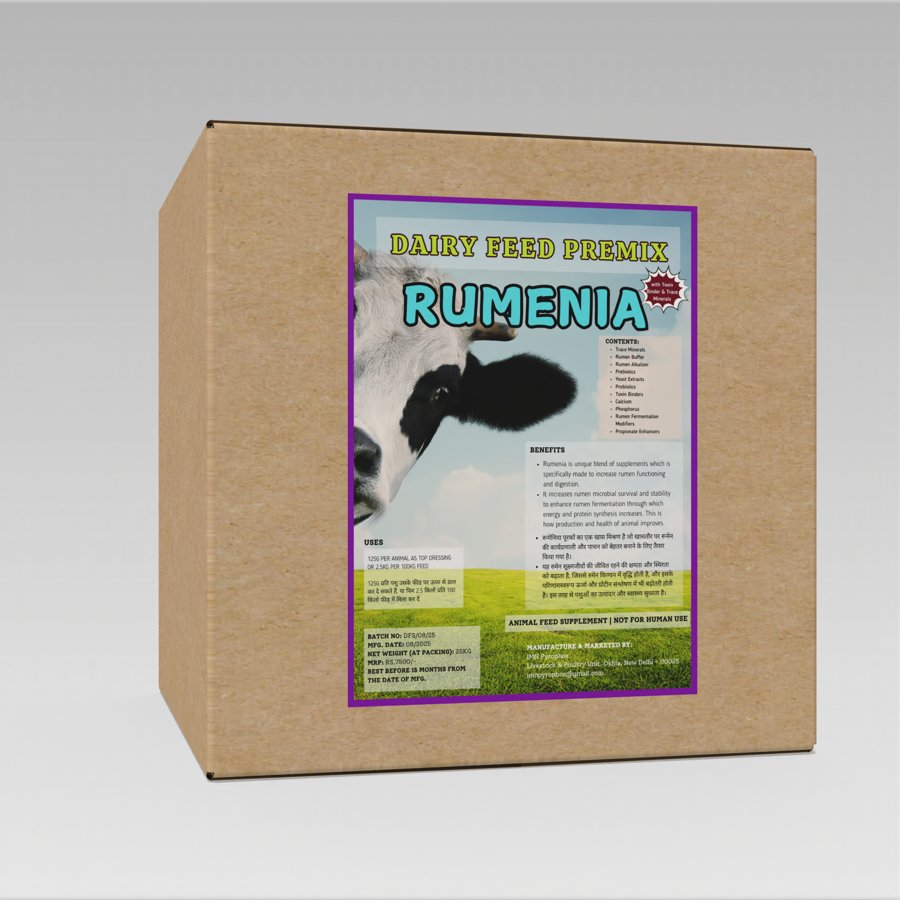
Dairy feed premix
Rumenia
Dairy feed premix with trace minerals, rumen buffer, prebiotics, yeast extracts, probiotics, toxin binders, calcium and phosphorus. Supports rumen function, microbe stability and fermentation, so energy and protein synthesis increase.
Dose: 2.5-3 kg per ton of feed (2.5-3 g per kg feed).
5 kg ₹1,400MRP ₹1,800 25 kg ₹5,625MRP ₹7,500
Pyromin is a chelated mineral mixture with chelated iron, manganese, copper, zinc, iodine, selenium, chromium and cobalt, vitamins A, D3, E and K, B vitamins, biotin and amino acids. For an adult cow or buffalo the dose is 10 g per day. It suits silage rations because Coppock noted that relying on one forage raises the risk of mineral shortage, and it supports milk production, fertility and immunity. It is a supplement, not a silage additive. Read our guide to the best mineral mixture for cow and buffalo too.
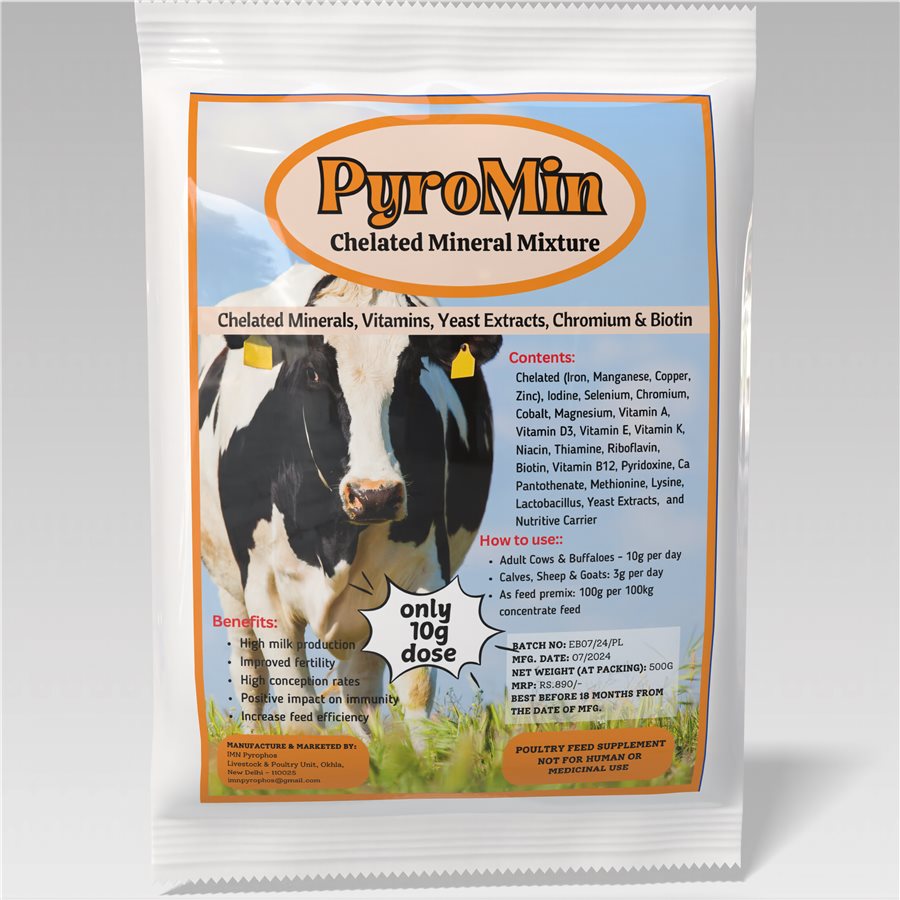
Chelated mineral mixture
Pyromin
Chelated iron, manganese, copper, zinc, iodine, selenium, chromium, cobalt, magnesium, vitamins A, D3, E, K, B vitamins, biotin, methionine, lysine, lactobacillus and yeast extract. Helps milk production, fertility, conception and immunity.
Dose: adult cow or buffalo 10 g per day; calves 3 g per day.
1 kg ₹655MRP ₹1,190
A supplement cannot fix spoiled silage, over-long chop, a crowded manger or a ration that is out of balance. Fix those first, then add the supplement. Our team can help you read your ration; send the details on WhatsApp.
Daily silage feeding checklist and common mistakes
Daily checklist
- Cut a fresh, clean layer from the whole face. Do not leave a loose, open face.
- Check the face and the heap for heat, mould and smell.
- Weigh the silage (kg as fed) for each group or each cow.
- Feed fresh in two or more portions in summer. Do not feed more than the animals can finish.
- Split the concentrate into at least two meals.
- Give some forage before concentrate.
- Push feed up several times a day.
- Weigh the leftovers. Look for sorting. Clear them out every day.
- Re-cover and weight the face.
- Note milk, fat, dung score and cud chewing weekly, in a notebook.
Common mistakes
| Mistake | Why it matters |
|---|---|
| Feeding by tokri, not by weight and DM | The real ration swings by a third between wet and dry silage |
| Cutting the face too slowly for the heat | Air gets in, silage heats, intake falls |
| Mixing mouldy top layers in | Spores, mould and mycotoxin risk and lower intake |
| Giving all the concentrate in one meal | Acid swings in the rumen |
| Chop too long | More chewing time and more sorting |
| Free-choice silage for dry cows and low yielders | Over-consumption of energy |
| Leaving old leftovers in the manger | Heating, sour feed, lower intake of the fresh feed |
| Skipping minerals on an all-silage ration | Silage is low in several minerals |
Silage feeding myths and facts
- Myth: The more silage a cow eats, the more milk she gives. Fact: intake is limited by chewing time, fermentation products, and energy needs, and mid-lactation cows may eat less on highly fermentable diets. Balance, not volume, drives milk.
- Myth: There is one correct kg of silage for every cow. Fact: it depends on silage DM, body weight, milk and the rest of the ration. Calculate from DM.
- Myth: Longer chop is always better for the rumen. Fact: cows chew to about 10 to 11 mm before swallowing, so very long particles mainly add eating time and sorting.
- Myth: Low pH silage is always good silage. Fact: the studies found no link between silage pH and intake; butyrate, ammonia and amines matter more.
- Myth: Steam from the face means the silage is spoiled. Fact: in cool weather steam is common and does not always mean spoilage. Check temperature, smell and mould.
- Myth: A premix or additive can rescue bad silage. Fact: a feed supplement supports the animal. It does not repair spoiled silage.
- Myth: Silage can be the only forage for years without any problem. Fact: Coppock found no clear problems over three lactations in some studies, but also warned about over-feeding energy, protein for heifers, minerals and vitamins.
Frequently asked questions
How many kg of silage should I feed a cow per day?
There is no single number. Decide how many kg of dry matter the silage should supply, then divide by the silage DM fraction to get kg as fed. For 8 kg of DM, a 30 percent DM silage is about 26.7 kg as fed. Ask us for the right DM target for your cow.
How much silage should I feed a buffalo per day?
Use the same method as for cows, then adjust to the buffalo’s weight, milk and total fodder. No paper here studied buffaloes, so start small, raise slowly over 10 to 14 days and watch dung and leftovers.
Can I feed only silage with no dry fodder?
Some studies fed corn silage as the only forage for several lactations without a clear fall in intake or milk. Still, Coppock warned about over-consumption of energy, minerals and vitamins. Add a mineral base and watch body condition and dung.
What is the best silage feeding schedule?
Feed fresh silage at least twice a day in hot weather, push the feed up through the day, split the concentrate, and remove leftovers daily. A routine of push-up and feeding for a small refusal was linked with 1.6 to 3.9 kg more milk per cow.
How fast should I cut the silage face?
Research gives minimums of 0.5 to 1.40 m per week in winter and 0.7 to 2.10 m per week in summer, rising with temperature. In a hot Indian summer, aim for the top end of that range, about 30 cm per day, and size the face to the herd. That last step is practical guidance.
Should I feed silage before or after concentrate?
No cow trial settled this. A fermenter study found that feeding corn silage 9 hours before a herbage meal changed fermentation, with lower ammonia and more propionate, but also lower pH. For most farms the safe practice is to split the concentrate and give some forage first.
Is TMR better than feeding silage separately?
A TMR gives a more uniform rumen supply and less slug feeding, but it needs a mixer and spreads a spoiled load across the herd. Separate feeding works on small farms if you weigh silage, split the concentrate and give every cow bunk space.
Why does my cow leave silage in the manger?
Common reasons are spoiled or heated silage, silage that is too wet or sour, long chop that she sorts, or a crowded manger. Check smell, temperature and refusal composition first.
Can calves and dry cows eat silage?
Calves should be on milk, starter and clean fodder first; add silage later in small amounts. Dry cows should not have free-choice silage, because Coppock found it leads to over-consumption of energy. Talk to us about dry and close-up cow feeding.
Do Rumenia and Pyromin improve silage?
No. They are fed to the animal, not added to silage, so they do not change silage quality. They are used in the concentrate or TMR to support the rumen and fill mineral gaps. They work best when silage quality and feeding routine are right first.
Conclusion: weigh it, convert it, feed it fresh
Good silage feeding for dairy cows comes down to a few habits. Work out silage from dry matter and weigh it. Keep the face moving fast enough for the weather. Feed fresh, push feed up, clear leftovers, and watch sorting. Set the amount by animal group, and keep dry cows and heifers away from free-choice silage. Then fill the mineral gaps with a balanced supplement.
Sources (research cited):
Grant RJ and Ferraretto LF (2018), Silage review: silage feeding management, J Dairy Sci 101:4111-4121.
Borreani G et al. (2018), Silage review: factors affecting dry matter and quality losses in silages, J Dairy Sci.
Kung L Jr et al. (2018), Silage review: interpretation of chemical, microbial and organoleptic components of silages, J Dairy Sci; Kung L Jr and Shaver RD, interpretation and use of silage fermentation analysis reports.
Gregorini P, Soder KJ and Waghorn G (2010), timing of corn silage supplementation, continuous culture fermentation, J Dairy Sci 93:3722-3729.
Coppock CE (1969), Problems associated with all corn silage feeding, J Dairy Sci 52.
Also read: Rumenia · Pyromin · Silage additives and inoculants: do they work · Dairy feed premix guide · IMN product guide
अच्छा silage भी मैंगर में बर्बाद हो सकता है। वही silage एक शेड में गाय को स्थिर रखता है और दूसरे शेड में गाय चुन-चुनकर खाती है, बाक़ी छोड़ देती है और दूध गिर जाता है। ज़्यादातर किसान एक ही सवाल पूछते हैं: “गाय को silage कितना खिलाएँ, रोज़ कितने kg?” सही जवाब यह है कि मात्रा silage के dry matter (DM), गाय के वज़न और दूध, और बाक़ी राशन पर निर्भर करती है, और silage कैसे खिलाते हैं यह उतना ही ज़रूरी है जितना कितना खिलाते हैं। यह गाइड गाय और भैंस के लिए silage feeding for dairy cows समझाती है: silage kg per day को DM से कैसे निकालें, silage intake और चबाने को कैसे बदलता है, sorting कैसे रोकें, face कितनी तेज़ी से काटें, silage कब खिलाएँ, और calves, heifers और dry cows को क्या दें। यह प्रकाशित research पर आधारित है, मुख्य रूप से Grant और Ferraretto (2018), Borreani et al. (2018), Gregorini et al. (2010) और Coppock (1969)। जहाँ बात हमारी practical सलाह है, research नहीं, वहाँ साफ़ लिखा है।
Silage feeding for dairy cows: silage क्यों खिलाएँ और यह क्या कर सकता है, क्या नहीं
Silage डेयरी फ़ार्म पर इसलिए चलता है कि यह कटाई से स्टोरेज तक पोषक तत्व बचाता है, खिलाना आसान बनाता है, और सूखे चारे के मुक़ाबले feed mixing और handling समय पर हो जाती है (Grant और Ferraretto, 2018)। Coppock (1969) ने लिखा कि जहाँ मक्का अच्छी उगती है, whole-plant corn silage की energy yield “किसी भी दूसरी फ़सल से ज़्यादा” है, मक्का के पौधे की digestibility maturity के बड़े दायरे में कम बदलती है, और मक्का को कई दूसरे चारों से कम पानी चाहिए (उनके दिए data में लगभग 372 kg पानी प्रति kg DM, जबकि alfalfa में 858 और oats में 635)।
जिस किसान के पास हरी मक्का या ज्वार है और गर्मी या सूखे में चारे की कमी होती है, उसके लिए मतलब साफ़ है: silage एक छोटी कटाई की खिड़की को महीनों के स्थिर feed में बदल देता है। पर silage जादू नहीं है।
- यह forage है, पूरा राशन नहीं। इससे fibre और energy मिलती है, पर कई minerals कम होते हैं। Coppock के data में corn silage में calcium 0.33% है, जबकि alfalfa hay में 1.64%, और sodium व sulphur भी काफ़ी कम (DM basis)।
- कटाई पर quality और खिलाते वक़्त quality अलग होती है। Fermentation products, face पर हवा का नुक़सान और मैंगर में गर्मी, ये सब बदलते हैं कि गाय असल में क्या खा रही है।
- Routine चाहिए। Bach et al. (2008) (Grant और Ferraretto में quoted) ने पाया कि जिन farms ने एक ही TMR खिलाया, उनमें routine feed push-up और थोड़ा refusal छोड़कर खिलाना, प्रति गाय रोज़ 1.6 से 3.9 kg ज़्यादा दूध से जुड़े थे।
अगर आप अभी silage बना रहे हैं तो pit खोलने से पहले corn silage कैसे बनाएँ: harvest stage, chopping और packing और silage quality check: smell, pH और spoilage signs पढ़ लें।
गाय को silage कितना खिलाएँ: DM से निकालें, अंदाज़ा न लगाएँ
जो papers हमने इस्तेमाल किए, उनमें से किसी में हर गाय के लिए एक fixed kg नहीं दिया गया, और fixed number ग़लत भी होता। Silage ज़्यादातर पानी है (Coppock corn silage के लिए 25 से 35% dry matter, DM, बताते हैं), इसलिए 30 kg गीला silage और 30 kg सूखा silage बिल्कुल अलग feed हैं। सही तरीक़ा यह है: पहले तय करें कि silage से कितने kg dry matter देनी है, फिर उसे kg as fed (जो आप तराज़ू पर तौलते हैं) में बदलें।
Illustrative worked example (सिफ़ारिश नहीं)
मान लीजिए आपके nutritionist या ration plan ने तय किया कि एक गाय को silage से 8 kg dry matter मिलनी चाहिए। मैंगर में कितना तौलना है, यह silage के DM पर बदलता है:
| Silage DM | हिसाब | 8 kg DM के लिए kg as fed |
|---|---|---|
| 25% (गीला) | 8 ÷ 0.25 | 32 kg |
| 30% | 8 ÷ 0.30 | लगभग 26.7 kg |
| 35% (सूखा) | 8 ÷ 0.35 | लगभग 22.9 kg |
वही 8 kg DM गीले silage में सूखे silage से लगभग 9 kg ज़्यादा silage माँगती है। जो किसान DM जाने बिना रोज़ “एक टोकरी” खिलाता है, वह चुपके से राशन को एक-तिहाई तक बदल देता है। हर नया pit या bag खोलने पर DM check करवाएँ (घर पर simple drying test या lab test)। यह practical सलाह है।
Papers क्या बताते हैं
- Coppock (1969, Cornell): 2.25 kg DM प्रति 100 kg body weight पर खाया गया corn silage (68% TDN) 600 kg गाय की maintenance energy और लगभग 16 kg 4% दूध की energy देता है (उस समय के NRC values से)। 600 kg गाय के लिए यह लगभग 13.5 kg DM है, जो 30% DM पर लगभग 45 kg as fed बनता है। यह पुराना figure है, बड़ी Holstein के लिए, ad libitum corn-silage forage diet में, इसलिए सिर्फ़ scale समझने के लिए लें। वे यह भी चेताते हैं कि free choice energy-rich silage से कम दूध वाली और dry गायें ज़्यादा खा जाती हैं।
- Beltsville study (Coppock में quoted): जिन गायों को corn silage अकेला forage और grain के साथ दिया गया, उन्होंने lactation average में रोज़ 7.7 से 16.4 kg silage as-fed basis पर खाया। यह controlled study नहीं थी, पर दिखाती है कि गायों के बीच असली intake कितना अलग होता है।
- Waugh et al. (Coppock में quoted): corn silage ad libitum के साथ जब hay लगभग 0.79 kg प्रति 100 kg body weight खाया गया तब maximum dry matter intake मिला, फिर भी groups में (fat-corrected) दूध में फ़र्क़ नहीं था। Silage और सूखा चारा एक-दूसरे की जगह ले सकते हैं।
तो practical तरीक़ा यह है: (1) अपने राशन में silage से कितनी DM लेनी है तय करें, (2) formula से बदलें, (3) रोज़ की मात्रा तौलें, (4) leftover और दूध देखकर adjust करें, (5) बाक़ी राशन balance करवाएँ। देखें corn silage के साथ राशन balance: mineral, buffer और vitamin।
पशु के प्रकार के हिसाब से silage: हर group के लिए क्या करें
Research हर group के लिए kg figure नहीं देती, इसलिए नीचे के table में तरीक़ा और papers से मिली सावधानियाँ हैं। पड़ोसी के शेड से kg number copy न करें।
| पशु | Silage की मात्रा कैसे तय करें | सावधानी (source) |
|---|---|---|
| Fresh और high-yielding गायें | Silage forage का एक हिस्सा है। DM से तय करें, फिर धीरे बढ़ाएँ और leftover, गोबर और दूध देखते रहें। | Ferraretto और Shaver (2015) के review में (Grant और Ferraretto में quoted) ज़्यादा NDF digestibility वाली corn silage hybrids से रोज़ लगभग 0.9 kg ज़्यादा DMI और 1.2 kg ज़्यादा दूध मिला। यहाँ silage quality सबसे ज़्यादा मायने रखती है। |
| Mid और late lactation, कम दूध वाली | दूध के हिसाब से दें, free choice नहीं। | Coppock: mid से late lactation में ज़्यादा energy से body fat बनने का ख़तरा। Highly fermentable diets अक्सर mid-late lactation में DMI घटाती हैं (Grant और Ferraretto)। |
| Dry cows | Dry गाय की ज़रूरत तक ही silage दें, minerals balance करके। | Coppock: free-choice corn silage से dry गायें ज़्यादा खा लेती हैं। संभव हो तो dry गायों को milking herd से अलग रखें। |
| बढ़ती heifers | रोज़ का weight gain control करें, free choice silage न दें। | Coppock: अकेले corn silage पर Holstein heifers ने 0.8 से 0.9 kg per day gain किया, जो suggested schedule से ऊपर था (Swanson: Holstein 0.54 से 0.86 kg per day, Jersey 0.39 से 0.63, stage के हिसाब से)। 300 kg से कम heifers को 0.6 kg gain पर रोकने से digestible protein कम पड़ गया। |
| Calves | किसी paper में calves नहीं हैं। Practical सलाह: पहले दूध, calf starter और साफ़ चारा, silage बाद में, थोड़ी मात्रा में, और सिर्फ़ ताज़ा अच्छी तरह fermented silage। | ख़राब silage heifers में intake घटाता है (Windle और Kung, Borreani et al., 2018 में quoted)। |
| भैंस | वही तरीक़ा: DM, बदलें, तौलें। नीचे buffalo section देखें। | यहाँ review किए किसी paper में भैंस पर study नहीं है। यह practical सलाह है। |
Silage dry matter intake को कैसे बदलता है: fibre, particle size, fermentation और starch
Grant और Ferraretto (2018) review करते हैं कि silage गाय के खा सकने की क्षमता को कैसे बदलता है, सिर्फ़ यह नहीं कि silage में क्या है। चार चीज़ें मायने रखती हैं।
1. Fibre content और digestibility
High-forage diet वाली गायें ज़्यादा देर खाती हैं। एक study में forage को diet के 40% से 70% करने पर eating time रोज़ 1.8 घंटे बढ़ा, पर rumination सिर्फ़ 35 मिनट बढ़ा, और resting 2.3 घंटे घट गया (Jiang et al., 2017)। गाय को एक तय मात्रा में आराम चाहिए, इसलिए ज़्यादा खाने का समय सीधे लेटने (आराम) के समय से कट जाता है। एक और study में conventional और brown midrib corn silage से eating time लगभग 30 मिनट per day बदला (Cotanch et al., 2012)। ज़्यादा digestible fibre वाली silage से ऐसे meal pattern जुड़े हैं जो intake बढ़ाते हैं।
2. Particle size (chop length)
मोटी silage चबाने में गाय को ज़्यादा समय लगता है। एक alfalfa silage study में mean particle length 4.1 से 6.8 mm करने पर eating time रोज़ 36 मिनट बढ़ा और intake 3.3 kg per day घटा। एक corn silage study में 12 mm की जगह 4.2 mm chopping से eating time रोज़ 43 मिनट कम हुआ और intake लगभग बराबर रहा। गायें निगलने से पहले feed को लगभग 10 से 11 mm तक चबाती हैं, चाहे शुरुआत कितनी भी लंबी हो (Schadt et al., 2012), इसलिए बहुत लंबे टुकड़े ज़्यादातर chewing time बढ़ाते हैं। Penn State Particle Separator की सबसे ऊपर वाली (19 mm) sieve पर रुके टुकड़े सबसे ज़्यादा sort होते हैं।
3. Fermentation end products
Silage में butyric acid ख़राब fermentation की typical निशानी है। Butyrate, ammonia-N और amines अक्सर कम intake से जुड़े पाए गए (Huhtanen et al., 2002; Krizsan और Randby, 2007), और दोनों studies में silage pH और intake के बीच कोई रिश्ता नहीं मिला, यानी सिर्फ़ pH से ज़्यादा end products मायने रखते हैं। Feeding environment में कोई भी कमी ख़राब silage का असर बढ़ा देती है (Grant और Ferraretto)। Kung और Shaver सलाह देते हैं कि अगर silage में acetic acid बहुत ज़्यादा हो (DM का 5 से 6% से ऊपर), तो TMR में उस silage की मात्रा कम करें।
4. Starch content और digestibility
Starch के digest होने से propionate बनता है, और liver तक पहुँचने वाला propionate satiety का signal देता है। इससे mid और late lactation गायों में intake fresh गायों से ज़्यादा घट सकता है, और अलग दूध वाली गायें एक ही silage पर अलग response देती हैं, इसलिए yield के हिसाब से grouping मदद करती है। Silage जितना लंबा fermentation होता है, starch digestibility बढ़ती है, इसलिए silage की उम्र मायने रखती है (देखें silage कब खोलें: ensiling time और starch digestibility)।
Feeding behaviour, sorting और bunk management
जो गाय sorting करती है वह मीठा बारीक हिस्सा खा लेती है और मोटा fibre छोड़ देती है। दिन भर में उसके rumen को वह diet नहीं मिलती जो आपने mix की थी।
| Finding | Source |
|---|---|
| Competitive feeding में refusal में हर 2 percentage-unit बढ़ने पर sorting 1.3% ज़्यादा; sorting में हर 1% बढ़ने पर milk per kg DMI लगभग 3% घटा | Sova et al., 2013 |
| बारीक silage (mean particle size 7.4 से 8.8 mm) से DMI linearly बढ़ा और सबसे ज़्यादा sorting 8.8 mm TMR में हुई; 19 mm sieve वाला हिस्सा सबसे ज़्यादा sort हुआ | Kononoff et al., 2003 |
| अच्छी condition में गायों को खाने के लिए रोज़ 3 से 5 घंटे चाहिए; 58% US freestall farms में recommended 60 cm bunk space per cow से कम था | Gomez और Cook, 2010; USDA, 2010 |
| Routine feed push-up और refusal के लिए खिलाना, रोज़ प्रति गाय 1.6 से 3.9 kg ज़्यादा दूध से जुड़े थे | Bach et al., 2008 |
| Tie-stall गाय दिन में sort करती है पर 24 घंटे तक लगभग वही खा लेती है जो दिया गया था; competitive शेड में sorting ज़्यादा नुक़सान करती है | Maulfair और Heinrichs, 2013; Albright और Arave, 1997 |
भारतीय शेड में इसका मतलब (practical सलाह)
- हर गाय को मैंगर या bunk space दें। भीड़ वाले मैंगर में dominant गायें पहले खाती हैं और दूसरी sort या skip करती हैं।
- गर्मी में ताज़ा silage दो या तीन छोटी बार में दें। Papers बताते हैं कि silage हवा में गर्म होकर ख़राब होता है। Windle और Kung ने पाया कि हवा में रखा TMR खाने वाली heifers ने ताज़े TMR वाली heifers से कम खाया।
- रोज़ leftover हटाएँ। पुराने feed पर ताज़ा न डालें। गर्म, खट्टा या फफूँद वाला leftover अगले meal को घटाता है।
- दिन में कई बार feed गाय की तरफ़ सरकाएँ। गाय वही खाती है जो उसकी पहुँच में है।
- थोड़ा refusal तौलें। ख़ाली मैंगर नहीं, थोड़ा बचा हुआ feed रखें, ताकि हर गाय खुलकर खा सके। Refusal में देखें कि क्या ज़्यादातर डंठल और लंबे टुकड़े हैं, यानी sorting हुई।
- Chop बहुत लंबा न करें। Research दिखाती है कि लंबे टुकड़े eating time और sorting बढ़ाते हैं और rumen में कम फ़ायदा देते हैं। देखें chopping और packing गाइड।
TMR या silage, चारा और concentrate अलग-अलग खिलाना
TMR (total mixed ration) में silage, सूखा चारा, concentrate और supplements mix होते हैं, इसलिए हर निवाले में वही balance होता है। अलग feeding में silage एक जगह और concentrate parlour या मैंगर पर दिया जाता है। दोनों सही management में काम करते हैं। तुलना:
| बात | TMR | अलग feeding |
|---|---|---|
| Rumen को supply | दिन भर ज़्यादा uniform supply, slug feeding कम | Concentrate कैसे बाँटते हैं उस पर निर्भर। एक meal में ज़्यादा grain से acid का ख़तरा |
| Sorting | Mix लंबा या सूखा हो तो हो सकती है। Competition से बढ़ती है | Silage और concentrate अलग हैं, पर गाय silage अपनी पसंद से खाती है |
| ख़राब silage का risk | एक ख़राब load पूरे mix को ख़राब करता है, और TMR bunk में reheat हो सकता है | ख़राब silage खिलाने से पहले दिख जाता और निकल जाता है |
| एक-एक पशु पर control | Mixed group में एक गाय के लिए मुश्किल | हर गाय का अपना concentrate देना आसान |
| मेहनत और machine | Mixer चाहिए | Chaff cutter और टोकरी से चल जाता है |
Grant और Ferraretto बताते हैं कि जब rumen को nutrients की steady supply मिलती है तो rumen का environment ज़्यादा uniform रहता है, जबकि तेज़ खाना या चुनकर खाना acid production में उतार-चढ़ाव लाता है और subacute acidosis (SARA) जैसी दिक़्क़तों तक ले जाता है। बिना mixer वाली छोटी फ़ार्म के लिए अलग feeding ठीक है: silage तौलें, concentrate कम से कम दो meal में बाँटें, और पहले थोड़ा forage दें। Kung et al. (2018) यह भी कहते हैं कि जो silage TMR को bunk में जल्दी गर्म कर दे, उसमें शायद yeast ज़्यादा है। Silage राशन पर पतले गोबर की समस्या के लिए हमारी dairy feed premix गाइड देखें।
Feed-out rate और face management: quality के बाद सबसे बड़ा lever
Pit खोलते ही face से हवा अंदर जाती है और silage गर्म होने लगता है। Borreani et al. (2018) face से removal rate को “aerobic spoilage रोकने के सबसे ज़रूरी factors में से एक” कहते हैं: unloading rate जितना ज़्यादा, नुक़सान उतना कम। हवा silage में face से 4 m तक जा सकती है, ख़ासकर किनारों पर।
Papers से minimum face removal rates
| जगह या हालत | Bunker face से minimum removal | Source |
|---|---|---|
| Wisconsin | गर्मी में 0.7 m per week और सर्दी में 0.5 m per week से कभी कम नहीं | Clark et al., 2008 |
| Northern Italy | सर्दी में 1.10 m per week से ऊपर, गर्मी में 1.75 m per week से ऊपर, ताकि moldy surface 2% से कम रहे | Borreani और Tabacco, 2012 |
| गंभीर spoilage दिखा | जब removal सर्दी में 0.5 m per week और गर्मी में 0.8 m per week से कम था | Borreani और Tabacco, 2012 |
| Israel (31 degree N, गर्मी का mean 23.7 °C) | suggested सर्दी में 1.40 m per week और गर्मी में 2.10 m per week | Borreani et al., 2018 की Table 6 |
Review में मौसम के mean temperature और minimum feed-out rate के बीच मज़बूत रिश्ता मिला: जितनी गर्मी, उतनी तेज़ removal। भारत की गर्मी इन ज़्यादातर जगहों से ज़्यादा है, इसलिए Israel का 2.10 m per week (लगभग 30 cm per day) सबसे नज़दीकी guide मानें। यह practical interpretation है, भारत का research number नहीं।
ख़राब होता silage क्या नुक़सान करता है
- एक trial में aerobically unstable high-moisture corn वाले TMR पर गायों ने stable corn वाली गायों से लगभग 3.2 kg कम दूध दिया, जबकि intake नहीं बदला (Hoffman और Ocker, 1997)।
- 8 दिन हवा में रखी corn silage को बकरियों ने average 53% कम खाया (Gerlach et al., 2013)।
- 30% DM silage के 1 tonne में हर 8.3 °C की बढ़त पर 26 MJ से ज़्यादा energy लगती है, जो हर tonne silage पर लगभग 4 kg दूध के नुक़सान के बराबर है। फफूँद दिखने से पहले ही nutritive value 16% तक गिर सकती है।
- साफ़ ख़राब corn silage का हिस्सा राशन में बढ़ने पर steers का intake 8.0 से 6.7 kg per day हो गया (Whitlock et al., 2000)।
Face management checklist
- एक ही face खोलें और उसे साफ़, सीधा काटें, ताकि ढीले या फटे किनारे न रहें।
- रोज़ पूरी चौड़ाई से ताज़ा layer लें। Face में गड्ढा न खोदें।
- Cover को face के पास रखें और दबाकर रखें, क्योंकि review के मुताबिक़ ढीले cover के नीचे हवा घुसती है।
- Face के 10 से 20 cm पीछे temperature नापें। Kung et al. (2018) के मुताबिक़ 40 °C से ऊपर temperature, मैंगर में दोबारा गर्म होना, दिखती फफूँद, या सपाट या सड़ी हुई गंध spoilage के संकेत हैं। सर्दी में face से भाप निकलना हमेशा spoilage नहीं होता।
- फफूँद वाला या गर्म silage फेंक दें। ख़राब layers को कभी राशन में न मिलाएँ, review इसे mycotoxin risk और कम intake से जोड़ता है।
- Face का size झुंड के हिसाब से रखें। छोटी herd के लिए बड़ा silo removal rate पूरा नहीं करता। छोटी herd के लिए छोटे pit या bag बनाएँ (practical सलाह)।
Loss के numbers और उन्हें कम करने के तरीक़ों के लिए पढ़ें silage losses: dry matter loss कैसे कम करें।
Silage और concentrate का timing: Gregorini et al. (2010) ने क्या पाया
कई किसान पूछते हैं कि silage concentrate या हरे चारे से पहले दें या बाद में। हमारे source set में timing पर सिर्फ़ एक study है, वह भी laboratory की, इसलिए इसे संकेत मानें, नियम नहीं।
Gregorini et al. (2010) ने continuous culture fermenters इस्तेमाल किए, यानी laboratory rumen model, ज़िंदा गायें नहीं। उन्होंने 28 g DM corn silage को एक छोटे, तेज़ orchardgrass meal (42 g DM) से 9 घंटे पहले या 1 घंटा पहले दिया, और अकेले herbage से तुलना की। कुल feed की मात्रा बराबर थी। सिर्फ़ timing बदली।
| नतीजा | Silage 9 घंटे पहले | Silage 1 घंटा पहले |
|---|---|---|
| Ammonia-N (mg per 100 mL) | 8.8 | 11.4 |
| Propionate (mM) | 20.5 | 18.1 |
| Mean pH | 5.6 | 6.5 |
| Organic matter digestibility | कोई फ़र्क़ नहीं | कोई फ़र्क़ नहीं |
यानी silage 9 घंटे पहले देने पर ammonia कम रहा (nitrogen का बेहतर इस्तेमाल) और propionate, glucose बनाने वाला acid, लगभग 13% ज़्यादा रहा। पर mean pH कम था और fibre digestibility भी कम होने की तरफ़ थी, इसलिए यह मुफ़्त का फ़ायदा नहीं है।
इससे कैसे काम लें (practical सलाह)
- यह grazing herbage पर fermenter study है, इसलिए TMR खाने वाली गायों के लिए फ़ायदा साबित नहीं करती।
- जिस गाय को हरा चारा या भारी concentrate meal मिलता है, उसके लिए लेने लायक़ बात है दिन भर feed को फैलाना, ताकि rumen पर सारा तेज़ fermenting feed एक साथ न पड़े।
- पूरे दिन का concentrate एक साथ न दें। दो या तीन meal में बाँटें, और दाने से पहले थोड़ा silage या सूखा चारा दें। इस study में concentrate timing test नहीं हुई, इसलिए यह हमारी practical सलाह है।
Calves, heifers और dry cows: silage कहाँ ग़लत जा सकता है
Coppock के review ने देखा कि जब corn silage अकेला forage हो तो क्या दिक़्क़तें आती हैं। उन्होंने कम से कम तीन lactation तक appetite या production में गिरावट नहीं पाई, पर उन्होंने risk बताए जो silage पर निर्भर farms पर आज भी लागू होते हैं।
- ज़्यादा energy। Free-choice silage और parlour में grain से कम दूध वाली गायें over-feed हो सकती हैं। Coppock बताते हैं कि यह सुझाया गया है कि over-conditioned गायों में clinical ketosis का ख़तरा हो सकता है। यह समस्या तब सबसे आसानी से रुकती है जब गायों को production के हिसाब से group किया जा सके या अलग-अलग खिलाया जा सके।
- Heifers का तेज़ बढ़ना। अकेले silage पर तेज़ growth आगे की lactation को नुक़सान पहुँचा सकती है, और उनके quoted studies में sterility से ज़्यादा culling से जोड़ी गई।
- हल्की heifers के लिए protein। अगर gain moderate रखने के लिए intake restrict किया जाए तो अकेले silage से digestible protein पूरी नहीं पड़ती।
- Minerals और vitamins। Corn silage में alfalfa से कम calcium होता है, और एक Maryland study में all-corn-silage पर पहली चार में से तीन गायें retained placenta के साथ ब्याईं और बछड़ों में goitre मिला; iodised नमक देने से समस्या ख़त्म हुई लगी (Coppock, 1969)। Corn silage में carotene silage बनाते वक़्त maturity पर निर्भर करता है (milk stage पर 140 mg per kg DM, dent stage पर 32, हल्के पाले के बाद 4)। ये पुराने findings हैं, पर ये याद दिलाते हैं कि silage राशन को mineral और vitamin का आधार चाहिए।
- Close-up dry cows। उन्हें silage के over-feeding से बचाएँ और transition feeding के लिए हमसे बात करें। देखें transition गायों के लिए negative DCAD premix।
Buffalo notes: भैंस को silage
हमारे इस्तेमाल किए किसी paper में भैंस पर study नहीं है, इसलिए नीचे की बातें practical सलाह हैं, research नहीं। Papers के rumen principles (fibre, chop length, sorting, spoilage, starch) ruminant biology के हैं, और एक समझदार शुरुआत हैं।
- वही तरीक़ा लगाएँ: silage से DM तय करें, kg as fed में बदलें, तौलें।
- भैंस की असली दिक़्क़त गर्मी है। गर्मी में ताज़ा silage ठंडी घड़ियों में (सुबह जल्दी और शाम) दें, सामने पानी रखें, और leftover गर्म होने से पहले हटा दें।
- Fat percentage। अगर silage राशन पर भैंस का fat गिर रहा है तो पहले chop length और fibre देखें। बाक़ी हमारी milk fat percentage बढ़ाने और milk fat booster गाइड में है।
- सर्दी का दूध। देखें भैंस का दूध सर्दी में कैसे बढ़ाएँ।
- Silage धीरे शुरू करें, 10 से 14 दिन में (practical सलाह), और गोबर, जुगाली और leftover देखते रहें।
Silage वाले राशन में concentrate और premix
जब silage मुख्य forage हो, तो concentrate और mineral supplement पर ज़्यादा बोझ आता है। Corn silage में कुछ minerals कम होते हैं (Coppock, 1969), और silage और grain से भरा राशन rumen से बहुत कुछ माँगता है। यहाँ premix और mineral supplement काम आते हैं, जो पशु को, concentrate या TMR में, खिलाए जाते हैं। इनमें से कोई भी silage additive या inoculant नहीं है। ये silage नहीं बनाते और silage को बचाते नहीं। ये उस गाय को support करते हैं जो silage खाती है।
Rumenia एक dairy feed premix है जिसमें trace minerals, rumen buffer, prebiotics, yeast extracts, probiotics, toxin binders, calcium और phosphorus हैं। Dose 2.5-3 kg per ton feed है, यानी 2.5-3 g per kg feed, तो 5 kg concentrate पर 12.5-15 g per गाय per day। अगर आप silage अलग खिलाते हैं तो dose concentrate के हिसाब से चलता है। जिस TMR में silage का हिस्सा ज़्यादा हो, उसका batch recipe WhatsApp पर भेजें, हम dose निकाल देंगे। पूरी जानकारी dairy feed premix गाइड में है।
डेयरी फीड प्रीमिक्स · बेस्टसेलर
Rumenia
Trace minerals, rumen buffer, prebiotics, yeast extracts, probiotics, toxin binders, कैल्शियम और फॉस्फोरस वाला डेयरी फीड प्रीमिक्स। rumen का काम, microbes की स्थिरता और fermentation बढ़ाता है, जिससे ऊर्जा और प्रोटीन का संश्लेषण बढ़ता है।
मात्रा: 2.5-3 किलो प्रति टन फ़ीड (2.5-3 ग्राम प्रति किलो फ़ीड)।
5 kg ₹1,400 · 25 kg ₹5,625MRP ₹1,800 / ₹7,500
Pyromin एक chelated mineral mixture है जिसमें chelated iron, manganese, copper, zinc, iodine, selenium, chromium और cobalt, vitamins A, D3, E और K, B vitamins, biotin और amino acids हैं। Adult गाय या भैंस के लिए dose 10 g per day है। यह silage राशन के लिए इसलिए ठीक बैठता है कि Coppock ने लिखा कि एक ही forage पर निर्भर रहने से mineral कमी का risk बढ़ता है, और यह milk production, fertility और immunity को support करता है। यह supplement है, silage additive नहीं। हमारी गाय-भैंस के लिए best mineral mixture गाइड भी पढ़ें।
चिलेटेड मिनरल · रोज़ थोड़ी मात्रा
Pyromin
चिलेटेड आयरन, मैंगनीज़, कॉपर, ज़िंक, आयोडीन, सेलेनियम, क्रोमियम, कोबाल्ट और मैग्नीशियम, साथ में विटामिन A, D3, E, K और B विटामिन, बायोटिन, मेथियोनीन, लाइसीन, लैक्टोबैसिलस और यीस्ट एक्सट्रैक्ट। दूध उत्पादन, प्रजनन, गाभिन ठहरने, रोग प्रतिरोधक क्षमता और चारे के बेहतर उपयोग में सहायक।
मात्रा: वयस्क गाय या भैंस को 10 ग्राम प्रति दिन; बछड़े, भेड़ और बकरी को 3 ग्राम प्रति दिन। प्रीमिक्स के रूप में 100 ग्राम प्रति 100 किलो दाना।
1 kg ₹655MRP ₹1,190
कोई supplement ख़राब silage, लंबा chop, भीड़ वाले मैंगर या बिगड़े हुए राशन को ठीक नहीं कर सकता। पहले वह ठीक करें, फिर supplement जोड़ें। हमारी टीम आपका राशन पढ़ने में मदद कर सकती है, details WhatsApp पर भेजें।
रोज़ का silage feeding checklist और आम ग़लतियाँ
Daily checklist
- पूरे face से ताज़ा, साफ़ layer काटें। ढीला, खुला face न छोड़ें।
- Face और ढेर में गर्मी, फफूँद और गंध देखें।
- हर group या हर गाय के लिए silage (kg as fed) तौलें।
- गर्मी में ताज़ा silage दो या ज़्यादा बार में दें। जितना पशु ख़त्म कर सके उतना ही दें।
- Concentrate को कम से कम दो meal में बाँटें।
- Concentrate से पहले थोड़ा forage दें।
- दिन में कई बार feed push-up करें।
- Leftover तौलें। Sorting देखें। रोज़ साफ़ करें।
- Face को दोबारा cover करें और दबाकर रखें।
- हफ़्ते में एक बार दूध, fat, गोबर score और जुगाली नोटबुक में लिखें।
आम ग़लतियाँ
| ग़लती | क्यों मायने रखती है |
|---|---|
| टोकरी से खिलाना, वज़न और DM से नहीं | गीले और सूखे silage में असली राशन एक-तिहाई तक बदल जाता है |
| गर्मी के हिसाब से face धीरे काटना | हवा घुसती है, silage गर्म होता है, intake गिरता है |
| फफूँद वाली ऊपरी layers को mix कर देना | Spores, फफूँद और mycotoxin का risk और कम intake |
| पूरा concentrate एक meal में देना | Rumen में acid के उतार-चढ़ाव |
| Chop लंबा रखना | ज़्यादा chewing time और ज़्यादा sorting |
| Dry cows और कम दूध वाली गायों को free-choice silage | Energy का over-consumption |
| मैंगर में पुराना leftover छोड़ना | गर्मी, खट्टा feed, ताज़े feed का कम intake |
| All-silage राशन में minerals छोड़ देना | Silage में कई minerals कम होते हैं |
Silage feeding के myths और facts
- Myth: गाय जितना ज़्यादा silage खाए, उतना ज़्यादा दूध देगी। Fact: intake chewing time, fermentation products और energy की ज़रूरत से बँधा है, और mid-lactation गायें highly fermentable diets पर कम खा सकती हैं। दूध balance से आता है, मात्रा से नहीं।
- Myth: हर गाय के लिए silage का एक सही kg होता है। Fact: यह silage DM, body weight, दूध और बाक़ी राशन पर निर्भर करता है। DM से हिसाब करें।
- Myth: लंबा chop rumen के लिए हमेशा बेहतर है। Fact: गायें निगलने से पहले लगभग 10 से 11 mm तक चबाती हैं, इसलिए बहुत लंबे टुकड़े ज़्यादातर eating time और sorting बढ़ाते हैं।
- Myth: कम pH वाला silage हमेशा अच्छा silage है। Fact: studies में silage pH और intake में कोई रिश्ता नहीं मिला; butyrate, ammonia और amines ज़्यादा मायने रखते हैं।
- Myth: face से भाप निकले तो silage ख़राब है। Fact: ठंडे मौसम में भाप आम है और हमेशा spoilage नहीं होती। Temperature, गंध और फफूँद देखें।
- Myth: premix या additive ख़राब silage को बचा लेगा। Fact: feed supplement पशु को support करता है। यह ख़राब silage को ठीक नहीं करता।
- Myth: silage सालों तक अकेला forage रखा जा सकता है, कोई दिक़्क़त नहीं। Fact: Coppock को कुछ studies में तीन lactation तक साफ़ दिक़्क़त नहीं मिली, पर उन्होंने energy के over-feeding, heifers के protein, minerals और vitamins पर चेतावनी भी दी।
अक्सर पूछे जाने वाले सवाल
गाय को रोज़ कितना kg silage खिलाएँ?
कोई एक number नहीं है। तय करें कि silage से कितने kg dry matter देनी है, फिर silage के DM fraction से भाग देकर kg as fed निकालें। 8 kg DM के लिए 30% DM silage लगभग 26.7 kg as fed होता है। अपनी गाय का सही DM target हमसे पूछें।
भैंस को रोज़ कितना silage दें?
गाय वाला तरीक़ा ही लगाएँ, फिर भैंस के वज़न, दूध और कुल चारे के हिसाब से adjust करें। यहाँ किसी paper में भैंस पर study नहीं है, इसलिए कम से शुरू करें, 10 से 14 दिन में धीरे बढ़ाएँ और गोबर और leftover देखें।
क्या सिर्फ़ silage खिलाएँ, सूखा चारा न दें?
कुछ studies में कई lactation तक corn silage अकेला forage दिया गया और intake या दूध में साफ़ गिरावट नहीं दिखी। फिर भी Coppock ने energy, minerals और vitamins के over-consumption पर चेतावनी दी। Mineral आधार दें और body condition और गोबर देखते रहें।
Silage feeding schedule क्या हो?
गर्मी में ताज़ा silage कम से कम दो बार दें, दिन भर push-up करें, concentrate बाँटें, और रोज़ leftover हटाएँ। Push-up और थोड़ा refusal छोड़कर खिलाने का routine प्रति गाय 1.6 से 3.9 kg ज़्यादा दूध से जुड़ा था।
Silage face कितनी तेज़ी से काटें?
Research minimum सर्दी में 0.5 से 1.40 m per week और गर्मी में 0.7 से 2.10 m per week बताती है, जो temperature के साथ बढ़ता है। भारत की गर्मी में इस range के ऊपर वाले हिस्से, लगभग 30 cm per day, का लक्ष्य रखें और face का size झुंड के हिसाब से रखें। यह आख़िरी step practical सलाह है।
Silage concentrate से पहले दें या बाद में?
किसी cow trial ने यह तय नहीं किया। एक fermenter study में herbage meal से 9 घंटे पहले corn silage देने पर fermentation बदला, ammonia कम और propionate ज़्यादा, पर pH भी कम। ज़्यादातर farms के लिए सुरक्षित तरीक़ा है concentrate बाँटना और पहले थोड़ा forage देना।
क्या TMR silage अलग खिलाने से बेहतर है?
TMR rumen को ज़्यादा uniform supply देता है और slug feeding कम करता है, पर mixer चाहिए और ख़राब load पूरे झुंड में फैल जाता है। छोटी फ़ार्म में अलग feeding भी चलती है अगर silage तौलें, concentrate बाँटें और हर गाय को bunk space दें।
मेरी गाय silage मैंगर में क्यों छोड़ देती है?
आम वजह: ख़राब या गर्म silage, बहुत गीला या खट्टा silage, लंबा chop जिसे वह sort करती है, या भीड़ वाला मैंगर। पहले गंध, temperature और refusal का composition देखें।
क्या calves और dry cows silage खा सकती हैं?
Calves को पहले दूध, starter और साफ़ चारा दें; silage बाद में थोड़ी मात्रा में। Dry गायों को free-choice silage नहीं देना चाहिए, क्योंकि Coppock के मुताबिक़ इससे energy का over-consumption होता है। Dry और close-up गाय की feeding के लिए हमसे बात करें।
क्या Rumenia और Pyromin silage को बेहतर बनाते हैं?
नहीं। ये पशु को खिलाए जाते हैं, silage में डाले नहीं जाते, इसलिए silage की quality नहीं बदलते। ये concentrate या TMR में rumen को support करने और mineral gap भरने के लिए हैं। ये तब सबसे अच्छा काम करते हैं जब पहले silage quality और feeding routine सही हो।
निष्कर्ष: तौलें, बदलें, ताज़ा खिलाएँ
अच्छी silage feeding for dairy cows कुछ आदतों पर टिकी है। Silage को dry matter से निकालें और तौलें। Face को मौसम के हिसाब से तेज़ी से काटें। ताज़ा खिलाएँ, push-up करें, leftover हटाएँ और sorting पर नज़र रखें। पशु group के हिसाब से मात्रा तय करें, और dry cows और heifers को free-choice silage से दूर रखें। फिर mineral gap को balanced supplement से भरें।
Sources (research):
Grant RJ और Ferraretto LF (2018), Silage review: silage feeding management, J Dairy Sci 101:4111-4121.
Borreani G et al. (2018), Silage review: factors affecting dry matter and quality losses in silages, J Dairy Sci.
Kung L Jr et al. (2018), Silage review: interpretation of chemical, microbial and organoleptic components of silages, J Dairy Sci; Kung L Jr और Shaver RD, interpretation and use of silage fermentation analysis reports.
Gregorini P, Soder KJ और Waghorn G (2010), timing of corn silage supplementation, continuous culture fermentation, J Dairy Sci 93:3722-3729.
Coppock CE (1969), Problems associated with all corn silage feeding, J Dairy Sci 52.
यह भी पढ़ें: Rumenia · Pyromin · Silage additives और inoculants: क्या काम करते हैं · Dairy feed premix गाइड · IMN प्रोडक्ट गाइड
Achha silage manger me bhi kharab ho sakta hai. Ek hi silage ek shed me cow ko steady rakhta hai, aur doosre shed me cow chun-chun kar khaati hai, chhod deti hai aur doodh gir jaata hai. Zyada kisan bas ek sawal poochhte hain: “cow ko silage kitna khilayein, roz kitne kg?” Sahi jawab ye hai ki matra silage ke dry matter (DM), cow ke wazan aur doodh, aur baaki ration par depend karti hai, aur silage kaise khilate hain wo kitna khilate hain se kam zaroori nahi. Ye guide silage feeding for dairy cows aur buffalo ke liye hai: silage kg per day DM se kaise nikaalein, silage intake aur chewing ko kaise badalta hai, sorting kaise roken, face kitni tezi se kaatein, silage kab khilayein, aur calves, heifers aur dry cows ko kya dein. Ye published research par based hai, mainly Grant aur Ferraretto (2018), Borreani et al. (2018), Gregorini et al. (2010) aur Coppock (1969). Jahan baat hamari practical salah hai, research nahi, wahan saaf likha hai.
Silage feeding for dairy cows: silage kyon khilayein aur ye kya kar sakta hai, kya nahi
Silage dairy farms par isliye chalta hai ki ye harvest se storage tak nutrients bachata hai, khilana aasaan banata hai, aur sukhe chaare ke mukable feed mixing aur handling time par ho jaati hai (Grant aur Ferraretto, 2018). Coppock (1969) ne likha ki jahan makka achhi ugti hai, whole-plant corn silage ki energy yield “kisi bhi doosri fasal se zyada” hai, makka ke paudhe ki digestibility maturity ke bade range me kam badalti hai, aur makka ko kai doosre chaaron se kam paani chahiye (unke diye data me lagbhag 372 kg paani per kg DM, jabki alfalfa me 858 aur oats me 635).
Jis kisan ke paas hari makka ya jowar hai aur garmi ya sukhe me chaare ki kami hoti hai, uske liye matlab saaf hai: silage ek chhoti harvest window ko mahino ke steady feed me badal deta hai. Par silage jaadu nahi hai.
- Ye forage hai, poora ration nahi. Isse fibre aur energy milti hai, par kai minerals kam hote hain. Coppock ke data me corn silage me calcium 0.33% hai, jabki alfalfa hay me 1.64%, aur sodium aur sulphur bhi kaafi kam (DM basis).
- Harvest par quality aur khilate waqt quality alag hoti hai. Fermentation products, face par hawa ka nuksan aur manger me garmi, ye sab badalte hain ki cow asal me kya khaa rahi hai.
- Routine chahiye. Bach et al. (2008) (Grant aur Ferraretto me quoted) ne paaya ki jin farms ne ek hi TMR khilaya, unme routine feed push-up aur thoda refusal chhodkar khilana, prati cow roz 1.6 se 3.9 kg zyada doodh se jude the.
Agar aap abhi silage bana rahe hain to pit kholne se pehle corn silage kaise banayein: harvest stage, chopping aur packing aur silage quality check: smell, pH aur spoilage signs padh lein.
Cow ko silage kitna khilayein: DM se nikaalein, andaaza mat lagayein
Jo papers hamne use kiye, unme se kisi me har cow ke liye ek fixed kg nahi diya gaya, aur fixed number galat bhi hota. Silage zyada tar paani hai (Coppock corn silage ke liye 25 se 35% dry matter, DM, batate hain), isliye 30 kg geela silage aur 30 kg sookha silage bilkul alag feed hain. Sahi tareeka ye hai: pehle tay karein ki silage se kitne kg dry matter dena hai, phir use kg as fed (jo aap tarazu par tolte hain) me badal lein.
Illustrative worked example (recommendation nahi)
Maan lijiye aapke nutritionist ya ration plan ne tay kiya ki ek cow ko silage se 8 kg dry matter milni chahiye. Manger me kitna tolna hai, ye silage ke DM par badalta hai:
| Silage DM | Hisaab | 8 kg DM ke liye kg as fed |
|---|---|---|
| 25% (geela) | 8 ÷ 0.25 | 32 kg |
| 30% | 8 ÷ 0.30 | lagbhag 26.7 kg |
| 35% (sookha) | 8 ÷ 0.35 | lagbhag 22.9 kg |
Wahi 8 kg DM, geele silage me sookhe silage se lagbhag 9 kg zyada silage maangti hai. Jo kisan DM jaane bina roz “ek tokri” khilata hai, wo chupke se ration ko ek tihaai tak badal deta hai. Har naya pit ya bag kholne par DM check karwayein (ghar par simple drying test ya lab test). Ye practical guidance hai.
Papers kya batate hain
- Coppock (1969, Cornell): 2.25 kg DM per 100 kg body weight par khaya gaya corn silage (68% TDN) 600 kg cow ki maintenance energy aur lagbhag 16 kg 4% doodh ki energy deta hai (us waqt ke NRC values se). 600 kg cow ke liye ye lagbhag 13.5 kg DM hai, jo 30% DM par lagbhag 45 kg as fed banta hai. Ye purana figure hai, bade Holstein ke liye, ad libitum corn-silage forage diet me, isliye sirf scale samajhne ke liye lein. Wo ye bhi chetaate hain ki free choice energy-rich silage se low yielder aur dry cows zyada kha jaati hain.
- Beltsville study (Coppock me quoted): jin cows ko corn silage akela forage aur grain ke saath diya gaya, unhone lactation average me roz 7.7 se 16.4 kg silage as-fed basis par khaya. Ye controlled study nahi thi, par dikhata hai ki cows ke beech asli intake kitna alag hota hai.
- Waugh et al. (Coppock me quoted): corn silage ad libitum ke saath jab hay lagbhag 0.79 kg per 100 kg body weight khaya gaya tab maximum dry matter intake mila, phir bhi groups me (fat-corrected) doodh me fark nahi tha. Silage aur sookha chaara ek doosre ki jagah le sakte hain.
To practical tareeka ye hai: (1) apne ration me silage se kitni DM leni hai tay karein, (2) formula se badlein, (3) roz ki matra tolein, (4) leftover aur doodh dekhkar adjust karein, (5) baaki ration balance karwayein. Dekhein corn silage ke saath ration balance: mineral, buffer aur vitamin.
Animal type ke hisaab se silage: har group ke liye kya karein
Research har group ke liye kg figure nahi deti, isliye neeche ke table me tareeka aur papers se mili savdhaniyan hain. Padosi ke shed se kg number copy mat karein.
| Pashu | Silage ki matra kaise tay karein | Savdhani (source) |
|---|---|---|
| Fresh aur high-yielding cows | Silage forage ka ek hissa hai. DM se tay karein, phir dheere badhayein aur leftover, dung aur doodh dekhte rahein. | Ferraretto aur Shaver (2015) ke review me (Grant aur Ferraretto me quoted) zyada NDF digestibility wali corn silage hybrids se roz lagbhag 0.9 kg zyada DMI aur 1.2 kg zyada doodh mila. Yahan silage quality sabse zyada maayne rakhti hai. |
| Mid aur late lactation, kam doodh wali | Doodh ke hisaab se dein, free choice nahi. | Coppock: mid se late lactation me zyada energy se body fat banne ka khatra. Highly fermentable diets aksar mid-late lactation me DMI ghatati hain (Grant aur Ferraretto). |
| Dry cows | Dry cow ki zaroorat tak hi silage dein, minerals balance karke. | Coppock: free-choice corn silage se dry cows zyada kha leti hain. Sambhav ho to dry cows ko milking herd se alag rakhein. |
| Badhti heifers | Roz ka weight gain control karein, free choice silage na dein. | Coppock: akele corn silage par Holstein heifers ne 0.8 se 0.9 kg per day gain kiya, jo suggested schedule se upar tha (Swanson: Holstein 0.54 se 0.86 kg per day, Jersey 0.39 se 0.63, stage ke hisaab se). 300 kg se kam heifers ko 0.6 kg gain par rokne se digestible protein kam pad gaya. |
| Calves | Kisi paper me calves nahi hain. Practical guidance: pehle doodh, calf starter aur saaf chaara, silage baad me, thodi matra me, aur sirf taaza achhi tarah fermented silage. | Kharab silage heifers me intake ghatata hai (Windle aur Kung, Borreani et al., 2018 me quoted). |
| Buffaloes | Wahi tareeka: DM, badlein, tolein. Neeche buffalo section dekhein. | Yahan review kiye kisi paper me buffalo par study nahi hai. Ye practical guidance hai. |
Silage dry matter intake ko kaise badalta hai: fibre, particle size, fermentation aur starch
Grant aur Ferraretto (2018) review karte hain ki silage cow ke kha sakne ki kshamta ko kaise badalta hai, sirf ye nahi ki silage me kya hai. Chaar cheezein maayne rakhti hain.
1. Fibre content aur digestibility
High-forage diet wali cows zyada der khaati hain. Ek study me forage ko diet ke 40% se 70% karne par eating time roz 1.8 ghante badha, par rumination sirf 35 minute badha, aur resting 2.3 ghante ghat gaya (Jiang et al., 2017). Cow ko ek tay matra me aaraam chahiye, isliye khaane ka zyada waqt seedha lete rehne (aaraam) ke waqt se kat jaata hai. Ek aur study me conventional aur brown midrib corn silage se eating time lagbhag 30 minute per day badla (Cotanch et al., 2012). Zyada digestible fibre wali silage se aisi meal pattern jude hain jo intake badhaate hain.
2. Particle size (chop length)
Moti silage chabane me cow ko zyada waqt lagta hai. Ek alfalfa silage study me mean particle length 4.1 se 6.8 mm karne par eating time roz 36 minute badha aur intake 3.3 kg per day ghata. Ek corn silage study me 12 mm ki jagah 4.2 mm chopping se eating time roz 43 minute kam hua aur intake lagbhag barabar raha. Cows swallow karne se pehle feed ko lagbhag 10 se 11 mm tak chabaati hain, chahe shuruaat kitni bhi lambi ho (Schadt et al., 2012), isliye bahut lambe tukde mostly chewing time badhaate hain. Penn State Particle Separator ki sabse upar wali (19 mm) sieve par ruke tukde sabse zyada sort hote hain.
3. Fermentation end products
Silage me butyric acid kharab fermentation ki typical nishani hai. Butyrate, ammonia-N aur amines aksar kam intake se jude paaye gaye (Huhtanen et al., 2002; Krizsan aur Randby, 2007), aur dono studies me silage pH aur intake ke beech koi rishta nahi mila, yaani sirf pH se zyada end products maayne rakhte hain. Feeding environment me koi bhi kami kharab silage ka asar badha deti hai (Grant aur Ferraretto). Kung aur Shaver salah dete hain ki agar silage me acetic acid bahut zyada ho (DM ka 5 se 6% se upar), to TMR me us silage ki matra kam karein.
4. Starch content aur digestibility
Starch ke digest hone se propionate banta hai, aur liver tak pahunchne wala propionate satiety ka signal deta hai. Isse mid aur late lactation cows me intake fresh cows se zyada ghat sakta hai, aur alag doodh wali cows ek hi silage par alag response deti hain, isliye yield ke hisaab se grouping madad karti hai. Silage jitna lamba fermentation hota hai, starch digestibility badhti hai, isliye silage ki umr maayne rakhti hai (dekhein silage kab kholein: ensiling time aur starch digestibility).
Feeding behaviour, sorting aur bunk management
Jo cow sorting karti hai wo meetha mehin hissa kha leti hai aur moti fibre chhod deti hai. Din bhar me uske rumen ko wo diet nahi milti jo aapne mix ki thi.
| Finding | Source |
|---|---|
| Competitive feeding me refusal me har 2 percentage-unit badhne par sorting 1.3% zyada; sorting me har 1% badhne par milk per kg DMI lagbhag 3% ghata | Sova et al., 2013 |
| Mehin silage (mean particle size 7.4 se 8.8 mm) se DMI linearly badha aur sabse zyada sorting 8.8 mm TMR me hui; 19 mm sieve wala hissa sabse zyada sort hua | Kononoff et al., 2003 |
| Achhi condition me cows ko khaane ke liye roz 3 se 5 ghante chahiye; 58% US freestall farms me recommended 60 cm bunk space per cow se kam tha | Gomez aur Cook, 2010; USDA, 2010 |
| Routine feed push-up aur refusal ke liye khilana, roz prati cow 1.6 se 3.9 kg zyada doodh se jude the | Bach et al., 2008 |
| Tie-stall cow din me sort karti hai par 24 ghante tak lagbhag wahi kha leti hai jo diya gaya tha; competitive shed me sorting zyada nuksaan karti hai | Maulfair aur Heinrichs, 2013; Albright aur Arave, 1997 |
Bhartiya shed me iska matlab (practical guidance)
- Har cow ko manger ya bunk space dein. Bheed wale manger me dominant cows pehle khaati hain aur doosri sort ya skip karti hain.
- Garmi me taaza silage do ya teen chhoti baar me dein. Papers batate hain ki silage hawa me garam hokar kharab hota hai. Windle aur Kung ne paaya ki hawa me rakha TMR khane wali heifers ne taaze TMR wali heifers se kam khaya.
- Roz leftover hataein. Purane feed par taaza na daalein. Garam, khatta ya fafoondi wala leftover agle meal ko ghatata hai.
- Din me kai baar feed cow ki taraf sarkayein. Cow wahi khaati hai jo uski pahunch me hai.
- Thoda refusal tolein. Khaali manger nahi, thoda bacha hua feed rakhein, taaki har cow khul kar kha sake. Refusal me dekhein ki kya zyada tar dande aur lambe tukde hain, yaani sorting hui.
- Chop bahut lamba na karein. Research dikhati hai ki lambe tukde eating time aur sorting badhaate hain aur rumen me kam faayda dete hain. Dekhein chopping aur packing guide.
TMR ya silage, chaara aur concentrate alag-alag khilana
TMR (total mixed ration) me silage, sookha chaara, concentrate aur supplements mix hote hain, isliye har nivaale (har munh) me wahi balance hota hai. Alag feeding me silage ek jagah aur concentrate parlour ya manger par diya jaata hai. Dono sahi management me kaam karte hain. Tulna:
| Baat | TMR | Alag feeding |
|---|---|---|
| Rumen ko supply | Din bhar zyada uniform supply, slug feeding kam | Concentrate kaise baanta hai us par depend. Ek meal me zyada grain se acid ka khatra |
| Sorting | Mix lamba ya sookha ho to ho sakti hai. Competition se badhti hai | Silage aur concentrate alag hain, par cow silage apni pasand se khaati hai |
| Kharab silage ka risk | Ek kharab load poore mix ko kharab karta hai, aur TMR bunk me reheat ho sakta hai | Kharab silage khilane se pehle dikh jaata aur nikal jaata hai |
| Ek-ek pashu par control | Mixed group me ek cow ke liye mushkil | Har cow ka apna concentrate dena aasaan |
| Mehnat aur machine | Mixer chahiye | Chaff cutter aur tokri se chal jaata hai |
Grant aur Ferraretto batate hain ki jab rumen ko nutrients ka steady supply milta hai to rumen ka environment zyada uniform rehta hai, jabki tez khaana ya chun kar khaana acid production me utaar-chadhaav laata hai aur subacute acidosis (SARA) jaisi dikkaton tak le jaata hai. Bina mixer wali chhoti farm ke liye alag feeding theek hai: silage tolein, concentrate kam se kam do meal me baantein, aur pehle thoda forage dein. Kung et al. (2018) ye bhi kehte hain ki jo silage TMR ko bunk me jaldi garam kar de, usme shayad yeast zyada hai. Silage ration par patle dung ki samasya ke liye hamari dairy feed premix guide dekhein.
Feed-out rate aur face management: quality ke baad sabse bada lever
Pit kholte hi face se hawa andar jaati hai aur silage garam hone lagta hai. Borreani et al. (2018) face se removal rate ko “aerobic spoilage rokne ke sabse zaroori factors me se ek” kehte hain: unloading rate jitna zyada, nuksaan utna kam. Hawa silage me face se 4 m tak ja sakti hai, khaas kar kinaaron par.
Papers se minimum face removal rates
| Jagah ya halat | Bunker face se minimum removal | Source |
|---|---|---|
| Wisconsin | garmi me 0.7 m per week aur sardi me 0.5 m per week se kabhi kam nahi | Clark et al., 2008 |
| Northern Italy | sardi me 1.10 m per week se upar, garmi me 1.75 m per week se upar, taaki moldy surface 2% se kam rahe | Borreani aur Tabacco, 2012 |
| Gambhir spoilage dikha | jab removal sardi me 0.5 m per week aur garmi me 0.8 m per week se kam tha | Borreani aur Tabacco, 2012 |
| Israel (31 degree N, garmi ka mean 23.7 °C) | suggested sardi me 1.40 m per week aur garmi me 2.10 m per week | Borreani et al., 2018 ki Table 6 |
Review me mausam ke mean temperature aur minimum feed-out rate ke beech majboot rishta mila: jitni garmi, utni tez removal. Bharat ki garmi in zyada tar jagahon se zyada hai, isliye Israel ka 2.10 m per week (lagbhag 30 cm per day) sabse najdeeki guide maanein. Ye practical interpretation hai, India ka research number nahi.
Kharab hota silage kya nuksaan karta hai
- Ek trial me aerobically unstable high-moisture corn wale TMR par cows ne stable corn wali cows se lagbhag 3.2 kg kam doodh diya, jabki intake nahi badla (Hoffman aur Ocker, 1997).
- 8 din hawa me rakhi corn silage ko bakriyon ne average 53% kam khaya (Gerlach et al., 2013).
- 30% DM silage ke 1 tonne me har 8.3 °C ki badhat par 26 MJ se zyada energy lagti hai, jo har tonne silage par lagbhag 4 kg doodh ke nuksaan ke barabar hai. Mould dikhne se pehle hi nutritive value 16% tak gir sakti hai.
- Saaf kharab corn silage ka hissa ration me badhne par steers ka intake 8.0 se 6.7 kg per day ho gaya (Whitlock et al., 2000).
Face management checklist
- Ek hi face kholein aur use saaf, seedha kaatein, taaki dhile ya phate kinaare na rahein.
- Roz poori chaudaai se taaza layer lein. Face me gaddha na khodein.
- Cover ko face ke paas rakhein aur dabaakar rakhein, kyunki review ke mutabik dhile cover ke neeche hawa ghusti hai.
- Face ke 10 se 20 cm peeche temperature naapein. Kung et al. (2018) ke mutabik 40 °C se upar temperature, manger me dobara garam hona, dikhta mould, ya sapaat ya sadi hui gandh spoilage ke sanket hain. Sardi me face se bhaap nikalna hamesha spoilage nahi hota.
- Mouldy ya garam silage phenk dein. Kharab layers ko kabhi ration me na milayein, review ise mycotoxin risk aur kam intake se jodta hai.
- Face ka size jhund ke hisaab se rakhein. Chhoti herd ke liye bada silo removal rate poora nahi karta. Chhoti herd ke liye chhote pit ya bag banayein (practical guidance).
Loss ke numbers aur unhe kam karne ke tareeke ke liye padhein silage losses: dry matter loss kaise kam karein.
Silage aur concentrate ka timing: Gregorini et al. (2010) ne kya paaya
Kai kisan poochhte hain ki silage concentrate ya hare chaare se pehle dein ya baad me. Hamare source set me timing par sirf ek study hai, wo bhi laboratory ki, isliye ise sanket maanein, niyam nahi.
Gregorini et al. (2010) ne continuous culture fermenters use kiye, yaani laboratory rumen model, zinda cows nahi. Unhone 28 g DM corn silage ko ek chhote, tez orchardgrass meal (42 g DM) se 9 ghante pehle ya 1 ghanta pehle diya, aur akele herbage se tulna ki. Kul feed ki matra barabar thi. Sirf timing badli.
| Natija | Silage 9 ghante pehle | Silage 1 ghanta pehle |
|---|---|---|
| Ammonia-N (mg per 100 mL) | 8.8 | 11.4 |
| Propionate (mM) | 20.5 | 18.1 |
| Mean pH | 5.6 | 6.5 |
| Organic matter digestibility | koi fark nahi | koi fark nahi |
Yaani silage 9 ghante pehle dene par ammonia kam raha (nitrogen ka behtar istemaal) aur propionate, glucose banane wala acid, lagbhag 13% zyada raha. Par mean pH kam tha aur fibre digestibility bhi kam hone ki taraf thi, isliye ye muft ka faayda nahi hai.
Isse kaise kaam lein (practical guidance)
- Ye grazing herbage par fermenter study hai, isliye TMR khaane wali cows ke liye faayda sabit nahi karti.
- Jis cow ko hara chaara ya bhaari concentrate meal milta hai, uske liye lene layak baat hai din bhar feed ko failana, taaki rumen par saara tez fermenting feed ek saath na pade.
- Poore din ka concentrate ek saath na dein. Do ya teen meal me baantein, aur daane se pehle thoda silage ya sookha chaara dein. Is study me concentrate timing test nahi hui, isliye ye hamari practical salah hai.
Calves, heifers aur dry cows: silage kahan galat ja sakta hai
Coppock ke review ne dekha ki jab corn silage akela forage ho to kya dikkatein aati hain. Unhone kam se kam teen lactation tak appetite ya production me girawat nahi paayi, par unhone risk bataye jo silage par nirbhar farms par aaj bhi laagu hote hain.
- Zyada energy. Free-choice silage aur parlour me grain se kam doodh wali cows over-feed ho sakti hain. Coppock batate hain ki ye sujhaaya gaya hai ki over-conditioned cows me clinical ketosis ka khatra ho sakta hai. Ye samasya tab sabse aasani se rukti hai jab cows ko production ke hisaab se group kiya ja sake ya alag-alag khilaya ja sake.
- Heifers ka tez badhna. Akele silage par tez growth aage ki lactation ko nuksaan pahuncha sakti hai, aur unke quoted studies me sterility se zyada culling se jodi gayi.
- Halki heifers ke liye protein. Agar gain moderate rakhne ke liye intake restrict kiya jaye to akele silage se digestible protein poori nahi padti.
- Minerals aur vitamins. Corn silage me alfalfa se kam calcium hota hai, aur ek Maryland study me all-corn-silage par pehle chaar me se teen cows retained placenta ke saath byaain aur bachhdon me goitre mila; iodised namak dene se samasya khatam hui lagi (Coppock, 1969). Corn silage me carotene silage banate waqt maturity par depend karta hai (milk stage par 140 mg per kg DM, dent stage par 32, halki pale ke baad 4). Ye purane findings hain, par ye yaad dilaate hain ki silage ration ko mineral aur vitamin ka aadhaar chahiye.
- Close-up dry cows. Unhe silage ke over-feeding se bachayein aur transition feeding ke liye humse baat karein. Dekhein transition cows ke liye negative DCAD premix.
Buffalo notes: bhains ko silage
Hamare use kiye kisi paper me buffalo par study nahi hai, isliye neeche ki baatein practical guidance hain, research nahi. Papers ke rumen principles (fibre, chop length, sorting, spoilage, starch) ruminant biology ke hain, aur ek samajhdaar shuruaat hain.
- Wahi tareeka lagayein: silage se DM tay karein, kg as fed me badlein, tolein.
- Bhains ki asli dikkat garmi hai. Garmi me taaza silage thandi ghadiyon me (subah jaldi aur shaam) dein, saamne paani rakhein, aur leftover garam hone se pehle hata dein.
- Fat percentage. Agar silage ration par bhains ka fat gir raha hai to pehle chop length aur fibre dekhein. Baaki hamare milk fat percentage badhane aur milk fat booster guides me hai.
- Sardi ka doodh. Dekhein bhains ka doodh sardi me kaise badhayein.
- Silage dheere shuru karein, 10 se 14 din me (practical guidance), aur dung, jugali aur leftover dekhte rahein.
Silage wali ration me concentrate aur premix
Jab silage mukhya forage ho, to concentrate aur mineral supplement par zyada bojh aata hai. Corn silage me kuch minerals kam hote hain (Coppock, 1969), aur silage aur grain se bhari ration rumen se bahut kuch maangti hai. Yahan premix aur mineral supplement kaam aate hain, jo pashu ko, concentrate ya TMR me, khilaye jaate hain. Inme se koi bhi silage additive ya inoculant nahi hai. Ye silage nahi banaate aur silage ko bachaate nahi. Ye us cow ko support karte hain jo silage khaati hai.
Rumenia ek dairy feed premix hai jisme trace minerals, rumen buffer, prebiotics, yeast extracts, probiotics, toxin binders, calcium aur phosphorus hain. Dose 2.5-3 kg per ton feed hai, yaani 2.5-3 g per kg feed, to 5 kg concentrate par 12.5-15 g per cow per day. Agar aap silage alag khilate hain to dose concentrate ke hisaab se chalta hai. Jis TMR me silage ka hissa zyada ho, uska batch recipe WhatsApp par bhejein, hum dose nikaal denge. Poori jaankari dairy feed premix guide me hai.
Dairy feed premix · bestseller
Rumenia
Trace minerals, rumen buffer, prebiotics, yeast extracts, probiotics, toxin binders, calcium aur phosphorus wala dairy feed premix. Rumen ka kaam, microbes ki sthirta aur fermentation badhata hai, jisse urja aur protein ka sanshleshan badhta hai.
Matra: 2.5-3 kg prati ton feed (2.5-3 g prati kg feed).
5 kg ₹1,400 · 25 kg ₹5,625MRP ₹1,800 / ₹7,500
Pyromin ek chelated mineral mixture hai jisme chelated iron, manganese, copper, zinc, iodine, selenium, chromium aur cobalt, vitamins A, D3, E aur K, B vitamins, biotin aur amino acids hain. Adult cow ya bhains ke liye dose 10 g per day hai. Ye silage ration ke liye isliye theek baithta hai ki Coppock ne likha ki ek hi forage par nirbhar rehne se mineral kami ka risk badhta hai, aur ye milk production, fertility aur immunity ko support karta hai. Ye supplement hai, silage additive nahi. Hamari gaay-bhains ke liye best mineral mixture guide bhi padhein.
Chelated mineral · roz thodi matra
Pyromin
Chelated iron, manganese, copper, zinc, iodine, selenium, chromium, cobalt aur magnesium, saath me vitamin A, D3, E, K aur B vitamin, biotin, methionine, lysine, lactobacillus aur yeast extract. Doodh utpadan, prajanan, gaabhin theharne, immunity aur chaare ke behtar upyog me sahayak.
Matra: Vayask gaay ya bhains ko 10 g prati din; bachhde, bhed aur bakri ko 3 g prati din. Premix ke roop me 100 g prati 100 kg daana.
1 kg ₹655MRP ₹1,190
Koi supplement kharab silage, lamba chop, bheed wale manger ya bigdi hui ration ko theek nahi kar sakta. Pehle wo theek karein, phir supplement jodein. Hamari team aapki ration padhne me madad kar sakti hai, details WhatsApp par bhejein.
Roz ka silage feeding checklist aur aam galtiyan
Daily checklist
- Poore face se taaza, saaf layer kaatein. Dhila, khula face na chhodein.
- Face aur dher me garmi, mould aur gandh dekhein.
- Har group ya har cow ke liye silage (kg as fed) tolein.
- Garmi me taaza silage do ya zyada baar me dein. Jitna pashu khatam kar sake utna hi dein.
- Concentrate ko kam se kam do meal me baantein.
- Concentrate se pehle thoda forage dein.
- Din me kai baar feed push-up karein.
- Leftover tolein. Sorting dekhein. Roz saaf karein.
- Face ko dobara cover karein aur dabaakar rakhein.
- Hafte me ek baar doodh, fat, dung score aur jugali notebook me likhein.
Aam galtiyan
| Galti | Kyon maayne rakhti hai |
|---|---|
| Tokri se khilana, wazan aur DM se nahi | Geele aur sookhe silage me asli ration ek tihaai tak badal jaata hai |
| Garmi ke hisaab se face dheere kaatna | Hawa ghusti hai, silage garam hota hai, intake girta hai |
| Mouldy upari layers ko mix kar dena | Spores, mould aur mycotoxin ka risk aur kam intake |
| Poora concentrate ek meal me dena | Rumen me acid ke utaar-chadhaav |
| Chop lamba rakhna | Zyada chewing time aur zyada sorting |
| Dry cows aur kam doodh wali cows ko free-choice silage | Energy ka over-consumption |
| Manger me purana leftover chhodna | Garmi, khatta feed, taaze feed ka kam intake |
| All-silage ration me minerals chhod dena | Silage me kai minerals kam hote hain |
Silage feeding ke myths aur facts
- Myth: cow jitna zyada silage khaaye, utna zyada doodh dega. Fact: intake chewing time, fermentation products aur energy ki zaroorat se bandha hai, aur mid-lactation cows highly fermentable diets par kam kha sakti hain. Doodh balance se aata hai, matra se nahi.
- Myth: har cow ke liye silage ka ek sahi kg hota hai. Fact: ye silage DM, body weight, doodh aur baaki ration par depend karta hai. DM se hisaab karein.
- Myth: lamba chop rumen ke liye hamesha behtar hai. Fact: cows swallow se pehle lagbhag 10 se 11 mm tak chabaati hain, isliye bahut lambe tukde mostly eating time aur sorting badhaate hain.
- Myth: kam pH wala silage hamesha achha silage hai. Fact: studies me silage pH aur intake me koi rishta nahi mila; butyrate, ammonia aur amines zyada maayne rakhte hain.
- Myth: face se bhaap nikle to silage kharab hai. Fact: thandi mausam me bhaap aam hai aur hamesha spoilage nahi hoti. Temperature, gandh aur mould dekhein.
- Myth: premix ya additive kharab silage ko bacha lega. Fact: feed supplement pashu ko support karta hai. Ye kharab silage ko theek nahi karta.
- Myth: silage saalon tak akela forage rakha ja sakta hai, koi dikkat nahi. Fact: Coppock ko kuch studies me teen lactation tak saaf dikkat nahi mili, par unhone energy ke over-feeding, heifers ke protein, minerals aur vitamins par chetavani bhi di.
Aksar poochhe jaane wale sawal
Cow ko roz kitna kg silage khilayein?
Koi ek number nahi hai. Tay karein ki silage se kitne kg dry matter deni hai, phir silage ke DM fraction se bhaag dekar kg as fed nikaalein. 8 kg DM ke liye 30% DM silage lagbhag 26.7 kg as fed hota hai. Apni cow ka sahi DM target humse poochhein.
Bhains ko roz kitna silage dein?
Cow wala tareeka hi lagayein, phir bhains ke wazan, doodh aur kul chaare ke hisaab se adjust karein. Yahan kisi paper me buffalo par study nahi hai, isliye kam se shuru karein, 10 se 14 din me dheere badhayein aur dung aur leftover dekhein.
Kya sirf silage khilayein, sookha chaara na dein?
Kuch studies me kai lactation tak corn silage akela forage diya gaya aur intake ya doodh me saaf girawat nahi dikhi. Phir bhi Coppock ne energy, minerals aur vitamins ke over-consumption par chetavani di. Mineral aadhaar dein aur body condition aur dung dekhte rahein.
Silage feeding schedule kya ho?
Garmi me taaza silage kam se kam do baar dein, din bhar push-up karein, concentrate baantein, aur roz leftover hataein. Push-up aur thoda refusal chhodkar khilane ka routine prati cow 1.6 se 3.9 kg zyada doodh se juda tha.
Silage face kitni tezi se kaatein?
Research minimum sardi me 0.5 se 1.40 m per week aur garmi me 0.7 se 2.10 m per week batati hai, jo temperature ke saath badhta hai. Bharat ki garmi me is range ke upar wale hisse, lagbhag 30 cm per day, ka lakshya rakhein aur face ka size jhund ke hisaab se rakhein. Ye aakhri step practical guidance hai.
Silage concentrate se pehle dein ya baad me?
Kisi cow trial ne ye tay nahi kiya. Ek fermenter study me herbage meal se 9 ghante pehle corn silage dene par fermentation badla, ammonia kam aur propionate zyada, par pH bhi kam. Zyada tar farms ke liye surakshit tareeka hai concentrate baantna aur pehle thoda forage dena.
Kya TMR silage alag khilane se behtar hai?
TMR rumen ko zyada uniform supply deta hai aur slug feeding kam karta hai, par mixer chahiye aur kharab load poore jhund me fail jaata hai. Chhoti farm me alag feeding bhi chalti hai agar silage tolein, concentrate baantein aur har cow ko bunk space dein.
Meri cow silage manger me kyon chhod deti hai?
Aam wajah: kharab ya garam silage, bahut geela ya khatta silage, lamba chop jise wo sort karti hai, ya bheed wala manger. Pehle gandh, temperature aur refusal ka composition dekhein.
Kya calves aur dry cows silage kha sakti hain?
Calves ko pehle doodh, starter aur saaf chaara dein; silage baad me thodi matra me. Dry cows ko free-choice silage nahi dena chahiye, kyunki Coppock ke mutabik isse energy ka over-consumption hota hai. Dry aur close-up cow feeding ke liye humse baat karein.
Kya Rumenia aur Pyromin silage ko behtar banate hain?
Nahi. Ye pashu ko khilaye jaate hain, silage me nahi daale jaate, isliye silage ki quality nahi badalte. Ye concentrate ya TMR me rumen ko support karne aur mineral gap bharne ke liye hain. Ye tab sabse achha kaam karte hain jab pehle silage quality aur feeding routine sahi ho.
Conclusion: tolein, badlein, taaza khilayein
Achhi silage feeding for dairy cows kuch aadaton par tiki hai. Silage ko dry matter se nikaalein aur tolein. Face ko mausam ke hisaab se tezi se kaatein. Taaza khilayein, push-up karein, leftover hataein aur sorting par nazar rakhein. Animal group ke hisaab se matra tay karein, aur dry cows aur heifers ko free-choice silage se door rakhein. Phir mineral gap ko balanced supplement se bharein.
Sources (research):
Grant RJ aur Ferraretto LF (2018), Silage review: silage feeding management, J Dairy Sci 101:4111-4121.
Borreani G et al. (2018), Silage review: factors affecting dry matter and quality losses in silages, J Dairy Sci.
Kung L Jr et al. (2018), Silage review: interpretation of chemical, microbial and organoleptic components of silages, J Dairy Sci; Kung L Jr aur Shaver RD, interpretation and use of silage fermentation analysis reports.
Gregorini P, Soder KJ aur Waghorn G (2010), timing of corn silage supplementation, continuous culture fermentation, J Dairy Sci 93:3722-3729.
Coppock CE (1969), Problems associated with all corn silage feeding, J Dairy Sci 52.
Yeh bhi padhein: Rumenia · Pyromin · Silage additives aur inoculants: kya kaam karte hain · Dairy feed premix guide · IMN product guide