Minerals are required by all dairy cows, and the amounts found in most feeds normally are inadequate for high milk production or growth. If these requirements are not met, deficiency symptoms can occur. Pastures are no exception and are often deficient in several minerals compared to the NRC requirements. Even with grain supplementation of pasture-based diets, most rations need to be supplemented with concentrated sources of certain minerals. Usually minerals are categorized as "macrominerals" and "microminerals" (Table). The macrominerals are generally expressed as percent of the dry matter of a feed. Minerals needed in lesser amounts, often called trace minerals, are usually expressed as parts per million (PPM) or milligrams per kilogram.
डेयरी पशुओं खनिज की आवश्यकता – खनिज डेयरी पशुओं की आवश्यकता का एक महत्वपूर्ण हिस्सा होता है क्योंकि अधिकतर फीड में खनिज पर्याप्त मात्रा में उपलब्ध नहीं होते जिसकी वजह से दूध उत्पादन और ग्रोथ दोनों प्रभावित होती है यदि यह आवश्यकता पूरी ना हो तो पशुओं में उसकी कमी के लक्षण दिखाई देने लगते हैं हरा चारा घास फूस अनाज खल आदि में यह पर्याप्त मात्रा में उपलब्ध नहीं होते इस वजह से हमें ऊपर से इन्हें फीड में मिलाना पड़ता है इन खनिजों को दो भागों में बांटा जाता है एक मैक्रो मिनरल कहलाते हैं दूसरे माइक्रोमिनरल कहलाते हैं जैसा कि इस टेबल में दिखाया गया है मैक्रो मिनरल खनिजों को परसेंट में दर्शाया जाता है जबकि माइक्रो मिनरल या जिन्हें ट्रेस मिनरल भी कहते हैं उन्हें पीपीएम मतलब प्रति 10 लाख भाग में दर्शाया जाता है|
Macro Minerals – Calcium Phosphorus Magnesium Sodium Potassium Chlorine Sulfur
Micro Minerals – Iodine Iron Copper Cobalt Manganese Molybdenum Zinc Selenium Boron
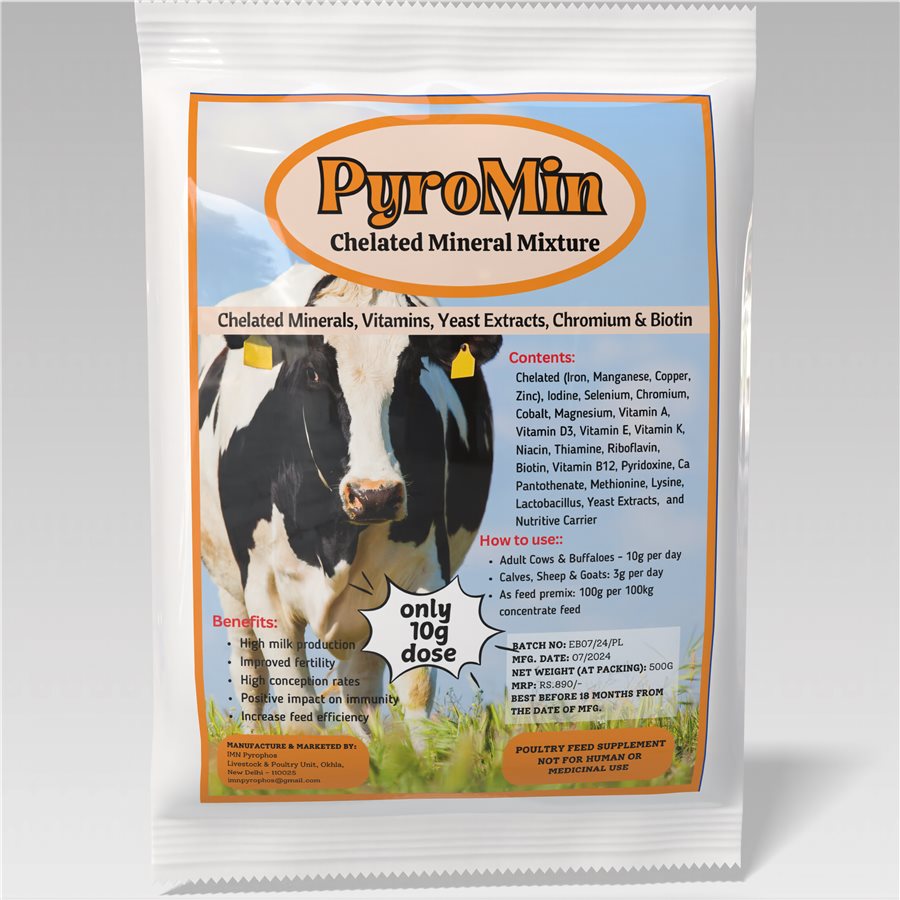
Chelated minerals
Pyromin
Chelated mineral mixture with iron, manganese, copper, zinc, iodine, selenium, chromium, cobalt and magnesium, vitamins A, D3, E, K and B vitamins, biotin, methionine, lysine, lactobacillus and yeast extract. Supports milk production, fertility, conception, immunity and feed efficiency.
Dose: Adult cow or buffalo 10 g per day; calves, sheep and goats 3 g per day. As a premix, 100 g per 100 kg of concentrate.
1 kg ₹655MRP ₹1,190
Calcium
The Ca content of pastures ranges from 0.43% for grass, and increases, as expected, with more legume in the pasture to about 1.3%. The NRC recommendation is that Ca be at least 0.65% of the total ration DM for high producing cows. Clearly, the grass pasture would need to be supplemented with additional Ca to meet the cow's needs. In table is shown average mineral contents of feedstuffs that typically would be used to supplement pasture-based feeding programs. With the exception of alfalfa hay, all feedstuffs are low in Ca compared to the lactating cow's needs. Therefore, additional supplementation of Ca is needed to ensure adequate daily intake with grass or mixed mostly grass-based pastures.
Phosphorus
Phosphorus supplementation is required with nearly all types of feeding programs. Pasture samples averaged about 0.25 to 0.30% P (Table) and all are low compared to the NRC recommendations of 0.40% of the total ration DM for milking cows. Many feedstuffs typically fed with pasture-based programs, particularly grains, are low in P (Table), thus, additional P supplementation is usually needed. Protein supplements such as soybean meal, corn distillers, and brewers grains are high in P (Table), but small amounts of these products are normally fed.
Magnesium
The NRC recommendation is that Mg be fed at 0.22% of the total ration DM. On spring pastures, which bring a risk of grass (Mg) tetany, a Mg level of 0.30 to 0.35% of the total ration DM or higher is often needed. Pasture Mg content averaged 0.20 to 0.28% being lowest on grass and increasing as the legume content increased (Table 2). Magnesium levels were lowest in the spring, emphasizing that supplemental Mg is most critical in the spring. Magnesium oxide is the most common source of supplemental Mg and should be added to the grain ration to bring the total ration Mg to at least 0.30%. Cows often will not consume all the allotted grain with lush pastures in the spring, thus other supplemental methods may be needed. Bolusing individual cows with MgO is one option. A free-choice mineral block with elevated Mg content can also be considered.
Need help with feeding or a health problem in your cows or buffaloes? Message Dr. Ibne Ali on WhatsApp.
WhatsApp: 98715 84101डेयरी पशुओं में खनिज (मिनरल) की ज़रूरत – सभी डेयरी गायों को खनिज चाहिए, और ज़्यादातर feed (हरा चारा, घास, अनाज, खल आदि) में मिलने वाली मात्रा ज़्यादा दूध उत्पादन या ग्रोथ के लिए आम तौर पर काफी नहीं होती। अगर यह ज़रूरत पूरी न हो, तो पशुओं में कमी के लक्षण दिखने लगते हैं। चरागाह भी इससे अलग नहीं हैं और NRC की ज़रूरतों की तुलना में अक्सर उनमें कई खनिजों की कमी होती है। चरागाह-आधारित खुराक में दाना (grain) मिलाने के बाद भी, ज़्यादातर राशन में कुछ खनिजों के गाढ़े स्रोत ऊपर से मिलाने पड़ते हैं। आम तौर पर खनिजों को "मैक्रो मिनरल" और "माइक्रो मिनरल" में बाँटा जाता है (टेबल)। मैक्रो मिनरल को आम तौर पर feed के dry matter के प्रतिशत (percent) में बताया जाता है। जो खनिज कम मात्रा में चाहिए, जिन्हें अक्सर trace minerals कहते हैं, उन्हें आम तौर पर parts per million (PPM) यानी प्रति 10 लाख भाग, या milligram प्रति किलोग्राम में बताया जाता है।
मैक्रो मिनरल – Calcium Phosphorus Magnesium Sodium Potassium Chlorine Sulfur
माइक्रो मिनरल – Iodine Iron Copper Cobalt Manganese Molybdenum Zinc Selenium Boron
कैल्शियम (Calcium)
चरागाह में Ca की मात्रा घास में 0.43% से शुरू होती है, और जैसा उम्मीद है, चरागाह में फलीदार (legume) चारा बढ़ने के साथ लगभग 1.3% तक बढ़ जाती है। NRC की सिफारिश है कि ज़्यादा दूध देने वाली गायों के लिए Ca कुल राशन DM का कम से कम 0.65% हो। साफ है कि घास वाले चरागाह में गाय की ज़रूरत पूरी करने के लिए अलग से Ca मिलाना होगा। टेबल में उन feed चीज़ों में खनिजों की औसत मात्रा दिखाई गई है जो आम तौर पर चरागाह-आधारित खुराक के साथ दी जाती हैं। Alfalfa hay को छोड़कर, सभी feed चीज़ों में दूध देने वाली गाय की ज़रूरत की तुलना में Ca कम है। इसलिए घास या ज़्यादातर घास वाले मिले-जुले चरागाह पर रोज़ाना पर्याप्त Ca पक्का करने के लिए अलग से Ca देना ज़रूरी है।
चिलेटेड मिनरल
Pyromin
चिलेटेड आयरन, मैंगनीज़, कॉपर, ज़िंक, आयोडीन, सेलेनियम, क्रोमियम, कोबाल्ट और मैग्नीशियम, विटामिन A, D3, E, K और B विटामिन, बायोटिन, मेथियोनीन, लाइसीन, लैक्टोबैसिलस और यीस्ट एक्सट्रैक्ट वाला मिनरल मिक्सचर। दूध उत्पादन, प्रजनन, गर्भधारण, इम्युनिटी और चारे के बेहतर उपयोग में सहायक।
मात्रा: वयस्क गाय या भैंस को 10 ग्राम प्रति दिन; बछड़े, भेड़ और बकरी को 3 ग्राम प्रति दिन। प्रीमिक्स के रूप में 100 ग्राम प्रति 100 किलो दाना।
1 kg ₹655MRP ₹1,190
फॉस्फोरस (Phosphorus)
लगभग हर तरह की खुराक में Phosphorus ऊपर से मिलाना ज़रूरी होता है। चरागाह के नमूनों में औसतन लगभग 0.25 से 0.30% P था (टेबल) और ये सभी दूध देने वाली गायों के लिए NRC की कुल राशन DM के 0.40% की सिफारिश से कम हैं। चरागाह-आधारित खुराक के साथ दी जाने वाली कई feed चीज़ें, खासकर अनाज, में P कम होता है (टेबल), इसलिए आम तौर पर अलग से P देना पड़ता है। Soybean meal, corn distillers और brewers grains जैसे प्रोटीन सप्लीमेंट में P ज़्यादा होता है (टेबल), लेकिन ये चीज़ें आम तौर पर कम मात्रा में खिलाई जाती हैं।
मैग्नीशियम (Magnesium)
NRC की सिफारिश है कि Mg कुल राशन DM का 0.22% दिया जाए। बसंत (spring) के चरागाहों पर, जहाँ grass (Mg) tetany का खतरा होता है, अक्सर कुल राशन DM का 0.30 से 0.35% या उससे ज़्यादा Mg चाहिए होता है। चरागाह में Mg औसतन 0.20 से 0.28% था, जो घास में सबसे कम था और legume बढ़ने के साथ बढ़ता गया (Table 2)। Magnesium का स्तर बसंत में सबसे कम था, जिससे साफ है कि अलग से Mg देना बसंत में सबसे ज़रूरी है। Magnesium oxide अलग से Mg देने का सबसे आम स्रोत है और इसे दाने (grain) के राशन में मिलाना चाहिए ताकि कुल राशन में Mg कम से कम 0.30% हो जाए। बसंत में हरे-भरे चरागाह होने पर गायें अक्सर दिया गया पूरा दाना नहीं खातीं, इसलिए दूसरे तरीके भी अपनाने पड़ सकते हैं। हर गाय को MgO का bolus देना एक विकल्प है। ज़्यादा Mg वाला free-choice mineral block (पशु जब चाहे चाट सके) भी रखा जा सकता है।
गाय-भैंस के दाने या बीमारी में मदद चाहिए? डॉ. इब्ने अली को WhatsApp कीजिए।
WhatsApp: 98715 84101Dairy Pashuon me Mineral ki Zarurat – Saari dairy gaayon ko minerals chahiye, aur zyadatar feed (hara chara, ghaas, anaaj, khal waghaira) me milne wali matra zyada doodh production ya growth ke liye aam taur par kaafi nahi hoti. Agar ye zarurat poori na ho, to pashuon me kami ke lakshan dikhne lagte hain. Charagah (pasture) bhi isse alag nahi hain aur NRC requirement ke mukable aksar unme kai minerals ki kami hoti hai. Pasture-based diet me grain (dana) milane ke baad bhi, zyadatar ration me kuch minerals ke concentrated source upar se milane padte hain. Aam taur par minerals ko "macrominerals" aur "microminerals" me baanta jaata hai (Table). Macrominerals ko aam taur par feed ke dry matter ke percent me bataya jaata hai. Jo minerals kam matra me chahiye, jinhe aksar trace minerals kehte hain, unhe aam taur par parts per million (PPM) yaani prati 10 lakh bhaag, ya milligram per kilogram me bataya jaata hai.
Macro Minerals – Calcium Phosphorus Magnesium Sodium Potassium Chlorine Sulfur
Micro Minerals – Iodine Iron Copper Cobalt Manganese Molybdenum Zinc Selenium Boron
Calcium
Pasture me Ca ki matra ghaas me 0.43% se shuru hoti hai, aur jaisa expected hai, pasture me legume (phalidaar chara) badhne ke saath lagbhag 1.3% tak badh jaati hai. NRC ki recommendation hai ki zyada doodh dene wali gaayon ke liye Ca total ration DM ka kam se kam 0.65% ho. Saaf hai ki ghaas wale pasture me gaay ki zarurat poori karne ke liye alag se Ca milana hoga. Table me un feed cheezon me minerals ki average matra dikhayi gayi hai jo aam taur par pasture-based feeding ke saath di jaati hain. Alfalfa hay ko chhodkar, saari feed cheezon me doodh dene wali gaay ki zarurat ke mukable Ca kam hai. Isliye ghaas ya zyadatar ghaas wale mixed pasture par roz kaafi Ca pakka karne ke liye alag se Ca supplement dena zaroori hai.
Chelated mineral
Pyromin
Chelated iron, manganese, copper, zinc, iodine, selenium, chromium, cobalt aur magnesium, vitamin A, D3, E, K aur B vitamin, biotin, methionine, lysine, lactobacillus aur yeast extract wala mineral mixture. Doodh utpadan, prajanan, garbh thaharne, immunity aur chaare ke behtar upyog me sahayak.
Matra: Vayask gaay ya bhains ko 10 g prati din; bachhde, bhed aur bakri ko 3 g prati din. Premix ke roop me 100 g prati 100 kg daana.
1 kg ₹655MRP ₹1,190
Phosphorus
Lagbhag har tarah ki feeding me phosphorus upar se milana zaroori hota hai. Pasture samples me average lagbhag 0.25 se 0.30% P tha (Table) aur ye sab doodh dene wali gaayon ke liye NRC ki total ration DM ke 0.40% ki recommendation se kam hain. Pasture-based feeding ke saath di jaane wali kai feed cheezein, khaaskar anaaj, me P kam hota hai (Table), isliye aam taur par alag se P dena padta hai. Soybean meal, corn distillers aur brewers grains jaise protein supplement me P zyada hota hai (Table), lekin ye cheezein aam taur par kam matra me khilayi jaati hain.
Magnesium
NRC ki recommendation hai ki Mg total ration DM ka 0.22% diya jaaye. Spring (basant) ke pasture par, jahan grass (Mg) tetany ka khatra hota hai, aksar total ration DM ka 0.30 se 0.35% ya usse zyada Mg chahiye hota hai. Pasture me Mg average 0.20 se 0.28% tha, jo ghaas me sabse kam tha aur legume badhne ke saath badhta gaya (Table 2). Magnesium level spring me sabse kam tha, jisse saaf hai ki alag se Mg dena spring me sabse zaroori hai. Magnesium oxide alag se Mg dene ka sabse common source hai aur ise grain ration me milana chahiye taaki total ration me Mg kam se kam 0.30% ho jaaye. Spring me hare-bhare pasture hone par gaayein aksar diya gaya poora grain nahi khaatin, isliye dusre tarike bhi apnane pad sakte hain. Har gaay ko MgO ka bolus dena ek option hai. Zyada Mg wala free-choice mineral block (pashu jab chahe chaat sake) bhi rakha ja sakta hai.
Gaay-bhains ke daane ya bimari me madad chahiye? Dr. Ibne Ali ko WhatsApp kijiye.
WhatsApp: 98715 84101