A Guide to Genetic Evaluations and Sire Selection in Dairy Cattle
1. Introduction and Purpose:
- The workbook aims to provide a basic understanding of genetics and dairy cattle breeding, which is essential for using sire summaries effectively.
- It emphasizes the importance of genetic evaluations in selecting superior parents and improving future generations.
- The document notes that genetic evaluations have become increasingly complex since their introduction in 1935.
- It highlights how an awareness of dairy cattle genetics can improve a herd's genetic progress.
2. Major Factors Influencing Genetic Change:
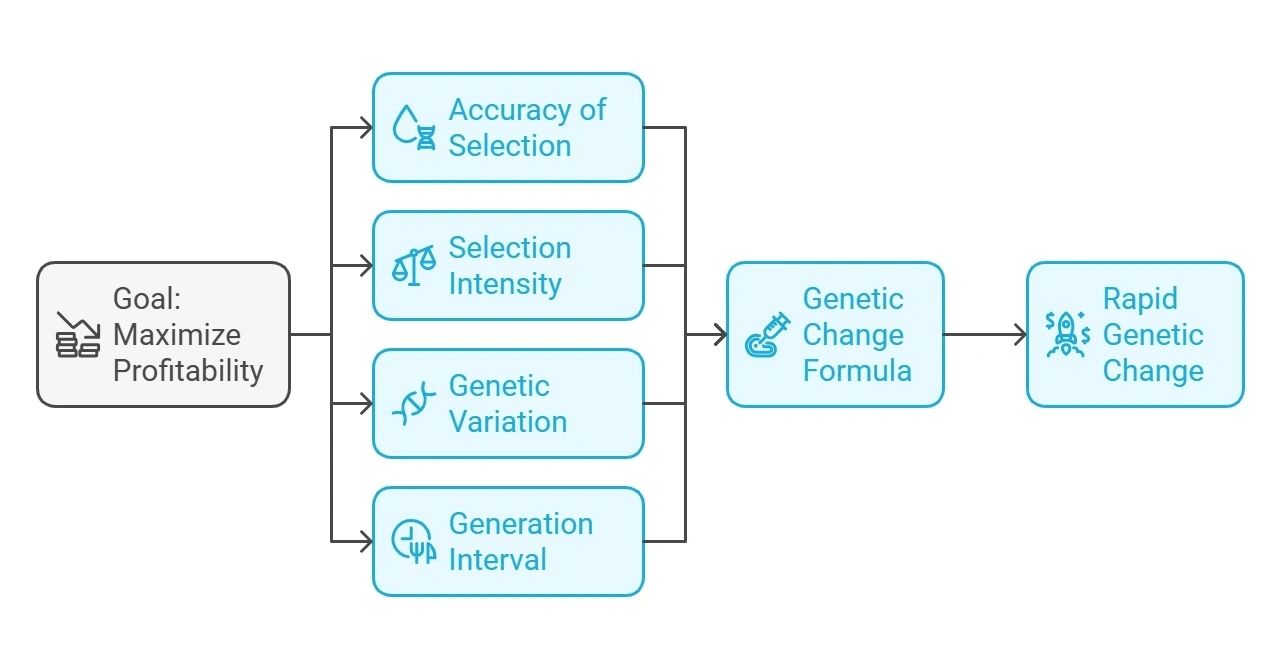
- The primary goal of dairy producers is to maximize profitability by having a genetically superior herd.
- Genetic change is permanent and accumulates over time.
- Four major factors influence genetic change:
- Accuracy of Selection: The ability to select animals that are genetically superior for a given trait. It depends on genetic evaluation techniques like the Animal Model.
- Selection Intensity: The proportion of animals kept as parents and their superiority compared to the average population.
- Genetic Variation: The relative differences among animals controlled by genetic factors, measured by the heritability of a trait.
- Generation Interval: The average age of a parent when offspring are born.
- The document provides a formula for calculating genetic change: Genetic Change = (Accuracy of Selection x Selection Intensity x Genetic Variation) / Generation Interval.
- Rapid genetic change is achieved with high accuracy of selection, genetically superior parents, highly heritable traits, and shorter generation intervals.
3. Definitions of Genetic Terms:
- Cell: The smallest structural unit of an organism, containing genetic material in the nucleus.
- Chromosomes: Structures in the cell nucleus that contain genes, with dairy cattle having 30 pairs. Humans have 23 pairs.
- DNA: Deoxyribonucleic acid, the chemical component of chromosomes, arranged in a double helix structure.
- Genes: Hereditary units that determine an animal’s characteristics and are part of DNA.
- Locus: The region on a chromosome where a particular gene is located.
- Allele: One component of a gene pair at a given locus.
- Meiosis: Cell division that creates sperm and eggs, each containing half the number of chromosomes as other cells. A random sample of one allele from each locus is found in the sperm and eggs.
- Mendelian Segregation: The random process during meiosis determining which allele of each gene is in a sperm or egg.
- Phenotype: The observable or measurable characteristics of an animal (e.g., milk record or classification score).
- Genotype: The actual genes an animal possesses for a trait. In quantitative traits, genotype is expressed as the breeding value.
- Dominant-Recessive: At each locus there are two alleles. In some cases, one allele is dominant over the other in determining the trait. An example is coat color in Holsteins, where black is dominant (B) and red is recessive (b).
- Heterozygous: An animal with two different alleles at a locus (e.g., Bb).
- Homozygous: An animal with two identical alleles at a locus (e.g., BB or bb).
- Qualitative Traits: Traits controlled by one gene pair, with a direct relationship between genotype and phenotype, such as sex or hair color.
- Quantitative Traits: Traits controlled by many genes, with each gene having a small effect, such as milk production and fat percentage. These traits are also significantly influenced by the environment.
- Environment: The external conditions that influence an animal's production and quantitative traits. A majority of the difference in cow's production is attributed to the environment.
- Environmental Variance: The difference in performance due to environmental effects. Genetic evaluations account for this variance.
- Breeding Value: The total genetic ability of an animal for a given trait, with each parent contributing half.
- Transmitting Ability: An estimate of the average genetic merit passed from parent to offspring (half of the breeding value).
- Heritability: The proportion of variation in a trait due to genetic factors, ranging from 0.0 to 1.0. Higher heritability leads to faster genetic progress.
- Generation Interval: The average age of a parent when offspring are born. A shorter generation interval increases the rate of genetic change.
- Inbreeding: Mating closely related animals, which can increase homozygosity and undesirable recessive traits, and negatively affect health, vigor, and production.
- Crossbreeding: Mating purebreds from different breeds to improve performance, health, and reproductive performance.
- Correlated Response: Genetic changes in other traits when selecting for one trait.
- Variation: Differences in genetic merit due to random sampling of alleles.
- Undesirable Recessives: Defects that may cause poor health or death, usually controlled by one gene. If an animal is homozygous for the recessive allele, the condition will be expressed.
- Progeny: An animal’s offspring.
4. Genetic Evaluations:
- Genetic evaluations are updated by the USDA and breed associations to provide accurate information for dairy breeders.
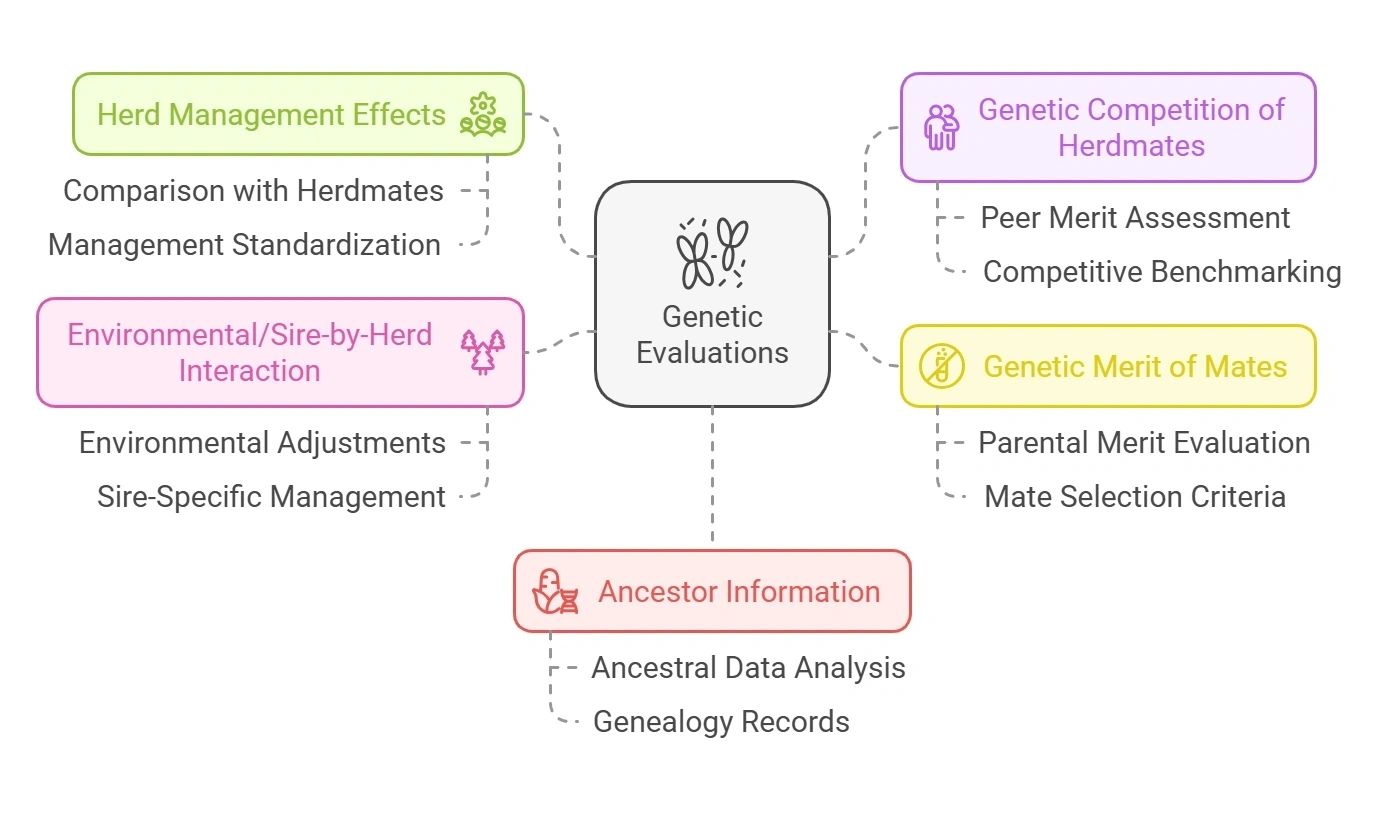
- The Animal Model is the current method for genetic evaluations. It accounts for environmental and genetic factors to minimize inaccurate and biased proofs.
- Factors considered in genetic evaluations include:
- Herd Management Effects: Comparing daughters of bulls with their herdmates to minimize differences due to herd management.
- Genetic Competition of Herdmates: Accounting for the genetic merit of herdmates.
- Genetic Merit of Mates: Considering the genetic merit of the other parent when evaluating an animal.
- Environmental/Sire-by-Herd Interaction: Addressing management differences for daughters of different bulls.
- Ancestor Information: Including ancestor information in calculations.
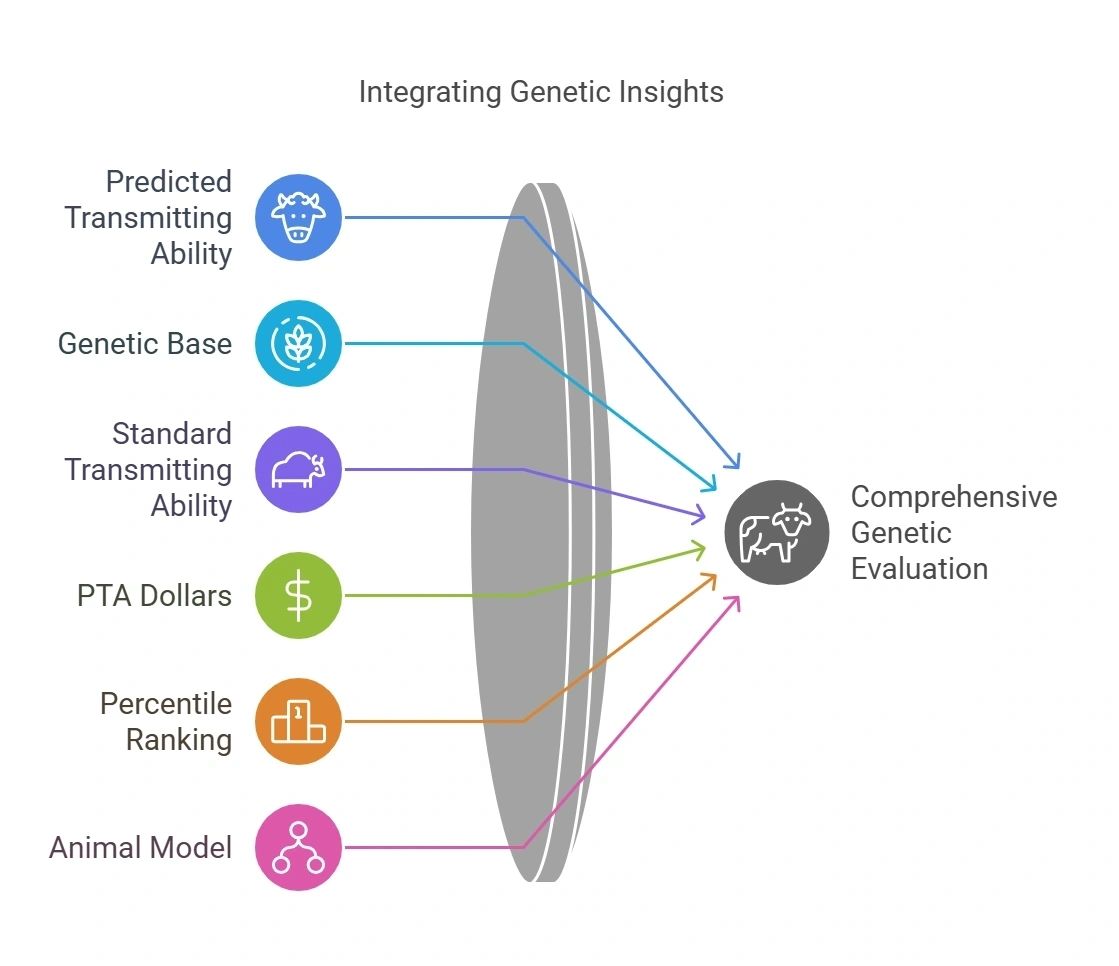
- Predicted Transmitting Ability (PTA): An estimate of genetic superiority an animal will transmit to its offspring. PTAs are calculated for various traits, including milk, fat, protein, somatic cell score, productive life, net merit, and final type score.
- Genetic Base: A reference point for genetic evaluations, with the average PTA for all cows born in a certain year set to zero. The base changes every five years.
- Standard Transmitting Ability (STA): Standardized values for linear type traits used because each trait has a different average PTA, and the ranges vary within traits. The average STA is 0.
- PTA Dollars (PTA$): An economic index combining relative values of milk and its components.
- Percentile: Indicates how an animal ranks relative to others. Bulls are ranked on Net Merit, while USDA's Elite Cow list is based on the percentile ranking for MFP$.
- Animal Model: Implemented in 1989, it incorporates information from the animal, its ancestors, and its progeny, using all records of female ancestors and descendants.
- Linear Composite Indexes: Combine linear descriptive type information into single number values for Udder (UD), Feet and Legs (FL), Body Form (BD), and Dairy Capacity (D).
5. What are Sire Summaries:
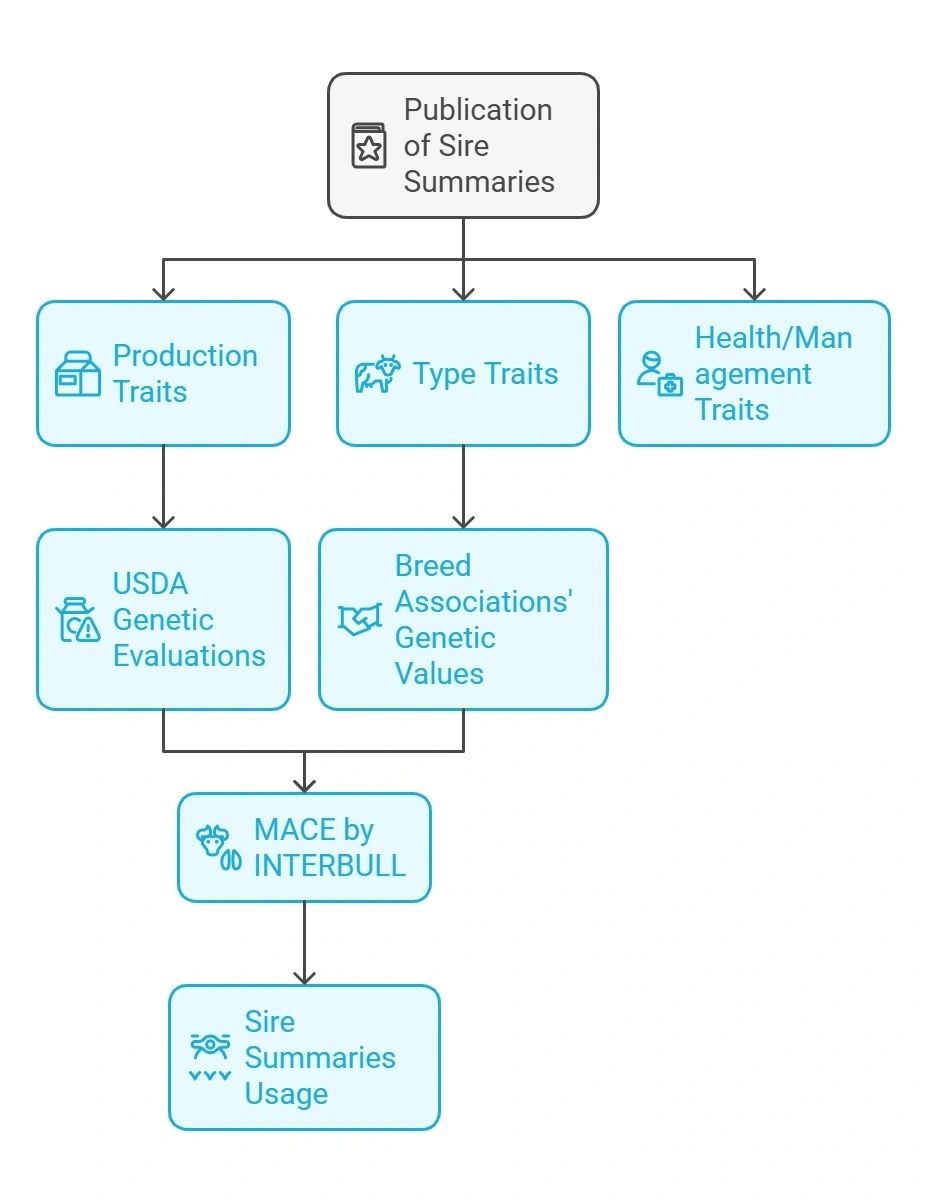
- Sire summaries are publications by breed organizations containing genetic information on production and type traits.
- They include information on production traits (milk, fat, protein), type traits (final score, linear traits, composite indexes), and health/management traits (productive life, somatic cell score, calving ease, daughter pregnancy rate).
- The USDA calculates genetic evaluations for production quarterly. Breed associations compute genetic values for type traits.
- The first Holstein sire summary was published in 1967 and has evolved over time.
- Multiple-trait Across Country Evaluations (MACE) are released by INTERBULL to compare sires from different countries.
- Sire summaries assist dairy producers, A.I. organizations, and others with breeding, merchandising, and marketing decisions.
6. Parts of the Sire Summaries:
- Holstein sire summaries are published three times a year and divided into sections.
- Section 1 includes the Top 100 TPI bulls with high reliability and the Top 50 Sire Lists for various traits.
- Section 1 contains production and type information on the top 400 TPI bulls with available semen and high genetic rankings. It also includes a linear profile and proof block for each sire.
- Section 2 includes limited genetic information on Active, Limited, or Foreign bulls.
- Section 3 includes the top 100 TPI Inactive Sires and Top 100 TPI Sires with high reliability, as well as Red and Red Carrier Sires ranked by TPI and the Top 100 TPI International Bulls.
7. How to Read Sire Information (Practical Step by Step Protocol):
The document provides a detailed guide on how to read sire information, which can be summarized as follows:
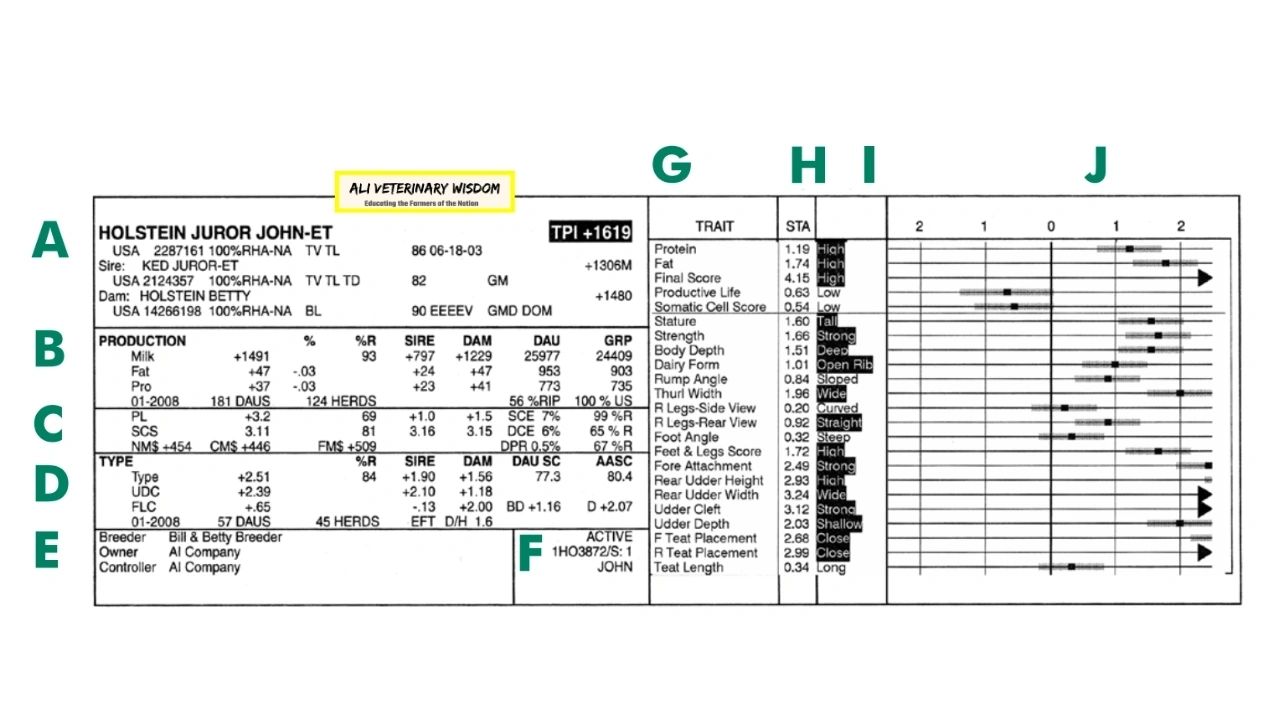
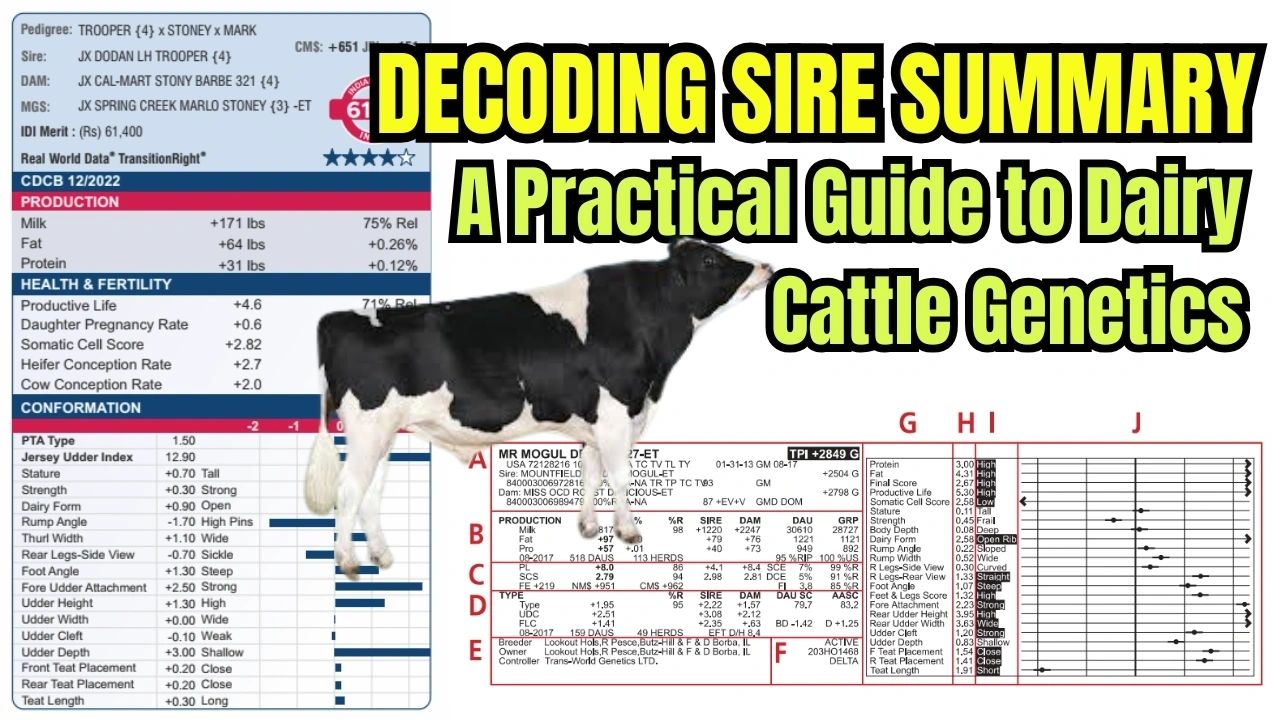
- Block A: Identification and Pedigree Information:
- Line 1: Bull's Registration Name and Total Performance Index (TPI).
- Line 2: Nation Code, Registration Number, %RHA, Genetic Test Results, Final Score, Birth Date, and Recognitions.
- Line 3: Sire’s Name and TPI Value.
- Line 4: Sire’s Nation Code, Registration Number, %RHA, Genetic Test Results, Classification Score, Recognitions.
- Line 5: Dam’s Name and CTPI Value.
- Line 6: Dam’s Nation Code, Registration Number, %RHA, Genetic Test Results, Final Score, Classification Breakdowns, and Recognitions.
- Block B: Production Summary:
- Line 1: Milk: PTA, % Reliability, Sire’s PTA, Dam’s PTA, Daughter Averages, and Management Group Average.
- Line 2: Fat: PTA, PTA %, Sire’s PTA, Dam’s PTA, Daughter Averages, and Management Group Average.
- Line 3: Protein: PTA, PTA %, Sire’s PTA, Dam’s PTA, Daughter Averages, and Management Group Average.
- Line 4: Evaluation Date, Number of Daughters and Herds, Percentage of Records in Progress (RIP), and Percentage of Daughters in U.S..
- Block C: Additional Genetic Information:
- Line 1: Productive Life: % Reliability, Sire’s PTA, Dam’s PTA.
- Line 2: Somatic Cell Score (SCS): PTA, % Reliability, Sire’s PTA, Dam’s PTA, % Difficult Births in Heifers (Calving Ease), and Calving Ease % Reliability.
- Line 3: Net Merit ($), Cheese Merit (CM$), and Fluid Merit (FM$).
- Block D: Type Summary:
- Line 1: Type: PTA, % Reliability, Sire’s PTA, Dam’s PTA, Daughter Averages for Final Score (SC), and Average Age Adjusted Score (AASC).
- Line 2: Udder Composite (UDC): Linear Composite Index for Udder (UDC), Sire’s UDC, and Dam’s UDC.
- Line 3: Feet & Legs Composite (FLC): Linear Composite Index for Feet & Legs (FLC), Sire’s FLC, Dam’s FLC, Body Size, and Dairy Capacity.
- Line 4: Evaluation Date, Number of Daughters and Herds, and Effective Daughters per Herd (EFT D/H).
- Block E: Ownership Information:
- Line 1: Name and State of the Bull’s Breeder.
- Line 2: Name and State of the Bull’s Owner or Lessee.
- Line 3: Name of the Bull’s Controller.
- Block F: NAAB Data Information:
- Line 1: Semen Status.
- Line 2: NAAB Number and Sampling Code, Sampler Controller Number.
- Line 3: Short Name.
- Block G: Trait Name Block: Displays the names of 23 traits for which STA values are graphed.
- Block H: Standard Transmitting Ability (STA): Displays STAs for each of the 23 traits.
- Block I: Biological Extremes: Highlights traits where a bull's STA is in the top 20% of the available bull population.
- Block J: Trait Profiles: A graphic representation of the STA and Confidence Range for each trait.
8. Genetics in the Future:
- The document discusses several techniques used to accelerate genetic improvements:
- Embryo Transfer (ET): Increases selection intensity and reduces generation intervals by producing more offspring from elite dams.
- Cloning: Creates multiple copies of an embryo.
- Multiple Ovulation and Embryo Transfer (MOET): A process designed to increase genetic improvement by comparing progeny within a single herd.
- Transgenic Animals: Involves injecting DNA into one cell embryos to introduce specific desirable genes from other species.
- Genetic Markers: Identifies structural differences in DNA to link specific production traits with patterns.
- Embryo Sexing: A process to determine the sex of an embryo before implantation.
Need help with feeding or a health problem in your cows or buffaloes? Message Dr. Ibne Ali on WhatsApp.
WhatsApp: 98715 84101डेयरी पशुओं में genetic evaluation और साँड़ (sire) चुनने की गाइड
1. परिचय और मकसद:
- इस workbook का मकसद genetics और डेयरी पशु प्रजनन (breeding) की बुनियादी समझ देना है, जो sire summary को सही तरह इस्तेमाल करने के लिए ज़रूरी है।
- इसमें बताया गया है कि अच्छे माता-पिता चुनने और आने वाली पीढ़ियों को बेहतर बनाने में genetic evaluation कितना अहम है।
- दस्तावेज़ में बताया गया है कि 1935 में शुरुआत के बाद से genetic evaluation लगातार ज़्यादा जटिल होते गए हैं।
- इसमें यह भी बताया गया है कि डेयरी पशु genetics की जानकारी से झुंड (herd) की genetic तरक्की कैसे बेहतर हो सकती है।
2. Genetic बदलाव पर असर डालने वाले मुख्य कारण:
- डेयरी किसानों का मुख्य लक्ष्य genetically बेहतर झुंड बनाकर ज़्यादा से ज़्यादा मुनाफ़ा कमाना है।
- Genetic बदलाव पक्का (permanent) होता है और समय के साथ जुड़ता जाता है।
- Genetic बदलाव पर चार मुख्य कारण असर डालते हैं:
- चुनाव की सटीकता (Accuracy of Selection): किसी गुण (trait) के लिए genetically बेहतर पशुओं को चुनने की क्षमता। यह Animal Model जैसी genetic evaluation तकनीकों पर निर्भर करती है।
- चुनाव की सख़्ती (Selection Intensity): माता-पिता के रूप में रखे गए पशुओं का अनुपात और औसत आबादी की तुलना में उनकी श्रेष्ठता।
- Genetic विविधता (Genetic Variation): पशुओं के बीच genetic कारणों से होने वाला आपसी फ़र्क, जिसे किसी गुण की heritability से मापा जाता है।
- पीढ़ी का अंतर (Generation Interval): बच्चे पैदा होने के समय माता-पिता की औसत उम्र।
- दस्तावेज़ में genetic बदलाव निकालने का फ़ॉर्मूला दिया गया है: Genetic Change = (Accuracy of Selection x Selection Intensity x Genetic Variation) / Generation Interval।
- तेज़ genetic बदलाव तब होता है जब चुनाव की सटीकता ज़्यादा हो, माता-पिता genetically बेहतर हों, गुण ज़्यादा heritable हों, और पीढ़ी का अंतर छोटा हो।
3. Genetic शब्दों के मतलब:
- Cell (कोशिका): किसी जीव की सबसे छोटी बनावटी इकाई, जिसके nucleus में genetic material होता है।
- Chromosomes: Cell के nucleus में मौजूद ढाँचे जिनमें genes होते हैं; डेयरी पशुओं में 30 जोड़े होते हैं। इंसानों में 23 जोड़े होते हैं।
- DNA: Deoxyribonucleic acid, chromosomes का रासायनिक हिस्सा, जो double helix (दोहरी घुमावदार सीढ़ी) की बनावट में होता है।
- Genes: विरासत की इकाइयाँ जो पशु के गुण तय करती हैं और DNA का हिस्सा होती हैं।
- Locus: Chromosome पर वह जगह जहाँ कोई खास gene होता है।
- Allele: किसी locus पर gene जोड़े का एक हिस्सा।
- Meiosis: Cell का विभाजन जिससे शुक्राणु (sperm) और अंडाणु (egg) बनते हैं, जिनमें बाकी cells के मुकाबले आधे chromosomes होते हैं। Sperm और egg में हर locus से एक allele बेतरतीब (random) तरीके से आता है।
- Mendelian Segregation: Meiosis के दौरान होने वाली random प्रक्रिया जो तय करती है कि हर gene का कौन सा allele sperm या egg में जाएगा।
- Phenotype: पशु के दिखने या मापे जा सकने वाले गुण (जैसे दूध का रिकॉर्ड या classification score)।
- Genotype: किसी गुण के लिए पशु में असल में मौजूद genes। Quantitative गुणों में genotype को breeding value के रूप में बताया जाता है।
- Dominant-Recessive: हर locus पर दो alleles होते हैं। कुछ मामलों में गुण तय करने में एक allele दूसरे पर भारी (dominant) होता है। इसका उदाहरण Holstein में चमड़ी/बालों का रंग है, जहाँ काला dominant (B) और लाल recessive (b) है।
- Heterozygous: ऐसा पशु जिसके एक locus पर दो अलग-अलग alleles हों (जैसे Bb)।
- Homozygous: ऐसा पशु जिसके एक locus पर दो एक जैसे alleles हों (जैसे BB या bb)।
- Qualitative गुण: एक gene जोड़े से नियंत्रित गुण, जिनमें genotype और phenotype का सीधा संबंध होता है, जैसे नर-मादा होना या बालों का रंग।
- Quantitative गुण: कई genes से नियंत्रित गुण, जिनमें हर gene का असर थोड़ा होता है, जैसे दूध उत्पादन और fat प्रतिशत। इन गुणों पर वातावरण का भी काफ़ी असर होता है।
- Environment (वातावरण): बाहरी हालात जो पशु के उत्पादन और quantitative गुणों पर असर डालते हैं। गायों के उत्पादन में ज़्यादातर फ़र्क वातावरण की वजह से होता है।
- Environmental Variance: वातावरण के असर से performance में फ़र्क। Genetic evaluation इस फ़र्क को हिसाब में लेते हैं।
- Breeding Value: किसी गुण के लिए पशु की कुल genetic क्षमता, जिसमें हर माता-पिता आधा हिस्सा देता है।
- Transmitting Ability: माता-पिता से बच्चे में जाने वाली औसत genetic योग्यता का अनुमान (breeding value का आधा)।
- Heritability: किसी गुण में genetic कारणों से होने वाली विविधता का अनुपात, जो 0.0 से 1.0 तक होता है। Heritability ज़्यादा हो तो genetic तरक्की तेज़ होती है।
- Generation Interval: बच्चे पैदा होने के समय माता-पिता की औसत उम्र। छोटा generation interval genetic बदलाव की रफ़्तार बढ़ाता है।
- Inbreeding: करीबी रिश्ते वाले पशुओं का मिलान, जिससे homozygosity और अनचाहे recessive गुण बढ़ सकते हैं, और सेहत, ताक़त और उत्पादन पर बुरा असर पड़ सकता है।
- Crossbreeding: Performance, सेहत और प्रजनन क्षमता सुधारने के लिए अलग-अलग नस्लों के शुद्ध पशुओं का मिलान।
- Correlated Response: एक गुण के लिए चुनाव करने पर दूसरे गुणों में होने वाले genetic बदलाव।
- Variation: Alleles के random चुनाव की वजह से genetic योग्यता में फ़र्क।
- Undesirable Recessives (अनचाहे recessive): ऐसे दोष जो खराब सेहत या मौत का कारण बन सकते हैं, आम तौर पर एक gene से नियंत्रित। अगर पशु recessive allele के लिए homozygous है, तो वह दोष दिखेगा।
- Progeny: पशु की संतान।
4. Genetic Evaluations:
- डेयरी breeders को सही जानकारी देने के लिए USDA और breed associations genetic evaluation को अपडेट करते रहते हैं।
- Genetic evaluation का मौजूदा तरीका Animal Model है। यह वातावरण और genetic दोनों कारणों को हिसाब में लेता है ताकि गलत और पक्षपाती proofs कम से कम हों।
- Genetic evaluation में इन बातों पर ध्यान दिया जाता है:
- झुंड प्रबंधन का असर (Herd Management Effects): साँड़ों की बेटियों की तुलना उसी झुंड की दूसरी गायों (herdmates) से करना, ताकि झुंड प्रबंधन के फ़र्क का असर कम हो।
- Herdmates की genetic टक्कर: साथ की गायों की genetic योग्यता को हिसाब में लेना।
- साथी (mate) की genetic योग्यता: किसी पशु को आँकते समय दूसरे माता/पिता की genetic योग्यता को ध्यान में रखना।
- Environmental/Sire-by-Herd Interaction: अलग-अलग साँड़ों की बेटियों के प्रबंधन में फ़र्क को संभालना।
- पूर्वजों की जानकारी: हिसाब में पूर्वजों (ancestors) की जानकारी शामिल करना।
- Predicted Transmitting Ability (PTA): पशु अपनी संतान को कितनी genetic श्रेष्ठता देगा, इसका अनुमान। PTA कई गुणों के लिए निकाला जाता है, जैसे दूध, fat, protein, somatic cell score, productive life, net merit, और final type score।
- Genetic Base: Genetic evaluation का एक reference point, जिसमें किसी खास साल में पैदा हुई सभी गायों का औसत PTA शून्य माना जाता है। Base हर पाँच साल में बदलता है।
- Standard Transmitting Ability (STA): Linear type गुणों के लिए standard मान, क्योंकि हर गुण का औसत PTA अलग होता है और गुणों के अंदर range भी अलग होती है। औसत STA 0 होता है।
- PTA Dollars (PTA$): एक आर्थिक index जो दूध और उसके घटकों के आपसी मूल्य को जोड़ता है।
- Percentile: बताता है कि पशु दूसरों के मुकाबले किस स्थान पर है। साँड़ों को Net Merit पर रैंक किया जाता है, जबकि USDA की Elite Cow list MFP$ की percentile ranking पर आधारित है।
- Animal Model: 1989 में लागू हुआ; इसमें पशु, उसके पूर्वजों और उसकी संतान की जानकारी शामिल होती है, और मादा पूर्वजों और वंशजों के सभी रिकॉर्ड इस्तेमाल होते हैं।
- Linear Composite Indexes: Linear descriptive type जानकारी को Udder (UD), Feet and Legs (FL), Body Form (BD), और Dairy Capacity (D) के लिए एक-एक नंबर में जोड़ते हैं।
5. Sire Summary क्या है:
- Sire summary नस्ल संगठनों (breed organizations) की प्रकाशित किताबें/रिपोर्ट हैं, जिनमें उत्पादन और type गुणों की genetic जानकारी होती है।
- इनमें उत्पादन गुणों (दूध, fat, protein), type गुणों (final score, linear traits, composite indexes), और सेहत/प्रबंधन गुणों (productive life, somatic cell score, calving ease, daughter pregnancy rate) की जानकारी होती है।
- USDA उत्पादन के लिए genetic evaluation हर तीन महीने में निकालता है। Type गुणों के genetic मान breed associations निकालते हैं।
- पहली Holstein sire summary 1967 में छपी थी और समय के साथ इसमें बदलाव होते गए।
- अलग-अलग देशों के साँड़ों की तुलना के लिए INTERBULL, Multiple-trait Across Country Evaluations (MACE) जारी करता है।
- Sire summary डेयरी किसानों, A.I. संगठनों और दूसरों को breeding, खरीद-बिक्री और marketing के फ़ैसलों में मदद करती है।
6. Sire Summary के हिस्से:
- Holstein sire summary साल में तीन बार छपती है और कई हिस्सों में बँटी होती है।
- Section 1 में ज़्यादा reliability वाले Top 100 TPI साँड़ और अलग-अलग गुणों के लिए Top 50 Sire Lists होती हैं।
- Section 1 में उपलब्ध semen और ऊँची genetic ranking वाले top 400 TPI साँड़ों की उत्पादन और type जानकारी होती है। इसमें हर साँड़ का linear profile और proof block भी होता है।
- Section 2 में Active, Limited, या Foreign साँड़ों की सीमित genetic जानकारी होती है।
- Section 3 में top 100 TPI Inactive Sires और ज़्यादा reliability वाले Top 100 TPI Sires, साथ ही TPI के हिसाब से रैंक किए गए Red और Red Carrier Sires और Top 100 TPI International Bulls होते हैं।
7. Sire की जानकारी कैसे पढ़ें (व्यावहारिक कदम-दर-कदम तरीका):
दस्तावेज़ में sire की जानकारी पढ़ने की विस्तृत गाइड दी गई है, जिसे इस तरह समझा जा सकता है:
- Block A: पहचान और वंशावली (Pedigree) की जानकारी:
- Line 1: साँड़ का Registration Name और Total Performance Index (TPI)।
- Line 2: Nation Code, Registration Number, %RHA, Genetic Test Results, Final Score, जन्म तिथि, और Recognitions।
- Line 3: पिता (Sire) का नाम और TPI Value।
- Line 4: पिता का Nation Code, Registration Number, %RHA, Genetic Test Results, Classification Score, Recognitions।
- Line 5: माँ (Dam) का नाम और CTPI Value।
- Line 6: माँ का Nation Code, Registration Number, %RHA, Genetic Test Results, Final Score, Classification Breakdowns, और Recognitions।
- Block B: उत्पादन का सार (Production Summary):
- Line 1: Milk: PTA, % Reliability, पिता का PTA, माँ का PTA, बेटियों का औसत, और Management Group Average।
- Line 2: Fat: PTA, PTA %, पिता का PTA, माँ का PTA, बेटियों का औसत, और Management Group Average।
- Line 3: Protein: PTA, PTA %, पिता का PTA, माँ का PTA, बेटियों का औसत, और Management Group Average।
- Line 4: Evaluation की तारीख, बेटियों और झुंडों की संख्या, Records in Progress (RIP) का प्रतिशत, और U.S. में बेटियों का प्रतिशत।
- Block C: अतिरिक्त genetic जानकारी:
- Line 1: Productive Life: % Reliability, पिता का PTA, माँ का PTA।
- Line 2: Somatic Cell Score (SCS): PTA, % Reliability, पिता का PTA, माँ का PTA, बछियों (heifers) में मुश्किल ब्यांत का % (Calving Ease), और Calving Ease % Reliability।
- Line 3: Net Merit ($), Cheese Merit (CM$), और Fluid Merit (FM$)।
- Block D: Type का सार (Type Summary):
- Line 1: Type: PTA, % Reliability, पिता का PTA, माँ का PTA, Final Score (SC) के लिए बेटियों का औसत, और Average Age Adjusted Score (AASC)।
- Line 2: Udder Composite (UDC): Udder के लिए Linear Composite Index (UDC), पिता का UDC, और माँ का UDC।
- Line 3: Feet & Legs Composite (FLC): Feet & Legs के लिए Linear Composite Index (FLC), पिता का FLC, माँ का FLC, Body Size, और Dairy Capacity।
- Line 4: Evaluation की तारीख, बेटियों और झुंडों की संख्या, और Effective Daughters per Herd (EFT D/H)।
- Block E: मालिकाना जानकारी:
- Line 1: साँड़ के Breeder का नाम और State।
- Line 2: साँड़ के मालिक या पट्टेदार (Lessee) का नाम और State।
- Line 3: साँड़ के Controller का नाम।
- Block F: NAAB Data की जानकारी:
- Line 1: Semen Status।
- Line 2: NAAB Number और Sampling Code, Sampler Controller Number।
- Line 3: छोटा नाम (Short Name)।
- Block G: Trait Name Block: उन 23 गुणों के नाम दिखाता है जिनके STA मान graph में दिखाए जाते हैं।
- Block H: Standard Transmitting Ability (STA): 23 गुणों में से हर एक का STA दिखाता है।
- Block I: Biological Extremes: उन गुणों को उभारता है जिनमें साँड़ का STA उपलब्ध साँड़ों में top 20% में है।
- Block J: Trait Profiles: हर गुण के STA और Confidence Range का graph के रूप में चित्र।
8. भविष्य में genetics:
- दस्तावेज़ में genetic सुधार तेज़ करने वाली कई तकनीकों पर बात की गई है:
- Embryo Transfer (ET): बेहतरीन माँओं (elite dams) से ज़्यादा संतान पैदा करके selection intensity बढ़ाता है और generation interval घटाता है।
- Cloning: एक embryo की कई प्रतियाँ बनाना।
- Multiple Ovulation and Embryo Transfer (MOET): एक ही झुंड के अंदर संतान की तुलना करके genetic सुधार बढ़ाने के लिए बनाई गई प्रक्रिया।
- Transgenic पशु: दूसरी प्रजातियों के खास अच्छे genes डालने के लिए एक cell वाले embryo में DNA inject करना।
- Genetic Markers: DNA में बनावट के फ़र्क पहचानना, ताकि खास उत्पादन गुणों को patterns से जोड़ा जा सके।
- Embryo Sexing: Embryo को गर्भाशय में रखने (implantation) से पहले उसका लिंग (नर या मादा) पता करने की प्रक्रिया।
गाय-भैंस के दाने या बीमारी में मदद चाहिए? डॉ. इब्ने अली को WhatsApp कीजिए।
WhatsApp: 98715 84101Dairy pashuon me genetic evaluation aur saand (sire) chunne ki guide
1. Introduction aur maqsad:
- Is workbook ka maqsad genetics aur dairy pashu breeding ki basic samajh dena hai, jo sire summary ko sahi tarah use karne ke liye zaruri hai.
- Isme bataya gaya hai ki achhe maa-baap chunne aur aane wali peedhiyon ko behtar banane me genetic evaluation kitna important hai.
- Document me bataya gaya hai ki 1935 me shuru hone ke baad se genetic evaluation lagatar zyada complex hote gaye hain.
- Isme ye bhi bataya gaya hai ki dairy pashu genetics ki jaankari se herd (jhund) ki genetic tarakki kaise behtar ho sakti hai.
2. Genetic badlav par asar daalne wale main kaaran:
- Dairy kisano ka main goal genetically behtar herd bana kar zyada se zyada profit kamana hai.
- Genetic badlav pakka (permanent) hota hai aur samay ke saath judta jaata hai.
- Genetic badlav par chaar main kaaran asar daalte hain:
- Chunav ki sateekta (Accuracy of Selection): Kisi gun (trait) ke liye genetically behtar pashuon ko chunne ki kshamta. Ye Animal Model jaisi genetic evaluation techniques par depend karti hai.
- Chunav ki sakhti (Selection Intensity): Maa-baap ke roop me rakhe gaye pashuon ka anupat aur average population ke mukable unki shreshthata.
- Genetic Variation: Pashuon ke beech genetic kaaranon se hone wala aapsi farak, jise kisi gun ki heritability se naapa jaata hai.
- Peedhi ka antar (Generation Interval): Bachhe paida hone ke samay maa-baap ki average umar.
- Document me genetic badlav nikalne ka formula diya gaya hai: Genetic Change = (Accuracy of Selection x Selection Intensity x Genetic Variation) / Generation Interval.
- Tez genetic badlav tab hota hai jab chunav ki sateekta zyada ho, maa-baap genetically behtar hon, gun zyada heritable hon, aur generation interval chhota ho.
3. Genetic shabdon ke matlab:
- Cell (koshika): Kisi jeev ki sabse chhoti banawati unit, jiske nucleus me genetic material hota hai.
- Chromosomes: Cell ke nucleus me maujood dhaanche jinme genes hote hain; dairy pashuon me 30 jode hote hain. Insaanon me 23 jode hote hain.
- DNA: Deoxyribonucleic acid, chromosomes ka chemical hissa, jo double helix (dohri ghumawdar seedhi) ki banawat me hota hai.
- Genes: Virasat ki units jo pashu ke gun tay karti hain aur DNA ka hissa hoti hain.
- Locus: Chromosome par wo jagah jahan koi khaas gene hota hai.
- Allele: Kisi locus par gene jode ka ek hissa.
- Meiosis: Cell ka division jisse sperm aur egg bante hain, jinme baaki cells ke mukable aadhe chromosomes hote hain. Sperm aur egg me har locus se ek allele random tareeke se aata hai.
- Mendelian Segregation: Meiosis ke dauran hone wali random process jo tay karti hai ki har gene ka kaun sa allele sperm ya egg me jayega.
- Phenotype: Pashu ke dikhne ya naape ja sakne wale gun (jaise doodh ka record ya classification score).
- Genotype: Kisi gun ke liye pashu me asal me maujood genes. Quantitative gunon me genotype ko breeding value ke roop me bataya jaata hai.
- Dominant-Recessive: Har locus par do alleles hote hain. Kuch cases me gun tay karne me ek allele doosre par bhaari (dominant) hota hai. Iska example Holstein me baalon/chamdi ka rang hai, jahan kaala dominant (B) aur laal recessive (b) hai.
- Heterozygous: Aisa pashu jiske ek locus par do alag-alag alleles hon (jaise Bb).
- Homozygous: Aisa pashu jiske ek locus par do ek jaise alleles hon (jaise BB ya bb).
- Qualitative gun: Ek gene jode se control hone wale gun, jinme genotype aur phenotype ka seedha rishta hota hai, jaise nar-maada hona ya baalon ka rang.
- Quantitative gun: Kai genes se control hone wale gun, jinme har gene ka asar thoda hota hai, jaise doodh production aur fat percentage. In gunon par mahaul (environment) ka bhi kaafi asar hota hai.
- Environment (mahaul): Bahari halaat jo pashu ke production aur quantitative gunon par asar daalte hain. Gaayon ke production me zyadatar farak mahaul ki wajah se hota hai.
- Environmental Variance: Mahaul ke asar se performance me farak. Genetic evaluation is farak ko hisaab me lete hain.
- Breeding Value: Kisi gun ke liye pashu ki total genetic kshamta, jisme maa aur baap dono aadha-aadha hissa dete hain.
- Transmitting Ability: Maa-baap se bachhe me jaane wali average genetic yogyata ka andaza (breeding value ka aadha).
- Heritability: Kisi gun me genetic kaaranon se hone wale variation ka anupat, jo 0.0 se 1.0 tak hota hai. Heritability zyada ho to genetic tarakki tez hoti hai.
- Generation Interval: Bachhe paida hone ke samay maa-baap ki average umar. Chhota generation interval genetic badlav ki speed badhata hai.
- Inbreeding: Kareebi rishte wale pashuon ka milan, jisse homozygosity aur anchahe recessive gun badh sakte hain, aur sehat, taakat aur production par bura asar pad sakta hai.
- Crossbreeding: Performance, sehat aur prajanan kshamta sudhaarne ke liye alag-alag nasl ke shuddh pashuon ka milan.
- Correlated Response: Ek gun ke liye chunav karne par doosre gunon me hone wale genetic badlav.
- Variation: Alleles ke random chunav ki wajah se genetic yogyata me farak.
- Undesirable Recessives (anchahe recessive): Aise dosh jo kharab sehat ya maut ka kaaran ban sakte hain, aam taur par ek gene se control hote hain. Agar pashu recessive allele ke liye homozygous hai, to wo dosh dikhega.
- Progeny: Pashu ki santaan.
4. Genetic Evaluations:
- Dairy breeders ko sahi jaankari dene ke liye USDA aur breed associations genetic evaluation ko update karte rehte hain.
- Genetic evaluation ka abhi ka tareeka Animal Model hai. Ye mahaul aur genetic dono kaaranon ko hisaab me leta hai taaki galat aur pakshpaati proofs kam se kam hon.
- Genetic evaluation me in baaton par dhyan diya jaata hai:
- Herd management ka asar: Saandon ki betiyon ki tulna usi herd ki doosri gaayon (herdmates) se karna, taaki herd management ke farak ka asar kam ho.
- Herdmates ki genetic takkar: Saath ki gaayon ki genetic yogyata ko hisaab me lena.
- Saathi (mate) ki genetic yogyata: Kisi pashu ko aankte samay doosre maa/baap ki genetic yogyata ko dhyan me rakhna.
- Environmental/Sire-by-Herd Interaction: Alag-alag saandon ki betiyon ke management me farak ko sambhalna.
- Purvajon ki jaankari: Hisaab me purvajon (ancestors) ki jaankari shamil karna.
- Predicted Transmitting Ability (PTA): Pashu apni santaan ko kitni genetic shreshthata dega, iska andaza. PTA kai gunon ke liye nikala jaata hai, jaise doodh, fat, protein, somatic cell score, productive life, net merit, aur final type score.
- Genetic Base: Genetic evaluation ka ek reference point, jisme kisi khaas saal me paida hui sabhi gaayon ka average PTA zero maana jaata hai. Base har paanch saal me badalta hai.
- Standard Transmitting Ability (STA): Linear type gunon ke liye standard values, kyunki har gun ka average PTA alag hota hai aur gunon ke andar range bhi alag hoti hai. Average STA 0 hota hai.
- PTA Dollars (PTA$): Ek economic index jo doodh aur uske components ki aapsi value ko jodta hai.
- Percentile: Batata hai ki pashu doosron ke mukable kis number par hai. Saandon ko Net Merit par rank kiya jaata hai, jabki USDA ki Elite Cow list MFP$ ki percentile ranking par based hai.
- Animal Model: 1989 me laagu hua; isme pashu, uske purvajon aur uski santaan ki jaankari shamil hoti hai, aur maada purvajon aur vanshajon ke sabhi records use hote hain.
- Linear Composite Indexes: Linear descriptive type jaankari ko Udder (UD), Feet and Legs (FL), Body Form (BD), aur Dairy Capacity (D) ke liye ek-ek number me jodte hain.
5. Sire Summary kya hai:
- Sire summary breed organizations ki chhapi hui reports hain, jinme production aur type gunon ki genetic jaankari hoti hai.
- Inme production gunon (doodh, fat, protein), type gunon (final score, linear traits, composite indexes), aur sehat/management gunon (productive life, somatic cell score, calving ease, daughter pregnancy rate) ki jaankari hoti hai.
- USDA production ke liye genetic evaluation har teen mahine me nikalta hai. Type gunon ki genetic values breed associations nikalte hain.
- Pehli Holstein sire summary 1967 me chhapi thi aur samay ke saath isme badlav hote gaye.
- Alag-alag deshon ke saandon ki tulna ke liye INTERBULL, Multiple-trait Across Country Evaluations (MACE) jaari karta hai.
- Sire summary dairy kisano, A.I. organizations aur doosron ko breeding, kharid-bikri aur marketing ke faislon me madad karti hai.
6. Sire Summary ke hisse:
- Holstein sire summary saal me teen baar chhapti hai aur kai sections me bati hoti hai.
- Section 1 me zyada reliability wale Top 100 TPI saand aur alag-alag gunon ke liye Top 50 Sire Lists hoti hain.
- Section 1 me available semen aur oonchi genetic ranking wale top 400 TPI saandon ki production aur type jaankari hoti hai. Isme har saand ka linear profile aur proof block bhi hota hai.
- Section 2 me Active, Limited, ya Foreign saandon ki limited genetic jaankari hoti hai.
- Section 3 me top 100 TPI Inactive Sires aur zyada reliability wale Top 100 TPI Sires, saath hi TPI ke hisaab se rank kiye gaye Red aur Red Carrier Sires aur Top 100 TPI International Bulls hote hain.
7. Sire ki jaankari kaise padhein (practical step by step tareeka):
Document me sire ki jaankari padhne ki detail guide di gayi hai, jise is tarah samjha ja sakta hai:
- Block A: Pehchan aur pedigree (vanshavali) ki jaankari:
- Line 1: Saand ka Registration Name aur Total Performance Index (TPI).
- Line 2: Nation Code, Registration Number, %RHA, Genetic Test Results, Final Score, janam tithi (Birth Date), aur Recognitions.
- Line 3: Baap (Sire) ka naam aur TPI Value.
- Line 4: Baap ka Nation Code, Registration Number, %RHA, Genetic Test Results, Classification Score, Recognitions.
- Line 5: Maa (Dam) ka naam aur CTPI Value.
- Line 6: Maa ka Nation Code, Registration Number, %RHA, Genetic Test Results, Final Score, Classification Breakdowns, aur Recognitions.
- Block B: Production Summary:
- Line 1: Milk: PTA, % Reliability, baap ka PTA, maa ka PTA, betiyon ka average, aur Management Group Average.
- Line 2: Fat: PTA, PTA %, baap ka PTA, maa ka PTA, betiyon ka average, aur Management Group Average.
- Line 3: Protein: PTA, PTA %, baap ka PTA, maa ka PTA, betiyon ka average, aur Management Group Average.
- Line 4: Evaluation ki date, betiyon aur herds ki sankhya, Records in Progress (RIP) ka percentage, aur U.S. me betiyon ka percentage.
- Block C: Extra genetic jaankari:
- Line 1: Productive Life: % Reliability, baap ka PTA, maa ka PTA.
- Line 2: Somatic Cell Score (SCS): PTA, % Reliability, baap ka PTA, maa ka PTA, bachhiyon (heifers) me mushkil byaant ka % (Calving Ease), aur Calving Ease % Reliability.
- Line 3: Net Merit ($), Cheese Merit (CM$), aur Fluid Merit (FM$).
- Block D: Type Summary:
- Line 1: Type: PTA, % Reliability, baap ka PTA, maa ka PTA, Final Score (SC) ke liye betiyon ka average, aur Average Age Adjusted Score (AASC).
- Line 2: Udder Composite (UDC): Udder ke liye Linear Composite Index (UDC), baap ka UDC, aur maa ka UDC.
- Line 3: Feet & Legs Composite (FLC): Feet & Legs ke liye Linear Composite Index (FLC), baap ka FLC, maa ka FLC, Body Size, aur Dairy Capacity.
- Line 4: Evaluation ki date, betiyon aur herds ki sankhya, aur Effective Daughters per Herd (EFT D/H).
- Block E: Malik ki jaankari:
- Line 1: Saand ke Breeder ka naam aur State.
- Line 2: Saand ke maalik ya Lessee (patte par lene wale) ka naam aur State.
- Line 3: Saand ke Controller ka naam.
- Block F: NAAB Data ki jaankari:
- Line 1: Semen Status.
- Line 2: NAAB Number aur Sampling Code, Sampler Controller Number.
- Line 3: Chhota naam (Short Name).
- Block G: Trait Name Block: Un 23 gunon ke naam dikhata hai jinke STA values graph me dikhaye jaate hain.
- Block H: Standard Transmitting Ability (STA): 23 gunon me se har ek ka STA dikhata hai.
- Block I: Biological Extremes: Un gunon ko highlight karta hai jinme saand ka STA available saandon me top 20% me hai.
- Block J: Trait Profiles: Har gun ke STA aur Confidence Range ka graph wala chitra.
8. Aane wale samay me genetics:
- Document me genetic sudhaar tez karne wali kai techniques par baat ki gayi hai:
- Embryo Transfer (ET): Behtareen maaon (elite dams) se zyada santaan paida karke selection intensity badhata hai aur generation interval ghatata hai.
- Cloning: Ek embryo ki kai copies banana.
- Multiple Ovulation and Embryo Transfer (MOET): Ek hi herd ke andar santaan ki tulna karke genetic sudhaar badhane ke liye banayi gayi process.
- Transgenic pashu: Doosri species ke khaas achhe genes daalne ke liye ek cell wale embryo me DNA inject karna.
- Genetic Markers: DNA me banawat ke farak pehchanna, taaki khaas production gunon ko patterns se joda ja sake.
- Embryo Sexing: Embryo ko bachhedani me rakhne (implantation) se pehle uska ling (nar ya maada) pata karne ki process.
Gaay-bhains ke daane ya bimari me madad chahiye? Dr. Ibne Ali ko WhatsApp kijiye.
WhatsApp: 98715 84101