Milk energy & calcium calculator (दूध के लिए ऊर्जा और कैल्शियम)
Uses the NRC formula from this article. Filled with average milk: 3.5% fat, 3% protein, 4.8% lactose, 65% efficiency, 1.2 g calcium per litre, 38% absorption.
Only the extra need for milk. Maintenance, pregnancy and growth are added on top.
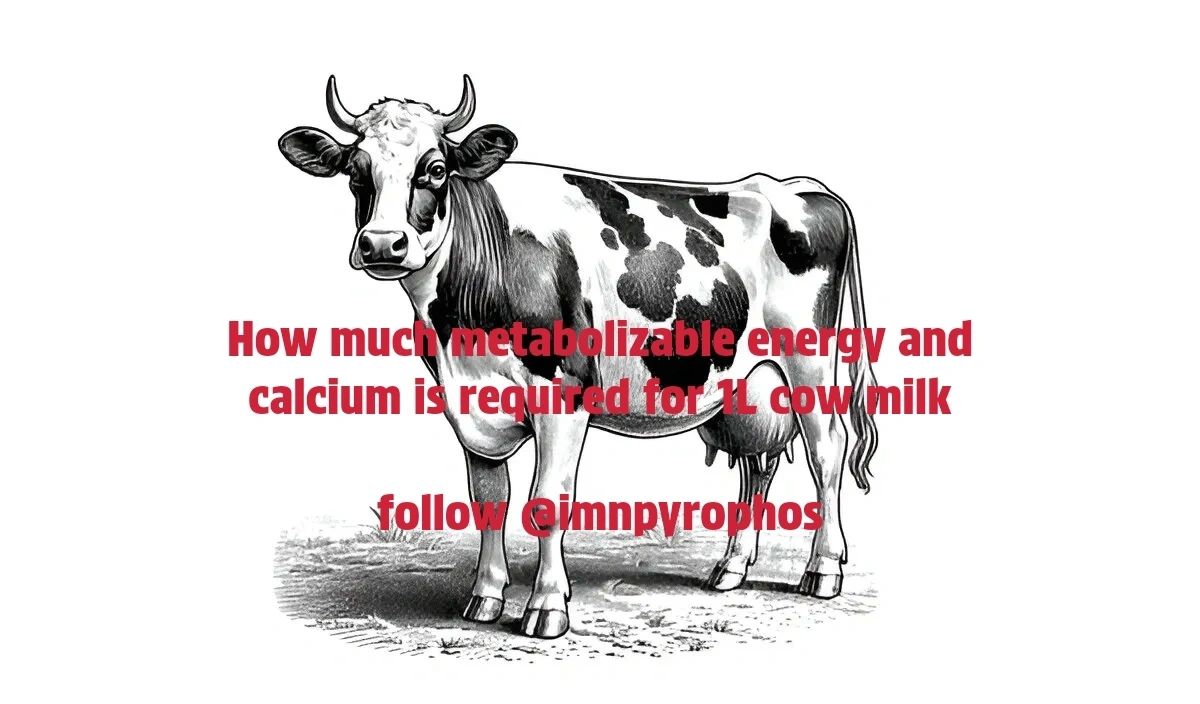
I remember that milk production in cows depends on several factors like the cow's breed, stage of lactation, diet, and the composition of the milk itself. But the question is specifically about ME and calcium per liter.
First, metabolizable energy. This is the energy available to the cow after digestion and absorption. So the energy needed for milk production would depend on the energy content of the milk. Milk has components like fat, protein, and lactose, each contributing to its energy content. We can calculate the energy in the milk and then determine how much ME the cow needs, considering that converting feed to milk isn't 100% efficient.
The energy in milk is often measured in megacalories (Mcal) per kilogram. Milk's energy can be estimated using formulas that take into account fat, protein, and lactose percentages.
The NRC (National Research Council) have a formula for this calculation. The general formula is like (0.0929 × % fat) + (0.0547 × % protein) + (0.0395 × % lactose) all multiplied by the weight of the milk. Since 1 liter of milk is roughly 1.03 kg (because the density is a bit higher than water), we should use that.
Let's assume average milk composition. If a cow's milk has around 3.5% fat, 3% protein, and 4.8% lactose, then plugging those into the formula: (0.0929 x 3.5) + (0.0547 x 3) + (0.0395 x 4.8).
Let us calculate each part:
0.0929 x 3.5 = 0.32515
0.0547 x 3 = 0.1641
0.0395 x 4.8 = 0.1896
Adding those up:
0.32515 + 0.1641 + 0.1896 = 0.67885 Mcal/kg.
Then multiply by 1.03 kg (for 1 liter) gives –
0.67885 x 1.03 ≈ 0.699 Mcal per liter.
So the milk itself has about 0.7 Mcal of energy. But that's the gross energy. The cow needs metabolizable energy, which accounts for the efficiency of converting feed energy into milk energy. The efficiency is around 60-70% for dairy cows.
Conversion efficiency for ME to milk energy is typically about 60-65%.
So if the milk has 0.7 Mcal, then the ME required would be 0.7 divided by 0.65 (assuming 65% efficiency), which is roughly 1.077 Mcal per liter.
So approximately 1.08 Mcal of ME per liter of milk. But this can vary based on the actual efficiency, which might depend on the diet and other factors.
Now for calcium. Milk contains calcium, so the amount needed would be the calcium content in the milk plus any consideration for absorption efficiency.
Milk typically has about 1.2 grams of calcium per liter. However, cows don't absorb all the calcium they consume. The absorption efficiency can vary, but let's say it's around 50% for a lactating cow.
So if the milk has 1.2 g, the cow needs to intake 1.2 / 0.5 = 2.4 grams of calcium per liter. Although there's also maintenance requirements for calcium, but we just consider the direct calcium lost in the milk adjusted for absorption (dairy cows require about 0.1 to 0.12 grams of calcium per kilogram of body weight for maintenance, but that's separate from milk production).
Since we only concern with requirement specifically for milk production, we can focus on the milk's calcium content and the absorption rate. So if milk has 1.2 g Ca per liter and absorption is 50%, then the requirement is 2.4 g. However, some sources sources says different absorption efficiency, like 30-40% during lactation. If absorption is lower, say 40%, then it would be 1.2 / 0.4 = 3 g per liter.
Looking up some references (in my mind, since I can't actually recall), the NRC (2001) for dairy cattle suggests that the calcium requirement for milk production is calculated by taking the calcium content in milk divided by the absorption coefficient. The absorption coefficient for calcium in lactating cows is approximately 0.38 (38%).
So if milk has 1.23 g Ca per kg (and 1 liter is ~1.03 kg), that's 1.23 x 1.03 ≈ 1.27 g Ca per liter.
Then divided by 0.38 gives roughly 3.34 g of dietary calcium needed per liter. So about 3.3 to 3.5 grams of calcium per liter of milk. However, different sources might round these numbers. Some may say approximately 3-3.5 grams of calcium per liter.
But some might use a slightly different absorption coefficient, so values between 3 and 4 grams per liter are common in recommendations.
Putting it all together, metabolizable energy required is approximately 1.08 Mcal per liter, but often rounded to 1.1 Mcal, and calcium is around 3.2 grams, often rounded to 3.2-3.5 grams per liter.
However, these values can vary based on milk composition and the cow's specific efficiency. For example, higher fat milk would require more energy. If the milk has 4% fat instead of 3.5%, the energy content would be higher, thus increasing the ME requirement. Similarly, if calcium content in milk is higher, the requirement would adjust accordingly.
Therefore, the final answer should present these estimates with the caveat that actual values can vary based on factors like milk composition and individual cow metabolism. But providing average values based on typical milk composition and standard conversion efficiencies.
To determine the metabolizable energy (ME) and calcium required for 1 liter of milk production in cows, we consider the following:
More milk
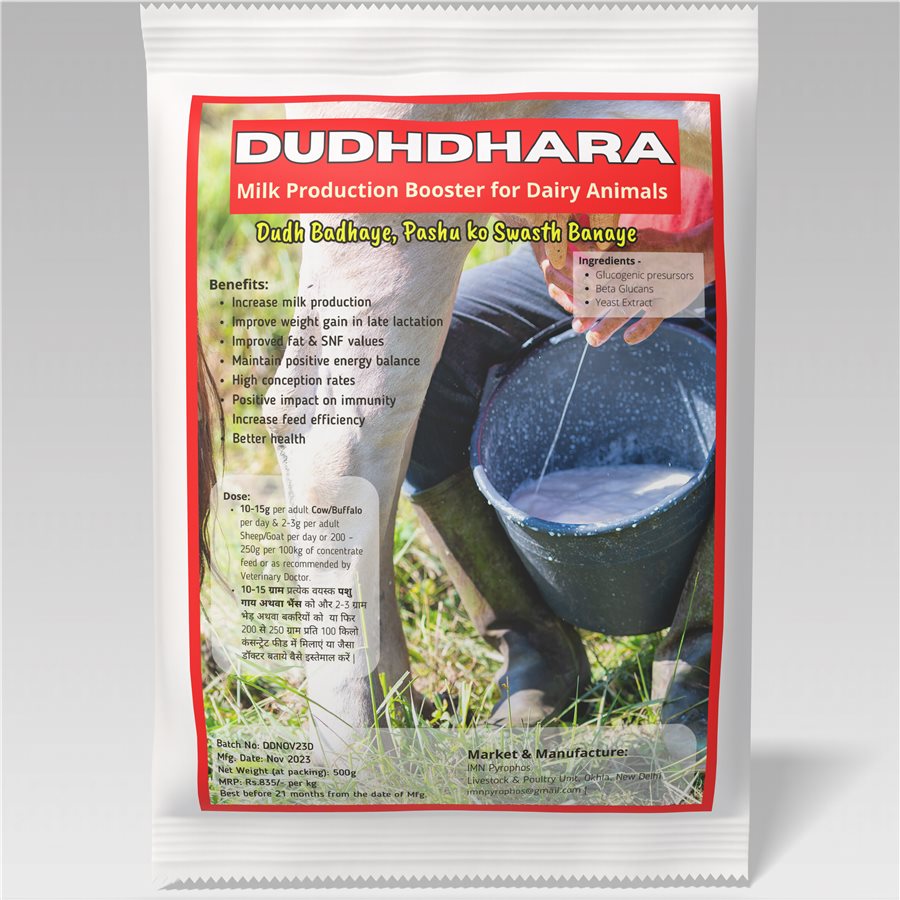
Dudh Dhara
Milk production booster with glucogenic precursors, beta glucans and yeast extract. Supports milk, fat and SNF, positive energy balance, conception and immunity.
Dose: 10–15 g per adult cow or buffalo per day; 2–3 g per sheep or goat; or 200–250 g per 100 kg concentrate.
1 kg ₹1,150MRP ₹1,410
1. Metabolizable Energy (ME):
Milk Energy Content:
Milk energy is calculated using its components (fat, protein, lactose). For average milk (3.5% fat, 3% protein, 4.8% lactose): Energy (Mcal/kg)=(0.0929×3.5)+(0.0547×3)+(0.0395×4.8)=0.68 Mcal/kg.Energy (Mcal/kg)=(0.0929×3.5)+(0.0547×3)+(0.0395×4.8)=0.68Mcal/kg.Adjusting for 1 liter (~1.03 kg): 0.68×1.03≈0.7 Mcal/liter.0.68×1.03≈0.7Mcal/liter.
Conversion Efficiency:
Cows convert ME to milk energy at ~60–65% efficiency. Using 65%: ME Required=0.70.65≈1.08 Mcal/liter.ME Required=0.650.7≈1.08Mcal/liter.
Final Estimate: 1.1 Mcal of ME per liter (rounded up due to variability in efficiency and milk composition).
Chelated minerals
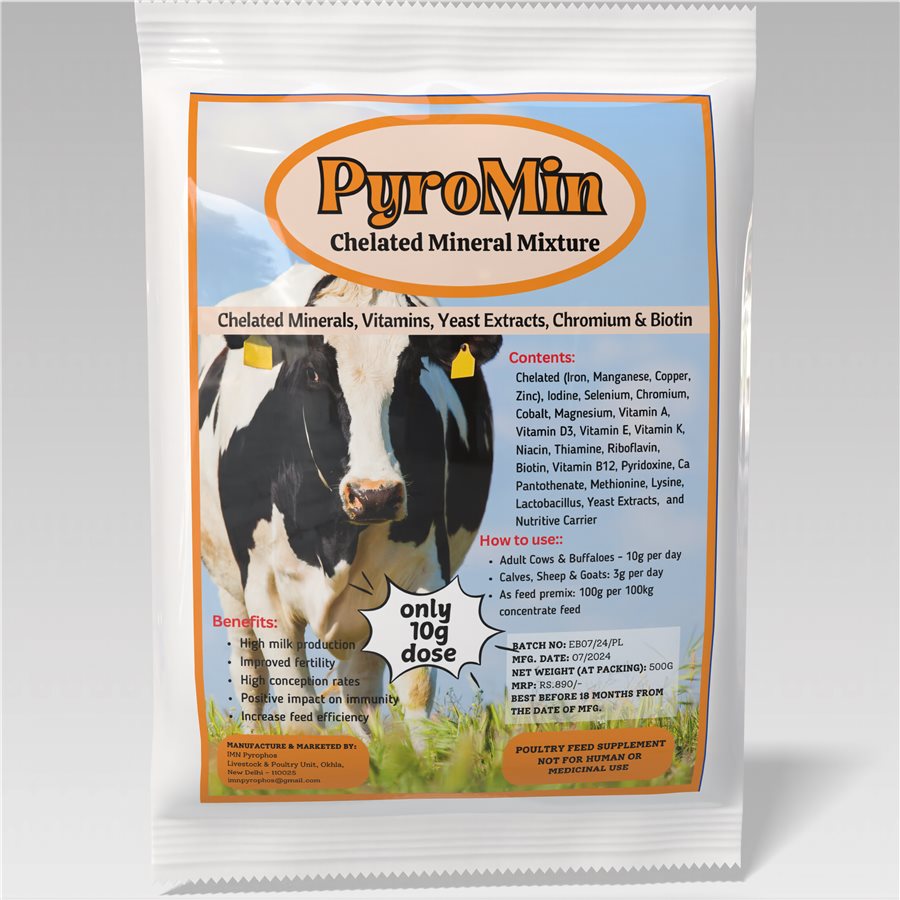
Pyromin
Chelated mineral mixture with iron, manganese, copper, zinc, iodine, selenium, chromium, cobalt and magnesium, vitamins A, D3, E, K and B vitamins, biotin, methionine, lysine, lactobacillus and yeast extract. Supports milk production, fertility, conception, immunity and feed efficiency.
Dose: Adult cow or buffalo 10 g per day; calves, sheep and goats 3 g per day. As a premix, 100 g per 100 kg of concentrate.
1 kg ₹655MRP ₹1,190
2. Calcium (Ca):
Calcium in Milk: Milk contains ~1.2 grams of calcium per liter.
Absorption Efficiency: Lactating cows absorb ~38% of dietary calcium. Thus: Dietary Ca Required=1.20.38≈3.2 g/liter.
Final Estimate: 3.2–3.5 grams of calcium per liter (varies with absorption rates and milk calcium content).
Key Considerations:
Milk Composition: Higher fat/protein increases ME demand (e.g., 4% fat milk requires ~1.2 Mcal/liter).
Cow Physiology: Breed, lactation stage, and diet influence efficiency.
Guidelines: NRC recommends adjustments based on individual herd metrics.
Summary:
ME: 1.1 Mcal/liter
Calcium: 3.2–3.5 g/liter
These values are averages; precise requirements depend on specific conditions.
For proper feed formulation & consultation you can contact us, we provide you step step by guidance which would help you improve the productivity and efficiency of your animals.
Contact on whatsapp or call 9871584101
Need help with feeding or a health problem in your cows or buffaloes? Message Dr. Ibne Ali on WhatsApp.
WhatsApp: 98715 84101मुझे याद है कि गायों में दूध उत्पादन कई बातों पर निर्भर करता है, जैसे गाय की नस्ल, ब्यांत (lactation) की स्टेज, खुराक और खुद दूध की बनावट (composition)। लेकिन सवाल खास तौर पर प्रति लीटर ME और कैल्शियम का है।
पहले, metabolizable energy (ME)। यह वह ऊर्जा है जो पाचन और अवशोषण के बाद गाय को मिलती है। इसलिए दूध उत्पादन के लिए ज़रूरी ऊर्जा दूध में मौजूद ऊर्जा पर निर्भर करेगी। दूध में fat, protein और lactose होते हैं, और हर एक दूध की ऊर्जा में योगदान देता है। हम दूध की ऊर्जा निकाल सकते हैं और फिर तय कर सकते हैं कि गाय को कितनी ME चाहिए, यह ध्यान में रखते हुए कि चारे को दूध में बदलना 100% कुशल नहीं होता।
दूध की ऊर्जा अक्सर megacalories (Mcal) प्रति किलोग्राम में मापी जाती है। दूध की ऊर्जा का अंदाज़ा उन फॉर्मूलों से लगाया जा सकता है जो fat, protein और lactose के प्रतिशत को ध्यान में रखते हैं।
NRC (National Research Council) के पास इस हिसाब का एक फॉर्मूला है। सामान्य फॉर्मूला कुछ ऐसा है (0.0929 × % fat) + (0.0547 × % protein) + (0.0395 × % lactose), और इसे दूध के वज़न से गुणा किया जाता है। क्योंकि 1 लीटर दूध लगभग 1.03 kg होता है (क्योंकि इसका घनत्व पानी से थोड़ा ज़्यादा है), हमें वही इस्तेमाल करना चाहिए।
मान लेते हैं दूध की औसत बनावट। अगर गाय के दूध में लगभग 3.5% fat, 3% protein और 4.8% lactose है, तो इन्हें फॉर्मूले में डालने पर: (0.0929 x 3.5) + (0.0547 x 3) + (0.0395 x 4.8)।
आइए हर हिस्से का हिसाब लगाएँ:
0.0929 x 3.5 = 0.32515
0.0547 x 3 = 0.1641
0.0395 x 4.8 = 0.1896
इन्हें जोड़ने पर:
0.32515 + 0.1641 + 0.1896 = 0.67885 Mcal/kg।
फिर 1.03 kg (1 लीटर के लिए) से गुणा करने पर –
0.67885 x 1.03 ≈ 0.699 Mcal प्रति लीटर।
तो दूध में खुद लगभग 0.7 Mcal ऊर्जा होती है। लेकिन यह gross energy है। गाय को metabolizable energy चाहिए, जिसमें चारे की ऊर्जा को दूध की ऊर्जा में बदलने की कुशलता (efficiency) शामिल होती है। डेयरी गायों में यह कुशलता लगभग 60-70% होती है।
ME को दूध की ऊर्जा में बदलने की कुशलता आम तौर पर लगभग 60-65% होती है।
तो अगर दूध में 0.7 Mcal है, तो ज़रूरी ME होगी 0.7 को 0.65 से भाग (65% कुशलता मानकर), जो लगभग 1.077 Mcal प्रति लीटर है।
यानी प्रति लीटर दूध के लिए लगभग 1.08 Mcal ME। लेकिन यह असली कुशलता के हिसाब से बदल सकता है, जो खुराक और दूसरी बातों पर निर्भर कर सकती है।
अब कैल्शियम की बात। दूध में कैल्शियम होता है, इसलिए ज़रूरी मात्रा होगी दूध में मौजूद कैल्शियम, साथ में अवशोषण की कुशलता का ध्यान रखते हुए।
दूध में आम तौर पर प्रति लीटर लगभग 1.2 ग्राम कैल्शियम होता है। लेकिन गायें जितना कैल्शियम खाती हैं, वह सारा अवशोषित नहीं करतीं। अवशोषण की कुशलता बदल सकती है, लेकिन मान लेते हैं दूध देने वाली गाय में यह लगभग 50% है।
तो अगर दूध में 1.2 g है, तो गाय को प्रति लीटर 1.2 / 0.5 = 2.4 ग्राम कैल्शियम खाना होगा। हालाँकि कैल्शियम की शरीर के रख-रखाव (maintenance) की ज़रूरत भी होती है, लेकिन हम सिर्फ दूध में सीधे जाने वाले कैल्शियम को, अवशोषण के हिसाब से एडजस्ट करके देख रहे हैं (डेयरी गायों को maintenance के लिए प्रति किलोग्राम शरीर वज़न पर लगभग 0.1 से 0.12 ग्राम कैल्शियम चाहिए, लेकिन वह दूध उत्पादन से अलग है)।
क्योंकि हमें सिर्फ दूध उत्पादन की ज़रूरत से मतलब है, हम दूध के कैल्शियम और अवशोषण दर पर ध्यान दे सकते हैं। तो अगर दूध में प्रति लीटर 1.2 g Ca है और अवशोषण 50% है, तो ज़रूरत 2.4 g है। लेकिन कुछ स्रोत अलग अवशोषण कुशलता बताते हैं, जैसे lactation के दौरान 30-40%। अगर अवशोषण कम है, मान लो 40%, तो यह 1.2 / 0.4 = 3 g प्रति लीटर होगा।
कुछ संदर्भ देखें तो (मन में, क्योंकि मैं असल में याद नहीं कर सकता), डेयरी पशुओं के लिए NRC (2001) बताता है कि दूध उत्पादन के लिए कैल्शियम की ज़रूरत दूध में कैल्शियम को अवशोषण गुणांक (absorption coefficient) से भाग देकर निकाली जाती है। दूध देने वाली गायों में कैल्शियम का absorption coefficient लगभग 0.38 (38%) है।
तो अगर दूध में प्रति kg 1.23 g Ca है (और 1 लीटर ~1.03 kg है), तो यह 1.23 x 1.03 ≈ 1.27 g Ca प्रति लीटर होता है।
फिर 0.38 से भाग देने पर प्रति लीटर लगभग 3.34 g खुराक वाला कैल्शियम चाहिए। यानी प्रति लीटर दूध के लिए लगभग 3.3 से 3.5 ग्राम कैल्शियम। हालाँकि अलग-अलग स्रोत इन संख्याओं को राउंड कर सकते हैं। कुछ कहते हैं प्रति लीटर लगभग 3-3.5 ग्राम कैल्शियम।
लेकिन कुछ लोग थोड़ा अलग absorption coefficient इस्तेमाल करते हैं, इसलिए सिफारिशों में प्रति लीटर 3 से 4 ग्राम के बीच की मात्रा आम है।
सब मिलाकर, ज़रूरी metabolizable energy प्रति लीटर लगभग 1.08 Mcal है, जिसे अक्सर 1.1 Mcal तक राउंड किया जाता है, और कैल्शियम लगभग 3.2 ग्राम है, जिसे अक्सर प्रति लीटर 3.2-3.5 ग्राम तक राउंड किया जाता है।
लेकिन ये मात्राएँ दूध की बनावट और गाय की अपनी कुशलता के हिसाब से बदल सकती हैं। उदाहरण के लिए, ज़्यादा fat वाले दूध के लिए ज़्यादा ऊर्जा चाहिए। अगर दूध में 3.5% की जगह 4% fat है, तो ऊर्जा ज़्यादा होगी, जिससे ME की ज़रूरत बढ़ेगी। इसी तरह, अगर दूध में कैल्शियम ज़्यादा है, तो ज़रूरत भी उसी हिसाब से बदलेगी।
इसलिए अंतिम जवाब में ये अनुमान इस शर्त के साथ दिए जाने चाहिए कि असली मात्रा दूध की बनावट और हर गाय के मेटाबॉलिज़्म जैसी बातों पर बदल सकती है। फिर भी सामान्य दूध की बनावट और मानक कुशलता के आधार पर औसत मात्रा दी जा रही है।
गायों में 1 लीटर दूध उत्पादन के लिए ज़रूरी metabolizable energy (ME) और कैल्शियम तय करने के लिए हम ये बातें देखते हैं:
ज़्यादा दूध
Dudh Dhara
ग्लूकोज़ बनाने वाले तत्व, बीटा ग्लूकन और यीस्ट एक्सट्रैक्ट वाला दूध बढ़ाने वाला सप्लीमेंट। दूध, फैट और SNF, ऊर्जा संतुलन, गर्भधारण और इम्युनिटी में सहायक।
मात्रा: 10–15 ग्राम प्रति वयस्क गाय या भैंस प्रति दिन; भेड़ या बकरी को 2–3 ग्राम; या 200–250 ग्राम प्रति 100 किलो दाना।
1 kg ₹1,150MRP ₹1,410
1. Metabolizable Energy (ME):
दूध में ऊर्जा की मात्रा:
दूध की ऊर्जा उसके हिस्सों (fat, protein, lactose) से निकाली जाती है। औसत दूध (3.5% fat, 3% protein, 4.8% lactose) के लिए: Energy (Mcal/kg)=(0.0929×3.5)+(0.0547×3)+(0.0395×4.8)=0.68 Mcal/kg.Energy (Mcal/kg)=(0.0929×3.5)+(0.0547×3)+(0.0395×4.8)=0.68Mcal/kg.1 लीटर (~1.03 kg) के लिए एडजस्ट करने पर: 0.68×1.03≈0.7 Mcal/liter.0.68×1.03≈0.7Mcal/liter.
बदलने की कुशलता (Conversion Efficiency):
गायें ME को दूध की ऊर्जा में ~60–65% कुशलता से बदलती हैं। 65% लेने पर: ME Required=0.70.65≈1.08 Mcal/liter.ME Required=0.650.7≈1.08Mcal/liter.
अंतिम अनुमान: प्रति लीटर 1.1 Mcal ME (कुशलता और दूध की बनावट में बदलाव की वजह से ऊपर राउंड किया गया)।
चिलेटेड मिनरल
Pyromin
चिलेटेड आयरन, मैंगनीज़, कॉपर, ज़िंक, आयोडीन, सेलेनियम, क्रोमियम, कोबाल्ट और मैग्नीशियम, विटामिन A, D3, E, K और B विटामिन, बायोटिन, मेथियोनीन, लाइसीन, लैक्टोबैसिलस और यीस्ट एक्सट्रैक्ट वाला मिनरल मिक्सचर। दूध उत्पादन, प्रजनन, गर्भधारण, इम्युनिटी और चारे के बेहतर उपयोग में सहायक।
मात्रा: वयस्क गाय या भैंस को 10 ग्राम प्रति दिन; बछड़े, भेड़ और बकरी को 3 ग्राम प्रति दिन। प्रीमिक्स के रूप में 100 ग्राम प्रति 100 किलो दाना।
1 kg ₹655MRP ₹1,190
2. कैल्शियम (Ca):
दूध में कैल्शियम: दूध में प्रति लीटर ~1.2 ग्राम कैल्शियम होता है।
अवशोषण की कुशलता: दूध देने वाली गायें खुराक के कैल्शियम का ~38% अवशोषित करती हैं। इसलिए: Dietary Ca Required=1.20.38≈3.2 g/liter.
अंतिम अनुमान: प्रति लीटर 3.2–3.5 ग्राम कैल्शियम (अवशोषण दर और दूध में कैल्शियम की मात्रा के हिसाब से बदलता है)।
ध्यान देने वाली मुख्य बातें:
दूध की बनावट: ज़्यादा fat/protein से ME की माँग बढ़ती है (जैसे 4% fat वाले दूध के लिए ~1.2 Mcal/liter चाहिए)।
गाय का शरीर: नस्ल, ब्यांत की स्टेज और खुराक कुशलता पर असर डालते हैं।
दिशा-निर्देश: NRC हर झुंड के अपने आँकड़ों के आधार पर एडजस्टमेंट की सलाह देता है।
सारांश:
ME: 1.1 Mcal/liter
कैल्शियम: 3.2–3.5 g/liter
ये मात्राएँ औसत हैं; सटीक ज़रूरत खास हालात पर निर्भर करती है।
सही feed formulation और सलाह के लिए आप हमसे संपर्क कर सकते हैं, हम आपको कदम-दर-कदम मार्गदर्शन देते हैं जिससे आपके पशुओं की उत्पादकता और कुशलता बढ़ाने में मदद मिलेगी।
WhatsApp या कॉल करें 9871584101
गाय-भैंस के दाने या बीमारी में मदद चाहिए? डॉ. इब्ने अली को WhatsApp कीजिए।
WhatsApp: 98715 84101Mujhe yaad hai ki gaayon me doodh production kai cheezon par depend karta hai, jaise gaay ki nasl, lactation (byaant) ki stage, diet aur khud doodh ka composition. Lekin sawaal khaas taur par per liter ME aur calcium ka hai.
Pehle, metabolizable energy (ME). Ye wo energy hai jo digestion aur absorption ke baad gaay ko milti hai. Isliye doodh production ke liye zaroori energy doodh me maujood energy par depend karegi. Doodh me fat, protein aur lactose hote hain, aur har ek doodh ki energy me contribute karta hai. Hum doodh ki energy nikal sakte hain aur phir tay kar sakte hain ki gaay ko kitni ME chahiye, ye dhyan me rakhte hue ki feed ko doodh me badalna 100% efficient nahi hota.
Doodh ki energy aksar megacalories (Mcal) per kilogram me naapi jaati hai. Doodh ki energy ka andaaza un formulas se lagaya ja sakta hai jo fat, protein aur lactose ke percentage ko dhyan me rakhte hain.
NRC (National Research Council) ke paas is calculation ka ek formula hai. General formula kuch aisa hai (0.0929 × % fat) + (0.0547 × % protein) + (0.0395 × % lactose), aur ise doodh ke weight se multiply kiya jata hai. Kyunki 1 liter doodh lagbhag 1.03 kg hota hai (kyunki iski density paani se thodi zyada hai), hume wahi use karna chahiye.
Maan lete hain doodh ka average composition. Agar gaay ke doodh me lagbhag 3.5% fat, 3% protein aur 4.8% lactose hai, to inhe formula me daalne par: (0.0929 x 3.5) + (0.0547 x 3) + (0.0395 x 4.8).
Chaliye har hissa calculate karte hain:
0.0929 x 3.5 = 0.32515
0.0547 x 3 = 0.1641
0.0395 x 4.8 = 0.1896
Inhe jodne par:
0.32515 + 0.1641 + 0.1896 = 0.67885 Mcal/kg.
Phir 1.03 kg (1 liter ke liye) se multiply karne par –
0.67885 x 1.03 ≈ 0.699 Mcal per liter.
To doodh me khud lagbhag 0.7 Mcal energy hoti hai. Lekin ye gross energy hai. Gaay ko metabolizable energy chahiye, jisme feed energy ko milk energy me badalne ki efficiency shaamil hoti hai. Dairy gaayon me ye efficiency lagbhag 60-70% hoti hai.
ME ko milk energy me badalne ki efficiency aam taur par lagbhag 60-65% hoti hai.
To agar doodh me 0.7 Mcal hai, to zaroori ME hogi 0.7 ko 0.65 se divide (65% efficiency maankar), jo lagbhag 1.077 Mcal per liter hai.
Yaani per liter doodh ke liye lagbhag 1.08 Mcal ME. Lekin ye asli efficiency ke hisaab se badal sakta hai, jo diet aur dusri cheezon par depend kar sakti hai.
Ab calcium ki baat. Doodh me calcium hota hai, isliye zaroori matra hogi doodh me maujood calcium, saath me absorption efficiency ka dhyan rakhte hue.
Doodh me aam taur par per liter lagbhag 1.2 gram calcium hota hai. Lekin gaay jitna calcium khati hai, wo saara absorb nahi karti. Absorption efficiency badal sakti hai, lekin maan lete hain doodh dene wali gaay me ye lagbhag 50% hai.
To agar doodh me 1.2 g hai, to gaay ko per liter 1.2 / 0.5 = 2.4 gram calcium khana hoga. Halanki calcium ki maintenance requirement bhi hoti hai, lekin hum sirf doodh me seedhe jaane wale calcium ko, absorption ke hisaab se adjust karke dekh rahe hain (dairy gaayon ko maintenance ke liye per kilogram body weight par lagbhag 0.1 se 0.12 gram calcium chahiye, lekin wo doodh production se alag hai).
Kyunki hume sirf doodh production ki requirement se matlab hai, hum doodh ke calcium aur absorption rate par focus kar sakte hain. To agar doodh me per liter 1.2 g Ca hai aur absorption 50% hai, to requirement 2.4 g hai. Lekin kuch sources alag absorption efficiency batate hain, jaise lactation ke time 30-40%. Agar absorption kam hai, maan lo 40%, to ye 1.2 / 0.4 = 3 g per liter hoga.
Kuch references dekhein to (mann me, kyunki main asal me yaad nahi kar sakta), dairy cattle ke liye NRC (2001) batata hai ki doodh production ke liye calcium requirement doodh ke calcium ko absorption coefficient se divide karke nikaali jaati hai. Doodh dene wali gaayon me calcium ka absorption coefficient lagbhag 0.38 (38%) hai.
To agar doodh me per kg 1.23 g Ca hai (aur 1 liter ~1.03 kg hai), to ye 1.23 x 1.03 ≈ 1.27 g Ca per liter hota hai.
Phir 0.38 se divide karne par per liter lagbhag 3.34 g dietary calcium chahiye. Yaani per liter doodh ke liye lagbhag 3.3 se 3.5 gram calcium. Halanki alag-alag sources in numbers ko round kar sakte hain. Kuch kehte hain per liter lagbhag 3-3.5 gram calcium.
Lekin kuch log thoda alag absorption coefficient use karte hain, isliye recommendations me per liter 3 se 4 gram ke beech ki value common hai.
Sab milakar, zaroori metabolizable energy per liter lagbhag 1.08 Mcal hai, jise aksar 1.1 Mcal tak round kiya jata hai, aur calcium lagbhag 3.2 gram hai, jise aksar per liter 3.2-3.5 gram tak round kiya jata hai.
Lekin ye values doodh ke composition aur gaay ki apni efficiency ke hisaab se badal sakti hain. Jaise, zyada fat wale doodh ke liye zyada energy chahiye. Agar doodh me 3.5% ki jagah 4% fat hai, to energy zyada hogi, jisse ME requirement badhegi. Isi tarah, agar doodh me calcium zyada hai, to requirement bhi usi hisaab se badlegi.
Isliye final answer me ye estimates is shart ke saath diye jaane chahiye ki asli value doodh ke composition aur har gaay ke metabolism jaisi cheezon par badal sakti hai. Phir bhi normal doodh composition aur standard efficiency ke aadhaar par average values di ja rahi hain.
Gaayon me 1 liter doodh production ke liye zaroori metabolizable energy (ME) aur calcium tay karne ke liye hum ye baatein dekhte hain:
Zyada doodh
Dudh Dhara
Glucose banane wale tatva, beta glucan aur yeast extract wala doodh badhane wala supplement. Doodh, fat aur SNF, urja santulan, garbh thaharne aur immunity me sahayak.
Matra: 10–15 g prati vayask gaay ya bhains prati din; bhed ya bakri ko 2–3 g; ya 200–250 g prati 100 kg daana.
1 kg ₹1,150MRP ₹1,410
1. Metabolizable Energy (ME):
Doodh me Energy ki Matra:
Doodh ki energy uske components (fat, protein, lactose) se nikaali jaati hai. Average doodh (3.5% fat, 3% protein, 4.8% lactose) ke liye: Energy (Mcal/kg)=(0.0929×3.5)+(0.0547×3)+(0.0395×4.8)=0.68 Mcal/kg.Energy (Mcal/kg)=(0.0929×3.5)+(0.0547×3)+(0.0395×4.8)=0.68Mcal/kg.1 liter (~1.03 kg) ke liye adjust karne par: 0.68×1.03≈0.7 Mcal/liter.0.68×1.03≈0.7Mcal/liter.
Conversion Efficiency:
Gaayein ME ko milk energy me ~60–65% efficiency se badalti hain. 65% lene par: ME Required=0.70.65≈1.08 Mcal/liter.ME Required=0.650.7≈1.08Mcal/liter.
Final Estimate: Per liter 1.1 Mcal ME (efficiency aur doodh composition me badlaav ki wajah se upar round kiya gaya).
Chelated mineral
Pyromin
Chelated iron, manganese, copper, zinc, iodine, selenium, chromium, cobalt aur magnesium, vitamin A, D3, E, K aur B vitamin, biotin, methionine, lysine, lactobacillus aur yeast extract wala mineral mixture. Doodh utpadan, prajanan, garbh thaharne, immunity aur chaare ke behtar upyog me sahayak.
Matra: Vayask gaay ya bhains ko 10 g prati din; bachhde, bhed aur bakri ko 3 g prati din. Premix ke roop me 100 g prati 100 kg daana.
1 kg ₹655MRP ₹1,190
2. Calcium (Ca):
Doodh me Calcium: Doodh me per liter ~1.2 gram calcium hota hai.
Absorption Efficiency: Doodh dene wali gaayein diet ke calcium ka ~38% absorb karti hain. Isliye: Dietary Ca Required=1.20.38≈3.2 g/liter.
Final Estimate: Per liter 3.2–3.5 gram calcium (absorption rate aur doodh me calcium ki matra ke hisaab se badalta hai).
Dhyan dene wali Main Baatein:
Doodh ka Composition: Zyada fat/protein se ME ki demand badhti hai (jaise 4% fat wale doodh ke liye ~1.2 Mcal/liter chahiye).
Gaay ki Body: Nasl, lactation stage aur diet efficiency par asar daalte hain.
Guidelines: NRC har herd ke apne data ke hisaab se adjustment ki salah deta hai.
Summary:
ME: 1.1 Mcal/liter
Calcium: 3.2–3.5 g/liter
Ye values average hain; exact requirement khaas halaat par depend karti hai.
Sahi feed formulation aur consultation ke liye aap humse contact kar sakte hain, hum aapko step-by-step guidance dete hain jisse aapke pashuon ki productivity aur efficiency badhane me madad milegi.
WhatsApp ya call karein 9871584101
Gaay-bhains ke daane ya bimari me madad chahiye? Dr. Ibne Ali ko WhatsApp kijiye.
WhatsApp: 98715 84101