
Corn silage fills the rumen with cheap energy, but it does not fill the ration. Anyone who feeds silage every day soon asks the same question: silage ke saath kya khilayein, or what should go with corn silage so the cow stays healthy and milk does not drop? This guide to corn silage ration balancing explains what corn silage does well, what it leaves short (protein, calcium, trace minerals, vitamins, buffering), what goes wrong when a herd lives on corn silage alone, and how to fill each gap in a simple, low-cost way. It draws on research by Coppock, Grant and Ferraretto, Cueva and colleagues, and an Italian milk study, and it marks clearly where the advice is practical field guidance for Indian farms and not research.
Corn silage ration balancing: what corn silage gives and what it leaves out
Corn silage is popular for good reason. Coppock, in his review of all-corn-silage feeding, noted that where corn grows well, whole-plant silage gives an energy yield per acre that no other crop beats, and that cows keep eating more of it across a wide range of plant dry matter. Starch makes up roughly a third of corn silage on average (Cueva et al., 2023), and that starch is why corn silage is such a strong energy feed. In Northern Italy, corn silage can be up to 90% of the forage in a milking cow’s ration (Rocchetti et al., 2022).
But a feed that is strong in one thing is weak in others. Corn silage is mainly the whole plant, with the grain doing most of the work. It is not a complete feed. Think of it as the energy engine of the ration, and then ask what the engine still needs to run: protein, minerals, vitamins and something to steady the rumen.
| Corn silage is good at | Corn silage is poor or uncertain at |
|---|---|
| Energy, mostly from starch in the grain | Protein: low, often around 7% crude protein in dry matter in tropical trials (Khan et al., 2024) |
| Palatability and steady intake | Calcium: about one fifth of alfalfa on a dry matter basis (Coppock) |
| Yield per acre and low water need per kg of dry matter (Coppock) | Several other minerals: ten of twelve minerals listed were higher in alfalfa than in corn silage (Coppock) |
| Little change in digestibility across a wide range of maturity (Coppock) | Carotene (vitamin A source): falls sharply as the plant matures or is frosted (Coppock) |
| Dry matter that stores well when ensiled correctly | Buffering: starchy feed needs chewing, saliva and fibre to keep rumen pH steady |
Before you balance anything, make sure the silage itself is sound. A poorly made, mouldy or very sour silage cannot be rescued with minerals. See our guides on how to make corn silage, silage quality checks and reducing dry matter loss.
Nutrient gaps in a corn silage ration: why they happen and how to fill them
This table is the core of the article. It lists each gap, why corn silage leaves it, and how to fill it in general terms. Exact amounts depend on your animals, your silage analysis and your other feeds, so treat it as a map and not as a recipe.
| Nutrient gap | Why corn silage leaves it | How to fill it |
|---|---|---|
| Protein | The plant is mostly stalk, leaf and starchy grain. Crude protein also falls as the crop matures (Wiersma et al.; Khan et al., 2024). | Protein source in the concentrate (oilcakes, pulse by-products, good-quality bypass protein). Do not rely on urea alone. |
| Calcium | Corn silage is low in calcium compared with legumes (Coppock, Table 4). | Calcium source in the mineral mixture or concentrate; a legume fodder such as lucerne or berseem where available. |
| Phosphorus, magnesium, sulphur | Moderate to low; sulphur becomes a concern when urea is used (Coppock). | A balanced mineral mixture; watch sulphur when urea or non-protein nitrogen is in the ration. |
| Trace minerals (zinc, copper, manganese, cobalt, iodine, selenium) | Content depends on soil. One silage-only herd in a Maryland study had iodine problems that settled after iodized salt (Coppock). | A chelated trace mineral mixture fed every day, in the concentrate or as top dressing. |
| Vitamin A (carotene) | Carotene in corn silage was 140 mg per kg dry matter at milk stage, 32 at dent and 4 after light frost (Coppock). Ensiling also destroys carotene. | Green fodder when available; vitamin A in the mineral mixture. |
| Vitamin E and selenium | Practical guidance, not from the papers above: both are low in stored, chopped, ensiled feed, and selenium depends on the soil. | A vitamin E and selenium supplement, especially for dry and transition cows. |
| Buffer and rumen stability | High starch ferments fast. Without enough fibre chewing and saliva, rumen pH drops. | Right chop length, some long fibre, steady feeding times, and a rumen buffer or premix in the concentrate. |
| Energy at the right place | Corn silage is energy-rich. Low yielders and dry cows can take in too much; early lactation cows still go into negative energy balance. | Group animals, restrict silage for low yielders and dry cows, and support early lactation metabolism. |
Protein: the biggest gap in a corn silage ration
In tropical trials, corn silage from different maize hybrids had about 6.9 to 7.3% crude protein (Khan et al., 2024). A cow giving a good yield needs more protein in the total ration than that. So the protein has to come from the concentrate, and the more silage you feed, the more important that becomes.
Coppock explained why protein is awkward when corn silage is the only forage. When silage is the only forage, the protein needed in the concentrate changes with the cow’s milk yield, so one concentrate does not fit all cows well. When corn silage is mixed with a legume forage such as alfalfa, one concentrate mix suits most cows better. In India, the same idea works with berseem or lucerne where you can grow or buy it.
What about urea?
Urea can lower the cost of protein, but Coppock warned that the saving can be wiped out by a small loss in milk. Urea needs readily fermentable carbohydrate, mainly starch, to be used well. In a nitrogen balance study he cites, cows fed urea-treated corn silage as the main ration used only 8% of dietary nitrogen for milk and body tissue, against 22% for cows fed alfalfa hay and grain. His message was not that urea is wrong but that its use needs care. The practical rule for a farm: do not add urea to the silage or the ration on your own. Ask for a ration plan first.
The research also notes that corn silage has a wide nitrogen to sulphur ratio, and that adding urea widens it further. Sulphur supplementation has been shown to help in a low-sulphur ration, but too much sulphur can interfere with copper and molybdenum balance (Coppock). This is one more reason a mineral mixture should be chosen with the whole ration in mind.
Minerals: calcium, phosphorus and trace minerals with corn silage
Coppock compared the mineral content of alfalfa hay and corn silage. Calcium was 1.64% in alfalfa and 0.33% in corn silage (dry matter basis). Of the 12 minerals he listed, 10 were higher in alfalfa. His point was simple: when corn silage replaces a legume forage, the mineral intake from forage drops, and the grain mix and a free-choice mineral have to make it up.
He also noted that using more urea and more cereal grain in place of plant proteins reduces mineral intake further, because plant proteins are richer in minerals than cereals. And he warned that relying on a single plant to supply what several forages once did increases the risk of a mineral deficiency showing up. In the Maryland trial he describes, the first cows on corn silage alone had retained placentas and calves with goitre, which settled after iodized salt was given.
For a farm in India the practical lesson is this. Give a good mineral mixture every day, not once in a while. Choose one with chelated trace minerals, and keep calcium and phosphorus in balance. Our guide to the best mineral mixture for cow and buffalo explains how to read a label.
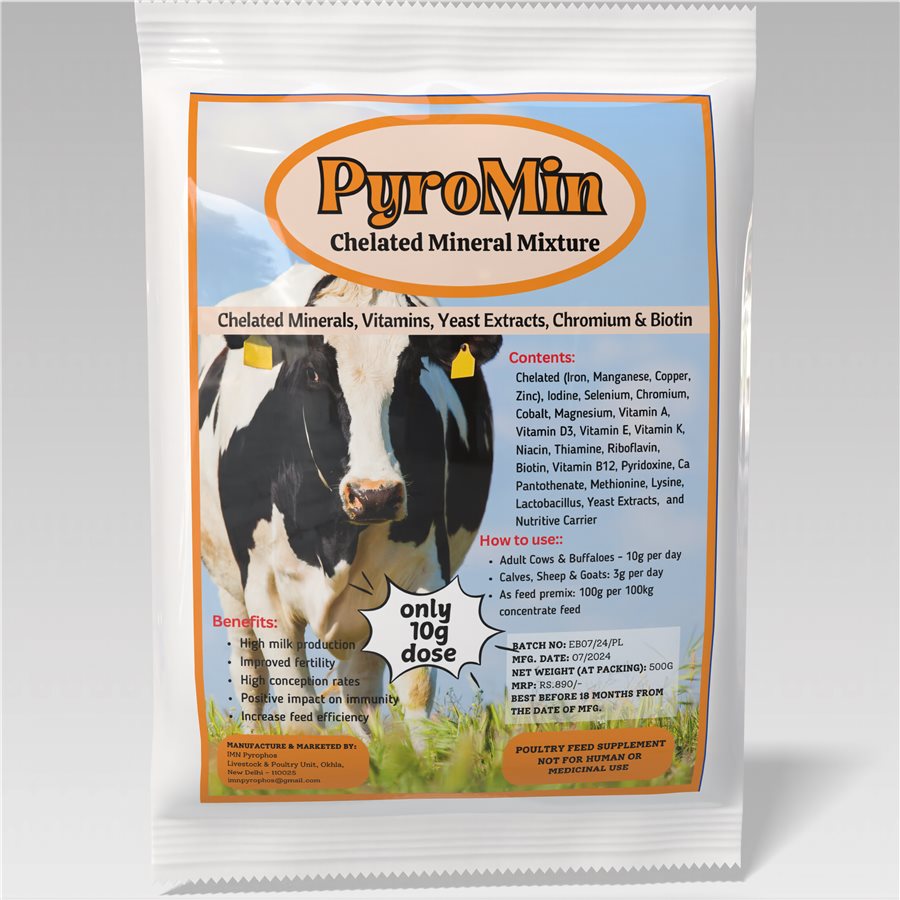
Chelated mineral · daily
Pyromin
Chelated iron, manganese, copper, zinc, iodine, selenium, chromium, cobalt, magnesium, vitamins A, D3, E, K, B vitamins, biotin, methionine, lysine, lactobacillus and yeast extract. Helps milk production, fertility, conception and immunity.
Dose: Adult cow or buffalo 10 g per day; calves, sheep and goats 3 g per day.
1 kg ₹655MRP ₹1,190
Pyromin is a chelated mineral mixture. It carries chelated iron, manganese, copper, zinc, iodine, selenium, chromium, cobalt and magnesium, vitamins A, D3, E and K, B vitamins, biotin, methionine, lysine, lactobacillus and yeast extract. The dose is 10 g per adult cow or buffalo per day, which at Rs 655 per kg is about Rs 6.5 per animal per day. It is fed to the animal, so it fills trace mineral and vitamin gaps in a silage ration. It is not a silage additive and does not change how the silage ferments.
Vitamins: vitamin A, vitamin E and selenium with corn silage
Coppock reviewed the carotene value of corn silage. Carotene is the plant source of vitamin A. Corn ensiled at milk stage had 140 mg carotene per kg dry matter, at dent stage 32 mg per kg, and after a light frost only 4 mg per kg. A cow needs about 64 mg of carotene for maintenance plus 32 mg for reproduction, so a silage cut late or from frosted maize cannot meet vitamin A needs alone. Carotene is also lost during ensiling and in the rumen (Coppock).
The farm lesson is to harvest at the right stage (see our corn silage harvest stage guide) and give vitamin A through the mineral mixture, especially in months when no green fodder is available.
Vitamin E and selenium are not covered in the papers reviewed here, so this part is practical guidance. Both work as antioxidants and matter for immunity, udder health and the transition period. Selenium in feed follows the soil, and chopped, stored feed loses vitamin E. For dry cows, close-up cows and the first weeks after calving, a dedicated vitamin E and selenium supplement is a sensible part of a silage ration.

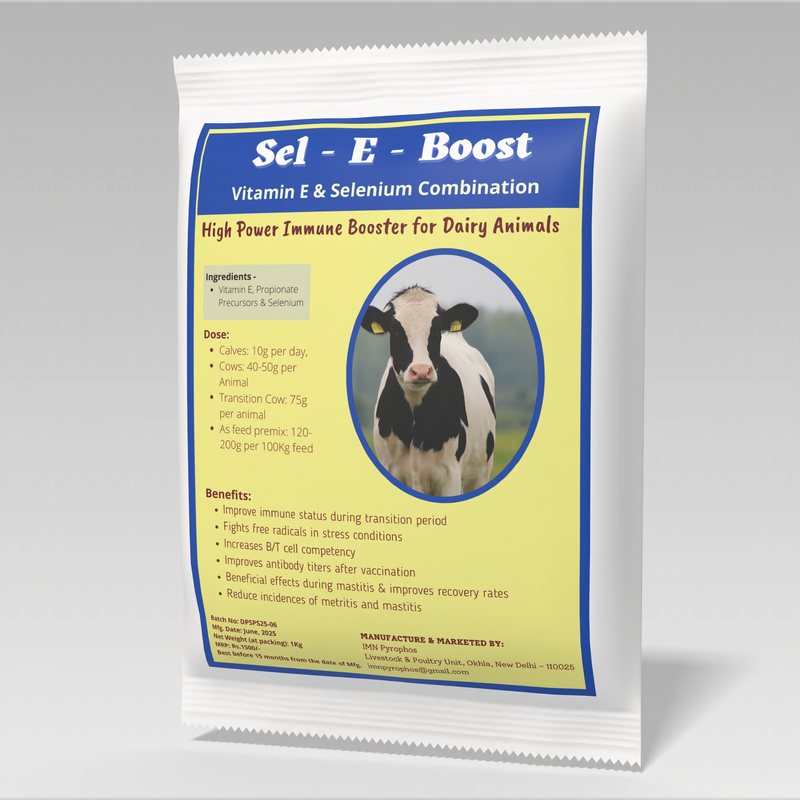
Dairy · vitamin E + selenium
Sel E Boost Dairy
Vitamin E and selenium combination with propionate precursors, a high power immune booster for dairy animals. Supports immune status in the transition period, fights free radicals in stress and helps recovery during mastitis.
Dose: Cows 40-50 g per animal; transition cow 75 g per animal; calves 10 g per day; as feed premix 120-200 g per quintal of feed.
1 kg ₹920MRP ₹1,500
Sel E Boost Dairy contains vitamin E, propionate precursors and selenium. The label doses are 40-50 g per cow per day and 75 g for a transition cow, calves 10 g per day, and 120-200 g per quintal of feed when it is mixed into the ration. At Rs 920 per kg, a transition dose of 75 g costs about Rs 69 per day. Do not confuse it with the poultry product of a similar name: they are separate products.
Acidosis and rumen pH: the starch risk in corn silage rations
Corn silage is a high-starch feed, and starch ferments quickly in the rumen. When fermentation runs ahead of the cow’s chewing and saliva, rumen pH falls. The result in the field is familiar: patchy appetite, loose dung with undigested grain, a drop in fat percentage, and cows that stand and do not chew the cud. This is sub-acute rumen acidosis, and it often builds up without a clear sickness.
Research tells us a few useful things about this risk.
- Chewing is the buffer. Grant and Ferraretto (2018) show that fibre content, digestibility and particle size change how long a cow eats and ruminates. Chewing produces saliva, which is the main natural buffer. Eating time can vary by over one hour a day by changing silage fibre and particle size.
- Chop length matters on both sides. Very long particles raise chewing effort and are more likely to be sorted (the cow picks the tasty fine bits and leaves the long ones). In their review, the particles retained on the 19 mm sieve of the Penn State separator were the ones most likely to be sorted. Too fine a chop, on the other hand, gives less chewing stimulus.
- Sorting hurts the rumen. In a competitive feeding situation, such as a shared bunk, sorting leaves the last cows with a more starchy, less fibrous ration. Keep feed in front of the cows and push it up often. One study cited found that routine feed push-up and feeding for a small refusal were linked with 1.6 to 3.9 kg more milk per cow per day among herds on the same TMR (Bach et al., 2008, in Grant and Ferraretto).
- Silage starch becomes more digestible as the silage ages. Cueva et al. (2023) showed that starch breakdown in the rumen rose across 0 to 150 days of ensiling, mostly in the first 60 days. A silage opened very early may behave differently from one opened after two months or more. See when to open silage.
- Timing of corn silage matters. In a laboratory fermenter study (Gregorini et al., 2010) corn silage given 9 hours before a short, intensive grass meal gave a lower mean rumen pH (5.6) than silage given 1 hour before (6.5). It was not a cow trial, but it fits the field rule: do not feed a big silage and grain load in one sudden meal, and keep the times steady.
How to protect the rumen in a corn silage ration
- Keep some long fibre in the ration. A dry fodder or a chopped straw portion gives the cow something to chew. See how much silage to feed per day.
- Keep the chop length right and check the TMR for sorting.
- Split concentrate into more meals rather than one big grain feed.
- Do not change the silage or the grain level suddenly. Move over 7 to 10 days. (Practical guidance.)
- Add a rumen buffer or dairy premix to the concentrate or TMR, and consider yeast.
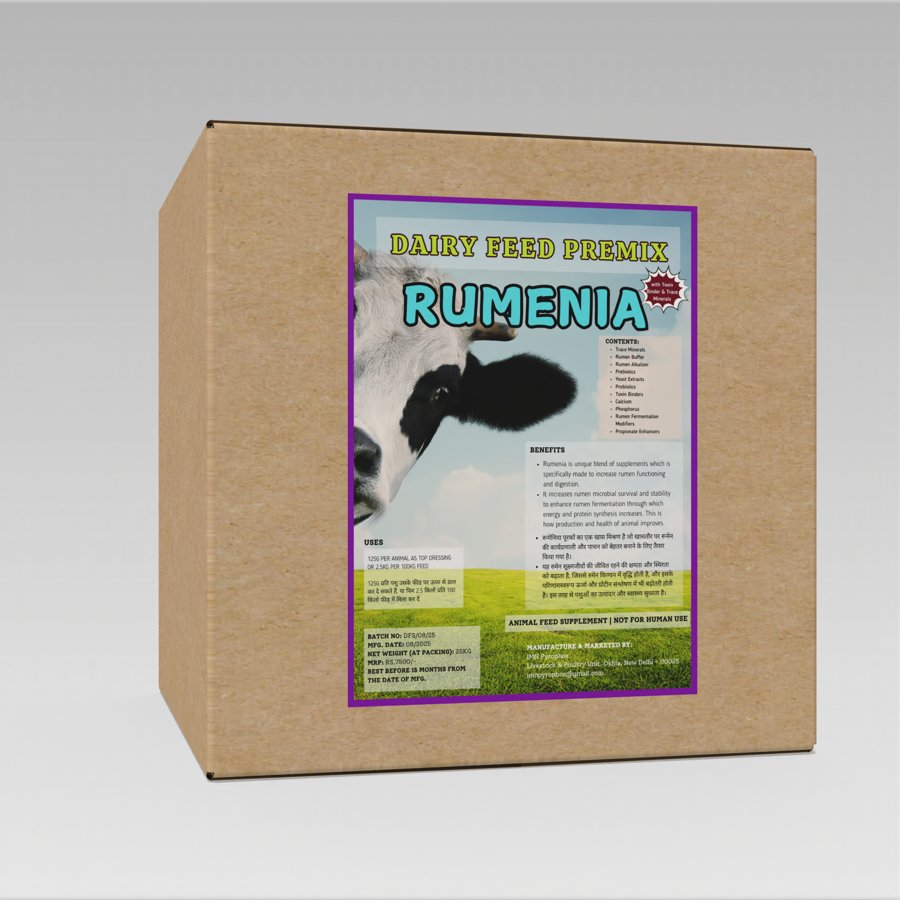
Dairy feed premix
Rumenia
Dairy feed premix with trace minerals, rumen buffer, prebiotics, yeast extracts, probiotics, toxin binders, calcium and phosphorus. Supports rumen function, microbe stability and fermentation, so energy and protein synthesis increase.
Dose: 2.5-3 kg per ton of feed (2.5-3 g per kg feed).
5 kg ₹1,400MRP ₹1,800 25 kg ₹5,625MRP ₹7,500
Rumenia is a dairy feed premix with trace minerals, rumen buffer, rumen alkalizer, prebiotics, yeast extracts, probiotics, toxin binders, calcium, phosphorus, rumen fermentation modifiers and propionate enhancers. The dose is 2.5-3 kg per ton of feed (2.5-3 g per kg of feed), so a cow on 5 kg of concentrate gets 12.5-15 g per day. On the 25 kg pack at Rs 225 per kg, that is about Rs 2.8 to Rs 3.4 per cow per day. It supports the rumen, but it does not replace fibre, a proper chop length or good feed management. For a full explanation of the premix, read our dairy feed premix guide.
Pyrosach is a rumen-adapted Saccharomyces cerevisiae yeast, given at 8-10 g per day to an adult cow or buffalo, mixed into feed. Yeast is often used in high-starch rations to support rumen stability and fibre digestion. See the Pyrosach page if your herd is on a heavy grain and silage ration.
All-corn-silage feeding: problems to watch (Coppock)
Many Indian dairy farms are moving to silage as the main forage. So what does the research say about feeding corn silage as the only forage? Coppock’s review gives a balanced picture.
- Milk production itself is usually fine. In several multi-lactation trials, cows on corn silage alone produced about the same milk and fat as cows on corn silage plus hay. No loss of appetite or production was seen in trials that ran up to three lactations. His conclusion was that the main problem with all-corn-silage feeding is not the feed itself, but our limited knowledge of what to supplement and how.
- Too much energy for some animals. Corn silage eaten free choice can cover a 600 kg cow’s maintenance plus about 16 kg of 4% milk, according to NRC values used in the paper. Low yielders, late-lactation cows and dry cows can take in more energy than they need and get over-conditioned. Over-conditioned cows are prone to appetite problems and ketosis in the next lactation. Practical fix: group cows by yield and limit silage for dry and low-yield animals.
- Heifers and calves. Holstein heifers gained about 0.8 to 0.9 kg per day on corn silage alone, which can be too fast for later milk and fertility. For young heifers, restricting silage can create a protein gap, so protein needs a plan.
- Protein, minerals and vitamins. These are the specific supplement problems we covered above: low protein, low calcium and other minerals, low carotene late in the crop, iodine in one trial, and sulphur when urea is used.
- Listeriosis and displaced abomasum. Some people blamed high corn silage feeding. Coppock found no published evidence that corn silage is more involved than other silages. Listeriosis was linked to poorly preserved silage with a high pH, above 5.0, and he found insufficient evidence linking displaced abomasum to corn silage. The lesson is to feed only well-made silage, and to check silage quality before feeding.
Note on the source: Coppock’s paper is from 1969. Cows today give far more milk and are fed far more grain. So his exact numbers should not be copied, but his points about what is missing from a corn silage ration still hold.
What a milk metabolome study tells us about silage-based rations
A 2022 paper in the Journal of Dairy Science (Rocchetti et al.) studied the milk of cows on corn silage-based rations in the Po valley of Italy. It sampled bulk tank milk from 36 farms, drawn from 66 farms that were grouped into 6 feeding strategies, mostly TMR with corn silage as the main ingredient. The strategies differed in the other feeds: high-moisture ear corn, legume silage, soy meal, compound feed and so on.
The team used a method called untargeted metabolomics, which measures hundreds of tiny chemical compounds in milk at once. In plain language, the question was: does what the cow eats leave a signature in her milk? The answer was yes. The milk samples separated into groups mainly by whether the ration contained high-moisture ear corn (HMC, a moist, ensiled corn ear or grain). The milk from HMC-based rations showed higher levels of break-down products of pyrimidines, which are building blocks of nucleic acids and are linked to microbial nitrogen use between the rumen and the udder. Alfalfa silage in the ration was linked with a vitamin B6 breakdown product in milk.
What this means for a farmer:
- The whole ration, not just the silage, shapes the cow’s metabolism and milk. Corn silage plus the right partner feeds is a different system from corn silage alone.
- Rumen microbes, protein and starch handling are linked all the way to the milk. A stable rumen helps the whole chain.
- This was an observational study of farm feeding strategies, not a trial of a product. It does not prove that any one feed raises milk yield, and it does not test any of the products mentioned here.
Transition and early lactation: where a silage ration needs the most support
Silage-based rations are often tight around calving. Energy intake lags behind milk output, and Coppock noted that many high-producing cows cannot eat enough energy in early lactation to meet their requirement. That is why this window needs the most care.
- Dry cows: do not let them eat free-choice corn silage. Control energy, balance minerals, and in the last weeks give a close-up plan (see negative DCAD premix, Chloromate, Calcigain and Bionice).
- First 10 days after calving: raise concentrate slowly, keep long fibre in the ration, and support liver and energy metabolism.
- Vitamin E and selenium: the label of Sel E Boost Dairy states a transition-cow dose of 75 g per animal.
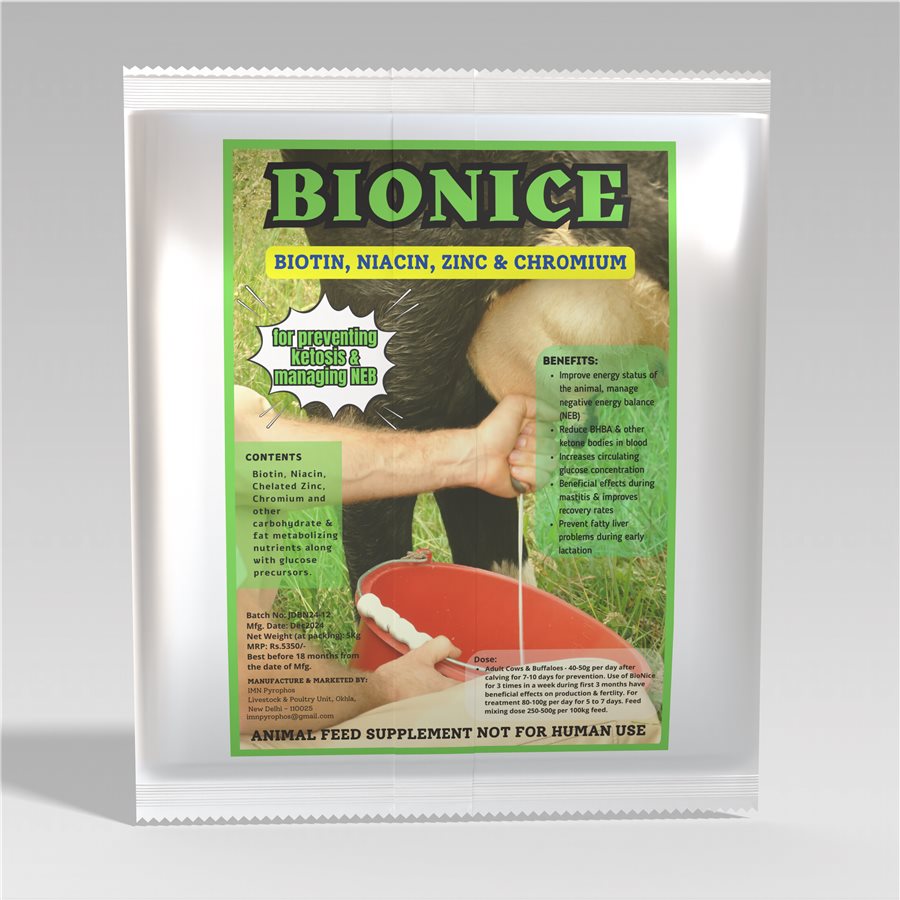
After calving, early milk
Bionice
Biotin, niacin, chelated zinc and chromium with glucose precursors. Supports energy metabolism and the liver in early lactation and helps recovery from mastitis.
Dose: Prevention: 40 to 50 g per day for 7 to 10 days after calving.
1 kg ₹768MRP ₹1,100
Bionice combines biotin, niacin, chelated zinc and chromium with glucose precursors. It is meant for early lactation: the usual plan is 40-50 g per day for 7 to 10 days after calving. At Rs 768 per kg, that works out to about Rs 215 to Rs 384 per cow for the whole course. It supports energy metabolism and the liver in early lactation. For fertility and herd-level questions, see our guide on repeat breeding.
Stage-wise add-ons for a corn silage ration
Use this table as a planning guide. Keep your own ration plan for amounts, and ask on WhatsApp if you need a plan for your herd.
| Stage | Main silage risk | What to add or watch |
|---|---|---|
| Calves and heifers | Growth too fast on silage alone; protein gap if silage is restricted | Protein-balanced concentrate, daily trace minerals (Pyromin 3 g per day for calves) |
| Dry cows (early dry) | Over-conditioning from free-choice silage | Limit silage, keep fibre, mineral mixture every day |
| Close-up (last 3 weeks) | Metabolic and immune stress around calving | Close-up plan; vitamin E and selenium (Sel E Boost Dairy, transition dose) |
| Fresh cow (0 to 10 days) | Energy deficit, ketosis risk, low intake | Bionice for 7 to 10 days, palatable ration, fibre |
| Peak milk (up to about 100 days) | Rumen pH drop from high grain and silage starch | Rumen buffer and premix (Rumenia), yeast (Pyrosach), daily Pyromin |
| Mid lactation | Over-eating energy as yield falls | Adjust silage and concentrate to yield, watch body condition |
| Late lactation and buffaloes in low season | Cows fattening instead of milking | Reduce concentrate, keep minerals; see buffalo milk in winter |
An illustrative ration with corn silage
Take a cross-bred cow giving a good yield, in mid lactation, fed a mix of silage, dry fodder and concentrate.
| Part of ration | Illustrative amount per cow per day | Role |
|---|---|---|
| Corn silage (as fed) | About 15 to 20 kg | Energy, bulk, palatability |
| Dry fodder or chopped straw | 2 to 4 kg | Long fibre, chewing, saliva |
| Green legume fodder (berseem or lucerne), if available | Some kg, seasonally | Protein, calcium, carotene |
| Concentrate with protein cake | About 5 to 6 kg, split into 2 or 3 meals | Protein and balance |
| Rumenia in the concentrate | 12.5 to 15 g (on 5 kg feed) | Rumen buffer, trace minerals, premix |
| Pyromin | 10 g | Chelated trace minerals and vitamins |
| Pyrosach (optional) | 8 to 10 g | Rumen-adapted yeast |
| Clean water | Free choice, always | Intake and milk |
If Rumenia and Pyromin are used together, a mineral overlap is possible, because both carry trace minerals. Do not double up without advice. Ask on WhatsApp how to combine them in your ration.
Daily cost from the prices above: Rumenia about Rs 2.8 to Rs 3.4 (25 kg pack), Pyromin about Rs 6.5, Pyrosach about Rs 5.6 to Rs 7.0. These are calculated from the 1 kg and 25 kg pack prices and can change, so confirm before ordering.
India-practical tips for feeding corn silage (field guidance, not research)
- Feed from the face. Take silage from the bunker, pit or bag face in a clean cut, and cover it again. Spoiled silage at the face lowers intake and carries mould risk.
- Summer heat. In hot weather silage heats up quickly once open and cows eat less. Feed fresh silage twice a day and give a cooling plan with plenty of water.
- Chaff cutter. If you chop dry fodder by chaff cutter, keep it at 2 to 3 cm so that it works as a fibre source and does not get sorted out.
- Mix well. Mix silage, dry fodder and concentrate together, ideally as a TMR, or feed the silage first and concentrate in two or three meals. Do not feed all the grain in one go.
- Mix mineral powder into the feed. Mix mineral and premix into the concentrate or the TMR, not into the silage face and not into water.
- Monitor with simple signs. Look at dung (soft but formed, no undigested grain), cud chewing, milk fat percentage and the body condition of cows.
- Farm scale. With 2 to 5 animals, it is simpler to give the mineral and premix as top dressing in the concentrate. On larger farms, the per ton premix dose in the TMR is easier.
- Green maize and jowar. If you feed green maize or jowar fresh as well, keep the same balance: they also lack protein, calcium and trace minerals, and young jowar can carry a risk that needs a vet’s advice.
Common mistakes in corn silage ration balancing
- Feeding silage free-choice to every cow, including dry and low-yield cows.
- Giving all the concentrate in one or two big meals.
- No long fibre in the ration, which leaves cows with too little chewing and saliva.
- Skipping the daily mineral because the silage looks rich.
- Adding urea to the ration without a plan, or without enough fermentable carbohydrate.
- Opening silage too early, then changing the ration suddenly.
- Feeding spoiled, mouldy silage and hoping a supplement will fix it.
- Expecting results in two days instead of tracking weekly averages.
A weekly checklist for a silage-fed herd
- Is the silage face clean, with no mould or heating?
- Is the ration balanced for protein, calcium and trace minerals?
- Do cows chew their cud (about half the herd lying down should be chewing)? (Practical guidance.)
- Is dung soft but formed, without undigested grain?
- Is milk fat stable?
- Do dry and close-up cows have their own plan?
- Is there feed in front of the cows all day, and is it pushed up?
- Are mineral, premix and yeast weighed, not guessed?
IMN products for a corn silage ration: quick map
| Product | Job in a silage ration | Label dose | Approximate cost |
|---|---|---|---|
| Pyromin | Chelated trace minerals and vitamins | 10 g per adult cow or buffalo per day | About Rs 6.5 per day (1 kg Rs 655) |
| Rumenia | Premix with rumen buffer, trace minerals, yeast, toxin binder | 2.5-3 kg per ton of feed (12.5-15 g on 5 kg feed) | About Rs 2.8 to 3.4 per day (25 kg pack) |
| Pyrosach | Rumen-adapted yeast for rumen stability | 8-10 g per day | About Rs 5.6 to 7.0 per day (1 kg Rs 700) |
| Bionice | Early lactation: biotin, niacin, zinc, chromium, glucose precursors | 40-50 g per day for 7 to 10 days after calving | About Rs 215 to 384 per course (1 kg Rs 768) |
| Sel E Boost Dairy | Vitamin E and selenium for transition and immunity | Cows 40-50 g, transition 75 g, calves 10 g per day | About Rs 37 to 69 per day (1 kg Rs 920) |
These are feed supplements fed to the animal. They support the ration; they do not replace good silage, fibre, clean water or a vet’s advice. Prices may change, so confirm on WhatsApp.
Myths and facts about corn silage rations
- Myth: corn silage is a complete feed. Fact: it is a strong energy feed, but short in protein, calcium, several trace minerals and vitamins.
- Myth: more silage always means more milk. Fact: low yielders and dry cows can get too much energy and become over-conditioned (Coppock).
- Myth: cows on silage do not need a mineral mixture. Fact: the mineral content of corn silage is lower than legume forages, and relying on one plant raises the risk of a deficiency.
- Myth: urea is a cheap way to fix silage protein. Fact: urea needs fermentable carbohydrate and a plan, and a small loss in milk can cancel the saving.
- Myth: corn silage causes listeriosis and displaced abomasum. Fact: the review found no evidence that corn silage is worse than other silages. Poorly preserved, high pH silage is the issue.
- Myth: a premix or yeast can repair bad silage. Fact: they are fed to the animal and support the rumen. They do not change the silage.
- Myth: the milk test shows that one feed raises milk. Fact: the Italian milk metabolome study shows that rations leave a signature in milk. It is not a product trial.
Frequently asked questions
What should I feed with corn silage?
Feed corn silage with a protein-rich concentrate, some long dry fodder, a legume green fodder if you have it, a daily mineral mixture with vitamins, and clean water. A rumen buffer or premix is useful in high-grain rations.
How do I balance a ration with corn silage?
Start with your silage dry matter and analysis, then fill energy, protein, fibre, minerals and vitamins in that order. Keep the plan by stage of lactation. Send your ration details on WhatsApp for help.
Can cows live on corn silage alone?
Research shows milk yields can be similar to a silage plus hay ration, but that needs supplements for protein, minerals and vitamins, and attention to energy intake. It is not a complete feed on its own (Coppock).
Does corn silage cause acidosis?
Not by itself, but its starch ferments quickly, so rumen pH can drop if fibre, chewing and feeding routine are poor. Keep long fibre, split the concentrate into meals, and avoid sudden changes.
Does corn silage lack calcium and trace minerals?
Yes, relative to legume forages. Coppock reported calcium at about one fifth of alfalfa and lower levels of most minerals. A daily chelated mineral mixture is a sensible way to cover it.
Is Rumenia a silage additive?
No. Rumenia is fed to the animal in the concentrate or TMR at 2.5-3 kg per ton of feed. It does not go into the silage and does not change fermentation in the silo.
Do dry cows need less silage?
Often yes. Free-choice corn silage can give dry and low-yield cows more energy than they need. Limit it and keep fibre and minerals in place, then follow a close-up plan.
When should I use Bionice and Sel E Boost Dairy?
Bionice is for the first 7 to 10 days after calving, at 40-50 g per day. Sel E Boost Dairy is a vitamin E and selenium supplement, with a transition-cow label dose of 75 g. Ask on WhatsApp for a calving plan.
Can I use urea with corn silage?
Only with a plan. Research shows that urea in corn silage rations can be used poorly without enough fermentable carbohydrate, and that sulphur and nitrogen need balance. Do not add it on your own.
How do I order these products?
Order on the product pages: Pyromin, Rumenia, Bionice and Sel E Boost Dairy, or on WhatsApp at +91 98715 84101.
Conclusion: balance the ration around the silage
Corn silage ration balancing is simple in idea: let silage supply energy, then fill what it leaves short. That means protein from the concentrate, calcium and trace minerals every day, vitamin A, vitamin E and selenium, a steady rumen with fibre and a buffer, and extra support in early lactation. Check the silage first, group cows by stage, and measure results week by week. You can see the full range on the IMN product guide by problem.
Also read: Dairy feed premix guide · Milk fat booster · Increase milk fat percentage · Silage feeding management · IMN product guide
Sources:
Coppock, C. E. Problems associated with all corn silage feeding. Journal of Dairy Science, 1969.
Grant, R. J. and Ferraretto, L. F. Silage review: silage feeding management. Journal of Dairy Science, 2018.
Cueva, S. F. et al. Effects of ensiling time on corn silage starch ruminal degradability. Journal of Dairy Science, 2023.
Rocchetti, G. et al. Milk metabolome and corn silage-based nutritional strategies. Journal of Dairy Science, 2022.
Khan, N. et al. Maize genotypes and harvest stages, corn silage in hot tropical summer. BMC Plant Biology, 2024; Gregorini, P. et al. Timing of corn silage supplementation. Journal of Dairy Science, 2010.
Corn silage rumen को सस्ती ऊर्जा से भर देता है, लेकिन पूरी राशन नहीं बनाता। जो किसान रोज़ silage खिलाता है, उसका सबसे पहला सवाल यही होता है: silage के साथ क्या खिलाएँ, ताकि गाय-भैंस सेहतमंद रहे और दूध न घटे? यह गाइड corn silage ration balancing पर है। इसमें बताया गया है कि corn silage क्या अच्छा देता है, क्या कम देता है (protein, calcium, trace minerals, विटामिन, buffer), सिर्फ़ corn silage पर रखने से क्या दिक्कतें आती हैं, और हर कमी को सस्ते और सरल तरीके से कैसे भरें। बातें Coppock, Grant और Ferraretto, Cueva की टीम और एक इतालवी दूध-अध्ययन की रिसर्च पर आधारित हैं। जहाँ सलाह रिसर्च नहीं बल्कि भारत के फ़ार्म की practical guidance है, वहाँ साफ़ लिखा है।
Corn silage ration balancing: corn silage क्या देता है और क्या छोड़ देता है
Corn silage की लोकप्रियता की वजह है। Coppock ने all-corn-silage feeding के रिव्यू में लिखा कि जहाँ मक्का अच्छी उगती है, वहाँ पूरे पौधे की silage से प्रति एकड़ ऊर्जा किसी और फ़सल से ज़्यादा मिलती है, और पौधे की maturity बदलने पर भी digestibility में ज़्यादा फ़र्क़ नहीं पड़ता। Cueva et al. (2023) के अनुसार corn silage में औसतन लगभग एक तिहाई starch होता है, और इसी starch की वजह से यह इतना ताक़तवर energy feed है। उत्तरी इटली में milking cow के forage का 90% तक हिस्सा corn silage होता है (Rocchetti et al., 2022)।
पर जो feed एक चीज़ में मज़बूत होता है, वह दूसरी चीज़ों में कमज़ोर होता है। Corn silage पूरा feed नहीं है। इसे ration का ऊर्जा वाला engine समझें, और फिर पूछें कि engine को चलने के लिए और क्या चाहिए: protein, mineral, विटामिन और rumen को स्थिर रखने वाली चीज़।
| Corn silage किसमें अच्छा है | Corn silage किसमें कमज़ोर या अनिश्चित है |
|---|---|
| ऊर्जा, ज़्यादातर दाने के starch से | Protein: कम, tropical trials में dry matter में लगभग 7% crude protein (Khan et al., 2024) |
| स्वाद और स्थिर intake | Calcium: alfalfa का लगभग पाँचवाँ हिस्सा (Coppock) |
| प्रति एकड़ yield और कम पानी की ज़रूरत (Coppock) | कई और mineral: सूची के 12 में से 10 mineral alfalfa में ज़्यादा थे (Coppock) |
| Maturity बदलने पर भी digestibility में कम बदलाव (Coppock) | Carotene (विटामिन A का स्रोत): पौधा पकने या पाला पड़ने पर बहुत गिर जाता है (Coppock) |
| सही तरह ensile करने पर अच्छी तरह store होता है | Buffering: starch वाले feed में जुगाली, लार और fibre से ही rumen pH स्थिर रहता है |
कुछ भी balance करने से पहले देख लें कि silage खुद ठीक है या नहीं। ख़राब, फफूँदी वाली या बहुत खट्टी silage को mineral से ठीक नहीं किया जा सकता। इसके लिए हमारे गाइड देखें: corn silage कैसे बनाएँ, silage quality check और dry matter loss कैसे कम करें।
Silage ration minerals और बाक़ी कमियाँ: क्यों होती हैं और कैसे भरें
यह table लेख का सबसे ज़रूरी हिस्सा है। इसमें हर कमी, उसकी वजह और उसे भरने का आम तरीक़ा दिया है। सही मात्रा आपके पशु, silage की जाँच और बाक़ी feed पर निर्भर करती है, इसलिए इसे नक़्शे की तरह लें, नुस्ख़े की तरह नहीं।
| कमी | Corn silage में क्यों रहती है | कैसे भरें |
|---|---|---|
| Protein | पौधा ज़्यादातर तना, पत्ता और starch वाला दाना है। फ़सल पकने पर crude protein और गिरता है (Wiersma et al.; Khan et al., 2024)। | Concentrate में protein source (खली, दलहन का छिलका, अच्छा bypass protein)। सिर्फ़ urea पर भरोसा न करें। |
| Calcium | Corn silage में calcium दलहन चारे से कम होता है (Coppock, Table 4)। | Mineral mixture या concentrate में calcium; जहाँ मिले वहाँ बरसीम या लूसर्न। |
| Phosphorus, magnesium, sulphur | मध्यम से कम; urea इस्तेमाल होने पर sulphur की चिंता बढ़ती है (Coppock)। | Balanced mineral mixture; urea या NPN हो तो sulphur का ध्यान। |
| Trace minerals (zinc, copper, manganese, cobalt, iodine, selenium) | मात्रा मिट्टी पर निर्भर। Maryland की एक study में सिर्फ़ silage वाले herd में iodine की दिक़्क़त आई जो iodized नमक देने पर ठीक हुई (Coppock)। | रोज़ chelated trace mineral mixture, concentrate में या top dressing में। |
| विटामिन A (carotene) | Corn silage में carotene milk stage पर 140 mg, dent stage पर 32 mg और हल्के पाले के बाद 4 mg प्रति kg dry matter था (Coppock)। Ensiling में भी carotene टूटता है। | हरा चारा जब मिले; mineral mixture में विटामिन A। |
| विटामिन E और selenium | Practical guidance, ऊपर के papers से नहीं: कटे और store किए feed में विटामिन E कम होता है और selenium मिट्टी पर निर्भर है। | विटामिन E और selenium supplement, ख़ासकर dry और transition cow के लिए। |
| Buffer और rumen की स्थिरता | ज़्यादा starch तेज़ी से ferment होता है। Fibre, जुगाली और लार कम हो तो rumen pH गिरता है। | सही chop length, थोड़ा लंबा fibre, steady feeding time और concentrate में rumen buffer या premix। |
| ऊर्जा सही जगह | Corn silage ऊर्जा से भरी है। कम दूध वाली और dry cow ज़्यादा खा सकती हैं; ब्याने के बाद वाली cow फिर भी energy deficit में जाती है। | पशुओं को groups में बाँटें, कम दूध/dry cow की silage limit करें, early lactation में support दें। |
Protein: corn silage ration की सबसे बड़ी कमी
Tropical trials में अलग-अलग maize hybrid की corn silage में लगभग 6.9 से 7.3% crude protein मिला (Khan et al., 2024)। अच्छा दूध देने वाली गाय को पूरी ration में इससे ज़्यादा protein चाहिए। इसलिए protein concentrate से आना पड़ता है, और silage जितनी ज़्यादा, यह बात उतनी ज़रूरी।
Coppock ने समझाया कि जब corn silage अकेला forage हो तो protein देना क्यों मुश्किल है। सिर्फ़ silage पर concentrate में protein की ज़रूरत दूध के हिसाब से बदलती है, इसलिए एक ही concentrate सब गायों को अच्छा fit नहीं होता। जब corn silage के साथ alfalfa जैसा दलहन चारा हो तो एक concentrate mix ज़्यादा अच्छी तरह काम करता है। भारत में यही बात बरसीम या लूसर्न के साथ लागू होती है।
Urea के बारे में क्या?
Urea protein की लागत कम कर सकता है, पर Coppock ने चेताया कि दूध में थोड़ा सा नुक़सान पूरी बचत को ख़त्म कर सकता है। Urea को अच्छे से इस्तेमाल करने के लिए जल्दी ferment होने वाला carbohydrate, ख़ासकर starch, चाहिए। उनके बताए nitrogen balance study में urea-treated corn silage खाने वाली गाय ने dietary nitrogen का सिर्फ़ 8% दूध और शरीर में लगाया, जबकि alfalfa hay और दाना खाने वाली गाय ने 22%। उनका मतलब यह नहीं कि urea ग़लत है, बल्कि यह कि इसे ध्यान से इस्तेमाल करना चाहिए। फ़ार्म के लिए practical नियम: अपने आप silage या ration में urea न मिलाएँ। पहले ration plan बनवा लें।
रिसर्च यह भी बताती है कि corn silage में nitrogen और sulphur का ratio चौड़ा होता है और urea डालने से और चौड़ा हो जाता है। कम sulphur वाली ration में sulphur देने से फ़ायदा दिखा है, पर ज़्यादा sulphur copper और molybdenum के balance में गड़बड़ी कर सकता है (Coppock)। इसी कारण mineral mixture पूरी ration को देखकर चुनना चाहिए।
Silage ration minerals: calcium, phosphorus और trace minerals
Coppock ने alfalfa hay और corn silage के mineral की तुलना की। Alfalfa में calcium 1.64% था और corn silage में 0.33% (dry matter basis)। 12 minerals में से 10 alfalfa में ज़्यादा थे। उनका point साफ़ था: जब corn silage दलहन चारे की जगह लेती है, तो forage से mineral intake गिर जाता है और दाने का mix और free-choice mineral को वह कमी पूरी करनी पड़ती है।
उन्होंने यह भी लिखा कि जब urea और अनाज plant protein की जगह लेते हैं तो mineral intake और घटता है, क्योंकि plant protein अनाज से mineral में ज़्यादा अमीर होते हैं। और एक ही पौधे पर पूरी ration टिकाने से mineral की कमी उभरने का risk बढ़ता है। Maryland के trial में जो cows सिर्फ़ corn silage पर थीं, उनमें शुरू की गायों में जेर (retained placenta) और बछड़ों में goitre दिखा, जो iodized नमक देने पर ठीक हुआ।
भारत के फ़ार्म के लिए सीख यह है: अच्छा mineral mixture रोज़ दें, कभी-कभी नहीं। Chelated trace minerals वाला चुनें और calcium-phosphorus का balance रखें। Label कैसे पढ़ें, यह हमारे गाय-भैंस के लिए best mineral mixture गाइड में है।
चिलेटेड मिनरल · रोज़ थोड़ी मात्रा
Pyromin
चिलेटेड आयरन, मैंगनीज़, कॉपर, ज़िंक, आयोडीन, सेलेनियम, क्रोमियम, कोबाल्ट और मैग्नीशियम, साथ में विटामिन A, D3, E, K और B विटामिन, बायोटिन, मेथियोनीन, लाइसीन, लैक्टोबैसिलस और यीस्ट एक्सट्रैक्ट। दूध उत्पादन, प्रजनन, गाभिन ठहरने, रोग प्रतिरोधक क्षमता और चारे के बेहतर उपयोग में सहायक।
मात्रा: वयस्क गाय या भैंस को 10 ग्राम प्रति दिन; बछड़े, भेड़ और बकरी को 3 ग्राम प्रति दिन। प्रीमिक्स के रूप में 100 ग्राम प्रति 100 किलो दाना।
1 kg ₹655MRP ₹1,190
Pyromin एक chelated mineral mixture है। इसमें chelated iron, manganese, copper, zinc, iodine, selenium, chromium, cobalt और magnesium, विटामिन A, D3, E और K, B विटामिन, biotin, methionine, lysine, lactobacillus और yeast extract हैं। मात्रा वयस्क गाय या भैंस को 10 g प्रति दिन है, जो Rs 655 प्रति kg पर लगभग Rs 6.5 प्रति पशु प्रति दिन पड़ती है। यह पशु को खिलाया जाता है, इसलिए silage ration में trace mineral और विटामिन की कमी भरता है। यह silage additive नहीं है और silage के fermentation को नहीं बदलता।
विटामिन: corn silage में विटामिन A, विटामिन E और selenium
Coppock ने corn silage के carotene value को देखा। Carotene पौधे से मिलने वाला विटामिन A का स्रोत है। Milk stage पर ensile की गई मक्का में 140 mg carotene प्रति kg dry matter था, dent stage पर 32 mg और हल्के पाले के बाद सिर्फ़ 4 mg। एक गाय को maintenance के लिए लगभग 64 mg और reproduction के लिए 32 mg carotene चाहिए, इसलिए देर से कटी या पाले वाली मक्का की silage अकेले विटामिन A की ज़रूरत पूरी नहीं कर सकती। Carotene ensiling और rumen दोनों में टूटता है (Coppock)।
इसलिए silage सही stage पर बनाएँ (देखें corn silage harvest stage गाइड) और ख़ासकर उन महीनों में जब हरा चारा नहीं होता, mineral mixture से विटामिन A दें।
विटामिन E और selenium ऊपर के papers में नहीं हैं, इसलिए यह हिस्सा practical guidance है। दोनों antioxidant हैं और immunity, थनैला और transition period में काम आते हैं। Feed में selenium मिट्टी के साथ बदलता है, और कटे, store किए feed में विटामिन E घट जाता है। Dry cow, close-up cow और ब्याने के बाद के पहले हफ़्तों में अलग से विटामिन E और selenium supplement silage ration का समझदार हिस्सा है।
डेयरी · विटामिन E + सेलेनियम
Sel-E-Boost (dairy)
डेयरी पशुओं के लिए विटामिन E और सेलेनियम combination, high power immune booster (label: विटामिन E, propionate precursors और सेलेनियम)। Transition period में immune status सुधारता है, तनाव में free radicals से लड़ता है, mastitis में recovery बेहतर करता है और metritis व mastitis के मामले घटाता है।
मात्रा: बछड़े 10 g प्रति दिन; गाय 40 से 50 g प्रति पशु; transition cow 75 g प्रति पशु; feed premix के रूप में 120 से 200 g प्रति 100 kg दाना।
1 kg ₹920MRP ₹1,500
Sel E Boost Dairy में विटामिन E, propionate precursors और selenium हैं। Label dose: गाय 40-50 g प्रति दिन, transition cow 75 g, बछड़े 10 g प्रति दिन, और ration में मिलाने पर 120-200 g प्रति quintal feed। Rs 920 प्रति kg पर 75 g की transition dose लगभग Rs 69 प्रति दिन पड़ती है। इसे poultry वाले मिलते-जुलते नाम के product से न मिलाएँ: दोनों अलग product हैं।
Acidosis और rumen pH: corn silage के starch का ख़तरा
Corn silage high-starch feed है और rumen में starch तेज़ी से ferment होता है। जब fermentation गाय की जुगाली और लार बनने से आगे निकल जाता है, तो rumen pH गिरता है। फ़ार्म पर इसके निशान जाने-पहचाने हैं: भूख ऊपर-नीचे, गोबर पतला और कच्चे दाने वाला, fat% में गिरावट, और गाय खड़ी रहती है पर जुगाली नहीं करती। इसे sub-acute rumen acidosis कहते हैं, और यह अक्सर बिना साफ़ बीमारी के धीरे-धीरे बनता है।
रिसर्च इस ख़तरे के बारे में कुछ काम की बातें बताती है।
- चबाना ही buffer है। Grant और Ferraretto (2018) दिखाते हैं कि fibre content, digestibility और particle size गाय के खाने और जुगाली का समय बदलते हैं। चबाने से लार बनती है जो rumen का सबसे बड़ा natural buffer है। Silage के fibre और particle size बदलने से खाने का समय रोज़ एक घंटे से ज़्यादा बदल सकता है।
- Chop length दोनों तरफ़ से ज़रूरी है। बहुत लंबे टुकड़े चबाने की मेहनत बढ़ाते हैं और sort होने का chance ज़्यादा होता है (गाय स्वाद वाले महीन टुकड़े उठा लेती है और लंबे छोड़ देती है)। उनके रिव्यू में Penn State separator की 19 mm sieve पर रुके particles सबसे ज़्यादा sort हुए। बहुत बारीक chop से चबाने की प्रेरणा कम मिलती है।
- Sorting rumen को नुक़सान करती है। साझे bunk जैसी competitive feeding में sorting से आख़िरी गायों को ज़्यादा starchy और कम fibre वाली ration मिलती है। Feed गाय के सामने रखें और बार-बार धकेलकर पास करें। एक study में वही TMR खाने वाले herds में routine feed push-up और थोड़ा refusal रखने से प्रति गाय प्रति दिन 1.6 से 3.9 kg ज़्यादा दूध जुड़ा था (Bach et al., 2008, Grant और Ferraretto में)।
- Silage पुरानी होने पर starch ज़्यादा digest होता है। Cueva et al. (2023) ने दिखाया कि 0 से 150 दिन ensiling में rumen में starch का टूटना बढ़ा, ज़्यादातर पहले 60 दिन में। बहुत जल्दी खुली silage और दो महीने बाद खुली silage अलग तरह से behave कर सकती है। देखें silage कब खोलें।
- Corn silage देने का समय। एक laboratory fermenter study (Gregorini et al., 2010) में छोटे और तेज़ grass meal से 9 घंटे पहले दी गई corn silage से औसत rumen pH 5.6 आया, जबकि 1 घंटे पहले देने पर 6.5। यह cow trial नहीं था, पर फ़ार्म के नियम से मिलता है: एक ही बार में बहुत silage और दाना न दें, और समय steady रखें।
Corn silage ration में rumen कैसे बचाएँ
- Ration में थोड़ा लंबा fibre रखें। सूखा चारा या कटा भूसा चबाने को देता है। देखें रोज़ कितनी silage खिलाएँ।
- Chop length सही रखें और TMR में sorting check करें।
- Concentrate एक बार में नहीं, दो-तीन बार में बाँटें।
- Silage या दाने का level अचानक न बदलें। 7 से 10 दिन में बदलाव करें। (Practical guidance।)
- Concentrate या TMR में rumen buffer या dairy premix डालें, और yeast पर विचार करें।
डेयरी फीड प्रीमिक्स · बेस्टसेलर
Rumenia
Trace minerals, rumen buffer, prebiotics, yeast extracts, probiotics, toxin binders, कैल्शियम और फॉस्फोरस वाला डेयरी फीड प्रीमिक्स। rumen का काम, microbes की स्थिरता और fermentation बढ़ाता है, जिससे ऊर्जा और प्रोटीन का संश्लेषण बढ़ता है।
मात्रा: 2.5-3 किलो प्रति टन फ़ीड (2.5-3 ग्राम प्रति किलो फ़ीड)।
5 kg ₹1,400 · 25 kg ₹5,625MRP ₹1,800 / ₹7,500
Rumenia एक dairy feed premix है जिसमें trace minerals, rumen buffer, rumen alkalizer, prebiotics, yeast extracts, probiotics, toxin binders, calcium, phosphorus, rumen fermentation modifiers और propionate enhancers हैं। मात्रा 2.5-3 kg प्रति ton feed (2.5-3 g प्रति kg feed) है, यानी 5 kg concentrate पर गाय को 12.5-15 g प्रति दिन। 25 kg pack में Rs 225 प्रति kg पर यह लगभग Rs 2.8 से Rs 3.4 प्रति गाय प्रति दिन पड़ता है। यह rumen को सहारा देता है, पर fibre, सही chop length या अच्छे feed management की जगह नहीं लेता। Premix के पूरे explanation के लिए हमारा dairy feed premix गाइड पढ़ें।
Pyrosach rumen-adapted Saccharomyces cerevisiae yeast है, जो वयस्क गाय या भैंस को 8-10 g प्रति दिन feed में मिलाकर दिया जाता है। High-starch ration में rumen की स्थिरता और fibre digestion के लिए yeast अक्सर इस्तेमाल होता है। अगर आपका herd भारी दाने और silage की ration पर है तो Pyrosach page देखें।
All corn silage feeding की दिक़्क़तें: क्या ध्यान रखें (Coppock)
बहुत से भारतीय dairy farm silage को main forage बना रहे हैं। तो रिसर्च क्या कहती है जब corn silage अकेला forage हो? Coppock का रिव्यू संतुलित तस्वीर देता है।
- दूध अक्सर ठीक रहता है। कई multi-lactation trials में सिर्फ़ corn silage पर गाय ने corn silage plus hay वाली गाय जितना ही दूध और fat दिया। तीन lactation तक चले trials में भूख या production में गिरावट नहीं दिखी। उनका निष्कर्ष था कि all-corn-silage feeding की मुख्य दिक़्क़त feed नहीं, बल्कि यह है कि क्या supplement देना है और कैसे, इसकी हमारी जानकारी कम है।
- कुछ पशुओं को ज़्यादा ऊर्जा। Paper के NRC values के हिसाब से free-choice corn silage 600 kg की गाय का maintenance और लगभग 16 kg 4% दूध की ऊर्जा दे सकती है। कम दूध वाली, late lactation और dry cow ज़रूरत से ज़्यादा ऊर्जा खाकर मोटी हो सकती हैं। मोटी cow में अगले lactation में भूख और ketosis की दिक़्क़त का ख़तरा रहता है। Practical उपाय: गायों को दूध के हिसाब से group करें और dry और कम दूध वाली की silage limit करें।
- Heifer और बछड़े। Holstein heifer सिर्फ़ corn silage पर रोज़ 0.8 से 0.9 kg बढ़ती हैं, जो आगे के दूध और fertility के लिए ज़्यादा तेज़ हो सकता है। छोटी heifer में silage रोकने पर protein की कमी बन सकती है, इसलिए protein का plan चाहिए।
- Protein, mineral और विटामिन। ये वही supplement की दिक़्क़तें हैं जो ऊपर बताईं: कम protein, कम calcium और बाक़ी minerals, फ़सल देर से कटने पर कम carotene, एक trial में iodine, और urea के साथ sulphur।
- Listeriosis और displaced abomasum। कुछ लोगों ने ज़्यादा corn silage को दोषी माना। Coppock को कोई published सबूत नहीं मिला कि corn silage बाक़ी silage से ज़्यादा ज़िम्मेदार है। Listeriosis को ख़राब तरह से बनी, ऊँचे pH (5.0 से ऊपर) वाली silage से जोड़ा गया, और displaced abomasum और corn silage के बीच link के सबूत कम थे। सीख: सिर्फ़ अच्छी बनी silage खिलाएँ और खिलाने से पहले silage quality check करें।
Source पर नोट: Coppock का paper 1969 का है। आज की गाय बहुत ज़्यादा दूध देती है और ज़्यादा दाना खाती है। इसलिए उनके exact numbers कॉपी न करें, पर corn silage ration में क्या छूट जाता है, ये बातें आज भी सही हैं।
Milk metabolome study: silage-based ration के बारे में क्या बताती है
2022 के Journal of Dairy Science के एक paper (Rocchetti et al.) ने इटली की Po valley में corn silage-based ration पर गायों के दूध को पढ़ा। 66 farms को 6 feeding strategies में बाँटा गया था, और उनमें से 36 farms के bulk tank milk के sample लिए गए। ज़्यादातर TMR थी जिसमें corn silage मुख्य था। Strategies में बाक़ी feed अलग थे: high-moisture ear corn, legume silage, soy meal, compound feed वग़ैरह।
टीम ने untargeted metabolomics नाम का तरीक़ा इस्तेमाल किया, जो दूध में सैकड़ों छोटे chemical compounds एक साथ नापता है। आसान भाषा में सवाल यह था: गाय जो खाती है, क्या वह उसके दूध में निशान छोड़ता है? जवाब हाँ था। दूध के sample मुख्य रूप से इस बात पर अलग-अलग groups में बँटे कि ration में high-moisture ear corn (HMC, गीला ensile किया मक्का का भुट्टा या दाना) था या नहीं। HMC वाली ration के दूध में pyrimidines के टूटने वाले products ज़्यादा मिले; ये nucleic acids के building blocks हैं और rumen से udder तक microbial nitrogen के इस्तेमाल से जुड़े हैं। Ration में alfalfa silage दूध में विटामिन B6 के एक breakdown product से जुड़ा मिला।
किसान के लिए मतलब:
- सिर्फ़ silage नहीं, पूरी ration गाय के metabolism और दूध को आकार देती है। Corn silage के साथ सही साथी feed एक अलग system है, सिर्फ़ corn silage अलग।
- Rumen microbes, protein और starch का handling दूध तक जुड़े हैं। स्थिर rumen पूरी chain को मदद करता है।
- यह farm feeding strategies की observational study थी, किसी product का trial नहीं। यह साबित नहीं करती कि कोई एक feed दूध बढ़ाता है, और इसमें यहाँ बताए गए किसी product को test नहीं किया गया।
Transition और early lactation: जहाँ silage ration को सबसे ज़्यादा सहारा चाहिए
Silage-based ration ब्याने के आसपास अक्सर tight होती है। ऊर्जा का intake दूध के पीछे रहता है, और Coppock ने लिखा कि बहुत सी high-producing गाय early lactation में अपनी ऊर्जा की ज़रूरत पूरी करने जितना खा नहीं पातीं। इसलिए इस दौर में सबसे ज़्यादा ध्यान चाहिए।
- Dry cow: free-choice corn silage न दें। ऊर्जा control करें, mineral balance करें, और आख़िरी हफ़्तों में close-up plan दें (देखें negative DCAD premix, Chloromate, Calcigain और Bionice)।
- ब्याने के बाद पहले 10 दिन: concentrate धीरे बढ़ाएँ, ration में लंबा fibre रखें, और liver और energy metabolism को सहारा दें।
- विटामिन E और selenium: Sel E Boost Dairy के label पर transition cow की dose 75 g प्रति पशु लिखी है।
ब्याने के बाद · शुरुआती दूध
Bionice
बायोटिन, नियासिन, चिलेटेड ज़िंक और क्रोमियम, साथ में ग्लूकोज़ बनाने वाले तत्व। शुरुआती दूध के समय कीटोसिस (ऊर्जा की कमी) और फैटी लिवर में सहायक, और थनैला से उबरने में मदद करता है।
मात्रा: बचाव के लिए ब्याने के बाद 7–10 दिन तक 40–50 ग्राम प्रति दिन; इलाज में 80–100 ग्राम प्रति दिन 5–7 दिन; दाने में 250–500 ग्राम प्रति 100 किलो दाना।
1 kg ₹768MRP ₹1,100
Bionice में biotin, niacin, chelated zinc और chromium के साथ glucose बनाने वाले तत्व हैं। यह early lactation के लिए है: आम plan ब्याने के बाद 7 से 10 दिन तक 40-50 g प्रति दिन है। Rs 768 प्रति kg पर पूरे course का ख़र्च लगभग Rs 215 से Rs 384 प्रति गाय आता है। यह early lactation में energy metabolism और liver को सहारा देता है। Fertility और herd के सवालों के लिए हमारा repeat breeding गाइड देखें।
Stage-wise add-ons: corn silage ration में कब क्या जोड़ें
इस table को planning guide की तरह इस्तेमाल करें। मात्रा के लिए अपना ration plan रखें, और अपने herd के plan के लिए WhatsApp पर पूछें।
| Stage | Silage का मुख्य ख़तरा | क्या जोड़ें या देखें |
|---|---|---|
| बछड़े और heifer | सिर्फ़ silage पर बहुत तेज़ growth; silage रोकने पर protein gap | Protein-balanced concentrate, रोज़ trace mineral (बछड़े को Pyromin 3 g प्रति दिन) |
| Dry cow (शुरुआती) | Free-choice silage से मोटी हो जाना | Silage limit करें, fibre रखें, रोज़ mineral mixture |
| Close-up (आख़िरी 3 हफ़्ते) | ब्याने के आसपास metabolic और immune तनाव | Close-up plan; विटामिन E और selenium (Sel E Boost Dairy, transition dose) |
| Fresh cow (0 से 10 दिन) | Energy deficit, ketosis का risk, कम intake | 7 से 10 दिन Bionice, स्वाद वाली ration, fibre |
| Peak milk (लगभग 100 दिन तक) | ज़्यादा दाने और silage के starch से rumen pH गिरना | Rumen buffer और premix (Rumenia), yeast (Pyrosach), रोज़ Pyromin |
| Mid lactation | दूध गिरते ही ज़्यादा ऊर्जा खा जाना | दूध के हिसाब से silage और concentrate set करें, body condition देखें |
| Late lactation और भैंस low season में | गाय दूध की जगह चर्बी बनाती है | Concentrate कम करें, mineral जारी रखें; देखें सर्दी में भैंस का दूध |
Corn silage के साथ एक illustrative ration
एक cross-bred गाय लें जो mid lactation में अच्छा दूध दे रही है और silage, सूखे चारे और concentrate का mix खा रही है।
| Ration का हिस्सा | Illustrative मात्रा प्रति गाय प्रति दिन | काम |
|---|---|---|
| Corn silage (as fed) | लगभग 15 से 20 kg | ऊर्जा, bulk, स्वाद |
| सूखा चारा या कटा भूसा | 2 से 4 kg | लंबा fibre, जुगाली, लार |
| हरा दलहन चारा (बरसीम या लूसर्न), अगर मिले | मौसम के हिसाब से कुछ kg | Protein, calcium, carotene |
| खली के साथ concentrate | लगभग 5 से 6 kg, 2 या 3 बार में | Protein और balance |
| Concentrate में Rumenia | 12.5 से 15 g (5 kg feed पर) | Rumen buffer, trace minerals, premix |
| Pyromin | 10 g | Chelated trace minerals और विटामिन |
| Pyrosach (optional) | 8 से 10 g | Rumen-adapted yeast |
| साफ़ पानी | हमेशा free choice | Intake और दूध |
अगर Rumenia और Pyromin साथ में दें तो दोनों में trace minerals होने से overlap हो सकता है। बिना सलाह दुगुना न करें। अपनी ration में दोनों कैसे मिलाएँ, यह WhatsApp पर पूछें।
ऊपर के दाम से रोज़ का ख़र्च: Rumenia लगभग Rs 2.8 से Rs 3.4 (25 kg pack), Pyromin लगभग Rs 6.5, Pyrosach लगभग Rs 5.6 से Rs 7.0। ये 1 kg और 25 kg pack के दाम से निकाला हिसाब है और बदल सकता है, इसलिए order से पहले confirm करें।
भारत के लिए practical टिप्स: corn silage खिलाते वक़्त ration में क्या ध्यान रखें (रिसर्च नहीं, field guidance)
- Face से खिलाएँ। Bunker, pit या bag के face से साफ़ cut में silage निकालें और फिर ढक दें। Face पर ख़राब silage intake कम करती है और फफूँदी का risk देती है।
- गर्मी। गर्मी में खुली silage जल्दी गरम होती है और गाय कम खाती है। ताज़ा silage दिन में दो बार दें और भरपूर पानी और cooling का plan रखें।
- Chaff cutter। सूखा चारा chaff cutter से काटें तो 2 से 3 cm रखें ताकि वह fibre source बन सके और sort न हो।
- अच्छी तरह मिलाएँ। Silage, सूखा चारा और concentrate को साथ मिलाएँ, बेहतर है TMR की तरह, या पहले silage दें और concentrate दो-तीन बार में। सारा दाना एक ही बार में न दें।
- Mineral powder feed में मिलाएँ। Mineral और premix को concentrate या TMR में मिलाएँ, silage face पर या पानी में नहीं।
- सरल निशान देखें। गोबर (नरम पर बना हुआ, बिना कच्चे दाने के), जुगाली, milk fat% और body condition देखें।
- Farm scale। 2 से 5 पशु हों तो mineral और premix concentrate में top dressing की तरह देना आसान है। बड़े farm पर TMR में प्रति ton premix dose आसान पड़ती है।
- हरा मक्का और ज्वार। अगर हरा मक्का या ज्वार भी खिलाते हैं तो वही balance रखें: इनमें भी protein, calcium और trace minerals कम होते हैं, और छोटी ज्वार के लिए vet की सलाह चाहिए।
Corn silage ration balancing में आम ग़लतियाँ
- हर गाय को free-choice silage देना, dry और कम दूध वाली को भी।
- सारा concentrate एक-दो बड़े meal में देना।
- Ration में लंबा fibre न होना, जिससे जुगाली और लार कम हो जाती है।
- Silage अमीर दिखती है इसलिए रोज़ का mineral छोड़ देना।
- बिना plan के या बिना fermentable carbohydrate के ration में urea मिलाना।
- Silage बहुत जल्दी खोलना और फिर ration अचानक बदलना।
- ख़राब, फफूँदी वाली silage खिलाना और उम्मीद करना कि supplement ठीक कर देगा।
- दो दिन में result की उम्मीद रखना, हफ़्ते के average देखने की जगह।
Silage खाने वाले herd के लिए साप्ताहिक checklist
- क्या silage face साफ़ है, बिना फफूँदी या गर्मी के?
- क्या ration में protein, calcium और trace minerals balanced हैं?
- क्या गाय जुगाली करती हैं (बैठी हुई गायों में लगभग आधी जुगाली करती होनी चाहिए)? (Practical guidance।)
- क्या गोबर नरम पर बना हुआ है, बिना कच्चे दाने के?
- क्या milk fat स्थिर है?
- क्या dry और close-up cow का अलग plan है?
- क्या दिन भर गाय के सामने feed है और उसे धकेला जाता है?
- क्या mineral, premix और yeast तौलकर दिए जाते हैं, अंदाज़े से नहीं?
Corn silage ration के लिए IMN products: एक नज़र में
| Product | Silage ration में काम | Label dose | लगभग ख़र्च |
|---|---|---|---|
| Pyromin | Chelated trace minerals और विटामिन | वयस्क गाय या भैंस 10 g प्रति दिन | लगभग Rs 6.5 प्रति दिन (1 kg Rs 655) |
| Rumenia | Rumen buffer, trace minerals, yeast, toxin binder वाला premix | 2.5-3 kg प्रति ton feed (5 kg feed पर 12.5-15 g) | लगभग Rs 2.8 से 3.4 प्रति दिन (25 kg pack) |
| Pyrosach | Rumen की स्थिरता के लिए rumen-adapted yeast | 8-10 g प्रति दिन | लगभग Rs 5.6 से 7.0 प्रति दिन (1 kg Rs 700) |
| Bionice | Early lactation: biotin, niacin, zinc, chromium, glucose precursors | ब्याने के बाद 7 से 10 दिन 40-50 g प्रति दिन | लगभग Rs 215 से 384 प्रति course (1 kg Rs 768) |
| Sel E Boost Dairy | Transition और immunity के लिए विटामिन E और selenium | गाय 40-50 g, transition 75 g, बछड़े 10 g प्रति दिन | लगभग Rs 37 से 69 प्रति दिन (1 kg Rs 920) |
ये feed supplement हैं जो पशु को खिलाए जाते हैं। ये ration का सहारा हैं; अच्छी silage, fibre, साफ़ पानी या vet की सलाह की जगह नहीं लेते। दाम बदल सकते हैं, इसलिए WhatsApp पर confirm करें।
Corn silage ration के myths और facts
- Myth: corn silage पूरा feed है। Fact: यह मज़बूत energy feed है, पर protein, calcium, कई trace minerals और विटामिन में कम है।
- Myth: ज़्यादा silage मतलब हमेशा ज़्यादा दूध। Fact: कम दूध वाली और dry cow को ज़्यादा ऊर्जा मिल सकती है और वे मोटी हो सकती हैं (Coppock)।
- Myth: silage खाने वाली गाय को mineral mixture नहीं चाहिए। Fact: corn silage में mineral दलहन चारे से कम हैं, और एक ही पौधे पर टिकने से कमी का risk बढ़ता है।
- Myth: urea silage के protein को सस्ते में ठीक करता है। Fact: urea को fermentable carbohydrate और plan चाहिए, और दूध में थोड़ा नुक़सान बचत ख़त्म कर सकता है।
- Myth: corn silage से listeriosis और displaced abomasum होता है। Fact: रिव्यू में कोई सबूत नहीं मिला कि corn silage बाक़ी silage से ज़्यादा ख़राब है। ख़राब बनी, ऊँचे pH वाली silage दिक़्क़त है।
- Myth: premix या yeast ख़राब silage ठीक कर देगा। Fact: ये पशु को खिलाए जाते हैं और rumen को सहारा देते हैं। ये silage को नहीं बदलते।
- Myth: milk test दिखाता है कि एक feed दूध बढ़ाता है। Fact: इतालवी milk metabolome study दिखाती है कि ration दूध में निशान छोड़ती है। यह product trial नहीं है।
अक्सर पूछे जाने वाले सवाल (FAQ)
Corn silage के साथ क्या खिलाएँ?
Corn silage के साथ protein वाला concentrate, थोड़ा लंबा सूखा चारा, अगर हो तो हरा दलहन चारा, रोज़ विटामिन वाला mineral mixture और साफ़ पानी दें। High-grain ration में rumen buffer या premix काम आता है।
Corn silage के साथ ration balance कैसे करें?
अपनी silage का dry matter और analysis लेकर ऊर्जा, protein, fibre, mineral और विटामिन को इसी क्रम में भरें। Plan stage के हिसाब से रखें। मदद के लिए ration की details WhatsApp पर भेजें।
क्या गाय सिर्फ़ corn silage पर रह सकती है?
रिसर्च में दूध silage plus hay ration जैसा मिला, पर उसके लिए protein, mineral और विटामिन के supplement और ऊर्जा के intake पर ध्यान चाहिए। यह अकेले पूरा feed नहीं है (Coppock)।
क्या corn silage से acidosis होता है?
अकेले नहीं, पर उसका starch तेज़ी से ferment होता है, इसलिए fibre, जुगाली और feeding routine ख़राब हो तो rumen pH गिर सकता है। लंबा fibre रखें, concentrate कई meal में बाँटें और अचानक बदलाव न करें।
क्या corn silage में calcium और trace minerals कम होते हैं?
हाँ, दलहन चारे के मुक़ाबले। Coppock के अनुसार calcium alfalfa का लगभग पाँचवाँ हिस्सा था और ज़्यादातर minerals कम। रोज़ chelated mineral mixture देना समझदारी है।
क्या Rumenia silage additive है?
नहीं। Rumenia concentrate या TMR में 2.5-3 kg प्रति ton feed पर पशु को खिलाया जाता है। यह silage में नहीं जाता और silo के fermentation को नहीं बदलता।
क्या dry cow को कम silage चाहिए?
अक्सर हाँ। Free-choice corn silage dry और कम दूध वाली गाय को ज़रूरत से ज़्यादा ऊर्जा दे सकती है। Limit करें, fibre और mineral रखें, फिर close-up plan follow करें।
Bionice और Sel E Boost Dairy कब इस्तेमाल करें?
Bionice ब्याने के बाद के पहले 7 से 10 दिन 40-50 g प्रति दिन के लिए है। Sel E Boost Dairy विटामिन E और selenium supplement है, जिसकी transition cow के लिए label dose 75 g है। Calving plan के लिए WhatsApp पर पूछें।
क्या corn silage के साथ urea इस्तेमाल कर सकते हैं?
सिर्फ़ plan के साथ। रिसर्च दिखाती है कि fermentable carbohydrate कम हो तो corn silage ration में urea ठीक से इस्तेमाल नहीं होता, और sulphur और nitrogen का balance चाहिए। अपने आप न मिलाएँ।
ये products कैसे order करें?
Product pages पर order करें: Pyromin, Rumenia, Bionice और Sel E Boost Dairy, या WhatsApp पर +91 98715 84101।
निष्कर्ष: silage के आसपास ration balance करें
Corn silage ration balancing का idea सरल है: silage से ऊर्जा लें, और जो वह कम देती है उसे भरें। मतलब concentrate से protein, रोज़ calcium और trace minerals, विटामिन A, विटामिन E और selenium, fibre और buffer से स्थिर rumen, और early lactation में extra सहारा। पहले silage जाँचें, गायों को stage के हिसाब से group करें और result हफ़्ते-दर-हफ़्ते नापें। पूरी range IMN product guide by problem में देख सकते हैं।
यह भी पढ़ें: Dairy feed premix गाइड · Milk fat booster · Milk fat percentage कैसे बढ़ाएँ · Silage feeding management · IMN product guide
Sources:
Coppock, C. E. Problems associated with all corn silage feeding. Journal of Dairy Science, 1969.
Grant, R. J. and Ferraretto, L. F. Silage review: silage feeding management. Journal of Dairy Science, 2018.
Cueva, S. F. et al. Effects of ensiling time on corn silage starch ruminal degradability. Journal of Dairy Science, 2023.
Rocchetti, G. et al. Milk metabolome and corn silage-based nutritional strategies. Journal of Dairy Science, 2022.
Khan, N. et al. Maize genotypes and harvest stages, corn silage in hot tropical summer. BMC Plant Biology, 2024; Gregorini, P. et al. Timing of corn silage supplementation. Journal of Dairy Science, 2010.
Corn silage rumen ko sasti urja se bhar deta hai, lekin poori ration nahi banata. Jo kisan roz silage khilata hai, uska sabse pehla sawal yahi hota hai: silage ke saath kya khilayein, taaki gaay-bhains sehatmand rahe aur doodh na ghate? Ye guide corn silage ration balancing par hai. Isme bataya gaya hai ki corn silage kya achha deta hai, kya kam deta hai (protein, calcium, trace minerals, vitamin, buffer), sirf corn silage par rakhne se kya dikkatein aati hain, aur har kami ko saste aur saral tareeke se kaise bharein. Baatein Coppock, Grant aur Ferraretto, Cueva ki team aur ek Italian milk study ke research par based hain. Jahan salah research nahi balki India ke farm ki practical guidance hai, wahan saaf likha hai.
Corn silage ration balancing: corn silage kya deta hai aur kya chhod deta hai
Corn silage ki popularity ki wajah hai. Coppock ne all-corn-silage feeding ke review me likha ki jahan makka achhi ugti hai, wahan poore paudhe ki silage se prati acre urja ka utpadan kisi aur fasal se zyada milta hai, aur paudhe ki maturity badalne par bhi digestibility me bahut fark nahi padta. Cueva et al. (2023) ke anusaar corn silage me ausat lagbhag ek tihai starch hota hai, aur isi starch ki wajah se ye itna taaqatwar energy feed hai. Northern Italy me milking cow ke forage ka 90% tak hissa corn silage hota hai (Rocchetti et al., 2022).
Par jo feed ek cheez me majboot hota hai, wo doosri cheezon me kamzor hota hai. Corn silage poora feed nahi hai. Ise ration ka urja wala engine samjhein, aur phir poochhein ki engine ko chalne ke liye aur kya chahiye: protein, mineral, vitamin aur rumen ko sthir rakhne wali cheez.
| Corn silage kis me achha hai | Corn silage kis me kamzor ya anishchit hai |
|---|---|
| Urja, zyadatar grain ke starch se | Protein: kam, tropical trials me lagbhag 7% crude protein dry matter me (Khan et al., 2024) |
| Swaad aur sthir intake | Calcium: alfalfa ka lagbhag paanchva hissa (Coppock) |
| Prati acre yield aur kam paani ki zaroorat (Coppock) | Kai aur mineral: list ke 12 me se 10 mineral alfalfa me zyada the (Coppock) |
| Maturity badalne par bhi digestibility me kam badlaav (Coppock) | Carotene (vitamin A ka source): paudha pakne ya paala padne par bahut gir jaata hai (Coppock) |
| Sahi tarah se ensile karne par achhi tarah store hota hai | Buffering: starch wale feed me cud chabane, laar aur fibre se hi rumen pH sthir rehta hai |
Kuch bhi balance karne se pehle ye dekh lein ki silage khud theek hai ya nahi. Kharab, fafoondi wali ya bahut khatti silage ko mineral se theek nahi kiya ja sakta. Iske liye hamare guide dekhein: corn silage kaise banayein, silage quality check aur dry matter loss kaise kam karein.
Silage ration minerals aur baaki kami: kyon hoti hai aur kaise bharein
Ye table article ka sabse zaroori hissa hai. Isme har kami, uski wajah aur use bharne ka aam tareeka diya hai. Sahi matra aapke pashu, silage ki jaanch aur baaki feed par nirbhar karti hai, isliye ise map ki tarah lein, recipe ki tarah nahi.
| Kami | Corn silage me kyon rehti hai | Kaise bharein |
|---|---|---|
| Protein | Paudha zyadatar tana, patta aur starchy daana hai. Fasal pakne par crude protein aur girta hai (Wiersma et al.; Khan et al., 2024). | Concentrate me protein source (khal, daal ka chhilka, achha bypass protein). Sirf urea par bharosa na karein. |
| Calcium | Corn silage me calcium dalhan wale chaare se kam hota hai (Coppock, Table 4). | Mineral mixture ya concentrate me calcium; jahan mile wahan berseem ya lucerne. |
| Phosphorus, magnesium, sulphur | Madhyam se kam; urea use hone par sulphur ki chinta badhti hai (Coppock). | Balanced mineral mixture; urea ya NPN ho to sulphur ka dhyan. |
| Trace minerals (zinc, copper, manganese, cobalt, iodine, selenium) | Matra mitti par nirbhar. Maryland ki ek study me sirf silage wale herd me iodine ki dikkat aayi jo iodized namak dene par theek hui (Coppock). | Roz chelated trace mineral mixture, concentrate me ya top dressing me. |
| Vitamin A (carotene) | Corn silage me carotene milk stage par 140 mg, dent stage par 32 mg aur halke paale ke baad 4 mg prati kg dry matter tha (Coppock). Ensiling me bhi carotene tootta hai. | Hara chaara jab mile; mineral mixture me vitamin A. |
| Vitamin E aur selenium | Practical guidance, upar ke papers se nahi: kata aur store kiya feed me vitamin E kam hota hai aur selenium mitti par nirbhar hai. | Vitamin E aur selenium supplement, khaaskar dry aur transition cow ke liye. |
| Buffer aur rumen ki sthirta | Zyada starch tezi se ferment hota hai. Fibre, cud aur laar kam ho to rumen pH girta hai. | Sahi chop length, thoda lamba fibre, steady feeding time aur concentrate me rumen buffer ya premix. |
| Urja sahi jagah | Corn silage urja se bhari hai. Kam doodh wali aur dry cow zyada kha sakti hain; byaane ke baad wali cow phir bhi energy deficit me jaati hai. | Pashu ko groups me baantein, kam doodh/dry cow ki silage limit karein, early lactation me support dein. |
Protein: corn silage ration ki sabse badi kami
Tropical trials me alag-alag maize hybrid ki corn silage me lagbhag 6.9 se 7.3% crude protein mila (Khan et al., 2024). Achha doodh dene wali gaay ko poori ration me isse zyada protein chahiye. Isliye protein concentrate se aana padta hai, aur silage jitni zyada, ye baat utni zaroori.
Coppock ne samjhaya ki jab corn silage akela forage ho to protein dena kyon mushkil hai. Sirf silage par concentrate me protein ki zaroorat doodh ke hisaab se badalti hai, isliye ek hi concentrate sab gaay ko achha fit nahi hota. Jab corn silage ke saath alfalfa jaisa dalhan chaara ho to ek concentrate mix zyada achhi tarah kaam karta hai. India me yehi baat berseem ya lucerne ke saath lagu hoti hai.
Urea ke baare me kya?
Urea protein ki lagat kam kar sakta hai, par Coppock ne chetaya ki doodh me thoda sa nuksaan poori bachat ko khatam kar sakta hai. Urea ko achhe se use karne ke liye jaldi ferment hone wala carbohydrate, khaaskar starch, chahiye. Unke bataye nitrogen balance study me urea-treated corn silage khane wali gaay ne dietary nitrogen ka sirf 8% doodh aur sharir me lagaya, jabki alfalfa hay aur daana khane wali gaay ne 22%. Unka matlab ye nahi ki urea galat hai, balki ye ki use dhyan se use karna chahiye. Farm ke liye practical niyam: apne aap silage ya ration me urea na milayein. Pehle ration plan banwa lein.
Research ye bhi batati hai ki corn silage me nitrogen aur sulphur ka ratio chaura hota hai aur urea dalne se aur chaura ho jaata hai. Kam sulphur wali ration me sulphur dene se fayda dikha hai, par zyada sulphur copper aur molybdenum ke balance me gadbad kar sakta hai (Coppock). Isi karan mineral mixture poori ration ko dekh kar chunna chahiye.
Silage ration minerals: calcium, phosphorus aur trace minerals
Coppock ne alfalfa hay aur corn silage ke mineral ki tulna ki. Alfalfa me calcium 1.64% tha aur corn silage me 0.33% (dry matter basis). 12 minerals me se 10 alfalfa me zyada the. Unka point saaf tha: jab corn silage dalhan chaare ki jagah leti hai, to forage se mineral intake gir jaata hai aur daane ka mix aur free-choice mineral ko wo kami poori karni padti hai.
Unhone ye bhi likha ki jab urea aur anaaj plant protein ki jagah lete hain to mineral intake aur ghatta hai, kyunki plant protein anaaj se mineral me zyada ameer hote hain. Aur ek hi paudhe par poori ration tikaane se mineral ki kami ubharne ka risk badhta hai. Maryland ke trial me jo cows sirf corn silage par thi, unme shuru ki gaayon me jer (retained placenta) aur bachhdon me goitre dikha, jo iodized namak dene par theek hua.
India ke farm ke liye seekh ye hai: achha mineral mixture roz dein, kabhi-kabhi nahi. Chelated trace minerals wala chunein aur calcium-phosphorus ka balance rakhein. Label kaise padhein, ye hamare gaay-bhains ke liye best mineral mixture guide me hai.
Chelated mineral · roz thodi matra
Pyromin
Chelated iron, manganese, copper, zinc, iodine, selenium, chromium, cobalt aur magnesium, saath me vitamin A, D3, E, K aur B vitamin, biotin, methionine, lysine, lactobacillus aur yeast extract. Doodh utpadan, prajanan, gaabhin theharne, immunity aur chaare ke behtar upyog me sahayak.
Matra: Vayask gaay ya bhains ko 10 g prati din; bachhde, bhed aur bakri ko 3 g prati din. Premix ke roop me 100 g prati 100 kg daana.
1 kg ₹655MRP ₹1,190
Pyromin ek chelated mineral mixture hai. Isme chelated iron, manganese, copper, zinc, iodine, selenium, chromium, cobalt aur magnesium, vitamin A, D3, E aur K, B vitamin, biotin, methionine, lysine, lactobacillus aur yeast extract hain. Matra vayask gaay ya bhains ko 10 g prati din hai, jo Rs 655 prati kg par lagbhag Rs 6.5 prati pashu prati din padti hai. Ye pashu ko khilaya jaata hai, isliye silage ration me trace mineral aur vitamin ki kami bharta hai. Ye silage additive nahi hai aur silage ke fermentation ko nahi badalta.
Vitamin: corn silage me vitamin A, vitamin E aur selenium
Coppock ne corn silage ke carotene value ko dekha. Carotene paudhe se milne wala vitamin A ka source hai. Milk stage par ensile ki gayi makka me 140 mg carotene prati kg dry matter tha, dent stage par 32 mg aur halke paale ke baad sirf 4 mg. Ek gaay ko maintenance ke liye lagbhag 64 mg aur reproduction ke liye 32 mg carotene chahiye, isliye der se kati ya paale wali makka ki silage akele vitamin A ki zaroorat poori nahi kar sakti. Carotene ensiling aur rumen dono me tootta hai (Coppock).
Isliye silage sahi stage par banayein (dekhein corn silage harvest stage guide) aur khaaskar un mahinon me jab hara chaara nahi hota, mineral mixture se vitamin A dein.
Vitamin E aur selenium upar ke papers me nahi hain, isliye ye hissa practical guidance hai. Dono antioxidant hain aur immunity, thanaila aur transition period me kaam aate hain. Feed me selenium mitti ke saath badalta hai, aur kata, store kiya feed me vitamin E ghat jaata hai. Dry cow, close-up cow aur byaane ke baad ke pehle hafton me alag se vitamin E aur selenium supplement silage ration ka samajhdaar hissa hai.
Dairy · vitamin E + selenium
Sel-E-Boost (dairy)
Dairy pashuon ke liye vitamin E aur selenium combination, high power immune booster (label: vitamin E, propionate precursors aur selenium). Transition period me immune status sudharta hai, tanav me free radicals se ladta hai, mastitis me recovery behtar karta hai aur metritis va mastitis ke maamle ghatata hai.
Matra: Bachhde 10 g prati din; gaay 40 se 50 g prati pashu; transition cow 75 g prati pashu; feed premix ke roop me 120 se 200 g prati 100 kg daana.
1 kg ₹920MRP ₹1,500
Sel E Boost Dairy me vitamin E, propionate precursors aur selenium hain. Label dose: gaay 40-50 g prati din, transition cow 75 g, bachhde 10 g prati din, aur ration me milane par 120-200 g prati quintal feed. Rs 920 prati kg par 75 g ki transition dose lagbhag Rs 69 prati din padti hai. Isse poultry wale milte-julte naam ke product se na milayein: dono alag product hain.
Acidosis aur rumen pH: corn silage ke starch ka khatra
Corn silage high-starch feed hai aur rumen me starch tezi se ferment hota hai. Jab fermentation gaay ke cud chabane aur laar banne se aage nikal jaata hai, to rumen pH girta hai. Farm par iske nishan jaane-pehchane hain: bhookh upar-neeche, dung patla aur kachche daane wala, fat% me giraavat, aur gaay khadi rehti hai par cud nahi chabati. Ise sub-acute rumen acidosis kehte hain, aur ye aksar bina saaf bimari ke dheere-dheere banta hai.
Research is khatre ke baare me kuch kaam ki baatein batati hai.
- Chabana hi buffer hai. Grant aur Ferraretto (2018) dikhate hain ki fibre content, digestibility aur particle size gaay ke khaane aur cud chabane ka samay badalte hain. Chabane se laar banti hai jo rumen ka sabse bada natural buffer hai. Silage ke fibre aur particle size badalne se khaane ka samay roz ek ghante se zyada badal sakta hai.
- Chop length dono taraf se zaroori hai. Bahut lambe tukde chabane ki mehnat badhate hain aur sort hone ka chance zyada hota hai (gaay swaad wale mahin tukde utha leti hai aur lambe chhod deti hai). Unke review me Penn State separator ki 19 mm sieve par ruke particles sabse zyada sort hue. Bahut barik chop se chabane ki prerna kam milti hai.
- Sorting rumen ko nuksaan karti hai. Saajhe bunk jaisi competitive feeding me sorting se aakhri gaayon ko zyada starchy aur kam fibre wali ration milti hai. Feed gaay ke saamne rakhein aur baar-baar dhakel kar paas karein. Ek study me wahi TMR khane wale herds me routine feed push-up aur thoda refusal rakhne se prati gaay prati din 1.6 se 3.9 kg zyada doodh juda tha (Bach et al., 2008, Grant aur Ferraretto me).
- Silage purani hone par starch zyada digest hota hai. Cueva et al. (2023) ne dikhaya ki 0 se 150 din ensiling me rumen me starch ka tootna badha, zyadatar pehle 60 din me. Bahut jaldi khuli silage aur do mahine baad khuli silage alag tarah se behave kar sakti hai. Dekhein silage kab kholein.
- Corn silage dene ka samay. Ek laboratory fermenter study (Gregorini et al., 2010) me chhote aur tez grass meal se 9 ghante pehle di gayi corn silage se ausat rumen pH 5.6 aaya, jabki 1 ghante pehle dene par 6.5. Ye cow trial nahi tha, par farm ke niyam se milta hai: ek hi baar me bahut silage aur daana na dein, aur samay steady rakhein.
Corn silage ration me rumen kaise bachayein
- Ration me thoda lamba fibre rakhein. Sookha chaara ya kata bhusa chabane ko deta hai. Dekhein roz kitni silage khilayein.
- Chop length sahi rakhein aur TMR me sorting check karein.
- Concentrate ek baar me nahi, do-teen baar me baantein.
- Silage ya daane ka level achanak na badlein. 7 se 10 din me badlaav karein. (Practical guidance.)
- Concentrate ya TMR me rumen buffer ya dairy premix dalein, aur yeast par vichar karein.
Dairy feed premix · bestseller
Rumenia
Trace minerals, rumen buffer, prebiotics, yeast extracts, probiotics, toxin binders, calcium aur phosphorus wala dairy feed premix. Rumen ka kaam, microbes ki sthirta aur fermentation badhata hai, jisse urja aur protein ka sanshleshan badhta hai.
Matra: 2.5-3 kg prati ton feed (2.5-3 g prati kg feed).
5 kg ₹1,400 · 25 kg ₹5,625MRP ₹1,800 / ₹7,500
Rumenia ek dairy feed premix hai jisme trace minerals, rumen buffer, rumen alkalizer, prebiotics, yeast extracts, probiotics, toxin binders, calcium, phosphorus, rumen fermentation modifiers aur propionate enhancers hain. Matra 2.5-3 kg prati ton feed (2.5-3 g prati kg feed) hai, yaani 5 kg concentrate par gaay ko 12.5-15 g prati din. 25 kg pack me Rs 225 prati kg par ye lagbhag Rs 2.8 se Rs 3.4 prati gaay prati din padta hai. Ye rumen ko sahara deta hai, par fibre, sahi chop length ya achhe feed management ki jagah nahi leta. Premix ke poore explanation ke liye hamara dairy feed premix guide padhein.
Pyrosach rumen-adapted Saccharomyces cerevisiae yeast hai, jo vayask gaay ya bhains ko 8-10 g prati din feed me milakar diya jaata hai. High-starch ration me rumen ki sthirta aur fibre digestion ke liye yeast aksar use hota hai. Agar aapka herd bhaari daane aur silage ki ration par hai to Pyrosach page dekhein.
All corn silage feeding problems: kya dhyan rakhein (Coppock)
Bahut se Indian dairy farm silage ko main forage bana rahe hain. To research kehti kya hai jab corn silage akela forage ho? Coppock ka review santulit tasveer deta hai.
- Doodh aksar theek rehta hai. Kai multi-lactation trials me sirf corn silage par gaay ne corn silage plus hay wali gaay jitna hi doodh aur fat diya. Teen lactation tak chale trials me bhookh ya production me giraavat nahi dikhi. Unka nishkarsh tha ki all-corn-silage feeding ki mukhya dikkat feed nahi, balki ye hai ki kya supplement dena hai aur kaise, iski hamari jaankari kam hai.
- Kuch pashuon ko zyada urja. Paper ke NRC values ke hisaab se free-choice corn silage 600 kg ki gaay ka maintenance aur lagbhag 16 kg 4% doodh ki urja de sakti hai. Kam doodh wali, late lactation aur dry cow zaroorat se zyada urja kha kar moti ho sakti hain. Moti cow me agle lactation me bhookh aur ketosis ki dikkat ka khatra rehta hai. Practical upay: gaayon ko doodh ke hisaab se group karein aur dry aur kam doodh wali ki silage limit karein.
- Heifer aur bachhde. Holstein heifer sirf corn silage par roz 0.8 se 0.9 kg badhti hain, jo aage ke doodh aur fertility ke liye zyada tez ho sakta hai. Choti heifer me silage rokne par protein ki kami ban sakti hai, isliye protein ka plan chahiye.
- Protein, mineral aur vitamin. Ye wahi supplement ki dikkatein hain jo upar bataye: kam protein, kam calcium aur baaki minerals, fasal der se katne par kam carotene, ek trial me iodine, aur urea ke saath sulphur.
- Listeriosis aur displaced abomasum. Kuch logon ne zyada corn silage ko doshi mana. Coppock ko koi published saboot nahi mila ki corn silage baaki silage se zyada zimmedar hai. Listeriosis ko kharab tarah se bani, ooncha pH (5.0 se upar) wali silage se joda gaya, aur displaced abomasum aur corn silage ke beech link ke saboot kam the. Seekh: sirf achhi bani silage khilayein aur khilane se pehle silage quality check karein.
Source par note: Coppock ka paper 1969 ka hai. Aaj ki gaay bahut zyada doodh deti hai aur zyada daana khati hai. Isliye unke exact numbers copy na karein, par corn silage ration me kya chhoot jaata hai, ye baatein aaj bhi sahi hain.
Milk metabolome study: silage-based ration ke baare me kya batati hai
2022 ke Journal of Dairy Science ke ek paper (Rocchetti et al.) ne Italy ki Po valley me corn silage-based ration par gaayon ke doodh ko padha. 66 farms ko 6 feeding strategies me baanta gaya tha, aur unme se 36 farms ke bulk tank milk ke sample liye gaye. Zyadatar TMR thi jisme corn silage mukhya tha. Strategies me baaki feed alag the: high-moisture ear corn, legume silage, soy meal, compound feed vagairah.
Team ne untargeted metabolomics naam ka tareeka use kiya, jo doodh me saikdon chhote chemical compounds ek saath naapta hai. Aasan bhasha me sawal ye tha: gaay jo khaati hai, kya wo uske doodh me nishaan chhodta hai? Jawab haan tha. Doodh ke sample mukhya roop se is baat par alag-alag groups me bante ki ration me high-moisture ear corn (HMC, geela ensile kiya makka ka bhutta ya daana) tha ya nahi. HMC wali ration ke doodh me pyrimidines ke tootne wale products zyada mile; ye nucleic acids ke building blocks hain aur rumen se udder tak microbial nitrogen ke istemal se jude hain. Ration me alfalfa silage doodh me vitamin B6 ke ek breakdown product se juda mila.
Kisan ke liye matlab:
- Sirf silage nahi, poori ration gaay ke metabolism aur doodh ko aakar deti hai. Corn silage ke saath sahi saathi feed ek alag system hai, sirf corn silage alag.
- Rumen microbes, protein aur starch ka handling doodh tak jude hain. Sthir rumen poori chain ko madad karta hai.
- Ye farm feeding strategies ki observational study thi, kisi product ka trial nahi. Ye sabit nahi karti ki koi ek feed doodh badhata hai, aur isme yahan bataye gaye kisi product ko test nahi kiya gaya.
Transition aur early lactation: jahan silage ration ko sabse zyada sahara chahiye
Silage-based ration byaane ke aaspaas aksar tight hoti hai. Urja ka intake doodh ke peeche rehta hai, aur Coppock ne likha ki bahut si high-producing gaay early lactation me apni urja ki zaroorat poori karne jitna kha nahi paatin. Isliye is daur me sabse zyada dhyan chahiye.
- Dry cow: free-choice corn silage na dein. Urja control karein, mineral balance karein, aur aakhri hafton me close-up plan dein (dekhein negative DCAD premix, Chloromate, Calcigain aur Bionice).
- Byaane ke baad pehle 10 din: concentrate dheere badhayein, ration me lamba fibre rakhein, aur liver aur energy metabolism ko sahara dein.
- Vitamin E aur selenium: Sel E Boost Dairy ke label par transition cow ki dose 75 g prati pashu likhi hai.
Byaane ke baad · shuruaati doodh
Bionice
Biotin, niacin, chelated zinc aur chromium, saath me glucose banane wale tatva. Shuruaati doodh ke samay ketosis (urja ki kami) aur fatty liver me sahayak, aur thanaila se ubharne me madad karta hai.
Matra: Bachav ke liye byaane ke baad 7–10 din tak 40–50 g prati din; ilaaj me 80–100 g prati din 5–7 din; daane me 250–500 g prati 100 kg daana.
1 kg ₹768MRP ₹1,100
Bionice me biotin, niacin, chelated zinc aur chromium ke saath glucose banane wale tatva hain. Ye early lactation ke liye hai: aam plan byaane ke baad 7 se 10 din tak 40-50 g prati din hai. Rs 768 prati kg par poore course ka kharch lagbhag Rs 215 se Rs 384 prati gaay aata hai. Ye early lactation me energy metabolism aur liver ko sahara deta hai. Fertility aur herd ke sawalon ke liye hamara repeat breeding guide dekhein.
Stage-wise add-ons: corn silage ration me kab kya jodein
Is table ko planning guide ki tarah use karein. Matra ke liye apna ration plan rakhein, aur apne herd ke plan ke liye WhatsApp par poochhein.
| Stage | Silage ka mukhya khatra | Kya jodein ya dekhein |
|---|---|---|
| Bachhde aur heifer | Sirf silage par bahut tez growth; silage rokne par protein gap | Protein-balanced concentrate, roz trace mineral (bachhde ko Pyromin 3 g prati din) |
| Dry cow (shuruaati) | Free-choice silage se moti ho jaana | Silage limit karein, fibre rakhein, roz mineral mixture |
| Close-up (aakhri 3 hafte) | Byaane ke aaspaas metabolic aur immune tanav | Close-up plan; vitamin E aur selenium (Sel E Boost Dairy, transition dose) |
| Fresh cow (0 se 10 din) | Energy deficit, ketosis ka risk, kam intake | 7 se 10 din Bionice, swaad wali ration, fibre |
| Peak milk (lagbhag 100 din tak) | Zyada daane aur silage ke starch se rumen pH girna | Rumen buffer aur premix (Rumenia), yeast (Pyrosach), roz Pyromin |
| Mid lactation | Doodh girte hi zyada urja kha jaana | Doodh ke hisaab se silage aur concentrate set karein, body condition dekhein |
| Late lactation aur bhains low season me | Gaay doodh ki jagah charbi banati hai | Concentrate kam karein, mineral jaari rakhein; dekhein sardi me bhains ka doodh |
Corn silage ke saath ek illustrative ration
Ek cross-bred gaay lein jo mid lactation me achha doodh de rahi hai aur silage, sookhe chaare aur concentrate ka mix khaa rahi hai.
| Ration ka hissa | Illustrative matra prati gaay prati din | Kaam |
|---|---|---|
| Corn silage (as fed) | Lagbhag 15 se 20 kg | Urja, bulk, swaad |
| Sookha chaara ya kata bhusa | 2 se 4 kg | Lamba fibre, cud, laar |
| Hara dalhan chaara (berseem ya lucerne), agar mile | Mausam ke hisaab se kuch kg | Protein, calcium, carotene |
| Khal ke saath concentrate | Lagbhag 5 se 6 kg, 2 ya 3 baar me | Protein aur balance |
| Concentrate me Rumenia | 12.5 se 15 g (5 kg feed par) | Rumen buffer, trace minerals, premix |
| Pyromin | 10 g | Chelated trace minerals aur vitamins |
| Pyrosach (optional) | 8 se 10 g | Rumen-adapted yeast |
| Saaf paani | Hamesha free choice | Intake aur doodh |
Agar Rumenia aur Pyromin saath me dein to dono me trace minerals hone se overlap ho sakta hai. Bina salah dugna na karein. Apni ration me dono kaise milayein, ye WhatsApp par poochhein.
Upar ke daam se roz ka kharch: Rumenia lagbhag Rs 2.8 se Rs 3.4 (25 kg pack), Pyromin lagbhag Rs 6.5, Pyrosach lagbhag Rs 5.6 se Rs 7.0. Ye 1 kg aur 25 kg pack ke daam se nikala hisaab hai aur badal sakta hai, isliye order se pehle confirm karein.
India ke liye practical tips: corn silage khilate waqt ration me kya dhyan rakhein (research nahi, field guidance)
- Face se khilayein. Bunker, pit ya bag ke face se saaf cut me silage nikalein aur phir dhak dein. Face par kharab silage intake kam karti hai aur fafoondi ka risk deti hai.
- Garmi. Garmi me khuli silage jaldi garam hoti hai aur gaay kam khati hai. Taaza silage din me do baar dein aur bharpoor paani aur cooling ka plan rakhein.
- Chaff cutter. Sookha chaara chaff cutter se kaatein to 2 se 3 cm rakhein taaki wo fibre source ban sake aur sort na ho.
- Achhi tarah milayein. Silage, sookha chaara aur concentrate ko saath milayein, behtar hai TMR ki tarah, ya pehle silage dein aur concentrate do-teen baar me. Sara daana ek hi baar me na dein.
- Mineral powder feed me milayein. Mineral aur premix ko concentrate ya TMR me milayein, silage face par ya paani me nahi.
- Saral nishaan dekhein. Dung (naram par bana hua, bina kachche daane ke), cud chabana, milk fat% aur body condition dekhein.
- Farm scale. 2 se 5 pashu ho to mineral aur premix concentrate me top dressing ki tarah dena aasan hai. Bade farm par TMR me prati ton premix dose aasan padti hai.
- Hara makka aur jowar. Agar hara makka ya jowar bhi khilate hain to wahi balance rakhein: inme bhi protein, calcium aur trace minerals kam hote hain, aur choti jowar ke liye vet ki salah chahiye.
Corn silage ration balancing me aam galtiyan
- Har gaay ko free-choice silage dena, dry aur kam doodh wali ko bhi.
- Sara concentrate ek-do bade meal me dena.
- Ration me lamba fibre na hona, jisse chabana aur laar kam ho jaati hai.
- Silage ameer dikhti hai isliye roz ka mineral chhod dena.
- Bina plan ke ya bina fermentable carbohydrate ke ration me urea milana.
- Silage bahut jaldi kholna aur phir ration achanak badalna.
- Kharab, fafoondi wali silage khilana aur ummeed karna ki supplement theek kar dega.
- Do din me result ki ummeed rakhna, hafte ke average dekhne ki jagah.
Silage khane wale herd ke liye saptahik checklist
- Kya silage face saaf hai, bina fafoondi ya garmi ke?
- Kya ration me protein, calcium aur trace minerals balanced hain?
- Kya gaay cud chabati hain (baithi hui gaayon me lagbhag aadhi cud chabati honi chahiye)? (Practical guidance.)
- Kya dung naram par bana hua hai, bina kachche daane ke?
- Kya milk fat sthir hai?
- Kya dry aur close-up cow ka alag plan hai?
- Kya din bhar gaay ke saamne feed hai aur use dhakela jaata hai?
- Kya mineral, premix aur yeast tol kar diye jaate hain, andaaze se nahi?
Corn silage ration ke liye IMN products: ek nazar me
| Product | Silage ration me kaam | Label dose | Lagbhag kharch |
|---|---|---|---|
| Pyromin | Chelated trace minerals aur vitamins | Vayask gaay ya bhains 10 g prati din | Lagbhag Rs 6.5 prati din (1 kg Rs 655) |
| Rumenia | Rumen buffer, trace minerals, yeast, toxin binder wala premix | 2.5-3 kg prati ton feed (5 kg feed par 12.5-15 g) | Lagbhag Rs 2.8 se 3.4 prati din (25 kg pack) |
| Pyrosach | Rumen ki sthirta ke liye rumen-adapted yeast | 8-10 g prati din | Lagbhag Rs 5.6 se 7.0 prati din (1 kg Rs 700) |
| Bionice | Early lactation: biotin, niacin, zinc, chromium, glucose precursors | Byaane ke baad 7 se 10 din 40-50 g prati din | Lagbhag Rs 215 se 384 prati course (1 kg Rs 768) |
| Sel E Boost Dairy | Transition aur immunity ke liye vitamin E aur selenium | Gaay 40-50 g, transition 75 g, bachhde 10 g prati din | Lagbhag Rs 37 se 69 prati din (1 kg Rs 920) |
Ye feed supplement hain jo pashu ko khilaye jaate hain. Ye ration ka sahara hain; achhi silage, fibre, saaf paani ya vet ki salah ki jagah nahi lete. Daam badal sakte hain, isliye WhatsApp par confirm karein.
Corn silage ration ke myths aur facts
- Myth: corn silage poora feed hai. Fact: ye majboot energy feed hai, par protein, calcium, kai trace minerals aur vitamin me kam hai.
- Myth: zyada silage matlab hamesha zyada doodh. Fact: kam doodh wali aur dry cow ko zyada urja mil sakti hai aur wo moti ho sakti hain (Coppock).
- Myth: silage khane wali gaay ko mineral mixture nahi chahiye. Fact: corn silage me mineral dalhan chaare se kam hain, aur ek hi paudhe par tikne se kami ka risk badhta hai.
- Myth: urea silage ke protein ko sasta theek karta hai. Fact: urea ko fermentable carbohydrate aur plan chahiye, aur doodh me thoda nuksaan bachat khatam kar sakta hai.
- Myth: corn silage se listeriosis aur displaced abomasum hota hai. Fact: review me koi saboot nahi mila ki corn silage baaki silage se zyada kharab hai. Kharab bani, ooncha pH wali silage dikkat hai.
- Myth: premix ya yeast kharab silage theek kar dega. Fact: ye pashu ko khilaye jaate hain aur rumen ko sahara dete hain. Ye silage ko nahi badalte.
- Myth: milk test dikhata hai ki ek feed doodh badhata hai. Fact: Italian milk metabolome study dikhati hai ki ration doodh me nishaan chhodti hai. Ye product trial nahi hai.
Aksar pooche jaane wale sawal (FAQ)
Corn silage ke saath kya khilayein?
Corn silage ke saath protein wala concentrate, thoda lamba sookha chaara, agar ho to hara dalhan chaara, roz vitamin wala mineral mixture aur saaf paani dein. High-grain ration me rumen buffer ya premix kaam aata hai.
Corn silage ke saath ration balance kaise karein?
Apni silage ka dry matter aur analysis lekar urja, protein, fibre, mineral aur vitamin ko isi kram me bharein. Plan stage ke hisaab se rakhein. Madad ke liye ration ki details WhatsApp par bhejein.
Kya gaay sirf corn silage par rah sakti hai?
Research me doodh silage plus hay ration jaisa mila, par uske liye protein, mineral aur vitamin ke supplement aur urja ke intake par dhyan chahiye. Ye akele poora feed nahi hai (Coppock).
Kya corn silage se acidosis hota hai?
Akele nahi, par uska starch tezi se ferment hota hai, isliye fibre, cud aur feeding routine kharab ho to rumen pH gir sakta hai. Lamba fibre rakhein, concentrate kai meal me baantein aur achanak badlaav na karein.
Kya corn silage me calcium aur trace minerals kam hote hain?
Haan, dalhan chaare ke mukable. Coppock ke anusaar calcium alfalfa ka lagbhag paanchva hissa tha aur zyadatar minerals kam. Roz chelated mineral mixture dena samajhdaari hai.
Kya Rumenia silage additive hai?
Nahi. Rumenia concentrate ya TMR me 2.5-3 kg prati ton feed par pashu ko khilaya jaata hai. Ye silage me nahi jaata aur silo ke fermentation ko nahi badalta.
Kya dry cow ko kam silage chahiye?
Aksar haan. Free-choice corn silage dry aur kam doodh wali gaay ko zaroorat se zyada urja de sakti hai. Limit karein, fibre aur mineral rakhein, phir close-up plan follow karein.
Bionice aur Sel E Boost Dairy kab use karein?
Bionice byaane ke baad ke pehle 7 se 10 din 40-50 g prati din ke liye hai. Sel E Boost Dairy vitamin E aur selenium supplement hai, jiski transition cow ke liye label dose 75 g hai. Calving plan ke liye WhatsApp par poochhein.
Kya corn silage ke saath urea use kar sakte hain?
Sirf plan ke saath. Research dikhati hai ki fermentable carbohydrate kam ho to corn silage ration me urea theek se use nahi hota, aur sulphur aur nitrogen ka balance chahiye. Apne aap na milayein.
Ye products kaise order karein?
Product pages par order karein: Pyromin, Rumenia, Bionice aur Sel E Boost Dairy, ya WhatsApp par +91 98715 84101.
Nishkarsh: silage ke aaspaas ration balance karein
Corn silage ration balancing ka idea saral hai: silage se urja lein, aur jo wo kam deti hai use bharein. Matlab concentrate se protein, roz calcium aur trace minerals, vitamin A, vitamin E aur selenium, fibre aur buffer se sthir rumen, aur early lactation me extra sahara. Pehle silage jaanchein, gaayon ko stage ke hisaab se group karein aur result hafte-dar-hafte naapein. Poori range IMN product guide by problem me dekh sakte hain.
Ye bhi padhein: Dairy feed premix guide · Milk fat booster · Milk fat percentage kaise badhayein · Silage feeding management · IMN product guide
Sources:
Coppock, C. E. Problems associated with all corn silage feeding. Journal of Dairy Science, 1969.
Grant, R. J. and Ferraretto, L. F. Silage review: silage feeding management. Journal of Dairy Science, 2018.
Cueva, S. F. et al. Effects of ensiling time on corn silage starch ruminal degradability. Journal of Dairy Science, 2023.
Rocchetti, G. et al. Milk metabolome and corn silage-based nutritional strategies. Journal of Dairy Science, 2022.
Khan, N. et al. Maize genotypes and harvest stages, corn silage in hot tropical summer. BMC Plant Biology, 2024; Gregorini, P. et al. Timing of corn silage supplementation. Journal of Dairy Science, 2010.