
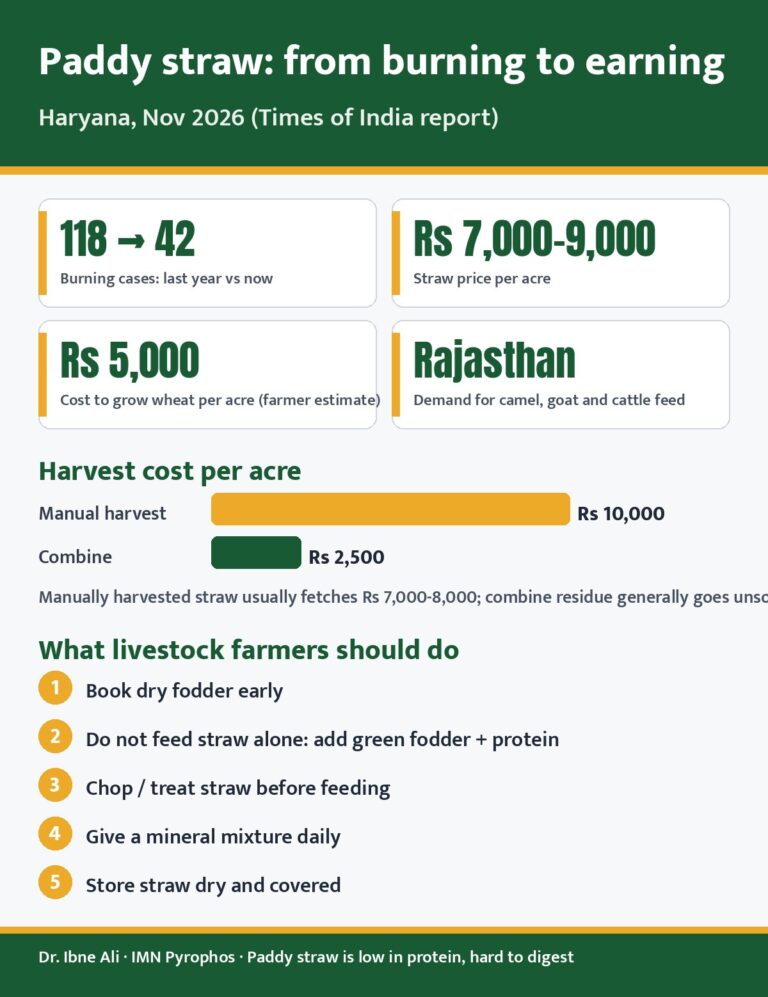
Haryana farmers are earning Rs 7,000 to Rs 9,000 per acre by selling paddy straw this season instead of burning it, and stubble-burning cases have fallen sharply as a result. According to agriculture department data quoted by the Times of India, 118 burning incidents were reported in Haryana up to 2 November last year, against just 42 this year. The straw is going to Rajasthan, where demand for cattle feed is high. For dairy and livestock farmers, it is also a reminder of how fast the dry fodder market is moving this winter.
Key facts
| Item | Detail |
|---|---|
| Burning incidents in Haryana | 118 up to 2 November last year; 42 this year (agriculture department data) |
| Price paid for paddy straw | Rs 7,000 to Rs 9,000 per acre this year |
| Minimum price offered by a private buyer | Rs 7,000 per acre (Raju, Ramrai village storage facility) |
| Where the straw is going | Rajasthan, as feed for camels, goats and other livestock |
| Cost to grow wheat on one acre (farmer’s estimate) | About Rs 5,000: Rs 1,500 fertiliser, Rs 1,500 seed, Rs 2,000 tractor work |
| Manual paddy harvesting | About Rs 10,000 per acre in labour; the Rs 7,000 to Rs 8,000 straw price is generally available on manually harvested fields |
| Combine harvester charge | About Rs 2,500 per acre; private buyers generally do not buy the residue left after combine harvesting |
What is happening on the ground
Raju, a private stubble buyer who has set up a large storage site in Ramrai village, told the Times of India that he buys straw straight from farmers at a minimum of Rs 7,000 per acre. He called these the highest paddy straw rates in recent years and said the push comes from Rajasthan, where demand is strong to feed camels, goats and other animals. He added that the trade has given work to hundreds of people, from labourers to tractor owners and loading machine operators.
Birender Bisla, a farmer from Rajthal, said stubble now brings extra income that helps him prepare for the next crop. By his estimate, wheat costs around Rs 5,000 per acre to grow, so the straw price this year more than covers it. Anil Godara, also of Rajthal in Hansi district, said his village has not reported a single burning incident so far, but he pointed out that the better price generally comes with manual harvesting, which costs about Rs 10,000 per acre in labour.
Why burning has fallen
Narender Pal, a quality control inspector with the agriculture department in Jind, confirmed a big drop in burning this season. He credited a mix of reasons: officials present in the fields, strict action against violations, more awareness among farmers, and biogas plants that use paddy straw as raw material. Price is the new factor. When straw sells for good money, burning it means throwing away income.
The gap that remains is the combine harvester. Farmers who need to clear the field quickly for wheat often use combines, and because buyers generally do not take the residue from these fields, some farmers still burn it. That is where the next improvement has to come from.
What it means for dairy and livestock farmers
Paddy straw leaving Haryana for Rajasthan means dry fodder is being traded over long distances. Livestock keepers should expect dry fodder to stay in demand and watch local straw and bhusa prices this winter. Remember also that paddy straw is a poor feed on its own: it is low in protein, high in fibre and hard to digest, so animals that depend mostly on straw need good protein, energy and minerals alongside it. This is general nutrition knowledge, not a claim from the report.
What farmers should do now
- Book your dry fodder early if you depend on bought straw or bhusa, and compare rates from more than one seller.
- Do not feed straw alone. Pair it with green fodder, a protein source such as oil cake and a concentrate that suits the animal’s milk yield.
- Treat and chop straw where you can, so animals waste less and digest it better.
- Give a mineral mixture every day. Rations heavy in dry fodder often run short of minerals, which shows up as lower milk and weaker fertility.
- Store straw dry and covered, away from rain and damp, to avoid mould.
- If you grow paddy, avoid burning. Selling the residue pays, and burning risks action and harms air quality.
Chelated minerals
Pyromin
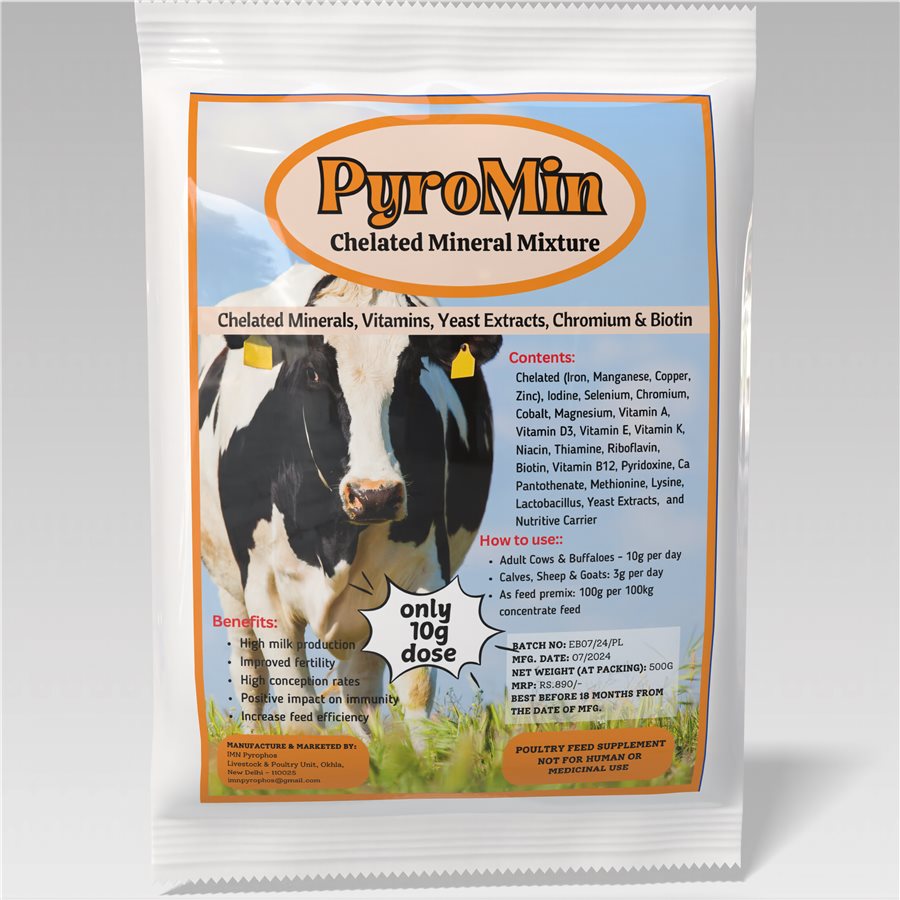
Chelated mineral mixture with vitamins A, D3, E, K, B vitamins, biotin, methionine, lysine, lactobacillus and yeast extract. Supports milk production, fertility, conception, immunity and feed efficiency.
Dose: 10 g per adult cow or buffalo per day; calves 3 g per day.
1 kg ₹655MRP ₹1,190
Frequently asked questions
How much are farmers earning from paddy straw in Haryana this year?
The Times of India reports Rs 7,000 to Rs 9,000 per acre, with a private buyer offering a minimum of Rs 7,000 per acre.
Why has stubble burning fallen in Haryana?
The agriculture department official quoted points to field monitoring, strict action, awareness and biogas plants that need paddy straw. Farmers also say the better straw price is a strong reason not to burn.
Can animals live on paddy straw alone?
No. Paddy straw is low in protein and hard to digest. It should be fed with green fodder, a protein source and a mineral mixture.
Source: Times of India, Chandigarh, November 2026. Written by the IMN Pyrophos team in our own words.
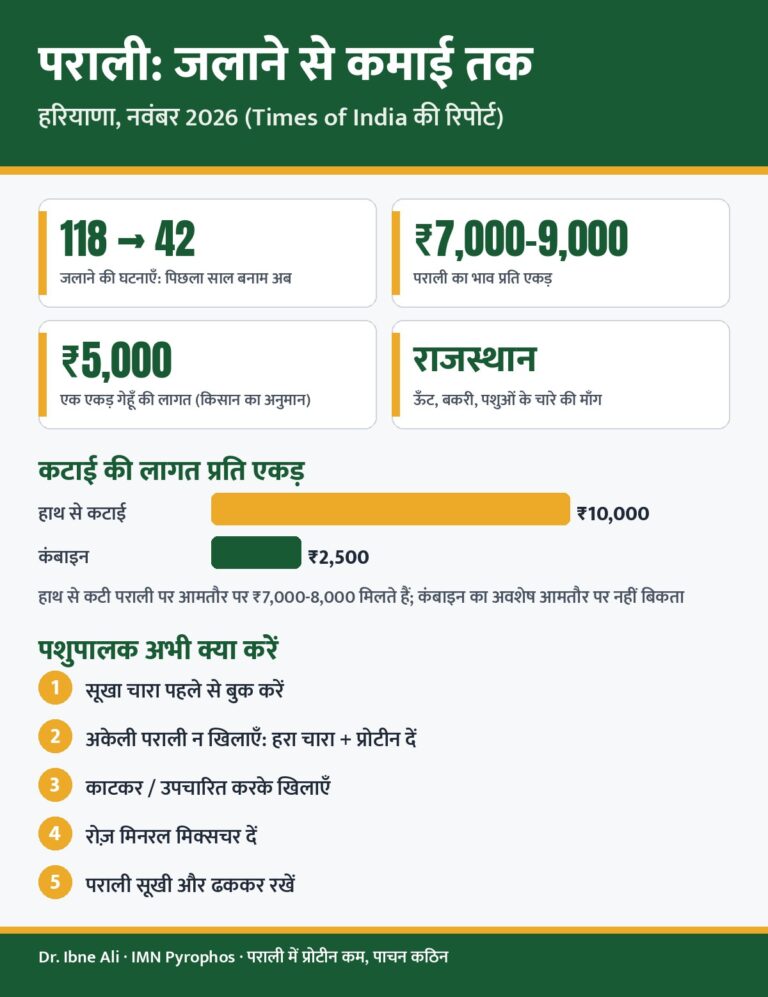
हरियाणा के किसान इस सीज़न धान की पराली जलाने के बजाय बेचकर प्रति एकड़ ₹7,000 से ₹9,000 कमा रहे हैं, और इसी वजह से पराली जलाने के मामले तेज़ी से घटे हैं। Times of India में छपे कृषि विभाग के आँकड़ों के अनुसार हरियाणा में पिछले साल 2 नवंबर तक 118 पराली जलाने की घटनाएँ दर्ज हुई थीं, जबकि इस साल सिर्फ़ 42। पराली राजस्थान जा रही है, जहाँ पशुओं के चारे की माँग ज़्यादा है। डेयरी और पशुपालकों के लिए यह इस बात की याद भी है कि इस सर्दी में सूखे चारे का बाज़ार कितनी तेज़ी से चल रहा है।
मुख्य तथ्य
| बिंदु | विवरण |
|---|---|
| हरियाणा में पराली जलाने की घटनाएँ | पिछले साल 2 नवंबर तक 118; इस साल 42 (कृषि विभाग के आँकड़े) |
| धान की पराली का भाव | इस साल ₹7,000 से ₹9,000 प्रति एकड़ |
| निजी ख़रीदार का न्यूनतम भाव | ₹7,000 प्रति एकड़ (राजू, रामराय गाँव का भंडारण केंद्र) |
| पराली कहाँ जा रही है | राजस्थान, ऊँट, बकरी और दूसरे पशुओं के चारे के रूप में |
| एक एकड़ में गेहूँ की लागत (किसान का अनुमान) | लगभग ₹5,000: ₹1,500 खाद, ₹1,500 बीज, ₹2,000 ट्रैक्टर का काम |
| हाथ से धान कटाई | मज़दूरी लगभग ₹10,000 प्रति एकड़; ₹7,000-₹8,000 का भाव आमतौर पर हाथ से कटे खेतों में मिलता है |
| कंबाइन हार्वेस्टर का किराया | लगभग ₹2,500 प्रति एकड़; कंबाइन के बाद बचे अवशेष को निजी ख़रीदार आमतौर पर नहीं लेते |
ज़मीन पर क्या हो रहा है
राजू, एक निजी पराली ख़रीदार जिन्होंने रामराय गाँव में बड़ा भंडारण केंद्र बनाया है, ने Times of India को बताया कि वे किसानों से सीधे कम से कम ₹7,000 प्रति एकड़ पर पराली ख़रीदते हैं। उन्होंने इसे हाल के वर्षों के सबसे ऊँचे भाव बताया और कहा कि इसके पीछे राजस्थान की माँग है, जहाँ ऊँट, बकरी और दूसरे पशुओं को खिलाने के लिए पराली चाहिए। उनके मुताबिक इस कारोबार से मज़दूरों, ट्रैक्टर मालिकों और लोडिंग मशीन चलाने वालों सहित सैकड़ों लोगों को काम मिला है।
राजथल के किसान बीरेंद्र बिसला ने कहा कि पराली अब अगली फ़सल की तैयारी के लिए अतिरिक्त आमदनी का ज़रिया है। उनके अनुमान से गेहूँ उगाने में लगभग ₹5,000 प्रति एकड़ लगते हैं, इसलिए इस साल पराली का भाव उससे ज़्यादा निकल आता है। हांसी ज़िले के राजथल के ही अनिल गोदारा ने बताया कि उनके गाँव में अब तक एक भी घटना नहीं हुई, पर उन्होंने यह भी कहा कि बेहतर भाव आमतौर पर हाथ से कटाई में मिलता है, जिसकी मज़दूरी लगभग ₹10,000 प्रति एकड़ आती है।
पराली जलाना क्यों घटा
जींद में कृषि विभाग के क्वालिटी कंट्रोल इंस्पेक्टर नरेंद्र पाल ने इस सीज़न में बड़ी गिरावट की पुष्टि की। उन्होंने कई कारण गिनाए: खेतों में अधिकारियों की लगातार मौजूदगी, उल्लंघन पर सख़्त कार्रवाई, किसानों में बढ़ी जागरूकता और बायोगैस प्लांट, जिन्हें कच्चे माल के रूप में धान की पराली चाहिए। नया कारण भाव है। जब पराली अच्छे दाम पर बिकती है तो उसे जलाने का मतलब अपनी आमदनी फेंकना है।
जो कमी बची है वह कंबाइन हार्वेस्टर की है। जिन किसानों को गेहूँ के लिए खेत जल्दी ख़ाली करना होता है, वे अक्सर कंबाइन का सहारा लेते हैं, और चूँकि ख़रीदार आमतौर पर ऐसे खेतों का अवशेष नहीं लेते, कुछ किसान अब भी उसे जला देते हैं। अगला सुधार यहीं से आना है।
डेयरी और पशुपालकों के लिए इसका मतलब
हरियाणा से राजस्थान जाती पराली का मतलब है कि सूखा चारा अब लंबी दूरी तक बिक रहा है। पशुपालक इस सर्दी सूखे चारे की माँग बनी रहने की उम्मीद रखें और अपने इलाक़े के भूसे और पराली के भाव पर नज़र रखें। यह भी याद रखें कि धान की पराली अकेले अच्छा चारा नहीं है: इसमें प्रोटीन कम, रेशा ज़्यादा है और पाचन कठिन है, इसलिए जिन पशुओं का ज़्यादातर चारा पराली है, उन्हें साथ में अच्छा प्रोटीन, ऊर्जा और मिनरल चाहिए। यह सामान्य पोषण की जानकारी है, रिपोर्ट का दावा नहीं।
किसान अभी क्या करें
- सूखा चारा पहले से बुक करें अगर आप ख़रीदे हुए भूसे या पराली पर निर्भर हैं, और एक से ज़्यादा विक्रेता से भाव मिलाएँ।
- अकेली पराली न खिलाएँ। साथ में हरा चारा, खली जैसा प्रोटीन स्रोत और पशु के दूध के हिसाब से दाना दें।
- पराली को काटकर और उपचारित करके खिलाएँ जहाँ संभव हो, ताकि बर्बादी कम हो और पाचन बेहतर हो।
- रोज़ मिनरल मिक्सचर दें। सूखे चारे वाली ख़ुराक में अक्सर मिनरल कम पड़ते हैं, जिसका असर दूध और प्रजनन पर दिखता है।
- पराली को सूखा और ढककर रखें, बारिश और नमी से दूर, ताकि फफूँद न लगे।
- धान उगाते हैं तो जलाएँ नहीं। अवशेष बेचने से कमाई होती है, और जलाने पर कार्रवाई का ख़तरा और हवा का नुकसान है।
चिलेटेड मिनरल · रोज़ थोड़ी मात्रा
Pyromin
चिलेटेड आयरन, मैंगनीज़, कॉपर, ज़िंक, आयोडीन, सेलेनियम, क्रोमियम, कोबाल्ट और मैग्नीशियम, साथ में विटामिन A, D3, E, K और B विटामिन, बायोटिन, मेथियोनीन, लाइसीन, लैक्टोबैसिलस और यीस्ट एक्सट्रैक्ट। दूध उत्पादन, प्रजनन, गाभिन ठहरने, रोग प्रतिरोधक क्षमता और चारे के बेहतर उपयोग में सहायक।
मात्रा: वयस्क गाय या भैंस को 10 ग्राम प्रति दिन; बछड़े, भेड़ और बकरी को 3 ग्राम प्रति दिन। प्रीमिक्स के रूप में 100 ग्राम प्रति 100 किलो दाना।
1 kg ₹655MRP ₹1,190
अक्सर पूछे जाने वाले सवाल
हरियाणा में इस साल किसान पराली से कितना कमा रहे हैं?
Times of India के अनुसार ₹7,000 से ₹9,000 प्रति एकड़, और एक निजी ख़रीदार कम से कम ₹7,000 प्रति एकड़ दे रहा है।
हरियाणा में पराली जलाना क्यों घटा?
उद्धृत कृषि विभाग अधिकारी खेतों की निगरानी, सख़्त कार्रवाई, जागरूकता और पराली लेने वाले बायोगैस प्लांट का नाम लेते हैं। किसान भी कहते हैं कि पराली का बेहतर भाव न जलाने की बड़ी वजह है।
क्या पशु अकेली धान की पराली पर रह सकते हैं?
नहीं। धान की पराली में प्रोटीन कम है और पाचन कठिन है। इसे हरे चारे, प्रोटीन स्रोत और मिनरल मिक्सचर के साथ खिलाना चाहिए।
स्रोत: Times of India, चंडीगढ़, नवंबर 2026। IMN Pyrophos टीम ने अपने शब्दों में लिखा।
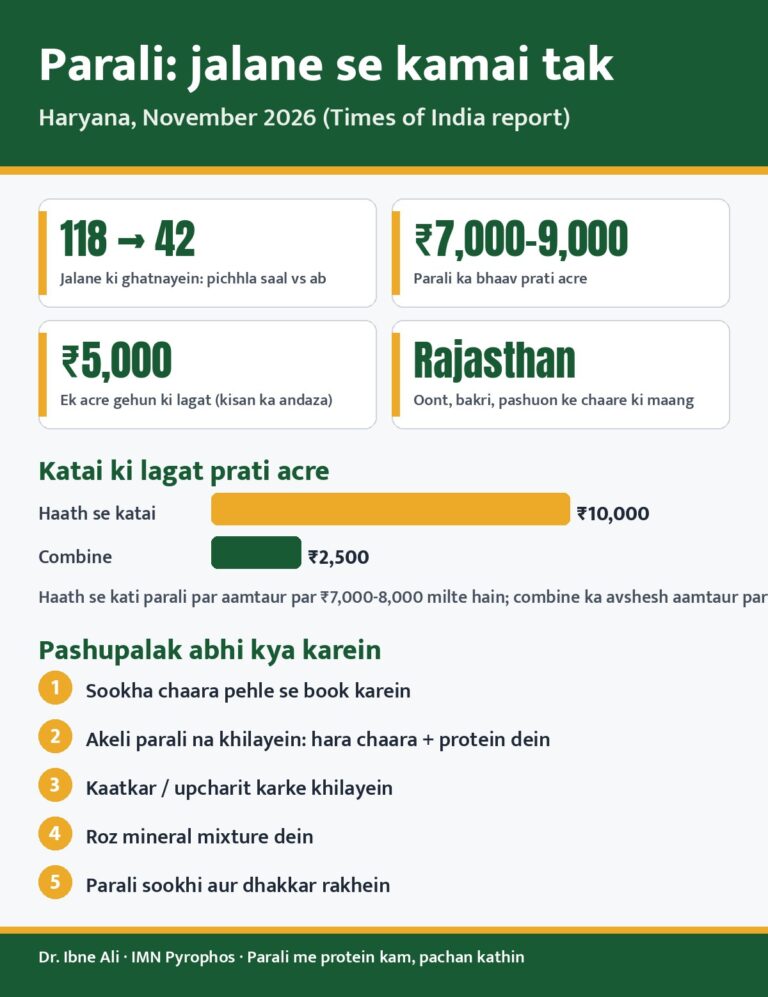
Haryana ke kisan is season dhaan ki parali jalane ke bajay bechkar prati acre ₹7,000 se ₹9,000 kama rahe hain, aur isi wajah se parali jalane ke maamle tezi se ghate hain. Times of India me chhape krishi vibhag ke aankdon ke anusaar Haryana me pichhle saal 2 November tak 118 parali jalane ki ghatnayein darj hui thi, jabki is saal sirf 42. Parali Rajasthan ja rahi hai, jahan pashuon ke chaare ki maang zyada hai. Dairy aur pashupalakon ke liye ye is baat ki yaad bhi hai ki is sardi me sookhe chaare ka bazaar kitni tezi se chal raha hai.
Mukhya tathya
| Bindu | Vivaran |
|---|---|
| Haryana me parali jalane ki ghatnayein | Pichhle saal 2 November tak 118; is saal 42 (krishi vibhag ke aankde) |
| Dhaan ki parali ka bhaav | Is saal ₹7,000 se ₹9,000 prati acre |
| Niji kharidar ka nyuntam bhaav | ₹7,000 prati acre (Raju, Ramrai gaon ka bhandaran kendra) |
| Parali kahan ja rahi hai | Rajasthan, oont, bakri aur doosre pashuon ke chaare ke roop me |
| Ek acre me gehun ki lagat (kisan ka andaza) | Lagbhag ₹5,000: ₹1,500 khaad, ₹1,500 beej, ₹2,000 tractor ka kaam |
| Haath se dhaan katai | Mazdoori lagbhag ₹10,000 prati acre; ₹7,000-₹8,000 ka bhaav aamtaur par haath se kate kheton me milta hai |
| Combine harvester ka kiraya | Lagbhag ₹2,500 prati acre; combine ke baad bache avshesh ko niji kharidar aamtaur par nahi lete |
Zameen par kya ho raha hai
Raju, ek niji parali kharidar jinhone Ramrai gaon me bada bhandaran kendra banaya hai, ne Times of India ko bataya ki wo kisanon se seedhe kam se kam ₹7,000 prati acre par parali kharidte hain. Unhone ise haal ke varshon ka sabse ooncha bhaav bataya aur kaha ki iske peechhe Rajasthan ki maang hai, jahan oont, bakri aur doosre pashuon ko khilane ke liye parali chahiye. Unke mutabik is karobar se mazdooron, tractor maalikon aur loading machine chalane walon samet saikdon logon ko kaam mila hai.
Rajthal ke kisan Birender Bisla ne kaha ki parali ab agli fasal ki taiyaari ke liye atirikt aamdani ka zariya hai. Unke andaze se gehun ugane me lagbhag ₹5,000 prati acre lagte hain, isliye is saal parali ka bhaav usse zyada nikal aata hai. Hansi zile ke Rajthal ke hi Anil Godara ne bataya ki unke gaon me ab tak ek bhi ghatna nahi hui, par unhone ye bhi kaha ki behtar bhaav aamtaur par haath se katai me milta hai, jiski mazdoori lagbhag ₹10,000 prati acre aati hai.
Parali jalana kyon ghata
Jind me krishi vibhag ke quality control inspector Narender Pal ne is season me badi giravat ki pushti ki. Unhone kai karan ginaye: kheton me adhikariyon ki lagaatar maujoodgi, ullanghan par sakht karyavahi, kisanon me badhi jagrookta aur biogas plant, jinhe kachche maal ke roop me dhaan ki parali chahiye. Naya karan bhaav hai. Jab parali achhe daam par bikti hai to use jalane ka matlab apni aamdani phenkna hai.
Jo kami bachi hai wo combine harvester ki hai. Jin kisanon ko gehun ke liye khet jaldi khali karna hota hai, wo aksar combine ka sahara lete hain, aur chunki kharidar aamtaur par aise kheton ka avshesh nahi lete, kuch kisan ab bhi use jala dete hain. Agla sudhar yahin se aana hai.
Dairy aur pashupalakon ke liye iska matlab
Haryana se Rajasthan jaati parali ka matlab hai ki sookha chaara ab lambi doori tak bik raha hai. Pashupalak is sardi sookhe chaare ki maang bani rehne ki ummeed rakhein aur apne ilaake ke bhoose aur parali ke bhaav par nazar rakhein. Ye bhi yaad rakhein ki dhaan ki parali akeli achhi khuraak nahi hai: isme protein kam, reshe zyada hain aur pachan kathin hai, isliye jin pashuon ka zyadatar chaara parali hai, unhe saath me achha protein, urja aur mineral chahiye. Ye saamanya poshan ki jaankari hai, report ka daava nahi.
Kisan abhi kya karein
- Sookha chaara pehle se book karein agar aap kharide hue bhoose ya parali par nirbhar hain, aur ek se zyada vikreta se bhaav milayein.
- Akeli parali na khilayein. Saath me hara chaara, khali jaisa protein strot aur pashu ke doodh ke hisaab se daana dein.
- Parali ko kaatkar aur upcharit karke khilayein jahan sambhav ho, taaki barbaadi kam ho aur pachan behtar ho.
- Roz mineral mixture dein. Sookhe chaare wali khuraak me aksar mineral kam padte hain, jiska asar doodh aur prajanan par dikhta hai.
- Parali ko sookha aur dhakkar rakhein, baarish aur nami se door, taaki fafoond na lage.
- Dhaan ugate hain to jalayein nahi. Avshesh bechne se kamai hoti hai, aur jalane par karyavahi ka khatra aur hawa ka nuksaan hai.
Chelated mineral · roz thodi matra
Pyromin
Chelated iron, manganese, copper, zinc, iodine, selenium, chromium, cobalt aur magnesium, saath me vitamin A, D3, E, K aur B vitamin, biotin, methionine, lysine, lactobacillus aur yeast extract. Doodh utpadan, prajanan, gaabhin theharne, immunity aur chaare ke behtar upyog me sahayak.
Matra: Vayask gaay ya bhains ko 10 g prati din; bachhde, bhed aur bakri ko 3 g prati din. Premix ke roop me 100 g prati 100 kg daana.
1 kg ₹655MRP ₹1,190
Aksar pooche jaane wale sawaal
Haryana me is saal kisan parali se kitna kama rahe hain?
Times of India ke anusaar ₹7,000 se ₹9,000 prati acre, aur ek niji kharidar kam se kam ₹7,000 prati acre de raha hai.
Haryana me parali jalana kyon ghata?
Uddhrit krishi vibhag adhikari kheton ki nigrani, sakht karyavahi, jagrookta aur parali lene wale biogas plant ka naam lete hain. Kisan bhi kehte hain ki parali ka behtar bhaav na jalane ki badi wajah hai.
Kya pashu akeli dhaan ki parali par reh sakte hain?
Nahi. Dhaan ki parali me protein kam hai aur pachan kathin hai. Ise hare chaare, protein strot aur mineral mixture ke saath khilana chahiye.
Source: Times of India, Chandigarh, November 2026. IMN Pyrophos team ne apne shabdon me likha.