
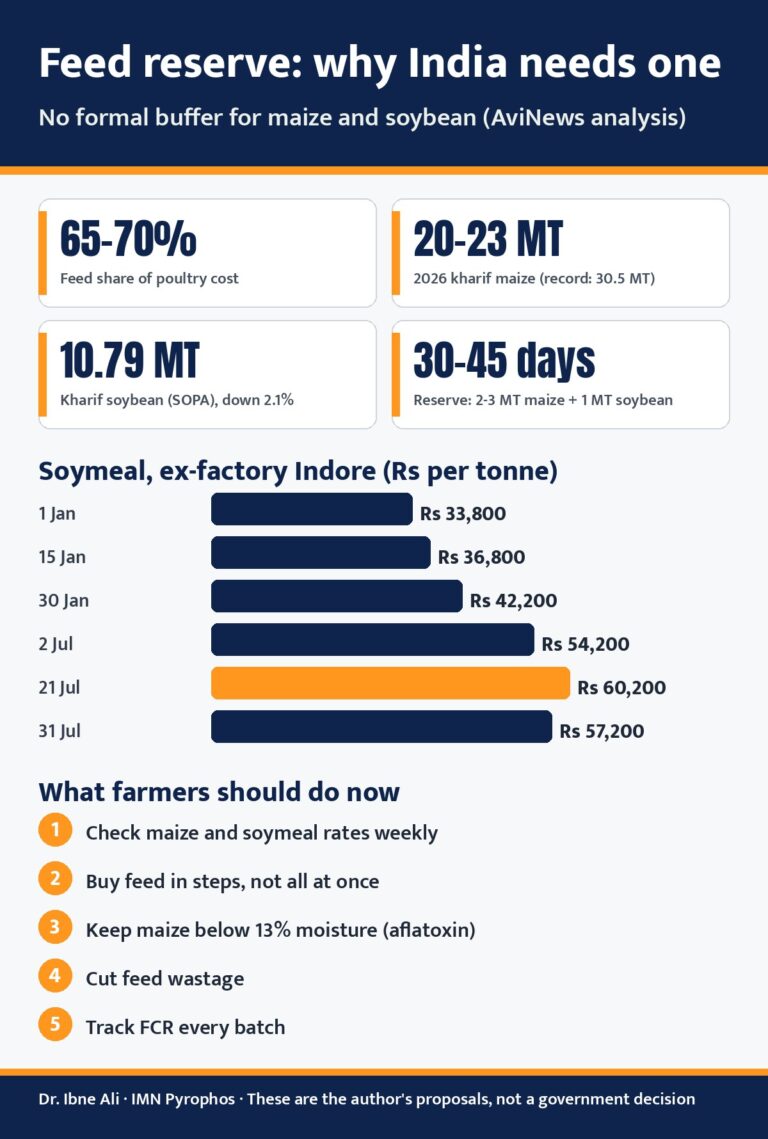
India keeps buffer stocks of wheat, rice, pulses and onions, but has no formal reserve for maize and soybean, the two ingredients that turn grain into eggs, chicken, milk and fish. A policy analysis published by AviNews in November 2026 argues for a revolving strategic feed reserve of 30 to 45 days of feed demand, after this year’s weather stress hit both crops together. For poultry and dairy farmers it explains why feed prices swing so hard and what a stable system could look like.
Key facts
| Item | Detail (as reported) |
|---|---|
| Kharif maize 2026 (industry estimate) | About 20 to 23 million tonnes (MT), against a record 30.5 MT in the Agriculture Ministry’s third advance estimate for 2025-26 |
| Kharif soybean 2026 (SOPA) | 10.79 MT, down 2.1%. Maharashtra, Karnataka and Telangana lost a third to nearly half of their output to moisture stress |
| Soymeal, ex-factory Indore | About Rs 33,800 per tonne on 1 January, Rs 60,200 on 21 July (mid-points of SOPA’s published ranges), a rise of about Rs 26,500 |
| Feed share of poultry cost | 65 to 70% |
| Maize use | Poultry takes about half of demand; about a quarter of the crop now goes to ethanol (as per ICAR-IIMR). Demand is projected near 72 MT by 2030-31 (FICCI-YES Bank) |
| Proposed reserve | 30 to 45 days of feed demand: about 2 to 3 MT maize and about 1 MT soybean, reviewed yearly, with a pilot at one-third of this size |
Rate-card proof: Skylark Proteins, same season, one year apart
Rate cards from Skylark Proteins Pvt Ltd (Jhalara, Makdone, Ujjain), shared with us by Dr. Ibne Ali, show the same jump at the plant gate. All rates are ex-plant, with advance payment and 5% GST extra.
| Product (Rs per tonne) | 11 Nov 2025 | 15 Nov 2025 | 27 Oct 2026 | 4 Nov 2026 | Change, 11 Nov 2025 to 4 Nov 2026 |
|---|---|---|---|---|---|
| Hi-Pro soymeal 50% | 39,500 | 40,000 | 68,000 | 66,500 | +27,000 (about +68%) |
| Normal soymeal 46% | 36,000 | 37,000 | 64,000 | 62,000 | +26,000 (about +72%) |
| Soya solvent oil | 1,200 | 1,190 | 1,400 | 1,375 | +175 (about +15%) |
The cards also show that rates eased slightly in the last week (Hi-Pro down Rs 1,500 and Normal down Rs 2,000 between 27 October and 4 November 2026), but they are still far above last year. The oil price moved much less than meal. The rates are as printed on the cards, and the percentages are our own calculation.
Why this matters
The author’s point is that a dry year hits rain-fed crops, and India has planned for the plate but not for the feed trough. Maize is now India’s third-largest food grain, with a record 55.1 MT produced in 2025-26, but feed, starch and fuel all chase the same grain. Soymeal is the main protein in poultry, fish and dairy rations, and substitutes are limited by amino-acid balance, availability and price. So a feed shock reaches the cheapest animal protein in the Indian diet first.
The piece also says imports alone are a slow answer. In August 2021, when soymeal prices had tripled, the Government allowed 1.2 MT of GM soymeal imports, but traders could contract only about 0.65 MT before the window closed. In 2026 the argument is back: poultry bodies want duty-free imports of 1.5 to 3 MT, while SOPA says 2026-27 availability of 8.17 MT is enough for demand of 8.0 MT. Feed makers put demand at 10.62 MT. When the numbers are disputed, the response is slow, and prices do the adjusting.
What the proposal says
- Hold what keeps. Maize should go into storage below 12 to 13% moisture, because the fungus that makes aflatoxin largely stops growing at that level. Intake should be gated by moisture and toxin tests, with silo or hermetic storage.
- Hold soybean as seed, not meal. Meal takes up moisture and loses quality in humid conditions. Whole soybean keeps better and can be crushed when released, using existing capacity.
- Size it in days. A 30 to 45 day cover means 2 to 3 MT of maize (about 4 to 5% of annual output) and roughly 1 MT of soybean.
- Keep it revolving. Stock should move first-in, first-out so it does not decay or distort the market. The piece points to China’s falling corn stocks after 2017 as a lesson.
- Buy low, release at a trigger. Buy at harvest lows to support farmers, and release by auction when prices cross a pre-notified level to protect feed buyers.
- Share the data. A monthly national feed balance sheet, owned jointly by Government, ICAR, SOPA, CLFMA and poultry bodies, so everyone argues from the same numbers.
It also suggests the Animal Husbandry department lead a framework in 90 days, and warns that the onion buffer shows the need for advance rules and prompt payment to sellers. These are the author’s proposals, not government decisions.
What it means for poultry and dairy farmers
No reserve exists yet, so feed cost will keep following the weather and the mandi. Maize and soymeal make up most of a broiler or layer ration, and soy cake and maize are key in dairy concentrate too. When these two rise together, margins fall fast, and small farms feel it first.
What farmers should do now
- Track local maize and soymeal rates every week and buy feed in steps, not all at once.
- If you store maize or make your own feed, keep grain dry (below about 13% moisture), off the floor and covered, to avoid mould and aflatoxin.
- Cut feed wastage. Spilled and wet feed loses more money than a small price move.
- Track FCR every batch. When feed is costly, a small FCR gain pays more. Use our CFCR calculator and read how to maintain FCR in winter.
- Ask your feed supplier how much stock they hold and how their price follows the market.
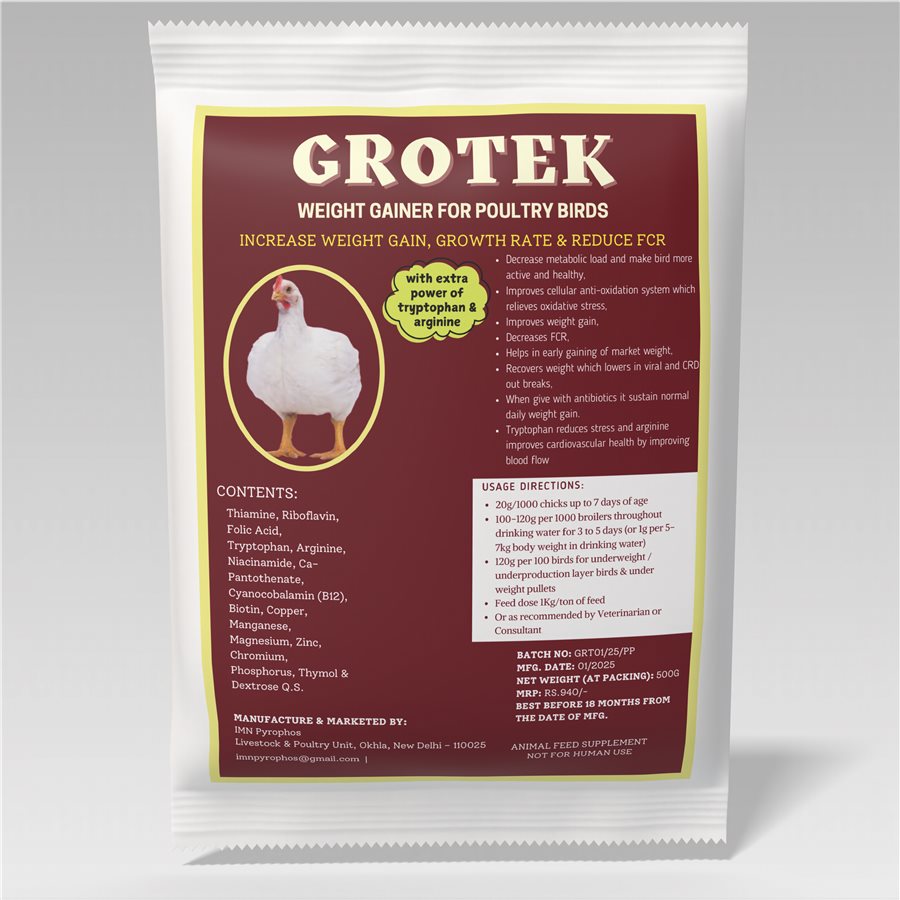
More weight · lower FCR
Grotek
B group vitamins, minerals and herbal antioxidants (amla, ashwagandha, tulsi). Improves feed intake and reduces FCR, increases growth rate to reach market weight early, supports the liver, and helps keep weight during infections and antibiotic use. Contains no iron.
Dose: 1–2 g per litre of water for 15–18 hours a day for 5 days; during or after infections 1 g per 5 kg body weight.
500 g ₹679MRP ₹940
Frequently asked questions
Does India have a strategic reserve for maize and soybean?
According to the article, no. India holds buffers of wheat, rice, pulses and onions but has no formal buffer for maize and soybean.
How big a reserve is suggested?
The author suggests 30 to 45 days of feed demand, about 2 to 3 million tonnes of maize and about 1 million tonnes of soybean, as a starting point for proper assessment.
Why store soybean as seed and not as meal?
Soymeal absorbs moisture and loses quality quickly in humid Indian conditions, while whole soybean at safe moisture keeps better and can be crushed on release.
Source: AviNews, “India guards its wheat, rice and onions: who guards the feed?”, November 2026. Written by the IMN Pyrophos team in our own words.
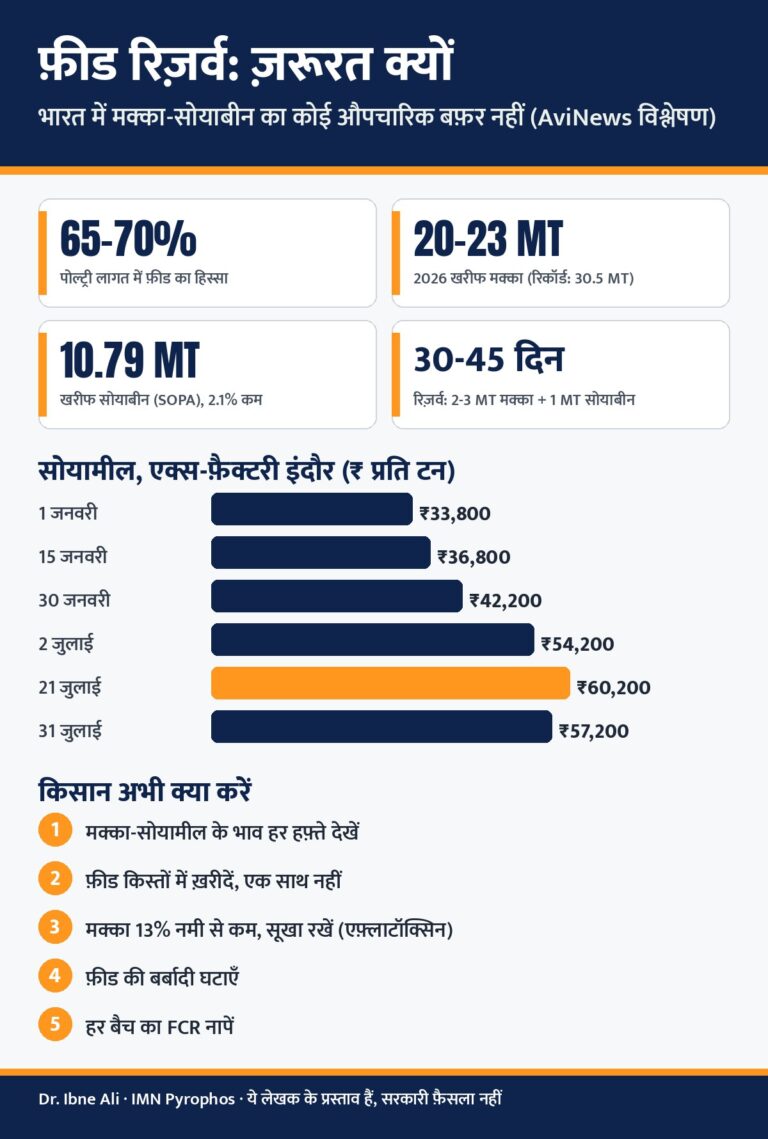
भारत गेहूँ, चावल, दालों और प्याज़ का बफ़र स्टॉक रखता है, पर मक्का और सोयाबीन का कोई औपचारिक रिज़र्व नहीं है, जबकि यही दो चीज़ें अनाज को अंडे, चिकन, दूध और मछली में बदलती हैं। नवंबर 2026 में AviNews पर छपे एक नीतिगत विश्लेषण में 30 से 45 दिन की फ़ीड माँग के बराबर घूमता हुआ रणनीतिक फ़ीड रिज़र्व बनाने की बात कही गई है, क्योंकि इस साल मौसम के तनाव ने दोनों फ़सलों को एक साथ चोट पहुँचाई। पोल्ट्री और डेयरी किसानों के लिए यह समझाता है कि फ़ीड के भाव इतना क्यों हिलते हैं और एक स्थिर व्यवस्था कैसी हो सकती है।
मुख्य तथ्य
| बिंदु | विवरण (रिपोर्ट के अनुसार) |
|---|---|
| 2026 खरीफ मक्का (उद्योग अनुमान) | लगभग 20 से 23 मिलियन टन (MT), जबकि 2025-26 के तीसरे अग्रिम अनुमान में रिकॉर्ड 30.5 MT |
| 2026 खरीफ सोयाबीन (SOPA) | 10.79 MT, 2.1% कम। महाराष्ट्र, कर्नाटक और तेलंगाना में नमी की कमी से उत्पादन का एक तिहाई से लगभग आधा नुकसान |
| सोयामील, एक्स-फ़ैक्टरी इंदौर | 1 जनवरी को लगभग ₹33,800 प्रति टन, 21 जुलाई को ₹60,200 (SOPA की प्रकाशित रेंज के मध्य मान), यानी लगभग ₹26,500 की बढ़त |
| पोल्ट्री लागत में फ़ीड का हिस्सा | 65 से 70% |
| मक्का की खपत | पोल्ट्री लगभग आधी माँग लेती है; फ़सल का लगभग चौथाई हिस्सा अब इथेनॉल में जाता है (ICAR-IIMR के अनुसार)। 2030-31 तक माँग लगभग 72 MT (FICCI-YES Bank) |
| प्रस्तावित रिज़र्व | 30 से 45 दिन की फ़ीड माँग: लगभग 2 से 3 MT मक्का और लगभग 1 MT सोयाबीन, हर साल समीक्षा, और पायलट इसके एक तिहाई आकार पर |
रेट कार्ड का सबूत: Skylark Proteins, एक साल के अंतर पर वही सीज़न
Skylark Proteins Pvt Ltd (झालारा, मकड़ोन, उज्जैन) के रेट कार्ड, जो डॉ. इब्ने अली ने हमें दिए, प्लांट के गेट पर वही उछाल दिखाते हैं। सारे भाव ex-plant हैं, एडवांस पेमेंट और ऊपर से 5% GST।
| उत्पाद (₹ प्रति टन) | 11 नवंबर 2025 | 15 नवंबर 2025 | 27 अक्टूबर 2026 | 4 नवंबर 2026 | बदलाव, 11 नवंबर 2025 से 4 नवंबर 2026 |
|---|---|---|---|---|---|
| Hi-Pro सोयामील 50% | 39,500 | 40,000 | 68,000 | 66,500 | +27,000 (लगभग +68%) |
| Normal सोयामील 46% | 36,000 | 37,000 | 64,000 | 62,000 | +26,000 (लगभग +72%) |
| सोया सॉल्वेंट ऑयल | 1,200 | 1,190 | 1,400 | 1,375 | +175 (लगभग +15%) |
कार्ड यह भी दिखाते हैं कि पिछले हफ़्ते भाव थोड़े नरम हुए (27 अक्टूबर से 4 नवंबर 2026 के बीच Hi-Pro ₹1,500 और Normal ₹2,000 कम), पर पिछले साल से अब भी बहुत ऊपर हैं। तेल का भाव मील के मुक़ाबले बहुत कम बढ़ा। भाव कार्ड के अनुसार हैं, प्रतिशत हमारी अपनी गणना है।
यह क्यों मायने रखता है
लेखक की बात यह है कि सूखा साल बारिश पर टिकी फ़सलों को मारता है, और भारत ने थाली की योजना बनाई है पर चारे की नाँद की नहीं। मक्का अब भारत का तीसरा सबसे बड़ा खाद्यान्न है, 2025-26 में रिकॉर्ड 55.1 MT, लेकिन फ़ीड, स्टार्च और ईंधन तीनों उसी अनाज के पीछे हैं। सोयामील पोल्ट्री, मछली और डेयरी की ख़ुराक का मुख्य प्रोटीन है, और विकल्प अमीनो एसिड संतुलन, उपलब्धता और भाव से सीमित हैं। इसलिए फ़ीड का झटका भारतीय थाली के सबसे सस्ते पशु प्रोटीन पर सबसे पहले पड़ता है।
लेख यह भी कहता है कि सिर्फ़ आयात धीमा उपाय है। अगस्त 2021 में, जब सोयामील के भाव तीन गुना हो गए थे, सरकार ने 1.2 MT GM सोयामील आयात की अनुमति दी, पर खिड़की बंद होने तक व्यापारी लगभग 0.65 MT का ही सौदा कर पाए। 2026 में वही बहस लौटी है: पोल्ट्री संगठन 1.5 से 3 MT शुल्क-मुक्त आयात चाहते हैं, जबकि SOPA का कहना है कि 2026-27 में 8.17 MT उपलब्धता 8.0 MT माँग के लिए काफ़ी है। फ़ीड निर्माता माँग 10.62 MT बताते हैं। जब आँकड़ों पर विवाद हो तो जवाब धीमा होता है, और भाव ही समायोजन करते हैं।
प्रस्ताव क्या कहता है
- वही रखें जो टिकता है। मक्का 12 से 13% से कम नमी पर भंडारित हो, क्योंकि उस स्तर पर एफ़्लाटॉक्सिन बनाने वाली फफूँद लगभग रुक जाती है। भंडार में लेना नमी और टॉक्सिन जाँच से तय हो, और भंडारण साइलो या हर्मेटिक हो।
- सोयाबीन बीज के रूप में रखें, मील नहीं। मील नमी खींचता है और नम मौसम में जल्दी ख़राब होता है। सुरक्षित नमी पर पूरा सोयाबीन ज़्यादा टिकता है और रिलीज़ के समय मौजूदा क्षमता से पेरा जा सकता है।
- आकार दिनों में तय करें। 30 से 45 दिन के कवर का मतलब 2 से 3 MT मक्का (सालाना उत्पादन का लगभग 4 से 5%) और लगभग 1 MT सोयाबीन।
- इसे घुमाते रहें। स्टॉक पहले आओ, पहले जाओ के हिसाब से चले, ताकि सड़े नहीं और बाज़ार न बिगाड़े। लेख 2017 के बाद चीन के घटते कॉर्न स्टॉक का उदाहरण देता है।
- सस्ते में ख़रीदें, ट्रिगर पर छोड़ें। कटाई के समय के निचले भाव पर ख़रीदकर किसान को सहारा दें, और पहले से घोषित स्तर पार होने पर नीलामी से छोड़कर फ़ीड ख़रीदारों को बचाएँ।
- आँकड़े साझा हों। सरकार, ICAR, SOPA, CLFMA और पोल्ट्री संगठनों की साझा मासिक राष्ट्रीय फ़ीड बैलेंस शीट, ताकि सब एक ही संख्या से बात करें।
लेख यह भी सुझाता है कि पशुपालन विभाग 90 दिन में ढाँचा तैयार करे, और प्याज़ बफ़र का अनुभव बताता है कि नियम पहले से घोषित हों और विक्रेताओं को समय पर भुगतान मिले। ये लेखक के सुझाव हैं, सरकारी फ़ैसले नहीं।
पोल्ट्री और डेयरी किसानों के लिए इसका मतलब
अभी कोई रिज़र्व नहीं है, इसलिए फ़ीड की लागत मौसम और मंडी के पीछे चलती रहेगी। ब्रॉयलर या लेयर की ख़ुराक का ज़्यादातर हिस्सा मक्का और सोयामील है, और डेयरी दाने में भी सोया खली और मक्का मुख्य हैं। जब दोनों साथ बढ़ते हैं तो मार्जिन तेज़ी से घटता है, और छोटे फ़ार्म पर असर सबसे पहले पड़ता है।
किसान अभी क्या करें
- स्थानीय मक्का और सोयामील के भाव हर हफ़्ते देखें और फ़ीड एक साथ नहीं, किस्तों में ख़रीदें।
- मक्का रखते हैं या अपना फ़ीड बनाते हैं तो अनाज सूखा (लगभग 13% नमी से कम), ज़मीन से ऊपर और ढककर रखें, ताकि फफूँद और एफ़्लाटॉक्सिन न बने।
- फ़ीड की बर्बादी घटाएँ। गिरा और गीला फ़ीड छोटे भाव उतार-चढ़ाव से ज़्यादा पैसा खोता है।
- हर बैच का FCR नापें। फ़ीड महँगा हो तो FCR में छोटा सुधार भी ज़्यादा फ़ायदा देता है। हमारा CFCR कैलकुलेटर इस्तेमाल करें और पढ़ें सर्दी में FCR कैसे बनाए रखें।
- फ़ीड सप्लायर से पूछें कि उसके पास कितना स्टॉक है और उसका भाव बाज़ार को कैसे फ़ॉलो करता है।
वज़न बढ़ाए · FCR घटाए
Grotek
B ग्रुप विटामिन, मिनरल और हर्बल एंटीऑक्सीडेंट (आँवला, अश्वगंधा, तुलसी)। दाना खाना बढ़ाता है और FCR घटाता है, बढ़वार तेज़ करता है ताकि बाज़ार का वज़न जल्दी आए, लिवर को सहारा देता है, और इन्फेक्शन व एंटीबायोटिक के दौरान वज़न बचाने में मदद करता है। इसमें आयरन नहीं है।
मात्रा: 1–2 ग्राम प्रति लीटर पानी, रोज़ 15–18 घंटे, 5 दिन; इन्फेक्शन के दौरान या बाद 1 ग्राम प्रति 5 किलो वज़न।
500 g ₹679MRP ₹940
अक्सर पूछे जाने वाले सवाल
क्या भारत के पास मक्का और सोयाबीन का रणनीतिक रिज़र्व है?
लेख के अनुसार नहीं। भारत के पास गेहूँ, चावल, दाल और प्याज़ के बफ़र हैं, पर मक्का और सोयाबीन का कोई औपचारिक बफ़र नहीं।
कितना बड़ा रिज़र्व सुझाया गया है?
लेखक 30 से 45 दिन की फ़ीड माँग सुझाते हैं: लगभग 2 से 3 मिलियन टन मक्का और लगभग 1 मिलियन टन सोयाबीन, पूरी जाँच के लिए शुरुआती बिंदु के रूप में।
सोयाबीन बीज के रूप में क्यों, मील क्यों नहीं?
सोयामील नम भारतीय मौसम में नमी खींचता है और जल्दी ख़राब होता है, जबकि सुरक्षित नमी पर पूरा सोयाबीन ज़्यादा टिकता है और रिलीज़ पर पेरा जा सकता है।
स्रोत: AviNews, “India guards its wheat, rice and onions: who guards the feed?”, नवंबर 2026। IMN Pyrophos टीम ने अपने शब्दों में लिखा।
Bharat gehun, chawal, daalon aur pyaaz ka buffer stock rakhta hai, par makka aur soybean ka koi aupcharik reserve nahi hai, jabki yahi do cheezein anaaj ko ande, chicken, doodh aur machhli me badalti hain. November 2026 me AviNews par chhape ek neetigat vishleshan me 30 se 45 din ki feed maang ke barabar ghoomta hua rananeetik feed reserve banane ki baat kahi gayi hai, kyonki is saal mausam ke tanaav ne dono faslon ko ek saath chot pahunchayi. Poultry aur dairy kisanon ke liye ye samjhata hai ki feed ke bhaav itna kyon hilte hain aur ek sthir vyavastha kaisi ho sakti hai.
Mukhya tathya
| Bindu | Vivaran (report ke anusaar) |
|---|---|
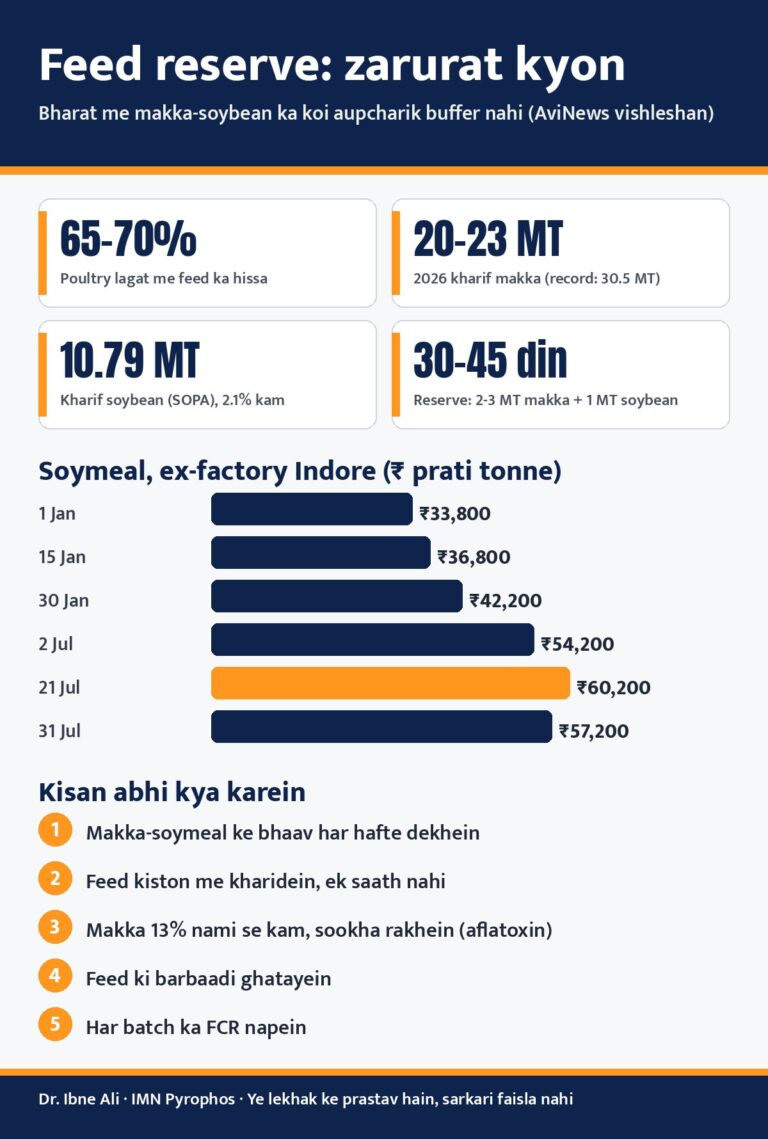
| 2026 kharif makka (udyog andaza) | Lagbhag 20 se 23 million tonne (MT), jabki 2025-26 ke teesre agrim andaze me record 30.5 MT |
| 2026 kharif soybean (SOPA) | 10.79 MT, 2.1% kam. Maharashtra, Karnataka aur Telangana me nami ki kami se utpadan ka ek tihai se lagbhag aadha nuksaan |
| Soymeal, ex-factory Indore | 1 January ko lagbhag ₹33,800 prati tonne, 21 July ko ₹60,200 (SOPA ki prakashit range ke madhya maan), yaani lagbhag ₹26,500 ki badhat |
| Poultry lagat me feed ka hissa | 65 se 70% |
| Makka ki khapat | Poultry lagbhag aadhi maang leti hai; fasal ka lagbhag chauthai hissa ab ethanol me jaata hai (ICAR-IIMR ke anusaar). 2030-31 tak maang lagbhag 72 MT (FICCI-YES Bank) |
| Prastavit reserve | 30 se 45 din ki feed maang: lagbhag 2 se 3 MT makka aur lagbhag 1 MT soybean, har saal samiksha, aur pilot iske ek tihai aakar par |
Rate card ka saboot: Skylark Proteins, ek saal ke antar par wahi season
Skylark Proteins Pvt Ltd (Jhalara, Makdone, Ujjain) ke rate card, jo Dr. Ibne Ali ne humein diye, plant ke gate par wahi uchhaal dikhate hain. Saare bhaav ex-plant hain, advance payment aur upar se 5% GST.
| Utpad (₹ prati tonne) | 11 Nov 2025 | 15 Nov 2025 | 27 Oct 2026 | 4 Nov 2026 | Badlaav, 11 Nov 2025 se 4 Nov 2026 |
|---|---|---|---|---|---|
| Hi-Pro soymeal 50% | 39,500 | 40,000 | 68,000 | 66,500 | +27,000 (lagbhag +68%) |
| Normal soymeal 46% | 36,000 | 37,000 | 64,000 | 62,000 | +26,000 (lagbhag +72%) |
| Soya solvent oil | 1,200 | 1,190 | 1,400 | 1,375 | +175 (lagbhag +15%) |
Card ye bhi dikhate hain ki pichhle hafte bhaav thode narm hue (27 October se 4 November 2026 ke beech Hi-Pro ₹1,500 aur Normal ₹2,000 kam), par pichhle saal se ab bhi bahut upar hain. Tel ka bhaav meal ke mukable bahut kam badha. Bhaav card ke anusaar hain, pratishat hamari apni ganana hai.
Ye kyon mayne rakhta hai
Lekhak ki baat ye hai ki sookha saal baarish par tiki faslon ko maarta hai, aur Bharat ne thaali ki yojana banayi hai par chaare ki naand ki nahi. Makka ab Bharat ka teesra sabse bada khaadyann hai, 2025-26 me record 55.1 MT, lekin feed, starch aur eendhan teeno usi anaaj ke peechhe hain. Soymeal poultry, machhli aur dairy ki khuraak ka mukhya protein hai, aur vikalp amino acid santulan, uplabdhta aur bhaav se seemit hain. Isliye feed ka jhatka Bhartiya thaali ke sabse sasta pashu protein par sabse pehle padta hai.
Lekh ye bhi kehta hai ki sirf aayat dheema upaay hai. August 2021 me, jab soymeal ke bhaav teen guna ho gaye the, sarkar ne 1.2 MT GM soymeal aayat ki anumati di, par khidki band hone tak vyapari lagbhag 0.65 MT ka hi sauda kar paye. 2026 me wahi bahas lauti hai: poultry sangathan 1.5 se 3 MT shulk-mukt aayat chahte hain, jabki SOPA ka kehna hai ki 2026-27 me 8.17 MT uplabdhta 8.0 MT maang ke liye kaafi hai. Feed nirmata maang 10.62 MT batate hain. Jab aankdon par vivaad ho to jawab dheema hota hai, aur bhaav hi samayojan karte hain.
Prastav kya kehta hai
- Wahi rakhein jo tikta hai. Makka 12 se 13% se kam nami par bhandarit ho, kyonki us star par aflatoxin banane wali fafoond lagbhag ruk jaati hai. Bhandar me lena nami aur toxin jaanch se tay ho, aur bhandaran silo ya hermetic ho.
- Soybean beej ke roop me rakhein, meal nahi. Meal nami kheenchta hai aur nam mausam me jaldi kharab hota hai. Surakshit nami par poora soybean zyada tikta hai aur release ke samay maujooda kshamta se pera ja sakta hai.
- Aakar dinon me tay karein. 30 se 45 din ke cover ka matlab 2 se 3 MT makka (salaana utpadan ka lagbhag 4 se 5%) aur lagbhag 1 MT soybean.
- Ise ghoomte rakhein. Stock pehle aao, pehle jao ke hisaab se chale, taaki sade nahi aur bazaar na bigaade. Lekh 2017 ke baad China ke ghatate corn stock ka udaharan deta hai.
- Saste me kharidein, trigger par chhodein. Katai ke samay ke nichle bhaav par kharidkar kisan ko sahara dein, aur pehle se ghoshit star paar hone par neelami se chhodkar feed kharidaron ko bachayein.
- Aankde saajha hon. Sarkar, ICAR, SOPA, CLFMA aur poultry sangathanon ki saajhi maasik rashtriya feed balance sheet, taaki sab ek hi sankhya se baat karein.
Lekh ye bhi sujhata hai ki pashupalan vibhag 90 din me dhancha taiyar kare, aur pyaaz buffer ka anubhav batata hai ki niyam pehle se ghoshit hon aur vikretaon ko samay par bhugtan mile. Ye lekhak ke sujhav hain, sarkari faisle nahi.
Poultry aur dairy kisanon ke liye iska matlab
Abhi koi reserve nahi hai, isliye feed ki lagat mausam aur mandi ke peechhe chalti rahegi. Broiler ya layer ki khuraak ka zyadatar hissa makka aur soymeal hai, aur dairy daane me bhi soya khali aur makka mukhya hain. Jab dono saath badhte hain to margin tezi se ghatta hai, aur chhote farm par asar sabse pehle padta hai.
Kisan abhi kya karein
- Sthaniya makka aur soymeal ke bhaav har hafte dekhein aur feed ek saath nahi, kiston me kharidein.
- Makka rakhte hain ya apna feed banate hain to anaaj sookha (lagbhag 13% nami se kam), zameen se upar aur dhakkar rakhein, taaki fafoond aur aflatoxin na bane.
- Feed ki barbaadi ghatayein. Gira aur geela feed chhote bhaav utaar-chadhav se zyada paisa khota hai.
- Har batch ka FCR napein. Feed mehnga ho to FCR me chhota sudhar bhi zyada faayda deta hai. Hamara CFCR calculator istemal karein aur padhein sardi me FCR kaise banaye rakhein.
- Feed supplier se poochhein ki uske paas kitna stock hai aur uska bhaav bazaar ko kaise follow karta hai.
Wazan badhaye · FCR ghataye
Grotek
B group vitamin, mineral aur herbal antioxidant (amla, ashwagandha, tulsi). Daana khana badhata hai aur FCR ghatata hai, badhwar tez karta hai taaki bazaar ka wazan jaldi aaye, liver ko sahara deta hai, aur infection va antibiotic ke dauran wazan bachane me madad karta hai. Isme iron nahi hai.
Matra: 1–2 g prati litre paani, roz 15–18 ghante, 5 din; infection ke dauran ya baad 1 g prati 5 kg wazan.
500 g ₹679MRP ₹940
Aksar pooche jaane wale sawaal
Kya Bharat ke paas makka aur soybean ka rananeetik reserve hai?
Lekh ke anusaar nahi. Bharat ke paas gehun, chawal, daal aur pyaaz ke buffer hain, par makka aur soybean ka koi aupcharik buffer nahi.
Kitna bada reserve sujhaya gaya hai?
Lekhak 30 se 45 din ki feed maang sujhate hain: lagbhag 2 se 3 million tonne makka aur lagbhag 1 million tonne soybean, poori jaanch ke liye shuruaati bindu ke roop me.
Soybean beej ke roop me kyon, meal kyon nahi?
Soymeal nam Bhartiya mausam me nami kheenchta hai aur jaldi kharab hota hai, jabki surakshit nami par poora soybean zyada tikta hai aur release par pera ja sakta hai.
Source: AviNews, “India guards its wheat, rice and onions: who guards the feed?”, November 2026. IMN Pyrophos team ne apne shabdon me likha.