
White, pasty droppings, birds that drink less, a flock that looks dull after IBD, IBH or E. coli: in many such flocks the kidney is the organ that quietly gives way first. Poultry kidneys have to pass out uric acid all day, and anything that dehydrates the bird or damages the kidney lets that waste build up. This guide explains why the kidney is so easily overloaded, what to fix on the farm, and where Nephrowin, a kidney flusher tonic from IMN Pyrophos, fits in. If you are searching for a kidney flusher for poultry, read the section on what to check before any tonic.
Why poultry kidneys are easily overloaded
Birds pass out nitrogen waste as uric acid, not as urine. The product page puts it simply: poultry kidneys pass out uric acid, but uric acid does not dissolve well and can cause problems on high protein feed. If the bird drinks too little, or the kidney tissue is inflamed, the urates are not flushed out. They settle in the kidney tubes and can later appear as gout or kidney stones.
What damages the kidney in a flock?
- Dehydration from low water intake, blocked nipples, long transport or heat stress.
- E. coli septicemia and other systemic bacterial infection.
- Viral disease such as IBD (Gumboro), IBH and infectious bronchitis. See our guide on poultry viral disease support.
- High protein feed in the first week, when chicks are still learning to drink.
- Toxins in feed and water, and some medicines used at a high dose.
- Baby chick nephropathy: kidney damage in very young chicks, linked with poor early water intake and stress.
Signs that the kidney is under stress
- Low water intake and dull, huddled birds.
- White, pasty droppings with plenty of urates.
- Swollen, pale kidneys at post-mortem, sometimes with white urate streaks in the ureters.
- Chalky deposits on the heart sac and liver, which means gout has started. Read gout treatment in poultry if you see these.
- Rising deaths in the first two weeks, or after a viral or E. coli attack.
What to fix first on the farm
- Water first. Check every nipple or bell drinker, flush lines and clean tanks. Our winter broiler brooding guide explains early water management.
- Look at the ration for protein and calcium that do not fit the age.
- Get a post-mortem to find the main disease, then treat that with your vet.
- Do not give extra calcium to a flock with swollen kidneys.
- Keep records of daily water intake and droppings.
What is Nephrowin?
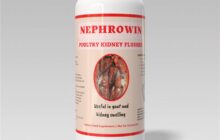
Nephrowin is a liquid kidney flusher tonic for poultry. The pack calls it a poultry kidney flusher, useful in gout and kidney swelling. The product page says it helps flush uric acid and other toxins from the body, and helps prevent kidney damage during E. coli septicemia, IBH and IBD. It is a supplement, not an antibiotic and not a vaccine.
What does Nephrowin do? (pack and product page)
| What the pack and product page say | What it means in the shed |
|---|---|
| Helps flush uric acid and other toxins from the body | Less waste sitting in the kidney |
| Helps prevent kidney damage during E. coli septicemia, IBH and IBD | Kidney support while the main disease is treated |
| Helps prevent gout | Fewer urate deposits on the heart and joints |
| Reduces chances of baby chick nephropathy | A safer first week |
| Useful in gout and kidney swelling (pack) | Support when kidneys look swollen |
Nephrowin supports the kidney. It does not replace clean water, a post-mortem or your vet’s treatment of the main disease.
Nephrowin dose
| Situation | Dose (product page) |
|---|---|
| Kidney swelling, nephrosis or low water intake | 1 to 2 ml per litre of water |
| During brooding | 1 ml per 100 chicks |
Cost example (calculated from the 1 L price of ₹498, about ₹0.50 per ml). At 1 to 2 ml per litre, each litre of medicated water costs about ₹0.50 to ₹1.00. For 1,000 chicks in brooding at 1 ml per 100 chicks you need 10 ml, about ₹5. The product page does not state how many days to give it, so confirm the course length with your vet or on WhatsApp.
How to give Nephrowin, step by step
- Work out the water the flock will drink in the day, in litres.
- Measure the liquid with a syringe or measuring cup, at 1 to 2 ml per litre.
- Mix it into the drinking water and keep drinkers clean and easy to reach.
- Do not stop the main treatment. Treat E. coli, IBD or IBH as your vet advises.
- Write down the date, dose, water intake and droppings.
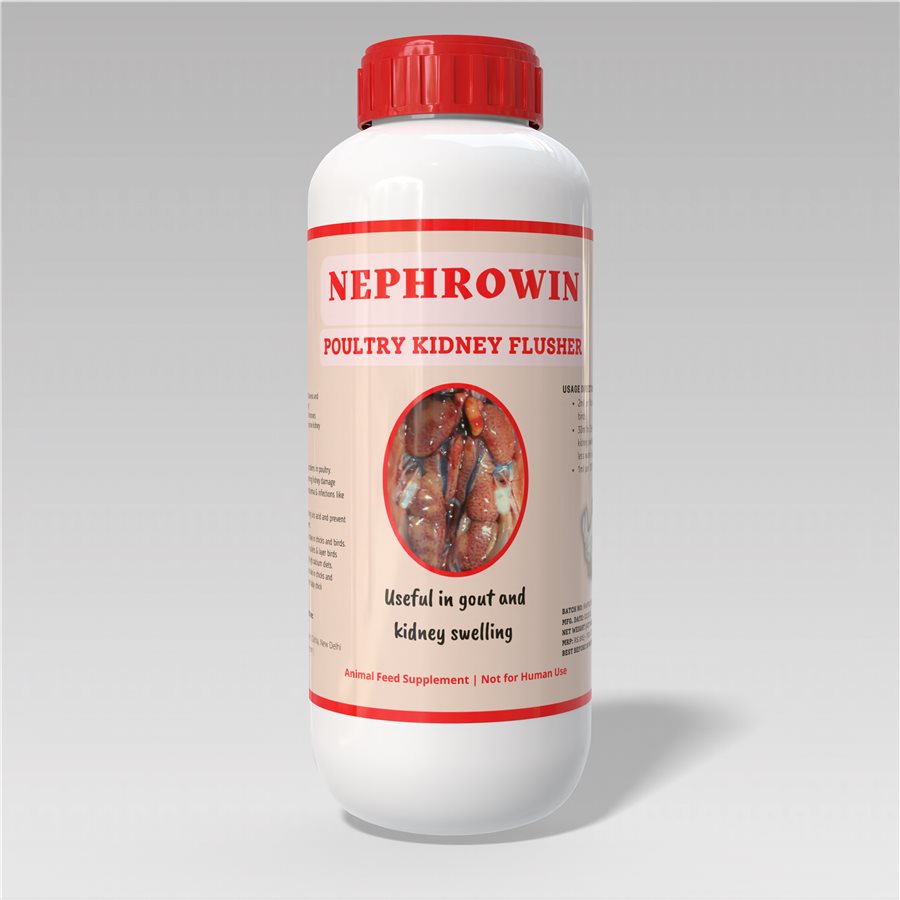
Kidney flusher tonic
Nephrowin
Kidney flusher tonic for poultry. Helps flush uric acid and other toxins, helps prevent kidney damage during E. coli septicemia, IBH and IBD, helps prevent gout and reduces the chance of baby chick nephropathy.
Dose: 1 to 2 ml per litre of water in kidney swelling, nephrosis or low water intake; 1 ml per 100 chicks in brooding.
1 L ₹498MRP ₹815 5 L ₹1,975MRP ₹4,175
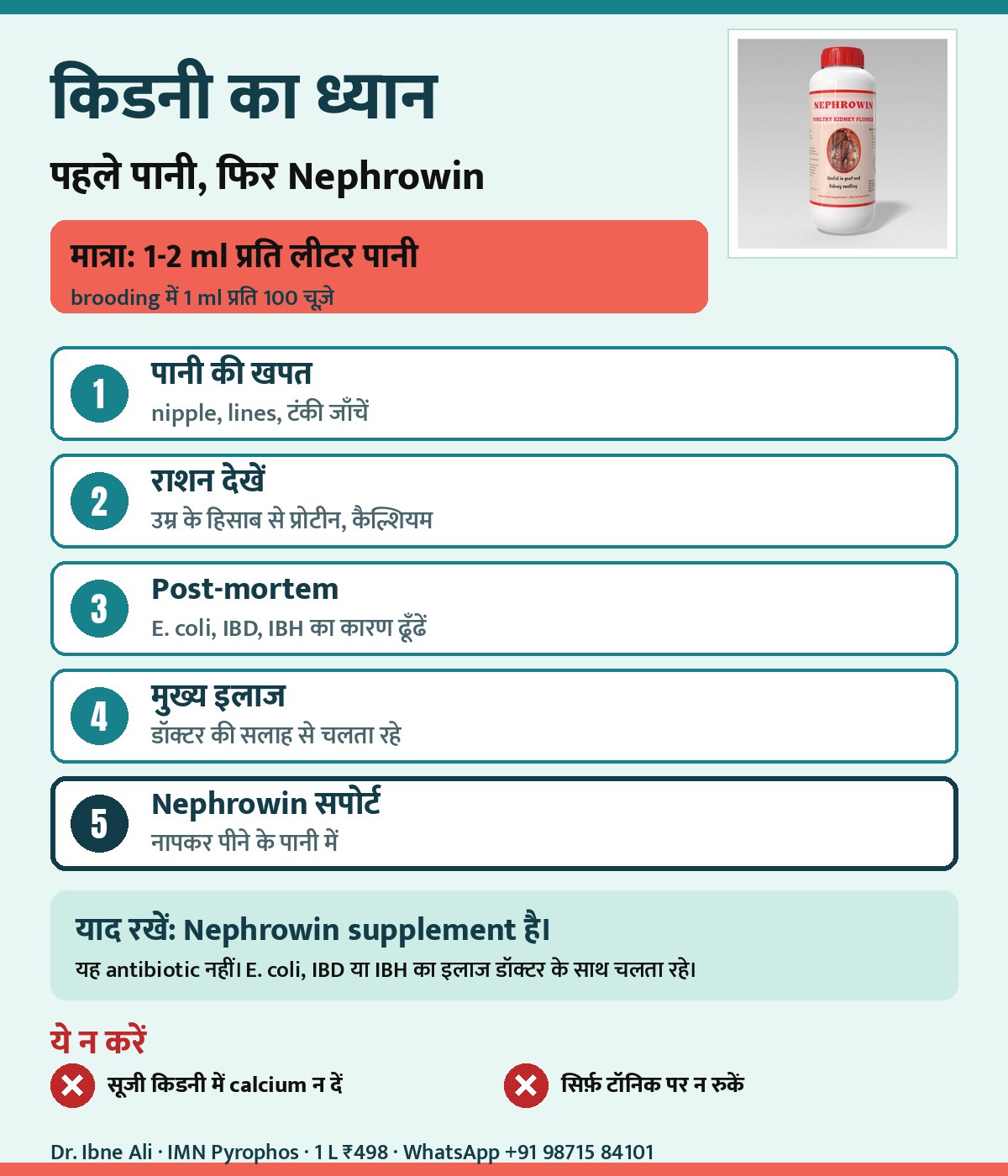
Nephrowin or Goutster?
Both support the kidney, but they are used differently. Nephrowin is a liquid kidney flusher, used when the kidney is swollen, water intake is low or a disease such as E. coli, IBH or IBD threatens the kidney. Goutster is a powder anti-gout combination with citrates and vitamin C that increases water intake and helps dissolve uric acid. Many farms plan one or the other on the advice of their vet. Send your case on WhatsApp if you are unsure which fits your flock.
A simple kidney care plan
- Check water in the first 3 days of life, and again after any vaccine or transport.
- Add Nephrowin in brooding at 1 ml per 100 chicks if early kidney stress is common on your farm.
- When disease strikes, treat the disease with your vet and use Nephrowin at 1 to 2 ml per litre to support the kidney.
- Watch droppings and water use each day.
- Support the gut with a probiotic. See our guide on loose droppings in poultry.
What not to do
- Do not treat the kidney alone when the real problem is E. coli, IBD or IBH.
- Do not add calcium tonics to birds with swollen kidneys.
- Do not use an antibiotic without your vet’s advice.
- Do not guess the dose or measure by eye.
Common mistakes
- Waiting for white droppings. By then the kidney is already loaded.
- Ignoring the first-week water intake of chicks.
- No post-mortem. Without one the cause stays unknown.
- Stopping water checks once medicine is started.
Frequently asked questions
What is the best kidney flusher for poultry? There is no single answer. Clean water, a balanced ration, treatment of the main disease and a kidney flusher tonic such as Nephrowin work together.
What is Nephrowin used for? It helps flush uric acid and other toxins, and helps prevent kidney damage during E. coli septicemia, IBH and IBD.
What is the Nephrowin dose? 1 to 2 ml per litre of water in kidney swelling, nephrosis or low water intake, and 1 ml per 100 chicks during brooding.
What is the price of Nephrowin? 1 L is ₹498 (MRP ₹815) and 5 L is ₹1,975 (MRP ₹4,175). Prices may change, so confirm on WhatsApp.
Is Nephrowin an antibiotic? No. It is a supplement. If bacteria are involved, your vet decides about antibiotics.
Can I give it to day-old chicks? The product page gives 1 ml per 100 chicks during brooding.
Does it help gout? The product page says it helps prevent gout, and the pack says it is useful in gout and kidney swelling.
Where can I see all IMN products? The IMN product guide lists each product by problem and stage.
Also read: Nephrowin · Gout treatment in poultry · Poultry viral disease support · Winter broiler brooding guide · IMN product guide
पोल्ट्री के लिए kidney flusher: किडनी की समस्या और Nephrowin की मात्रा
सफ़ेद चिपचिपी बीट, पानी कम पीते पक्षी, और IBD, IBH या E. coli के बाद सुस्त झुंड: ऐसे कई झुंडों में किडनी वह अंग है जो सबसे पहले चुपचाप जवाब देती है। पोल्ट्री की किडनी को दिन भर uric acid बाहर निकालना पड़ता है, और जो भी चीज़ पक्षी को dehydrate करे या किडनी को नुकसान पहुँचाए, उससे यह कचरा जमने लगता है। इस गाइड में बताया है कि किडनी पर इतनी आसानी से बोझ क्यों पड़ता है, फ़ार्म पर क्या ठीक करें और IMN Pyrophos का kidney flusher टॉनिक Nephrowin कहाँ फ़िट बैठता है। अगर आप kidney flusher for poultry खोज रहे हैं तो टॉनिक से पहले “क्या जाँचें” वाला हिस्सा पढ़ें।
पोल्ट्री की किडनी पर बोझ इतनी आसानी से क्यों पड़ता है
पक्षी नाइट्रोजन का कचरा पेशाब से नहीं, uric acid के रूप में निकालते हैं। प्रोडक्ट पेज सीधा कहता है: पोल्ट्री की किडनी uric acid बाहर निकालती है, लेकिन uric acid पानी में ठीक से नहीं घुलता और ज़्यादा प्रोटीन वाली फ़ीड पर दिक्कत कर सकता है। अगर पक्षी कम पानी पिए या किडनी के ऊतक में सूजन हो तो urates बाहर नहीं निकलते। वे किडनी की नलियों में जम जाते हैं और आगे चलकर गाउट या पथरी के रूप में दिख सकते हैं।
झुंड में किडनी को क्या नुकसान पहुँचाता है?
- Dehydration: कम पानी पीने, nipple जाम होने, लंबे सफ़र या heat stress से।
- E. coli septicemia और दूसरे सिस्टमिक बैक्टीरियल संक्रमण।
- वायरल बीमारी जैसे IBD (Gumboro), IBH और infectious bronchitis। हमारी गाइड पोल्ट्री की वायरल बीमारी में सहायक दवा देखें।
- ज़्यादा प्रोटीन वाला दाना पहले हफ़्ते में, जब चूज़े अभी पानी पीना सीख रहे होते हैं।
- टॉक्सिन: दाने और पानी में, और कुछ दवाएँ ज़्यादा मात्रा में देने पर।
- Baby chick nephropathy: बहुत छोटे चूज़ों में किडनी को नुकसान, जो शुरू में कम पानी और तनाव से जुड़ा है।
किडनी पर तनाव के लक्षण
- पानी कम पीना, और सुस्त, सिमटे हुए पक्षी।
- सफ़ेद, चिपचिपी बीट जिसमें urates बहुत हों।
- post-mortem में सूजी, पीली किडनी, कभी-कभी ureters में सफ़ेद urate की धारियाँ।
- दिल की थैली और लिवर पर खड़िया जैसी परत, यानी गाउट शुरू हो चुका है। ऐसा दिखे तो पोल्ट्री में गाउट का इलाज पढ़ें।
- पहले दो हफ़्तों में, या वायरल या E. coli हमले के बाद, मौतें बढ़ना।
फ़ार्म पर सबसे पहले क्या ठीक करें
- पहले पानी। हर nipple या bell drinker जाँचें, lines flush करें और टंकी साफ़ करें। शुरुआती पानी प्रबंधन हमारी सर्दी में broiler brooding गाइड में समझाया है।
- राशन देखें: उम्र से मेल न खाता प्रोटीन और कैल्शियम।
- Post-mortem कराएँ ताकि मुख्य बीमारी पता चले, फिर डॉक्टर के साथ उसका इलाज करें।
- ऊपर से कैल्शियम न दें जब किडनी सूजी हो।
- रिकॉर्ड रखें: रोज़ की पानी की खपत और बीट।
Nephrowin क्या है?
Nephrowin पोल्ट्री के लिए liquid kidney flusher टॉनिक है। पैक पर इसे poultry kidney flusher, गाउट और किडनी की सूजन में उपयोगी बताया गया है। प्रोडक्ट पेज के अनुसार यह uric acid और दूसरे टॉक्सिन को शरीर से बाहर निकालने में मदद करता है, और E. coli septicemia, IBH और IBD के दौरान किडनी को नुकसान से बचाने में मदद करता है। यह supplement है, antibiotic या वैक्सीन नहीं।
Nephrowin क्या करता है? (पैक और प्रोडक्ट पेज)
| पैक और प्रोडक्ट पेज क्या कहते हैं | शेड में इसका मतलब |
|---|---|
| uric acid और दूसरे टॉक्सिन शरीर से बाहर निकालने में मदद | किडनी में कचरा कम टिकता है |
| E. coli septicemia, IBH और IBD में किडनी को नुकसान से बचाने में मदद | मुख्य बीमारी के इलाज के दौरान किडनी को सहारा |
| गाउट बनने से रोकने में मदद | दिल और जोड़ों पर urates की परत कम |
| छोटे चूज़ों में baby chick nephropathy के चांस कम करता है | पहला हफ़्ता ज़्यादा सुरक्षित |
| गाउट और किडनी की सूजन में उपयोगी (पैक) | किडनी सूजी दिखे तो सहारा |
Nephrowin किडनी को सहारा देता है। यह साफ़ पानी, post-mortem या मुख्य बीमारी के डॉक्टर के इलाज की जगह नहीं लेता।
Nephrowin की मात्रा
| स्थिति | मात्रा (प्रोडक्ट पेज) |
|---|---|
| किडनी में सूजन, nephrosis या कम पानी पीना | 1 से 2 मिली प्रति लीटर पानी |
| Brooding में | 1 मिली प्रति 100 चूज़े |
खर्च का उदाहरण (1 L की कीमत ₹498, यानी लगभग ₹0.50 प्रति मिली के हिसाब से)। 1 से 2 मिली प्रति लीटर पर हर लीटर दवा वाले पानी का खर्च लगभग ₹0.50 से ₹1.00 आता है। brooding में 1,000 चूज़ों के लिए 1 मिली प्रति 100 चूज़े पर 10 मिली लगते हैं, यानी लगभग ₹5। प्रोडक्ट पेज पर कितने दिन देना है यह नहीं लिखा, इसलिए course की लंबाई डॉक्टर से या WhatsApp पर पक्की करें।
Nephrowin कैसे दें, कदम दर कदम
- पानी का हिसाब लगाएँ जो झुंड दिन भर में पिएगा, लीटर में।
- दवा नापें syringe या measuring cup से, 1 से 2 मिली प्रति लीटर।
- पीने के पानी में मिलाएँ और drinkers साफ़ तथा पहुँच में रखें।
- मुख्य इलाज बंद न करें। E. coli, IBD या IBH का इलाज डॉक्टर की सलाह से चलाएँ।
- लिखें: तारीख़, मात्रा, पानी की खपत और बीट।
Kidney flusher टॉनिक
Nephrowin
पोल्ट्री के लिए kidney flusher टॉनिक। uric acid और दूसरे टॉक्सिन को बाहर निकालने में मदद, E. coli septicemia, IBH और IBD में किडनी को नुकसान से बचाने में मदद, गाउट रोकने में मदद और छोटे चूज़ों में nephropathy के चांस कम करता है।
मात्रा: किडनी में सूजन, nephrosis या कम पानी पीने पर 1 से 2 मिली प्रति लीटर पानी; brooding में 1 मिली प्रति 100 चूज़े।
1 L ₹498 · 5 L ₹1,975MRP ₹815 / ₹4,175
Nephrowin या Goutster?
दोनों किडनी को सहारा देते हैं, पर इस्तेमाल अलग है। Nephrowin liquid kidney flusher है, जो तब काम आता है जब किडनी सूजी हो, पानी कम पिया जा रहा हो या E. coli, IBH या IBD जैसी बीमारी किडनी के लिए ख़तरा हो। Goutster पाउडर anti-gout combination है जिसमें citrates और विटामिन C हैं, जो पानी पीना बढ़ाता है और uric acid घुलाने में मदद करता है। कई फ़ार्म डॉक्टर की सलाह से इनमें से एक चुनते हैं। अगर तय न कर पाएँ तो अपना केस WhatsApp पर भेजें।
किडनी की देखभाल का आसान प्लान
- पानी जाँचें: ज़िंदगी के पहले 3 दिन, और हर टीके या सफ़र के बाद।
- Brooding में Nephrowin जोड़ें 1 मिली प्रति 100 चूज़े, अगर आपके फ़ार्म पर शुरू में किडनी का तनाव आम है।
- बीमारी आए तो डॉक्टर के साथ बीमारी का इलाज करें और किडनी को सहारा देने के लिए Nephrowin 1 से 2 मिली प्रति लीटर दें।
- बीट और पानी की खपत देखें रोज़।
- आँत को सहारा दें प्रोबायोटिक से। हमारी गाइड पोल्ट्री में loose droppings देखें।
क्या न करें
- जब असली समस्या E. coli, IBD या IBH हो तो सिर्फ़ किडनी का इलाज न करें।
- सूजी किडनी वाले पक्षियों को calcium tonic न दें।
- डॉक्टर की सलाह के बिना antibiotic न दें।
- अंदाज़े से या आँख से नापकर मात्रा न दें।
आम गलतियाँ
- सफ़ेद बीट का इंतज़ार करना। तब तक किडनी पर बोझ पड़ चुका होता है।
- चूज़ों के पहले हफ़्ते की पानी की खपत को नज़रअंदाज़ करना।
- Post-mortem न कराना। उसके बिना कारण अनजान रहता है।
- दवा शुरू होते ही पानी की जाँच बंद कर देना।
अक्सर पूछे जाने वाले सवाल
पोल्ट्री के लिए सबसे अच्छा kidney flusher कौन सा है? कोई एक जवाब नहीं है। साफ़ पानी, संतुलित राशन, मुख्य बीमारी का इलाज और Nephrowin जैसा kidney flusher टॉनिक मिलकर काम करते हैं।
Nephrowin किसलिए इस्तेमाल होता है? यह uric acid और दूसरे टॉक्सिन निकालने में मदद करता है, और E. coli septicemia, IBH और IBD में किडनी को नुकसान से बचाने में मदद करता है।
Nephrowin की मात्रा क्या है? किडनी में सूजन, nephrosis या कम पानी पीने पर 1 से 2 मिली प्रति लीटर पानी, और brooding में 1 मिली प्रति 100 चूज़े।
Nephrowin की कीमत क्या है? 1 L ₹498 (MRP ₹815) और 5 L ₹1,975 (MRP ₹4,175)। कीमत बदल सकती है, WhatsApp पर पक्की करें।
क्या Nephrowin antibiotic है? नहीं। यह supplement है। अगर बैक्टीरिया शामिल हैं तो antibiotic का फ़ैसला डॉक्टर करते हैं।
क्या इसे एक दिन के चूज़ों को दे सकते हैं? प्रोडक्ट पेज पर brooding में 1 मिली प्रति 100 चूज़े की मात्रा दी गई है।
क्या यह गाउट में मदद करता है? प्रोडक्ट पेज कहता है कि यह गाउट बनने से रोकने में मदद करता है, और पैक पर गाउट व किडनी की सूजन में उपयोगी लिखा है।
सारे IMN प्रोडक्ट कहाँ देखूँ? IMN product guide में हर प्रोडक्ट समस्या और stage के हिसाब से है।
यह भी पढ़ें: Nephrowin · पोल्ट्री में गाउट का इलाज · पोल्ट्री की वायरल बीमारी में सहायक दवा · सर्दी में broiler brooding गाइड · IMN product guide
Poultry ke liye kidney flusher: kidney ki samasya aur Nephrowin ki matra
Safed chipchipi beet, paani kam peete pakshi, aur IBD, IBH ya E. coli ke baad sust jhund: aise kai jhundon me kidney wo ang hai jo sabse pehle chupchaap jawab deti hai. Poultry ki kidney ko din bhar uric acid bahar nikalna padta hai, aur jo bhi cheez pakshi ko dehydrate kare ya kidney ko nuksaan pahunchaye, usse ye kachra jamne lagta hai. Is guide me bataya hai ki kidney par itni aasani se bojh kyon padta hai, farm par kya theek karein aur IMN Pyrophos ka kidney flusher tonic Nephrowin kahan fit baithta hai. Agar aap kidney flusher for poultry dhoondh rahe hain to tonic se pehle “kya jaanchein” wala hissa padhein.
Poultry ki kidney par bojh itni aasani se kyon padta hai
Pakshi nitrogen ka kachra peshab se nahi, uric acid ke roop me nikalte hain. Product page seedha kehta hai: poultry ki kidney uric acid bahar nikalti hai, lekin uric acid paani me theek se nahi ghulta aur zyada protein wali feed par dikkat kar sakta hai. Agar pakshi kam paani piye ya kidney ke tishu me soojan ho to urates bahar nahi nikalte. Wo kidney ki naliyon me jam jaate hain aur aage chalkar gout ya pathri ke roop me dikh sakte hain.
Jhund me kidney ko kya nuksaan pahunchata hai?
- Dehydration: kam paani peene, nipple jaam hone, lambe safar ya heat stress se.
- E. coli septicemia aur doosre systemic bacterial sankraman.
- Viral beemari jaise IBD (Gumboro), IBH aur infectious bronchitis. Hamari guide poultry ki viral beemari me sahayak dawa dekhein.
- Zyada protein wala daana pehle hafte me, jab chooze abhi paani peena seekh rahe hote hain.
- Toxin: daane aur paani me, aur kuch dawaiyan zyada matra me dene par.
- Baby chick nephropathy: bahut chhote choozon me kidney ko nuksaan, jo shuru me kam paani aur tanav se juda hai.
Kidney par tanav ke lakshan
- Paani kam peena, aur sust, simte hue pakshi.
- Safed, chipchipi beet jisme urates bahut hon.
- Post-mortem me soojhi, peeli kidney, kabhi-kabhi ureters me safed urate ki dhariyan.
- Dil ki thaili aur liver par khadiya jaisi parat, yaani gout shuru ho chuka hai. Aisa dikhe to poultry me gout ka ilaaj padhein.
- Pehle do hafton me, ya viral ya E. coli hamle ke baad, mautein badhna.
Farm par sabse pehle kya theek karein
- Pehle paani. Har nipple ya bell drinker jaanchein, lines flush karein aur tanki saaf karein. Shuruaati paani prabandhan hamari sardi me broiler brooding guide me samjhaya hai.
- Ration dekhein: umr se mel na khata protein aur calcium.
- Post-mortem karayein taaki mukhya beemari pata chale, phir doctor ke saath uska ilaaj karein.
- Upar se calcium na dein jab kidney soojhi ho.
- Record rakhein: roz ki paani ki khapat aur beet.
Nephrowin kya hai?
Nephrowin poultry ke liye liquid kidney flusher tonic hai. Pack par ise poultry kidney flusher, gout aur kidney ki soojan me upyogi bataya gaya hai. Product page ke anusaar ye uric acid aur doosre toxin ko sharir se bahar nikalne me madad karta hai, aur E. coli septicemia, IBH aur IBD ke dauran kidney ko nuksaan se bachane me madad karta hai. Ye supplement hai, antibiotic ya vaccine nahi.
Nephrowin kya karta hai? (pack aur product page)
| Pack aur product page kya kehte hain | Shed me iska matlab |
|---|---|
| Uric acid aur doosre toxin sharir se bahar nikalne me madad | Kidney me kachra kam tikta hai |
| E. coli septicemia, IBH aur IBD me kidney ko nuksaan se bachane me madad | Mukhya beemari ke ilaaj ke dauran kidney ko sahara |
| Gout banne se rokne me madad | Dil aur jodon par urates ki parat kam |
| Chhote choozon me baby chick nephropathy ke chance kam karta hai | Pehla hafta zyada surakshit |
| Gout aur kidney ki soojan me upyogi (pack) | Kidney soojhi dikhe to sahara |
Nephrowin kidney ko sahara deta hai. Ye saaf paani, post-mortem ya mukhya beemari ke doctor ke ilaaj ki jagah nahi leta.
Nephrowin ki matra
| Sthiti | Matra (product page) |
|---|---|
| Kidney me soojan, nephrosis ya kam paani peena | 1 se 2 ml prati litre paani |
| Brooding me | 1 ml prati 100 chooze |
Kharch ka udaharan (1 L ki keemat ₹498, yaani lagbhag ₹0.50 prati ml ke hisaab se). 1 se 2 ml prati litre par har litre dawa wale paani ka kharch lagbhag ₹0.50 se ₹1.00 aata hai. Brooding me 1,000 choozon ke liye 1 ml prati 100 chooze par 10 ml lagte hain, yaani lagbhag ₹5. Product page par kitne din dena hai ye nahi likha, isliye course ki lambai doctor se ya WhatsApp par pakki karein.
Nephrowin kaise dein, kadam dar kadam
- Paani ka hisaab lagayein jo jhund din bhar me piyega, litre me.
- Dawa naapein syringe ya measuring cup se, 1 se 2 ml prati litre.
- Peene ke paani me milayein aur drinkers saaf tatha pahunch me rakhein.
- Mukhya ilaaj band na karein. E. coli, IBD ya IBH ka ilaaj doctor ki salah se chalayein.
- Likhein: taareekh, matra, paani ki khapat aur beet.
Kidney flusher tonic
Nephrowin
Poultry ke liye kidney flusher tonic. Uric acid aur doosre toxin ko bahar nikalne me madad, E. coli septicemia, IBH aur IBD me kidney ko nuksaan se bachane me madad, gout rokne me madad aur chhote choozon me nephropathy ke chance kam karta hai.
Matra: Kidney me soojan, nephrosis ya kam paani peene par 1 se 2 ml prati litre paani; brooding me 1 ml prati 100 chooze.
1 L ₹498 · 5 L ₹1,975MRP ₹815 / ₹4,175
Nephrowin ya Goutster?
Dono kidney ko sahara dete hain, par istemal alag hai. Nephrowin liquid kidney flusher hai, jo tab kaam aata hai jab kidney soojhi ho, paani kam piya ja raha ho ya E. coli, IBH ya IBD jaisi beemari kidney ke liye khatra ho. Goutster powder anti-gout combination hai jisme citrates aur vitamin C hain, jo paani peena badhata hai aur uric acid ghulane me madad karta hai. Kai farm doctor ki salah se inme se ek chunte hain. Agar tay na kar payein to apna case WhatsApp par bhejein.
Kidney ki dekhbhal ka aasan plan
- Paani jaanchein: zindagi ke pehle 3 din, aur har teeke ya safar ke baad.
- Brooding me Nephrowin jodein 1 ml prati 100 chooze, agar aapke farm par shuru me kidney ka tanav aam hai.
- Beemari aaye to doctor ke saath beemari ka ilaaj karein aur kidney ko sahara dene ke liye Nephrowin 1 se 2 ml prati litre dein.
- Beet aur paani ki khapat dekhein roz.
- Aant ko sahara dein probiotic se. Hamari guide poultry me loose droppings dekhein.
Kya na karein
- Jab asli samasya E. coli, IBD ya IBH ho to sirf kidney ka ilaaj na karein.
- Soojhi kidney wale pakshiyon ko calcium tonic na dein.
- Doctor ki salah ke bina antibiotic na dein.
- Andaze se ya aankh se naapkar matra na dein.
Aam galtiyan
- Safed beet ka intezaar karna. Tab tak kidney par bojh pad chuka hota hai.
- Choozon ke pehle hafte ki paani ki khapat ko nazarandaaz karna.
- Post-mortem na karana. Uske bina karan anjaan rehta hai.
- Dawa shuru hote hi paani ki jaanch band kar dena.
Aksar poochhe jaane wale sawaal
Poultry ke liye sabse achha kidney flusher kaun sa hai? Koi ek jawab nahi hai. Saaf paani, santulit ration, mukhya beemari ka ilaaj aur Nephrowin jaisa kidney flusher tonic milkar kaam karte hain.
Nephrowin kisliye istemal hota hai? Ye uric acid aur doosre toxin nikalne me madad karta hai, aur E. coli septicemia, IBH aur IBD me kidney ko nuksaan se bachane me madad karta hai.
Nephrowin ki matra kya hai? Kidney me soojan, nephrosis ya kam paani peene par 1 se 2 ml prati litre paani, aur brooding me 1 ml prati 100 chooze.
Nephrowin ki keemat kya hai? 1 L ₹498 (MRP ₹815) aur 5 L ₹1,975 (MRP ₹4,175). Keemat badal sakti hai, WhatsApp par pakki karein.
Kya Nephrowin antibiotic hai? Nahi. Ye supplement hai. Agar bacteria shamil hain to antibiotic ka faisla doctor karte hain.
Kya ise ek din ke choozon ko de sakte hain? Product page par brooding me 1 ml prati 100 chooze ki matra di gayi hai.
Kya ye gout me madad karta hai? Product page kehta hai ki ye gout banne se rokne me madad karta hai, aur pack par gout va kidney ki soojan me upyogi likha hai.
Saare IMN products kahan dekhun? IMN product guide me har product samasya aur stage ke hisaab se hai.
Ye bhi padhein: Nephrowin · Poultry me gout ka ilaaj · Poultry ki viral beemari me sahayak dawa · Sardi me broiler brooding guide · IMN product guide