
Most early chick mortality is decided in the first week, and the loss is usually quiet: a few more dead chicks each morning, then a flock that never catches up. Chicks arrive tired, dehydrated and with a yolk sac that has to be absorbed. If germs such as E. coli get in through the navel or the gut, the deaths peak between day 2 and day 7. This guide explains the common causes, a day-wise brooding checklist, and where Alceau, a herbal antimicrobial from IMN Pyrophos, fits in with its label dose and a cost example per 1,000 chicks. If you are searching for early chick mortality in brooding, start with the checklist below.
Why chicks die in the first week
- Transport stress and dehydration. Chicks can spend many hours in a box before they reach the farm, and weak chicks do not find water quickly.
- Yolk sac and navel infection (omphalitis). A wet, open navel lets bacteria in, and the yolk is not absorbed properly.
- E. coli and other gut bacteria. Dirty drinkers, wet litter and chilled chicks all raise the load.
- Wrong brooding temperature. Chilled chicks huddle and stop drinking; overheated chicks pant and dehydrate.
- Poor water and feed access. If the first drink and first feed are late, the gut starts weak.
Our winter broiler brooding guide covers temperature, litter and water in detail. Fix these first; no supplement can cover for a cold, wet or thirsty brooder.
A simple day-wise brooding checklist
| Day | What to check |
|---|---|
| Day 1 | Shed and litter warm before arrival; clean water and a start-up solution ready; check chick crop fill after a few hours |
| Day 2 to 3 | Chicks spread evenly under the brooder; navels dry; no pasting of droppings; count dead and weak chicks every morning |
| Day 4 to 7 | Daily mortality count; watch for sleepy, huddled or pale chicks, loose droppings and respiratory sound; call your vet if deaths rise |
Write the number of dead chicks each morning. A rising count between day 2 and day 7 is your early warning.
What is Alceau?
Alceau (written Alcaeu on the pack) is a herbal antimicrobial feed supplement for poultry. The pack calls it an antibacterial formula, useful against E. coli infections. It contains extracts of onion, garlic, tulsi and cinnamon in a dextrose carrier, with curcumin, allicin and eugenol. It is sold as a poultry feed supplement, not as a medicine.
What does the label say it does?
- Reduces mortality caused by microbial infection.
- Improves feed intake during infections.
- Helps prevent early chick mortality and works effectively in brooding (day 2 to 7 is the risk window).
- Helps in yolk dissolution.
- Reduces respiratory sound in birds and is beneficial in infectious coryza and CRD.
- Works in secondary bacterial infections, for example during a viral outbreak.
- Reduces deaths from perihepatitis and pericarditis (the white layer over the liver and heart).
Alceau dose (label)
| Situation | Dose |
|---|---|
| Brooding | 1 g per 100 chicks |
| Moderate infection | 1 g per 8 kg body weight, or 1 g per litre of water |
| High mortality | 1 g per 5 kg body weight (in 3 hours of water), or 2 g per litre of water for 15 to 18 hours |
| In feed | 1 kg per ton of feed |
Cost example (calculated from the label dose and the 500 g price of ₹741, about ₹1.48 per gram). For 1,000 chicks in brooding at 1 g per 100 chicks you need 10 g, about ₹15 (₹0.015 per chick). For 1,000 birds of about 1 kg each at 1 g per 8 kg, you need 125 g, about ₹185; at the high-mortality dose of 1 g per 5 kg you need 200 g, about ₹297. The label does not state the number of days, so confirm the course length with your vet or on WhatsApp.
How to give Alceau, step by step
- Pick the situation: brooding, moderate infection or high mortality, and the matching label dose.
- Weigh the powder on a small scale. Do not scoop by eye.
- Dissolve in the drinking water that the birds will finish in the time given for that dose. Ask your vet before giving it together with other medicines.
- Keep drinkers clean and easy to reach at chick height.
- Record the date, dose and daily deaths so you can see if the count is falling.
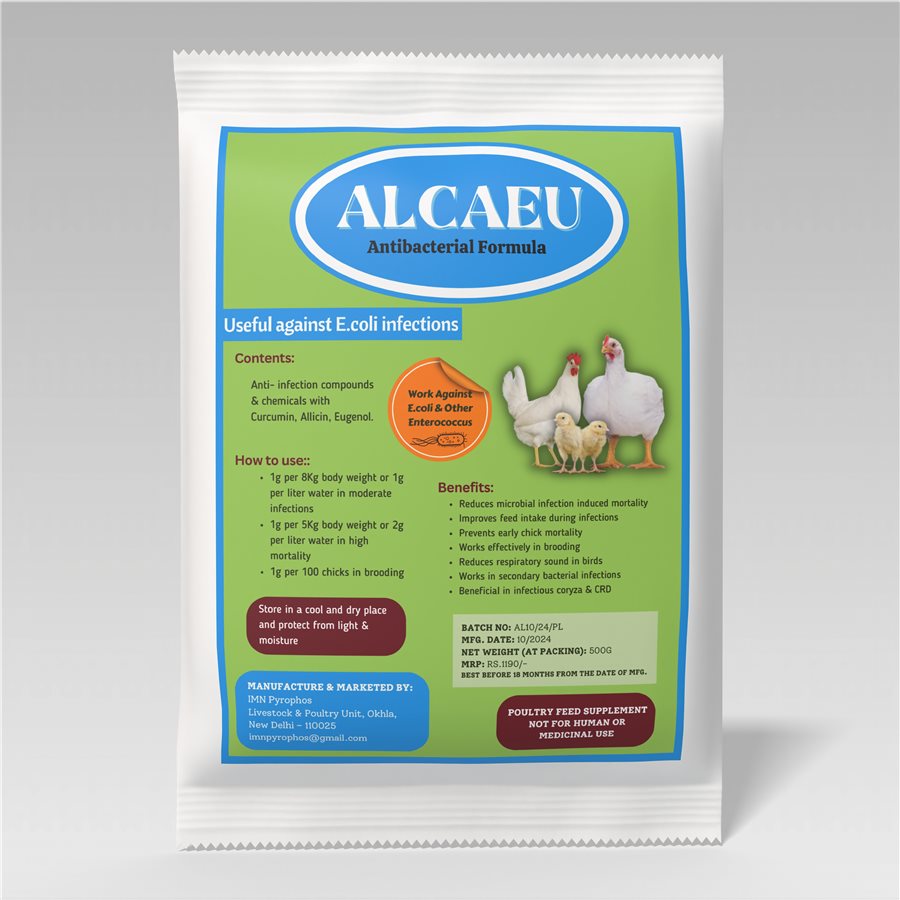
Herbal antimicrobial · brooding
Alceau
Herbal formula with onion, garlic, tulsi and cinnamon extracts, curcumin, allicin and eugenol. Reduces infection-related mortality, improves feed intake in infections and helps prevent early chick mortality in brooding (day 2 to 7).
Dose (label): 1 g per 100 chicks in brooding; 1 g per 8 kg body weight or 1 g per litre in moderate infection; 1 g per 5 kg body weight or 2 g per litre in high mortality; 1 kg per ton of feed.
500 g ₹741MRP ₹1,190 250 g ₹395MRP ₹630
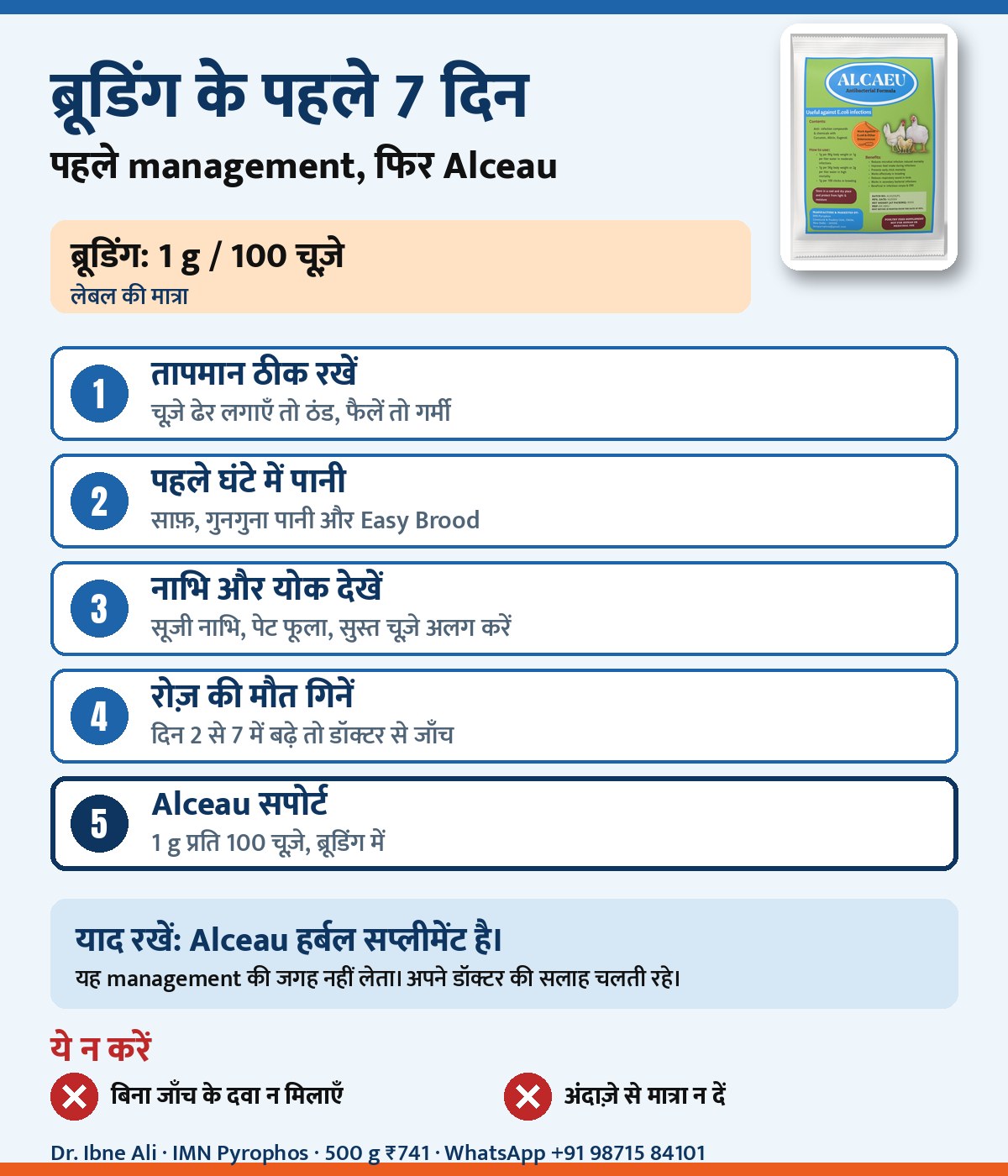
Where Alceau fits in a brooding plan
- Day 1 to 3: hydration and a start-up solution first, then the brooding dose of Alceau as advised by your vet.
- Gut health: many farms pair it with a probiotic such as Remipro so the gut flora settles.
- Respiratory sound: the label lists respiratory sound and CRD; read our CRD solution for poultry for the shed side.
- Viral outbreaks: to support the flock against secondary bacterial infection, together with your vet’s plan.
What not to do
- Do not treat Alceau as a replacement for brooding temperature, clean water and hygiene.
- Do not use it instead of a vet’s diagnosis when deaths are rising; ask for a post-mortem.
- Do not change the dose by guess. Use the label dose for your situation.
- Do not give it together with other medicines without your vet’s advice.
- Do not keep it in a hot or damp place. Store cool, dry and away from light.
Common mistakes
- Waiting for deaths to climb. The brooding dose is for the window of day 2 to 7, not after the damage is done.
- Ignoring the navel. A wet or red navel needs hygiene and a vet’s advice, not just a supplement.
- Guessing the water volume. Work out grams per litre or per 100 chicks properly.
- Not counting deaths daily. Without the number you cannot tell whether anything is working.
Frequently asked questions
What causes early chick mortality in brooding? Transport stress, dehydration, yolk sac and navel infection, E. coli, wrong temperature and late first water or feed.
What is the Alceau dose? 1 g per 100 chicks in brooding; 1 g per 8 kg body weight or 1 g per litre in moderate infection; 1 g per 5 kg body weight or 2 g per litre in high mortality; 1 kg per ton of feed.
What does Alceau contain? Extracts of onion, garlic, tulsi and cinnamon in a dextrose carrier, with curcumin, allicin and eugenol.
What is the price of Alceau? 500 g is ₹741 (MRP ₹1,190) and 250 g is ₹395 (MRP ₹630). Prices may change, so confirm on WhatsApp.
Is Alceau an antibiotic? No. It is a herbal antimicrobial feed supplement. Use your vet’s advice when an antibiotic is needed.
Can it be used with Easy Brood? Easy Brood is a start-up solution for the first 72 hours; many farms follow it with the brooding dose of Alceau. Ask on WhatsApp for the timing.
Where can I see all IMN products? The IMN product guide lists each product by problem and stage; use the button in the Alceau box above.
Also read: Alceau · Winter broiler brooding guide · Probiotic for poultry gut health · CRD solution for poultry
ब्रूडिंग में चूज़ों की शुरुआती मौत: कारण और Alceau हर्बल antimicrobial की मात्रा
चूज़ों की ज़्यादातर शुरुआती मौत पहले हफ़्ते में तय हो जाती है, और नुकसान अक्सर चुपके से होता है: रोज़ सुबह कुछ और मरे चूज़े, फिर ऐसा फ़्लॉक जो कभी पकड़ में नहीं आता। चूज़े थके, पानी की कमी वाले और yolk sac के साथ आते हैं जिसे absorb होना है। अगर E. coli जैसे germs नाभि या आँत से अंदर चले जाएँ तो मौत दिन 2 से दिन 7 के बीच सबसे ज़्यादा होती है। इस गाइड में आम कारण, दिन के हिसाब से ब्रूडिंग checklist, और IMN Pyrophos का हर्बल antimicrobial Alceau label की मात्रा और 1,000 चूज़ों के खर्च के उदाहरण के साथ कहाँ फ़िट होता है, यह बताया है। अगर आप early chick mortality in brooding खोज रहे हैं तो नीचे की checklist से शुरू करें।
पहले हफ़्ते में चूज़े क्यों मरते हैं
- सफर का तनाव और पानी की कमी। चूज़े फ़ार्म पहुँचने से पहले कई घंटे डिब्बे में रहते हैं, और कमज़ोर चूज़े पानी जल्दी नहीं ढूँढ पाते।
- Yolk sac और नाभि का इन्फ़ेक्शन (omphalitis)। गीली, खुली नाभि से बैक्टीरिया अंदर जाते हैं और yolk ठीक से absorb नहीं होता।
- E. coli और आँत के दूसरे बैक्टीरिया। गंदे drinker, गीला litter और ठंडे चूज़े, तीनों load बढ़ाते हैं।
- ब्रूडिंग का गलत temperature। ठंडे चूज़े सिमट जाते हैं और पीना बंद कर देते हैं; ज़्यादा गर्मी में हाँफते हैं और dehydrate होते हैं।
- पानी और दाने तक देर से पहुँच। पहला पानी और पहला दाना देर से मिले तो आँत कमज़ोर शुरू होती है।
हमारी सर्दी में broiler brooding गाइड में temperature, litter और पानी विस्तार से है। पहले यही ठीक करें; ठंडे, गीले या प्यासे brooder की कमी कोई सप्लीमेंट पूरी नहीं कर सकता।
दिन के हिसाब से सरल ब्रूडिंग checklist
| दिन | क्या देखें |
|---|---|
| दिन 1 | चूज़े आने से पहले शेड और litter गर्म; साफ़ पानी और स्टार्ट-अप घोल तैयार; कुछ घंटे बाद crop भरा है या नहीं देखें |
| दिन 2 से 3 | चूज़े brooder के नीचे बराबर फैले; नाभि सूखी; दस्त चिपके नहीं; रोज़ सुबह मरे और कमज़ोर चूज़े गिनें |
| दिन 4 से 7 | रोज़ की मौत की गिनती; सुस्त, सिमटे या पीले चूज़े, ढीले दस्त और साँस की आवाज़ पर नज़र; मौत बढ़े तो डॉक्टर को बुलाएँ |
रोज़ सुबह मरे चूज़ों की संख्या लिखें। दिन 2 से 7 के बीच बढ़ती गिनती आपकी पहली चेतावनी है।
Alceau क्या है?
Alceau (पैक पर Alcaeu लिखा है) पोल्ट्री के लिए हर्बल antimicrobial feed supplement है। पैक इसे antibacterial formula बताता है, जो E. coli इन्फ़ेक्शन में उपयोगी है। इसमें प्याज़, लहसुन, तुलसी और दालचीनी के extracts dextrose carrier में हैं, साथ में curcumin, allicin और eugenol। यह पोल्ट्री feed supplement के रूप में बिकता है, दवा के रूप में नहीं।
Label के अनुसार यह क्या करता है?
- Microbial इन्फ़ेक्शन से होने वाली मौत घटाता है।
- इन्फ़ेक्शन के समय feed intake सुधारता है।
- शुरुआती चूज़ा मौत रोकने में मदद करता है और ब्रूडिंग में अच्छा काम करता है (दिन 2 से 7 खतरे की खिड़की है)।
- Yolk घुलने में मदद करता है।
- पक्षियों में साँस की आवाज़ कम करता है और infectious coryza व CRD में फ़ायदेमंद है।
- Secondary bacterial इन्फ़ेक्शन में काम करता है, जैसे वायरल आउटब्रेक के दौरान।
- Perihepatitis और pericarditis (लिवर और दिल पर सफ़ेद परत) से होने वाली मौत घटाता है।
Alceau की मात्रा (label)
| स्थिति | मात्रा |
|---|---|
| ब्रूडिंग में | 1 g प्रति 100 चूज़े |
| मध्यम इन्फ़ेक्शन | 1 g प्रति 8 kg वज़न, या 1 g प्रति लीटर पानी |
| ज़्यादा मौत | 1 g प्रति 5 kg वज़न (3 घंटे के पानी में), या 2 g प्रति लीटर पानी 15 से 18 घंटे |
| दाने में | 1 kg प्रति टन दाना |
खर्च का उदाहरण (label की मात्रा और 500 g के ₹741 के भाव से गणना, लगभग ₹1.48 प्रति ग्राम): ब्रूडिंग में 1 g प्रति 100 चूज़े पर 1,000 चूज़ों के लिए 10 g चाहिए, लगभग ₹15 (₹0.015 प्रति चूज़ा)। लगभग 1 kg वज़न के 1,000 पक्षियों के लिए 1 g प्रति 8 kg पर 125 g चाहिए, लगभग ₹185; ज़्यादा मौत की मात्रा 1 g प्रति 5 kg पर 200 g चाहिए, लगभग ₹297। Label में दिनों की संख्या नहीं लिखी है, इसलिए course कितने दिन चले यह डॉक्टर से या WhatsApp पर पक्का करें।
Alceau कैसे दें, कदम दर कदम
- स्थिति चुनें: ब्रूडिंग, मध्यम इन्फ़ेक्शन या ज़्यादा मौत, और उसकी label मात्रा।
- Powder को तौलें छोटे काँटे पर। अंदाज़े से न डालें।
- पीने के पानी में घोलें जो पक्षी उस मात्रा के लिए बताए समय में खत्म कर लें। दूसरी दवा के साथ देना हो तो पहले डॉक्टर से पूछें।
- Drinker साफ़ और चूज़ों की ऊँचाई पर रखें।
- तारीख, मात्रा और रोज़ की मौत लिखें ताकि दिखे कि गिनती घट रही है या नहीं।
हर्बल एंटीमाइक्रोबियल · ब्रूडिंग
Alceau
प्याज़, लहसुन, तुलसी और दालचीनी के extracts वाला हर्बल फॉर्मूला, जिसमें curcumin, allicin और eugenol हैं। संक्रमण से होने वाली मौत घटाता है, संक्रमण में फ़ीड इनटेक सुधारता है और ब्रूडिंग में शुरुआती चूज़ा मृत्यु (दिन 2 से 7) से बचाव में मदद करता है।
मात्रा: ब्रूडिंग में 1 g प्रति 100 चूज़े; मध्यम इन्फेक्शन में 1 g प्रति 8 kg वज़न या 1 g प्रति लीटर पानी; ज़्यादा मौत में 1 g प्रति 5 kg वज़न या 2 g प्रति लीटर पानी; दाने में 1 kg प्रति टन।
500 g ₹741 · 250 g ₹395MRP ₹1,190 / ₹630
ब्रूडिंग प्लान में Alceau कहाँ फ़िट होता है
- दिन 1 से 3: पहले hydration और स्टार्ट-अप घोल, फिर डॉक्टर की सलाह से Alceau की ब्रूडिंग मात्रा।
- आँत की सेहत: कई फ़ार्म इसे Remipro जैसे प्रोबायोटिक के साथ देते हैं ताकि आँत का flora जमे।
- साँस की आवाज़: label में साँस की आवाज़ और CRD लिखा है; शेड की तरफ़ के लिए हमारा पोल्ट्री में CRD का solution पढ़ें।
- वायरल आउटब्रेक: secondary bacterial इन्फ़ेक्शन के खिलाफ़ फ़्लॉक को सहारा देने के लिए, डॉक्टर के प्लान के साथ।
क्या न करें
- Alceau को ब्रूडिंग temperature, साफ़ पानी और hygiene की जगह न समझें।
- मौत बढ़ रही हो तो डॉक्टर के diagnosis की जगह इसे न लें; post-mortem करवाएँ।
- मात्रा अंदाज़े से न बदलें। अपनी स्थिति की label मात्रा रखें।
- दूसरी दवा के साथ बिना सलाह के न दें।
- इसे गर्म या नम जगह न रखें। ठंडा, सूखा और रोशनी से दूर रखें।
आम गलतियाँ
- मौत बढ़ने का इंतज़ार। ब्रूडिंग की मात्रा दिन 2 से 7 की खिड़की के लिए है, नुकसान होने के बाद के लिए नहीं।
- नाभि को नज़रअंदाज़ करना। गीली या लाल नाभि को hygiene और डॉक्टर की सलाह चाहिए, सिर्फ़ सप्लीमेंट नहीं।
- पानी की मात्रा का अंदाज़ा। ग्राम प्रति लीटर या प्रति 100 चूज़े ठीक से निकालें।
- रोज़ मौत न गिनना। गिनती के बिना पता नहीं चलता कि कुछ काम कर रहा है या नहीं।
अक्सर पूछे जाने वाले सवाल
ब्रूडिंग में चूज़ों की शुरुआती मौत क्यों होती है? सफर का तनाव, पानी की कमी, yolk sac व नाभि इन्फ़ेक्शन, E. coli, गलत temperature और पहला पानी या दाना देर से मिलना।
Alceau की मात्रा क्या है? ब्रूडिंग में 1 g प्रति 100 चूज़े; मध्यम इन्फ़ेक्शन में 1 g प्रति 8 kg वज़न या 1 g प्रति लीटर पानी; ज़्यादा मौत में 1 g प्रति 5 kg वज़न या 2 g प्रति लीटर पानी; दाने में 1 kg प्रति टन।
Alceau में क्या है? प्याज़, लहसुन, तुलसी और दालचीनी के extracts dextrose carrier में, साथ में curcumin, allicin और eugenol।
Alceau की कीमत क्या है? 500 g ₹741 (MRP ₹1,190) और 250 g ₹395 (MRP ₹630)। कीमत बदल सकती है, WhatsApp पर पक्का करें।
क्या Alceau antibiotic है? नहीं। यह हर्बल antimicrobial feed supplement है। Antibiotic की ज़रूरत हो तो डॉक्टर की सलाह लें।
क्या Easy Brood के साथ दे सकते हैं? Easy Brood पहले 72 घंटे का स्टार्ट-अप घोल है; कई फ़ार्म उसके बाद Alceau की ब्रूडिंग मात्रा देते हैं। समय के लिए WhatsApp पर पूछें।
सारे IMN प्रोडक्ट कहाँ देखें? IMN product guide में हर प्रोडक्ट समस्या और stage के हिसाब से है (नीचे लिंक)।
ये भी पढ़ें: Alceau · सर्दी में broiler brooding गाइड · Poultry gut health के लिए प्रोबायोटिक · IMN product guide
Brooding me choozon ki shuruaati maut: karan aur Alceau herbal antimicrobial ki matra
Choozon ki zyadatar shuruaati maut pehle hafte me tay ho jaati hai, aur nuksan aksar chupke hota hai: roz subah kuch aur mare chooze, phir aisa flock jo kabhi pakad me nahi aata. Chooze thake, paani ki kami wale aur yolk sac ke saath aate hain jise absorb hona hai. Agar E. coli jaise germs naabhi ya aant se andar chale jayein to maut din 2 se din 7 ke beech sabse zyada hoti hai. Is guide me aam karan, din ke hisaab se brooding checklist, aur IMN Pyrophos ka herbal antimicrobial Alceau label ki matra aur 1,000 choozon ke kharch ke udaharan ke saath kahan fit hota hai, ye bataya hai. Agar aap early chick mortality in brooding dhoondh rahe hain to neeche ki checklist se shuru karein.
Pehle hafte me chooze kyon marte hain
- Safar ka tanav aur paani ki kami. Chooze farm pahunchne se pehle kai ghante dabbe me rehte hain, aur kamzor chooze paani jaldi nahi dhoondh paate.
- Yolk sac aur naabhi ka infection (omphalitis). Geeli, khuli naabhi se bacteria andar jaate hain aur yolk theek se absorb nahi hota.
- E. coli aur aant ke doosre bacteria. Gande drinker, geela litter aur thande chooze, teeno load badhate hain.
- Brooding ka galat temperature. Thande chooze simat jaate hain aur peena band kar dete hain; zyada garmi me hanfte hain aur dehydrate hote hain.
- Paani aur daane tak der se pahunch. Pehla paani aur pehla daana der se mile to aant kamzor shuru hoti hai.
Hamari sardi me broiler brooding guide me temperature, litter aur paani vistar se hai. Pehle yahi theek karein; thande, geele ya pyase brooder ki kami koi supplement poori nahi kar sakta.
Din ke hisaab se saral brooding checklist
| Din | Kya dekhein |
|---|---|
| Din 1 | Chooze aane se pehle shed aur litter garam; saaf paani aur start-up ghol taiyar; kuch ghante baad crop bhara hai ya nahi dekhein |
| Din 2 se 3 | Chooze brooder ke neeche barabar faile; naabhi sookhi; dast chipke nahi; roz subah mare aur kamzor chooze ginein |
| Din 4 se 7 | Roz ki maut ginti; susth, simte ya peele chooze, dheele dast aur saans ki awaaz par nazar; maut badhe to doctor ko bulayein |
Roz subah mare choozon ki sankhya likhein. Din 2 se 7 ke beech badhti ginti aapki pehli chetavani hai.
Alceau kya hai?
Alceau (pack par Alcaeu likha hai) poultry ke liye herbal antimicrobial feed supplement hai. Pack ise antibacterial formula bataata hai, jo E. coli infection me upyogi hai. Isme pyaaz, lehsun, tulsi aur daalchini ke extract dextrose carrier me hain, saath me curcumin, allicin aur eugenol. Ye poultry feed supplement ke roop me bikta hai, dawa ke roop me nahi.
Label ke anusaar ye kya karta hai?
- Microbial infection se hone wali maut ghatata hai.
- Infection ke samay feed intake sudharta hai.
- Shuruaati chooza maut rokne me madad karta hai aur brooding me achha kaam karta hai (din 2 se 7 khatre ki khidki hai).
- Yolk ghulne me madad karta hai.
- Pakshiyon me saans ki awaaz kam karta hai aur infectious coryza va CRD me faydemand hai.
- Secondary bacterial infection me kaam karta hai, jaise viral outbreak ke dauran.
- Perihepatitis aur pericarditis (liver aur dil par safed parat) se hone wali maut ghatata hai.
Alceau ki matra (label)
| Sthiti | Matra |
|---|---|
| Brooding me | 1 g prati 100 chooze |
| Madhyam infection | 1 g prati 8 kg wazan, ya 1 g prati litre paani |
| Zyada maut | 1 g prati 5 kg wazan (3 ghante ke paani me), ya 2 g prati litre paani 15 se 18 ghante |
| Daane me | 1 kg prati ton daana |
Kharch ka udaharan (label ki matra aur 500 g ke ₹741 ke bhav se ganana, lagbhag ₹1.48 prati gram): Brooding me 1 g prati 100 chooze par 1,000 choozon ke liye 10 g chahiye, lagbhag ₹15 (₹0.015 prati chooza). Lagbhag 1 kg wazan ke 1,000 pakshiyon ke liye 1 g prati 8 kg par 125 g chahiye, lagbhag ₹185; zyada maut ki matra 1 g prati 5 kg par 200 g chahiye, lagbhag ₹297. Label me dinon ki sankhya nahi likhi hai, isliye course kitne din chale ye doctor se ya WhatsApp par pakka karein.
Alceau kaise dein, kadam dar kadam
- Sthiti chunein: brooding, madhyam infection ya zyada maut, aur uski label matra.
- Powder ko tauleyein chhote kante par. Andaze se na daalein.
- Peene ke paani me ghulayein jo pakshi us matra ke liye bataye samay me khatam kar lein. Doosri dawa ke saath dena ho to pehle doctor se poochhein.
- Drinker saaf aur choozon ki unchai par rakhein.
- Taareekh, matra aur roz ki maut likhein taaki dikhe ki ginti ghat rahi hai ya nahi.
Herbal antimicrobial · brooding
Alceau
Pyaaz, lehsun, tulsi aur daalchini ke extract wala herbal formula, jisme curcumin, allicin aur eugenol hain. Infection se hone wali maut ghatata hai, infection me feed intake sudharta hai aur brooding me shuruaati chooza mrityu (din 2 se 7) se bachav me madad karta hai.
Matra: Brooding me 1 g prati 100 chooze; madhyam infection me 1 g prati 8 kg wazan ya 1 g prati litre paani; zyada maut me 1 g prati 5 kg wazan ya 2 g prati litre paani; daane me 1 kg prati ton.
500 g ₹741 · 250 g ₹395MRP ₹1,190 / ₹630
Brooding plan me Alceau kahan fit hota hai
- Din 1 se 3: pehle hydration aur start-up ghol, phir doctor ki salah se Alceau ki brooding matra.
- Aant ki sehat: kai farm ise Remipro jaise probiotic ke saath dete hain taaki aant ka flora jame.
- Saans ki awaaz: label me saans ki awaaz aur CRD likha hai; shed ki taraf ke liye hamari poultry me CRD ka solution padhein.
- Viral outbreak: secondary bacterial infection ke khilaf flock ko sahara dene ke liye, doctor ke plan ke saath.
Kya na karein
- Alceau ko brooding temperature, saaf paani aur hygiene ki jagah na samjhein.
- Maut badh rahi ho to doctor ke diagnosis ki jagah ise na lein; post-mortem karwayein.
- Matra andaze se na badlein. Apni sthiti ki label matra rakhein.
- Doosri dawa ke saath bina salah ke na dein.
- Ise garam ya nam jagah na rakhein. Thanda, sookha aur roshni se door rakhein.
Aam galtiyan
- Maut badhne ka intezar. Brooding ki matra din 2 se 7 ki khidki ke liye hai, nuksan hone ke baad ke liye nahi.
- Naabhi ko nazarandaz karna. Geeli ya laal naabhi ko hygiene aur doctor ki salah chahiye, sirf supplement nahi.
- Paani ki matra ka andaza. Gram prati litre ya prati 100 chooze theek se nikalein.
- Roz maut na ginna. Ginti ke bina pata nahi chalta ki kuch kaam kar raha hai ya nahi.
Aksar poochhe jaane wale sawal
Brooding me choozon ki shuruaati maut kyon hoti hai? Safar ka tanav, paani ki kami, yolk sac va naabhi infection, E. coli, galat temperature aur pehla paani ya daana der se milna.
Alceau ki matra kya hai? Brooding me 1 g prati 100 chooze; madhyam infection me 1 g prati 8 kg wazan ya 1 g prati litre paani; zyada maut me 1 g prati 5 kg wazan ya 2 g prati litre paani; daane me 1 kg prati ton.
Alceau me kya hai? Pyaaz, lehsun, tulsi aur daalchini ke extract dextrose carrier me, saath me curcumin, allicin aur eugenol.
Alceau ki keemat kya hai? 500 g ₹741 (MRP ₹1,190) aur 250 g ₹395 (MRP ₹630). Keemat badal sakti hai, WhatsApp par pakka karein.
Kya Alceau antibiotic hai? Nahi. Ye herbal antimicrobial feed supplement hai. Antibiotic ki zaroorat ho to doctor ki salah lein.
Kya Easy Brood ke saath de sakte hain? Easy Brood pehle 72 ghante ka start-up ghol hai; kai farm uske baad Alceau ki brooding matra dete hain. Samay ke liye WhatsApp par poochhein.
Saare IMN product kahan dekhein? IMN product guide me har product samasya aur stage ke hisaab se hai (neeche link).
Ye bhi padhein: Alceau · Sardi me broiler brooding guide · Poultry gut health ke liye probiotic · IMN product guide