
A proposed national-level multi-state cooperative, backed through the National Dairy Development Board (NDDB) at Anand, would link about 20,000 village dairy societies across nine states. It is called the Cooperative Milk Producers’ Organization Multi-State Limited. The aim is to bring village milk pooling points into one framework so small dairy farmers get better market access, stronger bargaining power and better returns. The report appeared on 26 October 2026, based on an Indian Cooperative report of 25 October.
Key facts
| Item | Detail |
|---|---|
| Proposed body | Cooperative Milk Producers’ Organization Multi-State Limited |
| Anchored through | National Dairy Development Board (NDDB), Anand, Gujarat |
| Scale | About 20,000 village dairy societies |
| States | Andhra Pradesh, Bihar, Gujarat, Maharashtra, Madhya Pradesh, Punjab, Rajasthan, Uttar Pradesh, West Bengal |
| Purpose | Better market access, collective bargaining and returns for small farmers |
| Funding and timeline | Not given in the report |
| Price gap quoted | About ₹35 per litre in the open market, up to ₹55 per litre through cooperatives (paraphrasing Union Minister Amit Shah) |
| Report date | 26 October 2026 (original report 25 October) |
The ₹55 figure is the best case the report cites, and the report says these are not guaranteed returns.
Why this is being proposed
India’s milk comes mostly from small farmers with a few animals each. Alone, such a farmer has little say when the buyer sets the price. Village societies already collect and pool milk, but they work separately. A single multi-state cooperative that connects them is meant to give them the scale to sell better and share the gains with members. The wider government programme, White Revolution 2.0, points the same way. According to a Press Information Bureau update dated 29 July 2026, it aims to set up 75,000 new societies and strengthen 46,422 existing ones. At that date 24,097 new societies had been formed and 31,394 strengthened. These figures belong to the wider programme and not to this 20,000-society network.
What it could mean for dairy farmers
If the plan goes ahead, the benefits will depend on details the report does not give yet: how milk is priced, how fat and SNF are tested, how quickly payment is made and who governs the body. Farmers in the nine states should watch these points. In most cooperative systems the rate follows fat and SNF, so better quality milk earns more. A bigger network can also help with common needs such as cattle feed, mineral mixtures and veterinary services, but the report does not say this will happen, so treat it as a possibility.
What farmers should do now
- Ask your society secretary whether it is part of this plan and what membership will change for you.
- Check your milk slip. Note fat and SNF each day and compare them across weeks.
- Keep records of daily milk, feed cost and payment dates. A clear record helps in any new system.
- Improve milk quality first. A stable rumen, enough clean water and a balanced ration lift fat and SNF.
- Do not expect the ₹55 figure to apply to you automatically. Wait for the actual procurement rates.
Milk booster
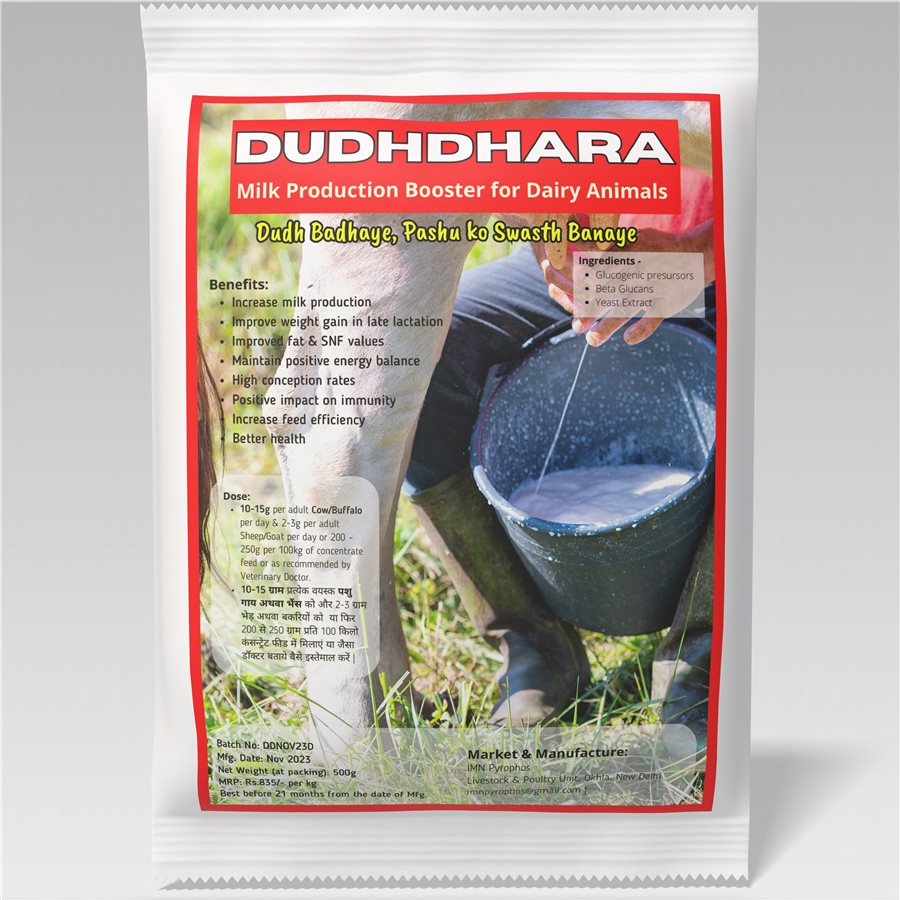
Dudh Dhara
Milk production booster with glucogenic precursors, beta glucans and yeast extract. Supports milk, fat and SNF, positive energy balance, conception and immunity.
Dose: 10 to 15 g per adult cow or buffalo per day, or 200 to 250 g per 100 kg of concentrate.
1 kg ₹1,150MRP ₹1,410
Frequently asked questions
Is the cooperative already running?
The report describes it as a proposed body. It gives no start date or milestones.
Which states are included?
Andhra Pradesh, Bihar, Gujarat, Maharashtra, Madhya Pradesh, Punjab, Rajasthan, Uttar Pradesh and West Bengal.
Will my milk price go up?
The report does not promise this. It cites a gap between open-market and cooperative prices, but says these are not guaranteed returns.
Source: Dairy News 7×7, citing Indian Cooperative, 26 Oct 2026. Written by the IMN Pyrophos team in our own words.
NDDB (नेशनल डेयरी डेवलपमेंट बोर्ड, आणंद) के सहारे एक प्रस्तावित राष्ट्रीय मल्टी-स्टेट कोऑपरेटिव नौ राज्यों की करीब 20,000 गाँव की डेयरी सोसायटियों को जोड़ेगा। इसका नाम Cooperative Milk Producers’ Organization Multi-State Limited है। मक़सद गाँवों के दूध इकट्ठा करने वाले केंद्रों को एक ढाँचे में लाना है, ताकि छोटे डेयरी किसानों को बेहतर बाज़ार, मोलभाव की ताक़त और बेहतर दाम मिलें। यह खबर 26 अक्टूबर 2026 की है और Indian Cooperative की 25 अक्टूबर की रिपोर्ट पर आधारित है।
मुख्य तथ्य
| बात | विवरण |
|---|---|
| प्रस्तावित संस्था | Cooperative Milk Producers’ Organization Multi-State Limited |
| किसके सहारे | NDDB, आणंद, गुजरात |
| दायरा | करीब 20,000 गाँव की डेयरी सोसायटियाँ |
| राज्य | आंध्र प्रदेश, बिहार, गुजरात, महाराष्ट्र, मध्य प्रदेश, पंजाब, राजस्थान, उत्तर प्रदेश, पश्चिम बंगाल |
| उद्देश्य | छोटे किसानों के लिए बेहतर बाज़ार, सामूहिक मोलभाव और बेहतर दाम |
| फंडिंग और समय | रिपोर्ट में नहीं दिया गया |
| बताया गया दाम का अंतर | खुले बाज़ार में करीब ₹35 प्रति लीटर, कोऑपरेटिव से ₹55 प्रति लीटर तक (केंद्रीय मंत्री अमित शाह की बात का सार) |
| रिपोर्ट की तारीख | 26 अक्टूबर 2026 (मूल रिपोर्ट 25 अक्टूबर) |
₹55 वाली बात रिपोर्ट में सबसे अच्छी स्थिति के रूप में है, और रिपोर्ट कहती है कि यह गारंटीड कमाई नहीं है।
यह क्यों प्रस्तावित है
भारत का ज़्यादातर दूध कम पशुओं वाले छोटे किसानों से आता है। अकेले किसान की खरीदार के सामने दाम पर बात करने की ताक़त कम होती है। गाँव की सोसायटियाँ पहले से दूध इकट्ठा करती हैं, पर अलग-अलग चलती हैं। उन्हें जोड़ने वाला एक मल्टी-स्टेट कोऑपरेटिव उन्हें बेहतर बेचने का पैमाना और सदस्यों को फ़ायदा देने का रास्ता देगा। बड़ा सरकारी कार्यक्रम White Revolution 2.0 भी इसी दिशा में है। 29 जुलाई 2026 के PIB अपडेट के अनुसार इसका लक्ष्य 75,000 नई सोसायटियाँ बनाना और 46,422 मौजूदा को मज़बूत करना है। उस तारीख तक 24,097 नई बनी थीं और 31,394 मज़बूत हुईं। ये आँकड़े बड़े कार्यक्रम के हैं, इस 20,000 सोसायटी वाले नेटवर्क के नहीं।
डेयरी किसानों के लिए इसका मतलब
योजना आगे बढ़ी तो फ़ायदा उन बातों पर निर्भर करेगा जो रिपोर्ट में अभी नहीं हैं: दूध का दाम कैसे तय होगा, फैट और SNF की जाँच कैसे होगी, भुगतान कितनी जल्दी होगा और संस्था कौन चलाएगा। नौ राज्यों के किसान इन बातों पर नज़र रखें। ज़्यादातर कोऑपरेटिव में दाम फैट और SNF पर चलता है, इसलिए अच्छी क्वालिटी का दूध ज़्यादा कमाता है। बड़ा नेटवर्क पशु आहार, मिनरल मिक्सचर और पशु चिकित्सा जैसी साझा ज़रूरतों में भी मदद कर सकता है, पर रिपोर्ट यह नहीं कहती, इसलिए इसे सिर्फ़ संभावना मानें।
किसान अभी क्या करें
- अपनी सोसायटी के सचिव से पूछें कि क्या वह इस योजना में है और सदस्यता में आपके लिए क्या बदलेगा।
- दूध की पर्ची देखें। रोज़ फैट और SNF लिखें और हफ़्तों में तुलना करें।
- रिकॉर्ड रखें: रोज़ का दूध, फ़ीड का खर्च और भुगतान की तारीखें। किसी भी नई व्यवस्था में साफ़ रिकॉर्ड काम आता है।
- पहले दूध की क्वालिटी सुधारें। स्थिर रुमेन, पर्याप्त साफ़ पानी और संतुलित राशन से फैट और SNF बढ़ते हैं।
- ₹55 वाला आँकड़ा अपने आप लागू होगा, यह न मानें। असली खरीद दरों का इंतज़ार करें।
दूध बढ़ाने वाला
Dudh Dhara
ग्लूकोजेनिक प्रीकर्सर, बीटा ग्लूकन और यीस्ट एक्सट्रैक्ट वाला दूध बढ़ाने वाला सप्लीमेंट। दूध, फैट और SNF, पॉज़िटिव एनर्जी बैलेंस, गाभिन ठहरने और रोग प्रतिरोधक क्षमता में सहायक।
मात्रा: 10–15 ग्राम प्रति वयस्क गाय या भैंस प्रति दिन, या 200–250 ग्राम प्रति 100 किलो दाना।
1 kg ₹1,150MRP ₹1,410
अक्सर पूछे जाने वाले सवाल
क्या यह कोऑपरेटिव चालू हो चुका है?
रिपोर्ट इसे प्रस्तावित संस्था बताती है। शुरू होने की तारीख या पड़ाव नहीं दिए गए।
कौन से राज्य शामिल हैं?
आंध्र प्रदेश, बिहार, गुजरात, महाराष्ट्र, मध्य प्रदेश, पंजाब, राजस्थान, उत्तर प्रदेश और पश्चिम बंगाल।
क्या मेरे दूध का दाम बढ़ेगा?
रिपोर्ट ऐसा वादा नहीं करती। वह खुले बाज़ार और कोऑपरेटिव के दाम का अंतर बताती है, पर कहती है कि यह गारंटीड कमाई नहीं है।
स्रोत: Dairy News 7×7, Indian Cooperative के हवाले से, 26 अक्टूबर 2026। IMN Pyrophos टीम ने अपने शब्दों में लिखा।
NDDB (National Dairy Development Board, Anand) ke sahare ek prastavit rashtriya multi-state cooperative nau rajyon ki lagbhag 20,000 gaon ki dairy societies ko jodega. Iska naam Cooperative Milk Producers’ Organization Multi-State Limited hai. Maqsad gaon ke doodh ikattha karne wale kendron ko ek dhaanche me laana hai, taaki chhote dairy kisanon ko behtar bazaar, molbhaav ki taqat aur behtar daam milein. Yeh khabar 26 October 2026 ki hai aur Indian Cooperative ki 25 October ki report par aadharit hai.
Mukhya tathya
| Baat | Vivaran |
|---|---|
| Prastavit sanstha | Cooperative Milk Producers’ Organization Multi-State Limited |
| Kiske sahare | NDDB, Anand, Gujarat |
| Daayra | Lagbhag 20,000 gaon ki dairy societies |
| Rajya | Andhra Pradesh, Bihar, Gujarat, Maharashtra, Madhya Pradesh, Punjab, Rajasthan, Uttar Pradesh, West Bengal |
| Uddeshya | Chhote kisanon ke liye behtar bazaar, samoohik molbhaav aur behtar daam |
| Funding aur samay | Report me nahi diya gaya |
| Bataya gaya daam ka antar | Khule bazaar me lagbhag ₹35 prati litre, cooperative se ₹55 prati litre tak (Kendriya mantri Amit Shah ki baat ka saar) |
| Report ki tareekh | 26 October 2026 (mool report 25 October) |
₹55 wali baat report me sabse achhi sthiti ke roop me hai, aur report kehti hai ki yeh guaranteed kamai nahi hai.
Yeh kyun prastavit hai
India ka zyada tar doodh kam pashuon wale chhote kisanon se aata hai. Akele kisan ki kharidaar ke saamne daam par baat karne ki taqat kam hoti hai. Gaon ki societies pehle se doodh ikattha karti hain, par alag-alag chalti hain. Unhe jodne wala ek multi-state cooperative unhe behtar bechne ka paimana aur members ko faayda dene ka raasta dega. Bada sarkari karyakram White Revolution 2.0 bhi isi disha me hai. 29 July 2026 ke PIB update ke anusaar iska lakshya 75,000 nayi societies banana aur 46,422 maujooda ko mazboot karna hai. Us tareekh tak 24,097 nayi bani thi aur 31,394 mazboot hui. Yeh aankde bade karyakram ke hain, is 20,000 society wale network ke nahi.
Dairy kisanon ke liye iska matlab
Yojana aage badhi to faayda un baaton par nirbhar karega jo report me abhi nahi hain: doodh ka daam kaise tay hoga, fat aur SNF ki jaanch kaise hogi, bhugtaan kitni jaldi hoga aur sanstha kaun chalayega. Nau rajyon ke kisan in baaton par nazar rakhein. Zyada tar cooperative me daam fat aur SNF par chalta hai, isliye achhi quality ka doodh zyada kamata hai. Bada network cattle feed, mineral mixture aur pashu chikitsa jaisi saajha zarooraton me bhi madad kar sakta hai, par report yeh nahi kehti, isliye ise sirf sambhavna maanein.
Kisan abhi kya karein
- Apni society ke secretary se poochhein ki kya woh is yojana me hai aur membership me aapke liye kya badlega.
- Doodh ki parchi dekhein. Roz fat aur SNF likhein aur hafton me tulna karein.
- Record rakhein: roz ka doodh, feed ka kharch aur bhugtaan ki tareekhein. Kisi bhi nayi vyavastha me saaf record kaam aata hai.
- Pehle doodh ki quality sudharein. Sthir rumen, paryapt saaf paani aur santulit ration se fat aur SNF badhte hain.
- ₹55 wala aankda apne aap lagu hoga, yeh na maanein. Asli kharid daron ka intezaar karein.
Doodh badhane wala
Dudh Dhara
Glucogenic precursor, beta glucan aur yeast extract wala doodh badhane wala supplement. Doodh, fat aur SNF, positive energy balance, gaabhin theharne aur immunity me sahayak.
Matra: 10–15 g prati vayask gaay ya bhains prati din, ya 200–250 g prati 100 kg daana.
1 kg ₹1,150MRP ₹1,410
Aksar puchhe jaane wale sawaal
Kya yeh cooperative chalu ho chuka hai?
Report ise prastavit sanstha batati hai. Shuru hone ki tareekh ya padaav nahi diye gaye.
Kaun se rajya shamil hain?
Andhra Pradesh, Bihar, Gujarat, Maharashtra, Madhya Pradesh, Punjab, Rajasthan, Uttar Pradesh aur West Bengal.
Kya mere doodh ka daam badhega?
Report aisa vaada nahi karti. Woh khule bazaar aur cooperative ke daam ka antar batati hai, par kehti hai ki yeh guaranteed kamai nahi hai.
Source: Dairy News 7×7, Indian Cooperative ke hawale se, 26 Oct 2026. IMN Pyrophos team ne apne shabdon me likha.