
In winter the same feed, the same chicks and the same farmer often give a worse FCR. A batch that finished at 1.65 in September can end at 1.80 in December, and on 5,000 birds that gap is a lot of feed money gone. The good news is that most of the loss comes from a few things you can control: warmth, litter, air, gut health, feed handling and a steady water routine. Here is how to hold your FCR in winter, and how the IMN Pyrophos winter 42-day schedule fits in.
What FCR is, in one line
FCR (feed conversion ratio) is total feed eaten divided by total live weight produced. If 5,000 birds ate 17,500 kg of feed and gave 10,000 kg of live weight, FCR is 1.75. Feed is the biggest cost in a broiler batch, so every 0.05 of FCR you lose is real money. To compare batches fairly at different weights, use CFCR; our free CFCR calculator does it in a minute.
Why FCR gets worse in winter
- Cold chicks burn feed for heat. Feed that should become meat goes into keeping the body warm. Chilled chicks also huddle, eat less and become uneven.
- Wet litter and ammonia. Closed curtains trap moisture and gas, which damage the eyes, airways and feet and cut feed intake. See how to control ammonia in winter sheds and wet litter and loose droppings.
- Gut upsets. Cold water, wet litter and sudden feed changes cause loose droppings. Feed passes through undigested and FCR rises.
- Respiratory and ascites stress. Poor air in a closed shed leads to breathing trouble and ascites in fast-growing birds. Sick birds eat but do not grow.
- Feed wastage. Damp feed, spilled feed, rats and wrong feeder height all quietly raise the feed you use per kg of meat.
Where your FCR leaks, and what to do
| Area | What to check | What to do |
|---|---|---|
| Brooding temperature | Chicks spread evenly, not piled under the brooder or running away from it | Pre-heat the shed before the chicks arrive and reduce the heat slowly week by week. Our winter brooding guide has the details. |
| First 3 days | Crop fill at 8 and 24 hours; chicks drinking and eating | Give clean warm water and a start-up supplement instead of the old gud or sugar solution. |
| Litter | Dry and crumbly under your hand; no smell at bird height | Fix leaking nipples, give minimum ventilation, and use an ammonia binder on day 1. |
| Ventilation | No stuffy air, no draught on the birds | Open curtains a little on the side away from the wind, and run fans in short bursts. |
| Droppings | Firm droppings with a white cap, not watery or foamy | Warm the water, support the gut, and treat the cause of loose droppings early. |
| Feed handling | Dry feed store, no spilled or caked feed, feeders at back height | Fill feeders little and often, remove wet feed and keep rats out. |
| Water | Clean, not ice-cold, enough drinkers and nipples | Let tank water reach shed temperature before chicks drink it. Birds that drink less eat less. |
| Weekly weight | Weigh 50 birds each week and compare with your breed chart | If you are behind at day 7 or day 14, correct it now. A late start is very hard to recover. |
The IMN winter 42-day schedule and your FCR
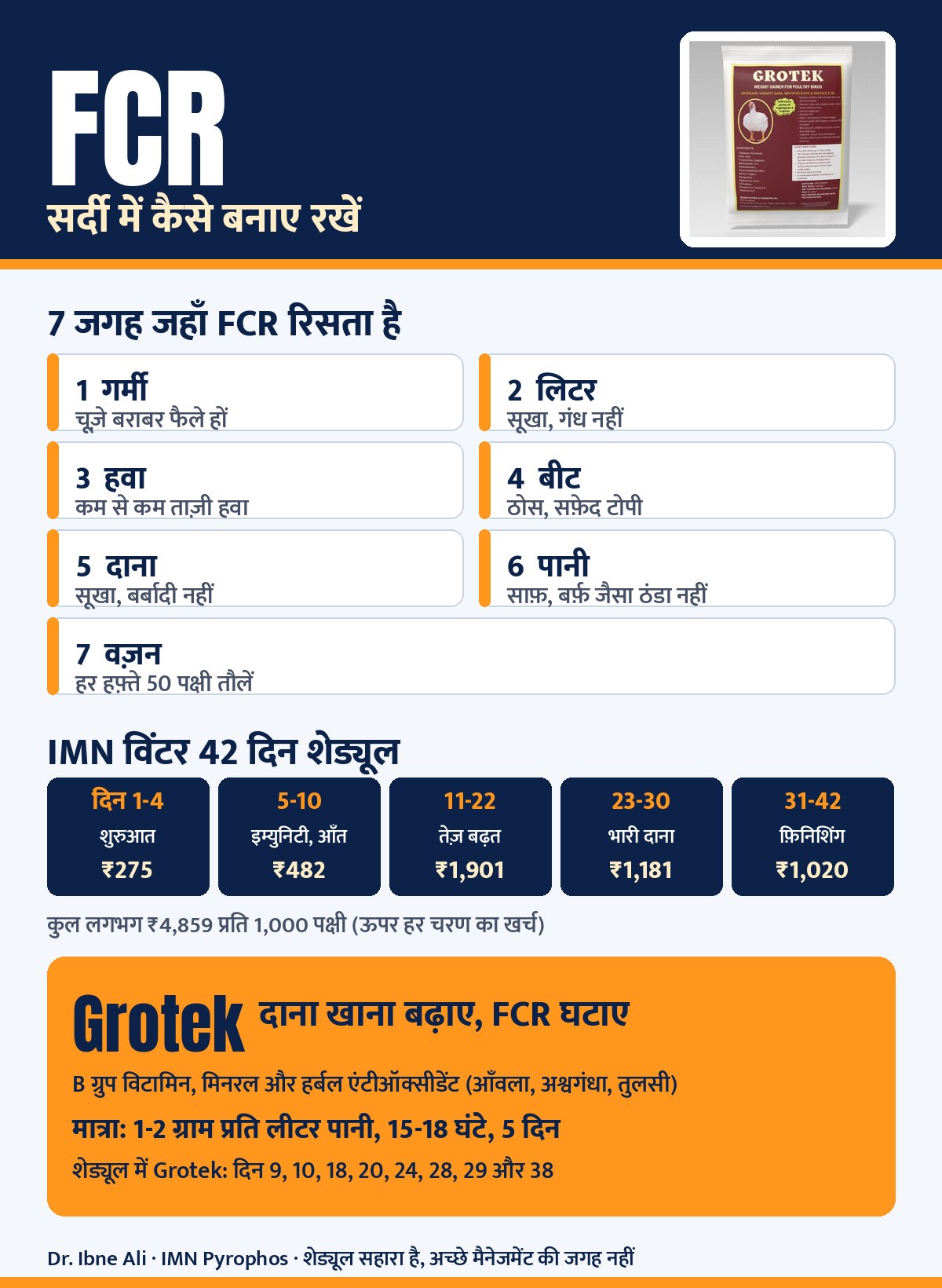
The IMN Pyrophos winter 2026 schedule gives a planned water-product programme for each day from day 1 to 42, per 1,000 birds. Each phase supports a part of the FCR story. The full day-by-day table is in our winter broiler medicine schedule.
| Days | What the schedule gives | Why it matters for FCR | Approx. cost per 1,000 birds |
|---|---|---|---|
| 1–4 | Easy Brood, Vitaden H, Pyrocal B, Alcaeu. ND-IB vaccine on day 4, with no medicine in the vaccine water | A strong, even start. Early deaths and weak chicks are the most expensive FCR losses. | ₹275 |
| 5–10 | Vitaden H, Pyrocal B, Sel-E Boost, Nexamune, Nephrowin, Hepasol DS, Grotek, Remipro | Immunity, liver and kidney support, and the first Grotek and Remipro for feed intake and gut flora | ₹482 |
| 11–22 | Septima, Ascitox, Respoze, Nexamune, Hepasol DS, Grotek, Goutster, Alcaeu and others | The fast-growth period: loose droppings, breathing stress and ascites risk are managed here | ₹1,901 |
| 23–30 | Plain water on day 23, then Respoze, Grotek, Goutster, Hepasol DS, Septima, Remipro, Ascitox | Keeps feed intake and gut health steady in the heaviest feeding weeks | ₹1,181 |
| 31–42 | Nexamune, Hepasol DS, Remipro, Ascitox, Grotek, with plain-water rest days | Finishing: keeps weight gain going to market weight | ₹1,020 |
The whole 42-day schedule costs about ₹4,859 per 1,000 birds, which is about ₹4.9 per bird. Compare this with the feed you save when FCR improves, and with the cost of one bad batch. Always use the exact quantities and the plain-water days shown in the full schedule.
IMN products that fit an FCR plan
Day 1–2 · in place of jaggery water
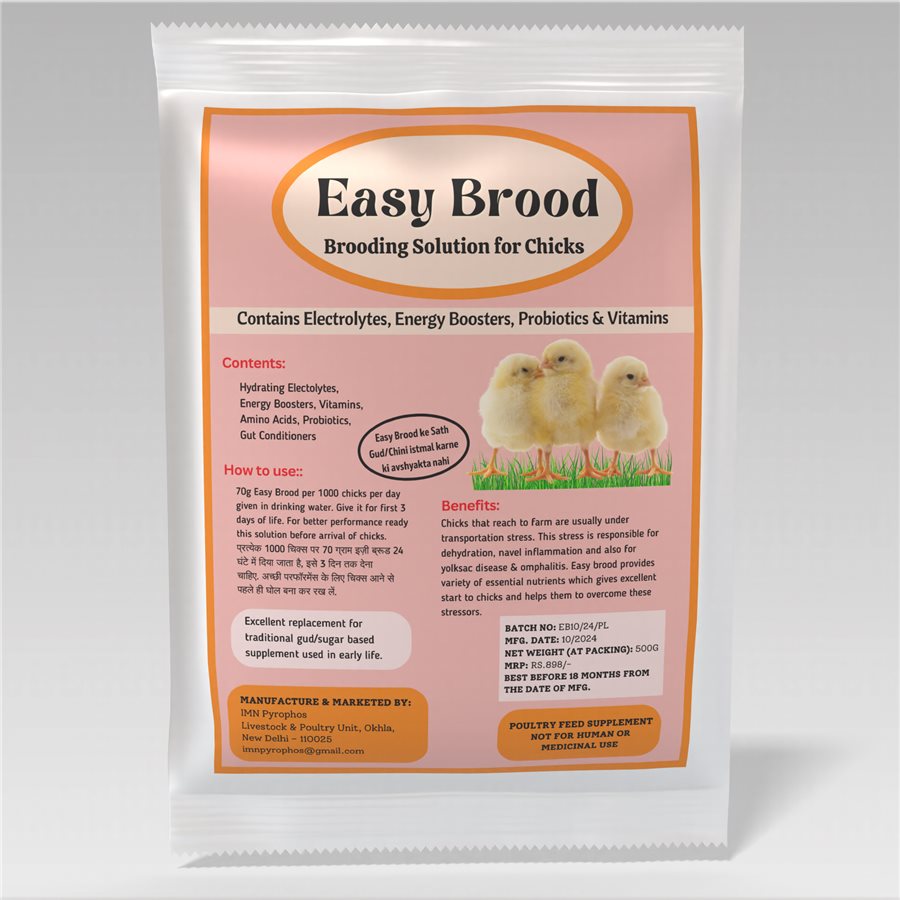
Easy Brood
Start-up solution for chicks: electrolytes, osmolytes, glucose for energy, vitamins C and B, betaine, glycine and probiotics. Reduces transport stress and dehydration, helps early navel healing, lowers the chance of yolk sac infection and early mortality. No need for jaggery, sugar or salt solutions. Antibiotic free. 250 g pack ₹295.
Dose: in the IMN winter schedule, 70 g per 1,000 chicks in the first water on day 1 (as soon as chicks arrive) and day 2. Label: 3–4 g per litre of drinking water, i.e. 50–70 g per 1,000 chicks per day. Prepare the solution before the chicks arrive.
500 g ₹565MRP ₹898

Ammonia binder · litter only
Ammobond
Ammonia binding and reducing agents in a powdered carrier. Cuts ammonia emissions in the farm by 50–60%. Helps heavier birds, better FCR and lower mortality, and lowers keratoconjunctivitis, tracheitis and foot burn problems. Do not feed to birds; use only in litter.
Dose: Sprinkle over the litter by broadcast method, like sowing seed, using gloves: 5 kg for every 2500 birds. In closed or EC-house brooding, mix it into the litter on day 1, then repeat the same dose on day 16–17, and on day 32–34 if needed. Do not rake the litter or add lime or bleaching powder after applying.
5 kg ₹1,655MRP ₹1,950
Gut health · bestseller
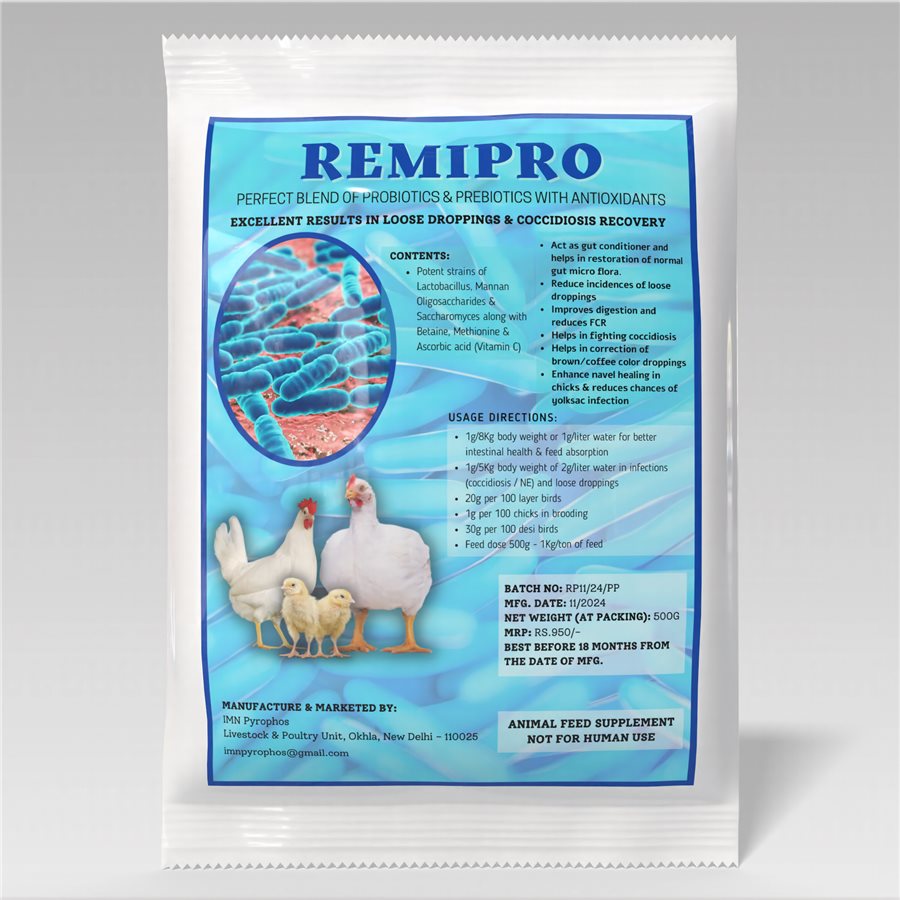
Remipro
Probiotic, prebiotic (MOS) and Saccharomyces with betaine, methionine and vitamin C. Restores gut flora, reduces loose droppings, improves digestion and FCR, and helps in recovery from coccidiosis.
Dose: 1 g per 8 kg body weight or 1 g per litre of water for routine gut health; 1 g per 5 kg body weight or 2 g per litre in infections and loose droppings; 1 g per 100 chicks in brooding.
500 g ₹626MRP ₹950
More weight · lower FCR
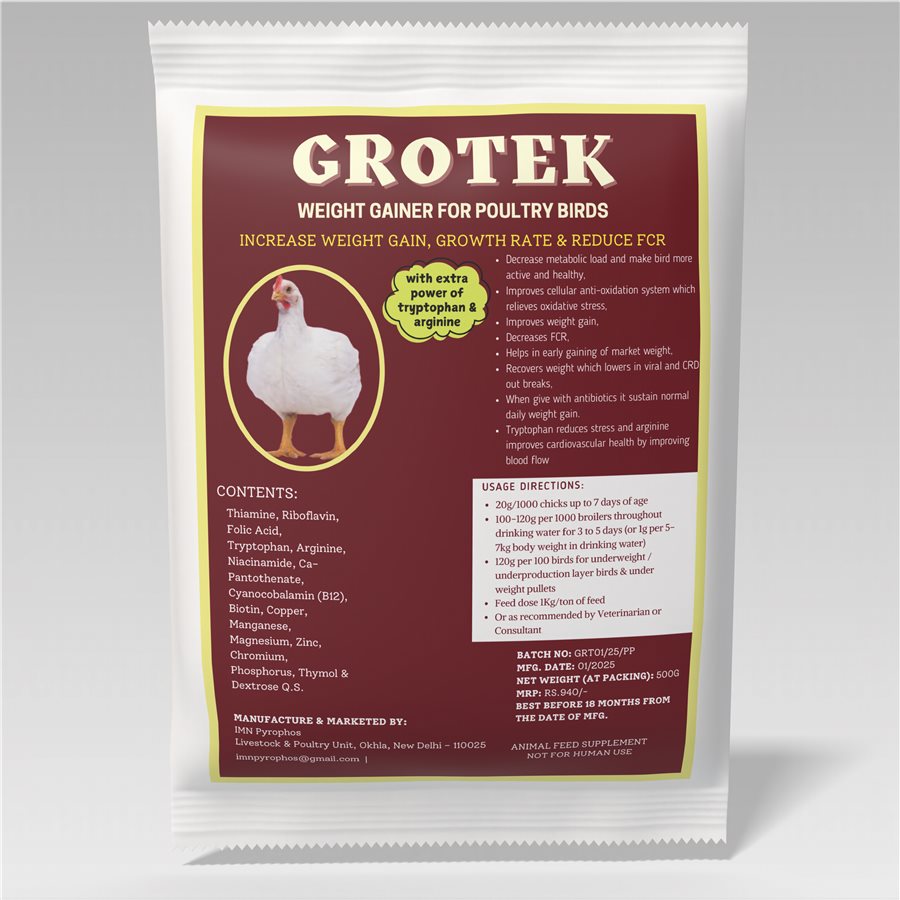
Grotek
B group vitamins, minerals and herbal antioxidants (amla, ashwagandha, tulsi). Improves feed intake and reduces FCR, increases growth rate to reach market weight early, supports the liver, and helps keep weight during infections and antibiotic use. Contains no iron.
Dose: 1–2 g per litre of water for 15–18 hours a day for 5 days; during or after infections 1 g per 5 kg body weight.
500 g ₹679MRP ₹940
A simple weekly FCR check
- Note the feed bags used each week.
- Weigh 50 random birds each week and find the average weight.
- Estimate total live weight (average weight x birds alive) and work out FCR so far.
- If FCR is high, look first at litter, air and droppings, then at feed wastage and water. Fix one cause at a time.
- At the end of the batch, find CFCR with the calculator and compare with the last batch.
Common mistakes that raise FCR in winter
- Closing all curtains for the whole night with no air change
- Letting drinkers leak and then trying to fix wet litter with powder alone
- Starting the schedule late, or skipping the plain-water days
- Giving the vaccine water and medicines together
- Giving ice-cold tank water at dawn
- Not weighing the birds, so the problem is found only at the end
- Changing the feed brand or form suddenly in mid-batch
Frequently asked questions
How do I maintain FCR in broilers in winter? Keep the chicks warm, the litter dry, give minimum fresh air, keep the gut healthy, handle feed carefully and follow a steady water routine. Weigh birds every week so you catch a problem early.
What is a good FCR for broilers? It depends on the market weight, the breed and the season. As a rough guide, a well-run batch at about 2 kg is often in the range of 1.6 to 1.8. Compare with your breed standard and your own earlier batches, or use CFCR.
Why is my FCR worse in winter? Birds use more feed to stay warm, and wet litter, ammonia, loose droppings and breathing stress all reduce how much feed becomes meat.
Which IMN products are used for FCR? Easy Brood in the first days, Ammobond in the litter, Remipro for gut flora and Grotek to support feed intake and growth. The full day-by-day plan is in the winter schedule.
What is the IMN winter schedule cost? About ₹4,859 per 1,000 birds for the full 42 days, as shown in the schedule. Prices may change, so confirm on WhatsApp.
Does the schedule replace good management? No. It supports it. Warmth, dry litter, fresh air and clean water come first.
How do I calculate FCR? Divide total feed eaten by total live weight produced. Use the CFCR calculator to compare batches fairly.
Also read: winter 42-day schedule · winter brooding guide · winter broiler management · CFCR calculator · ammonia binder · IMN poultry products
सर्दी में ब्रॉयलर का FCR कैसे बनाए रखें: मैनेजमेंट और IMN विंटर शेड्यूल
सर्दी में वही दाना, वही चूज़े और वही किसान, फिर भी FCR अक्सर बिगड़ जाता है। सितंबर में 1.65 पर खत्म हुआ बैच दिसंबर में 1.80 पर पहुँच सकता है, और 5,000 पक्षियों पर यह फ़र्क़ काफ़ी दाने के पैसे का होता है। अच्छी बात यह है कि ज़्यादातर नुकसान कुछ ऐसी चीज़ों से होता है जो आपके हाथ में हैं: गर्मी, लिटर, हवा, आँत की सेहत, दाने की संभाल और पानी की नियमित दिनचर्या। यहाँ पढ़िए सर्दी में FCR कैसे थामें और IMN Pyrophos का 42 दिन का विंटर शेड्यूल इसमें कहाँ बैठता है।
FCR क्या है, एक लाइन में
FCR (फ़ीड कन्वर्ज़न रेशियो) यानी कुल खाया दाना ÷ कुल बना लाइव वज़न। अगर 5,000 पक्षियों ने 17,500 किलो दाना खाया और 10,000 किलो लाइव वज़न बना, तो FCR 1.75 है। ब्रॉयलर बैच में सबसे बड़ा खर्च दाना है, इसलिए FCR में हर 0.05 का नुकसान असली पैसा है। अलग-अलग वज़न के बैच की बराबरी से तुलना के लिए CFCR निकालिए; हमारा फ्री CFCR कैलकुलेटर यह एक मिनट में कर देता है।
सर्दी में FCR क्यों बिगड़ता है
- ठंडे चूज़े दाना गर्मी में जला देते हैं। जो दाना मांस बनना चाहिए वह शरीर गर्म रखने में चला जाता है। ठंड खाए चूज़े सिमटकर बैठते हैं, कम खाते हैं और बैच में एकरूपता घटती है।
- गीला लिटर और अमोनिया। बंद पर्दों में नमी और गैस रुक जाती है, जिससे आँख, साँस की नली और पंजे ख़राब होते हैं और दाना खाना घटता है। पढ़िए सर्दी में शेड की अमोनिया कैसे घटाएँ और गीला लिटर और loose droppings।
- आँत की गड़बड़ी। ठंडा पानी, गीला लिटर और अचानक दाना बदलना loose droppings लाते हैं। दाना बिना पचे निकल जाता है और FCR बढ़ता है।
- साँस और ascites का तनाव। बंद शेड में हवा की कमी से तेज़ बढ़ने वाले पक्षियों में साँस की तकलीफ़ और ascites होता है। बीमार पक्षी खाते हैं पर बढ़ते नहीं।
- दाने की बर्बादी। नम दाना, गिरा हुआ दाना, चूहे और फ़ीडर की ग़लत ऊँचाई चुपचाप प्रति किलो मांस पर दाना बढ़ा देते हैं।
FCR कहाँ से रिसता है और क्या करें
| जगह | क्या देखें | क्या करें |
|---|---|---|
| ब्रूडिंग तापमान | चूज़े बराबर फैले हों, ब्रूडर के नीचे ढेर या उससे दूर भागते न हों | चूज़े आने से पहले शेड गर्म करें और हफ़्ते-दर-हफ़्ते गर्मी धीरे घटाएँ। विवरण के लिए विंटर ब्रूडिंग गाइड पढ़ें। |
| पहले 3 दिन | 8 और 24 घंटे पर क्रॉप भरा हो; चूज़े पानी और दाना ले रहे हों | पुराने गुड़ या चीनी के घोल की जगह साफ़ गुनगुना पानी और स्टार्ट-अप सप्लीमेंट दें। |
| लिटर | हाथ में सूखा और भुरभुरा; पक्षी की ऊँचाई पर गंध नहीं | टपकती निप्पल ठीक करें, कम से कम हवा दें और पहले दिन अमोनिया बाइंडर लगाएँ। |
| वेंटिलेशन | घुटन नहीं, पक्षियों पर सीधी ठंडी हवा नहीं | हवा की उलटी तरफ़ पर्दा थोड़ा खोलें और पंखे थोड़ी-थोड़ी देर चलाएँ। |
| बीट | सफ़ेद टोपी वाली ठोस बीट, पानी जैसी या झागदार नहीं | पानी गुनगुना रखें, आँत को सहारा दें और loose droppings का कारण जल्दी पकड़ें। |
| दाने की संभाल | सूखा स्टोर, गिरा या जमा दाना नहीं, फ़ीडर पक्षी की पीठ की ऊँचाई पर | फ़ीडर कम-कम और बार-बार भरें, गीला दाना हटाएँ और चूहे रोकें। |
| पानी | साफ़, बर्फ़ जैसा ठंडा नहीं, ड्रिंकर या निप्पल पर्याप्त | टंकी का पानी शेड के तापमान पर आने दें। जो पक्षी कम पीते हैं वे कम खाते हैं। |
| हफ़्ते का वज़न | हर हफ़्ते 50 पक्षी तौलें और अपने ब्रीड चार्ट से मिलाएँ | 7वें या 14वें दिन पीछे हों तो तुरंत सुधारें। देर से शुरू हुई कमी पूरी करना बहुत कठिन है। |
IMN विंटर 42 दिन शेड्यूल और आपका FCR
IMN Pyrophos का विंटर 2026 शेड्यूल दिन 1 से 42 तक, प्रति 1,000 पक्षी, रोज़ का पानी वाला प्रोग्राम देता है। हर चरण FCR की कहानी के एक हिस्से को सहारा देता है। पूरी दिन-दर-दिन तालिका हमारे विंटर ब्रॉयलर दवा शेड्यूल में है।
| दिन | शेड्यूल में क्या | FCR के लिए क्यों ज़रूरी | अनुमानित खर्च प्रति 1,000 पक्षी |
|---|---|---|---|
| 1–4 | Easy Brood, Vitaden H, Pyrocal B, Alcaeu। चौथे दिन ND-IB वैक्सीन, वैक्सीन के पानी में कोई दवा नहीं | मज़बूत और एक-सा शुरुआती दौर। शुरुआती मौतें और कमज़ोर चूज़े सबसे महंगा FCR नुकसान हैं। | ₹275 |
| 5–10 | Vitaden H, Pyrocal B, Sel-E Boost, Nexamune, Nephrowin, Hepasol DS, Grotek, Remipro | इम्युनिटी, लिवर-किडनी का सहारा, और दाना खाने व आँत के बैक्टीरिया के लिए पहला Grotek और Remipro | ₹482 |
| 11–22 | Septima, Ascitox, Respoze, Nexamune, Hepasol DS, Grotek, Goutster, Alcaeu आदि | तेज़ बढ़त का दौर: loose droppings, साँस का तनाव और ascites का ख़तरा यहीं संभलता है | ₹1,901 |
| 23–30 | दिन 23 सादा पानी, फिर Respoze, Grotek, Goutster, Hepasol DS, Septima, Remipro, Ascitox | सबसे ज़्यादा दाना खाने वाले हफ़्तों में दाना खाना और आँत की सेहत स्थिर रखता है | ₹1,181 |
| 31–42 | Nexamune, Hepasol DS, Remipro, Ascitox, Grotek, बीच-बीच में सादे पानी के आराम के दिन | फ़िनिशिंग: बाज़ार के वज़न तक बढ़त बनाए रखता है | ₹1,020 |
पूरे 42 दिन के शेड्यूल का खर्च लगभग ₹4,859 प्रति 1,000 पक्षी है, यानी करीब ₹4.9 प्रति पक्षी। इसे FCR सुधरने पर बचे दाने और एक ख़राब बैच के नुकसान से तौलकर देखिए। मात्रा और सादे पानी वाले दिन हमेशा पूरे शेड्यूल के अनुसार ही रखें।
FCR प्लान में फिट होने वाले IMN प्रोडक्ट
दिन 1–2 · गुड़ के घोल की जगह
Easy Brood
चूज़ों का स्टार्ट-अप घोल: इलेक्ट्रोलाइट, ऑस्मोलाइट, ग्लूकोज़ (ऊर्जा), विटामिन C और B, बीटेन, ग्लाइसीन और प्रोबायोटिक। सफर का तनाव और पानी की कमी घटाता है, नाभि जल्दी सूखने में मदद करता है, योक सैक इन्फेक्शन और शुरुआती मौत का खतरा कम करता है। गुड़, चीनी या नमक के घोल की ज़रूरत नहीं। एंटीबायोटिक मुक्त। 250 g पैक ₹295।
मात्रा: IMN सर्दी शेड्यूल में दिन 1 और 2 को पहले पानी में 70 ग्राम प्रति 1000 चूज़े (दिन 1 को चूज़े आते ही)। लेबल: 3–4 ग्राम प्रति लीटर पीने का पानी, यानी 50–70 ग्राम प्रति 1000 चूज़े प्रति दिन। चूज़े आने से पहले घोल बना कर रखें।
500 g ₹565MRP ₹898
लिटर में अमोनिया बाँधता है
Ammobond
लिटर में अमोनिया को बाँधने और घटाने वाले तत्व, पाउडर कैरियर में। फार्म में अमोनिया का उत्सर्जन 50–60% तक घटाता है। पक्षियों का वज़न, FCR और मृत्यु दर बेहतर करने में मदद करता है, और केराटोकंजंक्टिवाइटिस, ट्रेकाइटिस और पैर जलने की समस्या घटाता है। पक्षियों को खिलाना नहीं है, सिर्फ़ लिटर में इस्तेमाल करें।
मात्रा: Ammobond को दस्ताने पहनकर लिटर के ऊपर छिड़कें (ब्रॉडकास्ट तरीका, जैसे खेत में बीज बिखेरते हैं): हर 2500 पक्षियों पर 5 kg। क्लोज़्ड ब्रूडिंग / EC फार्म ब्रूडिंग में पहले दिन लिटर में मिला दें, फिर 16-17वें दिन उसी मात्रा में दोबारा, और ज़रूरत हो तो 32-34वें दिन। डालने के बाद रेकिंग न करें और चूना या ब्लीचिंग पाउडर न डालें।
5 kg ₹1,655MRP ₹1,950
आँत की सेहत · बेस्टसेलर
Remipro
प्रोबायोटिक, प्रीबायोटिक (MOS) और Saccharomyces, साथ में बीटेन, मेथियोनीन और विटामिन C। आँत के अच्छे बैक्टीरिया लौटाता है, loose droppings घटाता है, पाचन और FCR सुधारता है, कॉक्सीडियोसिस से उबरने में मदद करता है और भूरी/कॉफी रंग की बीट ठीक करता है।
मात्रा: रोज़ की आँत सेहत के लिए 1 ग्राम प्रति 8 किलो वज़न या 1 ग्राम प्रति लीटर पानी; loose droppings और इन्फेक्शन में 1 ग्राम प्रति 5 किलो वज़न या 2 ग्राम प्रति लीटर; ब्रूडिंग में 1 ग्राम प्रति 100 चूज़े।
500 g ₹626MRP ₹950
वज़न बढ़ाए · FCR घटाए
Grotek
B ग्रुप विटामिन, मिनरल और हर्बल एंटीऑक्सीडेंट (आँवला, अश्वगंधा, तुलसी)। दाना खाना बढ़ाता है और FCR घटाता है, बढ़वार तेज़ करता है ताकि बाज़ार का वज़न जल्दी आए, लिवर को सहारा देता है, और इन्फेक्शन व एंटीबायोटिक के दौरान वज़न बचाने में मदद करता है। इसमें आयरन नहीं है।
मात्रा: 1–2 ग्राम प्रति लीटर पानी, रोज़ 15–18 घंटे, 5 दिन; इन्फेक्शन के दौरान या बाद 1 ग्राम प्रति 5 किलो वज़न।
500 g ₹679MRP ₹940
हर हफ़्ते FCR की आसान जाँच
- हर हफ़्ते इस्तेमाल हुई दाने की बोरियाँ लिख लें।
- हर हफ़्ते 50 पक्षी तौलकर औसत वज़न निकालें।
- कुल लाइव वज़न (औसत वज़न × ज़िंदा पक्षी) का अंदाज़ा लगाकर अब तक का FCR निकालें।
- FCR ऊँचा हो तो पहले लिटर, हवा और बीट देखें, फिर दाने की बर्बादी और पानी। एक बार में एक कारण ठीक करें।
- बैच के अंत में कैलकुलेटर से CFCR निकालकर पिछले बैच से मिलाएँ।
सर्दी में FCR बढ़ाने वाली आम ग़लतियाँ
- पूरी रात सारे पर्दे बंद रखना और हवा बदलना नहीं
- ड्रिंकर टपकने देना और फिर गीले लिटर को सिर्फ़ पाउडर से ठीक करने की कोशिश
- शेड्यूल देर से शुरू करना, या सादे पानी के दिन छोड़ देना
- वैक्सीन का पानी और दवाएँ साथ देना
- सुबह टंकी का बर्फ़ जैसा ठंडा पानी देना
- पक्षी न तौलना, जिससे समस्या बैच के अंत में पता चलती है
- बैच के बीच में अचानक दाने का ब्रांड या रूप बदलना
अक्सर पूछे जाने वाले सवाल
सर्दी में ब्रॉयलर का FCR कैसे बनाए रखें? चूज़ों को गर्म रखें, लिटर सूखा रखें, कम से कम ताज़ी हवा दें, आँत स्वस्थ रखें, दाने की संभाल करें और पानी की नियमित दिनचर्या रखें। हर हफ़्ते पक्षी तौलें ताकि समस्या जल्दी पकड़ में आए।
ब्रॉयलर का अच्छा FCR कितना होता है? यह बाज़ार के वज़न, ब्रीड और मौसम पर निर्भर है। मोटे तौर पर लगभग 2 किलो पर अच्छे बैच का FCR अक्सर 1.6 से 1.8 के बीच रहता है। अपने ब्रीड स्टैंडर्ड और पिछले बैच से मिलाइए, या CFCR का इस्तेमाल कीजिए।
सर्दी में मेरा FCR क्यों बिगड़ता है? पक्षी गर्म रहने में ज़्यादा दाना खर्च करते हैं, और गीला लिटर, अमोनिया, loose droppings और साँस का तनाव दाने के मांस बनने को घटाते हैं।
FCR के लिए कौन से IMN प्रोडक्ट इस्तेमाल होते हैं? शुरुआती दिनों में Easy Brood, लिटर में Ammobond, आँत के बैक्टीरिया के लिए Remipro और दाना खाने व बढ़त के सहारे के लिए Grotek। पूरा दिन-दर-दिन प्लान विंटर शेड्यूल में है।
IMN विंटर शेड्यूल का खर्च कितना है? शेड्यूल के अनुसार पूरे 42 दिन के लिए लगभग ₹4,859 प्रति 1,000 पक्षी। भाव बदल सकते हैं, इसलिए WhatsApp पर पक्का कर लें।
क्या शेड्यूल अच्छे मैनेजमेंट की जगह ले लेता है? नहीं, वह सहारा देता है। गर्मी, सूखा लिटर, ताज़ी हवा और साफ़ पानी पहले आते हैं।
FCR कैसे निकालें? कुल खाए दाने को कुल बने लाइव वज़न से भाग दें। बैच की बराबरी से तुलना के लिए CFCR कैलकुलेटर इस्तेमाल करें।
यह भी पढ़ें: विंटर 42 दिन शेड्यूल · विंटर ब्रूडिंग गाइड · विंटर ब्रॉयलर मैनेजमेंट · CFCR कैलकुलेटर · अमोनिया बाइंडर · IMN पोल्ट्री प्रोडक्ट
Sardi me broiler ka FCR kaise banaye rakhein: management aur IMN winter schedule
Sardi me wahi daana, wahi chooze aur wahi kisan, phir bhi FCR aksar bigad jaata hai. September me 1.65 par khatam hua batch December me 1.80 par pahunch sakta hai, aur 5,000 pakshiyon par ye farq kaafi daane ke paise ka hota hai. Achhi baat ye hai ki zyadatar nuksaan kuch aisi cheezon se hota hai jo aapke haath me hain: garmi, litter, hawa, aant ki sehat, daane ki sambhaal aur paani ki niyamit dincharya. Yahan padhiye sardi me FCR kaise thaamein aur IMN Pyrophos ka 42 din ka winter schedule isme kahan baithta hai.
FCR kya hai, ek line me
FCR (feed conversion ratio) yaani kul khaya daana ÷ kul bana live wazan. Agar 5,000 pakshiyon ne 17,500 kg daana khaya aur 10,000 kg live wazan bana, to FCR 1.75 hai. Broiler batch me sabse bada kharch daana hai, isliye FCR me har 0.05 ka nuksaan asli paisa hai. Alag-alag wazan ke batch ki barabari se tulna ke liye CFCR nikaaliye; hamara free CFCR calculator ye ek minute me kar deta hai.
Sardi me FCR kyon bigadta hai
- Thande chooze daana garmi me jala dete hain. Jo daana maans banna chahiye wo sharir garm rakhne me chala jaata hai. Thand khaye chooze simatkar baithte hain, kam khaate hain aur batch me ekrupta ghatati hai.
- Geela litter aur ammonia. Band parde me nami aur gas ruk jaati hai, jisse aankh, saans ki nali aur panje kharab hote hain aur daana khana ghatata hai. Padhiye sardi me shed ki ammonia kaise ghatayein aur geela litter aur loose droppings.
- Aant ki gadbadi. Thanda paani, geela litter aur achanak daana badalna loose droppings laate hain. Daana bina pache nikal jaata hai aur FCR badhta hai.
- Saans aur ascites ka tanaav. Band shed me hawa ki kami se tez badhne wale pakshiyon me saans ki takleef aur ascites hota hai. Bimar pakshi khaate hain par badhte nahi.
- Daane ki barbaadi. Nam daana, gira hua daana, chuhe aur feeder ki galat unchai chupchaap prati kg maans par daana badha deti hain.
FCR kahan se rista hai aur kya karein
| Jagah | Kya dekhein | Kya karein |
|---|---|---|
| Brooding temperature | Chooze barabar faile hon, brooder ke neeche dher ya usse door bhaagte na hon | Chooze aane se pehle shed garm karein aur hafte-dar-hafte garmi dheere ghatayein. Details ke liye winter brooding guide padhiye. |
| Pehle 3 din | 8 aur 24 ghante par crop bhara ho; chooze paani aur daana le rahe hon | Purane gud ya cheeni ke ghol ki jagah saaf gunguna paani aur start-up supplement dein. |
| Litter | Haath me sookha aur bhurbhura; pakshi ki unchai par gandh nahi | Tapakti nipple theek karein, kam se kam hawa dein aur pehle din ammonia binder lagayein. |
| Ventilation | Ghutan nahi, pakshiyon par seedhi thandi hawa nahi | Hawa ki ulti taraf parda thoda kholein aur pankhe thodi-thodi der chalayein. |
| Beet | Safed topi wali thos beet, paani jaisi ya jhaagdaar nahi | Paani gunguna rakhein, aant ko sahara dein aur loose droppings ka karan jaldi pakdein. |
| Daane ki sambhaal | Sookha store, gira ya jama daana nahi, feeder pakshi ki peeth ki unchai par | Feeder kam-kam aur baar-baar bharein, geela daana hatayein aur chuhe rokein. |
| Paani | Saaf, baraf jaisa thanda nahi, drinker ya nipple paryapt | Tanki ka paani shed ke taapmaan par aane dein. Jo pakshi kam peete hain wo kam khaate hain. |
| Hafte ka wazan | Har hafte 50 pakshi taulein aur apne breed chart se milayein | 7wen ya 14wen din peeche hon to turant sudhaarein. Der se shuru hui kami poori karna bahut kathin hai. |
IMN winter 42 din schedule aur aapka FCR
IMN Pyrophos ka winter 2026 schedule din 1 se 42 tak, prati 1,000 pakshi, roz ka paani wala program deta hai. Har charan FCR ki kahani ke ek hisse ko sahara deta hai. Poori din-dar-din talika hamare winter broiler dawa schedule me hai.
| Din | Schedule me kya | FCR ke liye kyon zaroori | Anumanit kharch prati 1,000 pakshi |
|---|---|---|---|
| 1–4 | Easy Brood, Vitaden H, Pyrocal B, Alcaeu. Chauthe din ND-IB vaccine, vaccine ke paani me koi dawa nahi | Majboot aur ek-sa shuruaati daur. Shuruaati maut aur kamzor chooze sabse mehnge FCR nuksaan hain. | ₹275 |
| 5–10 | Vitaden H, Pyrocal B, Sel-E Boost, Nexamune, Nephrowin, Hepasol DS, Grotek, Remipro | Immunity, liver-kidney ka sahara, aur daana khane va aant ke bacteria ke liye pehla Grotek aur Remipro | ₹482 |
| 11–22 | Septima, Ascitox, Respoze, Nexamune, Hepasol DS, Grotek, Goutster, Alcaeu aadi | Tez badhat ka daur: loose droppings, saans ka tanaav aur ascites ka khatra yahin sambhalta hai | ₹1,901 |
| 23–30 | Din 23 saada paani, phir Respoze, Grotek, Goutster, Hepasol DS, Septima, Remipro, Ascitox | Sabse zyada daana khane wale hafton me daana khana aur aant ki sehat sthir rakhta hai | ₹1,181 |
| 31–42 | Nexamune, Hepasol DS, Remipro, Ascitox, Grotek, beech-beech me saade paani ke aaram ke din | Finishing: bazaar ke wazan tak badhat banaye rakhta hai | ₹1,020 |
Poore 42 din ke schedule ka kharch lagbhag ₹4,859 prati 1,000 pakshi hai, yaani kareeb ₹4.9 prati pakshi. Ise FCR sudharne par bache daane aur ek kharab batch ke nuksaan se taulkar dekhiye. Matra aur saade paani wale din hamesha poore schedule ke anusaar hi rakhein.
FCR plan me fit hone wale IMN products
Din 1–2 · gud ke ghol ki jagah
Easy Brood
Choozon ka start-up ghol: electrolyte, osmolyte, glucose (urja), vitamin C aur B, betaine, glycine aur probiotic. Safar ka tanav aur paani ki kami ghatata hai, naabhi jaldi sookhne me madad karta hai, yolk sac infection aur shuruaati maut ka khatra kam karta hai. Gud, cheeni ya namak ke ghol ki zaroorat nahi. Antibiotic mukt. 250 g pack ₹295.
Matra: IMN sardi schedule me din 1 aur 2 ko pehle paani me 70 g prati 1000 chooze (din 1 ko chooze aate hi). Label: 3–4 g prati litre peene ka paani, yaani 50–70 g prati 1000 chooze prati din. Chooze aane se pehle ghol bana kar rakhiye.
500 g ₹565MRP ₹898
Litter me ammonia bandhta hai
Ammobond
Litter me ammonia ko bandhne aur ghatane wale tatva, powder carrier me. Farm me ammonia ka utsarjan 50–60% tak ghatata hai. Pakshiyon ka wazan, FCR aur mrityu dar behtar karne me madad karta hai, aur keratoconjunctivitis, tracheitis aur pair jalne ki samasya ghatata hai. Pakshiyon ko khilana nahi hai, sirf litter me istemal karein.
Matra: Ammobond ko gloves pehankar litter ke upar chhidkein (broadcast tareeka, jaise khet me beej bikherte hain): har 2500 pakshiyon par 5 kg. Closed brooding / EC farm brooding me pehle din litter me mila dein, phir 16-17wein din same dose par dobara, aur zarurat ho to 32-34wein din. Daalne ke baad raking na karein aur chuna ya bleaching powder na daalein.
5 kg ₹1,655MRP ₹1,950
Aant ki sehat · bestseller
Remipro
Probiotic, prebiotic (MOS) aur Saccharomyces, saath me betaine, methionine aur vitamin C. Aant ke achhe bacteria lautata hai, loose droppings ghatata hai, pachan aur FCR sudharta hai, coccidiosis se ubharne me madad karta hai aur bhoori/coffee rang ki beet theek karta hai.
Matra: Roz ki aant sehat ke liye 1 g prati 8 kg wazan ya 1 g prati litre paani; loose droppings aur infection me 1 g prati 5 kg wazan ya 2 g prati litre; brooding me 1 g prati 100 chooze.
500 g ₹626MRP ₹950
Wazan badhaye · FCR ghataye
Grotek
B group vitamin, mineral aur herbal antioxidant (amla, ashwagandha, tulsi). Daana khana badhata hai aur FCR ghatata hai, badhwar tez karta hai taaki bazaar ka wazan jaldi aaye, liver ko sahara deta hai, aur infection va antibiotic ke dauran wazan bachane me madad karta hai. Isme iron nahi hai.
Matra: 1–2 g prati litre paani, roz 15–18 ghante, 5 din; infection ke dauran ya baad 1 g prati 5 kg wazan.
500 g ₹679MRP ₹940
Har hafte FCR ki aasaan jaanch
- Har hafte istemal hui daane ki boriyan likh lein.
- Har hafte 50 pakshi taulkar ausat wazan nikalein.
- Kul live wazan (ausat wazan × zinda pakshi) ka andaza lagakar ab tak ka FCR nikalein.
- FCR ooncha ho to pehle litter, hawa aur beet dekhein, phir daane ki barbaadi aur paani. Ek baar me ek karan theek karein.
- Batch ke ant me calculator se CFCR nikalkar pichhle batch se milayein.
Sardi me FCR badhane wali aam galtiyan
- Poori raat saare parde band rakhna aur hawa badalna nahi
- Drinker tapakne dena aur phir geele litter ko sirf powder se theek karne ki koshish
- Schedule der se shuru karna, ya saade paani ke din chhod dena
- Vaccine ka paani aur dawaen saath dena
- Subah tanki ka baraf jaisa thanda paani dena
- Pakshi na taulna, jisse samasya batch ke ant me pata chalti hai
- Batch ke beech me achanak daane ka brand ya roop badalna
Aksar pooche jaane wale sawaal
Sardi me broiler ka FCR kaise banaye rakhein? Choozon ko garm rakhein, litter sookha rakhein, kam se kam taazi hawa dein, aant swasth rakhein, daane ki sambhaal karein aur paani ki niyamit dincharya rakhein. Har hafte pakshi taulein taaki samasya jaldi pakad me aaye.
Broiler ka achha FCR kitna hota hai? Ye bazaar ke wazan, breed aur mausam par nirbhar hai. Mote taur par lagbhag 2 kg par achhe batch ka FCR aksar 1.6 se 1.8 ke beech rehta hai. Apne breed standard aur pichhle batch se milayein, ya CFCR ka istemal karein.
Sardi me mera FCR kyon bigadta hai? Pakshi garm rehne me zyada daana kharch karte hain, aur geela litter, ammonia, loose droppings aur saans ka tanaav daane ke maans banne ko ghatate hain.
FCR ke liye kaun se IMN products istemal hote hain? Shuruaati dinon me Easy Brood, litter me Ammobond, aant ke bacteria ke liye Remipro aur daana khane va badhat ke sahare ke liye Grotek. Poora din-dar-din plan winter schedule me hai.
IMN winter schedule ka kharch kitna hai? Schedule ke anusaar poore 42 din ke liye lagbhag ₹4,859 prati 1,000 pakshi. Bhaav badal sakte hain, isliye WhatsApp par pakka kar lein.
Kya schedule achhe management ki jagah le leta hai? Nahi, wo sahara deta hai. Garmi, sookha litter, taazi hawa aur saaf paani pehle aate hain.
FCR kaise nikalein? Kul khaye daane ko kul bane live wazan se bhaag dein. Batch ki barabari se tulna ke liye CFCR calculator istemal karein.
Ye bhi padhiye: winter 42 din schedule · winter brooding guide · winter broiler management · CFCR calculator · ammonia binder · IMN poultry products