
Water belly (ascites) is a winter killer in fast-growing broilers, and once fluid fills the abdomen most birds do not recover. That is why the real answer to “ascites in broilers treatment” is early prevention and early control: fix the shed first, then support the heart and lung with a proven programme such as Ascitox Q10. This guide shows the signs, the causes, the day-wise dose schedule, and what a nine-farm field study found.
What is ascites in broilers?
A fast-growing broiler needs a lot of oxygen, but its lungs cannot grow as quickly as its body. The heart works harder, pressure builds in the lung blood vessels, the right side of the heart fails, and fluid collects in the belly. Farmers call it pet me pani or water belly. For the full mechanism, read our veterinary note on ascites and pulmonary hypertension.
Signs to spot early
- Swollen, soft, drooping belly that feels like a water bag.
- Bluish comb and wattles, and breathing with effort.
- Birds standing apart, reluctant to move, eating less.
- Sudden deaths of good-looking birds, often at night or early morning.
- At post-mortem: straw-coloured fluid, a swollen liver, and a big, flabby heart.
Why winter makes it worse
Cold raises the oxygen need. Farmers close the curtains to save heat, so ammonia and dust rise and oxygen falls. Add high-energy feed and fast early growth, and the heart and lungs run out of room. Read our winter broiler management guide for curtain and ventilation management.
What to do on the farm today
- Keep chicks warm, but give fresh air. Open the curtain a little at the top at the right time of day.
- Control early growth if ascites keeps coming back. Talk to your nutritionist about the early feed and light programme.
- Do not give extra salt. Too much sodium in feed or water adds to the load on the heart.
- Treat respiratory disease early. A damaged lung makes ascites worse.
- Do a post-mortem on every few dead birds and write down the findings by day.
Ascitox Q10 programme: dose and timing
Ascitox Q10 contains coenzyme Q10, blood buffers, antioxidants, herbal diuretics, sodium ascorbate and selenite. It supports prevention and control of metabolic ascites and sudden death (SDS) and is used along with good shed management, not instead of it.
| When | Dose (label) | How |
|---|---|---|
| Prevention, day 2–4 | 1 g per 100 chicks | At night; hold feed for 2–3 hours |
| Prevention, day 13–15 | 7 g per 100 birds | Evening or night |
| Prevention, day 23–25 | 20 g per 100 birds | Evening or night |
| Control, when cases appear | 1 g per 3 kg body weight or 3–4 g per litre of water | 2–3 days; hold feed at night for 6–8 hours |
The prevention course for 1,000 birds uses about 280 g, which costs about ₹195 at the 1 kg price of ₹698 (calculated from the label dose and price).
What the field study showed
A winter study on nine commercial farms in northern India (Ali and Naqvi, Letters in Animal Biology, 2022) compared farms using Ascitox-Q10 with control farms:
| Measure | Control | Ascitox-Q10 |
|---|---|---|
| Overall mortality | 7.24% | 4.61% |
| Mortality after day 15 | 4.15% | 2.19% |
| Average weight gain | 2.12 kg | 2.29 kg |
| FCR | 1.81 | 1.62 |
The treated and control birds were on different farms, so this is a field observation and not a controlled trial. Veterinarians can read the tables, charts and limits in our Vets Technical Corner article on the study. You can also watch the video on ascites treatment.
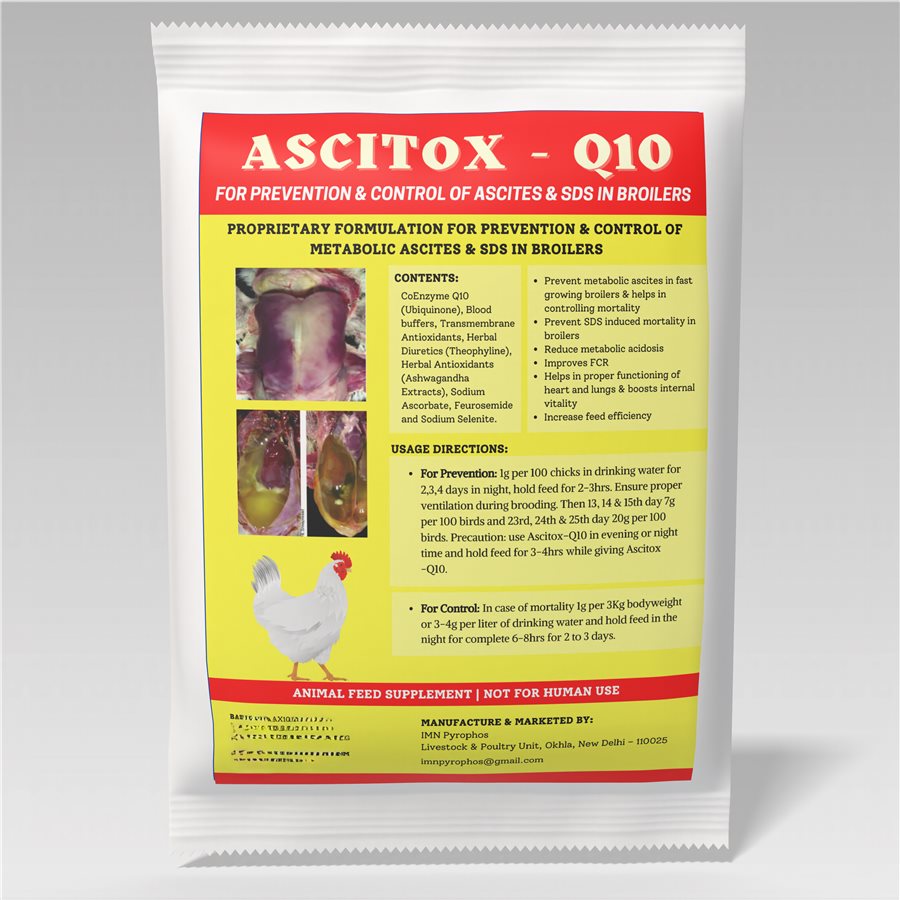
Ascites support
Ascitox Q10
Supportive supplement for the prevention and control of metabolic ascites and SDS in broilers. Contains coenzyme Q10, blood buffers, antioxidants, herbal diuretics, sodium ascorbate and selenite. It is given alongside, not in place of, good shed management.
Dose (label): prevention: 1 g per 100 chicks on day 2–4 at night (hold feed for 2–3 hours), 7 g per 100 birds on day 13–15, and 20 g per 100 birds on day 23–25, given in the evening or at night. Control: 1 g per 3 kg body weight or 3–4 g per litre, with feed held at night for 6–8 hours, for 2–3 days.
1 kg ₹698MRP ₹1,080
Common mistakes
- Waiting for the belly to swell. Start prevention by day 2–4, not after the first deaths.
- Closing the shed completely at night. Ammonia rises and oxygen falls.
- Using a supplement instead of fixing the shed. Temperature, air and feed come first.
- Giving it in the morning. The label says to give it in the evening or at night with feed held.
Frequently asked questions
What is the treatment of ascites in broilers? Once fluid has collected, most birds do not recover, so the focus is on prevention and early control: fix temperature and ventilation, avoid extra salt, treat respiratory disease early, and use a programme such as Ascitox Q10 on the label schedule.
What is the dose of Ascitox Q10? Prevention: 1 g per 100 chicks on day 2–4, 7 g per 100 birds on day 13–15 and 20 g per 100 birds on day 23–25. Control: 1 g per 3 kg body weight or 3–4 g per litre for 2–3 days.
What is the price of Ascitox Q10? 1 kg is ₹698 (MRP ₹1,080). Prices may change, so confirm on WhatsApp.
Is ascites the same as sudden death syndrome? They are related. Both come from high oxygen demand and heart stress in fast-growing birds, and Ascitox Q10 is labelled for both.
Where can I see all IMN products? The IMN product guide lists each product by problem and stage.
Also read: Ascitox Q10 · Winter broiler medicine schedule · IMN product guide
ब्रॉयलर में एसाइटिस (पेट में पानी): बचाव, इलाज और Ascitox Q10 की मात्रा
पेट में पानी (ascites) तेज़ बढ़ने वाले ब्रॉयलर में सर्दी का बड़ा नुकसान है, और पेट में पानी भर जाने के बाद ज़्यादातर पक्षी ठीक नहीं होते। इसलिए असली जवाब है जल्दी बचाव और जल्दी कंट्रोल: पहले शेड ठीक करें, फिर Ascitox Q10 जैसे प्रोग्राम से हार्ट और फेफड़ों को सपोर्ट दें। इस गाइड में लक्षण, कारण, दिन के हिसाब से मात्रा और नौ फार्म के फील्ड अध्ययन का नतीजा है।
ब्रॉयलर में एसाइटिस क्या है?
तेज़ बढ़ने वाले ब्रॉयलर को बहुत ऑक्सीजन चाहिए, पर फेफड़े शरीर जितनी तेज़ी से नहीं बढ़ते। हार्ट पर ज़ोर पड़ता है, फेफड़ों की नसों में दबाव (pulmonary hypertension) बढ़ता है, दायाँ हार्ट फेल होता है और पेट में पानी भर जाता है। पूरा मैकेनिज़्म हमारे वेटेरिनरी नोट में पढ़ें।
जल्दी पहचानने के लक्षण
- पेट फूला, नरम और लटका हुआ, पानी की थैली जैसा।
- कलगी और कान की झिल्ली नीली, साँस लेने में ज़ोर।
- पक्षी अलग खड़े, कम हिलते और कम खाते हैं।
- अच्छे दिखने वाले पक्षियों की अचानक मौत, अक्सर रात या सुबह।
- पोस्टमार्टम में: पीले रंग का पानी, सूजा हुआ लिवर और बड़ा ढीला हार्ट।
सर्दी में समस्या क्यों बढ़ती है
ठंड में ऑक्सीजन की ज़रूरत बढ़ती है। गर्मी बचाने के लिए पर्दे बंद करने पर अमोनिया और धूल बढ़ती है और ऑक्सीजन घटती है। इस पर ज़्यादा ऊर्जा वाला फ़ीड और तेज़ शुरुआती बढ़त जुड़ जाए तो हार्ट-फेफड़े जवाब दे देते हैं। पर्दे और वेंटिलेशन के लिए विंटर ब्रॉयलर मैनेजमेंट गाइड पढ़ें।
आज फार्म पर क्या करें
- चूज़ों को गर्म रखें, पर ताज़ी हवा भी दें। सही समय पर पर्दा ऊपर से थोड़ा खोलें।
- अगर एसाइटिस बार-बार आ रही है तो शुरुआती बढ़त पर नियंत्रण करें। न्यूट्रिशनिस्ट से शुरुआती फ़ीड और लाइट प्रोग्राम पर बात करें।
- अलग से नमक न दें। फ़ीड या पानी में ज़्यादा सोडियम हार्ट पर बोझ बढ़ाता है।
- साँस की बीमारी का जल्दी इलाज करें। खराब फेफड़े एसाइटिस बढ़ाते हैं।
- हर कुछ मरे पक्षियों का पोस्टमार्टम करें और दिन के हिसाब से लिखें।
Ascitox Q10 प्रोग्राम: मात्रा और समय
Ascitox Q10 में coenzyme Q10, ब्लड बफ़र, एंटीऑक्सीडेंट, हर्बल मूत्रवर्धक, सोडियम एस्कॉर्बेट और सेलेनाइट हैं। यह मेटाबॉलिक एसाइटिस और अचानक मौत (SDS) की रोकथाम और नियंत्रण में मदद करता है, और अच्छे शेड मैनेजमेंट के साथ दिया जाता है, उसकी जगह नहीं।
| कब | मात्रा (लेबल) | कैसे |
|---|---|---|
| बचाव, दिन 2–4 | 1 ग्राम प्रति 100 चूज़े | रात में, 2–3 घंटे दाना रोककर |
| बचाव, दिन 13–15 | 7 ग्राम प्रति 100 पक्षी | शाम या रात में |
| बचाव, दिन 23–25 | 20 ग्राम प्रति 100 पक्षी | शाम या रात में |
| कंट्रोल, केस आने पर | 1 ग्राम प्रति 3 किलो वज़न या 3–4 ग्राम प्रति लीटर पानी | 2–3 दिन; रात में 6–8 घंटे दाना रोककर |
1,000 पक्षियों के बचाव कोर्स में लगभग 280 ग्राम लगता है, जो 1 किलो के ₹698 भाव पर लगभग ₹195 बैठता है (लेबल की मात्रा और भाव से गणना)।
फील्ड अध्ययन में क्या दिखा
उत्तर भारत के नौ कमर्शियल फार्म पर सर्दी के अध्ययन (Ali और Naqvi, Letters in Animal Biology, 2022) में Ascitox-Q10 वाले फार्म की तुलना कंट्रोल फार्म से की गई:
| माप | कंट्रोल | Ascitox-Q10 |
|---|---|---|
| कुल मोर्टेलिटी | 7.24% | 4.61% |
| 15 दिन के बाद मोर्टेलिटी | 4.15% | 2.19% |
| औसत वज़न बढ़त | 2.12 किलो | 2.29 किलो |
| FCR | 1.81 | 1.62 |
ट्रीटेड और कंट्रोल पक्षी अलग फार्म पर थे, इसलिए यह कंट्रोल्ड ट्रायल नहीं, फील्ड ऑब्ज़र्वेशन है। वेटरनरी डॉक्टर टेबल, चार्ट और सीमाएँ हमारे Vets Technical Corner लेख में पढ़ सकते हैं। एसाइटिस ट्रीटमेंट का वीडियो भी देखें।
एसाइटिस और SDS से बचाव
Ascitox Q10
CoQ10, ब्लड बफ़र, एंटीऑक्सीडेंट, हर्बल मूत्रवर्धक (diuretic), सोडियम एस्कॉर्बेट और सेलेनाइट वाला मिश्रण। ब्रॉयलर में मेटाबॉलिक एसाइटिस (पेट में पानी भरना) और SDS (अचानक मौत) की रोकथाम और नियंत्रण में मदद करता है।
मात्रा: बचाव: दिन 2–4 में 1 ग्राम प्रति 100 चूज़े (रात में, 2–3 घंटे दाना रोक कर), दिन 13–15 में 7 ग्राम प्रति 100 पक्षी, दिन 23–25 में 20 ग्राम प्रति 100 पक्षी; शाम या रात में दें। नियंत्रण: 1 ग्राम प्रति 3 किलो वज़न या 3–4 ग्राम प्रति लीटर पानी, 2–3 दिन तक रात में 6–8 घंटे दाना रोक कर।
1 kg ₹698MRP ₹1,080
आम गलतियाँ
- पेट फूलने का इंतज़ार करना। बचाव दिन 2–4 से शुरू करें, पहली मौतों के बाद नहीं।
- रात में शेड पूरा बंद करना। अमोनिया बढ़ती है और ऑक्सीजन घटती है।
- शेड ठीक करने की जगह सप्लीमेंट देना। पहले तापमान, हवा और फ़ीड।
- सुबह देना। लेबल के अनुसार शाम या रात में, दाना रोककर।
अक्सर पूछे जाने वाले सवाल
ब्रॉयलर में एसाइटिस का इलाज क्या है? पानी भर जाने के बाद ज़्यादातर पक्षी ठीक नहीं होते, इसलिए ध्यान बचाव और जल्दी कंट्रोल पर रखें: तापमान और वेंटिलेशन ठीक करें, अलग नमक न दें, साँस की बीमारी का जल्दी इलाज करें और Ascitox Q10 लेबल के शेड्यूल पर दें।
Ascitox Q10 की मात्रा क्या है? बचाव: दिन 2–4 में 1 ग्राम प्रति 100 चूज़े, दिन 13–15 में 7 ग्राम प्रति 100 पक्षी और दिन 23–25 में 20 ग्राम प्रति 100 पक्षी। कंट्रोल: 1 ग्राम प्रति 3 किलो वज़न या 3–4 ग्राम प्रति लीटर, 2–3 दिन।
Ascitox Q10 की कीमत क्या है? 1 किलो ₹698 (MRP ₹1,080)। कीमत बदल सकती है, WhatsApp पर पक्का करें।
क्या एसाइटिस और सडन डेथ सिंड्रोम एक ही हैं? दोनों जुड़े हैं। दोनों तेज़ बढ़ने वाले पक्षियों में ऑक्सीजन की माँग और हार्ट पर तनाव से होते हैं, और Ascitox Q10 दोनों के लिए लेबल है।
सारे IMN प्रोडक्ट कहाँ देखें? IMN प्रोडक्ट गाइड में हर प्रोडक्ट समस्या और अवस्था के हिसाब से है।
यह भी पढ़ें: Ascitox Q10 · विंटर ब्रॉयलर मेडिसिन शेड्यूल · IMN प्रोडक्ट गाइड
Broiler me ascites (pet me pani): bachav, ilaaj aur Ascitox Q10 ki matra
Pet me pani (ascites) tez badhne wale broiler me sardi ka bada nuksan hai, aur pet me pani bhar jaane ke baad zyada tar pakshi theek nahi hote. Isliye asli jawab hai jaldi bachav aur jaldi control: pehle shed theek karein, phir Ascitox Q10 jaise programme se heart aur fefdon ko support dein. Is guide me lakshan, karan, din ke hisaab se matra aur nau farm ke field study ka nateeja hai.
Broiler me ascites kya hai?
Tez badhne wale broiler ko bahut oxygen chahiye, par fefde sharir jitni tezi se nahi badhte. Heart par zor padta hai, fefdon ki nason me dabav (pulmonary hypertension) badhta hai, daya heart fail hota hai aur pet me pani bhar jaata hai. Poora mechanism hamare veterinary note me padhein.
Jaldi pehchanne ke lakshan
- Pet phoola, naram aur latka hua, pani ki thaili jaisa.
- Kalgi aur wattle neele, saans lene me zor.
- Pakshi alag khade, kam hilte aur kam khate hain.
- Achhe dikhne wale pakshiyon ki achanak maut, aksar raat ya subah.
- Postmortem me: peele rang ka pani, soojha hua liver aur bada dheela heart.
Sardi me samasya kyun badhti hai
Thand me oxygen ki zarurat badhti hai. Garmi bachane ke liye parde band karne par ammonia aur dhool badhti hai aur oxygen ghatti hai. Isme zyada urja wala feed aur tez shuruaati badhat jud jaye to heart-fefde jawab de dete hain. Parde aur ventilation ke liye winter broiler management guide padhein.
Aaj farm par kya karein
- Chuzon ko garam rakhein, par taazi hawa bhi dein. Sahi samay par parda upar se thoda kholein.
- Agar ascites baar-baar aa rahi hai to shuruaati badhat par niyantran karein. Nutritionist se shuruaati feed aur light programme par baat karein.
- Alag se namak na dein. Feed ya pani me zyada sodium heart par bojh badhata hai.
- Saans ki bimari ka jaldi ilaaj karein. Kharab fefde ascites badhate hain.
- Har kuch mare pakshiyon ka postmortem karein aur din ke hisaab se likhein.
Ascitox Q10 programme: matra aur samay
Ascitox Q10 me coenzyme Q10, blood buffer, antioxidant, herbal mutravardhak, sodium ascorbate aur selenite hain. Yeh metabolic ascites aur achanak maut (SDS) ki roktham aur niyantran me madad karta hai, aur achhe shed management ke saath diya jaata hai, uski jagah nahi.
| Kab | Matra (label) | Kaise |
|---|---|---|
| Bachav, din 2–4 | 1 gram per 100 chuze | Raat me, 2–3 ghante dana rokkar |
| Bachav, din 13–15 | 7 gram per 100 pakshi | Shaam ya raat me |
| Bachav, din 23–25 | 20 gram per 100 pakshi | Shaam ya raat me |
| Control, case aane par | 1 gram per 3 kg vajan ya 3–4 gram per litre pani | 2–3 din; raat me 6–8 ghante dana rokkar |
1,000 pakshiyon ke bachav course me lagbhag 280 gram lagta hai, jo 1 kg ke ₹698 bhav par lagbhag ₹195 baithta hai (label ki matra aur bhav se ganana).
Field study me kya dikha
Uttar Bharat ke nau commercial farm par sardi ke study (Ali aur Naqvi, Letters in Animal Biology, 2022) me Ascitox-Q10 wale farm ki tulna control farm se ki gayi:
| Maap | Control | Ascitox-Q10 |
|---|---|---|
| Kul mortality | 7.24% | 4.61% |
| 15 din ke baad mortality | 4.15% | 2.19% |
| Aausat vajan badhat | 2.12 kg | 2.29 kg |
| FCR | 1.81 | 1.62 |
Treated aur control pakshi alag farm par the, isliye yeh controlled trial nahi, field observation hai. Veterinary doctor table, chart aur seemayein hamare Vets Technical Corner lekh me padh sakte hain. Ascites treatment ka video bhi dekhein.
Ascites aur SDS se bachav
Ascitox Q10
CoQ10, blood buffer, antioxidant, herbal diuretic (peshab badhane wali jadi-booti), sodium ascorbate aur selenite wala mishran. Broiler me metabolic ascites (pet me paani bharna) aur SDS (achanak maut) ki rokthaam aur niyantran me madad karta hai.
Matra: Bachav: din 2–4 me 1 g prati 100 chooze (raat me, 2–3 ghante daana rok kar), din 13–15 me 7 g prati 100 pakshi, din 23–25 me 20 g prati 100 pakshi; shaam ya raat me dijiye. Niyantran: 1 g prati 3 kg wazan ya 3–4 g prati litre paani, 2–3 din tak raat me 6–8 ghante daana rok kar.
1 kg ₹698MRP ₹1,080
Aam galtiyan
- Pet phoolne ka intezaar karna. Bachav din 2–4 se shuru karein, pehli mauton ke baad nahi.
- Raat me shed poora band karna. Ammonia badhti hai aur oxygen ghatti hai.
- Shed theek karne ki jagah supplement dena. Pehle temperature, hawa aur feed.
- Subah dena. Label ke anusar shaam ya raat me, dana rokkar.
Aksar puche jaane wale sawaal
Broiler me ascites ka ilaaj kya hai? Pani bhar jaane ke baad zyada tar pakshi theek nahi hote, isliye dhyan bachav aur jaldi control par rakhein: temperature aur ventilation theek karein, alag se namak na dein, saans ki bimari ka jaldi ilaaj karein aur Ascitox Q10 label ke schedule par dein.
Ascitox Q10 ki matra kya hai? Bachav: din 2–4 me 1 gram per 100 chuze, din 13–15 me 7 gram per 100 pakshi aur din 23–25 me 20 gram per 100 pakshi. Control: 1 gram per 3 kg vajan ya 3–4 gram per litre, 2–3 din.
Ascitox Q10 ki keemat kya hai? 1 kg ₹698 (MRP ₹1,080). Keemat badal sakti hai, WhatsApp par pakka karein.
Kya ascites aur sudden death syndrome ek hi hain? Dono jude hain. Dono tez badhne wale pakshiyon me oxygen ki maang aur heart par tanav se hote hain, aur Ascitox Q10 dono ke liye label hai.
Saare IMN product kahan dekhein? IMN product guide me har product samasya aur avastha ke hisaab se hai.
Yeh bhi padhein: Ascitox Q10 · Winter broiler medicine schedule · IMN product guide