
हिंदी में सार: उत्तर भारत के 9 कमर्शियल ब्रॉयलर फार्म पर सर्दी (नवंबर 2021 से फरवरी 2022) में Ascitox-Q10 का फील्ड अध्ययन किया गया। Ascitox-Q10 वाले ग्रुप में कुल मोर्टेलिटी 7.24% से घटकर 4.61% रही, 15 दिन के बाद की मोर्टेलिटी (M2) 4.15% से 2.19% रही, वज़न बढ़त 2.12 से 2.29 किलो और FCR 1.81 से 1.62 रहा। स्ट्रेन (Cobb 430Y और Hubbard) का मोर्टेलिटी पर असर नहीं दिखा। ध्यान रखें: ट्रीटेड और कंट्रोल पक्षी अलग फार्म पर थे, इसलिए यह रैंडमाइज़्ड ट्रायल नहीं, फील्ड ऑब्ज़र्वेशन है। नीचे सारी टेबल और चार्ट प्रकाशित आँकड़ों से बने हैं।
Ascites is one of the most expensive winter problems in fast-growing broilers. The mechanism is well known (see our note on ascites and pulmonary hypertension), but veterinarians still ask a practical question: what do field data show for a supplement-based programme? This article summarises one such study, published by Ali I and Naqvi S (2022), Letters in Animal Biology 2(2): 22–28, on Control of Winter Ascites in Commercial Broiler Chicken Through Proprietary Formulation. All numbers below are from that paper, except the clearly marked calculated ones.
Study design in brief
| Item | Detail |
|---|---|
| Setting | Nine commercial broiler farms, northern India, same eco-climatic zone, all with ascites cases |
| Strains | Cobb 430Y (farms 1–6), Skylark Hubbard (farms 7–9) |
| Treated farms | Farms 2, 4, 5, 7 and 8 (Ascitox-Q10); the other four were controls |
| Birds | Control 3,068; Ascitox-Q10 2,580 |
| Dose | 4 g per litre of drinking water on days 2–4, 13–15 and 23–25 |
| Feed withdrawal | 4 hours, applied on all farms as a preventive measure |
| Period | November 2021 to February 2022 (winter) |
| Diagnosis | Post-mortem by veterinarians: water belly with plasma-like fluid, enlarged liver with clots, right ventricular hypertrophy, oxidative-stress marks on breast muscle |
Mortality was split into M1 (0–15 days) and M2 (after 15 days), because early deaths are mostly chilling and brooding problems, while later deaths are where ascites and sudden death show up.
Mortality
| Group | Birds | M1 n | M1 % | M2 n | M2 % | Overall % |
|---|---|---|---|---|---|---|
| Control | 3,068 | 99 | 3.22 | 123 | 4.15 | 7.24 |
| Ascitox-Q10 | 2,580 | 64 | 2.50 | 55 | 2.19 | 4.61 |
| SEM | 27 | 3.5 | 0.17 | 2.9 | 0.16 | 0.21 |
| Significance | – | – | P<0.05 | – | P<0.01 | P<0.01 |
Source: Ali and Naqvi 2022, Table 1.
The effect was larger after day 15 (4.15% to 2.19%, P<0.01) than in the first two weeks (3.22% to 2.50%, P<0.05). That fits the biology: the heart and lung load builds up as the bird grows, so the later period is where a metabolic and antioxidant support programme has the most to act on.
Does strain matter?
| Strain | Birds | M1 % | M2 % | Overall % |
|---|---|---|---|---|
| Cobb 430Y | 2,778 | 2.84 | 3.13 | 5.90 |
| Skylark Hubbard | 2,833 | 2.87 | 3.16 | 5.93 |
| Significance | – | P>0.05 | P>0.05 | P>0.05 |
Source: Ali and Naqvi 2022, Table 1 (strain effects).
Cobb 430Y and Skylark Hubbard had almost the same mortality (5.90% and 5.93%, not significant), so the difference between the groups was not explained by strain.
Growth performance
| Group | Deaths | Weight gain (kg) | Feed intake (kg) | FCR |
|---|---|---|---|---|
| Control | 222 | 2.12 | 3.84 | 1.81 |
| Ascitox-Q10 | 119 | 2.29 | 3.71 | 1.62 |
| SEM | 3.5 | 0.07 | 0.09 | 0.06 |
| P value | – | P<0.01 | P<0.05 | P<0.01 |
Source: Ali and Naqvi 2022, Table 2.
What the numbers mean (calculated from the published means)
| Measure | Control | Ascitox-Q10 | Difference |
|---|---|---|---|
| Overall mortality | 7.24% | 4.61% | −2.63 points (−36%) |
| Deaths per 1,000 placed | about 72 | about 46 | about 26 fewer |
| M2 mortality | 4.15% | 2.19% | −1.96 points (−47%) |
| FCR | 1.81 | 1.62 | −0.19 (−10.5%) |
| Weight gain | 2.12 kg | 2.29 kg | +0.17 kg (+8.0%) |
Calculated by us from the published group means; the paper does not report these percentages.
In practical terms, about 26 fewer deaths per 1,000 chicks placed, and a bird that gained 170 g more on slightly less feed. At the label prevention dose (28 g per 100 birds over the three windows) and the 1 kg price of ₹698, the course costs about ₹195 per 1,000 birds, or roughly ₹0.20 per bird (calculated).
Why these ingredients (proposed rationale)
- Coenzyme Q10 and antioxidants (vitamin C as sodium ascorbate, selenite): support mitochondrial energy production and reduce oxidative stress in heart, lung and muscle, which is the common thread in pulmonary hypertension and sudden death.
- Blood buffers: help the acid-base balance during the high oxygen demand of fast growth.
- Herbal diuretics: help the bird clear excess fluid.
The study tested the formulation as a whole. It did not test the ingredients separately, so treat the above as a reasoned explanation, not a proven mechanism.
Reading the data critically
| Point | Why it matters when you read the result |
|---|---|
| Treated and control birds were on different farms | Farm, management and shed environment are mixed with the treatment effect. The result is a field observation, not a randomised trial. |
| Randomisation and blinding are not described | Allocation of farms to groups may carry bias. |
| The statistical test and unit of analysis are not stated | The P values cannot be re-checked, and farm-level clustering is not addressed. |
| Several actives in one product | CoQ10, buffers, diuretics, antioxidants and selenite were given together, so the effect of each part is unknown. |
| Feed intake | The text says intake was not clearly affected, while Table 2 flags P<0.05 (3.84 versus 3.71 kg). Read the table value. |
| Not reported | Ascites incidence rate, RV:TV ratio, haematocrit, blood gases and per-farm results. |
For a veterinarian the most useful reading is this: in nine real farms during one winter, the farms that used the programme had lower mortality and better FCR, and the pattern agrees with the physiology. A randomised, farm-matched trial with RV:TV and haematocrit would be the next step to confirm it.
- Fix temperature, ventilation and brooding first. No supplement replaces them.
- Keep the preventive feed withdrawal (4 hours in the study) and the three course windows: days 2–4, 13–15 and 23–25.
- Record M1, M2, necropsy findings and FCR for each batch, so you can compare your own farms with and without the programme.
Ascites support
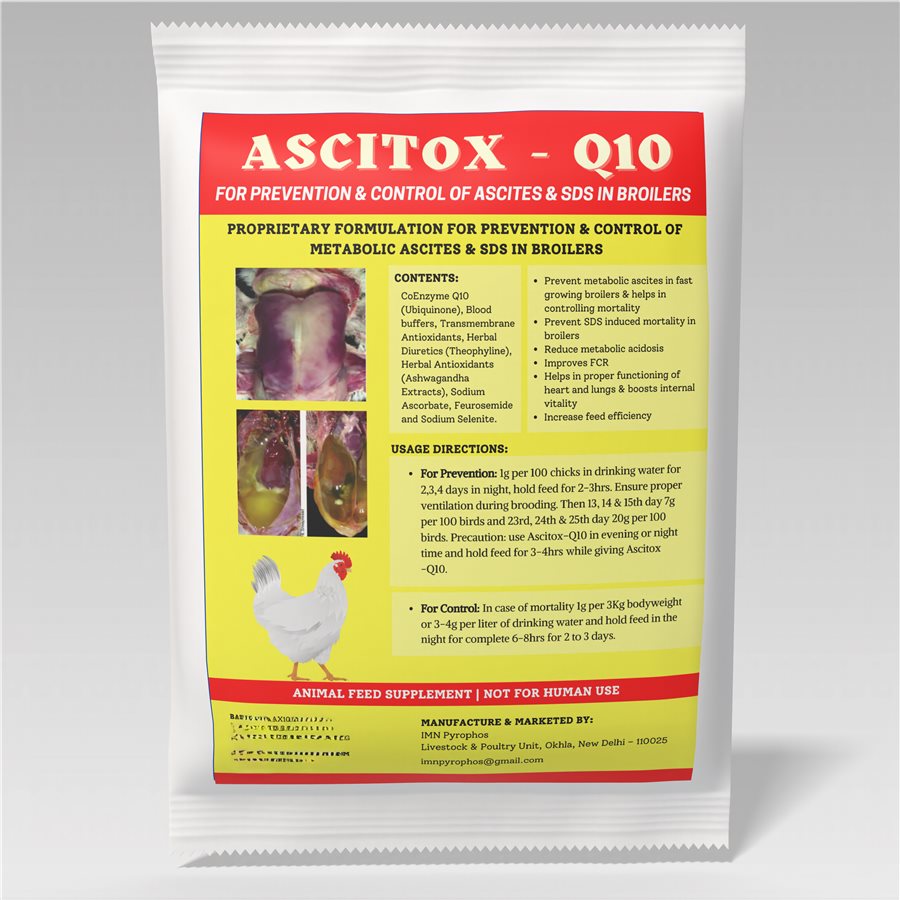
Ascitox Q10
The formulation studied above: coenzyme Q10, blood buffers, antioxidants, herbal diuretics, sodium ascorbate and selenite, for prevention and control of metabolic ascites and SDS in broilers.
Dose (label): prevention: 1 g per 100 chicks on day 2–4 at night (hold feed for 2–3 hours), 7 g per 100 birds on day 13–15 and 20 g per 100 birds on day 23–25, given in the evening or at night. Control: 1 g per 3 kg body weight or 3–4 g per litre, with feed held at night for 6–8 hours, for 2–3 days. Follow the current label.
1 kg ₹698MRP ₹1,080
Video (Hindi): Ascites in Broilers Treatment | Ascitox Q10 on the Ali Veterinary Wisdom channel.
Reference: Ali I, Naqvi S. Control of winter ascites in commercial broiler chicken through proprietary formulation. Letters in Animal Biology 2022; 2(2): 22–28. doi:10.62310/liab.v2i2.88. The authors are connected with the product maker, so read the results with that in mind.
More from the corner: Vets Technical Corner home · Ascites and pulmonary hypertension · Immunosuppression in broilers