हिंदी में सार: इम्यूनोसप्रेशन यानी पक्षी की रोग से लड़ने की ताकत कमज़ोर होना। इसमें टीके फेल होते हैं, E. coli और CRD बार-बार लौटते हैं, वज़न बराबर नहीं आता और FCR बढ़ता है। ब्रॉयलर में इसकी चार बड़ी वजहें हैं: गम्बोरो (IBD), चिकन इन्फेक्शियस एनीमिया (CIA), दाने में फफूंद का ज़हर (एफ्लाटॉक्सिन, T-2) और तनाव (ठंड, अमोनिया, भीड़)। पहचान: बर्सा छोटा होना, ELISA टाइटर में बहुत फर्क (CV% ज़्यादा), और दाने की टॉक्सिन जाँच। बचाव: पेरेंट में सही टीकाकरण, गम्बोरो टीके का सही दिन, सूखा और जाँचा हुआ दाना, विटामिन E, सेलेनियम और ज़िंक, और शेड में अच्छी हवा।
When a broiler flock “fails” its ND vaccine, keeps relapsing with colibacillosis after every antibiotic course, or shows inclusion body hepatitis and gangrenous dermatitis without an obvious primary cause, the real diagnosis is often not the disease you are treating but the immune system underneath it. Immunosuppression is rarely seen as a disease of its own. It shows up as vaccine failure, secondary infections, poor uniformity and a higher FCR. This article covers the main causes in commercial broilers, how to confirm them in the field and the lab, and how to control them.
- The bursa of Fabricius and the thymus are the main targets. A small bursa at 3–4 weeks is the single most useful field clue.
- Subclinical IBD before about 3 weeks of age and CIA virus are the two classic infectious causes, and they act together.
- Aflatoxin B1 and trichothecenes (T-2, DON) suppress immunity at feed levels well below those that cause visible toxicosis.
- High ELISA CV% after vaccination is a flock-level sign of poor or uneven immune response.
- Control rests on breeder immunity, correctly timed IBD vaccination, mycotoxin control, trace nutrient adequacy and stress reduction.
What immunosuppression does in a broiler flock
Immunosuppression is a reduced ability to mount humoral (antibody) or cell-mediated responses, or reduced innate defences such as phagocytosis and mucociliary clearance. In practice you see:
- Low or uneven titres after ND and IB vaccination, and outbreaks in vaccinated flocks
- Recurrent colibacillosis, airsacculitis and CRD that respond poorly to treatment
- Secondary viral disease such as inclusion body hepatitis (FAdV) and severe vaccine reactions
- Gangrenous dermatitis, cellulitis and higher late mortality
- Poor uniformity, lower weight for age and a higher FCR
Main causes in commercial broilers
| Cause | Main target | What it does | Field clues |
|---|---|---|---|
| Infectious bursal disease (IBD, Gumboro) | Bursa: dividing IgM⁺ B lymphocytes | Destroys B cells; infection before about 3 weeks of age, even subclinical, leaves lasting humoral suppression | Small, firm or oedematous bursa; haemorrhages in thigh and breast muscle in clinical cases; poor vaccine titres later |
| Chicken infectious anaemia (CIAV) | Bone marrow haemocytoblasts; thymic T-cell precursors | Aplastic anaemia and T-cell depletion; vertical and horizontal spread; maternal antibody protects chicks | Pale birds at 2–4 weeks, haematocrit below about 27%, pale or yellow fatty marrow, thymus atrophy, gangrenous dermatitis |
| Aflatoxin B1 | Liver; cell-mediated and innate immunity | Lowers phagocytosis, complement and antibody response; reduces vaccine titres | Pale, enlarged or fatty liver, poor pigmentation, poor growth, mouldy maize |
| Trichothecenes (T-2, DON) | Rapidly dividing cells: lymphoid tissue, gut lining | Lymphoid depletion and gut barrier damage | Oral and beak-corner lesions (T-2), feed refusal, poor feathering |
| Ochratoxin A | Kidney; lymphoid organs | Nephrotoxic; bursal and thymic atrophy | Swollen pale kidneys, wet litter, higher water intake |
| Stress and environment | Whole immune system via corticosterone | Lymphoid atrophy; higher heterophil:lymphocyte ratio; ammonia damages cilia | Cold or heat stress, high stocking, ammonia above about 20 ppm, wet litter |
| Nutrition | Antioxidant and cell-mediated defences | Low vitamin E, selenium, zinc, vitamin A or protein weaken responses | Poor feed formulation or storage losses of vitamins |
Other agents also contribute: Marek’s disease virus, reoviruses (with malabsorption) and some strains of avian adenovirus. Infections rarely act alone. IBD plus CIAV is the classic synergy: chicks that lose maternal CIA protection early and meet IBD virus can show severe anaemia, dermatitis and secondary IBH.
How to confirm it
At post-mortem
- Bursa: weigh it and the bird, and compare the bursa-to-body-weight ratio with a healthy flock of the same age, or use a bursometer. Clear atrophy at 3–4 weeks is significant.
- Thymus: lobes small and few in CIA and severe stress.
- Bone marrow: split the femur. Pale pink to yellow fatty marrow in a young bird points to CIA.
- Liver and kidney: fatty, pale or enlarged liver (aflatoxin); swollen pale kidneys (ochratoxin, IB nephropathogenic strains).
In the lab
- Histopathology of the bursa: lymphoid depletion scoring of follicles is the most direct proof.
- Serology: ND and IB ELISA after vaccination. Look at the mean titre and also at the CV%. A CV above about 35–40% means an uneven response and is a flock-level warning even when the mean looks acceptable.
- IBD maternal antibody at day 1 (ELISA on about 18–20 chicks) to calculate the vaccination age with the Deventer formula.
- PCR for IBDV (with genotyping for very virulent or variant strains) and CIAV on bursa and thymus samples.
- Haematocrit at 2–3 weeks if anaemia is suspected.
- Feed and ingredient testing for aflatoxin, T-2, DON, ochratoxin and fumonisin. Sample maize and DORB as well as finished feed.
Control and prevention
- Breeder immunity. Uniform, high maternal antibodies against IBD and CIAV protect chicks through the riskiest first weeks. Ask the hatchery for its parent vaccination programme and for day-old titres.
- Time the IBD vaccine. Vaccinating too early lets maternal antibody neutralise the vaccine; too late leaves a gap for field virus. Use day-old ELISA and the Deventer formula, or consider immune-complex or HVT-vector IBD vaccines given at the hatchery, which are less affected by maternal antibody. Follow your vet and the hatchery.
- Biosecurity and downtime. IBD virus survives in the house for months. Thorough cleaning, disinfection and a proper empty period between batches cut the field challenge.
- Mycotoxin control. Buy dry grain (maize moisture below about 13–14%), store it dry and ventilated, test lots, and reject or dilute contaminated ingredients. Clay binders such as bentonite bind aflatoxin well but are much less effective for trichothecenes and fumonisins, which need other strategies.
- Nutrition. Make sure vitamin E, selenium, zinc and vitamin A are adequate, and that premixes are stored cool and used before expiry, since vitamins degrade.
- Stress reduction. Correct brooding temperature, ventilation that keeps ammonia low (ideally below 10 ppm and never above about 20–25 ppm), dry litter and correct stocking density.
- Supportive immunomodulation. Antioxidant and immunity-support products can help around vaccination and stress periods, but they do not replace the steps above.
A quick field checklist when vaccines seem to fail
- Open 5 birds at 21–28 days: bursa size, thymus, marrow, liver.
- Check the IBD vaccination day against the hatchery’s maternal antibody data.
- Run ND/IB ELISA and look at CV% as well as the mean.
- Send feed and maize samples for a mycotoxin panel.
- Measure ammonia at bird height in the early morning.
- Review the vaccine cold chain and water vaccination technique before blaming the immune system.
Immunity support
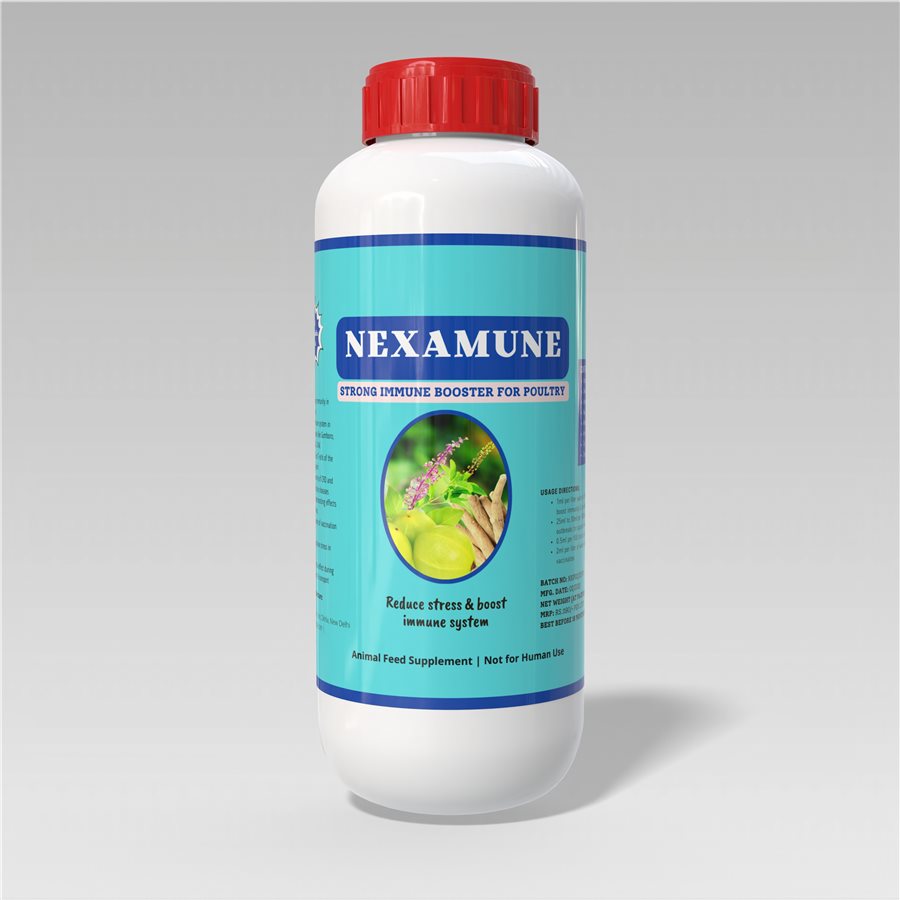
Nexamune
Vitamin E, selenium, amla, tulsi and ashwagandha extracts, vitamin C, vitamin D and niacin: an antioxidant immunity support. Supports the immune system during IB, ND, Gumboro, IBH and LPAI challenges, reduces the severity of CRD and other respiratory problems, and helps reduce the chance of vaccination failure.
Dose: 1 ml per litre of water or 15 ml per 100 birds for immunity and stress; 25–30 ml per 100 birds in viral outbreaks; 2 ml per litre before and after vaccination.
1 L ₹644MRP ₹1,190
Further reading: Swayne DE (ed.), Diseases of Poultry, 14th ed., chapters on infectious bursal disease, chicken infectious anaemia and mycotoxicoses; Schat KA, Kaspers B, Kaiser P (eds.), Avian Immunology, 2nd ed.
More from the corner: Vets Technical Corner home · winter broiler medicine schedule · CFCR calculator