
🐃 Beyond Conventional Minerals: Why Buffaloes Need a Rumen‑First Mineral System
Buffalo farming in India is a massive industry. With over 109 million buffaloes, India has the largest buffalo population in the world. Yet, most farmers treat buffaloes exactly like cows—same feed, same mineral mixture, same management. And then they wonder why results are not the same.
The truth is simple and often overlooked: A buffalo is not a small cow. Its digestive system is fundamentally different, and failing to understand this difference is the single biggest reason why peak milk drops early, body condition deteriorates, and fertility fails.
This comprehensive guide explains the unique biology of the buffalo rumen, the hidden crisis of mineral deficiency in India, why generic mineral mixtures fail, and a better solution—BMS (Buffalo Mineral System)——is buffalo mineral mixture designed specifically for the buffalo’s slow, efficient, but sensitive digestive system.
भैंस गाय नहीं है उससे कुछ अलग होती है। भैंस का रुमेन (पेट का पहला भाग) गाय से थोड़ा अलग काम करता है। रिसर्च बताती है कि भैंस के रुमेन में फाइबर तोड़ने वाले बैक्टीरिया गाय से ज़्यादा होते हैं, लेकिन यही ताकत उसे कंसन्ट्रेट दाना खाने के लिए संवेदनशील बना देती है। दूध जल्दी गिरता है, फैट कम आता है, भैंस दुबली हो जाती है। बाजार के ज़्यादातर मिनरल मिक्सचर सिर्फ शरीर की ज़रूरतें देखते हैं——रुमेन की स्थिति को नज़रअंदाज़ कर देते हैं। BMS (Buffalo Mineral System) कांसेप्ट पहले रुमेन को स्थिर करता है——सही पीएच, सही माइक्रोब्स, सही किण्वन (फर्मेंटेशन)। फिर मिनरल काम करता है। याद रखिए: जब रुमेन सही काम करेगा तब ही भैंस स्वस्थ रहेगी।
1: The Buffalo Rumen – Nature’s Deep Fermenter
The rumen is the first and largest compartment of a ruminant’s stomach. In buffaloes, this organ is built differently—and far more efficiently—than in cattle.
1.1 Larger Rumen, Longer Retention
The buffalo rumen is larger relative to body size, and its intestine is shorter than a cow’s. This anatomical difference leads to a longer ruminal transit time meaning feed stays inside the buffalo’s rumen much longer than in a cow’s. This longer retention allows microbes more time to break down tough plant fibres, resulting in better absorption of volatile fatty acids and maximized production of metabolizable protein.
1.2 Rumen Papillae: The Absorption Surface
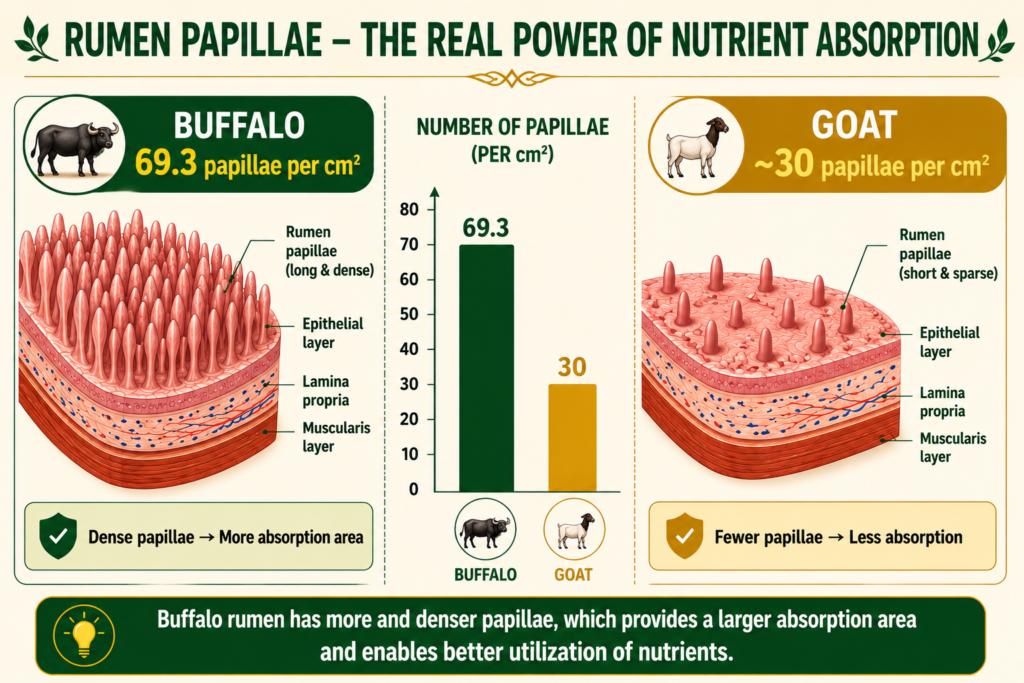
The inner surface of the rumen is covered with tiny, finger‑like projections called papillae. These papillae absorb volatile fatty acids (the end products of fermentation) into the bloodstream. More papillae means greater absorption surface area.
Research comparing wild and domestic ruminants found that the density of ruminal papillae is highest in buffalo (69.3 ± 1.79 per cm²), followed by blackbuck and deer, while being significantly lower in goats (29.9 ± 1.77). This means a buffalo’s rumen wall is far better equipped to absorb nutrients than many other ruminants——including cattle.
1.3 The Microbial Advantage: More Bacteria, More Fungi
The rumen is not a chemical digester; it is a living fermentation vat populated by billions of bacteria, protozoa, and fungi. Here, buffaloes have a clear, measurable advantage.
Studies comparing swamp buffalo and cattle fed on rice straw found that the nutrient digestibilities of DM, OM, CP, NDF and ADF were found higher in buffalo than in cattle. The digestibility of feed in buffaloes is 2–5% higher than in cattle, particularly when the feed supply is of low quantity or quality. It means on 20Kg dry matter intake buffalo yields results of 21kg dry matter in cows.
Using real‑time PCR techniques for the quantification of cellulolytic bacterial numbers, the research revealed that the population of Ruminococcus albus (a key fibre‑digesting bacterium) in the digesta of swamp buffalo was significantly higher than in cattle.
The proportion of Bacteroidetes (a major bacterial phylum involved in fibre degradation) increased in buffalo during the sampling period, whereas it remained constant in cattle. Additionally, a higher level of ruminal ammonia nitrogen was observed in buffalo (12.1 mg%) than in cattle (9.8 mg%), suggesting a larger increase in deaminase activities and/or a slower outflow rate of the rumen fluid in buffaloes.
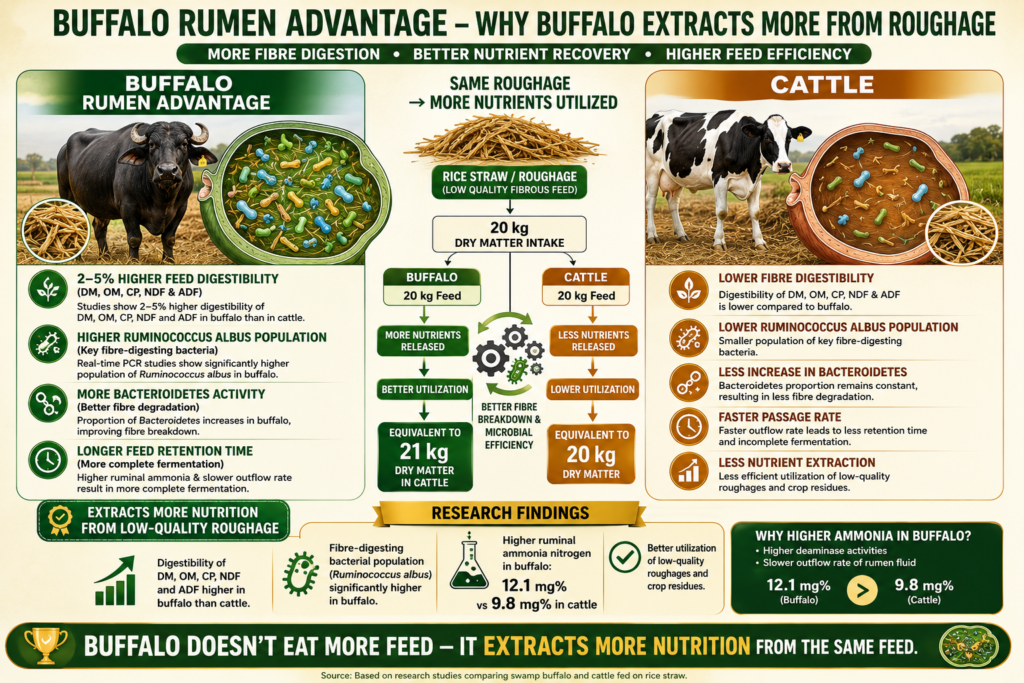
In terms of practical feed degradation, one study reported that the dry matter (DM) loss of rice straw for buffaloes was 53.6 ± 0.8%, while for cattle it was only 48.7 ± 2.6% after 48 hours of rumen incubation (p < 0.01). This confirms that buffaloes extract significantly more nutrition from low‑quality roughage than cattle.
Key difference: Buffaloes have more fibre‑digesting microbes, longer retention time, and greater absorption surface area——all of which make them deep fermenters, not just slow fermenters.
2: The Strength That Creates a Sensitivity
Every biological advantage comes with a trade‑off. The buffalo’s ability to hold feed longer and extract more from it also makes it highly sensitive to dietary changes.
When a farmer increases concentrate (dalia, grain, khal) to boost milk production, the rumen’s natural rhythm would get disrupted. The fibre‑digesting bacteria decline, fermentation becomes erratic, and the animal suffers. Research shows that diurnal ruminal pH and NH₃–N concentrations of buffalo are different from those in cattle, and the protozoal population is lower (p < 0.05).
This sensitivity manifests in visible signs that every buffalo farmer recognizes:
- Peak milk production drops earlier than expected
- Milk fat percentage declines
- Body condition deteriorates despite adequate feeding
- Poor expression of heat and fertility problems
This explains why thousands of Indian buffalo farmers experience variable and disappointing results from generic mineral mixtures—not because the minerals are bad, but because the rumen was not ready to absorb them.
3: The Hidden Crisis – Widespread Mineral Deficiency in Indian Buffaloes
Even before considering rumen health, a silent crisis exists: mineral deficiency is rampant across India’s buffalo population.
A comprehensive survey conducted in parts of northern India found alarming levels of macro‑mineral deficiency in buffaloes:
The same study noted that soil and fodder deficiencies of these minerals were also highly prevalent, with Mg deficiency in fodder at 19.72% and Ca deficiency in fodder at 13.88%. Even more concerning, the prevalence of micro‑mineral deficiencies is even higher: in central Uttar Pradesh, Cu deficiency was observed in 41.54%, Zn deficiency in 33.49%, and Co deficiency in 48.13% of buffaloes.
These figures represent tens of millions of buffaloes that are already mineral‑deficient before any feeding management issues are considered. Adding a generic mineral mixture to an unstable rumen is like pouring water into a leaky bucket——most of it never reaches the bloodstream.
Therapeutic supplementation studies have shown that providing a targeted mineral mixture can increase body weight, milk yield, haemoglobin concentration, and total erythrocyte count, while decreasing heart rate and respiratory rate. But crucially, these benefits were observed only when the mineral mixture was properly formulated and the rumen was in a condition to absorb it.
4: Why Most Mineral Mixtures Fail Buffaloes
The market is flooded with mineral mixtures that claim to support milk production, fat percentage, and animal health. But nearly all of them share the same flaw: they are designed for metabolic requirements alone.
These products ask one question: “What minerals does the animal need?” They supply calcium, phosphorus, zinc, copper—and stop there. They never ask: “Is the rumen in a condition to absorb these minerals?”
This is the critical oversight. The rumen is the gatekeeper of all nutrients. If the rumen environment is unstable——pH imbalanced, fibre‑digesting microbes suppressed, fermentation pattern deranged——then even the most expensive mineral supplement will pass through largely unabsorbed.
Area‑specific mineral mixtures (ASMM) developed by ICAR‑NIANP have shown promising results: 70% of animals with anoestrus started cycling within 40 days of supplementation, and 65% of cattle with reproductive problems became pregnant within 70 days. The cost‑benefit ratio of such supplementation is 1:8. However, even these well‑designed products primarily focus on the mineral composition of the feed and soil, not on the rumen’s functional state.
This explains the farmer’s common frustration: “I give minerals, but I don’t see the result.” The problem is often not the mineral——the problem is the rumen’s readiness to accept it.
Key Insight: Minerals Require Rumen Stability
| Mineral Function | Requires Rumen Stability Because… |
|---|---|
| Phosphorus absorption | Depends on rumen microbial phytase activity |
| Magnesium absorption | Requires proper rumen pH (low pH reduces Mg absorption) |
| Trace mineral utilization | Relies on healthy microbial population for chelation |
| Calcium metabolism | Influenced by rumen VFA profile and DCAD balance |
5: The Evidence – What Works in Buffalo Rumen Support
Decades of research have established what actually improves rumen function and nutrient utilization in buffaloes.
5.1 Exogenous Fibrolytic Enzymes
Supplementation with fibrolytic enzymes has been shown to significantly improve milk production and nutrient digestibility. One study on Murrah buffaloes fed a TMR containing 45% wheat straw, 15% green maize, and 40% concentrate found that adding a fibrolytic enzyme mixture at 1.5 g/kg DM increased:
- Total digestible nutrients intake by 12.53%
- Average daily milk yield by 12.99%
- 4% fat‑corrected milk (FCM) yield by 15.17%
In buffalo calves, the same enzyme mixture at 1.5 g/kg DM resulted in:
- Average daily gain of 800.79 g/d, compared to 693.33 g/d in the control group
- Higher digestibility coefficients for NDF, cellulose, and hemicellulose
5.2 Probiotics
Probiotics has positive effects on digestibility, nitrogen balance, ruminal pH, and ruminal NH₃–N concentration in buffalo bulls. A 2023 study on buffalo calves reported that dietary addition of probiotics (2 g/calve/day) and its combination with mannan‑oligosaccharide significantly improved:
- Average daily gain and feed conversion ratio (FCR)
- Rumen histology indices (rumen mucosal epithelium)
- Muscle morphometric features (muscle fibre and fascicle diameter)
The combined supplementation of MOS and yeast resulted in an increased number of short‑chain fatty acids in the rumen as well as improved ruminal pH (p < 0.05).
5.3 Rumen Stabilizers: Electrolytes and Buffers
The buffalo’s sensitivity to sudden dietary changes can be managed by maintaining proper electrolyte balance and rumen buffering capacity. Research on yeast‑fermented citrus pulp as a protein source in Nili‑Ravi buffalo bulls concluded that it can be used in concentrate diets up to 12% and has the potential as an alternative protein source.
The clear evidence from these studies is that supporting the rumen environment first——with enzymes, yeast, and stabilizers——leads to measurable improvements in digestibility, growth, and milk production.
6: Introducing BMS – Buffalo Mineral System
BMS (Buffalo Mineral System) is not just another mineral mixture. It is a rumen‑first mineral system designed specifically for buffalo biology.
Unlike generic products that focus solely on metabolic requirements, BMS:
- Stabilizes the rumen first——using live yeast, fibrolytic enzymes, and electrolytes to support fibre‑digesting microbes
- Supplies essential trace minerals (zinc, copper, manganese, selenium, iodine) in bioavailable forms
- Provides buffering support to prevent pH crashes when concentrate is increased
- Works synergistically with the buffalo’s natural deep fermentation system——not against it
BMS recognizes a fundamental principle: rumen stability comes first, mineral absorption follows, and production happens naturally.
Two Variants for Different Needs
| Variant | Daily Dose | Best For | Key Components |
|---|---|---|---|
| BMS Diamond | 40–50 g/day | Normal production, maintenance, dry period | Probiotics + fibrolytic enzymes + toxin binder + rumen conditioners + Osmoprotectants |
| BMS Gold | 70–80 g/day | High‑yielding (>15 L/day), stress periods, poor roughage | Trace minerals + electrolytes + basic rumen support |
Both variants are designed for low daily feeding rates (40–80 g per adult buffalo), making them easy to adopt and cost‑effective for long‑term use. The technology of area‑specific mineral mixtures has already demonstrated that 40–50 g per day is sufficient to correct mineral deficiencies and improve reproductive outcomes.
7: How to Use BMS for Best Results
Dosage Guidelines
| Animal Class | BMS Diamond | BMS Gold |
|---|---|---|
| Adult buffalo (maintenance/dry) | 30 g/day | – |
| Lactating buffalo (10-18 kg milk/day) | 50 g/day | – |
| Lactating buffalo (5-9 kg milk/day) | – | 80 g/day |
| Lactating buffalo (poor roughage quality) | 50g/day | 80 g/day |
| Heifers (6–24 months) | 10–15 g/day | – |
| Calves (3–6 months) | 5–10 g/day | – |
Key Usage Tips
- Mix BMS thoroughly into the concentrate portion of the ration or into the TMR.
- Do not feed dry. Always mix with moist feed to reduce dust and improve palatability.
- Be consistent. The benefits of rumen stabilization accumulate over time. Irregular feeding reduces effectiveness.
- During transition periods (3 weeks before and after calving), ensure BMS supplementation is continuous to prevent metabolic disorders.
- In summer months, when buffaloes are under heat stress, electrolyte support becomes even more critical. BMS Gold is recommended during this period.
Expected Response Timeline
| Timeframe | Expected Observations |
|---|---|
| First 7–10 days | Improved appetite, more consistent eating behaviour |
| 2–4 weeks | Firmer manure (better fiber digestion), improved hair coat |
| 4–6 weeks | Stable milk yield, maintenance of body condition |
| 6–8 weeks | Improved milk fat percentage and SNF, better heat expression |
Important Precautions
- Store in a cool, dry place away from direct sunlight.
- Keep the container tightly closed after each use.
- If BMS Gold contains rumenecin (monensin), do not feed to equines, calves under 3 months of age, or during the last 3 weeks of the dry period unless prescribed by a veterinarian.
- Do not exceed the recommended daily dose.
8: The BMS Promise
The BMS philosophy is simple, evidence‑based, and built on decades of ruminant nutrition research:
- Stabilize the rumen environment——correct pH, support fibre‑digesting microbes, maintain electrolyte balance
- Supply essential minerals——targeted, bioavailable, and matched to the specific deficiencies of your area
- Let the animal’s biology do the rest——when the rumen is stable, feed is digested better, minerals are absorbed efficiently, and production rises naturally
Jitna zyada bhusa aur fibrous chara, utni zyada BMS ki zaroorat. The poorer the roughage quality, the more your buffalo needs a rumen‑first mineral system.
भैंस गाय नहीं है। यह बात समझना सबसे ज़रूरी है। भैंस का रुमेन (पेट का पहला भाग) गाय से थोड़ा अलग काम करता है।
1. भैंस का पेट कैसे काम करता है?
भैंस और गाय दोनों का पेट चार हिस्सों में बँटा होता है। पहला हिस्सा सबसे बड़ा होता है – उसे रूमेन कहते हैं। रूमेन असल में एक बहुत बड़ा फर्मेंटेशन टैंक है, जहाँ छोटे-छोटे जीवाणु (बैक्टीरिया) और फफूँद (फंगस) चारे को तोड़ते हैं और ऊर्जा बनाते हैं।
भैंस का रूमेन गाय के रूमेन से बिल्कुल अलग होता है।
- रूमेन बड़ा होता है: भैंस के पेट का पहला भाग (रूमेन) गाय के मुकाबले बड़ा होता है।
- पाचन की सतह घनी होती है: रूमेन की दीवार पर छोटी-छोटी उँगलियाँ होती हैं, जिन्हें पैपिली कहते हैं। ये पैपिली जितनी घनी होंगी, पोषण सोखने की शक्ति उतनी ही बेहतर होगी। रिसर्च बताती है कि भैंस में पैपिली की संख्या 69.3 प्रति वर्ग सेंटीमीटर होती है, जबकि अन्य जानवरों (जैसे बकरी) में यह केवल 30 के आसपास होती है और गाये में भी कम होती हैं। मतलब भैंस का पेट ज्यादा पोषण सोखने के लिए बना है।
2. भैंस के रूमेन में अधिक और बेहतर सूक्ष्म जीव
अब सबसे दिलचस्प बात।
भैंस के रूमेन में फाइबर तोड़ने वाले जीवाणु (सेल्युलोलाइटिक बैक्टीरिया) गाय के मुकाबले लगभग तीन गुना अधिक होते हैं। ये जीवाणु भूसे, पराली, सूखे चारे में मौजूद सख्त रेशे (सेल्युलोज, हेमीसेल्युलोज) को तोड़ते हैं।
एक अध्ययन में देखा गया कि भैंस ने 48 घंटे में धान के भूसे का 53.6% सूखा पदार्थ पचा लिया, जबकि गाय सिर्फ 48.7% पचा पाई। यानी भैंस उसी चारे से 5-8% अधिक पोषण निकाल लेती है।
वैज्ञानिकों ने पाया कि भैंस के रूमेन में Ruminococcus albus (एक खास फाइबर तोड़ने वाला बैक्टीरिया) की संख्या गाय से कहीं ज़्यादा होती है। इसके अलावा भैंस के रूमेन में फंगस (कवक) की सक्रियता भी गाय से दोगुनी होती है।
तो यह है भैंस की असली ताकत – उसका गहरा, धीमा और अत्यधिक कुशल फर्मेंटेशन सिस्टम। इसे वैज्ञानिक भाषा में “डीप फर्मेंटर” कहते हैं।
3. हर ताकत के साथ एक नाजुकता भी आती है
लेकिन प्रकृति का नियम है – हर ताकत के साथ एक कमज़ोरी भी जुड़ी होती है।
भैंस का रूमेन जब धीरे-धीरे और गहराई से काम करता है, तब सब ठीक रहता है। लेकिन जैसे ही हम दूध ज्यादा निकालने के चक्कर में अचानक दाना, दलिया, खल, गेहूँ, मक्की बढ़ा देते हैं, तो रूमेन का संतुलन बिगड़ने लगता है।
क्योंकि भैंस का रूमेन तेजी से पचने वाले चारे (कंसंट्रेट) के लिए नहीं बना है। दाना ज्यादा देने से:
- रूमेन में एसिड बढ़ जाता है (पीएच गिर जाता है)।
- फाइबर तोड़ने वाले जीवाणु मरने लगते हैं।
- फर्मेंटेशन तेज तो होती है, लेकिन असंतुलित हो जाती है।
- एसीटेट (जो दूध का फैट बनाता है) कम बनता है, प्रोपियोनेट ज्यादा बनता है।
परिणाम क्या होता है, भाई साहब?
वही जो आप अक्सर देखते हो – भैंस का दूध पीक पर पहुँचने के बाद जल्दी गिर जाता है। फैट उतना नहीं आता जितना आना चाहिए। भैंस दुबली हो जाती है। गर्मी में दूध और गिर जाता है और प्रजनन (गर्मी में न आना, बार-बार गर्मी छूटना) में दिक्कतें आने लगती हैं।
4. देश भर में खनिज की कमी – एक बड़ा संकट
अब एक और मुश्किल।
हमारे देश में भैंसों में खनिज (मिनरल) की भारी कमी है। उत्तर भारत में कराए गए एक सर्वे में पाया गया:
- 25.48% भैंसों में कैल्शियम की कमी
- 24.66% भैंसों में फास्फोरस की कमी
- 24.36% भैंसों में मैग्नीशियम की कमी
इससे भी ज्यादा चिंता की बात यह है कि 41.54% भैंसों में ताँबा (कॉपर) और 33.49% में जिंक की कमी पाई गई है।
यानी लाखों करोड़ों भैंसें पहले से ही कमज़ोर हैं।
5. बाजार के मिनरल मिक्सचर क्यों नाकाम रहते हैं?
भाई साहब, बाजार में ढेरों मिनरल मिक्सचर बिकते हैं। वे सब बताते हैं कि इसमें कितना कैल्शियम है, कितना फास्फोरस, कितना जिंक, कितना ताँबा। लेकिन उनमें से कोई भी एक सवाल नहीं पूछता:
“जब भैंस का रूमेन ही ठीक से काम नहीं कर रहा, तो ये मिनरल खून में कैसे जाएँगे?”
यह सबसे बड़ी भूल है।
रूमेन एक गेटकीपर (द्वारपाल) की तरह है। जैसे हवाई अड्डे पर कस्टम अफसर बिना जाँचे सामान अंदर नहीं जाने देता, वैसे ही भैंस का रूमेन तब तक किसी पोषक तत्व को खून में नहीं जाने देता जब तक वह खुद स्थिर न हो।
जब रूमेन में पीएच सही न हो, फाइबर तोड़ने वाले जीवाणु कम हों, फर्मेंटेशन असंतुलित हो – तो चाहे आप कितना भी महँगा और अच्छा मिनरल डालो, उसका 50-70% फायदा नहीं मिलता। वह गोबर के साथ बाहर निकल जाता है।
इसलिए अक्सर किसान कहता है – “साहब, मिनरल तो दे रहा हूँ, पर फायदा नहीं दिखता।”
समस्या मिनरल की नहीं, समस्या रूमेन की है।
6. BMS – भैंस रूमेन मिनरल सिस्टम
अब इसी समस्या का हल लेकर आए हैं हम – BMS (Buffalo Mineral System)।
BMS कोई साधारण मिनरल मिक्सचर नहीं है। यह रूमेन-फर्स्ट फॉर्मूला है। यानी यह पहले रूमेन को स्थिर करता है, फिर मिनरल का काम करता है।
BMS में क्या-क्या है?
- लाइव प्रोबिओटिक– जो रूमेन में पीएच संतुलित रखता है और फाइबर तोड़ने वाले जीवाणुओं को बढ़ाता है।
- फाइब्रोलाइटिक एंजाइम – जो भूसे, पराली और सख्त चारे को जल्दी तोड़ने में मदद करते हैं।
- इलेक्ट्रोलाइट्स (पोटैशियम, सोडियम, मैग्नीशियम) – जो रूमेन में पानी का सही संतुलन बनाए रखते हैं।
- बफर (सोडियम बाइकार्बोनेट) – जो दाना ज्यादा देने पर बनने वाले एसिड को न्यूट्रल करता है।
- टॉक्सिन बाइंडर – जो चारे में मौजूद फफूँद और बैक्टीरियल टॉक्सिन को सोख लेता है।
- आवश्यक ट्रेस मिनरल – जिंक, ताँबा, मैंगनीज, सेलेनियम, आयोडीन (चिलेटेड रूप में – जो जल्दी अब्जॉर्ब होते हैं)।
BMS दो वैरिएंट में आता है:
| BMS Gold | BMS Diamond |
|---|---|
| 40-50 ग्राम प्रति दिन | 70-80 ग्राम प्रति दिन |
| सामान्य दूध (9 लीटर से कम), रखरखाव, सूखी अवधि | अधिक दूध (10 लीटर से अधिक), तनाव, गर्मी, खराब चारा |
| बेसिक मिनरल + इलेक्ट्रोलाइट + रूमेन सपोर्ट | एडवांस प्रोबिओटिक + एंजाइम + टॉक्सिन बाइंडर + रुमेन स्टेबलायिज़र] |
7. BMS से क्या फायदा होगा? (रिसर्च के आधार पर)
वैज्ञानिक अध्ययन बताते हैं कि जब रूमेन को सही सपोर्ट मिलता है:
- दूध में 12-15% तक की बढ़ोतरी हो सकती है।
- फैट प्रतिशत में 0.5 से 1.0 यूनिट का सुधार आता है।
- रूमेन पीएच स्थिर रहता है, जिससे गर्मी और दाना बढ़ाने पर भी एसिडोसिस नहीं होता।
- भूसे की पाचनशक्ति (NDF digestibility) बढ़ जाती है, जिससे भैंस को उसी चारे से ज्यादा ऊर्जा मिलती है।
- शरीर की स्थिति (बॉडी कंडीशन) बेहतर रहती है और प्रजनन चक्र सुधरता है।
एक प्रयोग में मुर्राह भैंसों को फाइब्रोलाइटिक एंजाइम देने पर दूध उत्पादन 13% बढ़ गया और फैट-करेक्टेड दूध में 15% से अधिक इजाफा हुआ।
एक अन्य अध्ययन में लाइव यीस्ट देने से भैंस के बछड़ों का औसत दैनिक वजन 693 ग्राम से बढ़कर 800 ग्राम हो गया।
8. कैसे करें BMS का इस्तेमाल?
- BMS Diamond: 40-50 ग्राम प्रति दिन (लगभग 2 चम्मच)।
- BMS Gold: 70-80 ग्राम प्रति दिन (लगभग 3-4 चम्मच)।
इस्तेमाल का तरीका: दाने या साइलेज के साथ अच्छे से मिलाकर दें। सूखा न डालें, थोड़ा गीला कर लें ताकि धूल न उड़े।
शुरू करने का सबसे अच्छा समय: ब्याने से 3 हफ्ते पहले से शुरू करें, और ब्याने के बाद कम से कम 120 दिनों तक लगातार देते रहें।
कितने दिन में असर दिखेगा?
- 7-10 दिन – भूख बढ़ना, गोबर गीला रहना
- 4 हफ्ते – गोबर सख्त (पाचन बेहतर), रौनक आना
- 6-8 हफ्ते – दूध स्थिर, फैट सुधरना
9. क्या सावधानियाँ रखें?
- BMS Gold में रुमेनिसिन (मोनेन्सिन) होता है – यह घोड़ों, 3 महीने से छोटे बछड़ों, और सूखी अवधि के आखिरी 3 हफ्ते में भैंस को न दें।
- ठंडी, सूखी जगह पर रखें। धूप और नमी से बचाएँ।
- डिब्बा खोलकर रखें तो जल्दी इस्तेमाल करें।
10. आखिरी बात
भाई साहब, भैंस की असली ताकत उसका रूमेन है। जब तक रूमेन स्थिर नहीं होगा, चाहे कितना भी अच्छा दाना, चारा, मिनरल दे दो – पूरा फायदा नहीं मिलेगा।
BMS पहले रूमेन को स्थिर करता है।
फिर मिनरल काम करता है।
फिर दूध ठहरता है, फैट बनता है, और भैंस स्वस्थ रहती है।
याद रखें – रूमेन पहले, परफॉर्मेंस हमेशा।
Jitna zyada bhusa aur fibrous chara, utni zyada BMS ki zaroorat.
आज ही BMS अपनाएँ और अपनी भैंसों को दें सही रूमेन सपोर्ट।
किसी भी प्रश्न या फीडिंग सलाह के लिए संपर्क करें।
📚 References & Further Reading
- Van Soest, P.J. (1982). Nutritional Ecology of the Ruminant. Cornell University Press.
- Differences between buffaloes and cows – Vetagro
- Comparison of ruminal fermentation characteristics and microbial population in swamp buffalo and cattle. Livestock Science, 143(2–3), 172–176.
- Abdullah, N. et al. (1992). Microbial colonization and digestion of feed materials in cattle and buffaloes. Asian‑Aust. J. Anim. Sci., 5:329–335.
- Effect of Difference Tropical Fibrous Feeds on Feed Intake and Digestibility in Swamps Buffaloes Compared to Ongole Cattle. Animal Production, 12(2):86–90.
- Prevalence of macro‑minerals deficiency in buffaloes in northern India. Asian‑Australasian Journal of Animal Sciences.
- Sharma, M.C. et al. (2009). Micronutrient status in soil, fodder and serum, haemato biochemical profile in some district of central Uttar Pradesh. Indian Journal of Animal Sciences, 79(10):1083–1086.
- Ullah, A. et al. (2017). Effect of different levels of yeast culture on digestibility, nitrogen balance and ruminal characteristics in buffalo bulls. Buffalo Bulletin, 36:653–660.
- Zeeshan, M. et al. (2023). Efficacy of mannan‑oligosaccharide and live yeast feed additives on performance, rumen morphology, serum biochemical parameters and muscle morphometric characteristics in buffalo calves. arXiv:2308.07456.
- Thakur, S.S. et al. (2010). Effect of exogenous fibrolytic enzymes supplementation on growth and nutrient utilization in Murrah buffalo calves. Indian Journal of Animal Sciences, 80(12):1217–1219.
- Area Specific Mineral Mixture technology. ICAR‑National Institute of Animal Nutrition and Physiology (NIANP).