
Buffalo evolution, domestication and tropical adaptation
River vs swamp buffalo, climatic adaptation, evolutionary feeding ecology, survival under seasonal forage scarcity, why buffalo metabolism evolved differently from modern dairy cows.
Before we can formulate a single diet, we must first understand the animal standing in front of us. The water buffalo is not a poorly performing cow; it is a masterfully adapted biological machine, fine-tuned over millennia for one primary purpose: survival and production in hot, humid, forage-scarce environments. Buffalo evolution and adaptation is an area of prime focus which required little more attention before formualting any feed or developing strategy.
River vs Swamp Buffalo: The Two Divergent Paths
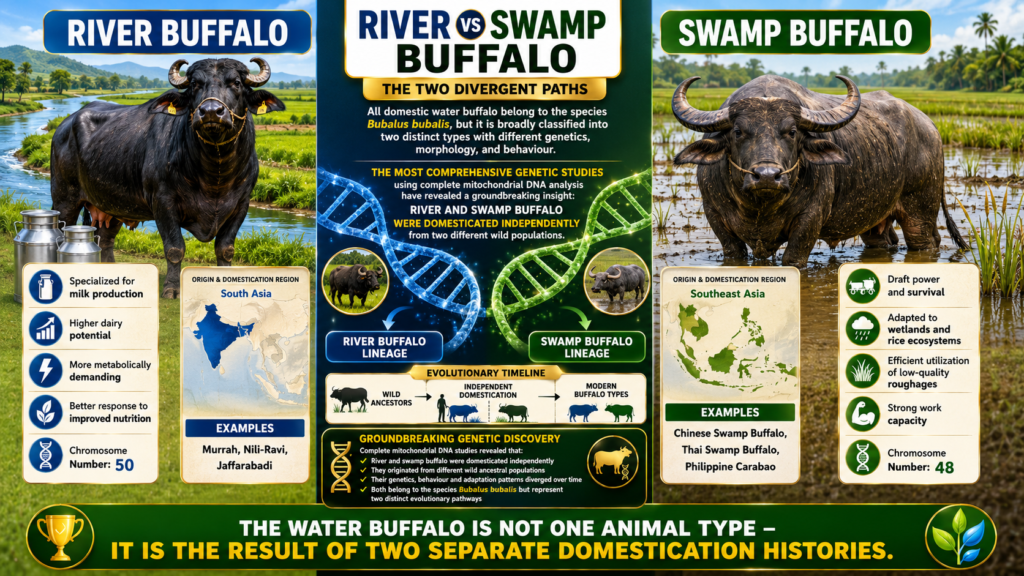
All domestic water buffalo belong to the species Bubalus bubalis, but it is broadly classified into two distinct types with different genetics, morphology, and behaviour: the river buffalo and the swamp buffalo.
The most comprehensive genetic studies using complete mitochondrial DNA analysis have revealed a groundbreaking insight: river and swamp buffalo were domesticated independently from two different wild populations.
The swamp buffalo is believed to have originated in Mainland Southeast Asia, evolving its characteristic wallowing behaviour and adaptability to wet, tropical environments. It is primarily a draft animal, with lower milk production but remarkable resilience. Some research suggests the Philippines native swamp buffalo is highly thermotolerant, able to maintain good semen quality under heat stress. The river buffalo, which includes India’s prized dairy breeds like Murrah, Nili-Ravi, and Surti, is the primary focus of high-production dairy systems.
Origins and Domestication of the River Buffalo
Genetic evidence has pinpointed the likely domestication site of the river buffalo. Analyses of complete mitochondrial genomes suggest that Northwestern India served as the pivotal domestication site for riverine buffaloes, with the present-day breeding tracts of the Mehsana, Surati and Pandharpuri breeds being key areas. This domestication occurred approximately 6,300 years ago.
The domestication of river buffalo was a complex, continuous process. A “remarkable and atypical” pattern of domestication was likely involved: wild buffalo (Bubalus arnee) were repeatedly and continuously introgressed into early domestic stocks across the Indian subcontinent. This intermixing of wild genes likely contributed to the resilience and hardiness we still see in today’s dairy buffalo. The animal quickly became central to the economy of the Indus Valley Civilization. By the third millennium BCE, alongside cattle, buffalo had become the primary domestic animals in the majority of Indus settlements.
Buffalo Metabolism: Why It Evolved Differently from Modern Dairy Cows
The buffalo evolved under a completely different ecological and selective regime than the modern Holstein cow.
- Cow (the Holstein Metabolic Paradigm): Cattle co-evolved with agriculture in temperate climates. Over centuries, and especially in the last 50 years, they have been intensively selected for one trait above all others: maximal nutrient throughput. This has resulted in an animal that:
- Has a very high voluntary dry matter intake (3.5-4.0% of body weight).
- Is adapted to rapidly ferment large quantities of starch and rapidly digestible energy sources.
- Possesses a “flexible” rumen and systemic metabolism, capable of handling significant dietary shifts.
- Buffalo (the Survival Metabolic Paradigm): The buffalo evolved in tropical and subtropical ecosystems characterized by:
- Seasonal Scarcity: Periods of drought and intense heat where high-quality forage was unavailable.
- Poor-Quality Forage: The available feed consisted largely of mature, lignified, fibrous grasses and crop residues.
- High Thermal Load: The constant challenge of dissipating body heat in a hot, humid environment (paradoxically combined with a poor ability to sweat).
To survive and reproduce under these harsh conditions, nature selected for a different metabolic strategy in the buffalo. It is an EFFICIENCY SPECIALIST, not a throughput specialist.
– Superior Fibre Digestion Efficiency: One of the buffalo’s most
to digest low-quality, high-fibre forages. It is well known for its unique utilization of low-quality fibrous feeds and outstanding digestion performance. Numerous comparative studies have reported that buffaloes digest feeds more efficiently than do cattle, particularly when feeds are of poor quality and are high in cellulose. Ichinohe et al. (2004) found that buffaloes had higher Gross Energy (GE) digestibility than cattle. This trait alone changes the entire philosophy of formulation.
– Lower Maintenance Requirement: The tropical adaptation of the buffalo is intimately linked to a significantly lower basal metabolic rate. This is a critical energy-conservation mechanism. Buffaloes generally require less metabolizable protein for maintenance than cattle. This means they can survive and maintain body condition on lower planes of nutrition, a huge advantage in forage-scarce systems.
The Paradox of Buffalo Thermoregulation
Perhaps the most significant evolutionary trade-off is in thermoregulation. The buffalo is paradoxically a tropical animal with low heat tolerance. Their most critical biological vulnerability is their inability to efficiently cool themselves.
A water buffalo has only about 400 sweat glands per cm² of skin, compared to over 2,600 per cm² in cattle. This is a staggering difference of nearly 1/6th the evaporative cooling capacity. This profound evolutionary adaptation forces them to rely on non-evaporative cooling methods such as wallowing and drinking large amounts of water, which serves as a major route of heat loss. The ability to “store” body heat, followed by rapid dissipation in water, is a key survival strategy.
Evolutionary Summary: From Adaptation to Nutrition
The direct and profound consequences of this evolutionary journey for modern buffalo nutrition are manifold.
- Low-Quality Roughage: The animal’s genetic blueprint is to extract maximum nutrition from low-quality fiber. Therefore, formulating diets that capitalize on this ability with high-quality, well-managed silage and hay is key.
- DMI Sensitivity: Because of their slower passage rate and sensitivity to rumen fill, DMI cannot be forced. Diets must be nutrient-dense to meet production goals.
- Heat Stress: The animal’s primary physiological vulnerability is heat stress. Nutrition programs must be designed around this fact, providing adequate electrolytes and adjusting feeding times and energy sources during summer.
- Starch Sensitivity: The buffalo’s metabolism did not evolve around aggressive starch fermentation. Sudden or excessive levels of starch will destabilize the rumen, leading to sub-acute acidosis, low milk fat, and reduced intake.
In essence, the modern dairy buffalo is a product of two intersecting forces: its ancient evolutionary history of efficiency and hardiness, and the modern demand for high milk production. The intelligent nutritionist’s task is not to make the buffalo a cow, but to work with its evolutionary strengths to meet modern production goals sustainably.
For consultation whatsapp 9871584101