
Buffalo Farming in India: Productivity, Milk Economics, Nutrition, and the Future of Scientific Buffalo Management
India’s dairy economy cannot be understood without understanding the role of the buffalo. While modern commercial dairy discussions often revolve around Holstein Friesian cows and high-yield exotic genetics, the reality is that buffaloes remain one of the most economically important livestock species in the Indian subcontinent. Buffaloes are not merely “milk animals”; they are biological systems uniquely adapted to Indian climatic, nutritional, and market conditions.
India currently holds nearly 57% of the global buffalo population, and buffaloes contribute approximately 43–45% of total milk production in the country. Recent estimates suggest annual buffalo milk production in India has crossed 104–110 million metric tons, making buffalo milk one of the largest contributors to the national dairy economy. Buffalo milk continues to dominate many regional milk markets because of its higher fat, SNF, processing quality, and superior suitability for traditional dairy products.
Why Buffaloes Remain Economically Important in India
Buffalo farming in India is highly integrated in agricultural system and provide huge economic support to rural India. The Indian dairy system differs fundamentally from many western intensive dairy systems. In several regions:
- green fodder availability fluctuates,
- heat stress is severe,
- feeding precision is inconsistent,
- and milk pricing is often based heavily on fat percentage.
Under such conditions, buffaloes maintain major economic advantages:
- higher milk fat,
- better adaptation to harsh environments,
- superior feed conversion under roughage-based systems,
- and stronger suitability for traditional value-added dairy products.
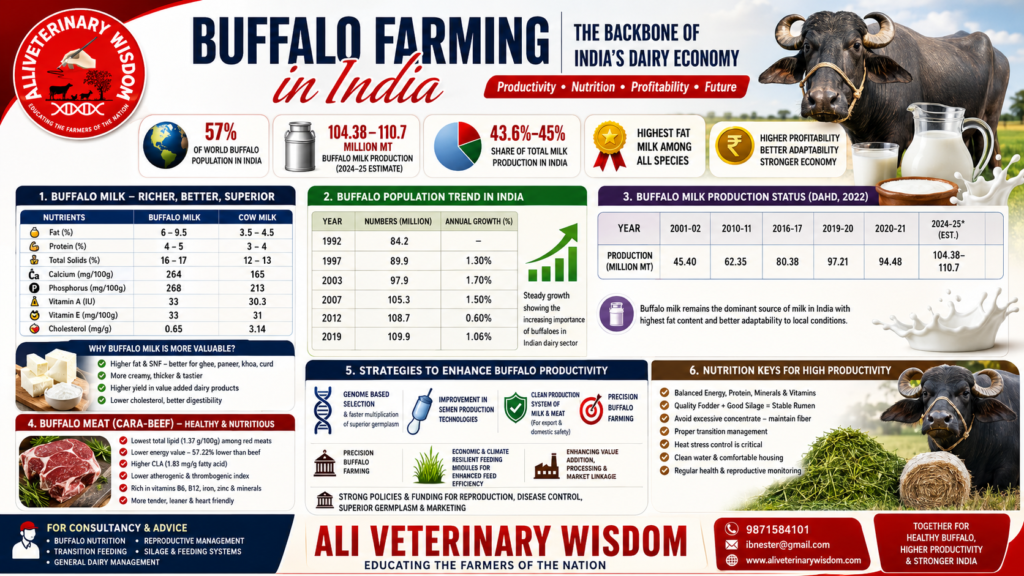
Buffalo milk contains significantly higher total solids compared to cow milk. Typical buffalo milk may contain:
| Parameter | Buffalo Milk | Cow Milk |
|---|---|---|
| Fat (%) | 6–9.5 | 3.5–4.5 |
| Protein (%) | 4–5 | 3–4 |
| Total Solids (%) | 16–17 | 12–13 |
| Calcium | Higher | Moderate |
| Cholesterol | Lower | Higher |
This higher solids content directly improves:
- paneer recovery,
- khoa yield,
- curd quality,
- ghee production,
- and overall processing profitability.
“India me buffalo sirf doodh dene wala pashu nahi hai — ye ek economic animal hai jo high fat milk, better total solids aur Indian conditions me adaptability ki wajah se dairy industry ka backbone bana hua hai.”
Buffalo Productivity in India: Current Scenario
Over the past decade, buffalo productivity has improved steadily due to:
- artificial insemination programs,
- genetic selection,
- improved feeding,
- better disease control,
- and scientific dairy management.
Average buffalo milk productivity in India has increased from approximately 4.7 kg/day to more than 5.5 kg/day over the last decade. However, this average still remains far below the true genetic potential of elite Murrah and high-performing buffaloes.
The biggest limitation is often not genetics itself.
The real bottleneck is:
- nutrition,
- reproductive inefficiency,
- poor transition management,
- delayed breeding,
- and low-quality feeding systems.
Understanding Buffalo Physiology: Why Buffaloes Behave Differently from Cows
One of the biggest scientific mistakes in dairy farming is treating buffaloes exactly like cows.
Buffaloes differ physiologically in several important ways:
- lower heat dissipation capacity,
- greater susceptibility to heat stress,
- slower metabolic rate,
- different reproductive behavior,
- stronger roughage utilization ability,
- and altered endocrine responsiveness.
This means buffalo feeding and management must be specifically adapted.
For example, buffaloes often:
- express silent heat,
- show weaker estrus signs,
- have longer postpartum anestrus,
- and are highly sensitive to environmental stress.
“Buffalo ko sirf ‘black cow’ samajhna scientific galti hai. Unka metabolism, heat tolerance aur reproductive behaviour cows se kaafi alag hota hai.”
Buffalo Nutrition: The Real Driver of Productivity
Modern buffalo production is fundamentally a question of nutrient partitioning.
A lactating buffalo must continuously allocate nutrients toward:
- maintenance,
- milk synthesis,
- reproduction,
- immune function,
- thermoregulation,
- and tissue repair.
When nutrition becomes imbalanced, the body prioritizes survival and milk production first, while lower-priority systems begin to fail.
This is why farms commonly observe:
- repeat breeding,
- low conception,
- mastitis,
- metabolic stress,
- poor body condition,
- and fertility collapse.
These are often not “diseases” alone.
They are expressions of:
metabolic imbalance and poor physiological adaptation.
Importance of Energy Density in Buffalo Feeding
High-producing buffaloes require significantly higher:
- energy density,
- metabolizable protein,
- digestible fiber,
- and rumen stability.
A major issue in Indian systems is excessive dependence on:
- dry straw,
- low digestibility roughages,
- and concentrate-heavy correction feeding.
This creates:
- unstable rumen fermentation,
- low microbial protein synthesis,
- acidosis risk,
- poor intake consistency,
- and metabolic inefficiency.
Proper buffalo nutrition therefore depends heavily on:
- digestible forage,
- stable silage,
- balanced minerals,
- adequate effective fiber,
- and rumen-friendly feeding systems.
Silage and Modern Buffalo Farming
Silage is becoming increasingly important in scientific buffalo farming because it helps stabilize:
- dry matter intake,
- fermentable energy supply,
- rumen microbial ecology,
- and milk consistency.
Good corn silage should ideally maintain:
- proper dry matter,
- stable fermentation,
- digestible starch,
- and good fiber digestibility.
Poor silage quality directly affects:
- milk yield,
- milk fat,
- fertility,
- and immune stability.
This effect becomes much more severe in high-producing animals.
“High yielding buffaloes ko sirf zyada dana nahi chahiye hota — unhe stable rumen fermentation aur consistent energy supply chahiye hoti hai. Poor silage unke metabolism par direct pressure daalta hai.”
Buffalo Reproduction: The Most Ignored Economic Factor
Many buffalo farms focus only on milk production while ignoring reproductive efficiency.
However, economically:
reproduction determines lifetime profitability.
Every extra day open increases:
- maintenance cost,
- feeding cost,
- and reduces lifetime milk efficiency.
Common reproductive problems include:
- silent heat,
- anestrus,
- delayed puberty,
- repeat breeding,
- low conception rates.
These are often linked to:
- energy deficiency,
- mineral imbalance,
- heat stress,
- poor transition management,
- and metabolic overload.
Hormonal treatment alone cannot solve these issues permanently if nutrition and body condition remain unstable.
Heat Stress: A Major Productivity Limitation
Buffaloes possess:
- darker skin,
- fewer sweat glands,
- and lower heat dissipation efficiency.
As environmental temperature rises:
- feed intake declines,
- fertility drops,
- rumination decreases,
- milk production falls,
- and immune stress increases.
This is why cooling systems are extremely important in scientific buffalo dairies.
Effective strategies include:
- wallowing,
- sprinklers,
- fans,
- shade management,
- and feeding during cooler periods.
Future of Buffalo Farming in India
The future of profitable buffalo farming will increasingly depend on:
- precision nutrition,
- reproductive management,
- genomic selection,
- scientific silage systems,
- and farm-level data monitoring.
The industry is gradually shifting from:
traditional feeding → precision metabolic management.
Future buffalo farms will require:
- forage analysis,
- balanced TMR systems,
- reproductive synchronization,
- transition cow management,
- and metabolic disease prevention strategies.
“Future dairy farming me sirf pashu rakhna kaafi nahi hoga. Data-based feeding, reproduction monitoring aur precision nutrition hi profitable buffalo farming ka base banega.”
Why Scientific Farm Auditing Matters
Most dairy farms lose profitability not because of a single major disease, but because of multiple hidden inefficiencies:
- low rumen efficiency,
- poor forage quality,
- subclinical acidosis,
- transition failures,
- delayed conception,
- mineral imbalance,
- inconsistent feeding practices.
Scientific farm auditing helps identify:
- metabolic bottlenecks,
- nutritional weaknesses,
- forage limitations,
- and management inefficiencies.
This is where precision consultancy becomes critical.
Final Conclusion
Buffaloes remain one of the most economically important livestock species for India due to their:
- superior milk solids,
- adaptability,
- roughage utilization,
- and processing advantages.
However, modern buffalo productivity cannot improve sustainably through genetics alone.
The real future lies in:
- scientific nutrition,
- metabolic stability,
- reproductive efficiency,
- forage quality,
- and precision management systems.
High production becomes sustainable only when physiology, nutrition, environment, and management remain aligned.
Courtesy
Dr Ibne Ali (MVSc, IVRI)
📞 9871584101
📧 ibnester@gmail.com
For consultancy and advice related to:
- buffalo nutrition,
- reproductive management,
- transition feeding,
- silage systems,
- and general dairy management,
you can contact us.