
Wheat in Poultry Feed: Nutritional Value, Challenges, and Practical Guidelines
Introduction
With the continuous rise in maize prices, poultry nutritionists and feed manufacturers are increasingly exploring alternative cereal grains. Wheat, being one of the most widely cultivated cereals in India and globally, has emerged as a potential replacement for maize in poultry diets. However, despite its availability and cost advantage, wheat inclusion in poultry feed requires careful nutritional and technical consideration.
This article provides a science-based and field-oriented evaluation of wheat as a poultry feed ingredient, covering its nutrient profile, limitations, digestive challenges, and best practices for safe and effective inclusion—particularly in broiler diets. The objective is to guide farmers, feed formulators, and nutrition professionals toward economically viable yet biologically safe feed decisions.
Wheat Production and Availability in India
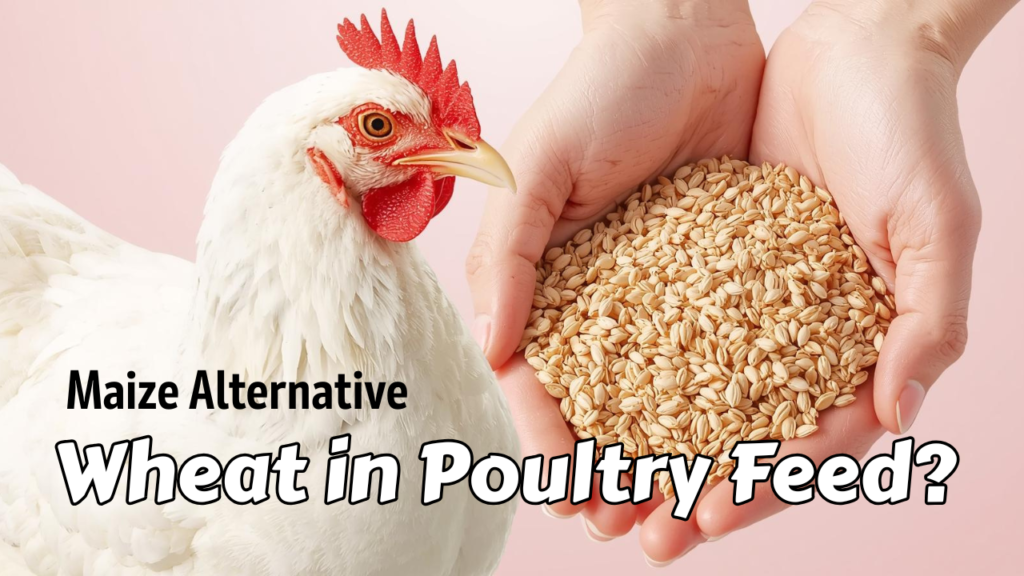
Wheat is a major rabi season cereal crop, predominantly grown during winter. India produced approximately 117.5 million tonnes of wheat in 2024–25, the highest ever recorded for the country.
To support farmers, the Government of India increased the Minimum Support Price (MSP) of wheat to ₹2,275 per quintal, and through the Food Corporation of India (FCI), wheat is distributed at subsidized rates under the National Food Security Act, covering more than 80 crore people.
Due to this massive production base and assured procurement, wheat often remains more price-stable and abundant compared to maize—especially during periods of market volatility.
Why Wheat Is Considered as a Maize Alternative
Maize is the standard cereal in poultry feed because of its:
- High metabolizable energy
- Stable nutrient profile
- Low non-starch polysaccharide content
However, when maize prices increase sharply (₹2,700 per quintal or higher), the economic pressure forces nutritionists to evaluate alternatives such as wheat, sorghum, bajra, and barley. Among these, wheat has a distinct advantage due to:
- Large-scale availability
- Established global research (especially European poultry systems)
- Competitive pricing during maize shortages
In several European countries, wheat-based poultry diets are routinely used, providing a strong scientific foundation for its use.
Nutritional Characteristics of Wheat
Compared to maize, wheat shows greater variability in nutrient composition.
- Maize (average):
- Crude Protein ≈ 9%
- ME ≈ 3300 kcal/kg
- Wheat (average, variable):
- Crude Protein: highly variable (can differ by >100%)
- ME: generally high but less consistent
👉 Because of this variability, extra caution is required when wheat inclusion exceeds 30% of the total feed.
Key Technical Challenges of Using Wheat in Poultry Feed
1. Non-Starch Polysaccharides (NSPs)
Wheat contains a specific group of NSPs known as pentosans, composed mainly of arabinans and xylans.
Key issues:
- Pentosans can absorb up to 10 times their weight in water
- Average wheat contains ≈ 5% NSP
- At 30% wheat inclusion, intestinal water retention may reach 15%
Consequences:
- Increased gut viscosity
- Reduced nutrient digestibility
- Wet litter and poor litter quality
- Higher risk of intestinal disorders
Although NSP-degrading enzymes (xylanases, pentosanases) are available, their efficacy varies widely. Selecting an enzyme based on validated trial data is essential.
2. Highly Variable Nutrient Profile
Wheat protein content depends on:
- Variety (hard vs soft wheat)
- Gluten concentration
- Agronomic practices
- Growing environment
In practice, actual protein values may differ drastically from textbook values. Therefore:
- Batch-wise nutrient analysis is strongly recommended
- Segregation into high-protein and low-protein wheat batches improves formulation accuracy
Ignoring this variability can lead to:
- Amino acid imbalance
- Suboptimal growth or egg production
- Increased feed cost without performance gain

3. Biotin Deficiency Risk
Wheat contains almost no bioavailable biotin, whereas maize has approximately 75% bioavailable biotin.
Biotin plays a critical role in:
- Energy metabolism
- Protein synthesis
- Fat metabolism
- Carbohydrate interconversion
Biotin-dependent reactions include:
- Carboxylation of pyruvate to oxaloacetate
- Conversion of malic acid to pyruvate
- Propionate and succinate metabolism
- Alpha-ketoglutarate formation
Biotin deficiency leads to:
- Leg disorders (perosis, partial paralysis)
- Poor footpad health
- Reduced lesion healing, especially under wet litter conditions
Practical recommendation:
- Maize-based diets: ~0.1 g biotin/ton
- Wheat-based diets: ≈ 0.3 g biotin/ton
4. Sticky Nature of Wheat Gluten
Wheat gluten is pasty and adhesive, leading to:
- Reduced feed flowability
- Mixing inefficiencies
- Equipment handling issues
Additionally:
- Fine grinding of wheat increases risk of beak impaction in broilers
- Coarse grinding or partial inclusion of whole wheat improves gut health
👉 Whole or coarsely ground wheat supports better gizzard development and digestion.
5. Mycotoxin Profile Differences
Wheat and maize differ significantly in:
- Mold ecology
- Mycotoxin spectrum
- Risk profile
Codex Alimentarius has established limits for DON (deoxynivalenol) and OTA (ochratoxin A) in wheat-based products.
Therefore:
- Do not blindly use maize-oriented toxin binders
- Binder selection should match the specific mycotoxin spectrum of wheat
- Regular screening is essential when sourcing wheat from new suppliers
6. Necrotic Enteritis: Clarifying the Myth
It is often stated that wheat-based diets cause necrotic enteritis, but this is an oversimplification.
Scientific understanding:
- Necrotic enteritis is caused by Clostridium perfringens
- Finely ground wheat increases gut viscosity and slows passage rate
- Undigested nutrients reach the lower gut, creating anaerobic conditions
- This environment favors Clostridium proliferation
Research shows:
- Coarse grinding or whole wheat feeding reduces NE incidence
- Removal of antibiotic growth promoters increases sensitivity
- NE is multifactorial, not solely diet-dependent
7. Pellet Quality Effects
Advantages:
- Wheat improves pellet durability
- Reduces fines
- Improves crumble integrity
Limitations:
- Excessively hard pellets require more energy for crumbling
- Feed mill adjustments may be needed
Practical Summary: Wheat as a Poultry Feed Ingredient
Wheat can serve as an excellent partial or even major replacement for maize, provided its nutritional and physical characteristics are properly managed.
Successful use of wheat requires:
- Controlled inclusion levels
- Enzyme support
- Biotin supplementation
- Coarse grinding strategy
- Mycotoxin risk assessment
In the current economic scenario, where maize prices remain volatile, scientifically managed wheat inclusion can significantly reduce feed costs without compromising bird performance.
Frequently Asked Questions
Can wheat fully replace maize in poultry feed?
Yes, but only with enzyme support, biotin supplementation, and careful formulation control.
What is the safe inclusion level of wheat in broiler feed?
Up to 20–30% is generally safe without major adjustments; higher levels require enzymes and monitoring.
Does wheat increase wet litter problems?
Yes, if NSPs are not managed properly through enzymes and particle size control.
Is wheat-based feed suitable for antibiotic-free production?
Yes, but gut health management becomes more critical.
गेहूं का पोल्ट्री फीड में इस्तेमाल
पोल्ट्री फीड में मक्का (maize) की कीमत बढ़ने के कारण आज गेहूं (wheat) एक महत्वपूर्ण विकल्प के रूप में सामने आ रहा है। भारत में गेहूं की प्रचुर उपलब्धता, स्थिर उत्पादन और सरकारी समर्थन इसे आर्थिक दृष्टि से आकर्षक बनाते हैं। हालांकि, गेहूं को पोल्ट्री फीड में शामिल करना केवल कीमत देखकर नहीं किया जा सकता, बल्कि इसके पोषण गुणों और तकनीकी सीमाओं को समझना आवश्यक है।
गेहूं की सबसे बड़ी चुनौती इसका variable nutrient profile है। मक्का की तुलना में गेहूं में प्रोटीन की मात्रा बहुत अधिक उतार-चढ़ाव वाली होती है, जो किस्म, खेती की पद्धति और पर्यावरण पर निर्भर करती है। इसलिए गेहूं का उपयोग करते समय प्रत्येक बैच का विश्लेषण करना अत्यंत आवश्यक होता है।
एक और महत्वपूर्ण समस्या गेहूं में मौजूद NSPs (Non-Starch Polysaccharides) हैं, विशेष रूप से pentosans। ये आंतों में पानी को अधिक मात्रा में रोकते हैं, जिससे gut viscosity बढ़ती है, पाचन खराब होता है और गीली लिटर (wet litter) की समस्या उत्पन्न होती है। इस समस्या को सही NSP enzymes और coarse grinding से काफी हद तक नियंत्रित किया जा सकता है।
गेहूं आधारित फीड में biotin की कमी भी एक गंभीर मुद्दा है। मक्का की तुलना में गेहूं में bioavailable biotin लगभग नहीं के बराबर होता है। Biotin की कमी से पैरों की कमजोरी, footpad lesions और healing क्षमता में कमी देखी जाती है। इसलिए गेहूं आधारित रेशन में biotin की मात्रा लगभग तीन गुना बढ़ानी चाहिए।
इसके अतिरिक्त, गेहूं का gluten स्वभाव से चिपचिपा होता है, जिससे feed mixing और flowability प्रभावित होती है। बहुत बारीक पिसा हुआ गेहूं ब्रॉयलर में beak impaction का कारण बन सकता है। इसलिए पूरे या मोटे पिसे गेहूं का उपयोग अधिक सुरक्षित माना जाता है।
Mycotoxin profile भी गेहूं में मक्का से अलग होता है, इसलिए toxin binder का चयन सोच-समझकर करना चाहिए। साथ ही, गेहूं आधारित फीड को necrotic enteritis से जोड़ना पूरी तरह सही नहीं है; यह समस्या मुख्यतः gut environment और feed processing से जुड़ी होती है।
निष्कर्ष रूप में, यदि सही enzyme, vitamin supplementation, particle size और गुणवत्ता नियंत्रण का पालन किया जाए, तो गेहूं पोल्ट्री फीड में मक्का का बेहतर और सुरक्षित विकल्प बन सकता है—विशेष रूप से आज के महंगे मक्का के दौर में।
📞 Need Expert Feed Formulation Guidance?
📧 ibnester@gmail.com
📱 WhatsApp: +91-9871584101

8