
Commerce and Industry Minister Piyush Goyal said on 3 November 2026 that India has never allowed imports of genetically modified (GM) products and will not do so in future, and that India has never opened its dairy sector to anyone in a trade deal. He was speaking to students at Kirori Mal College in New Delhi, in reply to a question on trade pacts. For poultry and dairy feed makers, the message is simple: do not expect foreign GM maize or soy meal to arrive through trade deals, so the price of feed will be set by what India grows, stores and moves. This article reports what was said, then gives our analysis of what it means and what policy has to do to make a no-import stance work.
Key facts (as reported by PTI)
| Item | Detail |
|---|---|
| Date and place | 3 November 2026, Kirori Mal College, New Delhi |
| On GM products | India has never allowed imports of GM products and will not do so in future; he called it a “very sensitive” issue |
| On dairy | “Till date, we have never opened up dairy for anybody”; India has never given duty concessions on dairy in any free trade agreement |
| Certification | Dairy imports would have to be strictly certified, for example against animal rennet (an enzyme taken from the stomach lining of young calves) and calf meat in production |
| Trade priorities | Preferential access for textiles, pharma, agri products, and gems and jewellery, with duties lower than on Indonesia, Malaysia, Vietnam, China and the Philippines |
| Protected groups | Farmers, fishermen and MSMEs; marine products and dairy named as sensitive |
| Exports (DD India) | About USD 480 billion in April to September 2026, up about 14% on last year, against a 2026-27 target of USD 1 trillion |
The reports do not name maize, soybean or any specific trade partner, and The Hindu article we were sent could not be opened from our system, so we have used the PTI text carried by The Week and DD India.
What it means for the feed industry (our analysis)
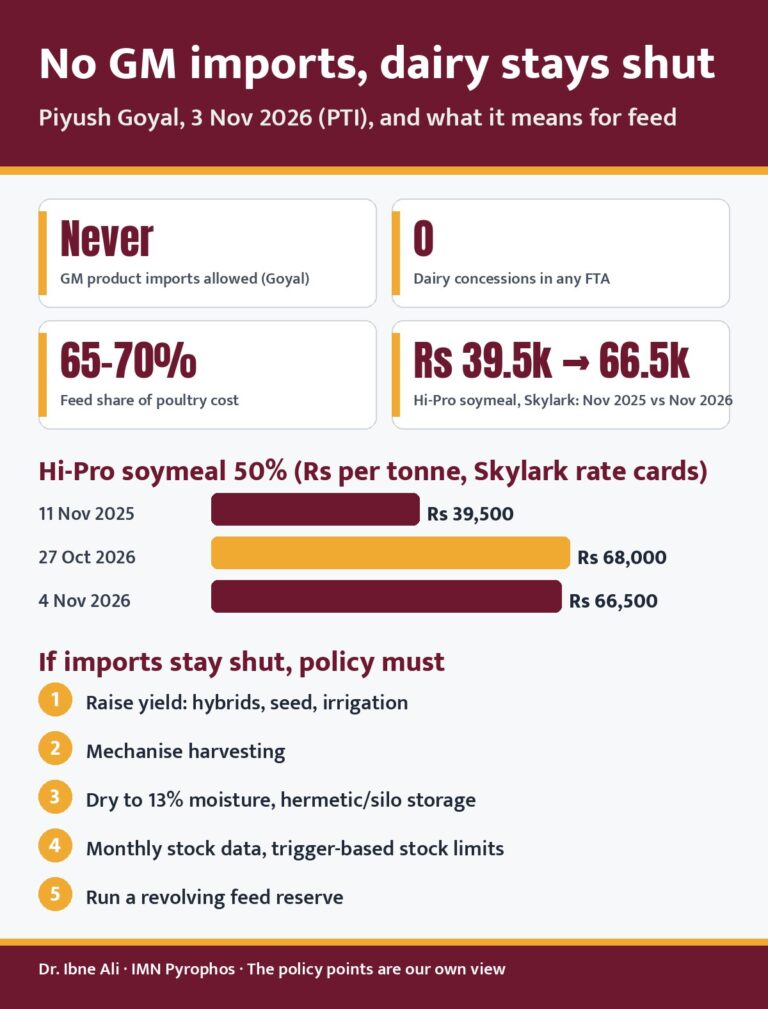
GM is a broad word. The PTI text does not say which products it covers, but most maize and soybean grown in the big exporting countries is GM. In practice that means the feed industry should plan on the assumption that duty-free or relaxed import of GM maize and GM soy meal is not coming through trade deals. Poultry and dairy rations depend on exactly these two ingredients. Feed is 65 to 70% of poultry production cost, so this matters to every farmer.
The stance protects maize and soybean growers from cheap foreign supply, but it also removes the safety valve that importers used in a bad year. In 2026 the kharif maize crop was estimated at roughly 20 to 23 million tonnes against a record 30.5 million tonnes expected earlier, and soymeal at Indore rose from about Rs 33,800 to Rs 60,200 per tonne between January and July (see our feed reserve news). Rate cards from Skylark Proteins show Hi-Pro soymeal at Rs 66,500 per tonne on 4 November 2026 against Rs 39,500 on 11 November 2025. When imports are closed, a weather shock goes straight into the price.
The stance on dairy is a separate matter. It shields small milk producers from imported milk products, which keeps domestic milk prices steadier, but it does not change what a dairy farmer pays for cattle feed, because that is still set by maize, cake and bran at home.
It is also important to be clear on a limit. A stance against imports cannot by itself make feed cheaper. If India closes the door, it has to be able to grow, save and deliver enough.
What policy should do if imports stay shut (our view)
If the aim is to protect farmers by keeping foreign maize out, the country needs to modernise its own production line so that the farmer, the livestock keeper and the feed buyer are all protected. Four things matter most:
- Raise yield. Better hybrids, quality seed, protective irrigation and good agronomy. Soybean still averages under one tonne per hectare, and maize output has grown mostly by area and demand. More tonnes per hectare is the only lasting way to keep prices in check without imports.
- Mechanise harvesting. Timely harvest, shelling and drying machines save grain and labour, and reduce rain damage at harvest.
- Cut post-harvest losses. Drying to safe moisture (below about 13% for maize), hermetic or silo storage and quick movement to storage. Wet or mouldy grain loses weight, quality and carries aflatoxin into feed and milk.
- Control hoarding by stockists. Publish stock data every month, set stock limits that apply only when prices cross a pre-notified level, and release strategic stock by open auction, as the feed reserve proposal suggests. Rules should work both ways: protect farmers from price collapse at harvest, and feed buyers from spikes later.
Without these four steps, “no imports” can mean higher and more volatile feed prices, with the burden falling hardest on small poultry and dairy farms. With them, it becomes a real protection for the whole chain.
What farmers should do now
- Plan for feed cost to follow the local crop and mandi. Compare maize and soy meal rates every week and buy in steps.
- Store grain well if you hold stock: dry, off the floor, covered, and tested for moisture.
- Track FCR each batch with our CFCR calculator, because feed efficiency is the cost you control.
- Ask your feed supplier how long their stock lasts and on what basis they price it.
- Dairy farmers: mix your own balanced ration where possible and add a mineral mixture every day.
Frequently asked questions
What did Piyush Goyal say about GM imports and dairy?
According to PTI, he said India has never allowed imports of GM products and will not do so in future, and that India has never opened its dairy sector to anybody in a trade deal.
Does this mean GM maize and soy meal cannot be imported?
The reports do not name specific products. Our reading is that the feed industry should not expect GM maize or soy meal imports through trade deals, but we have no official list.
Will feed prices fall or rise because of this?
The statement itself does not change a price. With imports closed, feed prices depend on the Indian maize and soybean crop, storage and trade, which is why yield, harvesting and storage improvements matter.
Source: PTI report via The Week and DD India, 3 Nov 2026 (also carried by The Hindu). Analysis sections are our own view. Written by the IMN Pyrophos team in our own words.
वाणिज्य और उद्योग मंत्री पीयूष गोयल ने 3 नवंबर 2026 को कहा कि भारत ने कभी जेनेटिकली मॉडिफाइड (GM) उत्पादों के आयात की अनुमति नहीं दी और भविष्य में भी नहीं देगा, और किसी भी व्यापार समझौते में भारत ने अपना डेयरी सेक्टर किसी के लिए नहीं खोला। वे नई दिल्ली के किरोड़ीमल कॉलेज में छात्रों से व्यापार समझौतों पर एक सवाल के जवाब में बोल रहे थे। पोल्ट्री और डेयरी फ़ीड बनाने वालों के लिए संदेश साफ़ है: व्यापार समझौतों के रास्ते विदेशी GM मक्का या सोया मील आने की उम्मीद न रखें, इसलिए फ़ीड का भाव इस पर तय होगा कि भारत क्या उगाता, रखता और पहुँचाता है। इस लेख में पहले बताया गया है कि क्या कहा गया, फिर हमारा विश्लेषण कि इसका मतलब क्या है और बिना आयात वाला रुख़ चलाने के लिए नीति को क्या करना होगा।
मुख्य तथ्य (PTI की रिपोर्ट के अनुसार)
| बिंदु | विवरण |
|---|---|
| तारीख और जगह | 3 नवंबर 2026, किरोड़ीमल कॉलेज, नई दिल्ली |
| GM उत्पादों पर | भारत ने कभी GM उत्पादों का आयात नहीं होने दिया और भविष्य में भी नहीं होने देगा; उन्होंने इसे “बहुत संवेदनशील” मुद्दा कहा |
| डेयरी पर | “आज तक हमने किसी के लिए डेयरी नहीं खोली”; किसी भी FTA में डेयरी पर शुल्क रियायत कभी नहीं दी गई |
| प्रमाणन | डेयरी आयात सख़्ती से प्रमाणित होना चाहिए, जैसे पशु रेनेट (बछड़ों के पेट की परत से मिलने वाला एंज़ाइम) और उत्पादन में बछड़े के मांस के विरुद्ध |
| व्यापार प्राथमिकताएँ | कपड़ा, फार्मा, कृषि उत्पाद और रत्न-आभूषण के लिए तरजीही पहुँच, इंडोनेशिया, मलेशिया, वियतनाम, चीन और फिलीपींस से कम शुल्क पर |
| संरक्षित वर्ग | किसान, मछुआरे और MSME; समुद्री उत्पाद और डेयरी संवेदनशील बताए गए |
| निर्यात (DD India) | अप्रैल से सितंबर 2026 में लगभग 480 अरब डॉलर, पिछले साल से लगभग 14% ज़्यादा, 2026-27 के 1 ट्रिलियन डॉलर के लक्ष्य के मुक़ाबले |
रिपोर्टों में मक्का, सोयाबीन या किसी ख़ास व्यापारिक साझेदार का नाम नहीं है, और हमें भेजा गया The Hindu का लेख हमारे सिस्टम से खुल नहीं सका, इसलिए हमने The Week और DD India में छपी PTI की ख़बर का इस्तेमाल किया है।
फ़ीड इंडस्ट्री के लिए इसका मतलब (हमारा विश्लेषण)
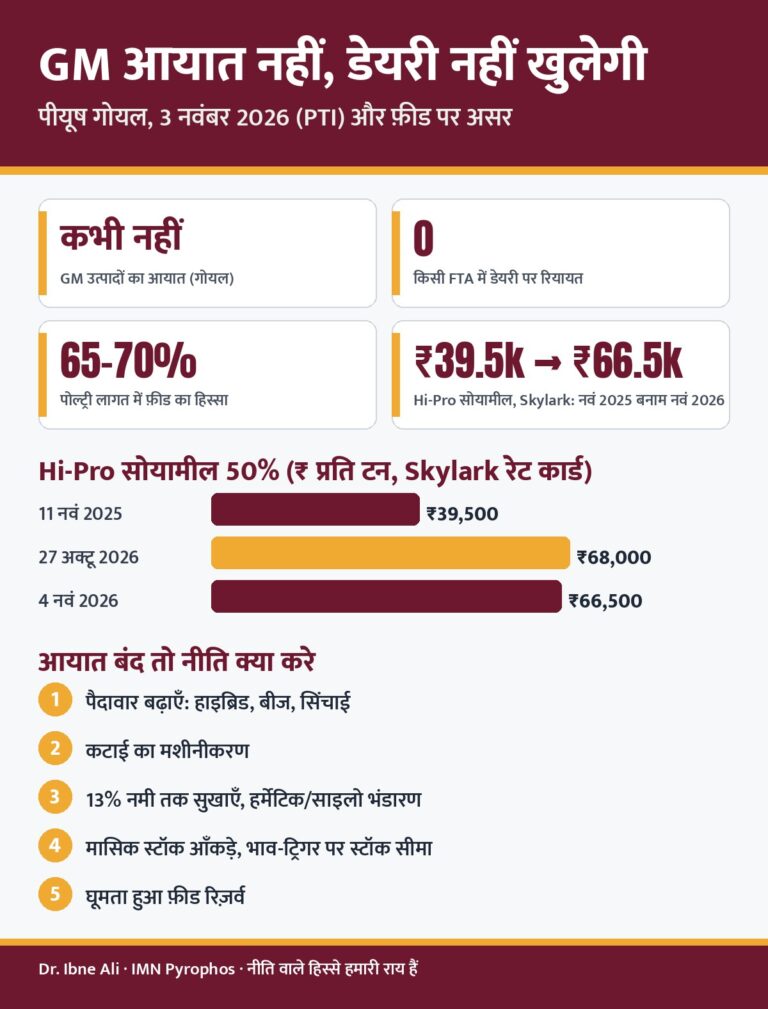
GM एक व्यापक शब्द है। PTI के पाठ में नहीं है कि इसमें कौन से उत्पाद आते हैं, पर बड़े निर्यातक देशों में उगने वाला ज़्यादातर मक्का और सोयाबीन GM है। व्यवहार में इसका अर्थ है कि फ़ीड इंडस्ट्री यह मानकर चले कि GM मक्का और GM सोया मील का शुल्क-मुक्त या ढीला आयात व्यापार समझौतों से नहीं आने वाला। पोल्ट्री और डेयरी की ख़ुराक ठीक इन्हीं दो चीज़ों पर टिकी है। पोल्ट्री उत्पादन लागत में फ़ीड 65 से 70% है, इसलिए यह हर किसान के लिए मायने रखता है।
यह रुख़ मक्का और सोयाबीन उगाने वालों को सस्ते विदेशी माल से बचाता है, पर साथ ही वह सेफ़्टी वाल्व भी हटाता है जिसे आयातक बुरे साल में इस्तेमाल करते थे। 2026 में खरीफ मक्का का अनुमान लगभग 20 से 23 मिलियन टन रहा, जबकि पहले 30.5 मिलियन टन का रिकॉर्ड अनुमान था, और इंदौर में सोयामील जनवरी से जुलाई के बीच लगभग ₹33,800 से ₹60,200 प्रति टन हो गया (देखें हमारी फ़ीड रिज़र्व वाली ख़बर)। Skylark Proteins के रेट कार्ड में Hi-Pro सोयामील 4 नवंबर 2026 को ₹66,500 प्रति टन है, जबकि 11 नवंबर 2025 को ₹39,500 था। जब आयात बंद हो तो मौसम का झटका सीधे भाव में आ जाता है।
डेयरी पर रुख़ अलग बात है। यह छोटे दूध उत्पादकों को आयातित दुग्ध उत्पादों से बचाता है, जिससे घरेलू दूध के भाव ज़्यादा स्थिर रहते हैं, पर इससे डेयरी किसान का पशु आहार का खर्च नहीं बदलता, क्योंकि वह अब भी घर के मक्का, खली और चोकर से तय होता है।
एक सीमा भी साफ़ रहनी चाहिए। आयात के ख़िलाफ़ रुख़ अपने आप में फ़ीड सस्ता नहीं करता। अगर भारत दरवाज़ा बंद रखता है तो उसे पर्याप्त उगाना, बचाना और पहुँचाना भी होगा।
अगर आयात बंद रहे तो नीति को क्या करना चाहिए (हमारी राय)
अगर लक्ष्य विदेशी मक्का को बाहर रखकर किसान की रक्षा है, तो देश को अपनी उत्पादन-श्रृंखला आधुनिक करनी होगी, ताकि किसान, पशुपालक और फ़ीड ख़रीदार सब सुरक्षित रहें। चार बातें सबसे अहम हैं:
- पैदावार बढ़ाएँ। बेहतर हाइब्रिड, अच्छा बीज, सुरक्षात्मक सिंचाई और सही खेती। सोयाबीन अब भी औसतन एक टन प्रति हेक्टेयर से कम देता है, और मक्का का उत्पादन ज़्यादातर रकबे और माँग से बढ़ा है। प्रति हेक्टेयर ज़्यादा टन ही आयात के बिना भाव क़ाबू में रखने का स्थायी रास्ता है।
- कटाई का मशीनीकरण। समय पर कटाई, शेलिंग और सुखाने की मशीनें अनाज और मज़दूरी बचाती हैं और कटाई के समय बारिश का नुकसान घटाती हैं।
- कटाई के बाद का नुकसान घटाएँ। सुरक्षित नमी तक सुखाना (मक्का के लिए लगभग 13% से कम), हर्मेटिक या साइलो भंडारण और जल्दी भंडार तक पहुँचाना। गीला या फफूँद लगा अनाज वज़न, गुणवत्ता खोता है और एफ़्लाटॉक्सिन को फ़ीड और दूध तक पहुँचाता है।
- स्टॉकिस्टों की जमाख़ोरी रोकें। हर महीने स्टॉक के आँकड़े प्रकाशित हों, स्टॉक सीमा सिर्फ़ तब लगे जब भाव पहले से घोषित स्तर पार करें, और रणनीतिक स्टॉक खुली नीलामी से छोड़ा जाए, जैसा फ़ीड रिज़र्व प्रस्ताव कहता है। नियम दोनों तरफ़ चलें: कटाई के समय भाव गिरने से किसान की रक्षा, और बाद के उछाल से फ़ीड ख़रीदार की रक्षा।
इन चारों के बिना “कोई आयात नहीं” का मतलब ऊँचे और ज़्यादा उतार-चढ़ाव वाले फ़ीड भाव हो सकता है, जिसका बोझ छोटे पोल्ट्री और डेयरी फ़ार्म पर सबसे ज़्यादा पड़ेगा। इनके साथ यह पूरी श्रृंखला की असली सुरक्षा बनता है।
किसान अभी क्या करें
- मानकर चलें कि फ़ीड की लागत देसी फ़सल और मंडी के पीछे चलेगी। मक्का और सोया मील के भाव हर हफ़्ते मिलाएँ और किस्तों में ख़रीदें।
- अनाज का भंडारण ठीक रखें अगर स्टॉक रखते हैं: सूखा, ज़मीन से ऊपर, ढका हुआ और नमी जाँचा हुआ।
- हर बैच का FCR नापें हमारे CFCR कैलकुलेटर से, क्योंकि फ़ीड की कार्यकुशलता ही वह लागत है जो आपके हाथ में है।
- फ़ीड सप्लायर से पूछें कि उसका स्टॉक कितने दिन चलेगा और भाव किस आधार पर तय होता है।
- डेयरी किसान: जहाँ संभव हो अपना संतुलित राशन बनाएँ और रोज़ मिनरल मिक्सचर दें।
अक्सर पूछे जाने वाले सवाल
पीयूष गोयल ने GM आयात और डेयरी पर क्या कहा?
PTI के अनुसार उन्होंने कहा कि भारत ने कभी GM उत्पादों का आयात नहीं होने दिया और भविष्य में भी नहीं होने देगा, और किसी व्यापार समझौते में भारत ने डेयरी सेक्टर किसी के लिए नहीं खोला।
क्या इसका मतलब है कि GM मक्का और सोया मील का आयात नहीं हो सकता?
रिपोर्टों में ख़ास उत्पादों के नाम नहीं हैं। हमारी समझ है कि फ़ीड इंडस्ट्री को व्यापार समझौतों से GM मक्का या सोया मील के आयात की उम्मीद नहीं रखनी चाहिए, पर हमारे पास कोई सरकारी सूची नहीं है।
क्या इससे फ़ीड के भाव गिरेंगे या बढ़ेंगे?
बयान से अपने आप कोई भाव नहीं बदलता। आयात बंद होने पर फ़ीड के भाव भारतीय मक्का और सोयाबीन की फ़सल, भंडारण और व्यापार पर निर्भर करेंगे, इसीलिए पैदावार, कटाई और भंडारण का सुधार मायने रखता है।
स्रोत: PTI की रिपोर्ट, The Week और DD India पर, 3 नवंबर 2026 (The Hindu में भी)। विश्लेषण वाले हिस्से हमारी अपनी राय हैं। IMN Pyrophos टीम ने अपने शब्दों में लिखा।
Vanijya aur Udyog Mantri Piyush Goyal ne 3 November 2026 ko kaha ki Bharat ne kabhi genetically modified (GM) utpadon ke aayat ki anumati nahi di aur bhavishya me bhi nahi dega, aur kisi bhi vyapar samjhaute me Bharat ne apna dairy sector kisi ke liye nahi khola. Wo New Delhi ke Kirori Mal College me chhatron se vyapar samjhauton par ek sawal ke jawab me bol rahe the. Poultry aur dairy feed banane walon ke liye sandesh saaf hai: vyapar samjhauton ke raaste videshi GM makka ya soya meal aane ki ummeed na rakhein, isliye feed ka bhaav is par tay hoga ki Bharat kya ugata, rakhta aur pahunchata hai. Is lekh me pehle bataya gaya hai ki kya kaha gaya, phir hamara vishleshan ki iska matlab kya hai aur bina aayat wala rukh chalane ke liye neeti ko kya karna hoga.
Mukhya tathya (PTI ki report ke anusaar)
| Bindu | Vivaran |
|---|---|
| Tareekh aur jagah | 3 November 2026, Kirori Mal College, New Delhi |
| GM utpadon par | Bharat ne kabhi GM utpadon ka aayat nahi hone diya aur bhavishya me bhi nahi hone dega; unhone ise “bahut sanvedansheel” mudda kaha |
| Dairy par | “Aaj tak humne kisi ke liye dairy nahi kholi”; kisi bhi FTA me dairy par shulk riyayat kabhi nahi di gayi |
| Praman | Dairy aayat sakhti se pramanit hona chahiye, jaise pashu rennet (bachhdon ke pet ki parat se milne wala enzyme) aur utpadan me bachhde ke maans ke virudh |
| Vyapar praathmikta | Kapda, pharma, krishi utpad aur ratna-aabhushan ke liye tarjihi pahunch, Indonesia, Malaysia, Vietnam, China aur Philippines se kam shulk par |
| Sanrakshit varg | Kisan, machhuare aur MSME; samudri utpad aur dairy sanvedansheel bataye gaye |
| Niryat (DD India) | April se September 2026 me lagbhag 480 arab dollar, pichhle saal se lagbhag 14% zyada, 2026-27 ke 1 trillion dollar ke lakshya ke mukable |
Reporton me makka, soybean ya kisi khaas vyaparik saajhedaar ka naam nahi hai, aur humein bheja gaya The Hindu ka lekh hamare system se khul nahi saka, isliye humne The Week aur DD India me chhapi PTI ki khabar ka istemal kiya hai.
Feed industry ke liye iska matlab (hamara vishleshan)
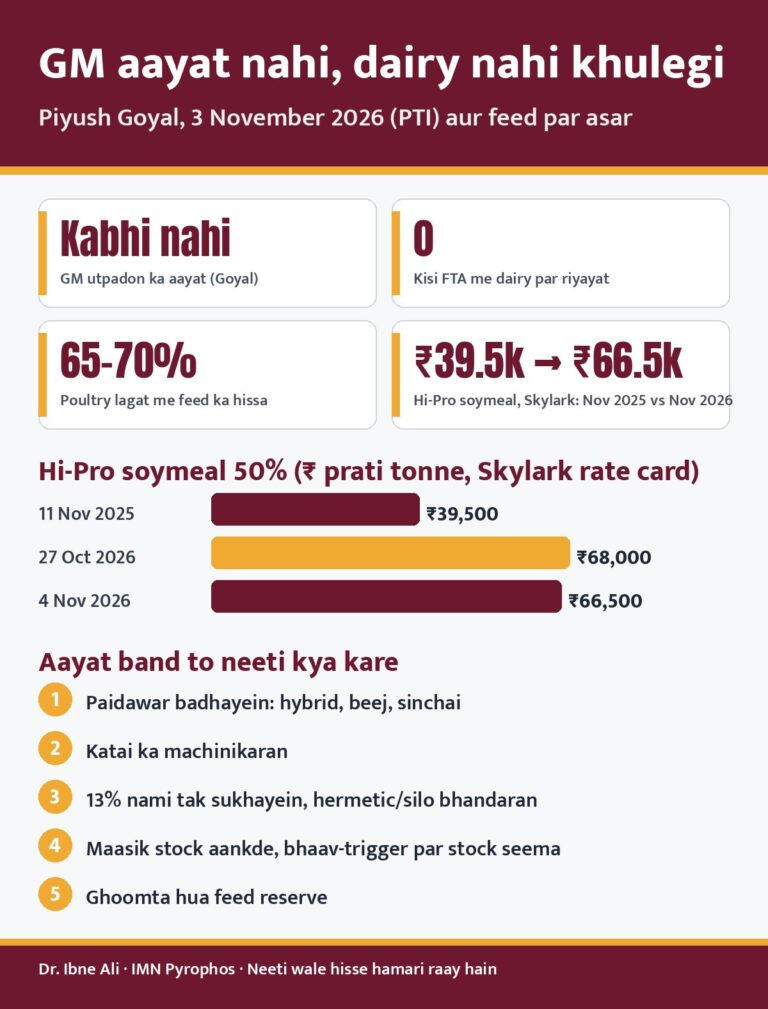
GM ek vyapak shabd hai. PTI ke paath me nahi hai ki isme kaun se utpad aate hain, par bade niryatak deshon me ugne wala zyadatar makka aur soybean GM hai. Vyavahar me iska arth hai ki feed industry ye maankar chale ki GM makka aur GM soya meal ka shulk-mukt ya dheela aayat vyapar samjhauton se nahi aane wala. Poultry aur dairy ki khuraak theek inhi do cheezon par tiki hai. Poultry utpadan lagat me feed 65 se 70% hai, isliye ye har kisan ke liye mayne rakhta hai.
Ye rukh makka aur soybean ugane walon ko saste videshi maal se bachata hai, par saath hi wo safety valve bhi hatata hai jise aayatak bure saal me istemal karte the. 2026 me kharif makka ka andaza lagbhag 20 se 23 million tonne raha, jabki pehle 30.5 million tonne ka record andaza tha, aur Indore me soymeal January se July ke beech lagbhag ₹33,800 se ₹60,200 prati tonne ho gaya (dekhein hamari feed reserve wali khabar). Skylark Proteins ke rate card me Hi-Pro soymeal 4 November 2026 ko ₹66,500 prati tonne hai, jabki 11 November 2025 ko ₹39,500 tha. Jab aayat band ho to mausam ka jhatka seedha bhaav me aa jaata hai.
Dairy par rukh alag baat hai. Ye chhote doodh utpadakon ko aayatit dugdh utpadon se bachata hai, jisse gharelu doodh ke bhaav zyada sthir rehte hain, par isse dairy kisan ka pashu aahaar ka kharch nahi badalta, kyonki wo ab bhi ghar ke makka, khali aur chokar se tay hota hai.
Ek seema bhi saaf rehni chahiye. Aayat ke khilaf rukh apne aap me feed sasta nahi karta. Agar Bharat darwaza band rakhta hai to use paryapt ugana, bachana aur pahunchana bhi hoga.
Agar aayat band rahe to neeti ko kya karna chahiye (hamari raay)
Agar lakshya videshi makka ko bahar rakhkar kisan ki raksha hai, to desh ko apni utpadan-shrinkhala aadhunik karni hogi, taaki kisan, pashupalak aur feed kharidar sab surakshit rahein. Chaar baatein sabse ahem hain:
- Paidawar badhayein. Behtar hybrid, achha beej, surakshatmak sinchai aur sahi kheti. Soybean ab bhi ausat ek tonne prati hectare se kam deta hai, aur makka ka utpadan zyadatar rakbe aur maang se badha hai. Prati hectare zyada tonne hi aayat ke bina bhaav kaabu me rakhne ka sthayi raasta hai.
- Katai ka machinikaran. Samay par katai, shelling aur sukhane ki machine anaaj aur mazdoori bachati hain aur katai ke samay baarish ka nuksaan ghatati hain.
- Katai ke baad ka nuksaan ghatayein. Surakshit nami tak sukhana (makka ke liye lagbhag 13% se kam), hermetic ya silo bhandaran aur jaldi bhandar tak pahunchana. Geela ya fafoond laga anaaj wazan, gunvatta khota hai aur aflatoxin ko feed aur doodh tak pahunchata hai.
- Stockiston ki jamakhori rokein. Har mahine stock ke aankde prakashit hon, stock seema sirf tab lage jab bhaav pehle se ghoshit star paar karein, aur rananeetik stock khuli neelami se chhoda jaye, jaisa feed reserve prastav kehta hai. Niyam dono taraf chalein: katai ke samay bhaav girne se kisan ki raksha, aur baad ke uchhaal se feed kharidar ki raksha.
In charon ke bina “koi aayat nahi” ka matlab oonche aur zyada utaar-chadhav wale feed bhaav ho sakta hai, jiska bojh chhote poultry aur dairy farm par sabse zyada padega. Inke saath ye poori shrinkhala ki asli suraksha banta hai.
Kisan abhi kya karein
- Maankar chalein ki feed ki lagat desi fasal aur mandi ke peechhe chalegi. Makka aur soya meal ke bhaav har hafte milayein aur kiston me kharidein.
- Anaaj ka bhandaran theek rakhein agar stock rakhte hain: sookha, zameen se upar, dhaka hua aur nami jaancha hua.
- Har batch ka FCR napein hamare CFCR calculator se, kyonki feed ki karyakushalta hi wo lagat hai jo aapke haath me hai.
- Feed supplier se poochhein ki uska stock kitne din chalega aur bhaav kis aadhar par tay hota hai.
- Dairy kisan: jahan sambhav ho apna santulit ration banayein aur roz mineral mixture dein.
Aksar pooche jaane wale sawaal
Piyush Goyal ne GM aayat aur dairy par kya kaha?
PTI ke anusaar unhone kaha ki Bharat ne kabhi GM utpadon ka aayat nahi hone diya aur bhavishya me bhi nahi hone dega, aur kisi vyapar samjhaute me Bharat ne dairy sector kisi ke liye nahi khola.
Kya iska matlab hai ki GM makka aur soya meal ka aayat nahi ho sakta?
Reporton me khaas utpadon ke naam nahi hain. Hamari samajh hai ki feed industry ko vyapar samjhauton se GM makka ya soya meal ke aayat ki ummeed nahi rakhni chahiye, par hamare paas koi sarkari soochi nahi hai.
Kya isse feed ke bhaav girenge ya badhenge?
Bayan se apne aap koi bhaav nahi badalta. Aayat band hone par feed ke bhaav Bhartiya makka aur soybean ki fasal, bhandaran aur vyapar par nirbhar karenge, isiliye paidawar, katai aur bhandaran ka sudhar mayne rakhta hai.
Source: PTI report, The Week aur DD India par, 3 November 2026 (The Hindu me bhi). Vishleshan wale hisse hamari apni raay hain. IMN Pyrophos team ne apne shabdon me likha.