
Heat stress does not start when birds fall dead. It starts when the afternoon shed turns hotter than the bird can lose heat. Panting, wings held away from the body, less feed and more water are the first signs, and by the time deaths begin the flock has already lost weight and eggs. Summer is a few months away, which is the right time to plan. This guide explains what to fix in the shed first and where Coolant and Osmosol from IMN Pyrophos fit, with the label doses of both, the cost for 1,000 L of water and the mistakes to avoid. If you are searching for a heat stress medicine for poultry, start with the dose table below.
What happens to a bird in heat stress?
A bird has no sweat glands. It loses heat by panting, and panting blows off carbon dioxide, which upsets the acid-base balance of the blood. The bird eats less to cut the heat from digestion, drinks more, and loses electrolytes. Growth slows, eggs get thinner shells, and in the worst afternoons birds collapse with heat stroke. A heavy broiler near market weight and a high-producing layer feel it first.
Signs to watch for
- Open-beak panting and wings held away from the body.
- Birds crowding at drinkers, wet litter from extra water, less feed eaten in the afternoon.
- Pale, soft or thin egg shells and a drop in egg numbers in layers.
- Weight loss or slow weight gain in broilers.
- Birds lying flat with wings spread, and sudden deaths in the hottest hours.
Fix the shed first
No product replaces cooling. Before any supplement, check these.
- Ventilation and air speed: open sides, run fans and cooling pads or foggers properly.
- Cool, clean water: shade the tank and pipes, flush lines in the afternoon, and keep enough drinkers. Sanitize the water (see our water and feed hygiene guide).
- Feed timing: move feeding to the cool early morning and late evening hours.
- Stocking density and litter: overcrowding and wet litter add heat and ammonia. See ammonia control in litter.
- Catching and loading: do it at night or early morning, with water and electrolytes given before.
Coolant and Osmosol: which one when?
Both are given in drinking water, but they are not the same thing and they do not cost the same. Osmosol is the low-cost routine product (1 kg, MRP ₹350). Coolant is the stronger heat stroke product (1 kg, MRP ₹1,050).
- Osmosol is the simple, lower-cost electrolyte mix with vitamin C and betaine for heat stress management. The label lists sodium bicarbonate, calcium propionate, calcium chloride, sodium chloride, potassium chloride, vitamin C, betaine, natural antioxidants and glucose. Use it for routine hot days, moderate heat stress, and for loading and transport.
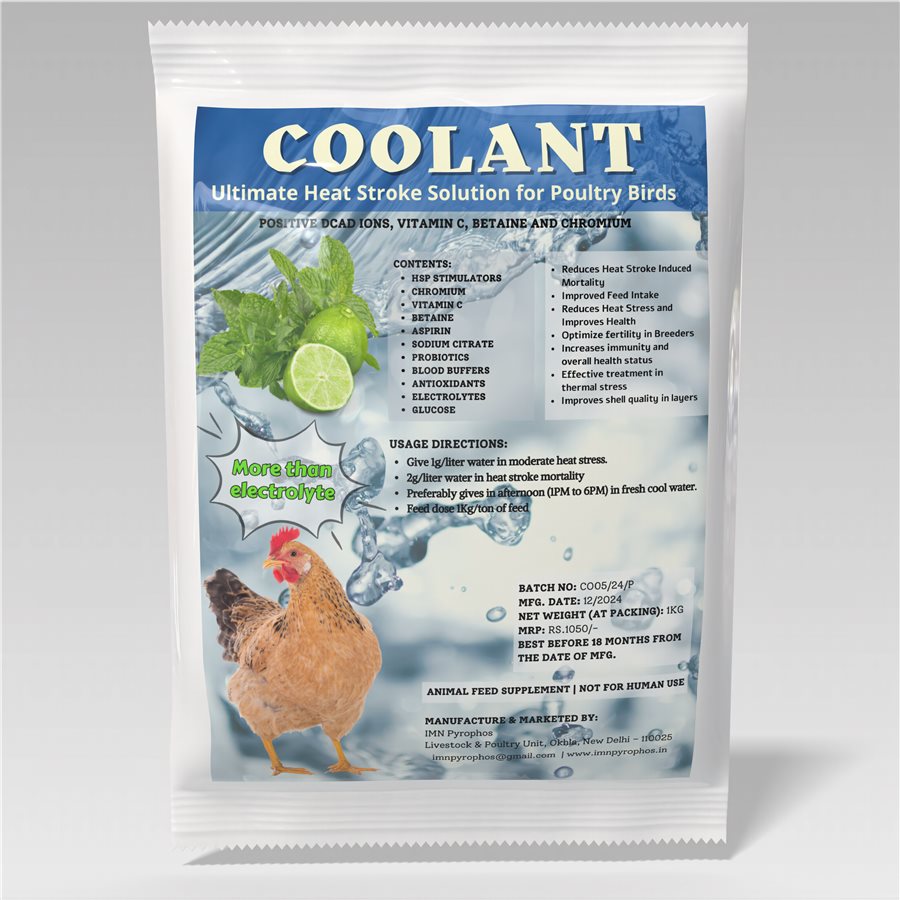
- Coolant is the “ultimate heat stroke solution”, more than an electrolyte. Along with positive DCAD ions, vitamin C, betaine and chromium, the label lists HSP stimulators, aspirin, sodium citrate, probiotics, blood buffers, antioxidants, electrolytes and glucose. Use it when the stress is high, birds are already panting and heat stroke deaths have started or are likely.
| Osmosol | Coolant | |
|---|---|---|
| Price (1 kg) | ₹245 (MRP ₹350) | ₹681 (MRP ₹1,050) |
| Best for | Routine and moderate heat stress, loading and transport | High stress and heat stroke mortality |
| Key ingredients | Electrolytes, vitamin C, betaine, glucose | Electrolytes, vitamin C, betaine, plus chromium, aspirin, HSP stimulators, sodium citrate, probiotics, blood buffers |
| When | Hot days, in drinking water | Preferably 1 PM to 6 PM, in fresh cool water |
Many farms keep Osmosol for the whole hot spell and add Coolant on the worst afternoons. Your vet can decide the exact plan for your flock.
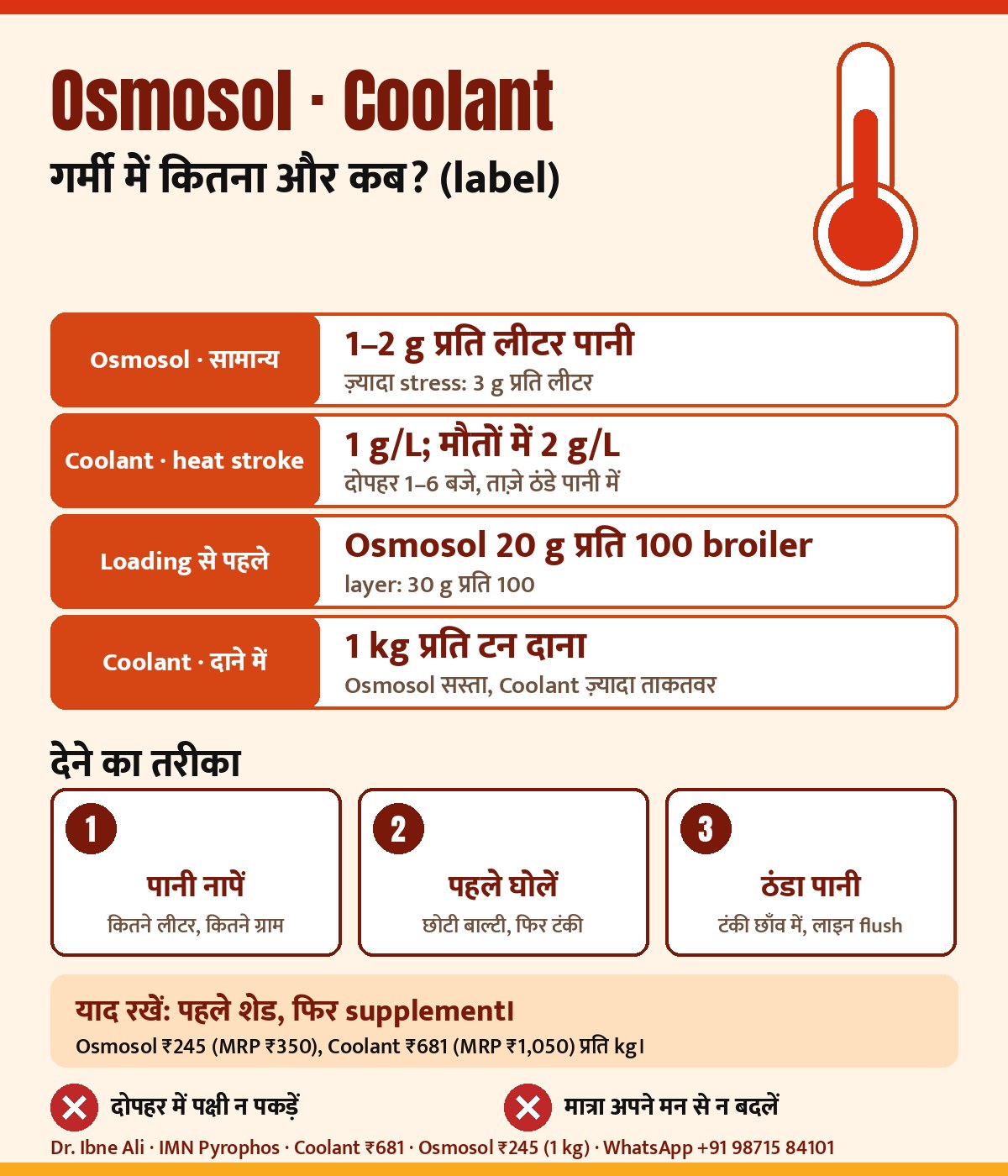
Dose (label)
All doses below are label doses. The label gives no number of days, so confirm the course with your vet or on WhatsApp.
| Situation | Osmosol (label) | Coolant (label) |
|---|---|---|
| Moderate heat stress | 1 to 2 g per litre of water | 1 g per litre of water |
| High stress | 3 g per litre of water | Not on label |
| Heat stroke mortality | Not on label | 2 g per litre of water |
| Before loading and transport | 20 g per 100 broilers | Not on label |
| Layers | 30 g per 100 layer birds | Not on label |
| In feed | Not on label | 1 kg per ton of feed |
| When to give | In drinking water on hot days | Preferably in the afternoon (1 PM to 6 PM) in fresh cool water |
Cost example (calculated from the label doses and the 1 kg prices: Osmosol ₹245, Coolant ₹681). For 1,000 L of drinking water, Osmosol at 1 to 2 g per litre needs 1 to 2 kg, about ₹245 to ₹490; at 3 g per litre 3 kg, about ₹735. Coolant at 1 g per litre needs 1 kg, about ₹681; at 2 g per litre 2 kg, about ₹1,362. Before loading, Osmosol at 20 g per 100 broilers is 200 g for 1,000 broilers, about ₹49. In feed, Coolant at 1 kg per ton of feed adds about ₹681 per ton.
How to give them, step by step
- Check the water volume the flock will drink in the hot hours, so you can work out grams per litre.
- Weigh the powder on a kitchen scale. Do not use a spoon by guess.
- Dissolve it in a small bucket first, then add to the tank or dosing pump.
- Give Coolant in the afternoon in fresh, cool water, as the label advises.
- Flush and refill the lines so the birds always find cool water.
- Note the date, dose and deaths every day so your vet can see what is working.
Heat stroke solution
Coolant
Heat stroke solution for poultry with positive DCAD ions, vitamin C, betaine and chromium, plus HSP stimulators, blood buffers, electrolytes and glucose. Label: reduces heat stroke induced mortality, improves feed intake, helps shell quality in layers.
Dose: 1 g per litre of water in moderate heat stress; 2 g per litre in heat stroke mortality; preferably in the afternoon (1 PM to 6 PM) in fresh cool water; feed dose 1 kg per ton of feed.
1 kg ₹681MRP ₹1,050
Electrolyte for heat stress
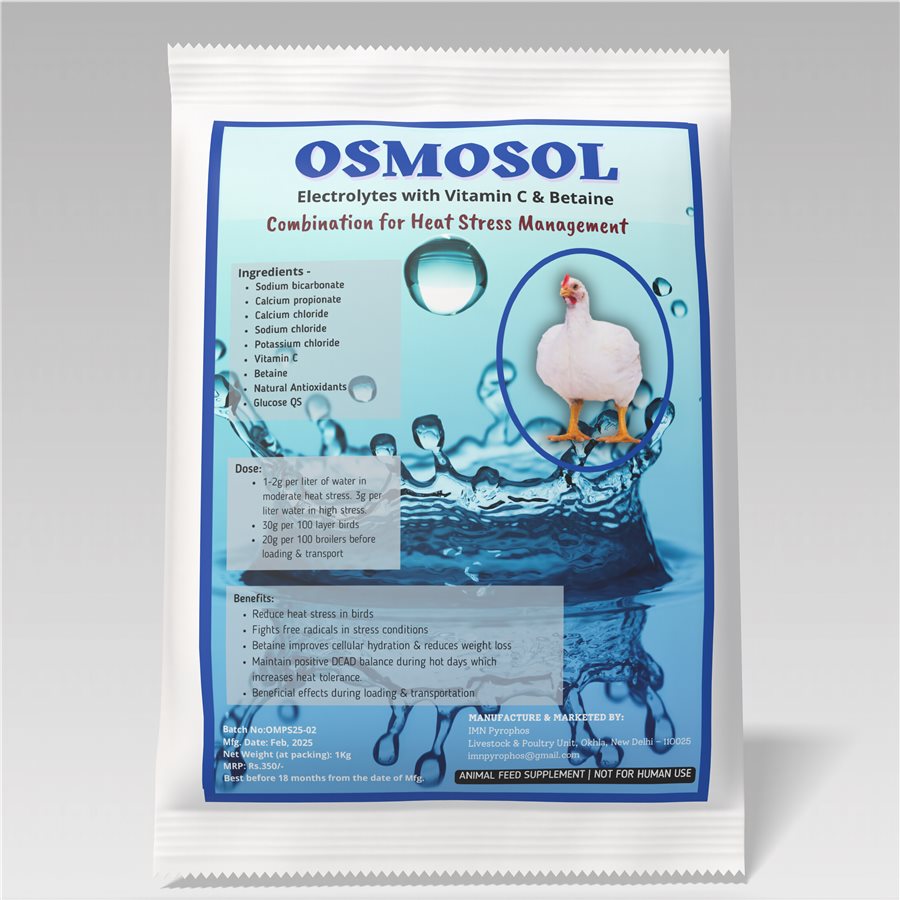
Osmosol
Electrolytes with vitamin C and betaine for heat stress management (sodium bicarbonate, calcium propionate, calcium chloride, sodium chloride, potassium chloride, vitamin C, betaine, natural antioxidants, glucose). Keeps DCAD balance positive on hot days.
Dose: 1 to 2 g per litre water in moderate heat stress; 3 g per litre in high stress; 20 g per 100 broilers or 30 g per 100 layers before loading and transport.
1 kg ₹245MRP ₹350
Where they fit in a summer plan
- Before loading for the mandi: Osmosol at the label dose, with night catching.
- Layers in heat: Coolant lists better shell quality on its label; also see egg production drop in layers for the egg side.
- Gut and FCR: heat stress upsets the gut, so many farms add a probiotic such as Remipro.
- Vitamins and immunity: see vitamin E and selenium immune booster for stress cover.
- Ascites and fast growth: read ascites in broilers.
What not to do
- Do not use a supplement instead of ventilation, shade and cool water.
- Do not change the dose on your own. Use the label doses of Osmosol and Coolant.
- Do not give hot water from a sun-baked tank. Birds will drink less.
- Do not mix many products in one tank without advice. Ask on WhatsApp first.
- Do not handle or load birds in the afternoon heat.
Common mistakes
- Starting only after deaths begin. Give support from the first hot days.
- Using the heat stroke dose every day. There is a lower dose for routine hot days.
- Guessing the water volume. Work out grams per litre properly.
- Forgetting the drinkers. Few or dirty drinkers undo the best electrolyte.
Frequently asked questions
What is the best medicine for heat stress in poultry? There is no single answer. Cooling, cool water and feed timing come first. Label-backed support such as Coolant and Osmosol helps on the hot days.
What is the Coolant dose? 1 g per litre of water in moderate heat stress, 2 g per litre in heat stroke mortality, and 1 kg per ton of feed. Give it preferably in the afternoon (1 PM to 6 PM) in fresh cool water.
What is the Osmosol dose? 1 to 2 g per litre in moderate heat stress, 3 g per litre in high stress, and 20 g per 100 broilers or 30 g per 100 layers before loading and transport.
What is the price? Coolant 1 kg is ₹681 (MRP ₹1,050). Osmosol 1 kg is ₹245 (MRP ₹350). Prices may change, so confirm on WhatsApp.
Can I give both together? Many farms use Osmosol through the hot spell and Coolant on the worst afternoons. Ask on WhatsApp for the plan that suits your flock.
Can layers get it? Yes. The Coolant label lists improved shell quality in layers, and Osmosol has a layer dose for loading and transport.
Where can I see all IMN products? The IMN product guide lists each product by problem and stage.
Also read: Coolant · Osmosol · Maintain FCR in broilers · Immune booster for poultry · IMN product guide
पोल्ट्री में heat stress: Osmosol की मात्रा, Coolant का सहारा, पहचान और गर्मी में इस्तेमाल
Heat stress तब शुरू नहीं होता जब मुर्गियाँ गिरकर मरने लगें। यह तब शुरू होता है जब दोपहर का शेड इतना गर्म हो जाए कि पक्षी गर्मी बाहर नहीं निकाल पाता। हाँफना, पंख शरीर से दूर रखना, दाना कम और पानी ज़्यादा, ये पहले संकेत हैं, और मौतें शुरू होने तक फ़्लॉक वज़न और अंडे दोनों खो चुका होता है। गर्मी आने में कुछ महीने हैं, यानी प्लान बनाने का सही समय अभी है। इस गाइड में बताया है कि शेड में पहले क्या ठीक करें और IMN Pyrophos के Coolant और Osmosol कहाँ फ़िट होते हैं, साथ में label की मात्रा, 1,000 लीटर पानी का खर्च और गलतियाँ। अगर आप heat stress medicine for poultry खोज रहे हैं तो नीचे की मात्रा वाली तालिका से शुरू करें।
Heat stress में पक्षी के शरीर में क्या होता है?
पक्षी में पसीने की ग्रंथियाँ नहीं होतीं। वह हाँफकर गर्मी निकालता है, और हाँफने से carbon dioxide निकलती है जिससे खून का acid-base संतुलन बिगड़ता है। पक्षी पाचन की गर्मी घटाने के लिए दाना कम खाता है, पानी ज़्यादा पीता है और electrolytes खोता है। बढ़वार धीमी होती है, अंडे का छिलका पतला होता है, और सबसे गर्म दोपहरों में पक्षी heat stroke से गिर जाते हैं। बाज़ार के वज़न के पास का भारी broiler और ज़्यादा अंडे देने वाली layer इसे सबसे पहले महसूस करती है।
किन संकेतों पर नज़र रखें
- चोंच खोलकर हाँफना और पंख शरीर से दूर रखना।
- Drinker पर भीड़, ज़्यादा पानी से गीला litter, दोपहर में दाना कम खाना।
- Layers में पतला या मुलायम छिलका और अंडों की संख्या में गिरावट।
- Broiler में वज़न का कम बढ़ना या घटना।
- पंख फैलाकर लेट जाना और सबसे गर्म घंटों में अचानक मौतें।
पहले शेड ठीक करें
कोई product ठंडक की जगह नहीं ले सकता। कोई भी supplement देने से पहले ये जाँचें।
- Ventilation और हवा की रफ़्तार: साइड खोलें, पंखे और cooling pad या fogger ठीक से चलाएँ।
- ठंडा और साफ़ पानी: टंकी और पाइप को छाँव में रखें, दोपहर में लाइन flush करें, drinker पर्याप्त रखें। पानी sanitize करें (हमारी पानी और दाने की hygiene गाइड देखें)।
- दाने का समय: दाना ठंडी सुबह और देर शाम को दें।
- Stocking density और litter: भीड़ और गीला litter गर्मी और ammonia बढ़ाते हैं। देखें litter में ammonia कंट्रोल।
- पकड़ना और लोडिंग: रात या सुबह जल्दी करें, और उससे पहले पानी में electrolytes दें।
Coolant और Osmosol: कब कौन सा?
दोनों पीने के पानी में दिए जाते हैं, पर ये एक जैसे नहीं हैं और दाम भी एक जैसा नहीं है। Osmosol सस्ता रोज़ का product है (1 kg, MRP ₹350)। Coolant ज़्यादा ताकतवर heat stroke product है (1 kg, MRP ₹1,050)।
- Osmosol heat stress संभालने के लिए vitamin C और betaine वाला सीधा-सादा, सस्ता electrolyte मिश्रण है। Label पर sodium bicarbonate, calcium propionate, calcium chloride, sodium chloride, potassium chloride, vitamin C, betaine, natural antioxidants और glucose लिखे हैं। रोज़ के गर्म दिनों, मध्यम heat stress, और loading व transport के लिए इस्तेमाल करें।
- Coolant “ultimate heat stroke solution” है, यानी electrolyte से ज़्यादा। Positive DCAD ions, vitamin C, betaine और chromium के साथ label पर HSP stimulators, aspirin, sodium citrate, probiotics, blood buffers, antioxidants, electrolytes और glucose लिखे हैं। तब इस्तेमाल करें जब stress ज़्यादा हो, पक्षी हाँफ रहे हों और heat stroke से मौतें शुरू हो गई हों या होने वाली हों।
| Osmosol | Coolant | |
|---|---|---|
| कीमत (1 kg) | ₹245 (MRP ₹350) | ₹681 (MRP ₹1,050) |
| किसके लिए | रोज़ का और मध्यम heat stress, loading व transport | ज़्यादा stress और heat stroke से मौतें |
| मुख्य तत्व | Electrolytes, vitamin C, betaine, glucose | Electrolytes, vitamin C, betaine, साथ में chromium, aspirin, HSP stimulators, sodium citrate, probiotics, blood buffers |
| कब | गर्म दिनों में, पीने के पानी में | बेहतर है दोपहर 1 से 6 बजे, ताज़े ठंडे पानी में |
कई फ़ार्म पूरी गर्मी में Osmosol रखते हैं और सबसे बुरी दोपहरों में Coolant जोड़ते हैं। आपके फ़्लॉक का सही प्लान आपका डॉक्टर तय कर सकता है।
मात्रा (label)
नीचे की सारी मात्राएँ label की हैं। Label में दिनों की संख्या नहीं लिखी है, इसलिए course डॉक्टर से या WhatsApp पर पक्का करें।
| स्थिति | Osmosol (label) | Coolant (label) |
|---|---|---|
| मध्यम heat stress | 1 से 2 g प्रति लीटर पानी | 1 g प्रति लीटर पानी |
| ज़्यादा stress | 3 g प्रति लीटर पानी | Label में नहीं |
| Heat stroke से मौतें | Label में नहीं | 2 g प्रति लीटर पानी |
| Loading और transport से पहले | 20 g प्रति 100 broiler | Label में नहीं |
| Layers | 30 g प्रति 100 layer | Label में नहीं |
| दाने में | Label में नहीं | 1 kg प्रति टन दाना |
| कब दें | गर्म दिनों में पीने के पानी में | बेहतर है दोपहर (1 से 6 बजे) ताज़े ठंडे पानी में |
खर्च का उदाहरण (label की मात्रा और 1 kg के भाव से गणना: Osmosol ₹245, Coolant ₹681)। 1,000 लीटर पीने के पानी के लिए Osmosol 1 से 2 g प्रति लीटर पर 1 से 2 kg, लगभग ₹245 से ₹490; 3 g प्रति लीटर पर 3 kg, लगभग ₹735। Coolant 1 g प्रति लीटर पर 1 kg, लगभग ₹681; 2 g प्रति लीटर पर 2 kg, लगभग ₹1,362। Loading से पहले Osmosol 20 g प्रति 100 broiler यानी 1,000 broiler के लिए 200 g, लगभग ₹49। दाने में Coolant 1 kg प्रति टन दाना पर लगभग ₹681 प्रति टन जुड़ता है।
कैसे दें, कदम दर कदम
- पानी की मात्रा देखें जो फ़्लॉक गर्म घंटों में पिएगा, ताकि प्रति लीटर ग्राम निकाल सकें।
- पाउडर तौलें किचन तराज़ू पर। चम्मच से अंदाज़ा न लगाएँ।
- पहले छोटी बाल्टी में घोलें, फिर टंकी या dosing pump में डालें।
- Coolant दोपहर में दें, ताज़े ठंडे पानी में, जैसा label कहता है।
- लाइन flush करके दोबारा भरें ताकि पक्षियों को हमेशा ठंडा पानी मिले।
- रोज़ तारीख, मात्रा और मौतें लिखें ताकि डॉक्टर देख सकें कि क्या काम कर रहा है।
Heat stroke solution
Coolant
Poultry के लिए ultimate heat stroke solution: positive DCAD ions, vitamin C, betaine और chromium, साथ में HSP stimulators, aspirin, sodium citrate, probiotics, blood buffers, electrolytes और glucose। Label: heat stroke से मौतें घटाता है, दाना खाना सुधारता है, layers में खोल की क्वालिटी में मदद।
मात्रा: मध्यम heat stress में 1 g प्रति लीटर पानी; heat stroke से मौतों में 2 g प्रति लीटर; बेहतर है दोपहर 1 से 6 बजे ताज़े ठंडे पानी में; दाने में 1 kg प्रति टन।
1 kg ₹681MRP ₹1,050
Heat stress के लिए electrolyte
Osmosol
Vitamin C और betaine के साथ सस्ता electrolyte मिश्रण (sodium bicarbonate, calcium propionate, calcium chloride, sodium chloride, potassium chloride, natural antioxidants, glucose)। गर्म दिनों में DCAD balance positive रखता है, loading और transport में फ़ायदेमंद।
मात्रा: मध्यम heat stress में 1 से 2 g प्रति लीटर पानी; ज़्यादा stress में 3 g प्रति लीटर; loading और transport से पहले 20 g प्रति 100 broiler; 30 g प्रति 100 layer।
1 kg ₹245MRP ₹350
गर्मी के प्लान में ये कहाँ फ़िट होते हैं
- मंडी के लिए loading से पहले: रात की पकड़ के साथ label की मात्रा में Osmosol।
- गर्मी में layers: Coolant के label पर layers में छिलके की क्वालिटी सुधार लिखा है; अंडे के पहलू के लिए layers में अंडे का उत्पादन गिरना भी देखें।
- आँत और FCR: गर्मी आँत बिगाड़ती है, इसलिए कई फ़ार्म Remipro जैसा probiotic जोड़ते हैं।
- विटामिन और immunity: तनाव में सहारे के लिए विटामिन E सेलेनियम immune booster देखें।
- Ascites और तेज़ बढ़वार: पढ़ें broiler में ascites।
क्या न करें
- Ventilation, छाँव और ठंडे पानी की जगह supplement न रखें।
- मात्रा अपने मन से न बदलें। Osmosol और Coolant की label मात्राएँ रखें।
- धूप में तपी टंकी का गर्म पानी न दें। पक्षी कम पिएँगे।
- बिना सलाह के एक टंकी में कई product न मिलाएँ। पहले WhatsApp पर पूछें।
- दोपहर की गर्मी में पक्षियों को न पकड़ें, न लोड करें।
आम गलतियाँ
- मौतें शुरू होने के बाद ही शुरू करना। पहले गर्म दिनों से सहारा दें।
- Heat stroke वाली मात्रा रोज़ देना। रोज़ के गर्म दिनों के लिए label में moderate मात्रा है।
- पानी की मात्रा का अंदाज़ा लगाना। प्रति लीटर ग्राम ठीक से निकालें।
- Drinker भूल जाना। कम या गंदे drinker सबसे अच्छे electrolyte को बेकार कर देते हैं।
अक्सर पूछे जाने वाले सवाल
पोल्ट्री में heat stress की सबसे अच्छी दवा कौन सी है? कोई एक जवाब नहीं है। ठंडक, ठंडा पानी और दाने का समय पहले आते हैं। Coolant और Osmosol जैसा label-आधारित सहारा गर्म दिनों में मदद करता है।
Coolant की मात्रा क्या है? मध्यम heat stress में 1 g प्रति लीटर पानी, heat stroke से मौतों में 2 g प्रति लीटर, और दाने में 1 kg प्रति टन। बेहतर है दोपहर (1 से 6 बजे) ताज़े ठंडे पानी में दें।
Osmosol की मात्रा क्या है? Moderate heat stress में 1 से 2 g प्रति लीटर, ज़्यादा stress में 3 g प्रति लीटर, और loading व transport से पहले 20 g प्रति 100 broiler या 30 g प्रति 100 layer।
कीमत क्या है? Coolant 1 kg ₹681 (MRP ₹1,050)। Osmosol 1 kg ₹245 (MRP ₹350)। कीमत बदल सकती है, WhatsApp पर पक्का करें।
क्या दोनों साथ दे सकते हैं? कई फ़ार्म पूरी गर्मी Osmosol और सबसे बुरी दोपहरों में Coolant देते हैं। अपने फ़्लॉक के प्लान के लिए WhatsApp पर पूछें।
क्या layers को दे सकते हैं? हाँ। Coolant के label पर layers में छिलके की क्वालिटी सुधार लिखा है, और Osmosol में loading व transport के लिए layer की मात्रा है।
सारे IMN प्रोडक्ट कहाँ देखें? IMN प्रोडक्ट गाइड में हर प्रोडक्ट समस्या और स्टेज के हिसाब से है।
यह भी पढ़ें: Coolant · Osmosol · Broiler में FCR बनाए रखें · पोल्ट्री के लिए इम्यून बूस्टर · IMN प्रोडक्ट गाइड
Poultry me heat stress: Osmosol ki matra, Coolant ka sahara, pehchan aur garmi me istemaal
Heat stress tab shuru nahi hota jab murgiyan girkar marne lagein. Ye tab shuru hota hai jab dopahar ka shed itna garm ho jaye ki pakshi garmi bahar nahi nikal paata. Hanphna, pankh sharir se door rakhna, daana kam aur paani zyada, ye pehle sanket hain, aur mautein shuru hone tak flock wazan aur ande dono kho chuka hota hai. Garmi aane me kuch mahine hain, yaani plan banane ka sahi samay abhi hai. Is guide me bataya hai ki shed me pehle kya theek karein aur IMN Pyrophos ke Coolant aur Osmosol kahan fit hote hain, saath me label ki matra, 1,000 litre paani ka kharch aur galtiyan. Agar aap heat stress medicine for poultry dhoondh rahe hain to neeche ki matra wali talika se shuru karein.
Heat stress me pakshi ke sharir me kya hota hai?
Pakshi me paseene ki granthiyan nahi hoti. Wo hanphkar garmi nikalta hai, aur hanphne se carbon dioxide nikalti hai jisse khoon ka acid-base santulan bigadta hai. Pakshi pachan ki garmi ghatane ke liye daana kam khata hai, paani zyada peeta hai aur electrolytes khota hai. Badhwar dheemi hoti hai, ande ka chhilka patla hota hai, aur sabse garm dopaharon me pakshi heat stroke se gir jaate hain. Bazaar ke wazan ke paas ka bhaari broiler aur zyada ande dene wali layer ise sabse pehle mehsoos karti hai.
Kin sanketon par nazar rakhein
- Chonch kholkar hanphna aur pankh sharir se door rakhna.
- Drinker par bheed, zyada paani se geela litter, dopahar me daana kam khana.
- Layers me patla ya mulayam chhilka aur andon ki sankhya me girawat.
- Broiler me wazan ka kam badhna ya ghatna.
- Pankh failakar let jaana aur sabse garm ghanton me achanak mautein.
Pehle shed theek karein
Koi product thandak ki jagah nahi le sakta. Koi bhi supplement dene se pehle ye jaanchein.
- Ventilation aur hawa ki raftaar: side kholein, pankhe aur cooling pad ya fogger theek se chalayein.
- Thanda aur saaf paani: tanki aur pipe ko chhaon me rakhein, dopahar me line flush karein, drinker paryapt rakhein. Paani sanitize karein (hamari paani aur daane ki hygiene guide dekhein).
- Daane ka samay: daana thandi subah aur der shaam ko dein.
- Stocking density aur litter: bheed aur geela litter garmi aur ammonia badhate hain. Dekhein litter me ammonia control.
- Pakadna aur loading: raat ya subah jaldi karein, aur usse pehle paani me electrolytes dein.
Coolant aur Osmosol: kab kaun sa?
Dono peene ke paani me diye jaate hain, par ye ek jaise nahi hain aur daam bhi ek jaisa nahi hai. Osmosol sasta roz ka product hai (1 kg, MRP ₹350). Coolant zyada taqatwar heat stroke product hai (1 kg, MRP ₹1,050).
- Osmosol heat stress sambhalne ke liye vitamin C aur betaine wala seedha-saada, sasta electrolyte mishran hai. Label par sodium bicarbonate, calcium propionate, calcium chloride, sodium chloride, potassium chloride, vitamin C, betaine, natural antioxidants aur glucose likhe hain. Roz ke garm dinon, madhyam heat stress, aur loading va transport ke liye istemaal karein.
- Coolant “ultimate heat stroke solution” hai, yaani electrolyte se zyada. Positive DCAD ions, vitamin C, betaine aur chromium ke saath label par HSP stimulators, aspirin, sodium citrate, probiotics, blood buffers, antioxidants, electrolytes aur glucose likhe hain. Tab istemaal karein jab stress zyada ho, pakshi haanf rahe hon aur heat stroke se mautein shuru ho gayi hon ya hone wali hon.
| Osmosol | Coolant | |
|---|---|---|
| Keemat (1 kg) | ₹245 (MRP ₹350) | ₹681 (MRP ₹1,050) |
| Kiske liye | Roz ka aur madhyam heat stress, loading va transport | Zyada stress aur heat stroke se mautein |
| Mukhya tatv | Electrolytes, vitamin C, betaine, glucose | Electrolytes, vitamin C, betaine, saath me chromium, aspirin, HSP stimulators, sodium citrate, probiotics, blood buffers |
| Kab | Garm dino me, peene ke paani me | Behtar hai dopahar 1 se 6 baje, taaze thande paani me |
Kai farm poori garmi me Osmosol rakhte hain aur sabse buri dopaharon me Coolant jodte hain. Aapke flock ka sahi plan aapka doctor tay kar sakta hai.
Matra (label)
Neeche ki saari matrayein label ki hain. Label me dinon ki sankhya nahi likhi, isliye course doctor se ya WhatsApp par pakka karein.
| Sthiti | Osmosol (label) | Coolant (label) |
|---|---|---|
| Madhyam heat stress | 1 se 2 g prati litre paani | 1 g prati litre paani |
| Zyada stress | 3 g prati litre paani | Label me nahi |
| Heat stroke se mautein | Label me nahi | 2 g prati litre paani |
| Loading aur transport se pehle | 20 g prati 100 broiler | Label me nahi |
| Layers | 30 g prati 100 layer | Label me nahi |
| Daane me | Label me nahi | 1 kg prati ton daana |
| Kab dein | Garm dino me peene ke paani me | Behtar hai dopahar (1 se 6 baje) taaze thande paani me |
Kharch ka udaharan (label ki matra aur 1 kg ke bhaav se ganana: Osmosol ₹245, Coolant ₹681). 1,000 litre peene ke paani ke liye Osmosol 1 se 2 g prati litre par 1 se 2 kg, lagbhag ₹245 se ₹490; 3 g prati litre par 3 kg, lagbhag ₹735. Coolant 1 g prati litre par 1 kg, lagbhag ₹681; 2 g prati litre par 2 kg, lagbhag ₹1,362. Loading se pehle Osmosol 20 g prati 100 broiler yaani 1,000 broiler ke liye 200 g, lagbhag ₹49. Daane me Coolant 1 kg prati ton daana par lagbhag ₹681 prati ton judta hai.
Kaise dein, kadam dar kadam
- Paani ki matra dekhein jo flock garm ghanton me piyega, taaki prati litre gram nikal sakein.
- Powder taulein kitchen taraazu par. Chammach se andaza na lagayein.
- Pehle chhoti baalti me gholein, phir tanki ya dosing pump me daalein.
- Coolant dopahar me dein, taaze thande paani me, jaisa label kehta hai.
- Line flush karke dobara bharein taaki pakshiyon ko hamesha thanda paani mile.
- Roz tareekh, matra aur mautein likhein taaki doctor dekh sakein ki kya kaam kar raha hai.
Heat stroke solution
Coolant
Poultry ke liye ultimate heat stroke solution: positive DCAD ions, vitamin C, betaine aur chromium, saath me HSP stimulators, aspirin, sodium citrate, probiotics, blood buffers, electrolytes aur glucose. Label: heat stroke se mautein ghatata hai, daana khana sudharta hai, layers me khol ki quality me madad.
Matra: Madhyam heat stress me 1 g prati litre paani; heat stroke se mauton me 2 g prati litre; behtar hai dopahar 1 se 6 baje taaze thande paani me; daane me 1 kg prati ton.
1 kg ₹681MRP ₹1,050
Heat stress ke liye electrolyte
Osmosol
Vitamin C aur betaine ke saath sasta electrolyte mishran (sodium bicarbonate, calcium propionate, calcium chloride, sodium chloride, potassium chloride, natural antioxidants, glucose). Garm dino me DCAD balance positive rakhta hai, loading aur transport me faydemand.
Matra: Madhyam heat stress me 1 se 2 g prati litre paani; zyada stress me 3 g prati litre; loading aur transport se pehle 20 g prati 100 broiler; 30 g prati 100 layer.
1 kg ₹245MRP ₹350
Garmi ke plan me ye kahan fit hote hain
- Mandi ke liye loading se pehle: raat ki pakad ke saath label ki matra me Osmosol.
- Garmi me layers: Coolant ke label par layers me chhilke ki quality sudhar likha hai; ande ke pehlu ke liye layers me ande ka utpadan girna bhi dekhein.
- Aant aur FCR: garmi aant bigaadti hai, isliye kai farm Remipro jaisa probiotic jodte hain.
- Vitamin aur immunity: tanav me sahare ke liye vitamin E selenium immune booster dekhein.
- Ascites aur tez badhwar: padhein broiler me ascites.
Kya na karein
- Ventilation, chhaon aur thande paani ki jagah supplement na rakhein.
- Matra apne man se na badlein. Osmosol aur Coolant ki label matrayein rakhein.
- Dhoop me tapi tanki ka garm paani na dein. Pakshi kam piyenge.
- Bina salah ke ek tanki me kai product na milayein. Pehle WhatsApp par poochhein.
- Dopahar ki garmi me pakshiyon ko na pakdein, na load karein.
Aam galtiyan
- Mautein shuru hone ke baad hi shuru karna. Pehle garm dino se sahara dein.
- Heat stroke wali matra roz dena. Roz ke garm dino ke liye label me moderate matra hai.
- Paani ki matra ka andaza lagana. Prati litre gram theek se nikalein.
- Drinker bhool jaana. Kam ya gande drinker sabse achhe electrolyte ko bekaar kar dete hain.
Aksar poochhe jaane wale sawaal
Poultry me heat stress ki sabse achhi dawa kaun si hai? Koi ek jawab nahi hai. Thandak, thanda paani aur daane ka samay pehle aate hain. Coolant aur Osmosol jaisa label-aadhaarit sahara garm dino me madad karta hai.
Coolant ki matra kya hai? Madhyam heat stress me 1 g prati litre paani, heat stroke se mauton me 2 g prati litre, aur daane me 1 kg prati ton. Behtar hai dopahar (1 se 6 baje) taaze thande paani me dein.
Osmosol ki matra kya hai? Moderate heat stress me 1 se 2 g prati litre, zyada stress me 3 g prati litre, aur loading aur transport se pehle 20 g prati 100 broiler ya 30 g prati 100 layer.
Keemat kya hai? Coolant 1 kg ₹681 (MRP ₹1,050). Osmosol 1 kg ₹245 (MRP ₹350). Keemat badal sakti hai, WhatsApp par pakka karein.
Kya dono saath de sakte hain? Kai farm poori garmi Osmosol aur sabse buri dopaharon me Coolant dete hain. Apne flock ke plan ke liye WhatsApp par poochhein.
Kya layers ko de sakte hain? Haan. Coolant ke label par layers me chhilke ki quality sudhar likha hai, aur Osmosol me loading aur transport ke liye layer ki matra hai.
Saare IMN product kahan dekhein? IMN product guide me har product samasya aur stage ke hisaab se hai.
Ye bhi padhein: Coolant · Osmosol · Broiler me FCR banaye rakhein · Poultry ke liye immune booster · IMN product guide