
Understanding Estrous Cycle in Cows: Hormonal Control, Follicular Waves, and Practical Reproductive Management
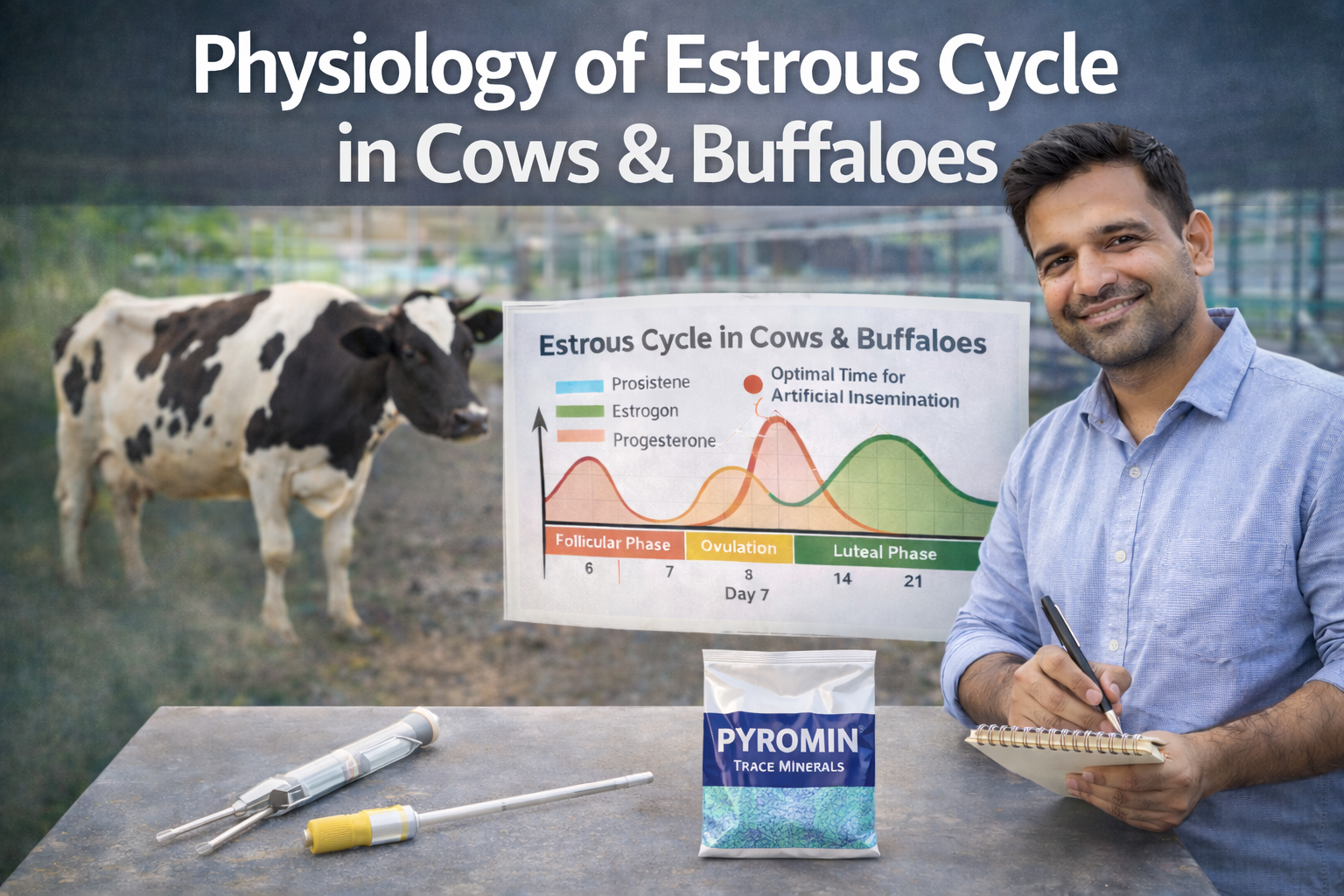
Efficient reproductive management in dairy cattle is not merely a function of heat detection or artificial insemination timing—it is fundamentally a matter of understanding the hormonal orchestration of the estrous cycle. The estrous cycle in cows is a highly regulated, dynamic system governed by the interplay between the hypothalamus, pituitary gland, ovaries, and uterus, with critical roles played by hormones such as luteinizing hormone (LH), estrogen, progesterone, and prostaglandin F2α (PGF2α).
This article explores the functional events of the estrous cycle, the role of the corpus luteum (CL), follicular wave dynamics, and the practical application of hormonal manipulation protocols in modern dairy herd management.
The Bovine Estrous Cycle: Overview and Duration
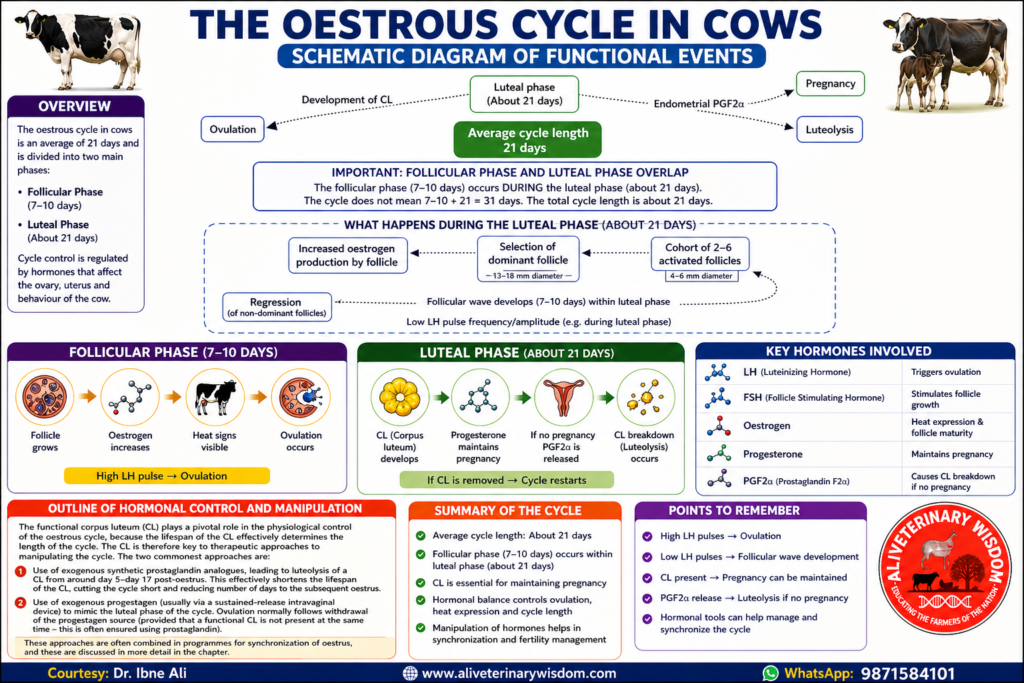
The estrous cycle in cattle typically lasts 21 days, although variations between 18–24 days are common under field conditions. This cycle can be divided into two primary phases:
- Follicular Phase (≈ 7–10 days)
- Luteal Phase (≈ 14 days)
The cycle begins with ovulation, followed by the formation of the corpus luteum, and ends with either pregnancy establishment or luteolysis leading to the next cycle.
Role of the Corpus Luteum (CL) in Cycle Regulation
The corpus luteum (CL) is central to the regulation of the estrous cycle. After ovulation, the ruptured follicle transforms into the CL, which secretes progesterone, the hormone responsible for maintaining the luteal phase.
Key Functions of the CL:
- Maintains uterine quiescence
- Suppresses further ovulation via negative feedback on LH
- Prepares the uterus for potential pregnancy
If pregnancy does not occur, the uterus releases prostaglandin F2α (PGF2α), leading to luteolysis, which marks the regression of the CL and initiates the next cycle.
Follicular Wave Dynamics: The Hidden Driver of Reproductive Efficiency
Unlike earlier assumptions of continuous follicular growth, modern understanding confirms that cows experience 2–3 follicular waves per cycle. Each wave follows a defined sequence:
1. Cohort Recruitment (4–6 mm follicles)
A group of small follicles begins to grow under the influence of FSH (Follicle Stimulating Hormone).
2. Dominant Follicle Selection (≈ 13–18 mm)
One follicle becomes dominant due to increased sensitivity to LH and higher estrogen production.
3. Estrogen Production
The dominant follicle produces estrogen, which:
- Induces estrus behavior
- Triggers LH surge (if progesterone is low)
- Prepares the reproductive tract for fertilization
4. Fate of the Dominant Follicle
- If progesterone is high (luteal phase) → follicle undergoes regression
- If progesterone is low (post-luteolysis) → ovulation occurs
LH Pulse Frequency: The Regulatory Switch
A critical but often overlooked factor in reproductive physiology is the frequency and amplitude of LH pulses.
During Luteal Phase:
- Progesterone suppresses LH pulses
- Result: follicular regression
During Follicular Phase:
- Progesterone drops after luteolysis
- LH pulses increase
- Result: dominant follicle maturation and ovulation
This explains why ovulation does not occur unless the progesterone block is removed.
Luteolysis and Cycle Reset: The Role of Prostaglandin F2α
The uterus plays an active role in regulating the cycle through the release of PGF2α, typically around day 16–17 post-ovulation.
Effects of PGF2α:
- Causes rapid regression of the CL
- Reduces progesterone levels
- Allows LH surge and ovulation
If pregnancy is established, embryonic signals prevent PGF2α release, thereby maintaining the CL.
Practical Application: Estrous Synchronization Protocols
Understanding hormonal control allows for strategic manipulation of the estrous cycle, which is widely used in dairy farms to improve reproductive efficiency.
1. Prostaglandin-Based Protocols
- PGF2α is administered 5–17 days post-estrus
- Causes luteolysis
- Shortens the estrous cycle
- Leads to synchronized heat
👉 Limitation: Only effective if a functional CL is present
2. Progesterone-Based Protocols
- Use of CIDR (Controlled Internal Drug Release devices)
- Mimics luteal phase by supplying exogenous progesterone
- Withdrawal leads to:
- LH surge
- Ovulation
👉 Often combined with PGF2α to ensure CL regression
3. Combined Synchronization Programs
Modern reproductive programs often combine:
- Progesterone (CIDR)
- Prostaglandin (PGF2α)
- GnRH (to control ovulation timing)
These protocols allow for:
- Timed Artificial Insemination (TAI)
- Reduced dependence on heat detection
- Improved conception rates
Why Estrous Cycle Understanding Matters in Dairy Farms
Many reproductive failures in dairy farms are not due to lack of insemination but due to failure of physiological alignment.
Common Field Problems:
- Silent heat
- Repeat breeding
- Anovulation
- Delayed ovulation
These are often linked to:
- Poor LH dynamics
- Persistent CL
- Incomplete luteolysis
- Metabolic stress
Metabolic–Reproductive Link: A Critical Insight
Reproductive physiology does not function in isolation. It is deeply influenced by metabolic status.
Key Interactions:
- Negative Energy Balance → ↓ LH secretion
- High NEFA / Ketones → Impaired follicular development
- Low insulin / IGF-1 → Reduced ovarian response
👉 Result: delayed ovulation, weak estrus, poor fertility
This is why high-producing dairy cows often face reproductive challenges despite proper hormonal protocols.
Advanced Insight: Follicular Waves vs Fixed-Time Breeding
A critical understanding from follicular wave theory is:
👉 At any given time, cows are at different stages of follicular development
This variability is the reason why:
- Heat detection fails
- Conception rates vary
Synchronization protocols essentially aim to:
👉 reset the cycle and align all cows to a predictable ovulation window
Key Takeaways for Practical Dairy Management
- Estrous cycle is hormone-driven, not event-driven
- Corpus luteum determines cycle length and ovulation timing
- Follicular waves continuously occur—only one leads to ovulation
- LH pulse frequency is the deciding factor for ovulation
- Prostaglandin is the natural “reset switch” of the cycle
- Hormonal protocols work only if physiology is understood correctly
- Metabolic health directly impacts reproductive success
Conclusion: From Physiology to Precision Reproduction
The bovine estrous cycle is not a simple repeating pattern but a dynamic hormonal system governed by feedback loops, metabolic status, and uterine signaling. Effective reproductive management requires moving beyond traditional heat detection toward precision synchronization and metabolic alignment.
Understanding the functional events of the estrous cycle, including follicular wave development, corpus luteum dynamics, and hormonal control mechanisms, allows veterinarians and farm managers to design data-driven, predictable, and efficient breeding programs.
In modern dairy systems, reproduction is no longer about chance—it is about controlled physiology.