
The All India Poultry Breeders Association, led by president Bahadur Ali, has asked the government to put stock limits on maize and soybean and to release about 30 lakh tonnes of government maize at concessional rates, as the industry says feed costs have pushed it into one of its worst crises in 50 years. The appeal was reported on 25 November 2026 by Global Agriculture and, citing the Economic Times, by News Minimalist. All figures below are industry estimates as reported by those sources.
Key facts
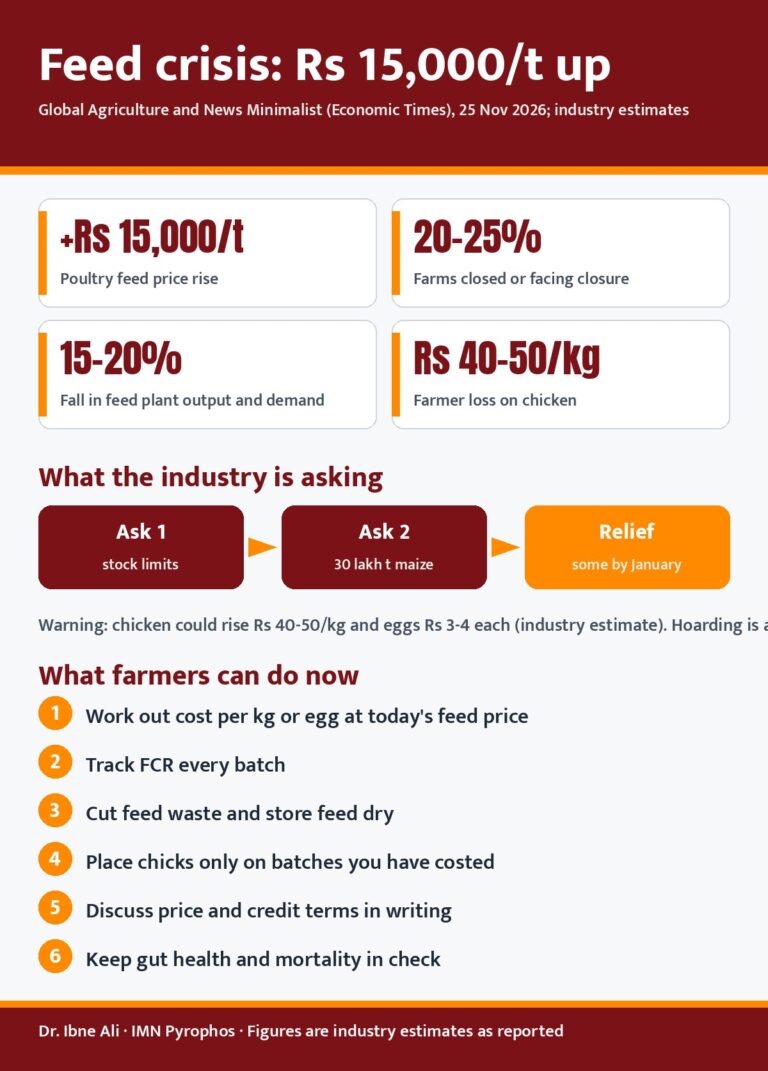
| Item | What was reported |
|---|---|
| Who is asking | All India Poultry Breeders Association, president Bahadur Ali |
| Demand 1 | Stock limits on maize and soybean |
| Demand 2 | About 30 lakh tonnes of government maize at concessional rates |
| Feed price rise | About Rs 15,000 per tonne |
| Farms affected | 20-25% closed or facing closure |
| Feed plants | Production and demand down 15-20% |
| Farmer loss | About Rs 40-50 per kg |
| Possible consumer impact | Chicken up Rs 40-50 per kg, eggs up Rs 3-4 each |
| Regions named | Karnataka, Tamil Nadu, Telangana, Andhra Pradesh, north India |
| Relief | Some easing expected by January |
Why is this happening?
Maize and soybean meal make up most of a typical commercial poultry ration, so any jump in their price flows straight into the cost of every bird and every egg. Mr Ali says crop production is adequate and that official data show enough availability. He blames what he calls artificial scarcity and hoarding. This is an allegation made by the industry body, not a finding, and the reports do not name any trader.
One source adds that higher maize prices have also hurt ethanol makers, with several plants reported to have paused operations. The association compares its request for concessional maize with the support given to ethanol manufacturers. It also says integrated companies’ profits from April to October were wiped out by November.
What it means for poultry farmers
Broiler growers: the association says farmers are losing about Rs 40-50 per kg because the selling price of chicken has not risen enough to cover costlier feed. Feed is the largest running cost, so even a small gap between feed price and bird price hits cash flow quickly.
Layer farmers: if the pressure continues, the body warns eggs could rise by Rs 3-4 each. That is an industry projection, not a market price today.
Closures: an estimated 20-25% of farms are shut or at risk, and feed plants report production and demand down 15-20%. Fewer chicks placed now can mean tighter supply later, which is one reason prices could swing.
Dairy links: Mr Ali also warned that millions of families depending on poultry and dairy-related work are at risk. Dairy farmers buying compound feed should watch the same maize and soybean prices.
What farmers should do now
- Work out your real cost per kg of bird or per egg using today’s feed price, not last month’s.
- Track feed conversion every batch. A small FCR gain saves more when feed is costly.
- Cut waste: fix feeders, avoid spillage, store feed dry and use it fast to prevent mould and loss.
- Avoid panic selling or heavy over-placement. Place chicks only for batches whose economics you have calculated.
- Talk to your integrator or feed supplier about price terms and credit, and get changes in writing.
- Keep gut health and mortality in check, because disease losses are hardest to absorb in a thin-margin period.
- Do not count on a quick fix. Some easing is expected by January, but this is an expectation, not a promise.
FAQ
Will chicken and egg prices rise?
The association warns chicken could rise Rs 40-50 per kg and eggs Rs 3-4 each if costs persist. This is a warning, not a confirmed price.
Has the government agreed to the demands?
The reports we read do not say so. They describe a request for stock limits and about 30 lakh tonnes of concessional maize.
Is the hoarding claim proven?
No. It is the association’s allegation, and the reports do not give evidence or name anyone.
Source: Global Agriculture and News Minimalist (credits Economic Times), 25 Nov 2026. Written by the IMN Pyrophos team in our own words.
ऑल इंडिया पोल्ट्री ब्रीडर्स एसोसिएशन के अध्यक्ष बहादुर अली ने सरकार से मक्का और सोयाबीन पर स्टॉक सीमा लगाने और लगभग 30 लाख टन सरकारी मक्का रियायती दर पर देने की माँग की है। उद्योग का कहना है कि फ़ीड की लागत ने उसे पिछले 50 साल के सबसे बुरे संकटों में से एक में पहुँचा दिया है। यह अपील 25 नवंबर 2026 को Global Agriculture और, Economic Times के हवाले से, News Minimalist ने रिपोर्ट की। नीचे के सभी आँकड़े इन स्रोतों में बताए गए उद्योग के अनुमान हैं।
मुख्य तथ्य
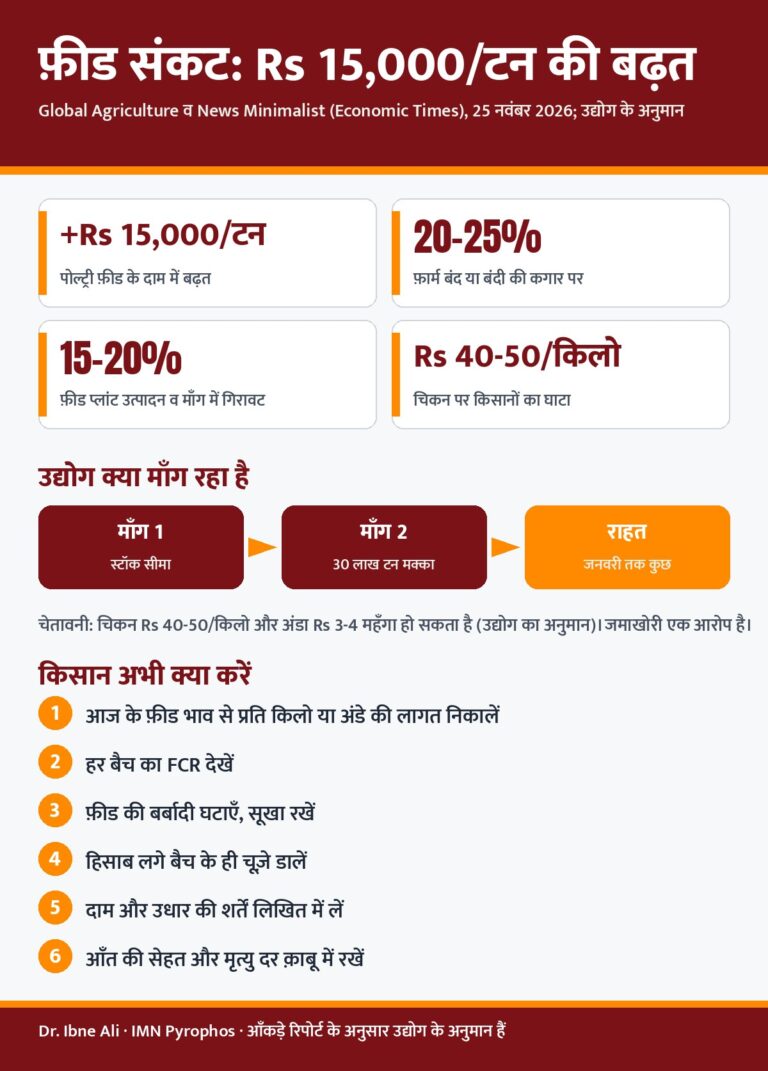
| बिंदु | रिपोर्ट में क्या बताया गया |
|---|---|
| माँग कौन कर रहा है | ऑल इंडिया पोल्ट्री ब्रीडर्स एसोसिएशन, अध्यक्ष बहादुर अली |
| माँग 1 | मक्का और सोयाबीन पर स्टॉक सीमा |
| माँग 2 | लगभग 30 लाख टन सरकारी मक्का रियायती दर पर |
| फ़ीड के दाम में बढ़त | लगभग Rs 15,000 प्रति टन |
| प्रभावित फ़ार्म | 20-25% बंद या बंद होने की कगार पर |
| फ़ीड प्लांट | उत्पादन और माँग 15-20% घटी |
| किसानों का घाटा | लगभग Rs 40-50 प्रति किलो |
| संभावित असर उपभोक्ता पर | चिकन Rs 40-50 प्रति किलो और अंडा Rs 3-4 प्रति अंडा महँगा |
| नामित क्षेत्र | कर्नाटक, तमिलनाडु, तेलंगाना, आंध्र प्रदेश, उत्तर भारत |
| राहत | जनवरी तक कुछ नरमी की उम्मीद |
ऐसा क्यों हो रहा है?
आम व्यावसायिक पोल्ट्री राशन का बड़ा हिस्सा मक्का और सोयाबीन मील से बनता है, इसलिए इनके दाम बढ़ते ही हर चूज़े और हर अंडे की लागत बढ़ जाती है। श्री अली का कहना है कि फ़सल उत्पादन पर्याप्त है और सरकारी आँकड़े भी पर्याप्त उपलब्धता दिखाते हैं। वे इसका कारण कृत्रिम कमी और जमाखोरी बताते हैं। यह उद्योग संगठन का आरोप है, कोई जाँच का नतीजा नहीं, और रिपोर्टों में किसी व्यापारी का नाम नहीं है।
एक स्रोत यह भी जोड़ता है कि मक्का महँगा होने से इथेनॉल बनाने वालों को भी चोट पहुँची है और कई प्लांट बंद होने की बात कही गई है। एसोसिएशन रियायती मक्के की अपनी माँग की तुलना इथेनॉल निर्माताओं को मिली मदद से करती है। वह यह भी कहती है कि अप्रैल से अक्टूबर तक इंटीग्रेटेड कंपनियों का मुनाफ़ा नवंबर तक ख़त्म हो गया।
पोल्ट्री किसानों के लिए इसका मतलब
ब्रॉयलर किसान: एसोसिएशन के अनुसार किसानों को लगभग Rs 40-50 प्रति किलो का घाटा हो रहा है, क्योंकि चिकन का भाव महँगे फ़ीड के हिसाब से नहीं बढ़ा। फ़ीड सबसे बड़ा चालू ख़र्च है, इसलिए फ़ीड और पक्षी के भाव में छोटा सा फ़र्क भी नक़दी पर जल्दी असर डालता है।
लेयर किसान: दबाव जारी रहा तो संगठन के अनुसार अंडा Rs 3-4 प्रति अंडा महँगा हो सकता है। यह उद्योग का अनुमान है, आज का बाज़ार भाव नहीं।
बंदी: अनुमान है कि 20-25% फ़ार्म बंद हैं या ख़तरे में हैं, और फ़ीड प्लांटों में उत्पादन व माँग 15-20% घटी है। अभी कम चूज़े डलने का मतलब आगे आपूर्ति कम होना हो सकता है, इसीलिए भाव में उतार-चढ़ाव संभव है।
डेयरी से जुड़ाव: श्री अली ने चेताया कि पोल्ट्री और डेयरी से जुड़े काम पर निर्भर लाखों परिवार ख़तरे में हैं। कंपाउंड फ़ीड ख़रीदने वाले डेयरी किसान भी मक्का और सोयाबीन के भाव पर नज़र रखें।
किसान अभी क्या करें
- प्रति किलो पक्षी या प्रति अंडा असली लागत निकालें, पिछले महीने का नहीं, आज के फ़ीड भाव से।
- हर बैच का फ़ीड कन्वर्शन देखें। फ़ीड महँगा हो तो FCR में छोटा सुधार भी ज़्यादा बचाता है।
- बर्बादी घटाएँ: फ़ीडर ठीक करें, दाना गिरने से रोकें, फ़ीड सूखा रखें और जल्दी इस्तेमाल करें ताकि फफूँद और नुकसान न हो।
- घबराकर न बेचें और बहुत ज़्यादा चूज़े न डालें। उन्हीं बैच के चूज़े डालें जिनका हिसाब आपने लगा लिया हो।
- इंटीग्रेटर या फ़ीड सप्लायर से दाम की शर्तों और उधार पर बात करें, और बदलाव लिखित में लें।
- आँत की सेहत और मृत्यु दर क़ाबू में रखें, क्योंकि कम मार्जिन के दौर में बीमारी का नुकसान सहना सबसे मुश्किल होता है।
- जल्दी हल की उम्मीद न रखें। जनवरी तक कुछ नरमी की उम्मीद है, पर यह अपेक्षा है, वादा नहीं।
अक्सर पूछे जाने वाले सवाल
क्या चिकन और अंडे के दाम बढ़ेंगे?
एसोसिएशन चेताती है कि लागत बनी रही तो चिकन Rs 40-50 प्रति किलो और अंडा Rs 3-4 प्रति अंडा महँगा हो सकता है। यह चेतावनी है, पक्का भाव नहीं।
क्या सरकार ने माँगें मान ली हैं?
हमने जो रिपोर्टें पढ़ीं उनमें ऐसा नहीं बताया गया। उनमें स्टॉक सीमा और लगभग 30 लाख टन रियायती मक्के की माँग का ज़िक्र है।
क्या जमाखोरी का आरोप साबित है?
नहीं। यह एसोसिएशन का आरोप है, और रिपोर्टों में न सबूत दिया गया है न किसी का नाम।
स्रोत: Global Agriculture और News Minimalist (Economic Times के हवाले से), 25 नवंबर 2026। IMN Pyrophos टीम द्वारा अपने शब्दों में लिखा गया।
All India Poultry Breeders Association ke adhyaksh Bahadur Ali ne sarkar se makka aur soybean par stock seema lagane aur lagbhag 30 lakh ton sarkari makka riyayati dar par dene ki maang ki hai. Udyog ka kehna hai ki feed ki laagat ne use pichhle 50 saal ke sabse bure sankton me se ek me pahuncha diya hai. Ye apeel 25 November 2026 ko Global Agriculture aur, Economic Times ke hawale se, News Minimalist ne report ki. Neeche ke sabhi aankde in sources me bataye gaye udyog ke anumaan hain.
Mukhya tathya
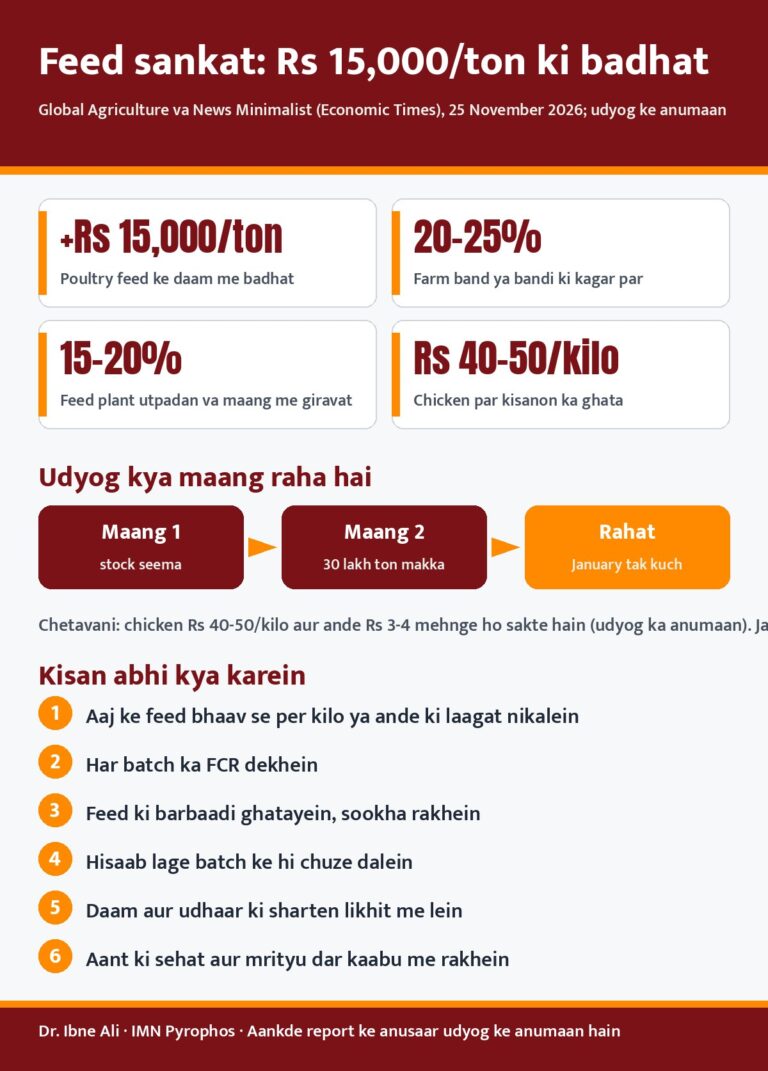
| Bindu | Report me kya bataya gaya |
|---|---|
| Maang kaun kar raha hai | All India Poultry Breeders Association, adhyaksh Bahadur Ali |
| Maang 1 | Makka aur soybean par stock seema |
| Maang 2 | Lagbhag 30 lakh ton sarkari makka riyayati dar par |
| Feed ke daam me badhat | Lagbhag Rs 15,000 per ton |
| Prabhavit farm | 20-25% band ya band hone ki kagar par |
| Feed plant | Utpadan aur maang 15-20% ghati |
| Kisanon ka ghata | Lagbhag Rs 40-50 per kilo |
| Sambhavit asar upbhokta par | Chicken Rs 40-50 per kilo aur ande Rs 3-4 per anda mehnge |
| Naamit kshetra | Karnataka, Tamil Nadu, Telangana, Andhra Pradesh, uttar Bharat |
| Rahat | January tak kuch narmi ki ummeed |
Aisa kyon ho raha hai?
Aam vyavsayik poultry ration ka bada hissa makka aur soybean meal se banta hai, isliye inke daam badhte hi har chuze aur har ande ki laagat badh jaati hai. Shri Ali ka kehna hai ki fasal utpadan paryapt hai aur sarkari aankde bhi paryapt uplabdhta dikhate hain. Ve iska karan kritrim kami aur jamakhori batate hain. Ye udyog sangathan ka aarop hai, koi jaanch ka nateeja nahi, aur reporton me kisi vyapari ka naam nahi hai.
Ek source ye bhi jodta hai ki makka mehnga hone se ethanol banane walon ko bhi chot pahunchi hai aur kai plant band hone ki baat kahi gayi hai. Association riyayati makke ki apni maang ki tulna ethanol nirmataon ko mili madad se karti hai. Wah ye bhi kehti hai ki April se October tak integrated companies ka munafa November tak khatm ho gaya.
Poultry kisanon ke liye iska matlab
Broiler kisan: Association ke anusaar kisanon ko lagbhag Rs 40-50 per kilo ka ghata ho raha hai, kyonki chicken ka bhaav mehnge feed ke hisaab se nahi badha. Feed sabse bada chalu kharch hai, isliye feed aur pakshi ke bhaav me chhota sa fark bhi nakdi par jaldi asar dalta hai.
Layer kisan: Dabav jari raha to sangathan ke anusaar ande Rs 3-4 per anda mehnge ho sakte hain. Ye udyog ka anumaan hai, aaj ka bazaar bhaav nahi.
Bandi: Anumaan hai ki 20-25% farm band hain ya khatre me hain, aur feed plantson me utpadan va maang 15-20% ghati hai. Abhi kam chuze dalne ka matlab aage aapurti kam hona ho sakta hai, isiliye bhaav me utaar-chadhav sambhav hai.
Dairy se judaav: Shri Ali ne chetaya ki poultry aur dairy se jude kaam par nirbhar lakhon parivar khatre me hain. Compound feed kharidne wale dairy kisan bhi makka aur soybean ke bhaav par nazar rakhein.
Kisan abhi kya karein
- Per kilo pakshi ya per ande ki asli laagat nikalein, pichhle mahine ki nahi, aaj ke feed bhaav se.
- Har batch ka feed conversion dekhein. Feed mehnga ho to FCR me chhota sudhar bhi zyada bachata hai.
- Barbaadi ghatayein: feeder theek karein, daana girne se rokein, feed sookha rakhein aur jaldi istemal karein taaki fafoondh aur nuksaan na ho.
- Ghabrakar na bechein aur bahut zyada chuze na dalein. Unhi batch ke chuze dalein jinka hisaab aapne laga liya ho.
- Integrator ya feed supplier se daam ki sharton aur udhaar par baat karein, aur badlaav likhit me lein.
- Aant ki sehat aur mrityu dar kaabu me rakhein, kyonki kam margin ke daur me bimari ka nuksaan sehna sabse mushkil hota hai.
- Jaldi hal ki ummeed na rakhein. January tak kuch narmi ki ummeed hai, par ye apeksha hai, waada nahi.
Aksar poochhe jaane wale sawaal
Kya chicken aur ande ke daam badhenge?
Association chetati hai ki laagat bani rahi to chicken Rs 40-50 per kilo aur ande Rs 3-4 per anda mehnge ho sakte hain. Ye chetavani hai, pakka bhaav nahi.
Kya sarkar ne maangein maan li hain?
Hamne jo reporten padhin unme aisa nahi bataya gaya. Unme stock seema aur lagbhag 30 lakh ton riyayati makke ki maang ka zikr hai.
Kya jamakhori ka aarop saabit hai?
Nahi. Ye Association ka aarop hai, aur reporton me na saboot diya gaya hai na kisi ka naam.
Srot: Global Agriculture aur News Minimalist (Economic Times ke hawale se), 25 November 2026. IMN Pyrophos team dwara apne shabdon me likha gaya.