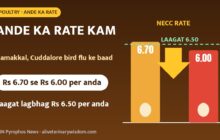

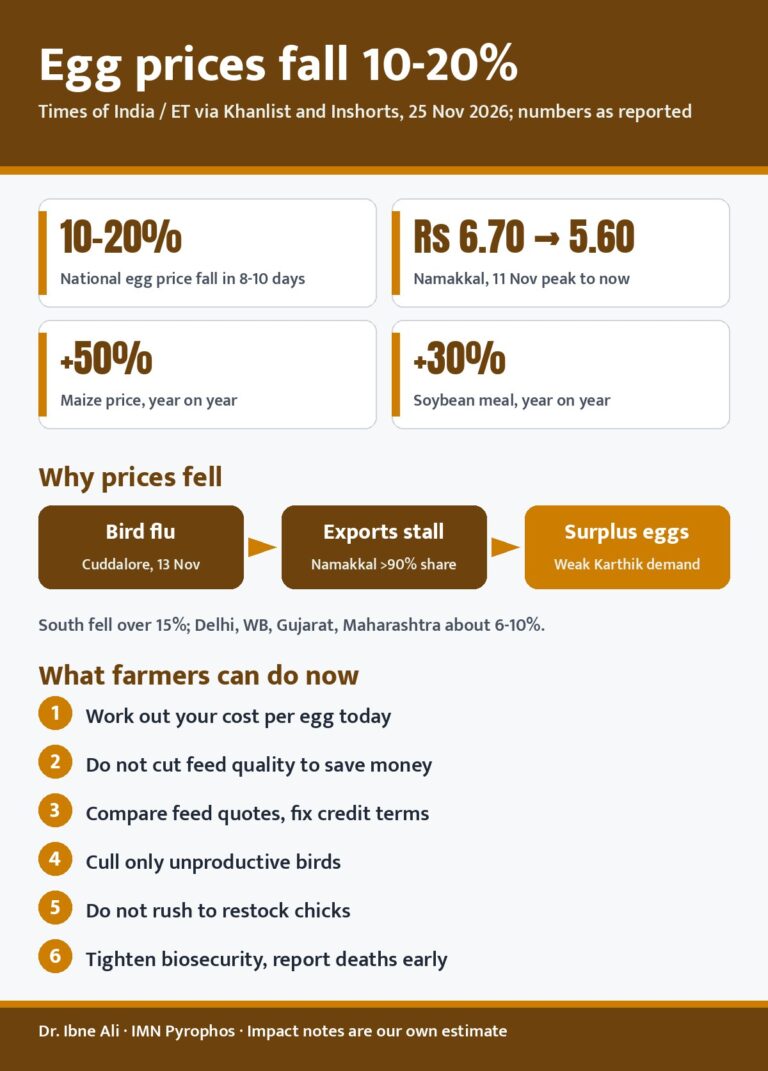
Egg prices across India have fallen 10-20% over the past 8-10 days after bird flu was confirmed in Cuddalore, Tamil Nadu, on 13 November 2026 and exports stalled, pushing surplus eggs into the home market just as seasonal demand is weak. In Namakkal, the main egg hub, the price slid from a peak of Rs 6.70 per egg on 11 November to Rs 5.60. At the same time maize and soybean meal cost far more than a year ago, so layer farmers are squeezed from both sides. The figures below come from a Times of India / Economic Times report and an Inshorts summary, both dated 25 November 2026.
Key facts
| Item | What was reported |
|---|---|
| National egg price | Down 10-20% over 8-10 days |
| Namakkal price | Peak Rs 6.70 on 11 Nov, now Rs 5.60 (reported as about 19% lower) |
| Other markets | Delhi, West Bengal, Gujarat and Maharashtra down about 6-10%; most southern states more than 15% |
| Bird flu | Confirmed in Cuddalore on 13 Nov; culling and a 90-day ban on raising poultry in the affected area |
| Namakkal share of exports | More than 90% of India’s egg exports |
| Maize and soybean meal | Maize up about 50% and soybean meal about 30% year on year |
| Chicken cost vs farm-gate | Cost above Rs 120/kg, farmers get about Rs 80/kg (KG Anand, Venkateshwara Hatcheries) |
Why are egg prices falling?
Two things hit at once. First, the Cuddalore outbreak disrupted exports. Namakkal supplies over 90% of India’s egg exports, so when overseas orders stall, eggs meant for shipment stay at home and add to local supply. Second, demand is soft in the south during the month of Karthik, when many families eat less non-vegetarian food. More eggs and fewer buyers push the price down, which is why southern states fell more than 15% while Delhi, West Bengal, Gujarat and Maharashtra fell only about 6-10%.
Sanjeev Chintawar of the National Egg Coordination Committee (NECC) spoke about the export slump, saying shipments were about one crore eggs a day last year. The report also quotes a very low current figure, but it looks like a misprint, so we have left it out. For the earlier rate cuts and export numbers, see our news item on the Namakkal egg rate cut after the Cuddalore bird flu, and for how a previous export shock hit prices, read the Namakkal egg price crisis explained.
A note on the numbers: Rs 6.70 to Rs 5.60 is a fall of Rs 1.10. The report calls this about 19%; our own arithmetic on the peak price gives roughly 16%, so the exact percentage depends on how it was measured.
What it means for poultry farmers
Layer farmers: a lower egg price meets a higher feed bill. Maize is up about 50% and soybean meal about 30% from a year ago, and these two make up most of a layer ration. Many farmers had trimmed production before Diwali to manage feed cost and planned to raise output in winter, which is exactly when prices have dropped. Chintawar also said feed suppliers are refusing credit, which can push farmers to cut feed quality, and weaker nutrition hurts production and shell quality.
Broiler farmers: KG Anand of Venkateshwara Hatcheries said chicken costs more than Rs 120/kg to produce while farmers get about Rs 80/kg, and said “farmers are bleeding”. Divya Kumar Gulati of the Compound Livestock Feed Manufacturers Association of India said “everyone is making losses”.
Farms near the affected area: the 90-day ban on raising poultry in the affected zone is a reminder that biosecurity is not optional. No recovery date has been given for prices.
What farmers should do now
- Work out your cost per egg today. Add feed, labour, medicine and electricity, divide by eggs. Compare it with the Rs 5.60 Namakkal level.
- Do not cut feed quality to save money. Poor nutrition lowers egg numbers and shell quality, which costs more than it saves.
- Buy feed smartly. Compare quotes, avoid panic stocking, and negotiate payment terms before suppliers stop credit.
- Cull only the unproductive birds. Remove non-layers and poor performers, but avoid selling good birds in distress.
- Do not rush to restock. Placing new chicks now adds eggs to a weak market months later; plan placements against realistic prices.
- Tighten biosecurity. Control visitors, vehicles and crates, keep wild birds away, and report unusual deaths quickly to the animal husbandry department.
- Track daily rates. Watch your local market and the NECC rate before you decide when to sell.
FAQ
Why are eggs getting cheaper when feed costs more?
Egg prices follow supply and demand, not farm costs. Stalled exports and weak seasonal demand pushed prices down while maize and soybean meal stayed expensive, so farm margins have shrunk.
How long will low egg prices last?
The report gives no forecast. Much depends on when exports restart and how demand recovers after Karthik, so keep watching daily rates.
Is this a food safety warning about eggs?
No. This item is about prices and farm economics. For health advice, follow your state animal husbandry and health departments, and cook eggs and poultry thoroughly.
Source: Khanlist (credits Times of India / Economic Times) and Inshorts, 25 Nov 2026. Written by the IMN Pyrophos team in our own words.
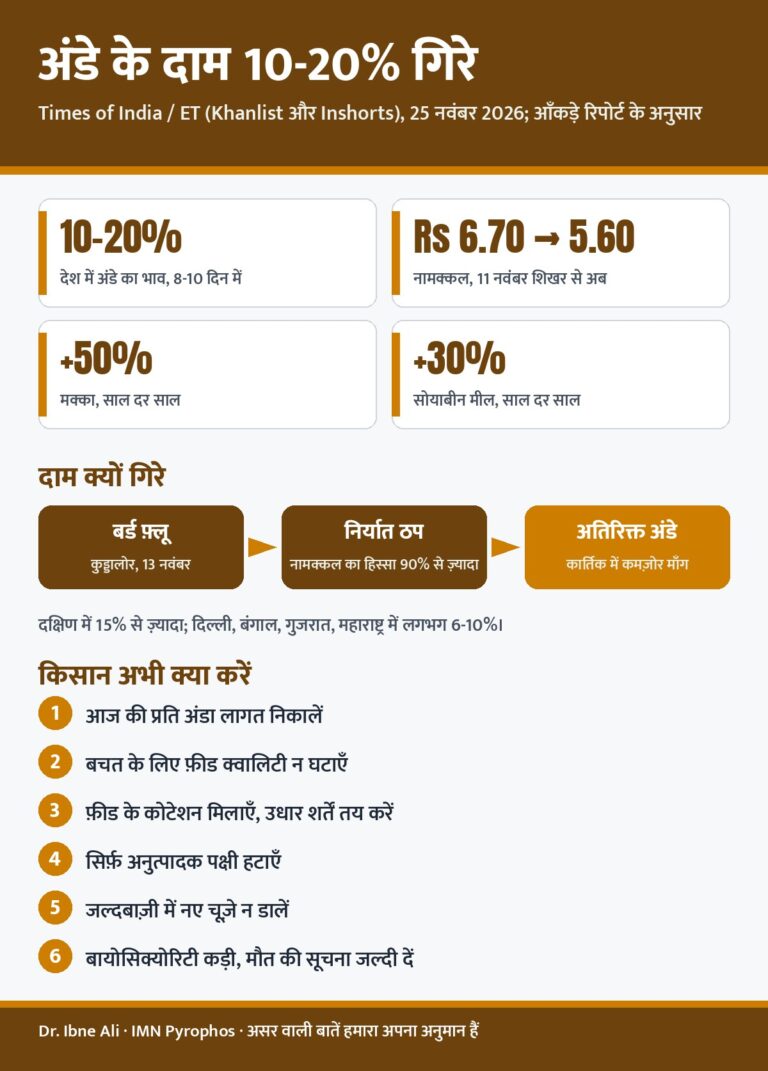
तमिलनाडु के कुड्डालोर में 13 नवंबर 2026 को बर्ड फ़्लू की पुष्टि और निर्यात रुकने के बाद पिछले 8-10 दिनों में देश भर में अंडे के दाम 10-20% गिर गए हैं। निर्यात वाले अतिरिक्त अंडे घरेलू बाज़ार में आ गए हैं और मौसमी माँग भी कमज़ोर है। मुख्य अंडा केंद्र नामक्कल में भाव 11 नवंबर के शिखर Rs 6.70 प्रति अंडा से घटकर Rs 5.60 रह गया। साथ ही मक्का और सोयाबीन मील साल भर पहले से काफ़ी महँगे हैं, इसलिए लेयर किसान दोनों तरफ़ से दबे हैं। नीचे के आँकड़े Times of India / Economic Times की रिपोर्ट और Inshorts के सारांश से हैं, दोनों 25 नवंबर 2026 के।
मुख्य तथ्य
| बिंदु | रिपोर्ट में क्या बताया गया |
|---|---|
| देश में अंडे का भाव | 8-10 दिन में 10-20% गिरा |
| नामक्कल भाव | 11 नवंबर को शिखर Rs 6.70, अब Rs 5.60 (रिपोर्ट के अनुसार लगभग 19% कम) |
| दूसरे बाज़ार | दिल्ली, पश्चिम बंगाल, गुजरात, महाराष्ट्र में लगभग 6-10% की गिरावट; ज़्यादातर दक्षिणी राज्यों में 15% से ज़्यादा |
| बर्ड फ़्लू | 13 नवंबर को कुड्डालोर में पुष्टि; पक्षियों की culling और प्रभावित इलाके में 90 दिन तक पोल्ट्री पालने पर रोक |
| निर्यात में नामक्कल का हिस्सा | भारत के अंडा निर्यात का 90% से ज़्यादा |
| मक्का और सोयाबीन मील | साल दर साल मक्का लगभग 50% और सोयाबीन मील लगभग 30% महँगा |
| चिकन लागत बनाम फ़ार्म भाव | लागत Rs 120/किलो से ऊपर, किसान को लगभग Rs 80/किलो (केजी आनंद, Venkateshwara Hatcheries) |
अंडे के दाम क्यों गिर रहे हैं?
दो बातें एक साथ हुईं। पहली, कुड्डालोर के प्रकोप से निर्यात में रुकावट आई। भारत के 90% से ज़्यादा अंडा निर्यात नामक्कल से होते हैं, इसलिए विदेशी ऑर्डर रुकने पर शिपमेंट वाले अंडे देश में ही रह गए और स्थानीय आपूर्ति बढ़ गई। दूसरी, दक्षिण में कार्तिक माह में माँग कमज़ोर रहती है क्योंकि कई परिवार माँसाहार कम करते हैं। ज़्यादा अंडे और कम ख़रीदार से भाव गिरता है, इसीलिए दक्षिणी राज्यों में 15% से ज़्यादा गिरावट आई जबकि दिल्ली, पश्चिम बंगाल, गुजरात और महाराष्ट्र में लगभग 6-10%।
नेशनल एग कोऑर्डिनेशन कमेटी (NECC) के संजीव चिंतावार ने निर्यात की सुस्ती पर बात की और बताया कि पिछले साल लगभग एक करोड़ अंडे रोज़ जाते थे। रिपोर्ट में मौजूदा आँकड़ा बहुत कम छपा है, पर वह छपाई की भूल लगती है, इसलिए हमने उसे छोड़ दिया है। पहले की भाव-कटौती और निर्यात आँकड़ों के लिए हमारी ख़बर कुड्डालोर बर्ड फ़्लू के बाद नामक्कल अंडा भाव में कटौती देखें, और पिछले निर्यात झटके का असर जानने के लिए नामक्कल अंडा भाव संकट पढ़ें। वह सब हम यहाँ दोहरा नहीं रहे।
आँकड़ों पर एक बात: Rs 6.70 से Rs 5.60 यानी Rs 1.10 की गिरावट। रिपोर्ट इसे लगभग 19% कहती है; शिखर भाव पर हमारा अपना हिसाब लगभग 16% देता है, यानी प्रतिशत इस पर निर्भर है कि कैसे नापा गया। Rs 1.10 की गिरावट को पक्का आँकड़ा मानें।
पोल्ट्री किसानों के लिए इसका मतलब
लेयर किसान: अंडे का भाव कम और फ़ीड का बिल ज़्यादा। मक्का साल भर पहले से लगभग 50% और सोयाबीन मील लगभग 30% महँगा है, और ये दोनों लेयर राशन का बड़ा हिस्सा हैं। कई किसानों ने फ़ीड लागत सँभालने के लिए दिवाली से पहले उत्पादन घटाया था और सर्दियों में बढ़ाने की योजना थी, ठीक तभी भाव गिर गए। चिंतावार ने यह भी कहा कि फ़ीड सप्लायर उधार देने से मना कर रहे हैं, जिससे किसान फ़ीड की क्वालिटी घटाने को मजबूर हो सकते हैं, और कमज़ोर पोषण से उत्पादन और खोल की गुणवत्ता गिरती है।
ब्रॉयलर किसान: Venkateshwara Hatcheries के केजी आनंद ने बताया कि चिकन की उत्पादन लागत Rs 120/किलो से ज़्यादा है जबकि किसान को लगभग Rs 80/किलो मिलता है, और कहा कि “किसान ख़ून के आँसू रो रहे हैं”। कंपाउंड लाइवस्टॉक फ़ीड मैन्युफ़ैक्चरर्स एसोसिएशन ऑफ़ इंडिया के दिव्य कुमार गुलाटी ने कहा कि “सबको नुकसान हो रहा है”।
प्रभावित इलाके के पास के फ़ार्म: प्रभावित क्षेत्र में 90 दिन की पाबंदी याद दिलाती है कि बायोसिक्योरिटी वैकल्पिक नहीं है। हमारा अपना अनुमान, रिपोर्ट का नहीं: निर्यात अटके रहने तक भाव नरम रह सकते हैं, पर सुधार की कोई तारीख़ किसी ने नहीं बताई।
किसान अभी क्या करें
- आज की प्रति अंडा लागत निकालें। फ़ीड, मज़दूरी, दवा और बिजली जोड़कर अंडों से भाग दें, फिर नामक्कल के Rs 5.60 से तुलना करें।
- पैसे बचाने के लिए फ़ीड की क्वालिटी न घटाएँ। कमज़ोर पोषण से अंडे और खोल की क्वालिटी गिरती है, जो बचत से ज़्यादा महँगा पड़ता है।
- फ़ीड समझदारी से ख़रीदें। कई कोटेशन लें, घबराकर स्टॉक न भरें, और सप्लायर के उधार रोकने से पहले भुगतान की शर्तें तय करें।
- सिर्फ़ अनुत्पादक पक्षी हटाएँ। नॉन-लेयर और कमज़ोर पक्षी निकालें, पर अच्छे पक्षी मजबूरी में न बेचें।
- जल्दबाज़ी में नए चूज़े न डालें। अभी चूज़े डालने से कुछ महीने बाद कमज़ोर बाज़ार में और अंडे आएँगे; प्लेसमेंट वास्तविक भाव के हिसाब से तय करें।
- बायोसिक्योरिटी कड़ी करें। आगंतुक, गाड़ियाँ और क्रेट नियंत्रित करें, जंगली पक्षियों को दूर रखें, और असामान्य मौत की सूचना पशुपालन विभाग को जल्दी दें।
- रोज़ के भाव देखें। बेचने का समय तय करने से पहले अपने स्थानीय बाज़ार और NECC का भाव देखें।
अक्सर पूछे जाने वाले सवाल
फ़ीड महँगा है तो अंडे सस्ते क्यों हो रहे हैं?
अंडे का भाव माँग और आपूर्ति से तय होता है, फ़ार्म की लागत से नहीं। रुके निर्यात और कमज़ोर मौसमी माँग से भाव गिरे, जबकि मक्का और सोयाबीन मील महँगे बने रहे, इसलिए फ़ार्म का मार्जिन घट गया।
कम भाव कितने समय रहेंगे?
रिपोर्ट में कोई अनुमान नहीं है। काफ़ी कुछ इस पर निर्भर है कि निर्यात कब शुरू होता है और कार्तिक के बाद माँग कैसे लौटती है, इसलिए रोज़ के भाव देखते रहें।
क्या यह अंडों के बारे में खाद्य सुरक्षा की चेतावनी है?
नहीं। यह ख़बर दाम और फ़ार्म अर्थशास्त्र की है। स्वास्थ्य सलाह के लिए अपने राज्य के पशुपालन और स्वास्थ्य विभाग की बात मानें, और अंडे व पोल्ट्री अच्छी तरह पकाकर खाएँ।
स्रोत: Khanlist (Times of India / Economic Times का हवाला) और Inshorts, 25 नवंबर 2026। IMN Pyrophos टीम द्वारा अपने शब्दों में लिखा गया।
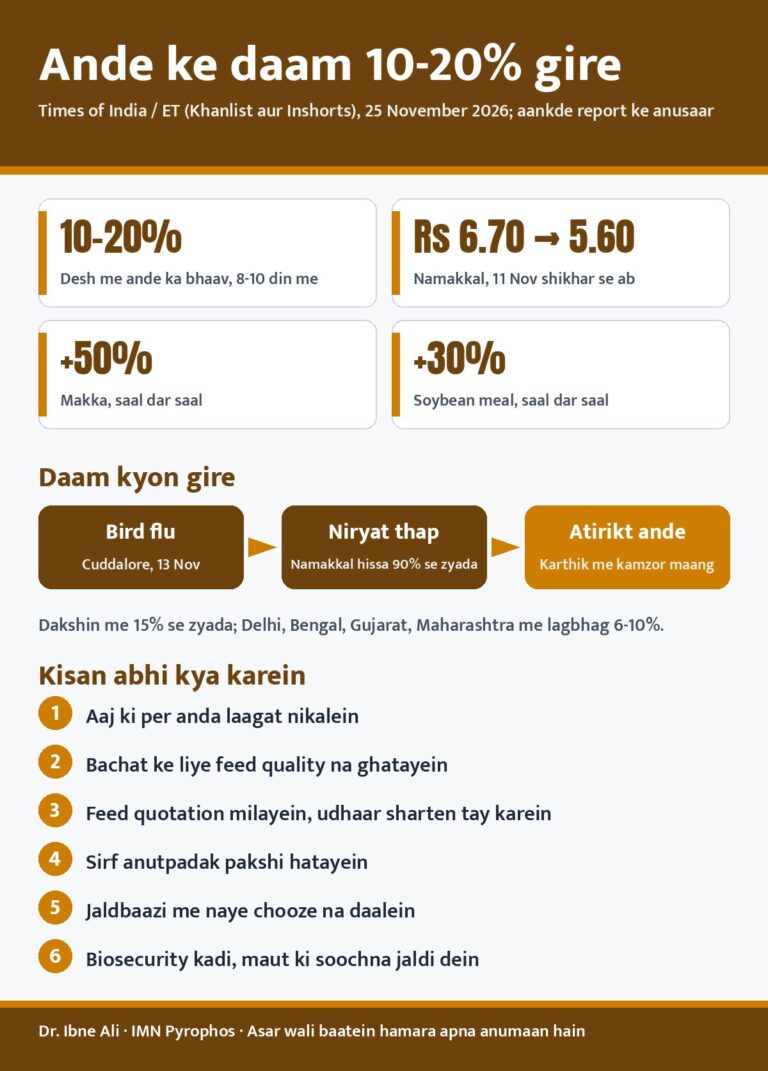
Tamil Nadu ke Cuddalore me 13 November 2026 ko bird flu ki pushti aur niryat rukne ke baad pichhle 8-10 dinon me desh bhar me ande ke daam 10-20% gir gaye hain. Niryat wale atirikt ande gharelu bazaar me aa gaye hain aur mausmi maang bhi kamzor hai. Mukhya anda kendra Namakkal me bhaav 11 November ke shikhar Rs 6.70 per anda se ghatkar Rs 5.60 reh gaya. Saath hi makka aur soybean meal saal bhar pehle se kaafi mehnge hain, isliye layer kisan dono taraf se dabe hain. Neeche ke aankde Times of India / Economic Times ki report aur Inshorts ke saaransh se hain, dono 25 November 2026 ke.
Mukhya tathya
| Bindu | Report me kya bataya gaya |
|---|---|
| Desh me ande ka bhaav | 8-10 din me 10-20% gira |
| Namakkal bhaav | 11 November ko shikhar Rs 6.70, ab Rs 5.60 (report ke anusaar lagbhag 19% kam) |
| Doosre bazaar | Delhi, West Bengal, Gujarat, Maharashtra me lagbhag 6-10% ki girawat; zyadatar dakshini rajyon me 15% se zyada |
| Bird flu | 13 November ko Cuddalore me pushti; pakshiyon ki culling aur prabhavit ilaake me 90 din tak poultry paalne par rok |
| Niryat me Namakkal ka hissa | Bharat ke anda niryat ka 90% se zyada |
| Makka aur soybean meal | Saal dar saal makka lagbhag 50% aur soybean meal lagbhag 30% mehnga |
| Chicken laagat banam farm bhaav | Laagat Rs 120/kg se upar, kisan ko lagbhag Rs 80/kg (KG Anand, Venkateshwara Hatcheries) |
Ande ke daam kyon gir rahe hain?
Do baatein ek saath huin. Pehli, Cuddalore ke prakop se niryat me rukawat aayi. Bharat ke 90% se zyada anda niryat Namakkal se hote hain, isliye videshi order rukne par shipment wale ande desh me hi reh gaye aur sthaniya aapurti badh gayi. Doosri, dakshin me Karthik maah me maang kamzor rehti hai kyonki kai parivaar maansahaar kam karte hain. Zyada ande aur kam kharidaar se bhaav girta hai, isiliye dakshini rajyon me 15% se zyada girawat aayi jabki Delhi, West Bengal, Gujarat aur Maharashtra me lagbhag 6-10%.
National Egg Coordination Committee (NECC) ke Sanjeev Chintawar ne niryat ki sustee par baat ki aur bataya ki pichhle saal lagbhag ek crore ande roz jaate the. Report me maujooda aankda bahut kam chhapa hai, par wo chhapai ki bhool lagti hai, isliye humne use chhod diya hai. Pehle ki bhaav-katauti aur niryat aankdon ke liye hamari khabar Cuddalore bird flu ke baad Namakkal anda bhaav me katauti dekhein, aur pichhle niryat jhatke ka asar jaanne ke liye Namakkal anda bhaav sankat padhein. Wo sab hum yahan dohra nahi rahe.
Aankdon par ek baat: Rs 6.70 se Rs 5.60 yaani Rs 1.10 ki girawat. Report ise lagbhag 19% kehti hai; shikhar bhaav par hamara apna hisaab lagbhag 16% deta hai, yaani pratishat is par nirbhar hai ki kaise naapa gaya. Rs 1.10 ki girawat ko pakka aankda maanein.
Poultry kisanon ke liye iska matlab
Layer kisan: ande ka bhaav kam aur feed ka bill zyada. Makka saal bhar pehle se lagbhag 50% aur soybean meal lagbhag 30% mehnga hai, aur ye dono layer ration ka bada hissa hain. Kai kisanon ne feed laagat sambhalne ke liye Diwali se pehle utpadan ghataya tha aur sardiyon me badhane ki yojana thi, theek tabhi bhaav gir gaye. Chintawar ne ye bhi kaha ki feed supplier udhaar dene se mana kar rahe hain, jisse kisan feed ki quality ghatane ko majboor ho sakte hain, aur kamzor poshan se utpadan aur khol ki gunwatta girti hai.
Broiler kisan: Venkateshwara Hatcheries ke KG Anand ne bataya ki chicken ki utpadan laagat Rs 120/kg se zyada hai jabki kisan ko lagbhag Rs 80/kg milta hai, aur kaha ki “kisan khoon ke aansoo ro rahe hain”. Compound Livestock Feed Manufacturers Association of India ke Divya Kumar Gulati ne kaha ki “sabko nuksaan ho raha hai”.
Prabhavit ilaake ke paas ke farm: prabhavit kshetra me 90 din ki paabandi yaad dilati hai ki biosecurity vaikalpik nahi hai. Hamara apna anumaan, report ka nahi: niryat atke rehne tak bhaav narm reh sakte hain, par sudhaar ki koi tareekh kisi ne nahi batayi.
Kisan abhi kya karein
- Aaj ki per anda laagat nikalein. Feed, mazdoori, dawa aur bijli jodkar andon se bhaag dein, phir Namakkal ke Rs 5.60 se tulna karein.
- Paise bachane ke liye feed ki quality na ghatayein. Kamzor poshan se ande aur khol ki quality girti hai, jo bachat se zyada mehnga padta hai.
- Feed samajhdari se kharidein. Kai quotation lein, ghabrakar stock na bharein, aur supplier ke udhaar rokne se pehle bhugtaan ki sharten tay karein.
- Sirf anutpadak pakshi hatayein. Non-layer aur kamzor pakshi nikalein, par achhe pakshi majboori me na bechein.
- Jaldbaazi me naye chooze na daalein. Abhi chooze daalne se kuch mahine baad kamzor bazaar me aur ande aayenge; placement vaastavik bhaav ke hisaab se tay karein.
- Biosecurity kadi karein. Aagantuk, gaadiyan aur crate niyantrit karein, jangli pakshiyon ko door rakhein, aur asamanya maut ki soochna pashupalan vibhag ko jaldi dein.
- Roz ke bhaav dekhein. Bechne ka samay tay karne se pehle apne sthaniya bazaar aur NECC ka bhaav dekhein.
Aksar poochhe jaane wale sawaal
Feed mehnga hai to ande sasta kyon ho rahe hain?
Ande ka bhaav maang aur aapurti se tay hota hai, farm ki laagat se nahi. Ruke niryat aur kamzor mausmi maang se bhaav gire, jabki makka aur soybean meal mehnge bane rahe, isliye farm ka margin ghat gaya.
Kam bhaav kitne samay rahenge?
Report me koi anumaan nahi hai. Kaafi kuch is par nirbhar hai ki niryat kab shuru hota hai aur Karthik ke baad maang kaise lautti hai, isliye roz ke bhaav dekhte rahein.
Kya ye andon ke baare me khadya suraksha ki chetawani hai?
Nahi. Ye khabar daam aur farm arthshastra ki hai. Swasthya salah ke liye apne rajya ke pashupalan aur swasthya vibhag ki baat manein, aur ande va poultry achhe se pakakar khayein.
Srot: Khanlist (Times of India / Economic Times ka hawala) aur Inshorts, 25 November 2026. IMN Pyrophos team dwara apne shabdon me likha gaya.