
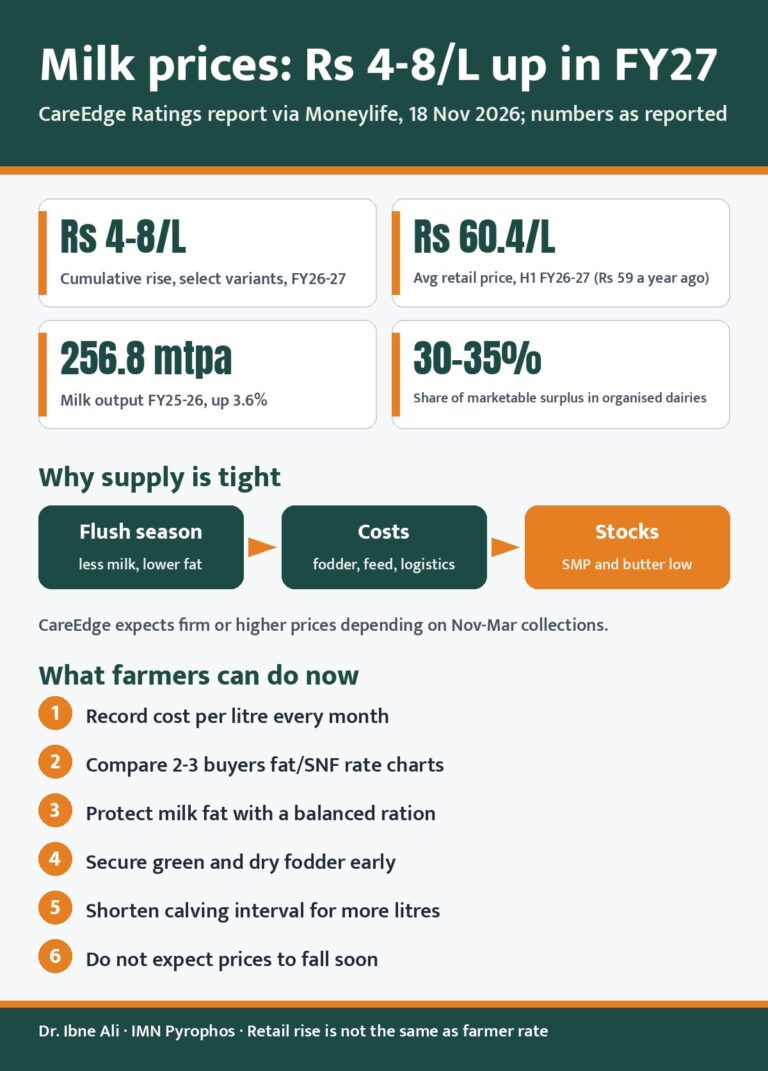
Milk prices have risen by a cumulative Rs 4 to Rs 8 per litre across select variants in FY26-27 so far, and supply is still tight even in the winter flush season, according to CareEdge Ratings. The report, covered by Moneylife on 18 November 2026, says the latest round announced in November added Rs 2 to Rs 6 per litre, after an earlier Rs 2 per litre rise by Amul and Mother Dairy in May. CareEdge expects prices to stay firm or rise further through FY26-27. All numbers below are as reported by the source.
Key facts
| Item | What was reported |
|---|---|
| Cumulative rise, FY26-27 | Rs 4 to Rs 8 per litre across select variants |
| Latest round (November) | Rs 2 to Rs 6 per litre |
| Earlier round (May) | Rs 2 per litre by Amul and Mother Dairy |
| Average retail price | About Rs 42.8/L (FY18-19), Rs 59.1 (FY25-26), Rs 60.4 in H1 FY26-27 vs Rs 59 in H1 FY25-26 |
| Milk production | 256.8 million tonnes (mtpa) in FY25-26, up 3.6% from 247.9 in FY24-25; 146.3 in FY14-15 |
| Availability per person | About 498 g a day, against 485 |
| International SMP | About US$3,850 a tonne in October, roughly 36% above a year earlier |
| Organised share | Only about 30-35% of marketable surplus |
| Announced capex | Above Rs 15,000 crore for FY27-FY29, with revenue potential above Rs 40,000 crore; capacity utilisation about 80% |
Why is supply tight in winter?
Winter is normally the flush season, when milk is plentiful, so prices tend to ease. The report says that has not happened. It points to tighter supply, lower milk fat in some procurement regions, the animals’ biological cycle, and higher fodder, feed, processing, packaging and logistics costs. Stocks are also low: skimmed milk powder (SMP) and butter inventories are small, which leaves dairies little cushion. Dairies that make powder and butter from surplus in the flush season rebuild these stocks, and until they do, liquid milk stays firm.
What it means for farmers
Better rates are possible, but not guaranteed. The report talks about retail prices and dairy-level costs. How much reaches the farmer depends on your dairy or society, so compare your own payment slips month by month.
Our own estimate: average retail price in H1 FY26-27 (Rs 60.4) is only about 2.4% above the same period last year (Rs 59), by our arithmetic. Over the seven years from FY18-19 to FY25-26 the average rose about 38% (Rs 42.8 to Rs 59.1). The recent Rs 4-8 rises are larger than that average year-on-year gain suggests, because they apply to select variants. Treat this as a rough reading, not a forecast.
Costs are rising too. The same reasons that lift milk prices, fodder, feed and logistics, also raise your own cost per litre. A higher rate helps only if your cost per litre does not rise as fast.
Unorganised sellers. Because organised dairies handle only about 30-35% of marketable surplus, many farmers sell to local buyers. Price signals from big dairies can take time to reach them, so ask around before accepting a rate.
What farmers should do now
- Record your cost per litre every month. Include feed, fodder, minerals, labour and vet cost.
- Compare buyers. Ask two or three collection points for their fat and SNF rate chart before choosing.
- Protect milk fat. Lower fat in some regions is cited as a cause of tightness; a balanced ration with good fibre and clean water helps keep fat up.
- Secure fodder early. Buy or grow green and dry fodder ahead of the lean months, because fodder cost is named as a driver.
- Look after fertility and calving gaps. A short calving interval gives more litres per year, which is the steadiest way to gain.
- Do not expect prices to fall soon. CareEdge expects firm or higher prices, depending on November to March collections and inventory rebuilding.
FAQ
Who is CareEdge?
CareEdge Ratings is a credit rating agency. This item is based on its report as covered by Moneylife.
Will farmers get the full Rs 4-8 rise?
The figure is a retail price rise on select variants. Farmer payment is set separately by each dairy, so check your own rate.
Is the 2.4% figure from the report?
No. It is our own calculation from the two reported averages and is only an estimate.
Source: Moneylife (report by CareEdge Ratings), 18 Nov 2026. Written by the IMN Pyrophos team in our own words.
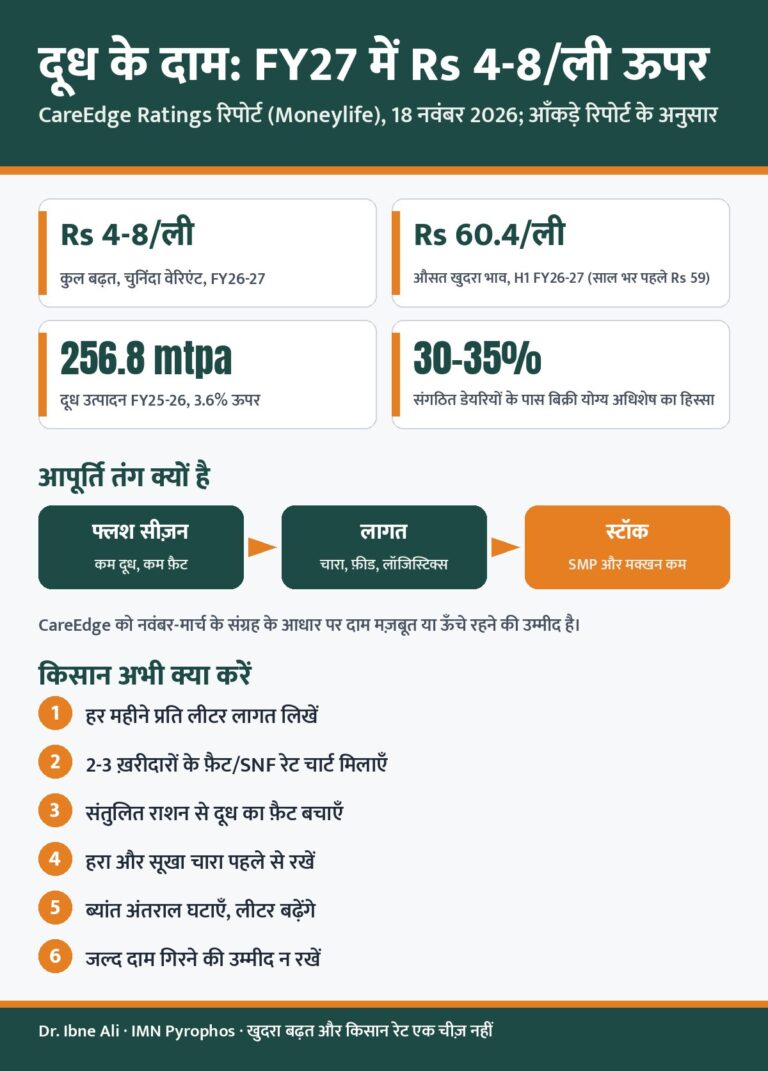
CareEdge Ratings के अनुसार FY26-27 में अब तक चुनिंदा वेरिएंट पर दूध के दाम कुल मिलाकर Rs 4 से Rs 8 प्रति लीटर बढ़ चुके हैं, और सर्दियों के फ्लश सीज़न में भी आपूर्ति तंग है। Moneylife ने 18 नवंबर 2026 को यह रिपोर्ट कवर की। उसके अनुसार नवंबर में घोषित ताज़ा दौर में Rs 2 से Rs 6 प्रति लीटर की बढ़त हुई, जबकि मई में Amul और Mother Dairy ने Rs 2 प्रति लीटर बढ़ाए थे। CareEdge को उम्मीद है कि FY26-27 में दाम मज़बूत रहेंगे या और बढ़ेंगे। नीचे सभी आँकड़े स्रोत के अनुसार हैं।
मुख्य तथ्य
| बिंदु | रिपोर्ट में क्या बताया गया |
|---|---|
| FY26-27 में कुल बढ़त | चुनिंदा वेरिएंट पर Rs 4 से Rs 8 प्रति लीटर |
| ताज़ा दौर (नवंबर) | Rs 2 से Rs 6 प्रति लीटर |
| पिछला दौर (मई) | Amul और Mother Dairy द्वारा Rs 2 प्रति लीटर |
| औसत खुदरा भाव | लगभग Rs 42.8/ली (FY18-19), Rs 59.1 (FY25-26), H1 FY26-27 में Rs 60.4 बनाम H1 FY25-26 में Rs 59 |
| दूध उत्पादन | FY25-26 में 256.8 मिलियन टन (mtpa), FY24-25 के 247.9 से 3.6% ज़्यादा; FY14-15 में 146.3 |
| प्रति व्यक्ति उपलब्धता | लगभग 498 ग्राम रोज़, पहले 485 |
| अंतरराष्ट्रीय SMP | अक्टूबर में लगभग US$3,850 प्रति टन, साल भर पहले से करीब 36% ऊपर |
| संगठित क्षेत्र का हिस्सा | बिक्री योग्य अधिशेष का सिर्फ़ लगभग 30-35% |
| घोषित पूँजीगत निवेश | FY27-FY29 के लिए Rs 15,000 करोड़ से ऊपर, राजस्व संभावना Rs 40,000 करोड़ से ऊपर; क्षमता उपयोग लगभग 80% |
सर्दियों में आपूर्ति तंग क्यों है?
सर्दी आमतौर पर फ्लश सीज़न होता है, जब दूध भरपूर होता है और दाम नरम पड़ते हैं। रिपोर्ट के अनुसार इस बार ऐसा नहीं हुआ। इसके कारण बताए गए हैं: कम आपूर्ति, कुछ ख़रीद क्षेत्रों में दूध में कम फ़ैट, पशुओं का जैविक चक्र, और चारा, फ़ीड, प्रोसेसिंग, पैकेजिंग व लॉजिस्टिक्स की ऊँची लागत। भंडार भी कम हैं: स्किम्ड मिल्क पाउडर (SMP) और मक्खन का स्टॉक कम है, जिससे डेयरियों के पास गुंजाइश नहीं बचती। फ्लश सीज़न के अधिशेष से पाउडर और मक्खन बनाकर डेयरियाँ ये स्टॉक दोबारा भरती हैं, और जब तक ऐसा नहीं होता, तरल दूध के दाम मज़बूत रहते हैं।
किसानों के लिए इसका मतलब
बेहतर रेट संभव है, पर पक्का नहीं। रिपोर्ट खुदरा दाम और डेयरी स्तर की लागत की बात करती है। किसान तक कितना पहुँचेगा, यह आपकी डेयरी या समिति पर निर्भर है, इसलिए हर महीने अपनी भुगतान पर्चियाँ मिलाएँ।
हमारा अपना अनुमान: H1 FY26-27 का औसत खुदरा भाव (Rs 60.4) पिछले साल की इसी अवधि (Rs 59) से हमारे हिसाब से सिर्फ़ लगभग 2.4% ऊपर है। FY18-19 से FY25-26 के सात सालों में औसत लगभग 38% बढ़ा (Rs 42.8 से Rs 59.1)। हाल की Rs 4-8 की बढ़तें इस औसत सालाना बढ़त से बड़ी दिखती हैं, क्योंकि वे चुनिंदा वेरिएंट पर हैं। इसे मोटा अंदाज़ा समझें, पूर्वानुमान नहीं।
लागत भी बढ़ रही है। जिन वजहों से दूध महँगा हो रहा है, यानी चारा, फ़ीड और लॉजिस्टिक्स, वही आपकी प्रति लीटर लागत भी बढ़ाती हैं। रेट बढ़ने का फ़ायदा तभी है जब आपकी लागत उतनी तेज़ी से न बढ़े।
असंगठित बिक्री। संगठित डेयरियाँ बिक्री योग्य अधिशेष का सिर्फ़ लगभग 30-35% संभालती हैं, इसलिए कई किसान स्थानीय ख़रीदारों को बेचते हैं। बड़ी डेयरियों के भाव का असर उन तक देर से पहुँच सकता है, इसलिए रेट मानने से पहले पूछताछ करें।
किसान अभी क्या करें
- हर महीने प्रति लीटर लागत लिखें। फ़ीड, चारा, मिनरल, मज़दूरी और पशु-चिकित्सा ख़र्च जोड़ें।
- ख़रीदारों की तुलना करें। चुनने से पहले दो-तीन कलेक्शन पॉइंट से फ़ैट और SNF का रेट चार्ट पूछें।
- दूध का फ़ैट बचाएँ। कुछ क्षेत्रों में कम फ़ैट को तंगी का कारण बताया गया है; अच्छे रेशे वाला संतुलित राशन और साफ़ पानी फ़ैट बनाए रखते हैं।
- चारा पहले से सुरक्षित करें। कमी वाले महीनों से पहले हरा और सूखा चारा ख़रीदें या उगाएँ, क्योंकि चारे की लागत को एक कारण बताया गया है।
- प्रजनन और ब्यांत का अंतराल देखें। छोटा ब्यांत अंतराल साल में ज़्यादा लीटर देता है, जो सबसे स्थिर फ़ायदा है।
- जल्द दाम गिरने की उम्मीद न रखें। CareEdge नवंबर से मार्च के संग्रह और स्टॉक भरने के आधार पर दाम मज़बूत या ऊँचे रहने की उम्मीद करता है।
अक्सर पूछे जाने वाले सवाल
CareEdge क्या है?
CareEdge Ratings एक क्रेडिट रेटिंग एजेंसी है। यह ख़बर Moneylife में कवर हुई उसकी रिपोर्ट पर आधारित है।
क्या किसानों को पूरी Rs 4-8 की बढ़त मिलेगी?
यह आँकड़ा चुनिंदा वेरिएंट पर खुदरा दाम की बढ़त है। किसान का भुगतान हर डेयरी अलग तय करती है, इसलिए अपना रेट जाँचें।
क्या 2.4% का आँकड़ा रिपोर्ट का है?
नहीं। यह रिपोर्ट के दो औसत भावों से हमारा अपना हिसाब है और सिर्फ़ अनुमान है।
स्रोत: Moneylife (CareEdge Ratings की रिपोर्ट), 18 नवंबर 2026। IMN Pyrophos टीम द्वारा अपने शब्दों में लिखा गया।
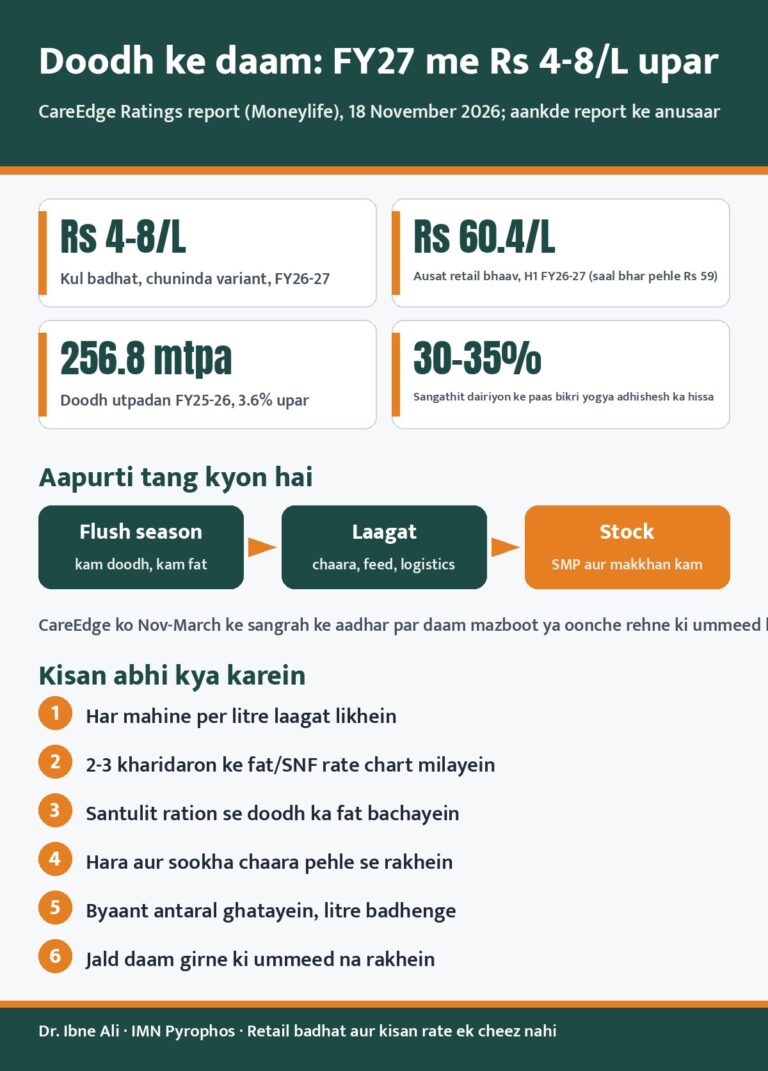
CareEdge Ratings ke anusaar FY26-27 me ab tak chuninda variant par doodh ke daam kul milakar Rs 4 se Rs 8 per litre badh chuke hain, aur sardiyon ke flush season me bhi aapurti tang hai. Moneylife ne 18 November 2026 ko ye report cover ki. Uske anusaar November me ghoshit taaza daur me Rs 2 se Rs 6 per litre ki badhat hui, jabki mai me Amul aur Mother Dairy ne Rs 2 per litre badhaye the. CareEdge ko ummeed hai ki FY26-27 me daam mazboot rahenge ya aur badhenge. Neeche sabhi aankde source ke anusaar hain.
Mukhya tathya
| Bindu | Report me kya bataya gaya |
|---|---|
| FY26-27 me kul badhat | Chuninda variant par Rs 4 se Rs 8 per litre |
| Taaza daur (November) | Rs 2 se Rs 6 per litre |
| Pichhla daur (mai) | Amul aur Mother Dairy dwara Rs 2 per litre |
| Ausat retail bhaav | Lagbhag Rs 42.8/L (FY18-19), Rs 59.1 (FY25-26), H1 FY26-27 me Rs 60.4 banaam H1 FY25-26 me Rs 59 |
| Doodh utpadan | FY25-26 me 256.8 million ton (mtpa), FY24-25 ke 247.9 se 3.6% zyada; FY14-15 me 146.3 |
| Per vyakti uplabdhta | Lagbhag 498 gram roz, pehle 485 |
| Antarrashtriya SMP | October me lagbhag US$3,850 per ton, saal bhar pehle se kareeb 36% upar |
| Sangathit kshetra ka hissa | Bikri yogya adhishesh ka sirf lagbhag 30-35% |
| Ghoshit capex | FY27-FY29 ke liye Rs 15,000 crore se upar, revenue sambhavna Rs 40,000 crore se upar; kshamta upyog lagbhag 80% |
Sardiyon me aapurti tang kyon hai?
Sardi aam taur par flush season hota hai, jab doodh bharpoor hota hai aur daam narm padte hain. Report ke anusaar is baar aisa nahi hua. Iske karan bataye gaye hain: kam aapurti, kuch kharid kshetron me doodh me kam fat, pashuon ka jaivik chakra, aur chaara, feed, processing, packaging va logistics ki oonchi laagat. Bhandaar bhi kam hain: skimmed milk powder (SMP) aur makkhan ka stock kam hai, jisse dairiyon ke paas gunjaish nahi bachti. Flush season ke adhishesh se powder aur makkhan banakar dairiyan ye stock dobara bharti hain, aur jab tak aisa nahi hota, taral doodh ke daam mazboot rahte hain.
Kisanon ke liye iska matlab
Behtar rate sambhav hai, par pakka nahi. Report retail daam aur dairy star ki laagat ki baat karti hai. Kisan tak kitna pahunchega, ye aapki dairy ya samiti par nirbhar hai, isliye har mahine apni bhugtaan parchiyan milayein.
Hamara apna anumaan: H1 FY26-27 ka ausat retail bhaav (Rs 60.4) pichhle saal ki isi avadhi (Rs 59) se hamare hisaab se sirf lagbhag 2.4% upar hai. FY18-19 se FY25-26 ke saat saalon me ausat lagbhag 38% badha (Rs 42.8 se Rs 59.1). Haal ki Rs 4-8 ki badhatein is ausat salana badhat se badi dikhti hain, kyonki ve chuninda variant par hain. Ise mota andaza samjhein, poorvanumaan nahi.
Laagat bhi badh rahi hai. Jin wajahon se doodh mehnga ho raha hai, yaani chaara, feed aur logistics, wahi aapki per litre laagat bhi badhati hain. Rate badhne ka fayda tabhi hai jab aapki laagat utni tezi se na badhe.
Asangathit bikri. Sangathit dairiyan bikri yogya adhishesh ka sirf lagbhag 30-35% sambhalti hain, isliye kai kisan sthaniya kharidaron ko bechte hain. Badi dairiyon ke bhaav ka asar un tak der se pahunch sakta hai, isliye rate maanne se pehle poochhtaachh karein.
Kisan abhi kya karein
- Har mahine per litre laagat likhein. Feed, chaara, mineral, mazdoori aur pashu-chikitsa kharch jodein.
- Kharidaron ki tulna karein. Chunne se pehle do-teen collection point se fat aur SNF ka rate chart poochhein.
- Doodh ka fat bachayein. Kuch kshetron me kam fat ko tangi ka karan bataya gaya hai; achhe reshe wala santulit ration aur saaf paani fat banaye rakhte hain.
- Chaara pehle se surakshit karein. Kami wale mahinon se pehle hara aur sookha chaara kharidein ya ugayein, kyonki chaare ki laagat ko ek karan bataya gaya hai.
- Prajanan aur byaant ka antaral dekhein. Chhota byaant antaral saal me zyada litre deta hai, jo sabse sthir fayda hai.
- Jald daam girne ki ummeed na rakhein. CareEdge November se March ke sangrah aur stock bharne ke aadhar par daam mazboot ya oonche rehne ki ummeed karta hai.
Aksar poochhe jaane wale sawaal
CareEdge kya hai?
CareEdge Ratings ek credit rating agency hai. Ye khabar Moneylife me cover hui uski report par aadharit hai.
Kya kisanon ko poori Rs 4-8 ki badhat milegi?
Ye aankda chuninda variant par retail daam ki badhat hai. Kisan ka bhugtaan har dairy alag tay karti hai, isliye apna rate jaanchein.
Kya 2.4% ka aankda report ka hai?
Nahi. Ye report ke do ausat bhaavon se hamara apna hisaab hai aur sirf anumaan hai.
Srot: Moneylife (CareEdge Ratings ki report), 18 November 2026. IMN Pyrophos team dwara apne shabdon me likha gaya.