
Mastitis is an udder infection, but whether a cow or buffalo catches it depends a lot on her defences and her condition at that moment. A fresh, high-yielding animal that is short of energy, has a stressed liver and low vitamin E and selenium fights germs less well. Hygiene and the vet’s treatment always come first. Supportive feed supplements can be added beside them. This guide explains where Nexamune L, an immune booster for mastitis in cows, and Livolact, a liver tonic for dairy animals, fit in, with the product-page doses, a cost example and what they cannot do. If you are searching for an immune booster for mastitis in cows, read the first-step section before you buy anything.
Mastitis in short
Mastitis is inflammation of the udder, usually caused by bacteria such as Staphylococcus aureus, E. coli and Streptococcus uberis. In clinical mastitis you see a hot, swollen, painful quarter, clots or watery milk and sometimes fever. In subclinical mastitis the milk looks normal but the cell count is high and yield and quality fall quietly. Subclinical cases are far more common than clinical ones, so a California Mastitis Test (CMT) on a regular basis is worth the small cost.
First steps that matter more than any supplement
- Call your vet for any clinical case. Antibiotic treatment is the vet’s decision, and the full course must be finished.
- Respect the withdrawal period. Milk from an animal on antibiotics must not be sold or used until the withdrawal time is over.
- Milk hygiene: wash and dry the teats, use a teat dip after milking, milk the affected animal last, and keep the milker’s hands clean.
- Dry, clean bedding and a non-slippery floor. Wet, muddy lying areas bring germs to the teat end, especially in winter.
- Complete milking at fixed times. Milk left in the udder invites infection.
- Test often with CMT, and separate or treat the positive quarters early.
What is Nexamune L?
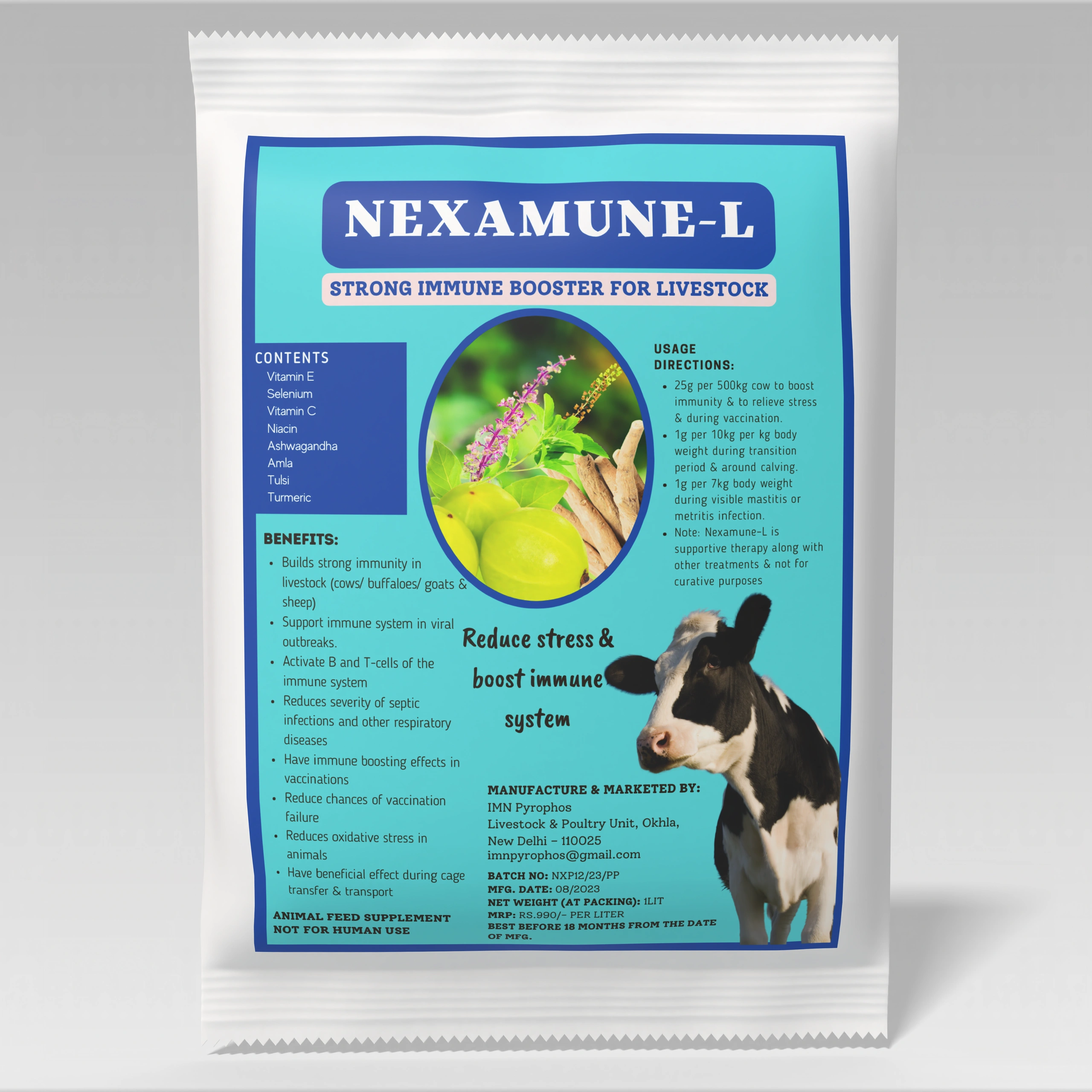
Nexamune L is a natural immune booster for cows, buffaloes, sheep and goats, sold for mastitis support. The IMN product page says it strengthens neutrophils, the body’s first line of defence, and that its antioxidant formula helps the animal fight mastitis bacteria without antibiotics. It lists vitamin E, selenium, vitamin C, niacin, and ashwagandha, amla and tulsi extracts. It is a feed supplement, not a therapeutic product, and supports early recovery along with the main line of treatment. Because it is not an antibiotic, the product page notes no antibiotic residue in milk from Nexamune L itself. Any antibiotic your vet gives still has its own withdrawal period.
Page benefits: easy to give as a daily feed additive, supports overall immunity and reduces stress, helps reduce the risk of mastitis and metritis, supports faster recovery from udder infection, and regular use improves udder health and milk quality.
Nexamune L dose
Nexamune L is added to the animal’s daily feed. The product page says “add the recommended dose to the daily feed” and does not print a number, so we do not print one either. Ask on WhatsApp for the right quantity for your animal, with its weight, yield and stage. Price: 1 kg is ₹920 (MRP ₹1,410).
Why the liver matters in a fresh cow: Livolact
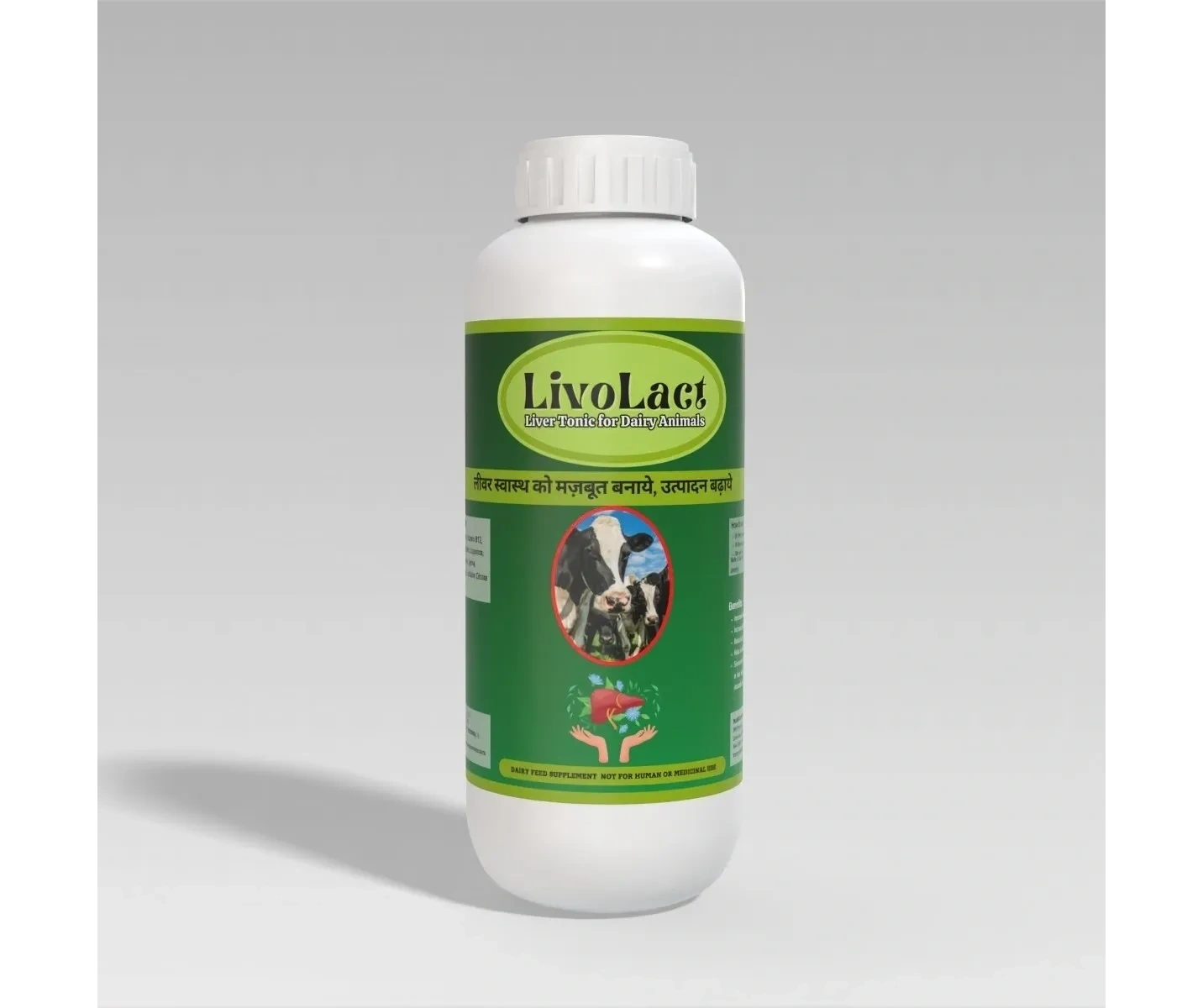
In early lactation milk rises faster than appetite, so the animal mobilizes body fat for energy and the liver gets loaded with fat. A fatty liver works less well, and the animal is dull, eats less, is more prone to ketosis and infections such as mastitis and metritis. Livolact is a liver tonic for dairy animals, especially high-producing cows and buffaloes that develop fatty liver from fat mobilization in early lactation. The label lists liver extract, silymarin, liquorice, vitamin B12, biotin and choline. According to the product page it helps reduce fatty liver, supports liver function and metabolism, supports detoxification and regeneration of liver cells, and supports milk yield and quality.
Livolact dose (product page)
| Animal | Dose |
|---|---|
| Cow or buffalo | 50 to 70 ml per animal for 3 to 5 days |
| Goat or sheep | 10 to 20 ml per animal for 3 to 5 days |
| Calf | 20 ml |
| Goat kids and lambs | 5 ml |
Cost example (calculated from the 1 L price of ₹435, about ₹0.44 per ml). At 50 to 70 ml a cow costs about ₹22 to ₹30 for a day, so a 3 to 5 day course is about ₹65 to ₹152 per animal. On the 5 L pack of ₹1,690 it is about ₹0.34 per ml. Livolact is a liquid, so measure it with a syringe or measuring cup.
How to use them, step by step
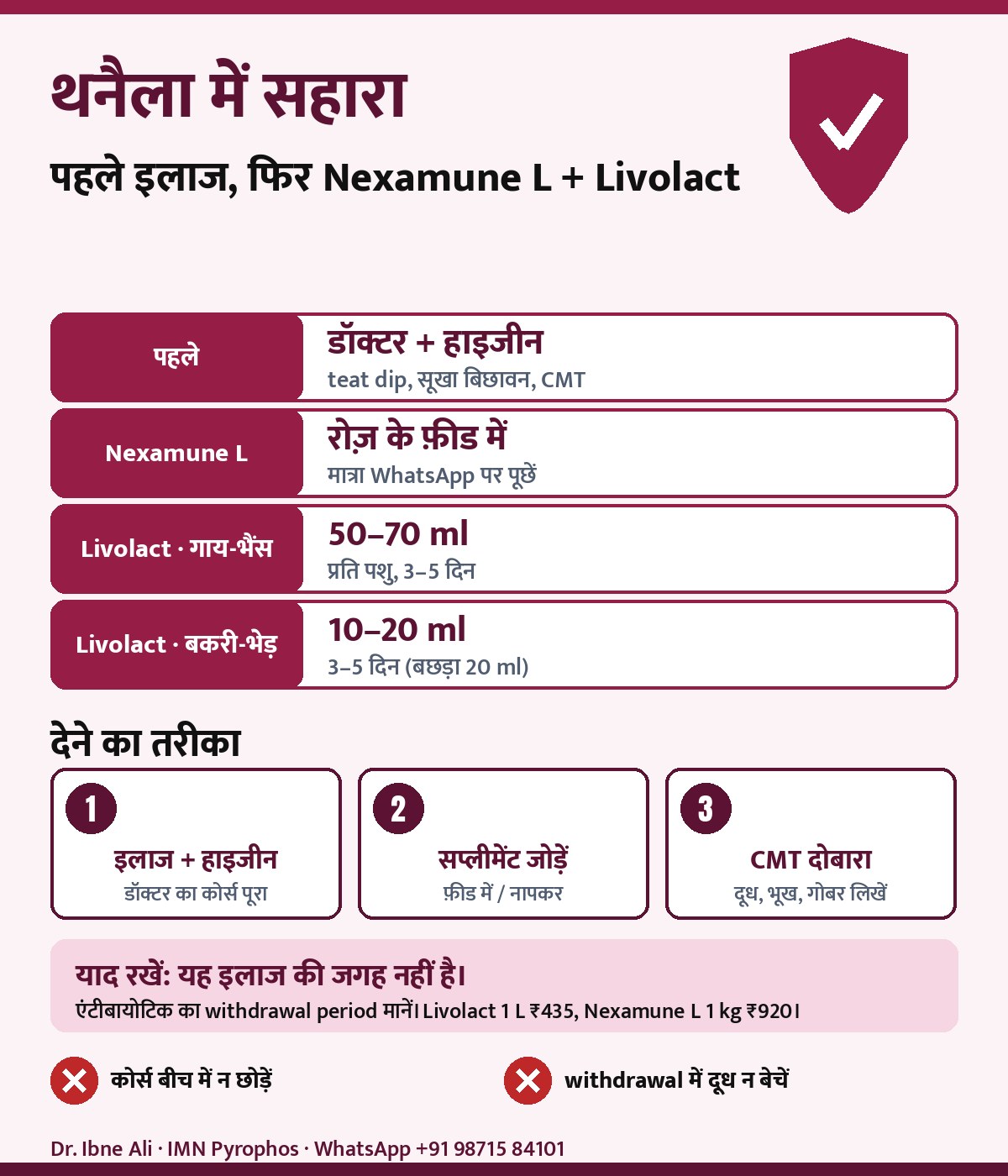
- Treat first: get the vet’s diagnosis and treatment for any clinical case, and fix hygiene.
- Nexamune L: weigh it and mix it evenly into the daily feed. Ask us on WhatsApp for the quantity.
- Livolact: measure the dose for the animal for 3 to 5 days, as in the table.
- Keep the feed and water routine steady with fresh water and good fodder.
- Re-test with CMT and note the milk, appetite and dung every day so your vet can see what is working.
Immune support in mastitis
Nexamune L
Natural immune booster for cows, buffaloes, sheep and goats with vitamin E, selenium, vitamin C, niacin, ashwagandha, amla and tulsi. Strengthens neutrophils and supports recovery along with the main treatment. A feed supplement, not a treatment.
Dose: Add to the daily feed. Ask on WhatsApp for the right quantity.
1 kg ₹920MRP ₹1,410
Liver tonic for dairy animals
Livolact
Liver tonic with liver extract, silymarin, liquorice, vitamin B12, biotin and choline. Helps reduce fatty liver in early lactation and supports liver function and metabolism.
Dose: Cow or buffalo 50 to 70 ml per animal for 3 to 5 days; goat or sheep 10 to 20 ml for 3 to 5 days; calf 20 ml; goat kids and lambs 5 ml.
1 L ₹435MRP ₹690 5 L ₹1,690MRP ₹3,390
Where they fit with other products
- After calving: Bionice (biotin, niacin, chelated zinc and chromium) supports energy and early lactation, and helps recovery from mastitis. See the calving plan with Chloromate, Calcigain and Bionice.
- Daily minerals: a balanced mineral such as Pyromin supplies chelated zinc, selenium and vitamins. Read our best mineral mixture guide.
- Milk fever and calving: see milk fever in cows, prevention, because a cow that had milk fever or a retained placenta is at higher risk.
- Winter housing: see winter care of dairy cows for bedding and shelter.
What not to do
- Do not use an immune booster instead of the vet’s treatment in a clinical case.
- Do not stop the antibiotic course early because the milk looks better.
- Do not sell or use milk during an antibiotic withdrawal period.
- Do not change the dose on your own. Use the dose given for your animal.
- Do not ignore dirty bedding, wet floors or an unclean milking routine.
Common mistakes
- Treating only the quarter. The herd routine, bedding and milking order cause the next case.
- Not testing. Subclinical cases are missed without CMT.
- Ignoring the fresh cow. Energy, liver and minerals in the first weeks set up the defences.
- Judging a supplement in 2 days. Track the weekly milk, CMT and cell count.
Frequently asked questions
What is the best immune booster for mastitis in cows? There is no single product. Hygiene, correct vet treatment, good feeding and minerals come first. A supplement such as Nexamune L can be added to support the immune system.
Does Nexamune L cure mastitis? No. It is a feed supplement that supports the immune system and recovery along with the main line of treatment.
Is there a withdrawal period for Nexamune L? The product page says no antibiotic residue and no withdrawal period for the supplement itself. Follow your vet for any antibiotic.
What does Nexamune L contain? Vitamin E, selenium, vitamin C, niacin, and ashwagandha, amla and tulsi extracts.
What is the Livolact dose? Cow or buffalo 50 to 70 ml per animal for 3 to 5 days; goat or sheep 10 to 20 ml for 3 to 5 days; calf 20 ml; goat kids and lambs 5 ml.
What is the price? Nexamune L 1 kg is ₹920 (MRP ₹1,410). Livolact 1 L is ₹435 (MRP ₹690) and 5 L is ₹1,690 (MRP ₹3,390). Prices may change, so confirm on WhatsApp.
Can goats and sheep use Nexamune L? The product page lists cows, buffaloes, sheep and goats. Ask for the dose on WhatsApp.
Where can I see all IMN products? The IMN product guide lists each product by problem and stage.
Also read: Nexamune L · Livolact · Milk fever in cows · Winter care of dairy cows · IMN product guide
गाय-भैंस में थनैला (mastitis): Nexamune L और Livolact से इम्यूनिटी और लिवर का सहारा
थनैला थन का इन्फ़ेक्शन है, लेकिन गाय या भैंस को यह होगा या नहीं, यह काफ़ी हद तक उसकी रोग-प्रतिरोधक क्षमता और उस समय की हालत पर टिका है। जो ताज़ा ब्याई, ज़्यादा दूध देने वाली पशु ऊर्जा की कमी में है, जिसका लिवर थका है और जिसमें vitamin E और selenium कम हैं, वह कीटाणुओं से कम लड़ पाती है। हाइजीन और डॉक्टर का इलाज हमेशा पहले आते हैं। सहारे के फ़ीड सप्लीमेंट उनके साथ जोड़े जा सकते हैं। इस गाइड में बताया है कि थनैला के लिए immune booster Nexamune L और डेयरी पशुओं का liver tonic Livolact कहाँ बैठते हैं, प्रोडक्ट पेज की मात्रा, खर्च का उदाहरण और ये क्या नहीं कर सकते। अगर आप थनैला के लिए immune booster ढूँढ रहे हैं तो कुछ भी खरीदने से पहले पहला-कदम वाला हिस्सा पढ़ें।
थनैला संक्षेप में
थनैला थन की सूजन है, जो आमतौर पर Staphylococcus aureus, E. coli और Streptococcus uberis जैसे बैक्टीरिया से होती है। Clinical mastitis में थन का हिस्सा गर्म, सूजा और दर्द वाला होता है, दूध में थक्के या पानी जैसा दूध आता है और कभी बुखार भी होता है। Subclinical mastitis में दूध सामान्य दिखता है, पर cell count ऊँचा होता है और दूध की मात्रा और गुणवत्ता चुपचाप घटती है। Subclinical केस clinical से कहीं ज़्यादा होते हैं, इसलिए नियमित California Mastitis Test (CMT) थोड़े खर्च में बहुत काम का है।
पहले के कदम जो किसी भी सप्लीमेंट से ज़्यादा ज़रूरी हैं
- डॉक्टर को बुलाएँ हर clinical केस में। एंटीबायोटिक इलाज डॉक्टर तय करते हैं और पूरा कोर्स खत्म करना ज़रूरी है।
- Withdrawal period मानें। एंटीबायोटिक पर चल रहे पशु का दूध withdrawal समय खत्म होने तक न बेचें न इस्तेमाल करें।
- दुहने की हाइजीन: थन धोकर सुखाएँ, दुहने के बाद teat dip लगाएँ, प्रभावित पशु को आखिर में दुहें और दुहने वाले के हाथ साफ़ रखें।
- सूखा, साफ़ बिछावन और फिसलन-रहित फ़र्श। गीली, कीचड़ वाली जगह थन की नोक तक कीटाणु पहुँचाती है, खासकर सर्दी में।
- पूरा दुहना, तय समय पर। थन में बचा दूध इन्फ़ेक्शन को बुलाता है।
- बार-बार जाँच CMT से, और positive हिस्सों को जल्दी अलग करें या इलाज दें।
Nexamune L क्या है?
Nexamune L गाय, भैंस, भेड़ और बकरी के लिए प्राकृतिक immune booster है, जो थनैला में सहारे के लिए बिकता है। IMN के प्रोडक्ट पेज के अनुसार यह neutrophils, यानी शरीर की पहली सुरक्षा पंक्ति, को मज़बूत करता है और इसका antioxidant फ़ॉर्मूला पशु को बिना एंटीबायोटिक के थनैला के बैक्टीरिया से लड़ने में मदद करता है। इसमें vitamin E, selenium, vitamin C, niacin, और अश्वगंधा, आँवला और तुलसी के extracts लिखे हैं। यह फ़ीड सप्लीमेंट है, इलाज वाला प्रोडक्ट नहीं, और मुख्य इलाज के साथ जल्दी सुधार में सहारा देता है। एंटीबायोटिक न होने से प्रोडक्ट पेज के अनुसार Nexamune L से दूध में एंटीबायोटिक residue नहीं आता। डॉक्टर जो एंटीबायोटिक दें उसका अपना withdrawal period फिर भी रहता है।
पेज के फ़ायदे: रोज़ के फ़ीड में आसानी से दिया जा सकता है, कुल immunity को सहारा देता है और तनाव घटाता है, थनैला और metritis का खतरा घटाने में मदद करता है, थन के इन्फ़ेक्शन से जल्दी सुधार में सहायक, और नियमित इस्तेमाल से थन की सेहत और दूध की गुणवत्ता सुधरती है।
Nexamune L की मात्रा
Nexamune L पशु के रोज़ के फ़ीड में मिलाया जाता है। प्रोडक्ट पेज पर “सुझाई गई मात्रा रोज़ के फ़ीड में मिलाएँ” लिखा है और कोई संख्या नहीं दी, इसलिए हम भी संख्या नहीं छाप रहे। अपने पशु के वज़न, दूध और अवस्था के साथ WhatsApp पर सही मात्रा पूछें। भाव: 1 किलो ₹920 (MRP ₹1,410)।
ताज़ा ब्याई गाय में लिवर क्यों मायने रखता है: Livolact
शुरुआती दूध में दूध भूख से तेज़ बढ़ता है, इसलिए पशु ऊर्जा के लिए शरीर की चर्बी गलाता है और लिवर में चर्बी भर जाती है। चर्बी वाला लिवर कम काम करता है, पशु सुस्त रहता है, कम खाता है, और ketosis तथा थनैला व metritis जैसे इन्फ़ेक्शन की ओर ज़्यादा झुकता है। Livolact डेयरी पशुओं का liver tonic है, खासकर ज़्यादा दूध देने वाली गाय-भैंसों के लिए, जिन्हें शुरुआती दूध में चर्बी गलने से fatty liver हो जाता है। Label पर liver extract, silymarin, मुलेठी, vitamin B12, biotin और choline लिखे हैं। प्रोडक्ट पेज के अनुसार यह fatty liver घटाने में मदद करता है, लिवर के काम और metabolism को सहारा देता है, detoxification और लिवर कोशिकाओं के पुनर्निर्माण में सहायक है, और दूध की मात्रा व गुणवत्ता को सहारा देता है।
Livolact की मात्रा (प्रोडक्ट पेज)
| पशु | मात्रा |
|---|---|
| गाय या भैंस | 50 से 70 ml प्रति पशु, 3 से 5 दिन |
| बकरी या भेड़ | 10 से 20 ml प्रति पशु, 3 से 5 दिन |
| बछड़ा | 20 ml |
| बकरी के बच्चे और मेमने | 5 ml |
खर्च का उदाहरण (1 लीटर के ₹435 के भाव से गणना, लगभग ₹0.44 प्रति ml)। 50 से 70 ml पर एक गाय का एक दिन का खर्च लगभग ₹22 से ₹30 है, इसलिए 3 से 5 दिन का कोर्स लगभग ₹65 से ₹152 प्रति पशु पड़ता है। 5 लीटर पैक ₹1,690 का है तो लगभग ₹0.34 प्रति ml। Livolact लिक्विड है, इसलिए सिरिंज या मेज़रिंग कप से नापें।
कैसे इस्तेमाल करें, कदम दर कदम
- पहले इलाज: हर clinical केस में डॉक्टर का निदान और इलाज लें, और हाइजीन ठीक करें।
- Nexamune L: तोलकर रोज़ के फ़ीड में बराबर मिलाएँ। मात्रा के लिए WhatsApp पर पूछें।
- Livolact: पशु के हिसाब से तालिका की मात्रा 3 से 5 दिन नापकर दें।
- फ़ीड और पानी का रूटीन स्थिर रखें, ताज़ा पानी और अच्छा चारा दें।
- CMT दोबारा करें और रोज़ दूध, भूख और गोबर लिखें ताकि डॉक्टर देख सकें कि क्या काम कर रहा है।
थनैला में इम्यूनिटी का सहारा
Nexamune L
गाय, भैंस, भेड़ और बकरी के लिए प्राकृतिक immune booster: vitamin E, selenium, vitamin C, niacin, अश्वगंधा, आँवला और तुलसी। neutrophils को मज़बूत करता है और मुख्य इलाज के साथ सुधार में सहारा देता है। फ़ीड सप्लीमेंट है, इलाज नहीं।
मात्रा: रोज़ के फ़ीड में मिलाएँ। सही मात्रा WhatsApp पर पूछें।
1 kg ₹920MRP ₹1,410
डेयरी पशुओं का liver tonic
Livolact
Liver extract, silymarin, मुलेठी, vitamin B12, biotin और choline वाला liver tonic। शुरुआती दूध में fatty liver घटाने और लिवर के काम व metabolism को सहारा देता है।
मात्रा: गाय-भैंस 50–70 ml प्रति पशु 3–5 दिन; बकरी-भेड़ 10–20 ml 3–5 दिन; बछड़ा 20 ml; बकरी के बच्चे और मेमने 5 ml।
1 L ₹435 · 5 L ₹1,690MRP ₹690 / ₹3,390
बाकी प्रोडक्ट के साथ ये कहाँ बैठते हैं
- ब्याने के बाद: Bionice (biotin, niacin, chelated zinc और chromium) ऊर्जा और शुरुआती दूध में सहारा देता है और थनैला से उबरने में मदद करता है। देखें Chloromate, Calcigain और Bionice का ब्याने का प्लान।
- रोज़ के मिनरल: Pyromin जैसा संतुलित मिनरल chelated zinc, selenium और विटामिन देता है। हमारी सबसे अच्छा मिनरल मिक्सचर गाइड पढ़ें।
- मिल्क फीवर और ब्याना: गाय में मिल्क फीवर से बचाव देखें, क्योंकि जिस पशु को मिल्क फीवर या जेर रुकना हुआ हो उसमें खतरा ज़्यादा है।
- सर्दी में आवास: बिछावन और आश्रय के लिए सर्दी में गाय की देखभाल देखें।
क्या न करें
- clinical केस में डॉक्टर के इलाज की जगह immune booster न दें।
- दूध ठीक दिखने पर एंटीबायोटिक कोर्स बीच में बंद न करें।
- एंटीबायोटिक के withdrawal period में दूध न बेचें न इस्तेमाल करें।
- मात्रा अपने मन से न बदलें। अपने पशु के लिए बताई मात्रा रखें।
- गंदा बिछावन, गीला फ़र्श या अस्वच्छ दुहने का तरीका नज़रअंदाज़ न करें।
आम गलतियाँ
- सिर्फ़ एक थन का इलाज। झुंड का रूटीन, बिछावन और दुहने का क्रम अगला केस बनाते हैं।
- जाँच न करना। CMT के बिना subclinical केस छूट जाते हैं।
- ताज़ा ब्याई गाय को नज़रअंदाज़ करना। पहले हफ़्तों की ऊर्जा, लिवर और मिनरल सुरक्षा तय करते हैं।
- 2 दिन में सप्लीमेंट आँकना। हफ़्ते का दूध, CMT और cell count देखें।
अक्सर पूछे जाने वाले सवाल
गाय में थनैला के लिए सबसे अच्छा immune booster कौन सा है? कोई एक प्रोडक्ट नहीं है। हाइजीन, डॉक्टर का सही इलाज, अच्छी खुराक और मिनरल पहले आते हैं। Nexamune L जैसा सप्लीमेंट immune system को सहारा देने के लिए जोड़ा जा सकता है।
क्या Nexamune L थनैला ठीक करता है? नहीं। यह फ़ीड सप्लीमेंट है जो मुख्य इलाज के साथ immune system और सुधार को सहारा देता है।
क्या Nexamune L का withdrawal period है? प्रोडक्ट पेज के अनुसार सप्लीमेंट में एंटीबायोटिक residue और withdrawal period नहीं है। एंटीबायोटिक के लिए डॉक्टर की सलाह मानें।
Nexamune L में क्या है? Vitamin E, selenium, vitamin C, niacin, और अश्वगंधा, आँवला व तुलसी के extracts।
Livolact की मात्रा क्या है? गाय-भैंस 50 से 70 ml प्रति पशु 3 से 5 दिन; बकरी-भेड़ 10 से 20 ml 3 से 5 दिन; बछड़ा 20 ml; बकरी के बच्चे और मेमने 5 ml।
भाव क्या है? Nexamune L 1 किलो ₹920 (MRP ₹1,410)। Livolact 1 लीटर ₹435 (MRP ₹690) और 5 लीटर ₹1,690 (MRP ₹3,390)। भाव बदल सकते हैं, WhatsApp पर पक्का करें।
क्या बकरी और भेड़ में Nexamune L चलेगा? प्रोडक्ट पेज पर गाय, भैंस, भेड़ और बकरी लिखे हैं। मात्रा WhatsApp पर पूछें।
IMN के सारे प्रोडक्ट कहाँ देखूँ? IMN प्रोडक्ट गाइड में हर प्रोडक्ट समस्या और अवस्था के हिसाब से है।
यह भी पढ़ें: Nexamune L · Livolact · गाय में मिल्क फीवर · सर्दी में गाय की देखभाल · IMN प्रोडक्ट गाइड
Gaay-bhains me thanaila (mastitis): Nexamune L aur Livolact se immunity aur liver ka sahara
Thanaila than ka infection hai, lekin gaay ya bhains ko ye hoga ya nahi, ye kaafi had tak uski rog-pratirodhak kshamta aur us samay ki haalat par tika hai. Jo taaza byaayi, zyada doodh dene wali pashu urja ki kami me hai, jiska liver thaka hai aur jisme vitamin E aur selenium kam hain, wo keetanuon se kam lad paati hai. Hygiene aur doctor ka ilaaj hamesha pehle aate hain. Sahare ke feed supplement unke saath jode ja sakte hain. Is guide me bataya hai ki thanaila ke liye immune booster Nexamune L aur dairy pashuon ka liver tonic Livolact kahan baithte hain, product page ki matra, kharch ka udaharan aur ye kya nahi kar sakte. Agar aap thanaila ke liye immune booster dhoondh rahe hain to kuch bhi kharidne se pehle pehla-kadam wala hissa padhein.
Thanaila sankshep me
Thanaila than ki soojan hai, jo aamtaur par Staphylococcus aureus, E. coli aur Streptococcus uberis jaise bacteria se hoti hai. Clinical mastitis me than ka hissa garam, sooja aur dard wala hota hai, doodh me thakke ya paani jaisa doodh aata hai aur kabhi bukhar bhi hota hai. Subclinical mastitis me doodh saamanya dikhta hai, par cell count ooncha hota hai aur doodh ki matra aur gunvatta chupchaap ghatti hai. Subclinical case clinical se kahin zyada hote hain, isliye niyamit California Mastitis Test (CMT) thode kharch me bahut kaam ka hai.
Pehle ke kadam jo kisi bhi supplement se zyada zaroori hain
- Doctor ko bulayein har clinical case me. Antibiotic ilaaj doctor tay karte hain aur poora course khatam karna zaroori hai.
- Withdrawal period maanein. Antibiotic par chal rahe pashu ka doodh withdrawal samay khatam hone tak na bechein na istemaal karein.
- Duhne ki hygiene: than dhokar sukhayein, duhne ke baad teat dip lagayein, prabhavit pashu ko aakhir me duhein aur duhne wale ke haath saaf rakhein.
- Sookha, saaf bichhawan aur phislan-rahit farsh. Geeli, keechad wali jagah than ki nok tak keetanu pahunchati hai, khaaskar sardi me.
- Poora duhna, tay samay par. Than me bacha doodh infection ko bulata hai.
- Baar-baar jaanch CMT se, aur positive hisson ko jaldi alag karein ya ilaaj dein.
Nexamune L kya hai?
Nexamune L gaay, bhains, bhed aur bakri ke liye prakritik immune booster hai, jo thanaila me sahare ke liye bikta hai. IMN ke product page ke anusaar ye neutrophils, yaani sharir ki pehli suraksha pankti, ko mazboot karta hai aur iska antioxidant formula pashu ko bina antibiotic ke thanaila ke bacteria se ladne me madad karta hai. Isme vitamin E, selenium, vitamin C, niacin, aur ashwagandha, amla aur tulsi ke extracts likhe hain. Ye feed supplement hai, ilaaj wala product nahi, aur mukhya ilaaj ke saath jaldi sudhar me sahara deta hai. Antibiotic na hone se product page ke anusaar Nexamune L se doodh me antibiotic residue nahi aata. Doctor jo antibiotic dein uska apna withdrawal period phir bhi rehta hai.
Page ke fayde: roz ke feed me aasaani se diya ja sakta hai, kul immunity ko sahara deta hai aur tanav ghatata hai, thanaila aur metritis ka khatra ghatane me madad karta hai, than ke infection se jaldi sudhar me sahayak, aur niyamit istemaal se than ki sehat aur doodh ki gunvatta sudharti hai.
Nexamune L ki matra
Nexamune L pashu ke roz ke feed me milaya jaata hai. Product page par “sujhayi gayi matra roz ke feed me milayein” likha hai aur koi sankhya nahi di, isliye hum bhi sankhya nahi chhaap rahe. Apne pashu ke wazan, doodh aur avastha ke saath WhatsApp par sahi matra poochhein. Bhav: 1 kg ₹920 (MRP ₹1,410).
Taaza byaayi gaay me liver kyon maayne rakhta hai: Livolact
Shuruaati doodh me doodh bhookh se tez badhta hai, isliye pashu urja ke liye sharir ki charbi galata hai aur liver me charbi bhar jaati hai. Charbi wala liver kam kaam karta hai, pashu sust rehta hai, kam khata hai, aur ketosis tatha thanaila va metritis jaise infection ki or zyada jhukta hai. Livolact dairy pashuon ka liver tonic hai, khaaskar zyada doodh dene wali gaay-bhainson ke liye, jinhe shuruaati doodh me charbi galne se fatty liver ho jaata hai. Label par liver extract, silymarin, mulethi, vitamin B12, biotin aur choline likhe hain. Product page ke anusaar ye fatty liver ghatane me madad karta hai, liver ke kaam aur metabolism ko sahara deta hai, detoxification aur liver koshikaon ke punarnirman me sahayak hai, aur doodh ki matra va gunvatta ko sahara deta hai.
Livolact ki matra (product page)
| Pashu | Matra |
|---|---|
| Gaay ya bhains | 50 se 70 ml prati pashu, 3 se 5 din |
| Bakri ya bhed | 10 se 20 ml prati pashu, 3 se 5 din |
| Bachhda | 20 ml |
| Bakri ke bachche aur memne | 5 ml |
Kharch ka udaharan (1 litre ke ₹435 ke bhav se ganana, lagbhag ₹0.44 prati ml): 50 se 70 ml par ek gaay ka ek din ka kharch lagbhag ₹22 se ₹30 hai, isliye 3 se 5 din ka course lagbhag ₹65 se ₹152 prati pashu padta hai. 5 litre pack ₹1,690 ka hai to lagbhag ₹0.34 prati ml. Livolact liquid hai, isliye syringe ya measuring cup se naapein.
Kaise istemaal karein, kadam dar kadam
- Pehle ilaaj: har clinical case me doctor ka nidaan aur ilaaj lein, aur hygiene theek karein.
- Nexamune L: tolkar roz ke feed me barabar milayein. Matra ke liye WhatsApp par poochhein.
- Livolact: pashu ke hisaab se talika ki matra 3 se 5 din naapkar dein.
- Feed aur paani ka routine sthir rakhein, taaza paani aur achha chaara dein.
- CMT dobara karein aur roz doodh, bhookh aur gobar likhein taaki doctor dekh saken ki kya kaam kar raha hai.
Thanaila me immunity ka sahara
Nexamune L
Gaay, bhains, bhed aur bakri ke liye prakritik immune booster: vitamin E, selenium, vitamin C, niacin, ashwagandha, amla aur tulsi. Neutrophils ko mazboot karta hai aur mukhya ilaaj ke saath sudhar me sahara deta hai. Feed supplement hai, ilaaj nahi.
Matra: Roz ke feed me milayein. Sahi matra WhatsApp par poochhein.
1 kg ₹920MRP ₹1,410
Dairy pashuon ka liver tonic
Livolact
Liver extract, silymarin, mulethi, vitamin B12, biotin aur choline wala liver tonic. Shuruaati doodh me fatty liver ghatane aur liver ke kaam va metabolism ko sahara deta hai.
Matra: Gaay-bhains 50–70 ml prati pashu 3–5 din; bakri-bhed 10–20 ml 3–5 din; bachhda 20 ml; bakri ke bachche aur memne 5 ml.
1 L ₹435 · 5 L ₹1,690MRP ₹690 / ₹3,390
Baaki products ke saath ye kahan baithte hain
- Byaane ke baad: Bionice (biotin, niacin, chelated zinc aur chromium) urja aur shuruaati doodh me sahara deta hai aur thanaila se ubharne me madad karta hai. Dekhein Chloromate, Calcigain aur Bionice ka byaane ka plan.
- Roz ke mineral: Pyromin jaisa santulit mineral chelated zinc, selenium aur vitamin deta hai. Hamari sabse achha mineral mixture guide padhein.
- Milk fever aur byaana: gaay me milk fever se bachav dekhein, kyunki jis pashu ko milk fever ya jer rukna hua ho usme khatra zyada hai.
- Sardi me aawas: bichhawan aur aashray ke liye sardi me gaay ki dekhbhal dekhein.
Kya na karein
- Clinical case me doctor ke ilaaj ki jagah immune booster na dein.
- Doodh theek dikhne par antibiotic course beech me band na karein.
- Antibiotic ke withdrawal period me doodh na bechein na istemaal karein.
- Matra apne man se na badlein. Apne pashu ke liye batayi matra rakhein.
- Ganda bichhawan, geela farsh ya aswachh duhne ka tareeka nazarandaz na karein.
Aam galtiyan
- Sirf ek than ka ilaaj. Jhund ka routine, bichhawan aur duhne ka kram agla case banate hain.
- Jaanch na karna. CMT ke bina subclinical case chhoot jaate hain.
- Taaza byaayi gaay ko nazarandaz karna. Pehle hafton ki urja, liver aur mineral suraksha tay karte hain.
- 2 din me supplement aankna. Hafte ka doodh, CMT aur cell count dekhein.
Aksar pooche jaane wale sawaal
Gaay me thanaila ke liye sabse achha immune booster kaun sa hai? Koi ek product nahi hai. Hygiene, doctor ka sahi ilaaj, achhi khuraak aur mineral pehle aate hain. Nexamune L jaisa supplement immune system ko sahara dene ke liye joda ja sakta hai.
Kya Nexamune L thanaila theek karta hai? Nahi. Ye feed supplement hai jo mukhya ilaaj ke saath immune system aur sudhar ko sahara deta hai.
Kya Nexamune L ka withdrawal period hai? Product page ke anusaar supplement me antibiotic residue aur withdrawal period nahi hai. Antibiotic ke liye doctor ki salah maanein.
Nexamune L me kya hai? Vitamin E, selenium, vitamin C, niacin, aur ashwagandha, amla va tulsi ke extracts.
Livolact ki matra kya hai? Gaay-bhains 50 se 70 ml prati pashu 3 se 5 din; bakri-bhed 10 se 20 ml 3 se 5 din; bachhda 20 ml; bakri ke bachche aur memne 5 ml.
Bhav kya hai? Nexamune L 1 kg ₹920 (MRP ₹1,410). Livolact 1 litre ₹435 (MRP ₹690) aur 5 litre ₹1,690 (MRP ₹3,390). Bhav badal sakte hain, WhatsApp par pakka karein.
Kya bakri aur bhed me Nexamune L chalega? Product page par gaay, bhains, bhed aur bakri likhe hain. Matra WhatsApp par poochhein.
IMN ke saare products kahan dekhun? IMN product guide me har product samasya aur avastha ke hisaab se hai.
Ye bhi padhein: Nexamune L · Livolact · Gaay me milk fever · Sardi me gaay ki dekhbhal · IMN product guide