
Learn how dairy cows obtain energy from straw, silage, starch, sugars, fat, protein, propylene glycol, glycerol and calcium propionate—and how each follows a different metabolic pathway.
Energy Sources in Dairy Cattle: Understanding the Metabolic Pathways
When we talk about energy sources in dairy cattle, the discussion often becomes confusing. Farmers may hear that maize provides energy, but so does wheat straw. Silage provides energy, molasses provides energy, bypass fat provides energy, and even protein can eventually be used for energy.
Then there are specialized supplements such as propylene glycol, glycerol and calcium propionate, which are used particularly around the transition period.
If all of these are called “energy sources,” are they actually doing the same thing?
No.
The important concept is that different feed components enter the animal’s metabolism through different biochemical routes. Their final effects on glucose supply, milk lactose, milk fat, ATP production, body-fat mobilization and ketone production can therefore be very different.
The 2021 dairy cattle model itself treats energy, fat, carbohydrates and protein as interconnected but distinct components of nutrient supply and utilization.
Energy Is More Than Calories
The simplest way to understand dairy cow energy metabolism is:
Feed → Digestion/Fermentation → Metabolites → Tissues → ATP and biosynthesis
ATP is the immediate energy currency used by cells. However, the cow does not simply absorb “calories” from the feed and distribute them uniformly.
Instead, the feed is converted into specific metabolic substrates.
The major metabolic entry points include:
- Acetyl-CoA
- Propionate-derived succinyl-CoA
- Pyruvate
- TCA-cycle intermediates
- Glucose
- Long-chain fatty acids
- Amino-acid carbon skeletons
This is why two diets with apparently similar energy values can produce different biological responses.
Literature specifically describes acetyl-CoA as a metabolic crossroads for complete oxidation of fuels, while substrates such as propionate and lactate can act as anaplerotic substrates that replenish TCA-cycle intermediates.
1. Fiber: Why Straw Is Also an Energy Source
One of the most important misconceptions in dairy nutrition is that straw has no energy.
Straw absolutely provides energy—but the quantity and rate of energy available depend heavily on its digestibility.
Cellulose and hemicellulose are fermented by rumen microorganisms rather than being digested like starch in the small intestine.
The simplified pathway is:
Fiber → Rumen microbial fermentation → VFA → Absorption → Tissue metabolism
The major volatile fatty acids are:
Acetate + Propionate + Butyrate
Acetate is particularly important because it is a major precursor for de novo milk-fat synthesis.
Butyrate is extensively metabolized by the rumen epithelium and contributes to epithelial energy metabolism, while propionate is particularly important for glucose production.
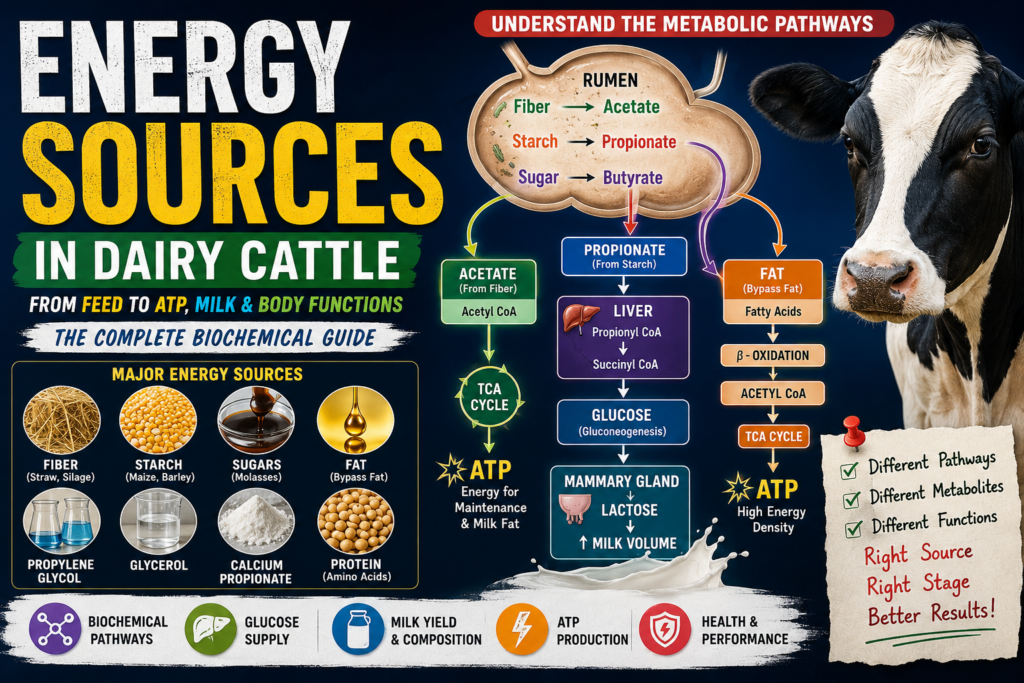
This means straw can contribute to:
ATP production + rumen function + milk-fat synthesis
However, highly lignified straw can have poor digestibility and can impose substantial physical fill limitations. Therefore, its energy contribution cannot be judged simply from its crude nutrient composition.
New researches emphasizes the importance of forage NDF, particle size and physically effective fiber in maintaining appropriate ruminal conditions; its carbohydrate chapter specifically addresses NDF, ruminal digestion and physically effective NDF.
So the correct statement is not:
“Straw is an energy source equal to maize.”
It is:
“Straw is an energy source, but its energy is released slowly and its nutritional role is fundamentally different from rapidly fermentable starch.”
2. Silage and Green Fodder: Mixed Energy Systems
Silage and green fodder cannot be placed into a single biochemical category.
They may simultaneously provide:
Digestible fiber + starch + sugars + protein + minerals
Their actual contribution depends on species, maturity, dry matter, NDF digestibility, starch concentration and fermentation characteristics.
For example, corn silage can provide substantially more fermentable carbohydrate than a mature cereal straw, while still contributing physically effective fiber.
This is why feed analysis and digestibility matter more than simply calling something “roughage.”
Literature recommends testing forage NDF digestibility for applications such as troubleshooting, forage allocation and purchasing decisions.
3. Starch: The Major Glucose-Producing Route
Starch-containing feeds such as maize, barley, wheat and broken rice behave very differently from straw.
Much of the starch is fermented by rumen microbes, producing volatile fatty acids, with propionate being particularly important for hepatic gluconeogenesis.
The pathway can be simplified as:
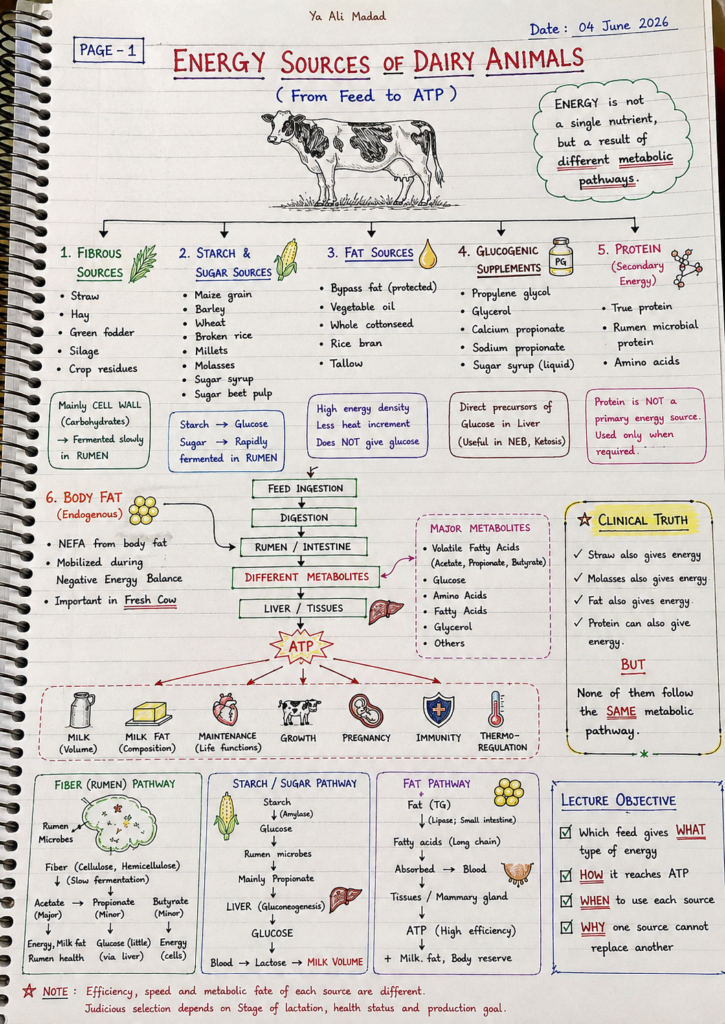
Starch → Rumen fermentation → Propionate → Portal blood → Liver → Propionyl-CoA → Methylmalonyl-CoA → Succinyl-CoA → TCA intermediates → Gluconeogenesis → Glucose
This is one of the most important pathways in dairy nutrition.
Unlike a monogastric animal, the dairy cow does not depend primarily on absorption of dietary glucose from the intestine. Ruminants obtain most circulating glucose through hepatic and renal gluconeogenesis. Propionate is the quantitatively dominant glucogenic precursor.
And why is glucose so important?
Because the mammary gland uses glucose extensively for lactose synthesis, and lactose is a major determinant of milk volume.
Therefore:
Propionate → Glucose → Lactose → Milk volume
This does not mean “more starch always means more milk.” Excessively rapid starch fermentation can disturb ruminal fermentation and reduce ruminal pH. NRC specifically relates dietary starch, forage NDF, particle size and ruminal pH in its carbohydrate recommendations.
4. Sugars and Molasses: Rapidly Available Fermentation Energy
Molasses, sugar syrup and other rapidly fermentable carbohydrate sources can provide readily available substrate for rumen microbes.
Their major advantage is not that they directly deliver large amounts of glucose to the mammary gland.
Instead:
Sugar → Rapid ruminal fermentation → VFAs + microbial growth
Therefore, sugar can support microbial metabolism and microbial protein synthesis.
But rapid fermentation also means that dose and dietary context matter.
Adding large quantities of rapidly fermentable carbohydrate without considering fiber, starch, particle size and rumen buffering can create an unfavorable ruminal environment.
Thus, molasses is not simply “liquid glucose for the cow.”
Its first metabolic destination is largely the rumen microbial ecosystem.
5. Fat: Highest Energy Density, Different Destination
Fat represents another completely different energy system.
Long-chain fatty acids can be absorbed post-ruminally and transported to tissues.
A simplified pathway is:
Dietary fat → Small intestine → Fatty acids → Absorption → Blood → Tissue uptake → β-oxidation → Acetyl-CoA → TCA cycle → Electron transport chain → ATP
Fat has a high energy density and can increase the energy concentration of a diet without adding fermentable carbohydrate to the rumen.
However, there is a critical distinction:
Fat is an excellent energy source, but it is not a direct glucose source.
This is why bypass fat cannot simply replace a glucogenic substrate when the primary problem is inadequate glucose supply.
Fat can also contribute directly to milk-fat synthesis depending on fatty-acid supply and metabolic state.
Latest edition substantially revised its treatment of fatty-acid digestion and digestibility coefficients for feeds and common fat supplements.
6. Propylene Glycol, Glycerol and Calcium Propionate
These compounds are particularly interesting because they are metabolic tools rather than conventional feed ingredients.
Propylene Glycol
Propylene glycol can be converted in the liver through intermediates including lactate and pyruvate and ultimately contribute to gluconeogenesis.
Conceptually:
Propylene glycol → Lactate/Pyruvate → Gluconeogenesis → Glucose
It has therefore been used as a glucogenic supplement in transition and ketotic cows.
Glycerol
Glycerol has a different biochemical entry point:
Glycerol → Glycerol-3-phosphate → DHAP → Gluconeogenesis → Glucose
This is particularly interesting because glycerol can enter the gluconeogenic pathway without first needing to enter the TCA cycle in the same manner as propionate.
The Veterinary Clinics review specifically notes that glycerol can enter gluconeogenesis through dihydroxyacetone phosphate (DHAP).
Calcium Propionate
Calcium propionate supplies propionate:
Propionate → Propionyl-CoA → Methylmalonyl-CoA → Succinyl-CoA → Gluconeogenesis → Glucose
These compounds therefore should not simply be described as “energy supplements.”
They are better understood as specific metabolic substrates with glucogenic potential.
7. Protein Can Become Energy—But It Is Not Primarily an Energy Feed
Protein can contribute to energy metabolism when amino acids are oxidized.
After deamination or transamination, the amino-acid carbon skeleton can enter pathways at different points:
Pyruvate
Oxaloacetate
α-Ketoglutarate
Succinyl-CoA
or other metabolic intermediates.
From there, carbon can enter the TCA cycle or contribute to gluconeogenesis.
But using protein primarily as an energy source is metabolically inefficient because the nitrogen component must be handled separately.
Therefore:
Protein → Amino acids → Carbon skeleton + Nitrogen
The nitrogen ultimately requires metabolism and excretion or recycling.
NRC treats metabolizable protein and amino-acid supply as a separate component of dairy cattle nutrition rather than simply classifying protein as dietary energy.
So protein should primarily be supplied for protein synthesis, microbial protein production, milk protein, tissue maintenance and other nitrogen-dependent functions, not simply to increase dietary energy.
8. Body Fat: The Cow’s Internal Energy Reserve
The most dramatic energy source becomes visible during the transition period.
After calving, the cow’s demand for glucose increases substantially while dry matter intake may temporarily lag behind requirements.
This creates negative energy balance (NEB).
The sequence becomes:
↓ DMI + ↑ glucose demand
↓
↓ Insulin
↓
Adipose lipolysis
↓
Triglycerides → NEFA + glycerol
↓
NEFA → Liver
From here, NEFA can undergo β-oxidation to generate energy.
But excessive NEFA delivery creates another problem:
NEFA → Acetyl-CoA → Ketone bodies
including:
Acetoacetate + β-hydroxybutyrate (BHB)
If hepatic lipid accumulation becomes excessive, liver function and gluconeogenesis can also be compromised.
The Veterinary Clinics review describes excessive NEFA flux as being associated with fatty liver and ketosis, and explains that excessive triglyceride accumulation can impair fatty-acid oxidation and gluconeogenesis.
The Most Important Concept: Energy Quality and Destination
This is the central lesson of dairy energy nutrition:
One Mcal of metabolizable energy is not automatically biologically identical to another Mcal in terms of its metabolic destination.
A practical way to think about the major pathways is:
| Energy source | Major metabolic destination | Major role |
|---|---|---|
| Straw/fiber | Acetate and other VFAs | Rumen function, maintenance, milk fat |
| Starch | Propionate → glucose | Lactose and milk volume |
| Sugars | Rapid rumen fermentation | Microbial energy |
| Bypass fat | Long-chain fatty acids | Energy density, fatty-acid supply |
| Propylene glycol | Glucogenic pathway | Glucose support |
| Glycerol | DHAP → gluconeogenesis | Glucose support |
| Calcium propionate | Propionate → succinyl-CoA | Glucose support |
| Protein | Amino-acid carbon skeletons | Tissue/milk protein; secondary energy |
| Body fat | NEFA → β-oxidation/ketogenesis | Energy during NEB |
How Should Farmers Use These Energy Sources?
The answer is not to choose the “strongest” energy source.
The correct approach is:
Right energy source + right animal + right stage + right quantity.
A fresh cow with ketosis risk may need a different metabolic strategy from a mid-lactation cow with low milk fat.
A cow with inadequate glucose supply cannot necessarily be corrected simply by adding bypass fat.
A cow with poor fiber digestion cannot necessarily be corrected by adding more starch.
And a cow consuming excessive rapidly fermentable carbohydrate may not benefit from simply increasing molasses or grain.
The goal of formulation is therefore not merely to maximize dietary energy density. It is to provide the correct mixture of fermentable carbohydrates, digestible fiber, fatty acids, glucogenic substrates and metabolizable protein while maintaining rumen function and matching the cow’s physiological state.
Final Takeaway
Straw is energy. Silage is energy. Starch is energy. Sugar is energy. Fat is energy. Protein can become energy. Propylene glycol, glycerol and calcium propionate can provide specific glucogenic substrates. Body fat is also an energy reserve.
But they are not metabolically interchangeable.
Fiber predominantly feeds the rumen fermentation system. Starch and propionate strongly support hepatic glucose production. Fat supplies dense fatty-acid energy without directly supplying glucose. Glucogenic supplements target specific pathways toward glucose. Protein supplies amino acids first and becomes an energy substrate when metabolically appropriate. Body fat becomes a major emergency fuel during negative energy balance.
That is why advanced dairy nutrition should move beyond the simple question:
“How much energy is in this feed?”
and ask:
“Where does this energy enter metabolism, what does it become, where is it used, and is that the metabolite this cow actually needs?”
That is the foundation of precision energy nutrition in dairy cattle.
Consultation and dairy nutrition formulation contact 9871584101