
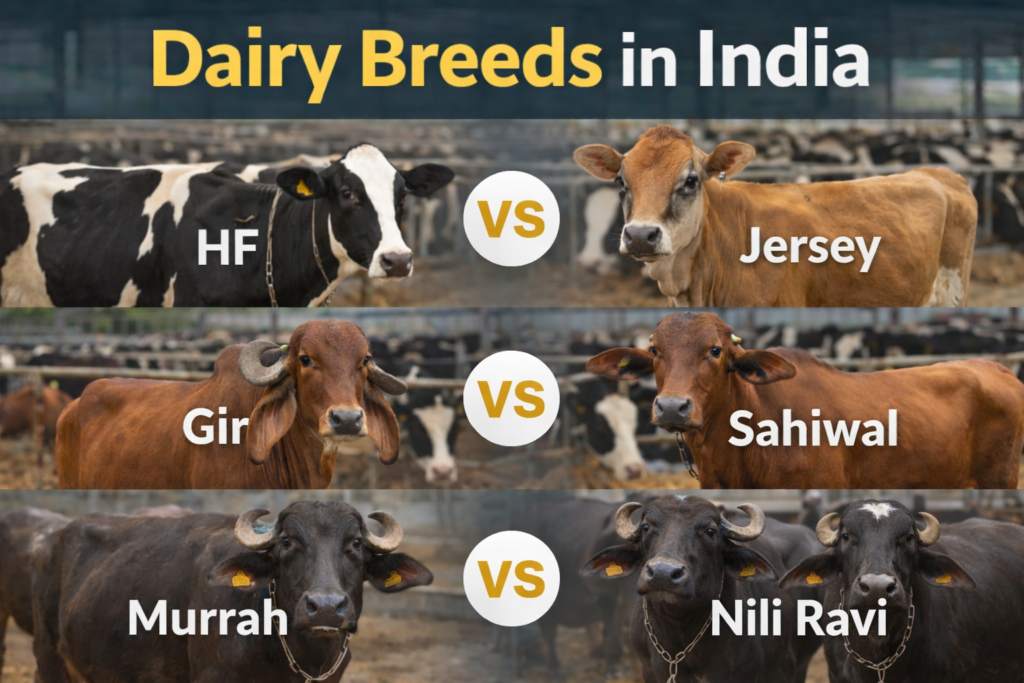
Dairy Breeds in India
Best Dairy Cow and Buffalo Breeds for Milk Yield, Fat, Profit and Indian Conditions
Choosing the right dairy breed is one of the most important business decisions in dairy farming. Many farmers focus only on milk yield while buying animals, but in reality breed selection decides feeding cost, disease risk, fertility, milk fat and long-term profit.
This is why experienced dairy farmers always say:
Wrong breed selection means wrong profit, even with good feeding.
In this guide, we explain the best dairy cow breeds in India, compare HF vs Jersey milk yield, do a Gir vs Sahiwal comparison, and explain why Murrah buffalo milk fat makes it so popular — all from a practical, field-oriented perspective.
Why Dairy Breed Selection Is a Business Decision
Breed affects almost every part of dairy farming:
- Feed requirement and feed efficiency
- Heat tolerance and disease resistance
- Milk yield consistency
- Milk fat percentage and pricing
- Veterinary cost and fertility performance
A breed that performs well in one region may fail completely in another. Therefore, Indian climate, feeding system and management capacity must always come before milk yield numbers.
Best Dairy Breeds in India: HF, Jersey, Gir, Murrah Learn best dairy cow and buffalo breeds in India. Compare HF vs Jersey, Gir vs Sahiwal performance and Murrah buffalo milk fat for profitable dairy farming.
Holstein Friesian (HF) – High Milk Yield, High Management Breed
Overview
Holstein Friesian cows are among the highest milk-yielding dairy cows and are widely used in crossbred form across India.
Milk yield
- Very high milk potential
- Suitable for farmers aiming for volume-based milk sales
Key advantages
- High daily milk production
- Good response to balanced concentrate feeding
- Popular in organized and commercial dairy farms
Practical limitations
- Poor heat tolerance
- Higher disease and mastitis risk
- Sensitive to feeding imbalance
- Higher veterinary and management cost
Best suited for
- Well-managed farms
- Good quality feed availability
- Proper housing and cooling systems
👉 HF cows give more milk, but only when feeding, housing and health management are strong. Otherwise, profit quickly turns into loss.
Jersey Cow – Balanced Performer for Indian Conditions
Overview
Jersey cows are known for better adaptability and higher milk fat compared to HF.
Milk yield and fat
- Moderate milk yield
- Higher fat percentage than HF
Key advantages
- Better heat tolerance
- Lower body size → lower maintenance cost
- Good fertility and feed efficiency
Practical limitations
- Lower peak milk yield compared to HF
- Profit depends heavily on fat-based milk pricing
Best suited for
- Small and medium dairy farms
- Regions with warm climate
- Farmers focusing on fat-based payment systems
👉 In HF vs Jersey milk yield comparison, HF wins in volume, but Jersey often wins in net profit under Indian conditions.
Gir Cow – Rising Star of Indian Dairy Farming (Pros & Cons)
Why Gir cow is becoming very popular
Gir cow demand has increased sharply in recent years due to:
- Indigenous breed awareness
- Better heat tolerance
- Perception of low disease risk
- Strong cultural and breeding value
Milk yield
- Moderate milk yield
- Performance depends heavily on genetics and feeding
Major advantages
- Excellent heat tolerance
- Strong disease resistance
- Better performance under low-input systems
- Long productive life
Important limitations (often ignored)
- High purchase price due to popularity
- Milk yield varies greatly between animals
- Requires proper nutrition to perform well
- Not all Gir cows are high milk producers
Business reality
Many farmers buy Gir cows expecting high milk with low feeding, which often leads to disappointment. Gir cows perform best when:
- Selected from proven milk lines
- Given balanced feeding, not starvation diets
👉 Gir cows are robust and profitable when managed well, but they are not magic cows that perform without nutrition.
Sahiwal Cow – Consistent and Reliable Indigenous Breed
Overview
Sahiwal is one of the best dairy indigenous cow breeds in India for consistent performance.
Milk yield and fat
- Moderate milk yield
- Good fat percentage
Key advantages
- Excellent heat tolerance
- Strong disease resistance
- Stable milk production
- Lower veterinary cost
Practical limitations
- Lower peak yield than HF cross
- Availability of true purebred animals is limited
Best suited for
- Farmers wanting stability over extremes
- Hot and humid regions
- Long-term sustainable dairy farming
👉 In a Gir vs Sahiwal comparison, Gir often attracts attention, but Sahiwal delivers more consistent and predictable results.
Murrah Buffalo – King of Milk Fat
Why Murrah is highly preferred
Murrah buffaloes are famous for:
- Very high milk fat percentage
- Strong demand in fat-based milk markets
Milk yield and fat
- Good milk yield
- Excellent fat percentage
Key advantages
- High milk fat = higher milk price
- Strong adaptability to Indian conditions
- Long productive life
Practical limitations
- Higher feed requirement
- Sensitive to heat stress
- Needs proper cooling and water availability
Best suited for
- Regions with strong buffalo milk demand
- Farmers with good water and housing facilities
👉 Murrah buffalo milk fat is a major profit driver where fat-based pricing exists.
Breed, Feeding and Cost: The Hidden Connection
Different breeds convert feed differently:
- HF cows require higher-quality concentrate
- Jersey and indigenous breeds perform better on balanced straw-based feeding
- Buffaloes require higher energy intake
Wrong breed choice increases:
- Feed cost per litre
- Disease frequency
- Fertility problems
Correct breed choice improves:
- Feed efficiency
- Milk stability
- Cost control
This is why breed selection must always align with:
- Dairy feeding and nutrition strategy
- Cost and profit planning
- Housing and management capacity
Common Breed Selection Mistakes by Farmers
- Buying animals only based on milk yield claims
- Ignoring climate and heat stress
- Overpaying for popular breeds without performance data
- Expecting low-input, high-output results
- Not matching breed with feeding capacity
These mistakes often lead to high cost, low milk and poor profit, even on good farms.
Learn Modern Dairy Breed & Farm Management (Optional)
Choosing the right breed is easier when farmers understand:
- Breed behavior
- Feeding requirements
- Health risks
- Economic outcomes
For structured learning on modern dairy practices, including breed selection and management:
📞 Call / WhatsApp: +91-9871584101
📧 Email: ibnester@gmail.com
Available through the Ali Veterinary Wisdom App (optional learning resource).
Final Takeaway for Dairy Farmers
There is no “best breed” for everyone.
The best dairy breed in India is the one that:
- Matches your climate
- Matches your feeding system
- Matches your budget and management ability
When breed, feeding and management align, milk becomes stable, costs come down and profit improves naturally.
भारत में डेयरी नस्लें – हिंदी सारांश (व्यावहारिक दृष्टिकोण)
डेयरी फार्मिंग में नस्ल का चुनाव सिर्फ दूध की मात्रा का फैसला नहीं होता, बल्कि यह पूरे डेयरी बिज़नेस की दिशा तय करता है। गलत नस्ल चुनने से फीड का खर्च बढ़ जाता है, बीमारियाँ ज़्यादा होती हैं और मुनाफा घट जाता है। जबकि सही नस्ल, सही फीडिंग और सही मैनेजमेंट के साथ डेयरी फार्म लंबे समय तक सफल रहता है।
इसलिए अनुभवी किसान हमेशा कहते हैं कि गलत नस्ल = गलत मुनाफा।
होल्स्टीन फ्रिज़ियन (HF)
HF गायें दूध उत्पादन में बहुत आगे होती हैं, लेकिन इन्हें संभालना भी उतना ही मुश्किल होता है। ये गर्मी को कम सहन करती हैं और इन्हें संतुलित कंसन्ट्रेट फीड, अच्छी हाउसिंग और नियमित स्वास्थ्य देखभाल की ज़रूरत होती है। अगर मैनेजमेंट कमजोर हो, तो HF गाय जल्दी बीमार पड़ जाती है और खर्च बढ़ जाता है। इसलिए HF नस्ल अच्छे मैनेजमेंट वाले फार्म के लिए ही उपयुक्त है।
जर्सी गाय
जर्सी गाय भारतीय परिस्थितियों के लिए ज़्यादा अनुकूल मानी जाती है। इसका दूध HF से कम होता है, लेकिन फैट प्रतिशत ज़्यादा होता है। यह नस्ल गर्मी को बेहतर सहन करती है, कम फीड में भी अच्छा प्रदर्शन देती है और छोटे व मध्यम डेयरी फार्म के लिए बेहतर विकल्प होती है। कई मामलों में HF बनाम जर्सी की तुलना में जर्सी से प्रति लीटर मुनाफा ज़्यादा निकलता है।
गिर गाय – बढ़ती लोकप्रियता के पीछे की सच्चाई
गिर गाय आजकल बहुत लोकप्रिय हो रही है। इसकी वजह है इसकी गर्मी सहने की क्षमता, रोग प्रतिरोधक शक्ति और देसी नस्ल होने की पहचान। लेकिन गिर गाय को लेकर कई गलत धारणाएँ भी हैं। हर गिर गाय ज़्यादा दूध नहीं देती। अच्छे परिणाम तभी मिलते हैं जब गाय अच्छी दूध देने वाली लाइन से हो और उसे संतुलित आहार मिले। ऊँची कीमत पर खरीदी गई गिर गाय अगर सही फीडिंग न पाए, तो उम्मीद के अनुसार दूध नहीं देती।
साहीवाल गाय
साहीवाल गाय एक भरोसेमंद देसी नस्ल है। इसका दूध उत्पादन स्थिर रहता है और यह गर्मी व बीमारियों को अच्छी तरह सहन करती है। यह नस्ल उन किसानों के लिए बेहतर है जो बहुत ज़्यादा जोखिम नहीं लेना चाहते और स्थिर, लंबे समय तक चलने वाली डेयरी चाहते हैं। गिर और साहीवाल की तुलना में साहीवाल ज़्यादा भरोसेमंद परिणाम देती है।
मुर्रा भैंस
मुर्रा भैंस को दूध के फैट का राजा कहा जाता है। इसका दूध फैट में बहुत ऊँचा होता है, जिससे जहाँ फैट के हिसाब से दूध का दाम मिलता है वहाँ यह बहुत फायदेमंद होती है। हालांकि इसे गर्मी से बचाव, अच्छा पानी और उच्च ऊर्जा वाला आहार देना ज़रूरी होता है। सही मैनेजमेंट के साथ मुर्रा भैंस डेयरी मुनाफे का मजबूत आधार बन सकती है।
नस्ल, फीडिंग और मुनाफे का संबंध
हर नस्ल की फीडिंग ज़रूरत अलग होती है। HF को ज़्यादा कंसन्ट्रेट चाहिए, जबकि जर्सी और देसी नस्लें संतुलित भूसा आधारित आहार पर भी अच्छा प्रदर्शन कर सकती हैं। गलत नस्ल चुनने से प्रति लीटर दूध की लागत बढ़ जाती है और बीमारी का खतरा भी बढ़ता है।
❌ किसानों की आम गलतियाँ
- सिर्फ दूध देखकर पशु खरीदना
- गर्मी और जलवायु को नज़रअंदाज़ करना
- गिर जैसी लोकप्रिय नस्ल से बिना सही फीडिंग के ज़्यादा उम्मीद रखना
- फीड और मैनेजमेंट क्षमता से ज़्यादा बड़ी नस्ल लेना
✅ अंतिम संदेश
भारत में कोई एक “सबसे अच्छी नस्ल” नहीं होती।
सबसे अच्छी डेयरी नस्ल वही होती है जो आपके इलाके, फीडिंग सिस्टम और बजट के अनुकूल हो।
जब नस्ल, आहार और मैनेजमेंट एक साथ सही बैठते हैं, तब दूध स्थिर रहता है, खर्च नियंत्रित होता है और डेयरी फार्म मुनाफे में चलता है।