
Winter Management in Broiler Poultry Farming
Prepared by Ali Veterinary Wisdom for Poultry Farmers
- Winters are good
- Winters are bad
Why are winters good?
Winters are good for the growth & FCR of poultry birds. All strains whether Hubbard / Cobb / Ross / Aviagen perform well because these birds are from temperate countries & well adapted to cold climates. They are developed to perform in cold climates. The second thing is the quality and availability of feed is quite good. Feed become cheaper because harvesting season has just completed after rains. Good quality toxin-free cheap feed is available all around. Its a time to start new businesses, and farmers should aim to earn well this season. Whatever losses faced in summers and previous seasons should be compensated in these days. Do not become lazy in winter.
This broiler management guide would be very helpful for farmers. Its broiler management pdf is also available.
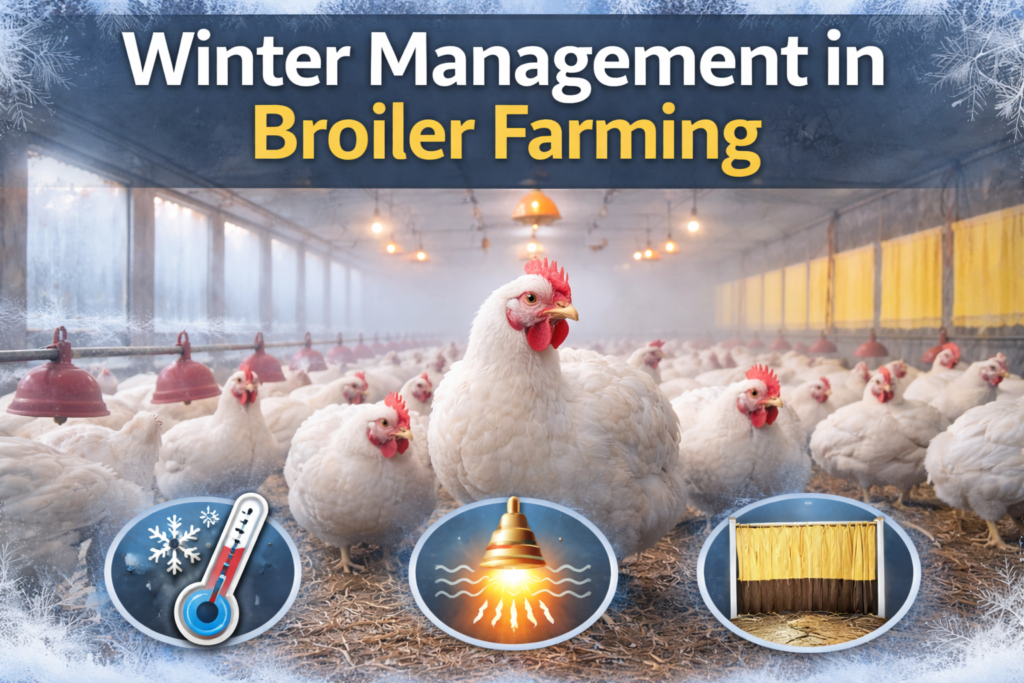
Why are winters bad?
Infectious disease outbreaks in winter are quite dangerous and widespread due for various reasons. Metabolic & management problems also create huge setbacks if proper care is not taken. Due to high production, markets are weak.
- Ranikhet – VVND
- Infectious Bronchitis (IB)
- ILT in broilers
- HPAI & LPAI
- CRD
These diseases become very frequent and cause huge mortality. Metabolic and management problems take a central place due to reducing ventilation and improper temperature management. Mortality during brooding, high ammonia/dust in sheds and ascites / sudden death in heavy birds are responsible for losses.
Before the arrival of chicks
Cleaning of shed
- Proper disposal of previous litter
- Cleaning of roof and spider webs & dirt
- Remove fans & clean them properly
- Whitewash of all structures with lime (chuna)
- Kachha floor – lime treatment after scrapping upper 6 inch layer
- Pakka floor – wash it properly and spray with 1% Biobuster or KMnO4 (10g per liter water)
- Clean the curtains with high pressure water and placed them on sides
- After that fogging/Spray with Sokrena or B904 or with Sanitrom (cheap and best).
- Water pipeline should be cleaned with Sanitrom.
- After spray keep farm closed for atleast 2 -3 days or until the arrival of chicks.
- 12 hours before arrival start preparing for chicks
- Arrangement of heating and its back should be done in advance.
Before arrival – day zero
- Electricity with all backup
- Proper bulbs and lights, keep drinkers feeders ready
- Heating source along with backup (temperature of brooding area should be 30-32 d C)
- Never let them free in open farm, always make a brooding area. Properly place newspaper on litter.
- Litter thickness should be 4 inch. Rice husk is best litter.
- 0.3% EASY BROOD solution (3g per liter water) should be ready in chick drinkers 1 hour before chicks arrival in normal water.
- Manage temperature, low temperature is the major factor for early mortality
- EASY BROOD contains all essential probiotics, yolk utilizing components, vitamins, amino acids, glucose & electrolytes.
- After Easy Brood on first day, second water should be given VitADEN
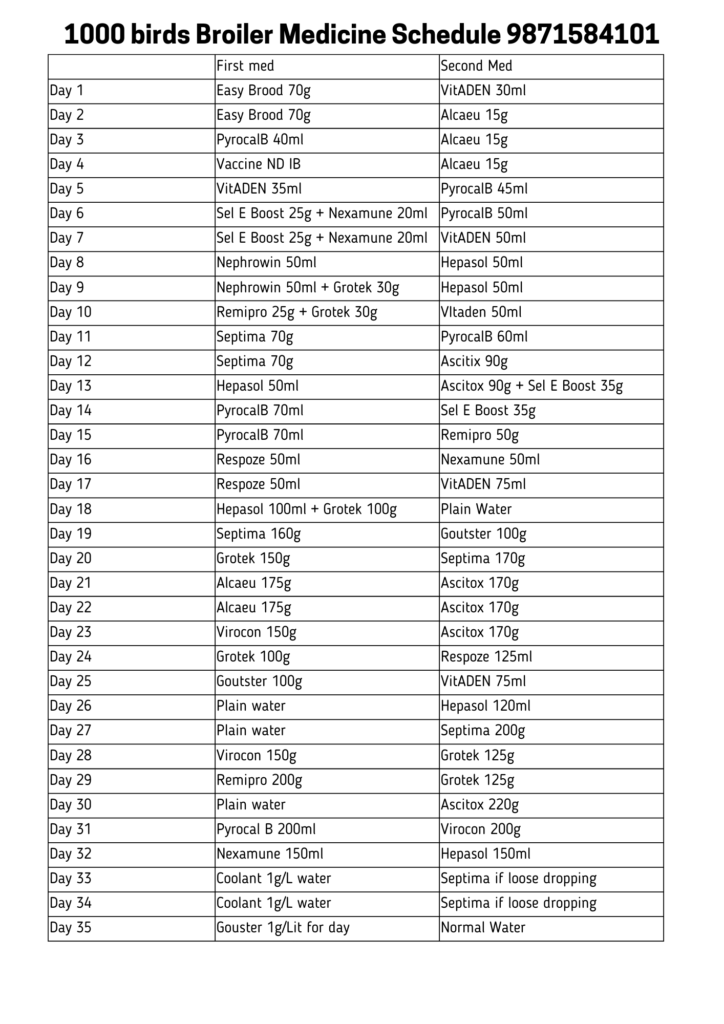
- From second day, water should be changed twice a day. Alcaeu, VitADEN, PyrocalB & Easy Brood should be given as per schedule. This will reduce chances of mortality due to yolk infection and give your birds a robust start.
- Feed should also be spread on newspaper and in chick trays (1/100) before the arrival of chicks.
- Atleast 25% of the feed should be on the papers on first 2 days.
- Temperature maintenance is very necessary in the first 12 days because chicks cannot maintain their temperature.
- To maintain temperature consider brooder canopy under false ceiling in winters. Space per chick should be? (3-4 chicks per sqft)
- In this system ventilation is not hampered much.
- Otherwise dust and ammonia causes sound problem
- Dim the light while placing chicks in brooding area, when chicks are accustomed to the environment slowly increase the light.
- Give 23hr light (30-40 lux), 1 hour dark can be given from 1st day without affecting FCR.
- 24hr light is also not a problem
- 20 chick drinkers per 1000 chicks should be present and place at equal distances. Change water 2 times a day at least.
- From 3-4th day sanitizer (sanitrom) can be starter at the rate of 1ml/5L water.
- Observe chicks – best indicator of temperature is chick’s behavior
- If chicks are huddling, check chicks temperature by placing its feet on your neck.
- Chicks should be uniformly distributed (as shown in the diagram)
- All chicks must be able to eat and drink immediately upon placement in the house.
- The empty boxes should be removed from the house without delay.
- Leave chicks to settle for 1 to 2 hours to become accustomed to their new environment.
- The longer the chicks remain in the boxes, the greater the degree of potential dehydration.
- This may result in early mortality and reduced growth as indicated by 7-day and final live weight.
- After this time, make a check to see that all chicks have easy access to feed and water.
- Make adjustments to equipment and temperatures where necessary.
Key Points and recommended values of climate factors are:
- Pre-heat the house (30-33 d C)
- Ready EASY BROOD solution and feed
- Dim the light for 1-2 hrs
- Unload and place chicks quickly
- Make feed and water available immediately
- Leave chicks to settle for 1 to 2 hours
- Air temperature of 30°C/86°F
- Litter temperature of 28–30°C/82–86°F
- Relative humidity of 60-70%
Day One Management
- When chicks arrived they are hungry, healthy chicks should eat feed quickly, properly and fill their crops.
- Check a sample of birds at 8 and 24 hours after arrival on the farm to make sure that all the chicks have found feed and water.
- Gently feel each chick’s crop.
- Give first-day vaccination as per schedule
- The chick on the left has a full, rounded crop, while the chick on the right has an empty crop.
- Target crotp fill at 8 hours after delivery is 80% and at 24 hours after delivery 95–100%.
- Ventilation at this time is equally important as that of temperature, During day time, if possible open the curtains or run exhautst fans.
- In winter sometimes RH goes down below 50%. It increases dust in air and reduces air track moisture. Watch humidity not good beyond 70% and below 50%.
- When Easy Brood water is over give VitADEN as per schedule, upgrading liver’s fat soluble vitamins.
Day Two Management
- Keep continuing EASY BROOD in water. Around 30 litres of water is consumed by 1000 chicks.
- Take care of feed, 1000 chicks consume around 13kg of feed.
- If gout problem is seen add 15g Goutster per 1000 chicks. It also increases water intake and improves kidney filtration.
- In the evening start giving Alcaeu for immunity and prevention of yolk infection.
- Observe chicks’ behaviour and separate any loose chicks.
- If mortality is seen (10 out of 1000 chicks died), it is alarming.
- First-week mortality is mainly due to hatchery infection/ transport stress/ poor temperature management.
Day Three Management
- In morning water, give 40ml Pyocal-B and 10ml VitADEN (if chicks are under weight) per 1000 chicks in same water.
- In evening give ALCAEU 15g per 1000 chicks. If mortality seen earlier it can be given before.
- Remove soiled newspaper and replace with new
- Third day is very important as by this day chicks are start consuming feed properly and adjusted in the environment. Take proper care of temperature and ventilation.
- If mortality is seen by this time it is mainly due to huddling and poor hatch or long distance travel. Chicks should weigh around 80g by the end of 3rd day.
- Weak inactive chicks should be seperated.
Day Four Management
- On 4th day in the morning ND or ND-IB vaccine can be given. It should be given by eye or nasal drop method. If given orally in drinking water no medicine or sanitozer should be used in water.
- After 2 hours of vaccine in morning water, give 10ml Nexamune and 10ml VitADEN per 1000 chicks in same water.
- In evening start giving ALCAEU 15g per 1000 chicks.
- Total water consumed around 40 to 45 liter.
- Third day is very important as by this day chicks are start consuming feed properly and adjusted in the environment. Take proper care of temperature and ventilation.
- If mortality is seen by this time it is mainly due to huddling and poor hatch or long distance travel. Chicks should weigh around 80g by the end of 3rd day.
Day Five Management
- In morning water, give 35ml VitADEN and per 1000 chicks in same water after this water in next water give 45ml Pyrocal-B.
- If mortality is not seen ALCAEU should be stopped. Water sanitizer except acidifier should not be given.
- By fifth day average weight of chicks should be around 125 -130g and mortality should less than 0.2% (2/1000).
- Water consumption should be 55liter or less in winters.
- Total feed consumed by now is 100 to 110g & FCR of 0.76
- 5th day is important because many people give ND vaccination on 6th day, so NEXAMUNE on 5th day can be mixed with Pyrocal-B is beneficial.
- Check temperature and observe any huddling, remove weak, small and dull chicks in a separate brooder. Increase brooder area if required (depend on weather).
Day Six Management
- Give F1 or Lasota vaccine in the morning through nasal or eye route, only when vaccine were not given earlier. Medcines can be given after 2hrs of vaccine.
- After this, give Sel E Boost 25g + Nexamune 20ml and per 1000 chicks in water and in second water of the day give PyrocalB 50ml.
- Dont give any sanitizer in water if vaccine is given.
- Remove newspapers.
- Remove chick trays and give feed in feeders only.
- Gradually increase floor space.
- Increase brooder height and maintain temperature.
- Avoid any huddling or any other stress.
- Give them ventilation during suitable warm time of the day.
- Never ignore mortality at this time. Do a postmortem and try to identify the cause.
- Stress should be avoided at this time.
- Total mortality should be less than 0.4% by now.
- 1 hour dark in the night should keep continuing.
Day Seven Management
- Most important work to do is to weigh chicks and monitor growth.
- Weight on 7th day explain us the whole picture of farm management, feed and chick quality.
- Check total feed intake.
- Body weight between 180 to 200g is fine. Any weight below this shows problem which has to be identified.
- Area should be increased but keep under brooder.
- On this day, if you are going to keep birds for more than 2.5kg than give IBH vaccination (only if IBH is a problem).
- In morning water, give Sel E Boost 25g + Nexamune 20ml per 1000 chicks in water & in evening VitADEN 50ml per 1000 chicks.
- It must be noted that if mortality in early days was high due to any reason than uniformity in flock will be lost and target weight is very difficult to achieve.
- Separate these chicks and start growth promoter in them.
Day Eight & Nine Management
- For 2 days, in morning water, give Nephrowin & in evening Hepasol as per scheduled dose.
- Growth should be monitor regularly.
- Keep giving sanitizer if required
Day Ten to Twelve Management
- For 3 days, Remipro, Grotek, VitADEN & Septima should be given.
- Grotek should be given it boots growth. In low-weight chicks grotek has good effects.
- Growth should be monitor regularly.
- For prevention of ascites problem Ascitox is also started.
- Keep giving sanitizer if required
- Total feed consumption on 10th day is approximately 300kg per 1000 chicks.
- Daily water intake per 1000 chicks is about 100liters.
- By 9 or 10th day brooder can be removed
- Area should be increased
- Temperature should be at least 28 d C.
- Biosecurity should be keep tight
- Increase ventilation in farm otherwise sound problems could occur.
- Dust & ammonia should be controlled in winters (spread AmmoBond, be proved beneficial).
Day Thirteen to Fifteen Management
- For 3 days, Hepasol, Ascitox, Sel e Boost & Pyrocal-B as per schedule given below.
- In evening schedule give Ascitox 70g per 1000 chicks, if ascites problem is suspected due to poor brooding and extreme winter temperature.
- Gumboro vaccination is risky in broilers, if you want to do, do it on 13th or 14th day.
- By 14th day 1000 chicks should gain 430 – 450kg weight.
- At this time birds should e shifted to starter diet.
- Check droppings after changing the feed if loose dropping are seen give Remipro.
- Proper ventilation could be provided in day time even in cold temperature.
- Keep eye on sound problem.
- Water tank should be checked for any algae growth.
Day Sixteen to Nineteen Management
- Sound problem came in the flock by 16th day. To tackle this RESPOZE should be given.
- Working of RESPOZE is unique as it clear mucous from trachea and have protective effect on cilia.
- It effectively control sound problem.
- Other problems in these days are development if IB – CRD duo which is further complexed by E.coli.
- Another problem is IBH which start showing at this stage of broiler life.
- Feed is changed so loose droppings may be seen thats why SEPTIMA should be used
- If viral like IBH, IB, RD, LPAI etc is suspected VIROCON should be given.
Day Twenty to Twenty-Two Management
- Sometimes ceacal droppings are seen on these days which are chocolaty in color.
- SEPTIMA should be given in water @ 130g per 1000 birds.
- Keep eye on weight.
- To prevent CRD and respiratory infections, Alcaeu is given.
- By day 21, average weight of the bird would be around 900 to 950g.
- FCR at this point should be between 1.25 to 1.30
- Daily feed intake is about 100g
- Dark period in night should continue
- On 21st day Lasota should be given through drinking water of eye drop method. DO NOT IGNORE THIS VACCINE. Do not perform lasota if it is not done on day 1 or 6.
- Ventilation day should be given by opening the curtains
- Check the quality of litter, it you find is wet than use AmmoBond. Dont spread lime powder THAT IS NOT OF ANY USE.
- If flock is running good till now than take a breath of sigh.
Day Twenty-Three to Twenty-Five Management
- This is the time when viral-related problems are started.
- In the morning Virocon should be given in water.
- If ascites is a problem and cold conditions are prevailing then keep continuing ASCITOX Q10 schedule in the early night.
- Never forget to lift the feed in the night for 2 – 3hrs.
- By the 25th day sudden mortality or lameness type of conditions are seen. If a bird is losing and mortality is occurring due to E.coli then use ALCAEU and SEPTIMA one after another.
- If you are using a schedule of these medicines and see a mortality problem, you can consult over WhatsApp @ 9540612588
- Water intake should be observed, in normal conditions 1000 birds could drink 220liter water per day. GOUTSTER should be given in case of low water intake.
- You should note one point here, that in Ascites mortality it is not necessary that died bird have water in her belly.
Day Twenty-Six to Twenty-Nine Management
- During this time birds are rapidly growing and sudden death issues become more prevalent. Gumboro, IB and RD is seen and MABs goes down in the birds. Mucosal immunity is required to enhance. Birds are heavy and have more than 1kg of weight.
- Finisher feed starts by this time so necrotic enteritis cases also rise which causes huge losses.
- ALCAEU and SEPTIMA keep in hand if necrotic enteritis is seen & RESPOZE for sound problems.
- REMIPRO and VIROCON from 27 – 29 days.
- Bird weight on 28 day should be 1500g
- Water intake should be observed, in normal conditions 1000 birds could drink 320liter water per day.
- Ventilation requirements are very high during this time, if it is compromised than huge losses could be seen.
- Follow schedule for dosage and timings
Day Thirty to Thirty-Five
- Mortality does not occur after 1.5kg weight. Only sudden deaths due to heart failure are seen.
- Birds consume feed very vigorously and the feeder should not run out of feed otherwise weight could be back.
- Some extra maize /wheat could be given without affecting FCR & it saves feed.
- Higher feed intake needs higher water but in winter water consumption is reduced which consequently reduces feed intake.
- GOUTSTER should be given @ 200g per 1000 birds on alternate days
- Hepasol DS is also useful if feed intake is a lower and fatty liver problem is seen.
- On the 35th day 2kg weight should be reached
- If this weight is not achieved start giving GROTEK @ 200g per 1000 birds.
- If all runs well then no medicines are required beyond this stage.
WhatsApp (click here) for All Type of Consultancy (disease, treatment, feed formulation etc) or call 9871584101
सर्दियों में ब्रॉयलर मैनेजमेंट
Complete Winter Broiler Management SOP (Day 0–35)
Prepared by Ali Veterinary Wisdom for Poultry Farmers
📞 Call / WhatsApp: 9871584101
यह ब्रॉयलर मैनेजमेंट गाइड उन किसानों के लिए तैयार की गई है जो सर्दियों में अपने फार्म से maximum growth, बेहतर FCR और minimum mortality चाहते हैं। यह केवल theory नहीं बल्कि practical, day-wise SOP है, जो field conditions में काम करता है। इस broiler management guide का PDF version भी उपलब्ध है।
Winters Are Good – Winters Are Bad (Reality of Broiler Management)
सर्दियों का मौसम ब्रॉयलर फार्मिंग के लिए सबसे ज़्यादा misunderstood मौसम है। कई किसान इसे सबसे अच्छा season मानते हैं, तो कई इसे सबसे ज़्यादा loss देने वाला। सच्चाई यह है कि सर्दियाँ अच्छी भी हैं और खतरनाक भी — फर्क सिर्फ़ ब्रॉयलर मैनेजमेंट का होता है।
सर्दियाँ ब्रॉयलर के लिए अच्छी क्यों होती हैं
सर्दियों में ब्रॉयलर birds की growth और FCR naturally बेहतर होती है। सभी commercial strains जैसे Hubbard, Ross और Aviagen temperate देशों से आती हैं और cold climate में perform करने के लिए genetically developed होती हैं। इसलिए ठंडे मौसम में ये birds कम energy body temperature maintain करने में खर्च करती हैं और ज़्यादा energy growth में लगती है।
दूसरा बड़ा फायदा feed का होता है। बारिश के बाद harvesting season पूरा हो चुका होता है, जिससे market में fresh, toxin-free और comparatively cheap feed ingredients उपलब्ध रहते हैं। यही समय होता है जब नए batches शुरू करके किसान गर्मियों और पिछले seasons के नुकसान की भरपाई कर सकता है। लेकिन सर्दियों में आलस करना सबसे बड़ी गलती है।
सर्दियाँ खतरनाक क्यों होती हैं
सर्दियों में infectious diseases का pressure बहुत ज़्यादा होता है। high production के कारण market weak रहता है और साथ-साथ ventilation कम होने से management और metabolic problems बढ़ जाती हैं।
सर्दियों में आमतौर पर ये diseases ज़्यादा देखने को मिलती हैं:
- Ranikhet – VVND
- Infectious Bronchitis (IB)
- ILT in broilers
- HPAI & LPAI
- CRD
इनके अलावा brooding mortality, sheds में ammonia और dust का बढ़ना, और heavy birds में ascites व sudden death बड़े नुकसान का कारण बनते हैं। अधिकतर मामलों में root cause होता है improper ventilation और गलत temperature management।
🧹 चूजों के आने से पहले की तैयारी (Before Arrival of Chicks)
सफल ब्रॉयलर मैनेजमेंट की शुरुआत चूजों के आने से पहले होती है। सबसे पहले shed की proper cleaning ज़रूरी है। पुराने litter को पूरी तरह हटाकर सुरक्षित तरीके से dispose करें। छत, spider webs और जमी हुई गंदगी को साफ करें। सभी fans को हटाकर अच्छी तरह धोएँ और सुखाएँ।
पूरे shed की lime (चूना) से whitewash करें।
- Kachha floor में ऊपर की 6 inch layer scrape करके lime treatment करें।
- Pakka floor को अच्छे से धोकर 1% Biobuster या KMnO₄ (10g per liter water) से spray करें।
Curtains को high-pressure पानी से धोकर sides में रखें। इसके बाद पूरे farm में Sokrena, B904 या Sanitrom से fogging/spray करें। Water pipelines को भी Sanitrom से clean करें। Spray के बाद farm को कम से कम 2–3 दिन बंद रखें।
⏰ Chicks आने से 12 घंटे पहले
Chicks arrival से लगभग 12 घंटे पहले broiler management की तैयारी शुरू हो जानी चाहिए। Heating arrangements और उसका backup पहले से check करें। Electricity और backup power सुनिश्चित करें। Bulbs, lights, drinkers और feeders ready रखें। Brooding area का temperature 30–32°C होना चाहिए।
🐣 Day Zero – Chicks Arrival & Brooding Management
Chicks को कभी भी open farm में free नहीं छोड़ना चाहिए। हमेशा proper brooding area बनाना ज़रूरी है। Litter thickness 4 inch रखें, जिसमें rice husk सबसे अच्छा माना जाता है। Newspaper को litter के ऊपर सही तरीके से बिछाएँ।
Chicks arrival से 1 घंटे पहले normal water में 0.3% EASY BROOD solution (3g per liter) तैयार रखें। Low temperature early mortality का सबसे बड़ा कारण होता है, इसलिए temperature management पर पूरा ध्यान दें।
EASY BROOD में probiotics, yolk utilizing components, vitamins, amino acids, glucose और electrolytes होते हैं, जो chicks को मजबूत शुरुआत देते हैं। First day Easy Brood के बाद second water में VitADEN दें। Second day से पानी दिन में दो बार बदलें और schedule के अनुसार Alcaeu, VitADEN, Pyrocal-B और Easy Brood दें, ताकि yolk infection और early mortality का risk कम हो।
Feed को भी newspaper और chick trays (1/100) में arrival से पहले फैलाएँ। पहले 2 दिनों में कम से कम 25% feed paper पर होना चाहिए।
पहले 12 दिनों तक temperature maintenance बहुत critical है क्योंकि chicks खुद temperature maintain नहीं कर पाते। Winters में false ceiling के नीचे brooder canopy लगाना बेहतर रहता है, इससे ventilation भी ज्यादा प्रभावित नहीं होती। Space 3–4 chicks per sq ft रखें।
Placement के समय light dim रखें और chicks environment के अनुसार adjust हो जाएँ, तब धीरे-धीरे light बढ़ाएँ। 23 घंटे light (30–40 lux) और 1 घंटे dark day-1 से दिया जा सकता है। 24 घंटे light भी कोई problem नहीं है।
20 chick drinkers per 1000 chicks रखें और पानी दिन में कम से कम 2 बार बदलें। 3–4 दिन से sanitizer (Sanitrom) 1ml/5L water की दर से शुरू किया जा सकता है।
Chicks का behaviour temperature का सबसे अच्छा indicator है। अगर chicks huddling करें, तो उनके पैरों को अपनी गर्दन पर रखकर temperature महसूस करें। Chicks uniformly distributed होने चाहिए।
Empty boxes तुरंत shed से बाहर निकालें। Chicks को 1–2 घंटे settle होने दें। Boxes में ज़्यादा देर रहने से dehydration बढ़ता है, जिससे early mortality और 7-day व final weight दोनों प्रभावित होते हैं।
🌡️ Brooding के Key Climate Points
House को 30–33°C तक pre-heat करें।
Air temperature लगभग 30°C, litter temperature 28–30°C और relative humidity 60–70% रखें। Light 1–2 घंटे dim रखें, chicks को जल्दी unload करें और feed-water तुरंत उपलब्ध कराएँ।
🐥 Day One Management
Chicks arrival के बाद hungry होते हैं। Healthy chicks तुरंत feed लेना शुरू कर देते हैं। 8 और 24 घंटे पर sample birds का crop check करें। 8 घंटे में 80% और 24 घंटे में 95–100% crop fill target होना चाहिए। First-day vaccination schedule के अनुसार करें।
इस समय ventilation temperature जितना ही ज़रूरी है। दिन में curtains खोलें या exhaust fans चलाएँ। Winters में RH कई बार 50% से नीचे चला जाता है, जिससे dust बढ़ती है, जबकि 70% से ऊपर humidity भी ठीक नहीं है। Easy Brood खत्म होने के बाद schedule के अनुसार VitADEN दें।
🐥 Day Two Management
EASY BROOD जारी रखें। 1000 chicks लगभग 30 liters पानी और 13 kg feed consume करते हैं। अगर gout problem दिखे तो Goutster 15g/1000 chicks दें। Evening में yolk infection prevention और immunity के लिए Alcaeu शुरू करें।
Loose chicks अलग करें। अगर mortality 10/1000 हो जाए, तो यह alarm है। First week mortality का मुख्य कारण hatchery infection, transport stress या poor temperature management होता है।
🐥 Day Three Management
Morning water में Pyrocal-B 40ml + VitADEN 10ml (अगर chicks underweight हों) दें। Evening में Alcaeu 15g/1000 chicks दें। Soiled newspaper हटाकर नया लगाएँ।
Day 3 तक chicks feed लेना शुरू कर देते हैं और environment के अनुसार adjust हो जाते हैं। इस दिन weight लगभग 80g होना चाहिए। Weak और inactive chicks अलग करें।
🐥 Day Four Management
Fourth day morning में ND या ND-IB vaccine eye या nasal drop से दें। Oral water vaccination के समय कोई medicine या sanitizer पानी में न दें। Vaccine के 2 घंटे बाद Nexamune 10ml + VitADEN 10ml/1000 chicks दें। Evening में फिर Alcaeu 15g दें। Water consumption लगभग 40–45 liters रहता है।
🐥 Day Five Management
Morning water में VitADEN 35ml/1000 chicks, अगली water में Pyrocal-B 45ml दें। अगर mortality नहीं है तो Alcaeu बंद करें। Fifth day तक weight 125–130g, mortality <0.2%, water ≤55 liters, feed intake 100–110g और FCR लगभग 0.76 होना चाहिए।
🐥 Day Six Management
अगर पहले vaccine नहीं दी गई हो तो morning में F1 या Lasota vaccine eye/nasal route से दें। Vaccine के 2 घंटे बाद Sel-E Boost 25g + Nexamune 20ml/1000 chicks और second water में Pyrocal-B 50ml दें। Vaccine day पर sanitizer न दें। Newspaper और chick trays हटा दें, floor space धीरे-धीरे बढ़ाएँ और ventilation दें। Total mortality <0.4% होनी चाहिए।
🐥 Day Seven Management
यह सबसे important दिन है। Chicks को weigh करें। 7th day weight पूरे farm management की तस्वीर दिखा देता है। Ideal weight 180–200g है। Low weight problem का संकेत है। अगर birds को 2.5kg से ऊपर रखना है और IBH problem है, तो vaccination करें। Morning में Sel-E Boost 25g + Nexamune 20ml, evening में VitADEN 50ml/1000 chicks दें।
🐥 Day 8–9 से Day 35 (पूरा Revised Schedule Intact)
इसके बाद Day 8–9, Day 10–12, Day 13–15, Day 16–19, Day 20–22, Day 23–25, Day 26–29 और Day 30–35 तक वही schedule follow करें जैसा ऊपर दिया गया है —
जिसमें Nephrowin, Hepasol, Remipro, Grotek, Septima, Ascitox, Virocon, Respoze, Goutster, Sel-E Boost आदि का उपयोग condition और timing के अनुसार किया गया है, साथ ही weight targets, water intake, ventilation और biosecurity पर लगातार निगरानी रखी जाती है।
📞 Consultancy Support
अगर इस पूरे schedule के बावजूद mortality, disease या performance issue दिखे, तो:
👉 Ali Veterinary Wisdom
📱 WhatsApp / Call: 9871584101