
Understanding Buffalo Biology
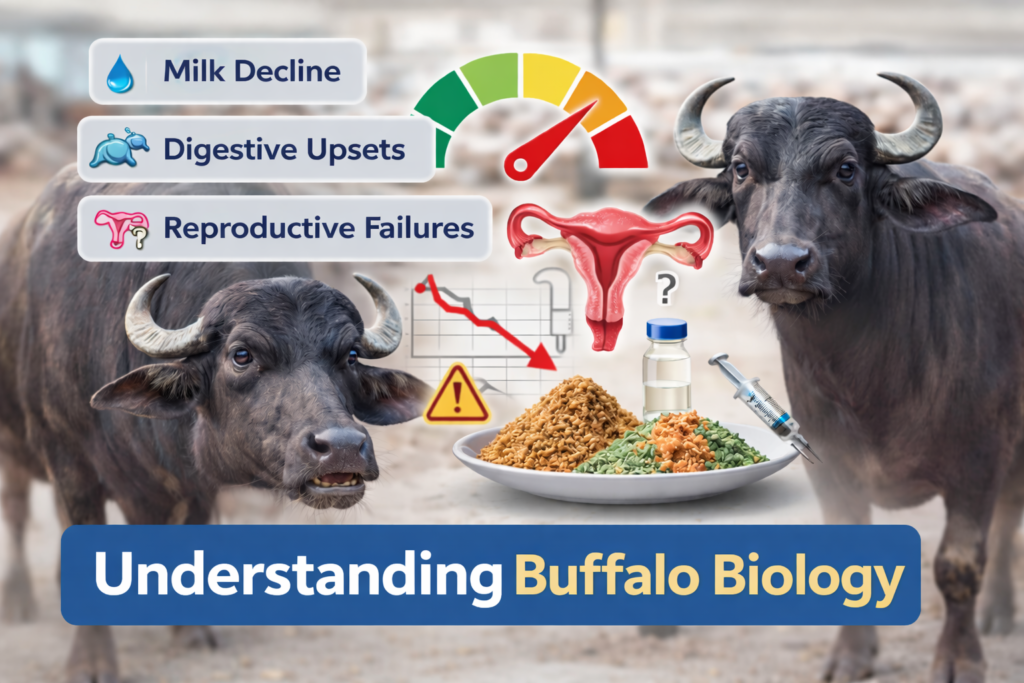
Buffalo biology is often oversimplified at the farm level. Most management decisions are taken assuming that buffaloes behave exactly like cows, which is a fundamental mistake. Buffaloes have a slower metabolic rhythm, higher tolerance for fibrous feed, and a different stress response pattern compared to cattle.
Iska matlab ye hai ki buffalo zyada bolti nahi, par jab reaction deti hai to damage pehle ho chuka hota hai.
From a digestive perspective, buffalo rumen is highly efficient in utilizing roughages, but it is also sensitive to imbalance when concentrate levels rise suddenly. Their metabolism adapts well to low-input systems, but once milk production pressure increases, even small nutritional gaps begin to show as fertility problems, milk inconsistency, or health disturbances.
In simple terms, buffalo farming rewards consistency, not experimentation.
Gradual Milk Yield Decline
Gradual milk decline is one of the most misunderstood problems in buffalo farming. Farmers often respond by increasing concentrate or changing feed brands, expecting an immediate jump in milk yield. Unfortunately, this approach rarely works in the long term.
Milk yield does not decline suddenly due to one bad feeding day. It drops because of long-standing metabolic stress, inefficient rumen fermentation, or micronutrient deficiencies that remain unnoticed for weeks or months.
Milk girna actually ek warning hoti hai, punishment nahi.
Unless the underlying metabolic balance is corrected, short-term interventions only provide temporary relief.
Poor Reproductive Performance
Reproductive inefficiency in buffaloes is rarely a standalone reproductive problem. Conditions such as silent heat, repeat breeding, or delayed conception are usually metabolic reflections, not gynecological failures.
Buffalo reproduction is closely linked to:
- Energy balance
- Mineral status
- Stress load
Jab animal ka system survival mode me hota hai, reproduction automatic priority list me neeche chala jaata hai.
This is why many buffaloes appear healthy, yet fail to conceive consistently. Understanding this link changes the way reproduction is approached—from treatment-based to system-based correction.
Digestive Upsets & Feed Inefficiency
Digestive disturbances in buffaloes often appear as loose dung, reduced appetite, or fluctuating fat percentage. Farmers usually blame feed quality alone, but the real issue lies deeper.
Sudden changes in ration composition, poor fiber structure, or inconsistent feeding timings disturb the rumen microbial ecosystem. Once rumen balance is lost, feed efficiency drops even if feed quantity increases.
Rumen ko sirf bharna nahi hota, sambhalna hota hai.
Modern dairy management increasingly focuses on rumen environment stabilization rather than just nutrient quantity.
Why Quick Fix Solutions Fail
Quick-fix solutions fail because buffalo farming problems are rarely linear. Most issues are multi-factorial, involving nutrition, environment, management rhythm, and animal physiology.
One supplement cannot correct a feeding inconsistency. One injection cannot solve metabolic stress. And one ration change cannot compensate for months of imbalance.
Professional consultancy ka kaam problem ko todna nahi, samajhna hota hai.