
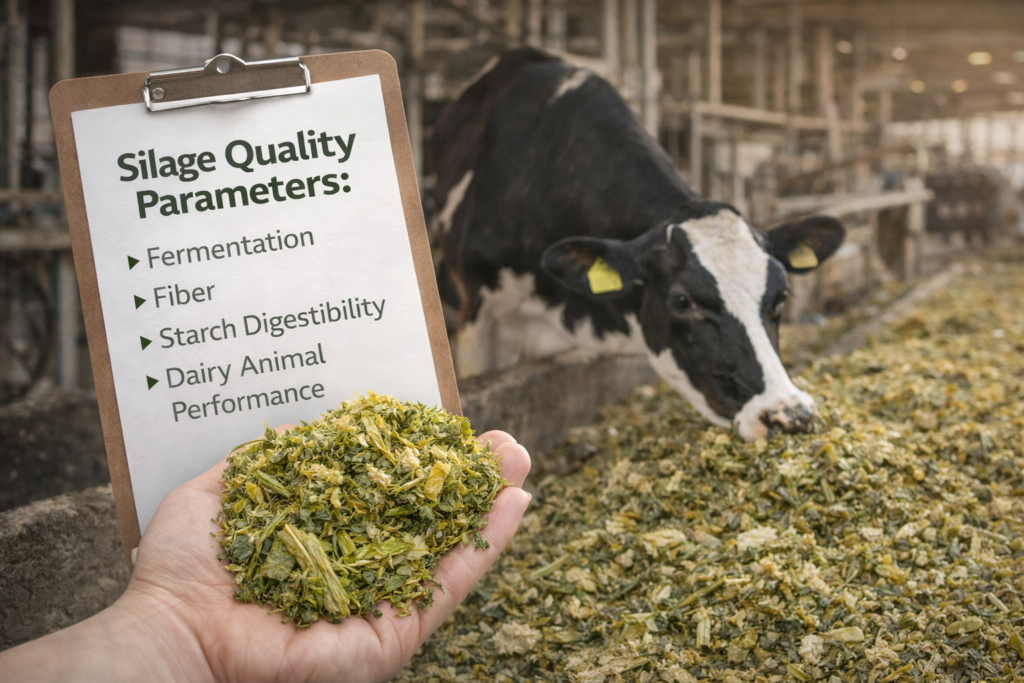
Silage Quality Parameters: Fermentation, Fiber, Starch Digestibility, and Dairy Animal Performance
(With practical biological interpretation — including occasional Roman Hindi explanations for clarity)
Silage is often described simply as preserved green fodder, but from a modern livestock nutrition and dairy physiology perspective, it is far more than a storage technique. Silage represents a controlled biochemical and microbial transformation of plant material that directly influences rumen ecology, feed intake behavior, metabolic efficiency, and ultimately animal productivity. When we reduce silage to just “stored forage,” we miss its deeper functional role in dairy production systems. Silage quality parameters therefore become central point of discussion when we talk about performance impact of silage on cows, because it is single most ingredient which shapes DMI.
Jab hum silage ko sirf chara store karna samajhte hain, tab hum uska metabolic impact ignore kar dete hain. Silage actually ek “programmed feed system” hai — jo rumen microbes, digestion aur intake behaviour ko shape karta hai.
Plant Physiology Before Fermentation
Once forage is harvested, plant metabolism does not immediately stop. Cellular respiration continues for some time, consuming soluble carbohydrates that otherwise could contribute to animal energy intake. If oxygen exposure persists, this respiration results in dry matter loss and opens the door for undesirable microbial growth.
Silage fermentation essentially aims to arrest this respiration rapidly by establishing anaerobic conditions. Lactic acid bacteria then dominate fermentation, producing organic acids that lower pH and stabilize the forage.
Simple terms me: plant ko jaldi “anaerobic sleep mode” me daalna hota hai, warna energy waste hoti rahegi.
Microbial Succession — The Real Silage Engine
Silage fermentation is not a single-step process but a microbial succession. Early aerobic microbes and plant enzymes act first, followed by facultative anaerobes, and eventually lactic acid bacteria dominate. If this succession proceeds correctly, lactic acid becomes the main fermentation product.
However, if moisture is excessive, packing is inadequate, or sealing is delayed, clostridial fermentation may occur. This produces butyric acid, ammonia nitrogen, and biogenic amines — compounds strongly associated with reduced feed intake and metabolic inefficiency.
Yahan ek important baat: bad fermentation sirf smell problem nahi hota. Yeh intake, rumen stability aur nitrogen utilization sab affect karta hai.
Physical Structure Matters: Particle Length and NDF
Silage evaluation often focuses on nutrient numbers such as crude protein, neutral detergent fiber (NDF), or total digestible nutrients. But physical characteristics are equally critical. Particle length influences chewing behavior, rumen fill, saliva production, and ultimately feed intake.
Research suggests cows chew feed to roughly a 10–11 mm particle size before swallowing, regardless of initial forage length. Excessively long silage particles therefore do not necessarily enhance rumen function but do increase eating time.
Cow ka daily schedule fixed hota hai — khana, rumination, rest. Agar eating time zyada ho gaya, resting compromise hota hai. Aur resting kam hua to indirectly milk production aur health impact hoti hai.
Fiber digestibility is another dimension. Highly lignified fiber slows rumen passage rate and can mechanically restrict intake. Conversely, overly fine fiber reduces rumen buffering and increases acidosis risk. Effective silage feeding therefore requires balancing structural fiber effectiveness with intake freedom.
Feeding Environment and Behavioral Ecology
One of the most underestimated aspects of silage feeding is the feeding environment. Feed bunk space, competition among animals, feeding frequency, and social hierarchy strongly influence intake.
Even nutritionally excellent silage may underperform if animals lack sufficient access time. Subordinate cows often reduce intake under competitive conditions, leading to uneven herd performance.
Isliye silage quality ke saath feeding management equally important hota hai — warna nutritionist ka ration paper par perfect hota hai, ground par nahi.
Starch Digestibility: The Prolamine Matrix Effect
Corn silage and similar cereal forages contain starch granules encased in protein matrices known as prolamines. During ensiling, proteolytic activity gradually breaks down this matrix, increasing starch accessibility without necessarily changing measured starch percentage.
This biochemical change has significant implications. Improved ruminal starch digestibility increases propionate production. Propionate serves as a key gluconeogenic precursor but also plays a role in hepatic oxidation signals that regulate feed intake.
Simple explanation: starch percentage same ho sakta hai, lekin digestibility change hone se cow ka intake behaviour aur energy efficiency change ho sakta hai.
This explains why two silages with similar laboratory analyses may produce different animal responses.
Nitrogen Transformation During Ensiling
Protein degradation during fermentation converts part of true protein into non-protein nitrogen (NPN). This is not inherently negative. Rumen microbes can effectively utilize NPN if sufficient fermentable energy is simultaneously available.
However, asynchronous nitrogen and energy release leads to ammonia absorption, increased liver detoxification energy demand, and reduced production efficiency.
Yeh hidden inefficiency hoti hai — ration numbers correct lagte hain, lekin microbial synchrony mismatch ho jata hai.
Fermentation End Products and Feed Intake
Lactic acid is typically the dominant fermentation product in well-preserved silage. While often associated with good silage quality, its relationship with dry matter intake (DMI) is complex.
Studies suggest that intake reduction is more strongly associated with secondary fermentation compounds such as butyrate, ammonia nitrogen, and biogenic amines rather than lactic acid itself.
Yani lactic acid ko isolate karke quality judge karna incomplete approach hai — poora fermentation profile dekhna padta hai.
Acetic acid may influence intake through rumen osmotic pressure and palatability effects. Propionate production in the rumen, often linked with starch digestibility, can regulate satiety via hepatic oxidation pathways. Ethanol, sometimes present in silage, generally does not significantly reduce intake at typical concentrations.
Butyric acid, however, is widely considered a marker of poor fermentation and is often associated with reduced intake and nitrogen metabolism disturbances.
Silage pH: Not the Whole Story
Silage pH has traditionally been used as a quality indicator, but modern research suggests it is not always a reliable predictor of intake or performance. Two silages with similar pH values may differ significantly in fermentation end-product profiles and animal responses.
Isliye sirf pH number dekhna sufficient nahi hota — fermentation acids, ammonia-N aur fiber digestibility sab evaluate karna padta hai.
Sorting Behavior and Rumen Stability
Selective feeding or sorting is common when silage particle distribution is uneven. Cows often avoid longer particles and consume more fermentable fractions first. This creates fluctuations in rumen fermentation patterns and increases the risk of subclinical ruminal acidosis.
Sorting ka effect silent hota hai — milk fat drop, inconsistent intake, unexplained performance variation.
Proper chopping, mixing, and ration consistency are therefore critical components of silage utilization.
Silage as a Tool for Nutritional Predictability
One of silage’s greatest advantages is its ability to stabilize seasonal forage supply. Consistent feed availability improves herd-level intake stability and production predictability.
However, poor-quality silage produces the opposite effect — fluctuating intake, inconsistent milk yield, and increased metabolic stress.
Silage herd metabolism ko “stabilize” bhi kar sakta hai aur “destabilize” bhi — depend karta hai fermentation quality aur feeding management par.
Integrating Silage into Modern Dairy Systems
Today’s high-producing dairy animals operate close to metabolic limits. Small changes in rumen fermentation patterns, feed intake behavior, or nutrient synchrony can significantly impact performance.
Silage sits at the intersection of plant science, microbiology, animal nutrition, and farm management. Effective silage utilization therefore requires system-level understanding rather than isolated nutrient analysis.
Yeh ek multidisciplinary subject hai — agronomy, microbiology, nutrition aur management sab combine hote hain.
Final Perspective
Silage should not be viewed merely as preserved forage but as a biologically active feed influencing rumen function, intake regulation, metabolic efficiency, and herd productivity. Its evaluation demands not only laboratory analysis but also understanding of fermentation dynamics, animal behavior, and farm management context.
When properly managed, silage can enhance dairy performance, stabilize feed supply, and improve efficiency. When poorly understood, it can quietly limit production despite apparently adequate nutrition.
Aur honestly — isi deeper understanding ki wajah se silage evaluation ek specialized skill ban jata hai, sirf fodder preservation technique nahi.
Join Dairy Farming Online Training – Click here
Consultancy – Whatsapp or Call 9871584101