
Proximate Analysis in Animal Nutrition -Weende vs Van Soest | BVSc Animal Nutrition
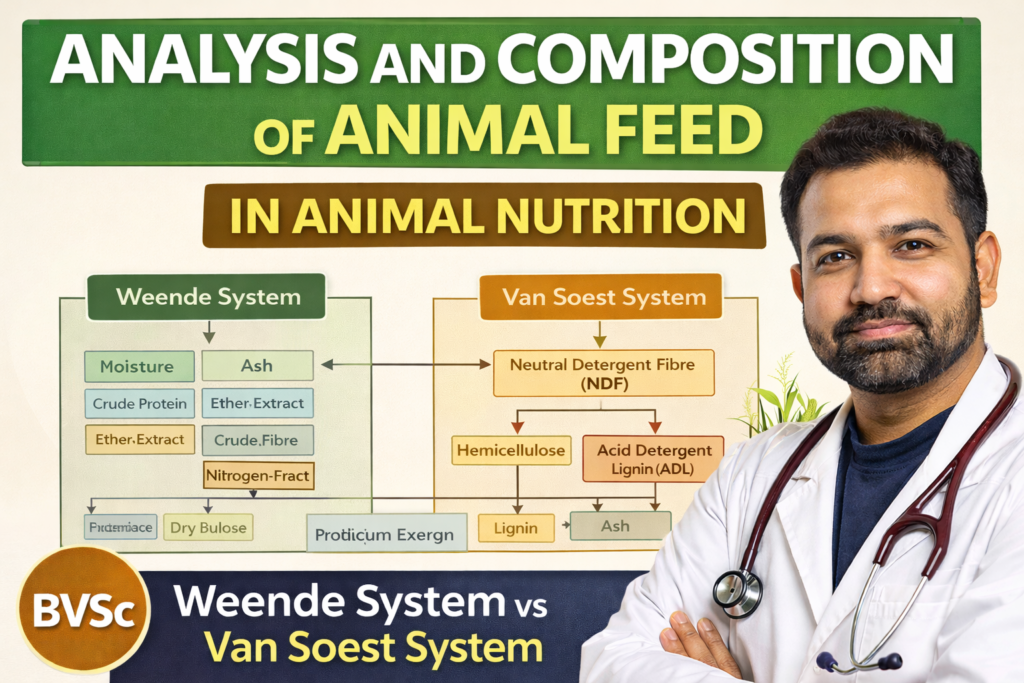
Analysis and Composition of Animal Feed
(Principles of Animal Nutrition and Feed Technology – BVSc as per VCI Curriculum)
Introduction
The evaluation of feeds and fodders forms the scientific foundation of animal nutrition. In order to formulate balanced rations, predict animal performance, and ensure economical livestock production, it is essential to understand the chemical composition of foods and the methods used for their analysis. Historically, the knowledge of feed composition was largely derived from the proximate analysis system developed in the nineteenth century by Henneberg and Stohmann. Despite the development of several modern analytical techniques, proximate analysis still forms the statutory basis for feed composition declaration in many countries and continues to be taught in veterinary curricula.
For veterinary graduates, a clear understanding of both classical and modern feed analysis methods is crucial—not only for examinations but also for practical application in the field, dairy advisory services, feed industry, and research. This article discusses the analysis and composition of foods with special reference to the Weende system of proximate analysis, its limitations, and the evolution of modern analytical methods such as the Van Soest detergent system and Near Infrared Reflectance Spectroscopy (NIRS).
Weende system = what is present
Van Soest / CNCPS = how nutrients behave in the animal
Proximate Analysis of Foods (Weende System)
The proximate analysis system divides food into six major fractions:
- Moisture
- Ash
- Crude Protein (CP)
- Ether Extract (EE)
- Crude Fibre (CF)
- Nitrogen-Free Extractives (NFE)
This system provides a general picture of feed composition and is still widely used in routine laboratory analysis.
1. Moisture and Dry Matter
Moisture content is determined as the loss in weight when a known quantity of feed is dried at 100 °C until constant weight is achieved. The remaining portion is referred to as dry matter (DM). While this method is satisfactory for most feeds, it can result in the loss of volatile substances such as short-chain fatty acids and alcohols, particularly in silages.
For silages, moisture content is more accurately determined by toluene distillation, which allows the recovery of volatile compounds. A corrected dry matter value can be calculated from oven dry matter using established equations. Knowledge of dry matter is fundamental because all nutrient concentrations are expressed on a DM basis for ration formulation.
2. Ash
Ash content is determined by igniting the feed sample at approximately 550 °C until all organic matter is removed. The residue represents the inorganic fraction of the feed. Although ash is often equated with mineral content, it is not a precise representation, as some minerals may volatilise during ignition and some organic elements (such as sulphur and phosphorus from proteins) may remain.
Animals do not require ash per se but require individual mineral elements. Therefore, detailed mineral profiling requires advanced analytical techniques such as atomic absorption spectrometry or inductively coupled plasma spectroscopy.
3. Crude Protein
Crude protein is estimated from the nitrogen content of the feed, traditionally determined using the Kjeldahl method. The nitrogen value is multiplied by 6.25, assuming that proteins contain 16% nitrogen. This estimation includes nitrogen from non-protein sources such as free amino acids, nucleic acids, and amines; hence the term crude protein rather than true protein.
The nitrogen content of proteins varies depending on amino acid composition, making crude protein an approximate measure rather than an exact indicator of protein quality.
4. Ether Extract
Ether extract represents the lipid fraction of the feed and is determined by continuous extraction using petroleum ether. In addition to fats, this fraction includes organic acids, pigments, and alcohols. Modern methods often include acid hydrolysis before ether extraction to improve recovery, referred to as acid ether extract.
5. Crude Fibre
Crude fibre is estimated by subjecting the defatted feed sample to sequential boiling in dilute acid and alkali. The residue consists mainly of cellulose, lignin, and a portion of hemicellulose. However, this method dissolves a variable proportion of cell wall material, leading to an underestimation of true fibre content.
6. Nitrogen-Free Extractives
Nitrogen-free extractives are calculated by difference after subtracting the sum of moisture, ash, crude protein, ether extract, and crude fibre from the total. This fraction contains soluble carbohydrates such as sugars, starch, pectins, and organic acids. Due to inaccuracies in crude fibre estimation, NFE often overestimates readily digestible carbohydrates.
Limitations of Proximate Analysis
Despite its widespread use, the proximate analysis system has been criticised for being imprecise and outdated. Major limitations include:
- Inaccurate estimation of fibre fractions
- Heterogeneous nature of NFE
- Poor prediction of digestibility and nutrient availability
These limitations led to the development of alternative analytical systems better aligned with animal nutrient requirements.
Modern Analytical Methods
Analysis of Carbohydrates
To overcome the inadequacies of NFE, methods have been developed to quantify non-structural carbohydrates (NSC), primarily sugars and starch.
Sugars can be determined colorimetrically using reagents such as anthrone or by official methods involving ethanol extraction and chemical reduction techniques. Starch is commonly measured by acid or enzymatic hydrolysis followed by quantification of released glucose.
Enzymatic methods using α-amylase and amyloglucosidase are now preferred due to their specificity and accuracy.
Fibre Analysis: Van Soest Detergent System
The Van Soest system revolutionised fibre analysis by dividing plant material into nutritionally meaningful fractions:
- Neutral Detergent Fibre (NDF): Represents cell wall components including cellulose, hemicellulose, and lignin. NDF is inversely related to voluntary feed intake.
- Acid Detergent Fibre (ADF): Comprises cellulose and lignin and is negatively correlated with digestibility.
- Acid Detergent Lignin (ADL): Represents the indigestible lignin fraction.
These measurements are particularly valuable in forage evaluation and are widely used in ration formulation for ruminants.
Carbohydrate Fractionation Systems
Advanced systems such as the Cornell Net Carbohydrate and Protein System (CNCPS) further classify carbohydrates based on their ruminal degradation rates:
- Fraction A: Rapidly degradable sugars
- Fraction B1: Intermediate (starch, pectins)
- Fraction B2: Slowly degradable cell wall carbohydrates
- Fraction C: Indigestible lignin-bound fraction
This classification improves the prediction of rumen fermentation patterns and nutrient supply.
Dietary Fibre Concept
Dietary fibre is defined as carbohydrates and lignin resistant to digestion in the small intestine but partially fermentable in the hindgut. It includes soluble and insoluble fractions, each with distinct physiological roles. In animals, dietary fibre influences gut health, fermentation, energy supply through volatile fatty acids, and behaviour.
Mineral Analysis
Simple ash estimation is insufficient to describe mineral availability. Advanced spectroscopic techniques such as atomic absorption spectroscopy, flame emission spectroscopy, and inductively coupled plasma spectroscopy are used to determine individual mineral concentrations. However, mineral availability cannot be accurately predicted by chemical methods alone and often requires biological evaluation.
Amino Acids, Fatty Acids, and Sugars
For non-ruminants, crude protein content alone is inadequate; amino acid profiling is essential. Chromatographic techniques such as gas–liquid chromatography and high-performance liquid chromatography (HPLC) are employed to determine amino acid and fatty acid composition. These methods provide critical information for precise diet formulation.
Protein Evaluation in Ruminants
Modern protein evaluation systems require information on rumen degradability and intestinal digestibility of protein. Acid detergent insoluble nitrogen is used to estimate unavailable protein. Systems like CNCPS integrate detergent fibre analysis with protein fractionation to predict microbial protein synthesis and metabolizable protein supply.
Spectroscopic Techniques in Feed Analysis
Near Infrared Reflectance Spectroscopy (NIRS)
Near Infrared Reflectance Spectroscopy is a rapid, non-destructive analytical technique increasingly used in feed and forage analysis. It is based on the absorption of near-infrared energy by hydrogen-containing functional groups in organic compounds.
NIRS offers several advantages:
- Rapid analysis with minimal sample preparation
- Simultaneous estimation of multiple parameters
- High throughput and low cost per sample
However, its accuracy depends on proper calibration using samples analysed by standard chemical methods. NIRS is widely used in compound feed manufacturing, forage evaluation, and on-farm feed analysis.
Other Spectroscopic Methods
Nuclear magnetic resonance spectroscopy provides detailed structural information but is mainly confined to research applications due to its cost and complexity.
Conclusion
The analysis and composition of foods remain central to animal nutrition and feed technology. While the proximate analysis system laid the foundation for feed evaluation, modern analytical techniques provide more precise and biologically relevant information. For veterinary graduates, an integrated understanding of classical and modern methods is essential for both academic success and practical application in livestock nutrition.
| Component | Method of Analysis | Major Constituents | Nutritional Significance | Limitations / Remarks |
|---|---|---|---|---|
| Moisture / Dry Matter | Oven drying / Toluene distillation (silage) | Water | Basis for expressing all nutrients | Volatile losses in silage |
| Ash | Ignition at 550 °C | Total minerals + silica | Indicates total mineral content | Does not reflect mineral availability |
| Crude Protein (CP) | Kjeldahl / Dumas | True protein + NPN | Protein supply estimation | Not true protein; no AA info |
| Ether Extract (EE) | Ether extraction | Fats, pigments, organic acids | Energy dense fraction | Not pure lipid |
| Crude Fibre (CF) | Acid–alkali digestion | Cellulose, lignin, some hemicellulose | Rough estimate of fibre | Underestimates true fibre |
| Nitrogen Free Extract (NFE) | By difference | Sugars, starch, pectins | Readily digestible carbs | Highly heterogeneous |
| Neutral Detergent Fibre (NDF) | Van Soest method | Cellulose + hemicellulose + lignin | Predicts feed intake | Does not measure digestibility directly |
| Acid Detergent Fibre (ADF) | Van Soest method | Cellulose + lignin | Predicts digestibility | No hemicellulose |
| Acid Detergent Lignin (ADL) | Sulphuric acid treatment | Lignin | Indicates indigestible fraction | Completely indigestible |
| Non-Structural Carbohydrates (NSC) | Calculated fraction | Sugars + starch | Rapid rumen energy | Excess causes acidosis |
| Dietary Fibre (DF) | Enzymic methods | NSP + lignin | Gut health, VFA production | Difficult to measure |
| Minerals | ICP / AAS | Macro & trace elements | Metabolism & production | Availability not chemical |
| Amino Acids | HPLC / Chromatography | Individual amino acids | Essential AA balance | Costly analysis |
| Fatty Acids | Gas chromatography | Saturated & unsaturated FA | Energy & milk fat | Unsaturates affect rumen |
| NIRS Estimates | Spectroscopy | DM, CP, NDF, ADF, ME | Rapid feed evaluation | Depends on calibration |
Frequently Asked Questions (FAQs)
1. Define proximate analysis of feeds.
Proximate analysis is a classical system of feed analysis that divides food into moisture, ash, crude protein, ether extract, crude fibre, and nitrogen-free extractives.
2. Why is crude protein not a true measure of protein?
Because it includes nitrogen from non-protein sources and assumes a constant nitrogen content of 16%.
3. What is the significance of NDF and ADF?
NDF is related to feed intake, while ADF is inversely related to digestibility.
4. List limitations of the Weende system.
Inaccurate fibre estimation, heterogeneous NFE fraction, and poor prediction of digestibility.
5. What is NIRS and its application in feed analysis?
NIRS is a rapid spectroscopic technique used to estimate chemical composition of feeds based on infrared energy absorption.
6. Differentiate between crude fibre and dietary fibre.
Crude fibre is a laboratory fraction, while dietary fibre is a physiological concept related to indigestible carbohydrates.
7. Why is protein evaluation different in ruminants and non-ruminants?
Because ruminants rely on rumen microbial protein synthesis, whereas non-ruminants require specific amino acids.
Objective Type Questions (MCQs)
Q1.
The proximate analysis system of feeds was originally developed by:
A. Van Soest and Goering
B. Henneberg and Stohmann
C. Kjeldahl and Dumas
D. Englyst and Cornell
Q2.
In proximate analysis, crude protein content of feed is calculated by multiplying nitrogen content by:
A. 5.25
B. 6.00
C. 6.25
D. 6.38
Q3.
Which of the following fractions in proximate analysis is calculated by difference?
A. Crude fibre
B. Ether extract
C. Ash
D. Nitrogen-free extractives
Q4.
Loss of volatile fatty acids during oven drying is a major limitation of dry matter estimation in:
A. Concentrates
B. Cereal grains
C. Silages
D. Oil cakes
Q5.
Neutral Detergent Fibre (NDF) mainly represents:
A. Cell contents of plants
B. Lignin only
C. Plant cell wall constituents
D. Non-structural carbohydrates
Q6.
Which fibre fraction is most closely related to voluntary feed intake in ruminants?
A. Acid detergent fibre (ADF)
B. Neutral detergent fibre (NDF)
C. Acid detergent lignin (ADL)
D. Crude fibre
Q7.
Acid Detergent Fibre (ADF) consists mainly of:
A. Hemicellulose and cellulose
B. Cellulose and lignin
C. Lignin and silica only
D. Sugars and starch
Q8.
Which carbohydrate fraction in the Cornell Net Carbohydrate and Protein System (CNCPS) is rapidly degradable in the rumen?
A. Fraction B2
B. Fraction C
C. Fraction A
D. Fraction B1
Q9.
The major limitation of crude fibre estimation is that it:
A. Overestimates fibre content
B. Underestimates true fibre content
C. Measures lignin accurately
D. Separates soluble and insoluble fibre clearly
Q10.
Near Infrared Reflectance Spectroscopy (NIRS) works on the principle of absorption of energy by:
A. Mineral elements
B. Carbon atoms only
C. Hydrogen-containing functional groups
D. Ionic bonds
Q11.
Which of the following nutrients cannot be directly estimated by NIRS?
A. Crude protein
B. Fibre fractions
C. Minerals
D. Moisture
Q12.
Acid Detergent Insoluble Nitrogen (ADIN) in feeds represents:
A. Rapidly degradable protein
B. Non-protein nitrogen
C. Undegradable and unavailable protein fraction
D. Microbial protein
Answer Key
C – Undegradable and unavailable protein fraction
B – Henneberg and Stohmann
C – 6.25
D – Nitrogen-free extractives
C – Silages
C – Plant cell wall constituents
B – Neutral detergent fibre (NDF)
B – Cellulose and lignin
C – Fraction A
B – Underestimates true fibre content
C – Hydrogen-containing functional groups
C – Minerals
C – Undegradable and unavailable protein fraction
About Ali Veterinary Wisdom
Ali Veterinary Wisdom is a veterinarian-led platform dedicated to addressing nutritional and metabolic challenges in poultry and livestock through scientific understanding and field-based insights. The focus lies on explaining why problems occur at the physiological level, enabling sustainable solutions rather than temporary symptom control.