
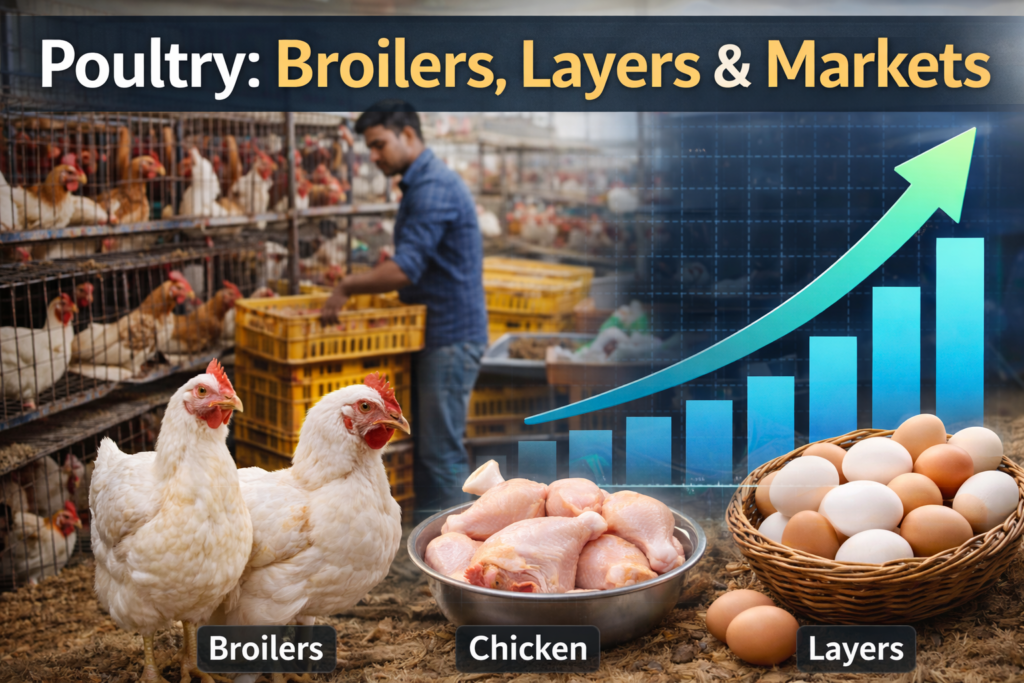
Indian poultry is moving into a new phase. For years, broiler and layer systems dominated because they were fast, standardized, and built around scale. That model still matters—and it will keep growing—but the biggest on-ground shift is happening in parallel: consumers are paying premiums for “desi”, coloured, free-range/backyard-style chicken, and this is changing how smart farmers plan production.
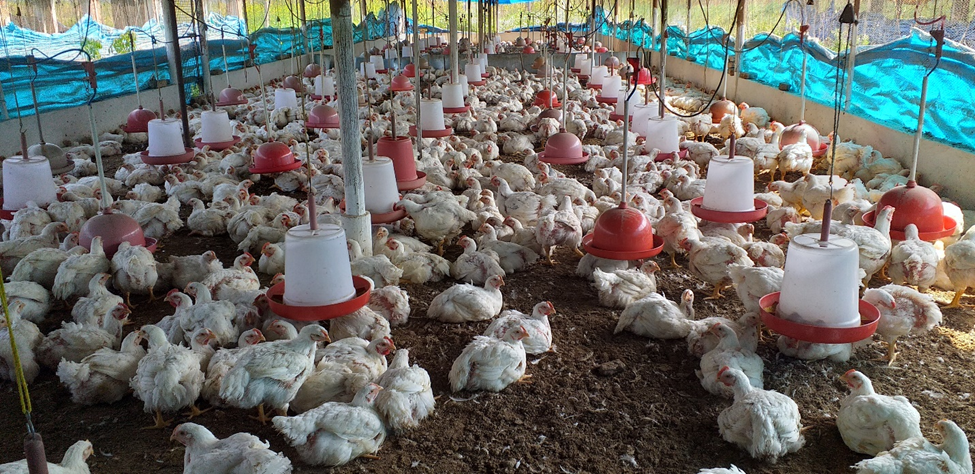
If you run poultry as a business, you must think in two lanes at the same time. Lane one is commodity poultry (broiler meat and layers), where profit comes from efficiency, feed cost control, disease prevention, and consistent supply. Lane two is value poultry—desi/coloured birds like FFG/Kuroiler-type and Sonali-type birds—where profit comes from market positioning, survival, slower growth but higher selling price, and credibility.
This is not hype. It is visible in pricing, consumer preference, and how hatcheries and backyard poultry models are expanding.
The Poultry Market is Growing, But the Profit Model is Splitting
Multiple market outlook reports project continued growth in India’s poultry sector over the next decade, driven by rising protein demand, urbanization, and food service expansion. For example, IMARC projects strong long-term growth for the Indian poultry market through the 2025–2033 period. IMARC Group Another report projects poultry market expansion into the 2030s with growth linked to cold-chain and institutional demand.
What matters for farmers is what is happening underneath these big numbers: poultry profit is no longer “one-size-fits-all.” Farmers are increasingly choosing either:
- High-volume, low-margin broiler models, or
- Lower-volume, premium-price desi/coloured chicken models, often with better resilience in local markets.
Why Desi/Coloured Chicken Demand is Rising
Across many Indian states, consumers associate desi/coloured birds with better taste, better texture, and “healthier” perception. In several markets, desi chicken prices have surged sharply and can even exceed other meats. A widely reported example from Andhra Pradesh showed country chicken selling at very high retail rates compared with mutton in parts of the state, reflecting a supply–demand mismatch and strong preference for country chicken dishes.
This demand is also creating a credibility problem: when premiums rise, some traders start selling crossbreds as “pure desi.” That makes it even more important for farmers to build trust through consistent bird type, consistent finishing weight, and transparent rearing practices.
The key point is simple: desi/coloured poultry is increasingly behaving like a premium segment, not just a rural hobby.
FFG / Kuroiler-Type Coloured Birds: The “Bridge” Between Broiler and Desi
Many farmers want a bird that grows faster than pure desi but sells better than broiler. That is exactly why coloured birds like FFG/Kuroiler-type models have expanded in backyard-commercial systems. Some supplier literature highlights that such birds can reach roughly 1.5–2.0 kg in about 6–8 weeks, and also have meaningful laying potential (often discussed in the range of a few hundred eggs/year depending on strain and management).
From a business angle, the strength of these birds is that they allow you to:
- target “desi-like” demand without waiting 4–6 months like traditional country birds,
- create a faster cash cycle than pure desi,
- operate in semi-intensive systems where broiler-style efficiency is not possible, but pure backyard is too slow.
The risk is that farmers treat these birds like broilers in closed sheds without adjusting management. If ventilation, floor dryness, litter quality, and vaccination discipline are weak, losses rise quickly—especially in new farms.
Sonali-Type Birds: Coloured Market + Better Acceptance Than White Broilers
“Sonali” birds are well known in South Asia as a coloured crossbred line. Many descriptions identify Sonali as a cross involving Fayoumi and Rhode Island Red (RIR) lineage and position it as a dual-purpose type with stronger consumer acceptance than white broilers in some markets. daulathatcheries.com+1 Supplier and breed write-ups repeatedly emphasize “desi-like” market preference and premium selling potential versus standard broilers.
One practical data point commonly shared by sellers: around 13–14 weeks, Sonali birds may reach roughly 1.1–1.2 kg body weight, with feed consumption noted in the ~3.2–3.8 kg range, and egg production often described in a broad band depending on strain and conditions. (Exact performance varies heavily with genetics, temperature, health, and feed—so farmers should treat these as planning references, not guarantees.)
Business-wise, Sonali-type birds are attractive because they can fit semi-intensive and rural-commercial models where:
- the market wants coloured birds,
- farmers want better growth than pure desi,
- and mortality control is easier than pushing very high-performance broilers in low-tech environments.
The Real Growth Engine Behind Poultry: Feed Economics and Input Pressure
If you want to understand the future of poultry, watch feed. Poultry feed demand is a direct signal of poultry expansion and intensification. One industry report projects India’s poultry feed market rising from about USD 18.0B (2025) toward USD 25.25B by 2030 (about 7% CAGR). Mordor Intelligence Another market listing also projects poultry feed market growth through 2030.
For farmers, the implication is blunt: feed will remain the biggest cost driver, and profitability will increasingly come from nutrition strategy, feed conversion discipline, and disease prevention that protects feed efficiency.
This is also why desi/coloured segments are rising: when feed is expensive, farmers look for models where selling price has more cushion.
What This Means for Farmers: Choose Your Model, Don’t Mix Models
A lot of losses happen because farmers try to run two different businesses under one roof.
If you are doing commodity broiler: you must win on speed, uniformity, biosecurity, and cost control—because your selling price is competitive and margins are thin.
If you are doing desi/coloured: you must win on survival, trust, local branding, finishing weight timing, and consistent supply—because your buyer is paying for perceived quality and type.
Trying to treat desi/coloured as broiler often increases mortality and destroys the premium story. Trying to treat broiler as desi wastes time and feed and loses the efficiency advantage.
A Practical “Future-Proof” Strategy for Poultry in India
The most future-proof poultry businesses will likely be those that build a portfolio approach:
- keep a stable base in conventional systems (broiler/layer) where management allows,
- add a controlled desi/coloured segment for premium local markets,
- build technical capacity (health + feeding + records) to reduce volatility.
The winners will not be those with the largest sheds. The winners will be those who control disease risk, manage feed cost intelligently, and match production to the market that pays best in their region.
Technical Guidance Becomes More Valuable as Markets Fragment
As poultry diversifies into multiple models—broiler, layer, desi, coloured, backyard-commercial—the need for species-appropriate technical guidance increases. Farmers who do not understand strain differences, vaccination discipline, stress management, and nutrition planning will see repeated cycles of losses.
This is why veterinary-led, field-oriented training is no longer optional for growth-focused farmers—it is risk insurance.
🏠Poultry Management & Housing
Scientific poultry shed design, ventilation, litter management, biosecurity and day-to-day farm practices to reduce stress, disease risk and losses.
🌽 Poultry Feeding & Nutrition
Practical poultry feeding strategies, feed formulation basics, nutrient balance, cost control and nutrition-related performance problems explained.
💰 Poultry Economics & Profitability
Understand poultry production costs, feed economics, mortality impact, cash flow and realistic profit planning for sustainable poultry businesses in India.
🐔 Broiler Farming
Broiler farm setup, fast growth management, feed conversion, disease prevention and cost-efficient production for short-cycle poultry meat systems.
🥚 Layer Farming
Layer management for consistent egg production, nutrition, lighting programs, disease control and economic planning in commercial farms.
🦆 Duck Farming
Duck farming basics, housing, feeding, disease management and profitability in wetland, backyard and small commercial duck production systems.
🦠 Poultry Diseases & Vaccination
Common poultry diseases, vaccination schedules, biosecurity measures and early warning signs explained from a preventive veterinary perspective.
🐓 Desi and Backyard Poultry
Desi and coloured poultry systems, backyard and semi-commercial models, breed selection, survival management and premium market.
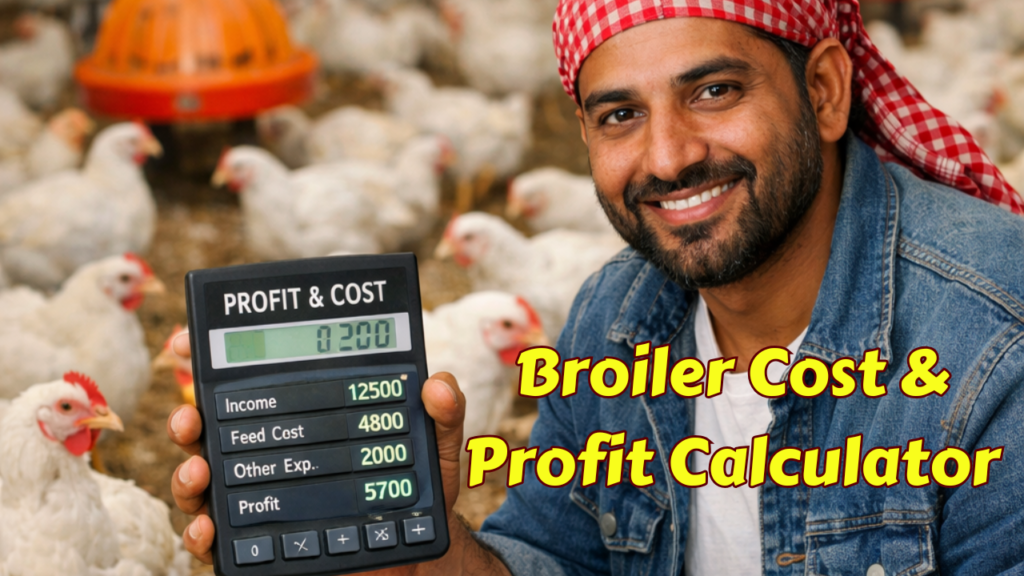
💰 Poultry Cost and Profit Calculator
Understand poultry production costs, feed economics, mortality impact, cash flow and realistic profit planning for sustainable poultry businesses in India.
Popular/featured articles
- Dairy Feed Management
- Silage Dry Matter
- Causes and Treatment of Lameness in Poultry
- Broiler Farming in Hindi Guide
- Cow Not Eating, Cow Not Giving Milk, Cow Not Standing Up
Connect us on WhatsApp Click Below
Consultation Charges & Guidelines
Your suggestions and quries are more than welcome, help us to improve our Ali Veterinary Wisdom initiative